REVIEW 3 major objections 3 minor 27 references
The role of Pad\'e and D-Log Pad\'e approximants in the context of the MUonE Experiment
T0 review · 3 major / 3 minor · reviewed 2026-08-12 · deepseek-v4-flash
Pith's one-line read Padé and D-Log Padé approximants recover the muon's hadronic contribution from MUonE data to better than 0.06%.
desk verdict A competent proceedings summary of a solid PRD paper; the MUonE context is new but the method's extrapolation guarantee rests on an empirical extension of Stieltjes convergence theorems and unexamined fit-selection bias. read the letter →
The pith
A machine-rendered reading of the paper's core claim, the machinery that carries it, and where it could break.
The reading
What carries the argument
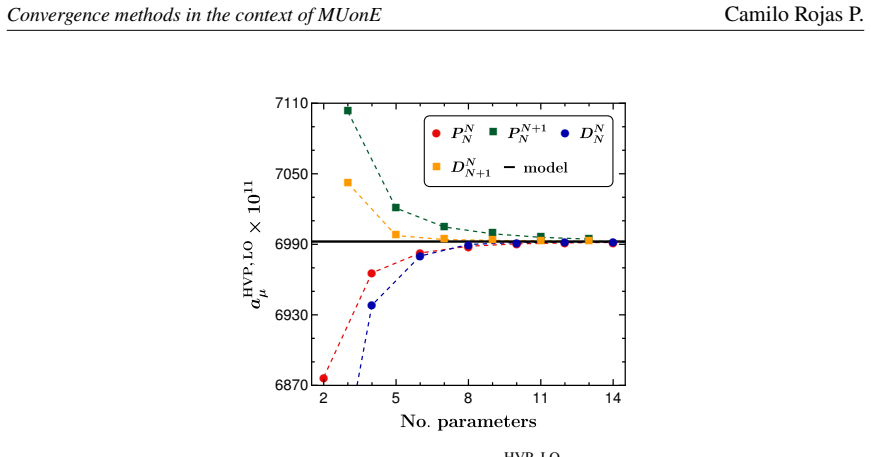
The mechanism is the Stieltjes integral representation $\Delta\alpha_{\rm had}(t)=\int_0^\infty d\phi(u)/(1+t\,u)$, in which the hadronic vacuum polarization is an analytic function generated by a positive spectral measure. A Padé approximant $P_N^M(t)=Q_N(t)/R_M(t)$ is a ratio of polynomials matched to the Taylor expansion, and for Stieltjes functions its poles are real and positive; the sequences $P_{M+k}^M$ with $k\ge -1$ bound the function from above and below. A D-Log Padé approximant $D_N^M(t)=f(0)\exp(\int \bar P_N^M(t)\,dt)$ instead approximates the logarithmic derivative first, turning branch cuts into simple poles and yielding an unbiased estimate of the position and multiplicity of the hadronic cut; it reproduces the first $M+N+2$ Taylor coefficients of $f$. These two objects, together with the Stieltjes property of $\Delta\alpha_{\rm had}$, carry the extrapolation strategy and supply the systematic interpretation of the spread among approximants.
What would settle it
If a reanalysis of the actual MUonE data, or a stress test with an independent model of the hadronic vacuum polarization, finds that the bracketing sequence of the highest-order approximants does not contain the value obtained by lattice QCD or by the dispersive e+e- method, or that the median deviates by more than the quoted 68% intervals, then the empirical extension of the convergence theorems is falsified and the extrapolation beyond x=0.93 is uncontrolled.
Extended reading notes
Core claim
The central claim is that $\Delta\alpha_{\rm had}(t)$ is a Stieltjes function of $t$, so rational approximants inherit guaranteed bounding and convergence properties: the sequences $P_1^1\le P_2^2\le\cdots\le\Delta\alpha_{\rm had}\le\cdots\le P_3^2\le P_2^1$, and analogous D-Log sequences, hold. Fitting these approximants to simulated MUonE data in $x\in[0.2,0.93]$ and extrapolating to $x=1$ gives $a_\mu^{\rm HVP,LO}$ medians of $6987^{+46}_{-34}\times10^{-11}$ (Padé) and $6988^{+48}_{-39}\times10^{-11}$ (D-Log), inside the pseudo-data distribution $6991^{+22}_{-20}\times10^{-11}$ and within 0.06% and 0.05% of the reference model. The paper presents this as evidence that the approximants, applied as least-squares fitting functions rather than as Taylor-coefficient constructions, still satisfy the Stieltjes convergence pattern and provide competitive, conservative uncertainties whose dominant part comes from the extrapolation beyond the data region.
Load-bearing premise
The load-bearing premise is that the Stieltjes convergence and bounding theorems, proven only for approximants built from Taylor coefficients, still govern least-squares fits to noisy, finite-range data; a secondary premise is that the reference model used to generate the toy data is a realistic stand-in for the true hadronic vacuum polarization.
Editorial extensions
If this is right
- If the bracketing pattern survives real MUonE data, the spread between the highest-order Padé and D-Log approximants gives a data-driven systematic error for $a_\mu^{\rm HVP,LO}$ that requires no external hadronic model.
- The method converts the experiment's blind spot beyond $x=0.93$ into a controlled extrapolation: truncating at $x_{\max}=0.990$ covers 99.1% of the integral and lowers the uncertainty by about 25%, a concrete trade-off for the experiment's design.
- A single fixed fitting function is not needed; the framework is claimed to be superior because its model dependence is explicit and its uncertainty estimate conservative.
- With only 30 bins over $x\in[0.2,0.93]$, the reported precision indicates that analytic constraints, not data density, control the final answer, so the method could serve as a cross-check of lattice HVP results.
Reading between the lines
- Editorial inference: if the convergence pattern holds on real data, the difference between the Padé final value and the D-Log final value could be treated as a direct, statistic-free estimate of extrapolation systematics, a quantity dispersive and lattice determinations do not currently quote.
- Editorial inference: the same D-Log machinery should transfer to any space-like observable that is a Stieltjes function with branch points, such as semileptonic form factors or hadronic tau spectral functions; one could test this by deliberately fitting with a wrong model and checking whether the bracketing sequence still brackets the input.
- Editorial inference: the high defect rates quoted for low-order Padé approximants (roughly 30–56% discarded for $P_2^2$ and $P_3^2$) while D-Logs defected far less suggest that D-Logs may be the safer default for a real MUonE analysis; this is an inference from the paper's reported discard rates, not a stated conclusion.
- Editorial inference: a decisive test would use a second independent model, not the reference model that generated the toy data; if the 0.05–0.06% agreement persists, the method is less dependent on the benchmark model's particular analytic structure than a skeptical reader might fear.
Editorial analysis
A structured set of objections, weighed in public.
Referee Report
Summary. The paper proposes Padé and D-Log Padé approximants as a model-independent framework for extracting the hadronic vacuum polarization contribution to the muon anomalous magnetic moment from simulated MUonE data. The authors use the Greynat–de Rafael model as a benchmark truth, generate 1000 toy data sets over the expected MUonE kinematic range x in [0.2, 0.93], and fit low-order approximants with Stieltjes-inspired constraints. The median of the accepted fits for the highest-order approximants yields aHVP_LO = (6987 +46 -34) x 10^-11 for PAs and (6988 +48 -39) x 10^-11 for D-Logs, both within ~0.1% of the model benchmark 6992.4 x 10^-11. The central claim is that Stieltjes convergence and bounding theorems (Eqs. 6–7) carry over to least-squares fits from noisy finite-range data, making the extrapolation beyond x = 0.93 controlled.
Significance. If the claim holds, the method is directly relevant to the MUonE physics program and offers an alternative to fixed-shape fitting functions for an experiment whose statistical reach demands controlled extrapolation. The paper's strengths are that the toy-data pipeline is internally consistent, the benchmark comparison is explicit, and the analysis is an honest exploration of a real methodological question: whether Stieltjes convergence theory, proven for Taylor-coefficient approximants, survives the transition to least-squares fits to finite-range noisy data. This is an important question for the community and the paper is a clear, readable contribution to that discussion.
major comments (3)
- [Section 5, Eq. (6)–(7)] The load-bearing premise of the paper is that the Stieltjes convergence theorems, stated in Equations (6) and (7), remain valid when PAs and D-Logs are fitted to 30 noisy data points over a finite interval rather than built from the Taylor coefficients. Section 5 itself concedes that these theorems "are not strictly valid when the approximants are not built from the Taylor series," and cites only empirical evidence from other analyses. This is a correctness-risk concern that the manuscript acknowledges but does not quantify. I would like to see either (a) a direct numerical test of the monotone bounding structure in the actual fitting setup, e.g., checking the inequalities of Eq. (6) hit-by-hit on the toy data and reporting the rate and size of violations, or (b) a statement that the claimed coverage of the quoted 68% CL intervals is not guaranteed by the present evidence, and therefore that the final uncertainties should be treated as indicative rather than as rigorous confidence intervals.
- [Section 6, defect-discard rates] The procedure discards 30% of P2_2 fits and 56% of P3_2 fits as defects before quoting the median as the final result. The paper does not address whether the defect rate is correlated with the underlying value of the extrapolated integral. If the defect probability depends on the value being fitted, the median of accepted fits is a biased estimator and the quoted 68% CL (e.g., 6987+46-34) would not have nominal coverage. I would ask the authors to report, at minimum, the means of the accepted and rejected distributions, and to demonstrate on the toy data that the accepted-fits median retains the claimed coverage (for example, by reporting the empirical coverage of the 68% intervals across the 1000 pseudo-experiments).
- [Section 4, GdR model reliance] The benchmark truth is the Greynat–de Rafael model, and the pseudo-data are generated from that same model. The test is therefore a closure test within one function class: it demonstrates that the method recovers a Stieltjes function when the true function is Stieltjes, which is a necessary but not sufficient condition for the method to perform well on real hadronic vacuum polarization. I do not regard this as circular in a damaging sense, but the paper should state more explicitly that the claimed model independence is only tested within the Stieltjes class and that no non-Stieltjes or near-Stieltjes stress test (e.g., adding a small non-Stieltjes component or a further singularity beyond the data region) is performed in this work.
minor comments (3)
- [Section 5, paragraph 1] The term "modified chi-squared function" is introduced without specifying what is modified. Please state the exact definition of the objective function used in the fits.
- [Section 6, Table 1] The table caption lists chi2/n.d.o.f. distributions, but the quoted values are given as medians with 68% CL intervals. Please explicitly state that these are medians of the distribution over the 1000 pseudo-experiments, to avoid confusion with the per-fit chi-squared value of a single fit.
- [Section 6, paragraph 1] The description of the pseudo-data generation says errors range from 0.7% to 6.7% but does not state the bin widths or the exact x-binning beyond "equally distributed." Please provide the explicit x-values of the 30 data points, as the extrapolation dependence on the last bin is relevant to the result.
Circularity Check
No significant circularity: the closure test against the Greynat-de Rafael model is a genuine extrapolation test, and the analyticity input comes from external Padé/Stieltjes theory.
full rationale
The paper's derivation chain is a closure test: pseudo-data are generated from the Greynat-de Rafael model and the model's own integrated value is used as a benchmark, but the benchmark value is not an input to the fits. The approximants see only 30 noisy data points over x in [0.2,0.93] and must extrapolate the integrand to x=1; agreement at the 0.05-0.06% level is therefore a genuine test of the extrapolation, not a reduction by construction. The Stieltjes analyticity of Delta_alpha_had and the Padé convergence/bounding theorems (Eqs. 6-7) are imported from external Padé theory (Baker and Graves-Morris) and from independent references for the HVP correlator, e.g. Aubin et al. [21]; the paper's own Masjuan-Peris reference [20] is accompanied by an independent citation. The acknowledged breakdown of the strict Taylor-coefficient theorems for least-squares fits ('the convergence theorems, which are not strictly valid when the approximants are not built from the Taylor series, are apparently satisfied in all these cases') is an explicit limitation and a correctness risk, not a circularity: the paper does not redefine the theorem to include fits, it simply observes empirically that the pattern persists. The companion-paper citation [13] supplies details and the observed D-Log bounding pattern, but the central numerical results are obtained from the fits reported in Table 1, not imported by citation. No fitted parameter is renamed as a prediction, and no central claim is equivalent to its input by definition.
Assumptions & free parameters
free parameters (2)
- Pade and D-Log approximant coefficients =
not reported
- Extrapolation endpoint x_max =
1.0, with 0.990 variant
assumptions (4)
- domain assumption Delta alpha_had(t) is a Stieltjes function in the t variable, so it admits the integral representation (5) and Pade convergence theorems apply.
- ad hoc to paper Pade convergence theorems for Stieltjes functions remain valid when approximants are least-squares fits to noisy data rather than constructed from Taylor coefficients.
- domain assumption The Greynat-de Rafael model is a realistic proxy for the true hadronic vacuum polarization, including the location and multiplicity of its branch cuts.
- domain assumption The expected MUonE uncertainties provided by the collaboration are accurate inputs for the toy-data generation.
Cite this review
Pith. "Pith review of The role of Pad\'e and D-Log Pad\'e approximants in the context of the MUonE Experiment." pith.science (2026). https://pith.science/paper/3KETNIXO
@misc{pith2026241110379,
  author       = {Pith},
  title        = {Pith review of: The role of Pad\'e and D-Log Pad\'e approximants in the context of the MUonE Experiment},
  year         = {2026},
  howpublished = {\url{https://pith.science/paper/3KETNIXO}},
  note         = {Machine review of arXiv:2411.10379}
}
abstract
In the context of the anomalous magnetic moment of the muon, the hadronic contribution plays a crucial role, especially given its large contribution to the final error. Currently, lattice QCD simulations are in disagreement with dispersive calculations based on $e^+e^-$ hadronic cross sections. The new MUonE experiment intends to shed light on this situation extracting the hadronic contribution to the running of the electromagnetic coupling in the space-like region, $\Delta \alpha_{\rm had}(t)$, from elastic $e\mu$ scattering. Still, due to the limited kinematic range that can be covered by the experiment, a powerful method must be devised to accurately extract the desired hadronic contribution from a new experiment of this type. In this work, we show how Pad\'e and D-Log Pad\'e approximants profiting from the analyticity of the correlator governing the hadronic contribution can be a powerful tool in reaching the required precision.
Figures
Reference graph
Works this paper leans on
-
[13]
D.Boito,C.Y.London,P.MasjuanandC.Rojas, Model-independentextrapolationofmuone data with padé and d-log approximants,Phys. Rev. D110 (2024) 074012 [2405.13638v2]
work page Pith review arXiv 2024
-
[1]
Muon𝑔-2collaboration, Measurement of the positive muon anomalous magnetic moment to 0.46 ppm,Phys. Rev. Lett.126 (2021) 141801 [2104.03281]
arXiv 2021
-
[2]
Muon g-2 collaboration, Measurement of the Positive Muon Anomalous Magnetic Moment to 0.20 ppm, Phys. Rev. Lett.131 (2023) 161802 [2308.06230]
arXiv 2023
-
[3]
Muon𝑔-2collaboration, Final report of the muon E821 anomalous magnetic moment measurement at BNL, Phys. Rev. D73(2006) 072003 [hep-ex/0602035]
arXiv 2006
-
[4]
Aoyama et al.,The anomalous magnetic moment of the muon in the Standard Model,Phys
T. Aoyama et al.,The anomalous magnetic moment of the muon in the Standard Model,Phys. Rept. 887 (2020) 1 [2006.04822]
arXiv 2020
-
[5]
S. Borsanyi et al.,Leading hadronic contribution to the muon magnetic moment from lattice QCD, Nature 593 (2021) 51 [2002.12347]
arXiv 2021
-
[6]
A. Boccaletti, S. Borsanyi, M. Davier, Z. Fodor, F. Frech, A. Gerardin et al.,High precision calculation of the hadronic vacuum polarisation contribution to the muon anomaly, 2407.10913
-
[7]
C. M. Carloni Calame, M. Passera, L. Trentadue and G. Venanzoni,A new approach to evaluate the leading hadronic corrections to the muon𝑔-2, Phys. Lett. B746 (2015) 325 [1504.02228]
arXiv 2015
Show all 27 references
-
[8]
Abbiendi et al.,Measuring the leading hadronic contribution to the muon𝑔-2 via𝜇𝑒 scattering,Eur
G. Abbiendi et al.,Measuring the leading hadronic contribution to the muon𝑔-2 via𝜇𝑒 scattering,Eur. Phys. J. C77 (2017) 139 [1609.08987]
2017 arXiv
-
[9]
Abbiendi,Letter of intent: the MUonE project, tech
G. Abbiendi,Letter of intent: the MUonE project, tech. rep., CERN, Geneva, 2019
2019
-
[10]
Abbiendi,Status of the MUonE experiment, Phys
G. Abbiendi,Status of the MUonE experiment, Phys. Scripta97 (2022) 054007 [2201.13177]
2022 arXiv
-
[11]
Ignatov, R
F. Ignatov, R. N. Pilato, T. Teubner and G. Venanzoni,An alternative evaluation of the leading-order hadronic contribution to the muon𝑔− 2 with MUonE, Phys. Lett. B848 (2024) 138344 [2309.14205]. 7 Convergence methods in the context of MUonE Camilo Rojas P
2024 arXiv
-
[12]
D.GreynatandE.deRafael, HadronicvacuumpolarizationandtheMUonEproposal ,JHEP 05 (2022) 084 [2202.10810]
2022 arXiv
-
[14]
B. e. Lautrup, A. Peterman and E. de Rafael,Recent developments in the comparison between theory and experiments in quantum electrodynamics, Phys. Rept.3 (1972) 193
1972
-
[15]
Bernecker and H
D. Bernecker and H. B. Meyer,Vector Correlators in Lattice QCD: Methods and applications,Eur. Phys. J. A47(2011) 148 [1107.4388]
2011 arXiv
-
[16]
G. A. Baker and P. Graves-Morris,Padé approximants. Cambridge University Press, Cambridge, 2nd ed., 1996
1996
-
[17]
G. A. Baker,Essentials of Padé approximants. Academic Press, New York, 1975
1975
-
[18]
Boito, P
D. Boito, P. Masjuan and F. Oliani,Higher-order QCD corrections to hadronic𝜏 decays from Padé approximants, JHEP 08(2018) 075 [1807.01567]
2018 arXiv
-
[19]
Boito, C
D. Boito, C. Y. London and P. Masjuan,Higher-order QCD corrections to H→ b𝑏 from rational approximants,JHEP 01 (2022) 054 [2110.09909]
2022 arXiv
-
[20]
Masjuan and S
P. Masjuan and S. Peris,Pade Theory applied to the vacuum polarization of a heavy quark, Phys. Lett. B686 (2010) 307 [0903.0294]
2010 arXiv
-
[21]
Aubin, T
C. Aubin, T. Blum, M. Golterman and S. Peris,Model-independent parametrization of the hadronic vacuum polarization and𝑔-2 for the muon on the lattice, Phys. Rev. D86(2012) 054509 [1205.3695]
2012 arXiv
-
[22]
Boito, A
D. Boito, A. Cucchieri, C. Y. London and T. Mendes,Probing the singularities of the landau-gauge gluon and ghost propagators with rational approximants,Journal of High Energy Physics2023(2023) 1 [2210.10490v2]
2023 arXiv
-
[23]
Gonzàlez-Solís, P
S. Gonzàlez-Solís, P. Masjuan and C. Rojas,Padé approximants to𝑏→𝜋ℓ𝜈ℓ and 𝐵𝑠→𝑘ℓ𝜈ℓ and determination of|𝑉𝑢𝑏|,Phys. Rev. D104 (2021) 114041 [2110.06153]
2021 arXiv
-
[24]
R.Escribano,S.Gonzàlez-Solís,P.MasjuanandP.Sanchez-Puertas, 𝜂’transitionformfactor from space- and timelike experimental data, Phys. Rev. D94(2016) 054033 [1512.07520]
2016 arXiv
-
[25]
Escribano, P
R. Escribano, P. Masjuan and P. Sanchez-Puertas,𝜂 and𝜂’ transition form factors from rational approximants,Phys. Rev. D89 (2014) 034014 [1307.2061]
2014 arXiv
-
[26]
Masjuan, S
P. Masjuan, S. Peris and J. J. Sanz-Cillero,Vector Meson Dominance as a first step in a systematic approximation: The Pion vector form-factor, Phys. Rev. D78 (2008) 074028 [0807.4893]
2008 arXiv
-
[27]
Masjuan and P
P. Masjuan and P. Sanchez-Puertas,Pseudoscalar-pole contribution to the(𝑔𝜇− 2): a rational approach, Phys. Rev. D95(2017) 054026 [1701.05829]. 8
2017 arXiv
Reviewed August 12, 2026 · model on record in the stance chip above.
Discussion (0). Continue with ORCID to comment.