REVIEW 4 major objections 6 minor 68 references
Efficient Alignment of Large Language Models via Data Sampling
T0 review · 4 major / 6 minor · reviewed 2026-08-12 · deepseek-v4-flash
Pith's one-line read LLM alignment quality plateaus exponentially with data, so a 10% subset can match the full dataset.
desk verdict The central claim that ISA matches full-data alignment is contradicted by the paper's own tables on two of three datasets; the scaling law is a two-point fit. read the letter →
The pith
A machine-rendered reading of the paper's core claim, the machinery that carries it, and where it could break.
The reading
What carries the argument
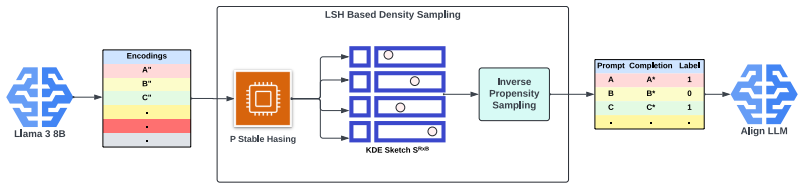
The machinery is the combination of the plateau law and the ISA sampler. ISA first models all alignment examples as a two-component Gaussian mixture over embeddings from a Llama-3-8B-Instruct encoder, interpreting the two components as desired and undesired responses. It computes each point's log-likelihood under the mixture, converts it to a probability, computes the dataset entropy $H(X)$, and then scores every point by the drop in entropy its removal would cause. Keeping the highest-drop points yields a subset that is meant to be both diverse, because the mixture separates clusters, and high-quality, because points that most affect the distribution are retained. The law, in turn, tells the user how little data is enough: it is the value of $x$ at which $R(x)$ stops changing.
What would settle it
Run the same KTO alignment on three additional datasets at 40%, 70%, and 100% data fractions and score the outputs with human annotators; if human win rates keep rising past 40% or ISA's sampled models do not match full-data models under human judgment, the plateau law and the >90% savings claim fail.
Extended reading notes
Core claim
The central discovery is a scaling law for direct alignment with KTO: win rate versus data fraction follows $R(x) = r - (r-a)e^{-bx}$, where $r$ is the ceiling, $a$ the unaligned model's win rate, and $b$ a growth rate tied to dataset complexity. Empirically the curve rises sharply and then flattens, meaning the last 50--90% of the dataset contributes almost nothing to the judge-measured win rate. The paper presents this as evidence that alignment is over-optimized on full data and that KTO is more robust to over-optimization than earlier direct algorithms, which show a hump-shaped rather than plateau pattern.
Load-bearing premise
All measured win rates, including the exponential plateau curve and the ISA advantage, come from a single GPT-4o judge with no reported agreement check or alternative metric, so a systematic bias in that judge would reshape every experimental conclusion.
Editorial extensions
If this is right
- Alignment runs can be cut to 10% or less of the preference data without a measurable drop in judge-reported win rate, saving most of the compute, memory, and time.
- The plateau law gives a concrete rule for choosing subset size: stop adding data once $R(x)$ flattens, rather than training on the full set.
- If the plateau generalizes to other direct alignment algorithms, current RLHF-style pipelines are systematically over-optimized.
- High-quality subsets can be identified without labels: a two-component Gaussian mixture plus entropy scoring supplies both diversity and quality.
- The same scaling law could be used to predict the data quantity needed before running a new alignment experiment.
Reading between the lines
- The reported numbers already contain a tension: on OpenAssistant and Ultrafeedback the full-data model beats ISA by 2.9 and 1.6 win-rate points with non-overlapping error bars, so 'comparable' holds only at moderate tolerance; a stricter equivalence test would likely reject equality.
- The judge is used both to fit the curve and to compare samplers, which can create a feedback loop: if GPT-4o prefers a certain style, the sampler that mimics that style will appear to work best; human evaluation would be needed to rule this out.
- The exponential fit has only three parameters and five data points per dataset; a model with more flexible curves might fit equally well, so the functional form is a hypothesis to test, not a law.
- The ISA sampler's reliance on a specific embedding model means its benefit may not transfer to other encoders; a sensitivity analysis across embedding models would clarify which component of the method carries the gain.
Editorial analysis
A structured set of objections, weighed in public.
Referee Report
Summary. The paper addresses data-efficient alignment of LLMs. It first claims an empirical scaling law R(x) = r - (r-a)e^{-bx} (Eq. 1) for alignment performance as a function of data fraction, and then proposes Information Sampling for Alignment (ISA), which models alignment data as a 2-component Gaussian mixture and uses entropy-based sampling to select a small subset. The authors claim that ISA outperforms random, density, and LLM-based sampling baselines and is comparable to full-data alignment while using less than 10% of the data, yielding over 90% resource savings.
Significance. If the claims were supported, the paper would make a practically valuable contribution by showing that alignment can be performed with a fraction of the data, and the proposed ISA method is a creative combination of GMM-based diversity and information-theoretic selection. However, the central 'comparable to full data' claim is contradicted by the paper's own winrate tables on two of three datasets, and the scaling-law fit is partly circular because its asymptote and initial value are fixed to observed endpoints. The appendix also reports that the scaling pattern did not appear on five other models. These issues mean the contributions are not yet established; the paper's significance is therefore currently limited.
major comments (4)
- [Section 4 / Tables 1 and 2] The abstract and Section 4 claim that ISA performs 'comparable' to full-data alignment. This is contradicted by the reported 95% confidence intervals. On OpenAssistant, full-data KTO wins 24.6601 ± 0.5427 vs ISA 21.73 ± 0.6329; on Ultrafeedback, full-data wins 26.869 ± 0.1756 vs ISA 25.2252 ± 0.7007. In both cases the intervals do not overlap, indicating a statistically significant deficit for ISA under the paper's own statistics. Only the Anthropic Golden dataset shows ISA numerically ahead, but there the full-data result (82.7093) is below the 75% checkpoint (83.1681), so the scaling pattern is non-monotonic. The paper must either weaken the central claim to 'slightly worse but with large resource savings' or provide a pre-specified equivalence margin and show the differences fall within it.
- [Section 3 / Table 3] The scaling-law fit in Eq. (1) is not an independent discovery: in Table 3, the asymptote r is set equal to the observed 75%-data winrate (e.g., 83.1681 for Anthropic, 24.6601 for OpenAssistant, 27.4849 for Ultrafeedback) and a is set equal to the 0% baseline from Table 2. Thus only the rate parameter b is fitted to the remaining data, so the exponential-plateau shape is substantially imposed by construction. The paper reports no goodness-of-fit, no uncertainty on b, and no comparison against alternative functional forms such as the hump-shaped scaling found by Rafailov et al. (2024). The non-monotonic Anthropic data (75% vs 100%) further suggests that the exponential plateau is not an adequate description. Please re-fit with all parameters free, report model comparison, and test predictive accuracy on held-out fractions.
- [Appendix A.6.2] The appendix states that experiments on Alpaca-7B, Pythia-6.9B, LLaMa-2-7B-Chat, Dolly-6B, and Vicuna-7B 'did not reveal significant performance improvements for alignment.' This is a direct counterexample to the general claim in Section 3 that alignment performance follows the exponential plateau, and to the conclusion that data-efficient alignment is broadly feasible. The paper cannot simply speculate about data leakage without verification; either the claims must be restricted to models where the pattern holds, or the failure must be analyzed to show that the absence of improvement is not due to an incompatible scaling law.
- [Section 3 / Evaluation protocol] All empirical conclusions rest on GPT-4o judge winrates, but the paper does not report the evaluation set size, the number of judge calls, judge-human agreement, or any variance due to judge sampling. The reference to 'the same setting as the KTO study' is insufficient for reproducibility, and using the same judge for both fitting the scaling law and evaluating ISA creates a risk that systematic judge bias shapes the comparison. Please provide a detailed evaluation protocol, report judge agreement, and include at least one non-judge metric (e.g., standard benchmark scores) to corroborate the winrate findings.
minor comments (6)
- [Section 2] The dataset name 'OpenAssitant1' should be 'OpenAssistant1'.
- [Section 3] The word 'intial' should be 'initial'.
- [Table 3 / Table 2] The values of a in Table 3 (e.g., 18.2681 for Anthropic) differ slightly from the N/A rows in Table 2 (18.2663). Please ensure consistency.
- [Algorithm 1] Algorithm 1 recomputes the entropy over the whole dataset for every candidate removed, giving O(N^2) complexity. Since efficiency is a core claim, a discussion of runtime or a scalable approximation would be helpful.
- [Figure 5] The LLM sampling prompt contains the typo 'reposne' instead of 'response'.
- [Appendix A.6.2] The 'Limitations' section is only in the appendix; the main text should explicitly reference it when making general claims about the scaling law and the feasibility of efficient alignment.
Circularity Check
Scaling-law plateau is anchored to the observed endpoint winrates; the ISA comparison itself is measured, so circularity is partial and localized to the fitted scaling-law reasoning.
-
fitted input called prediction
[Section 3, Eq. (1); parameter values in Table 3, Appendix A.3]
"We treat the GPT-4o winrates over the dataset fraction as a proxy of the reward and fit curves using the empirical results over the three datasets mentioned in section 2 and the fitted curves and the data points are present in Figure 1. We observe that the curve takes the form of an exponential growth which decays into a plateau: R(x) = r − (r − a)e−bx (1) where, x represents the percentage of the data used for alignment, R(x) represents the proxy reward of GPT-4o winrates, r represents the asymptote depicting the max reward attainable, a represents the initial reward of the unaligned model"
The parameters in Table 3 are taken directly from the observed winrate table: r is set to the largest observed winrate (83.1681 for Anthropic 75% data, 24.6601 for OpenAssistant all-data, 27.4849 for Ultrafeedback 75% data) and a is set to the unaligned-model winrate. Thus the exponential-plateau curve is anchored at the observed maximum by construction: the claimed finding that alignment performance 'follows an exponential plateau pattern' and the inference that roughly 10% data is sufficient are restatements of the fitted endpoints rather than independent predictions. The ISA method's winrates in Table 1 are separately measured, so the circularity is partial and confined to the scaling-law reasoning.
full rationale
The paper is largely self-contained: ISA is a concrete two-stage heuristic (GMM log-likelihood plus entropy sampling on Llama-3 embeddings), and its reported winrates are measured against random, density, and LLM sampling rather than derived from the scaling law. No load-bearing self-citation appears; the authors do not rely on their own prior theorems. The main circular element is the scaling-law discussion: Eq. (1) is fit with r equal to the largest observed winrate and a equal to the unaligned baseline, so the 'plateau' and the less-than-10%-data inference are anchored by construction to the same winrate table. The post-hoc selection of 3.5%/10% as the 'minimum percentage required for comparable performance' is a robustness flaw, but because the ISA winrates are actual measurements, it does not by itself make the ISA comparison circular. The paper's own Tables 1 and 2 also contradict the headline 'comparable to full data' on OpenAssistant (24.6601±0.5427 vs 21.73±0.6329) and Ultrafeedback (26.869±0.1756 vs 25.2252±0.7007), with non-overlapping 95% confidence intervals; that is a correctness/falsification issue rather than a circularity. Appendix A.6.2 further notes that several other models 'did not reveal significant performance improvements for alignment,' limiting generality. Overall, the circularity is partial and localized to the fitted scaling-law reasoning, not to the ISA method itself.
Assumptions & free parameters
free parameters (3)
- Scaling-law parameters r, a, b =
Anthropic: r=83.1681, a=18.2681, b=0.3; OpenAssistant: r=24.6601, a=8.4452, b=0.02; Ultrafeedback: r=27.4849…
- GMM parameters (pi, mu1, mu2, Sigma1, Sigma2) =
not reported
- Subsample fraction k =
3.5% (Anthropic), 10% (OpenAssistant, Ultrafeedback)
assumptions (4)
- ad hoc to paper Alignment data can be modeled as a 2-component Gaussian mixture
- domain assumption GPT-4o judge winrate is a valid proxy for alignment quality
- ad hoc to paper The exponential plateau curve R(x) = r - (r-a)e^{-bx} describes alignment scaling
- domain assumption KTO on Mistral-7B for one epoch is representative of LLM alignment
Cite this review
Pith. "Pith review of Efficient Alignment of Large Language Models via Data Sampling." pith.science (2026). https://pith.science/paper/4KD6IGSS
@misc{pith2026241110545,
  author       = {Pith},
  title        = {Pith review of: Efficient Alignment of Large Language Models via Data Sampling},
  year         = {2026},
  howpublished = {\url{https://pith.science/paper/4KD6IGSS}},
  note         = {Machine review of arXiv:2411.10545}
}
read the original abstract
LLM alignment ensures that large language models behave safely and effectively by aligning their outputs with human values, goals, and intentions. Aligning LLMs employ huge amounts of data, computation, and time. Moreover, curating data with human feedback is expensive and takes time. Recent research depicts the benefit of data engineering in the fine-tuning and pre-training paradigms to bring down such costs. However, alignment differs from the afore-mentioned paradigms and it is unclear if data efficient alignment is feasible. In this work, we first aim to understand how the performance of LLM alignment scales with data. We find out that LLM alignment performance follows an exponential plateau pattern which tapers off post a rapid initial increase. Based on this, we identify data subsampling as a viable method to reduce resources required for alignment. Further, we propose an information theory-based methodology for efficient alignment by identifying a small high quality subset thereby reducing the computation and time required by alignment. We evaluate the proposed methodology over multiple datasets and compare the results. We find that the model aligned using our proposed methodology outperforms other sampling methods and performs comparable to the model aligned with the full dataset while using less than 10% data, leading to greater than 90% savings in costs, resources, and faster LLM alignment.
Figures


Figures from the paper (3 more)


Reference graph
Works this paper leans on
-
[1]
Llama 3 model card
AI@Meta. Llama 3 model card. 2024. URL https://github.com/meta-llama/llama3/ blob/main/MODEL_CARD.md
2024
-
[2]
Data pruning and neural scaling laws: fundamental limitations of score-based algorithms, 2023
Fadhel Ayed and Soufiane Hayou. Data pruning and neural scaling laws: fundamental limitations of score-based algorithms, 2023. URL https://arxiv.org/abs/2302.06960
arXiv 2023
-
[3]
Training a helpful and harmless assistant with reinforcement learning from human feedback, 2022
Yuntao Bai, Andy Jones, Kamal Ndousse, Amanda Askell, Anna Chen, Nova DasSarma, Dawn Drain, Stanislav Fort, Deep Ganguli, Tom Henighan, Nicholas Joseph, Saurav Kadavath, Jackson Kernion, Tom Conerly, Sheer El-Showk, Nelson Elhage, Zac Hatfield-Dodds, Danny Hernandez, Tristan Hume, Scott Johnston, Shauna Kravec, Liane Lovitt, Neel Nanda, Catherine Olsson, ...
arXiv 2022
-
[4]
Pythia: A suite for analyzing large language models across training and scaling, 2023
Stella Biderman, Hailey Schoelkopf, Quentin Anthony, Herbie Bradley, Kyle O’Brien, Eric Hallahan, Mohammad Aflah Khan, Shivanshu Purohit, USVSN Sai Prashanth, Edward Raff, Aviya Skowron, Lintang Sutawika, and Oskar van der Wal. Pythia: A suite for analyzing large language models across training and scaling, 2023. URL https://arxiv.org/abs/2304. 01373
work page 2023
-
[5]
Ulma: Unified language model alignment with human demonstration and point-wise preference, 2024
Tianchi Cai, Xierui Song, Jiyan Jiang, Fei Teng, Jinjie Gu, and Guannan Zhang. Ulma: Unified language model alignment with human demonstration and point-wise preference, 2024. URL https://arxiv.org/abs/2312.02554
arXiv 2024
-
[6]
Open problems and fundamental limitations of reinforcement learning from human feedback
Stephen Casper, Xander Davies, Claudia Shi, Thomas Krendl Gilbert, Jérémy Scheurer, Javier Rando, Rachel Freedman, Tomasz Korbak, David Lindner, Pedro Freire, et al. Open problems and fundamental limitations of reinforcement learning from human feedback. arXiv preprint arXiv:2307.15217, 2023
arXiv 2023
-
[7]
Deep reinforcement learning from human preferences
Paul F Christiano, Jan Leike, Tom Brown, Miljan Martic, Shane Legg, and Dario Amodei. Deep reinforcement learning from human preferences. Advances in neural information processing systems, 30, 2017
2017
-
[8]
Hello dolly: Democratizing the magic of chat- gpt with open models, 2023
Mike Conover, Matt Hayes, Ankit Mathur, Xiangrui Meng, Jianwei Xie, Jun Wan, Ali Gh- odsi, Patrick Wendell, and Matei Zaharia. Hello dolly: Democratizing the magic of chat- gpt with open models, 2023. URL https://www.databricks.com/blog/2023/03/24/ hello-dolly-democratizing-magic-chatgpt-open-models.html
work page 2023
Show all 68 references
-
[9]
Ultrafeedback: Boosting language models with high-quality feedback, 2023
Ganqu Cui, Lifan Yuan, Ning Ding, Guanming Yao, Wei Zhu, Yuan Ni, Guotong Xie, Zhiyuan Liu, and Maosong Sun. Ultrafeedback: Boosting language models with high-quality feedback, 2023
2023
-
[10]
Kto: Model alignment as prospect theoretic optimization
Kawin Ethayarajh, Winnie Xu, Niklas Muennighoff, Dan Jurafsky, and Douwe Kiela. Kto: Model alignment as prospect theoretic optimization. arXiv preprint arXiv:2402.01306, 2024
2024 arXiv
-
[11]
Red teaming language models to reduce harms: Methods, scaling behaviors, and lessons learned,
Deep Ganguli, Liane Lovitt, Jackson Kernion, Amanda Askell, Yuntao Bai, Saurav Kadavath, Ben Mann, Ethan Perez, Nicholas Schiefer, Kamal Ndousse, Andy Jones, Sam Bowman, Anna Chen, Tom Conerly, Nova DasSarma, Dawn Drain, Nelson Elhage, Sheer El-Showk, Stanislav Fort, Zac Hatfi...
-
[12]
Scaling laws for reward model overoptimization
Leo Gao, John Schulman, and Jacob Hilton. Scaling laws for reward model overoptimization. In International Conference on Machine Learning , pages 10835–10866. PMLR, 2023
2023
-
[13]
Deepcore: A comprehensive library for coreset selection in deep learning
Chengcheng Guo, Bo Zhao, and Yanbing Bai. Deepcore: A comprehensive library for coreset selection in deep learning. In International Conference on Database and Expert Systems Applications, pages 181–195. Springer, 2022. 5
2022
-
[14]
Don’t stop pretraining: Adapt language models to domains and tasks
Suchin Gururangan, Ana Marasovi´c, Swabha Swayamdipta, Kyle Lo, Iz Beltagy, Doug Downey, and Noah A Smith. Don’t stop pretraining: Adapt language models to domains and tasks. arXiv preprint arXiv:2004.10964, 2020
2004 arXiv
-
[15]
Lora: Low-rank adaptation of large language models
Edward J Hu, Yelong Shen, Phillip Wallis, Zeyuan Allen-Zhu, Yuanzhi Li, Shean Wang, Lu Wang, and Weizhu Chen. Lora: Low-rank adaptation of large language models. arXiv preprint arXiv:2106.09685, 2021
2021 arXiv
-
[16]
Albert Q. Jiang, Alexandre Sablayrolles, Arthur Mensch, Chris Bamford, Devendra Singh Chaplot, Diego de las Casas, Florian Bressand, Gianna Lengyel, Guillaume Lample, Lucile Saulnier, Lélio Renard Lavaud, Marie-Anne Lachaux, Pierre Stock, Teven Le Scao, Thibaut Lavril, Thomas ...
2023 arXiv
-
[17]
Openassistant conversations – democratizing large language model alignment, 2023
Andreas Köpf, Yannic Kilcher, Dimitri von Rütte, Sotiris Anagnostidis, Zhi-Rui Tam, Keith Stevens, Abdullah Barhoum, Nguyen Minh Duc, Oliver Stanley, Richárd Nagyfi, Shahul ES, Sameer Suri, David Glushkov, Arnav Dantuluri, Andrew Maguire, Christoph Schuhmann, Huu Nguyen, and A...
2023 arXiv
-
[18]
What makes good data for alignment? a comprehensive study of automatic data selection in instruction tuning
Wei Liu, Weihao Zeng, Keqing He, Yong Jiang, and Junxian He. What makes good data for alignment? a comprehensive study of automatic data selection in instruction tuning. arXiv preprint arXiv:2312.15685, 2023
2023 arXiv
-
[19]
Sentence-t5: Scalable sentence encoders from pre-trained text-to-text models
Jianmo Ni, Gustavo Hernandez Abrego, Noah Constant, Ji Ma, Keith B Hall, Daniel Cer, and Yinfei Yang. Sentence-t5: Scalable sentence encoders from pre-trained text-to-text models. arXiv preprint arXiv:2108.08877, 2021
2021 arXiv
-
[20]
Training language models to follow instructions with human feedback
Long Ouyang, Jeffrey Wu, Xu Jiang, Diogo Almeida, Carroll Wainwright, Pamela Mishkin, Chong Zhang, Sandhini Agarwal, Katarina Slama, Alex Ray, et al. Training language models to follow instructions with human feedback. Advances in neural information processing systems , 35:277...
2022
-
[21]
Improving language understanding by generative pre-training
Alec Radford, Karthik Narasimhan, Tim Salimans, Ilya Sutskever, et al. Improving language understanding by generative pre-training
-
[22]
Scaling laws for reward model overoptimization in direct alignment algorithms, 2024
Rafael Rafailov, Yaswanth Chittepu, Ryan Park, Harshit Sikchi, Joey Hejna, Bradley Knox, Chelsea Finn, and Scott Niekum. Scaling laws for reward model overoptimization in direct alignment algorithms, 2024. URL https://arxiv.org/abs/2406.02900
2024 arXiv
-
[23]
Direct preference optimization: Your language model is secretly a reward model
Rafael Rafailov, Archit Sharma, Eric Mitchell, Christopher D Manning, Stefano Ermon, and Chelsea Finn. Direct preference optimization: Your language model is secretly a reward model. Advances in Neural Information Processing Systems , 36, 2024
2024
-
[24]
How to train data-efficient llms
Noveen Sachdeva, Benjamin Coleman, Wang-Cheng Kang, Jianmo Ni, Lichan Hong, Ed H Chi, James Caverlee, Julian McAuley, and Derek Zhiyuan Cheng. How to train data-efficient llms. arXiv preprint arXiv:2402.09668, 2024
2024 arXiv
-
[25]
Proximal policy optimization algorithms
John Schulman, Filip Wolski, Prafulla Dhariwal, Alec Radford, and Oleg Klimov. Proximal policy optimization algorithms. arXiv preprint arXiv:1707.06347, 2017
2017 arXiv
-
[26]
Hashimoto
Rohan Taori, Ishaan Gulrajani, Tianyi Zhang, Yann Dubois, Xuechen Li, Carlos Guestrin, Percy Liang, and Tatsunori B. Hashimoto. Stanford alpaca: An instruction-following llama model. https://github.com/tatsu-lab/stanford_alpaca, 2023
2023
-
[27]
Fine- tuning language models for factuality
Katherine Tian, Eric Mitchell, Huaxiu Yao, Christopher D Manning, and Chelsea Finn. Fine- tuning language models for factuality. arXiv preprint arXiv:2311.08401, 2023
2023 arXiv
-
[28]
Llama: Open and efficient foundation language models, 2023
Hugo Touvron, Thibaut Lavril, Gautier Izacard, Xavier Martinet, Marie-Anne Lachaux, Timo- thée Lacroix, Baptiste Rozière, Naman Goyal, Eric Hambro, Faisal Azhar, Aurelien Rodriguez, Armand Joulin, Edouard Grave, and Guillaume Lample. Llama: Open and efficient foundation langua...
2023 arXiv
-
[29]
Llama 2: Open foundation and fine-tuned chat models, 2023
Hugo Touvron, Louis Martin, Kevin Stone, Peter Albert, Amjad Almahairi, Yasmine Babaei, Nikolay Bashlykov, Soumya Batra, Prajjwal Bhargava, Shruti Bhosale, Dan Bikel, Lukas Blecher, Cristian Canton Ferrer, Moya Chen, Guillem Cucurull, David Esiobu, Jude Fernandes, Jeremy Fu, W...
2023 arXiv
-
[30]
Rush, and Thomas Wolf
Lewis Tunstall, Edward Beeching, Nathan Lambert, Nazneen Rajani, Kashif Rasul, Younes Belkada, Shengyi Huang, Leandro von Werra, Clémentine Fourrier, Nathan Habib, Nathan Sarrazin, Omar Sanseviero, Alexander M. Rush, and Thomas Wolf. Zephyr: Direct distillation of lm alignment...
2023 arXiv
-
[31]
Gpt-re: In-context learning for relation extraction using large language models
Zhen Wan, Fei Cheng, Zhuoyuan Mao, Qianying Liu, Haiyue Song, Jiwei Li, and Sadao Kurohashi. Gpt-re: In-context learning for relation extraction using large language models. arXiv preprint arXiv:2305.02105, 2023
2023 arXiv
-
[32]
Pandora’s white-box: Increased training data leakage in open llms
Jeffrey G Wang, Jason Wang, Marvin Li, and Seth Neel. Pandora’s white-box: Increased training data leakage in open llms. arXiv preprint arXiv:2402.17012, 2024
2024 arXiv
-
[33]
Gpt-ner: Named entity recognition via large language models
Shuhe Wang, Xiaofei Sun, Xiaoya Li, Rongbin Ouyang, Fei Wu, Tianwei Zhang, Jiwei Li, and Guoyin Wang. Gpt-ner: Named entity recognition via large language models. arXiv preprint arXiv:2304.10428, 2023
2023 arXiv
-
[34]
Finetuned language models are zero-shot learners
Jason Wei, Maarten Bosma, Vincent Y Zhao, Kelvin Guu, Adams Wei Yu, Brian Lester, Nan Du, Andrew M Dai, and Quoc V Le. Finetuned language models are zero-shot learners. arXiv preprint arXiv:2109.01652, 2021
2021 arXiv
-
[35]
Zero-shot information extraction via chatting with chatgpt
Xiang Wei, Xingyu Cui, Ning Cheng, Xiaobin Wang, Xin Zhang, Shen Huang, Pengjun Xie, Jinan Xu, Yufeng Chen, Meishan Zhang, et al. Zero-shot information extraction via chatting with chatgpt. arXiv preprint arXiv:2302.10205, 2023
2023 arXiv
-
[36]
Xing, Hao Zhang, Joseph E
Lianmin Zheng, Wei-Lin Chiang, Ying Sheng, Siyuan Zhuang, Zhanghao Wu, Yonghao Zhuang, Zi Lin, Zhuohan Li, Dacheng Li, Eric P. Xing, Hao Zhang, Joseph E. Gonzalez, and Ion Stoica. Judging llm-as-a-judge with mt-bench and chatbot arena, 2023. URL https://arxiv.org/ abs/2306.05685
2023 arXiv
-
[37]
Yes" if the interaction contains an informative signal for alignment and
Chunting Zhou, Pengfei Liu, Puxin Xu, Srinivasan Iyer, Jiao Sun, Yuning Mao, Xuezhe Ma, Avia Efrat, Ping Yu, Lili Yu, et al. Lima: Less is more for alignment. Advances in Neural Information Processing Systems, 36, 2024. A Appendix / supplemental material A.1 Alignment Prelimin...
2024
-
[39]
Drinking on an empty stomach can lead to faster absorption of alcohol and more severe hangover symptoms the next day
Eat before and during your drinking session. Drinking on an empty stomach can lead to faster absorption of alcohol and more severe hangover symptoms the next day. Eating a balanced meal before and during drinking can help slow the absorption of alcohol and reduce the severity ...
-
[40]
Different types of alcohol can have varying levels of congeners, which are impurities that can worsen hangover symptoms
Choose your drinks wisely. Different types of alcohol can have varying levels of congeners, which are impurities that can worsen hangover symptoms. Generally, darker liquors like whiskey and red wine have higher levels of congeners. Clear liquors like vodka and gin tend to hav...
-
[41]
Drinking water between alcoholic drinks is a good start, but it’s also important to hydrate throughout the day and night
Stay hydrated. Drinking water between alcoholic drinks is a good start, but it’s also important to hydrate throughout the day and night. Drinking a glass of water before bed can also help prevent dehydration and alleviate hangover symptoms the next day
-
[42]
Alcohol can disrupt your sleep, so getting a good night’s rest can help your body recover and reduce the severity of hangover symptoms
Get enough sleep. Alcohol can disrupt your sleep, so getting a good night’s rest can help your body recover and reduce the severity of hangover symptoms
-
[43]
It’s worth noting that everyone’s tolerance for alcohol and their hangover symptoms can vary, so it’s important to pay attention to how your body reacts and adjust accordingly
Consider taking an over-the-counter pain reliever like ibupro- fen or aspirin to help alleviate headaches. It’s worth noting that everyone’s tolerance for alcohol and their hangover symptoms can vary, so it’s important to pay attention to how your body reacts and adjust accord...
-
[44]
Try to drink at least 8-10 glasses of water a day
Hydration: Drinking plenty of water throughout the day and before bed can help prevent dehydration, which is one of the main causes of headaches and nausea after drinking. Try to drink at least 8-10 glasses of water a day
-
[45]
Try to eat a meal rich in protein and complex carbohydrates before you start drinking
Eat beforehand: Eating a healthy meal before drinking can slow down the absorption of alcohol into your bloodstream, reducing its effects on your body. Try to eat a meal rich in protein and complex carbohydrates before you start drinking
-
[46]
Alternate drinks with water or non-alcoholic beverages: Drinking water or other non-alcoholic beverages between each alcoholic drink can help keep you hydrated and reduce your overall consumption of alcohol, which will reduce its negative effects on your body Random Sampling T...
-
[47]
Try to drink a glass of water for every alcoholic beverage you consume
Stay hydrated: Drinking plenty of water before, during, and after drinking alcohol can help prevent dehydration, which can contribute to headaches and nausea. Try to drink a glass of water for every alcoholic beverage you consume
-
[48]
Eat high-quality food: Eating nutritious meals with healthy fats and proteins can help keep your blood sugar levels stable and reduce the likelihood of experiencing low blood sugar or other imbalances that may lead to symptoms like nausea or headaches. Aim for a balanced diet ...
-
[49]
This will help prevent dehydration which can contribute to nausea and headaches
Stay hydrated: Drink plenty of water before, during, and af- ter drinking alcoholic beverages. This will help prevent dehydration which can contribute to nausea and headaches. Electrolytes like sodium and potassium can also help with hydration so consider adding an electrolyte...
-
[50]
This can help prevent dehydration and reduce the severity of hangover symptoms
Stay hydrated: Drink plenty of water before, during, and af- ter drinking alcohol. This can help prevent dehydration and reduce the severity of hangover symptoms. You can also try adding electrolytes to your water by squeezing in some fresh lemon or lime juice or mixing in som...
-
[51]
Take vitamins: Some people find that taking certain vitamins before going out helps prevent hangovers or reduces their severity. For example, Vitamin B complex supplements may help by replenishing essential nutrients lost during alcohol consumption, while milk thistle suppleme...
-
[52]
Aim for at least 8-10 glasses of water per day, including during your party
Hydrate: Drinking plenty of water before, during, and after consuming alcohol can help prevent dehydration, which can contribute to nausea and headaches. Aim for at least 8-10 glasses of water per day, including during your party. You can also sip on non-alcoholic beverages li...
-
[53]
Eat beforehand: Having a meal before drinking can help slow down the absorption of alcohol into your bloodstream and reduce its effects on your body. Choose foods that are high in protein or complex carbohydrates (e.g., whole grains), as these will help stabilize your blood su...
-
[54]
You can do this at a Ministry of Interior office or by mail
Check the expiration of your Israeli identity card: If your identity card has expired, you will need to renew it as soon as possible. You can do this at a Ministry of Interior office or by mail
-
[55]
This can be done online or at a local municipal office
Update your address: If you have a new address in Israel, you will need to update your address with the Ministry of Interior. This can be done online or at a local municipal office
-
[56]
This can be done online or at a local municipal office
Register your foreign residence: If you have lived outside of Israel for an extended period, you may be required to register your foreign residence with the Ministry of Interior. This can be done online or at a local municipal office
-
[57]
Apply for an Israeli tax number: You will need to apply for an Israeli tax number (available at the Israeli tax authority website) to prove your residency and file taxes
-
[58]
You can register for National Insurance at a local municipal office or online
Register with National Insurance: As a returning resident, you may be eligible for National Insurance benefits. You can register for National Insurance at a local municipal office or online. It is important to note that this list of steps may not be compre- hensive, and the sp...
-
[59]
If you do not have an Israeli passport, apply for one through the Ministry of Foreign Affairs website or at an Israeli embassy/consulate near you
Obtain your passport: Ensure that your Israeli passport is valid and up-to-date, as it will be required for re-entry into the country. If you do not have an Israeli passport, apply for one through the Ministry of Foreign Affairs website or at an Israeli embassy/consulate near you
-
[60]
Make sure your Aliyah (immigration) file is active: If you made Aliyah (immigrated) to Israel within the last seven years, make sure that your immigration file with the National Population Registry Authority (NPRA) remains active by informing them of any changes in address or ...
-
[61]
However, with the right guidance and preparation, it can be a straightforward journey back home
Register with Magen David Adom (MDA): You will need a MDA card which acts as a national health insurance card when returning to Israel from abroad; register online on MDA’s website before leaving on your trip back home if possible; otherwise sign up upon arrival at Ben Gurion ...
-
[62]
Gather your documents: Before beginning the process of re- establishing your residency in Israel, ensure that you have all necessary documents ready. These may include your passport or national ID card (teudat zehut), birth certificate, marriage certificate (if applicable), an...
-
[63]
This type of visa grants new immigrants certain benefits such as subsidized housing options and tax exemptions during their first 10 years in the country [2]
Apply for a visa: If you have been living outside of Israel for more than five years or if you plan on staying in Israel for longer than three months within one year after arrival (regardless of how long ago your initial departure was), then applying for an Oleh Chadash visa i...
-
[64]
Israeli Citizenship and Residence: If you are an Israeli citizen, you do not need to apply for a visa or residence permit to enter Israel
Register with local authorities upon arrival: Once arriving back into Israeli territory make sure that all family members register themselves at their nearest municipality office within seven days fol- lowing entry into country using existing teudat zehut cards if available; o...
-
[65]
If necessary, renew your passport before traveling back to Israel by contacting the relevant embassy or consulate of your country of citizenship abroad
Passports: Check Your Expiration Date: Before returning to Israel, make sure that your passport is valid for at least 6 months from the date of arrival in Israel and has sufficient blank pages for entryexit stamps (at least two blank pages). If necessary, renew your passport b...
-
[66]
If you do not have an Israeli identity card, you may need to apply for one at an embassy or consulate in your country of residence
Preparation: Gather all necessary documents, such as your Is- raeli identity card (teudat zehut), passport, and any relevant immigration documents (e.g., B-1 visa). If you do not have an Israeli identity card, you may need to apply for one at an embassy or consulate in your co...
-
[67]
Make sure your travel documents are valid and up-to-date before booking the flight
Booking a flight: Purchase a ticket for a direct or connecting flight that will take you back to Israel. Make sure your travel documents are valid and up-to-date before booking the flight
-
[68]
Travel arrangements: Plan your transportation from the air- port in Israel to your final destination in the country, whether it’s by taxi, public transport, or private vehicle rental services like UberLyftGettMyCarsRental). You may also want to consider purchasing travel insur...
-
[2022]
URL https://arxiv.org/abs/2209.07858
Reviewed August 12, 2026 · model on record in the stance chip above.
Discussion (0). Continue with ORCID to comment.