REVIEW 4 major objections 5 minor 1 cited by
I'm Spartacus, No, I'm Spartacus: Measuring and Understanding LLM Identity Confusion
T0 review · 4 major / 5 minor · reviewed 2026-08-12 · deepseek-v4-flash
Pith's one-line read This paper claims that about 26 percent of tested large language models misstate their own identity, that this is a hallucination rather than evidence of model copying, and that the error erodes user trust more than logical mistakes do.
desk verdict Useful first measurement of LLM identity confusion, but the prevalence count is internally inconsistent and the hallucination-vs-reuse conclusion isn't supported by the output-similarity analysis. read the letter →
The pith
A machine-rendered reading of the paper's core claim, the machinery that carries it, and where it could break.
The reading
What carries the argument
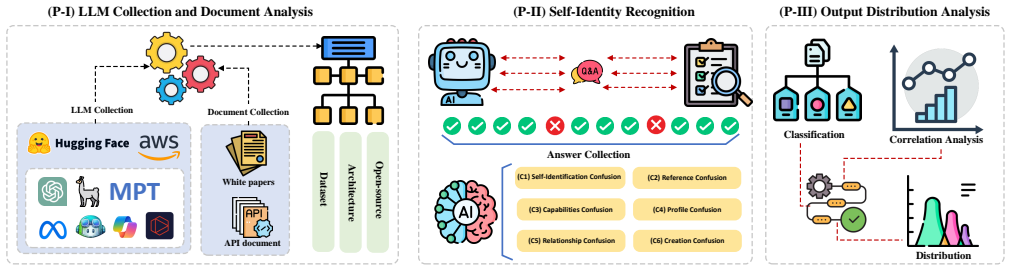
The argument is carried by a three-phase measurement pipeline. Phase one collects and classifies each model's official documentation into architecture and dataset categories. Phase two tests self-identity recognition with 77 reformulated questions targeting six confusion types (self-identification, reference, capabilities, profile, relationship, and creation confusion). Phase three compares part-of-speech frequency distributions of outputs using Euclidean distance, cosine similarity, and Jaccard similarity to fingerprint models. The fingerprinting logic is the load-bearing step: if two different models are actually distinct, their output distributions on the same prompts should diverge, and versions of the same model should converge; the authors use the HC3 dataset as the common prompt set and show exactly this pattern.
What would settle it
Show a single identity-confused model pair (for example, a model that claims to be ChatGPT) that, when tested on several different prompt subsets rather than one, produces output distributions close to the claimed model on at least one subset; or find memorized training text shared between the two models. Either observation would break the inference that divergence on one dataset rules out reuse.
Extended reading notes
Core claim
The paper's central claim is that identity confusion is a real and measurable failure mode of LLMs, that it is primarily a hallucination phenomenon rather than evidence of one model being a copy of another, and that it damages user trust out of proportion to its severity as a technical error. The authors report that 25.93% of 27 tested LLMs exhibited at least one of six types of identity confusion, with creation confusion (claiming the wrong creator) being the most common at 63.13% of incidents. They support the hallucination conclusion by showing that models which admit to being a different product still have part-of-speech output distributions that are far apart from the distribution of the model they claim to be, whereas different versions of the same model are close. Their survey data indicate that trust drops by more than 35% across all six confusion types, with the sharpest declines in educational and professional tasks—declines larger than those caused by logical or consistency errors.
Load-bearing premise
The conclusion that identity confusion is hallucination rather than reuse assumes that two models with divergent part-of-speech distributions on one test set cannot be derived from a common source, but a model fine-tuned or distilled from another can produce quite different word distributions on some inputs.
Editorial extensions
If this is right
- Identity confusion can be treated as a distinct defect category, separate from factual errors and inconsistency, with its own remediation path in fine-tuning.
- Fine-tuned models in the sample showed zero identity confusion, suggesting that explicit identity training during fine-tuning is an effective mitigation.
- Because creation confusion dominates (63.13%), developers should prioritize identity statements in the model's own voice during post-training.
- Reference confusion (C2) caused the largest trust decline, so providing wrong API links or docs is the most reputationally damaging subtype.
- The iFLYTEK Spark case shows the issue can be fixed quickly; a model that previously confused itself with ChatGPT passed all identity questions in this evaluation.
Reading between the lines
- If hallucination is the root cause, then general hallucination-reduction techniques—retrieval grounding, reinforcement learning, or constrained decoding—should also reduce identity confusion, a prediction the paper does not test directly.
- The survey's attribution result (29.81% of users suspect plagiarism) implies that even innocent developers face reputational damage similar to that suffered by actual copycats, so identity confusion is a brand-risk problem as much as a technical bug.
- A natural extension would be to measure identity confusion in multimodal or agentic LLMs, where identity is expressed through tool use and actions rather than only text.
- The output-distribution method could be sharpened by replacing part-of-speech counts with semantic embeddings, which would better separate stylistic similarity from content reuse.
Editorial analysis
A structured set of objections, weighed in public.
Referee Report
Summary. This paper introduces the concept of "identity confusion" in LLMs, proposes a six-category taxonomy (C1–C6), and reports a measurement study of 27 models. The authors use an LLM-assisted pipeline consisting of documentation analysis, self-identity recognition questions, and output-distribution comparison based on part-of-speech (POS) frequencies on HC3 subsets. They claim that 25.93% of evaluated models exhibit identity confusion and that output-similarity analysis shows the cause is hallucination rather than model reuse or replication. A Credamo survey with 208 valid respondents is used to argue that identity confusion erodes user trust more than logical errors or response inconsistencies, especially for critical tasks.
Significance. The phenomenon is timely, and the taxonomy separating self-identification, reference, capabilities, profile, relationship, and creation confusion is a useful organizing device. The paper also deserves credit for assembling a diverse set of 27 models and for attempting a multi-phase measurement rather than relying only on anecdotal examples. However, the two headline quantitative claims are not supported by the evidence as presented. The prevalence figure depends on an unvalidated LLM-based classifier, and the counts inside §5.2 and Table 4 are inconsistent. The causal claim that identity confusion stems from hallucination rather than reuse rests on a POS-distance test that cannot distinguish independent models from fine-tuned or distilled derivatives, and the paper's own distance matrix shows cross-model pairs as close as same-model versions. As a measurement paper, the current experimental design does not establish the central findings.
major comments (4)
- [§5.2 / §4.1 (P-II) / Table 4] The 25.93% prevalence figure rests on an LLM-based response classifier that is never validated: no precision/recall on a gold-standard set, no human agreement study, and no error analysis are reported. This section also contains internally inconsistent counts: the text reports 7 affected models and states that 2 out of 12 proprietary models are affected, while Table 4 reports 3 out of 12 proprietary; the dataset rows sum to 30 (16 public plus 14 private) although only 27 models were evaluated; and §5.3 later refers to "six LLMs" exhibiting identity confusion. The paper also excludes Hailuo AI in §6 after listing it in the 27-model set, without reconciling how an excluded affected model affects the denominator. These inconsistencies make the RQ1 result unreliable as a quantitative claim.
- [§5.3 / §4.1 (P-III) / Eq. (1)] The causal conclusion that identity confusion is due to hallucination rather than replication or reuse rests on the claim that confused models are distinct because their POS frequency vectors diverge on HC3 subsets. This inference is invalid: a fine-tuned or distilled model can diverge from its base or teacher on a single dataset subset while still being derived from it. There is no positive control showing that any known derived pair is detected as similar by the POS-distance test. Moreover, Figure 4 shows the DeepSeek–Yi-34b distance (0.9) is identical to the GPT2-xl–GPT2-large distance (0.9), so the data do not separate cross-model pairs from same-series pairs. The radar chart in Figure 5 uses only cross-model pairs and contains no same-model controls. The evidence therefore cannot rule out reuse, plagiarism, or derivation.
- [§4.1 (P-I) / Table 3 / Table 4] The architecture and dataset categorization, which feeds the breakdowns in Table 4 and the discussion in §6, is produced by an LLM reading technical documentation, with no reported human validation of the extracted categories. The paper says manual reviews confirmed document provenance but does not say that the architecture/dataset labels were manually verified. Without validation or error analysis, the 30%-vs-0% difference between architecture classes and the public/private dataset comparison are not supported.
- [§5.4 / Table 5] The survey results are presented as percentage changes without any statistical testing, confidence intervals, or effect sizes. The relationship between the "Initial" column and the per-scenario counts is not fully reconciled (e.g., Personal Entertainment shows +30.8% for C3 while the TOTAL row declines), and the claim that identity confusion erodes trust more than Fault I and Fault II needs paired significance tests. As presented, the reported differences could be within sampling variability, especially for the smaller task subgroups such as Professional Q&A.
minor comments (5)
- [§5.3 / Figure 5] The text refers to "Figure 5.2" and "results are presented in Figure 5.2", but the referenced figure is numbered Figure 5; the cross-reference should be corrected.
- [§6 / Table 3] The paper says Hailuo AI was excluded from evaluation due to lack of an API, but Table 3 still lists it among the 27 models and Figure 3 includes it in the identity-confusion breakdown; clarify exactly which analyses include Hailuo AI and how this affects the reported prevalence.
- [§4.2 / Appendix] The survey appendix lists only the questions and answer options; the manuscript does not report the full scenario texts or the order in which Fault I, Fault II, and C1–C6 were presented, which would be needed to assess possible ordering effects.
- [§3.1 / References] Some motivating examples are cited to informal sources such as Hacker News threads and community forum posts; for a measurement paper, primary sources or archived versions would strengthen the reproducibility of the motivating claims.
- [§5.2] The text says "2 out of 12 (17%)" but 2/12 is 16.7%; this is a minor rounding issue, but it contributes to the impression that the numerical reporting in this section is not carefully checked.
Circularity Check
No significant circularity: the paper's claims are measurement-based and the output-similarity inference, while empirically fragile, is not circular.
full rationale
The paper does not derive its central claims from definitions or fitted parameters. RQ1 is a measurement study: identity confusion is detected by comparing a model's self-reported identity against documentation of the model's actual identity. RQ2 is addressed through an empirical output-distribution comparison: the authors infer that divergent POS distributions on HC3 subsets indicate that confused models are not derived from the model they claim to be. This inference is an empirical assumption, not a tautology: 'divergent output distributions' is not the same by construction as 'not derived,' and the paper provides no positive control for fine-tuned or distilled pairs. That is a validity limitation, not circularity. The survey (RQ3) is an independent user study with its own data. Self-citations appear only in background references and do not carry the argument. There are no fitted parameters relabeled as predictions, no uniqueness theorem imported from the authors' prior work, and no ansatz smuggled in via citation. The output-similarity method is cited to external fingerprinting work. Accordingly, the paper is self-contained in its derivation chain; the identified concerns are correctness risks, not circular steps.
Assumptions & free parameters
assumptions (4)
- domain assumption Output similarity based on part-of-speech distributions is a reliable fingerprint for LLM derivation.
- domain assumption An LLM can accurately classify whether another LLM's response exhibits identity confusion.
- ad hoc to paper Divergent output distributions on one dataset subset rule out model reuse or replication.
- domain assumption The 27 evaluated LLMs are representative of the broader LLM ecosystem.
Cite this review
Pith. "Pith review of I'm Spartacus, No, I'm Spartacus: Measuring and Understanding LLM Identity Confusion." pith.science (2026). https://pith.science/paper/3I2MYDSB
@misc{pith2026241110683,
  author       = {Pith},
  title        = {Pith review of: I'm Spartacus, No, I'm Spartacus: Measuring and Understanding LLM Identity Confusion},
  year         = {2026},
  howpublished = {\url{https://pith.science/paper/3I2MYDSB}},
  note         = {Machine review of arXiv:2411.10683}
}
read the original abstract
Large Language Models (LLMs) excel in diverse tasks such as text generation, data analysis, and software development, making them indispensable across domains like education, business, and creative industries. However, the rapid proliferation of LLMs (with over 560 companies developing or deploying them as of 2024) has raised concerns about their originality and trustworthiness. A notable issue, termed identity confusion, has emerged, where LLMs misrepresent their origins or identities. This study systematically examines identity confusion through three research questions: (1) How prevalent is identity confusion among LLMs? (2) Does it arise from model reuse, plagiarism, or hallucination? (3) What are the security and trust-related impacts of identity confusion? To address these, we developed an automated tool combining documentation analysis, self-identity recognition testing, and output similarity comparisons--established methods for LLM fingerprinting--and conducted a structured survey via Credamo to assess its impact on user trust. Our analysis of 27 LLMs revealed that 25.93% exhibit identity confusion. Output similarity analysis confirmed that these issues stem from hallucinations rather than replication or reuse. Survey results further highlighted that identity confusion significantly erodes trust, particularly in critical tasks like education and professional use, with declines exceeding those caused by logical errors or inconsistencies. Users attributed these failures to design flaws, incorrect training data, and perceived plagiarism, underscoring the systemic risks posed by identity confusion to LLM reliability and trustworthiness.
Figures


Figures from the paper (5 more)


Forward citations
Cited by 1 Pith paper
-
KBF: Knowledge Boundary as Fingerprint for Language Model and Black-Box API Auditing
KBF uses stable numerical recall near the knowledge boundary to fingerprint and audit black-box LLM APIs, successfully detecting all tested substitutions and some real-world inconsistencies across production endpoints.
Reference graph
Works this paper leans on
-
[1]
iflytek: Rumors that xinghuo is a “repackaged chatgpt” are completely false. https://zhidx.com/news/37509.html, 2023. Accessed: 2024-10- 09
work page 2023
-
[2]
360 ai:people-oriented, safe and credible
360. 360 ai:people-oriented, safe and credible. https://ai.360.com/,
-
[3]
01. AI, :, Alex Young, Bei Chen, Chao Li, Chengen Huang, Ge Zhang, Guanwei Zhang, Heng Li, Jiangcheng Zhu, Jianqun Chen, Jing Chang, Kaidong Yu, Peng Liu, Qiang Liu, Shawn Yue, Senbin Yang, Shiming Yang, Tao Yu, Wen Xie, Wenhao Huang, Xiaohui Hu, Xiaoyi Ren, Xinyao Niu, Pengcheng Nie, Yuchi Xu, Yudong Liu, Yue Wang, Yuxuan Cai, Zhenyu Gu, Zhiyuan Liu, and...
arXiv 2024
-
[4]
DeepSeek-AI, :, Xiao Bi, Deli Chen, Guanting Chen, Shanhuang Chen, Damai Dai, Chengqi Deng, Honghui Ding, Kai Dong, Qiushi Du, Zhe Fu, Huazuo Gao, Kaige Gao, Wenjun Gao, Ruiqi Ge, Kang Guan, Daya Guo, Jianzhong Guo, Guangbo Hao, Zhewen Hao, Ying He, Wenjie Hu, Panpan Huang, Erhang Li, Guowei Li, Jiashi Li, Yao Li, Y . K. Li, Wenfeng Liang, Fangyun Lin, A....
arXiv 2024
-
[5]
Bert: Pre-training of deep bidirectional transformers for language understanding
Jacob Devlin. Bert: Pre-training of deep bidirectional transformers for language understanding. arXiv preprint arXiv:1810.04805 , 2018
arXiv 2018
-
[6]
Human chatgpt comparison corpus (hc3)
Guo et al. Human chatgpt comparison corpus (hc3). https: //huggingface.co/datasets/Hello-SimpleAI/HC3, 2023. Accessed: November 13, 2024
work page 2023
-
[7]
Gpt-3: Its nature, scope, limits, and consequences
Luciano Floridi and Massimo Chiriatti. Gpt-3: Its nature, scope, limits, and consequences. Minds and Machines , 30:681–694, 2020
work page 2020
-
[8]
Watermax: breaking the llm wa- termark detectability-robustness-quality trade-off
Eva Giboulot and Teddy Furon. Watermax: breaking the llm wa- termark detectability-robustness-quality trade-off. arXiv preprint arXiv:2403.04808, 2024
arXiv 2024
Show all 49 references
-
[9]
Github. Mengzi3. https://github.com/Langboat/Mengzi3, 2023. Ac- cessed: 2024-10-09
2023
-
[10]
iflytek spark
iFLYTEK. iflytek spark. https://xinghuo.xfyun.cn/, 2023. Accessed: 2024-10-09
2023
-
[11]
Double- i watermark: Protecting model copyright for llm fine-tuning
Shen Li, Liuyi Yao, Jinyang Gao, Lan Zhang, and Yaliang Li. Double- i watermark: Protecting model copyright for llm fine-tuning. arXiv preprint arXiv:2402.14883, 2024
2024 arXiv
-
[12]
Attention is all you need for llm-based code vulnerability localization
Yue Li, Xiao Li, Hao Wu, Yue Zhang, Xiuzhen Cheng, Sheng Zhong, and Fengyuan Xu. Attention is all you need for llm-based code vulnerability localization. arXiv preprint arXiv:2410.15288 , 2024
2024 arXiv
-
[13]
A survey of text watermarking in the era of large language models
Aiwei Liu, Leyi Pan, Yijian Lu, Jingjing Li, Xuming Hu, Xi Zhang, Lijie Wen, Irwin King, Hui Xiong, and Philip Yu. A survey of text watermarking in the era of large language models. ACM Computing Surveys, 57(2):1–36, 2024
2024
-
[14]
MarketsandMarkets. Large language model (llm) market by component (hardware, software, services), end user (bfsi, healthcare, retail & e-commerce, it & telecom), deployment mode (on-premise, cloud), and region - global forecast to
-
[15]
Your Large Language Models Are Leaving Fingerprints
Hope McGovern, Rickard Stureborg, Yoshi Suhara, and Dimitris Alikaniotis. Your Large Language Models Are Leaving Fingerprints. arXiv e-prints, page arXiv:2405.14057, May 2024
2024 arXiv
-
[16]
Gemini-pro on poe claims its baidu’s wenxin llm when asked in chinese
Hacker News. Gemini-pro on poe claims its baidu’s wenxin llm when asked in chinese. https://news.ycombinator.com/item?id=38680212,
-
[17]
Bytedance accused of ai ’repackaging,’ is keeping a low profile the real issue? https://www.chinaventure.com.cn/news/ 78-20231219-378840.html, 2023
Huxiu News. Bytedance accused of ai ’repackaging,’ is keeping a low profile the real issue? https://www.chinaventure.com.cn/news/ 78-20231219-378840.html, 2023. Accessed: 2024-10-09
2023
-
[18]
Li kaifu’s company caught in llama architecture naming dispute, 01.ai responds: Code updates will follow
Sohu News. Li kaifu’s company caught in llama architecture naming dispute, 01.ai responds: Code updates will follow. https://www.sohu. com/a/736451466 114778, 2023. Accessed: 2024-10-09
2023
-
[19]
Accessed: 2024-10-09
2024
-
[20]
Gpt-4 through api says it’s gpt-3
OpenAI. Gpt-4 through api says it’s gpt-3. https://community. openai.com/t/gpt-4-through-api-says-its-gpt-3/286881, 2023. Ac- cessed: 2024-10-09
2023
-
[21]
Sometimes gpt-4 thinks it’s 3.5? https://community
OpenAI. Sometimes gpt-4 thinks it’s 3.5? https://community. openai.com/t/sometimes-gpt-4-thinks-it-s-3-5/561604, 2023. Ac- cessed: 2024-10-09
2023
-
[22]
GPT-4 Technical Report
OpenAI. GPT-4 Technical Report. arXiv e-prints , page arXiv:2303.08774, March 2023
2023 arXiv
-
[23]
Mark- llm: An open-source toolkit for llm watermarking
Leyi Pan, Aiwei Liu, Zhiwei He, Zitian Gao, Xuandong Zhao, Yijian Lu, Binglin Zhou, Shuliang Liu, Xuming Hu, Lijie Wen, et al. Mark- llm: An open-source toolkit for llm watermarking. arXiv preprint arXiv:2405.10051, 2024
2024 arXiv
-
[24]
At- tacking llm watermarks by exploiting their strengths
Qi Pang, Shengyuan Hu, Wenting Zheng, and Virginia Smith. At- tacking llm watermarks by exploiting their strengths. arXiv preprint arXiv:2402.16187, 2024
2024 arXiv
-
[25]
Long Ouyang, Jeff Wu, Xu Jiang, Diogo Almeida, Carroll L. Wain- wright, Pamela Mishkin, Chong Zhang, Sandhini Agarwal, Katarina Slama, Alex Ray, John Schulman, Jacob Hilton, Fraser Kelton, Luke Miller, Maddie Simens, Amanda Askell, Peter Welinder, Paul Christiano, Jan Leike, a...
2022 arXiv
-
[26]
Language models are unsupervised multitask learners
Alec Radford, Jeff Wu, Rewon Child, David Luan, Dario Amodei, and Ilya Sutskever. Language models are unsupervised multitask learners. 2019
2019
-
[27]
In some condition, bard considered itself as a product of baidu
Reddit. In some condition, bard considered itself as a product of baidu. https://www.reddit.com/r/Bard/comments/18kalm2/in some condition bard considered itself as a/, 2023. Accessed: 2024-10- 09
2023
-
[28]
Mooncake: A KVCache-centric Disaggregated Architecture for LLM Serving
Ruoyu Qin, Zheming Li, Weiran He, Mingxing Zhang, Yongwei Wu, Weimin Zheng, and Xinran Xu. Mooncake: A KVCache-centric Disaggregated Architecture for LLM Serving. arXiv e-prints , page arXiv:2407.00079, June 2024
2024 arXiv
-
[29]
Hey, that’s my model! intro- ducing chain & hash, an llm fingerprinting technique
Mark Russinovich and Ahmed Salem. Hey, that’s my model! intro- ducing chain & hash, an llm fingerprinting technique. arXiv preprint arXiv:2407.10887, 2024
2024 arXiv
-
[30]
ERNIE 3.0: Large-scale Knowledge Enhanced Pre-training for Language Understanding and Generation
Yu Sun, Shuohuan Wang, Shikun Feng, Siyu Ding, Chao Pang, Junyuan Shang, Jiaxiang Liu, Xuyi Chen, Yanbin Zhao, Yuxiang Lu, Weixin Liu, Zhihua Wu, Weibao Gong, Jianzhong Liang, Zhizhou Shang, Peng Sun, Wei Liu, Xuan Ouyang, Dianhai Yu, Hao Tian, Hua Wu, and Haifeng Wang. ERNIE ...
2021 arXiv
-
[31]
Zidong taichu
Wuhan AI Research and Chinese Academy of Sciences the Institute of Automation. Zidong taichu. https://taichu-web.ia.ac.cn/, 2023. Ac- cessed: 2024-10-09
2023
-
[32]
ChatGLM: A Family of Large Language Models from GLM- 130B to GLM-4 All Tools
Team GLM, :, Aohan Zeng, Bin Xu, Bowen Wang, Chenhui Zhang, Da Yin, Dan Zhang, Diego Rojas, Guanyu Feng, Hanlin Zhao, Hanyu Lai, Hao Yu, Hongning Wang, Jiadai Sun, Jiajie Zhang, Jiale Cheng, Jiayi Gui, Jie Tang, Jing Zhang, Jingyu Sun, Juanzi Li, Lei Zhao, Lindong Wu, Lucen Zh...
2024 arXiv
-
[33]
Tencent hunyuan
Tencent. Tencent hunyuan. https://hunyuan.tencent.com/, 2023. Ac- cessed: 2024-10-09
2023
-
[34]
Gemini: A Family of Highly Capable Multimodal Models
Gemini Team. Gemini: A Family of Highly Capable Multimodal Models. arXiv e-prints, page arXiv:2312.11805, December 2023
2023 arXiv
-
[35]
Llama 2: Open Foundation and Fine-Tuned Chat Models
Hugo Touvron, Louis Martin, Kevin Stone, Peter Albert, Amjad Almahairi, Yasmine Babaei, Nikolay Bashlykov, Soumya Batra, Pra- jjwal Bhargava, Shruti Bhosale, Dan Bikel, Lukas Blecher, Cris- tian Canton Ferrer, Moya Chen, Guillem Cucurull, David Esiobu, Jude Fernandes, Jeremy F...
2023 arXiv
-
[36]
Behind the ai boom: Large language model (llm) trends
TrendFeedr. Behind the ai boom: Large language model (llm) trends. https://trendfeedr.com/blog/large-language-model-llm-trends/,
-
[37]
Tianrang xiaobai
tianrang. Tianrang xiaobai. https://www.tianrang.com/, 2023. Ac- cessed: 2024-10-09
2023
-
[38]
Sky- work: A More Open Bilingual Foundation Model
Tianwen Wei, Liang Zhao, Lichang Zhang, Bo Zhu, Lijie Wang, Haihua Yang, Biye Li, Cheng Cheng, Weiwei L ¨u, Rui Hu, Chenxia Li, Liu Yang, Xilin Luo, Xuejie Wu, Lunan Liu, Wenjun Cheng, Peng Cheng, Jianhao Zhang, Xiaoyu Zhang, Lei Lin, Xiaokun Wang, Yutuan Ma, Chuanhai Dong, Ya...
-
[39]
Bypassing llm watermarks with color-aware substitutions
Qilong Wu and Varun Chandrasekaran. Bypassing llm watermarks with color-aware substitutions. arXiv preprint arXiv:2403.14719 , 2024
2024 arXiv
-
[40]
On protecting the data privacy of large language models (llms): A survey
Biwei Yan, Kun Li, Minghui Xu, Yueyan Dong, Yue Zhang, Zhaochun Ren, and Xiuzhen Cheng. On protecting the data privacy of large language models (llms): A survey. arXiv preprint arXiv:2403.05156, 2024
2024 arXiv
-
[41]
Conu: Conformal uncertainty in large language models with correctness coverage guarantees
Zhiyuan Wang, Jinhao Duan, Lu Cheng, Yue Zhang, Qingni Wang, Xiaoshuang Shi, Kaidi Xu, Hengtao Shen, and Xiaofeng Zhu. Conu: Conformal uncertainty in large language models with correctness coverage guarantees. arXiv preprint arXiv:2407.00499 , 2024
2024 arXiv
-
[42]
A fingerprint for large language models
Zhiguang Yang and Hanzhou Wu. A fingerprint for large language models. arXiv preprint arXiv:2407.01235 , 2024
2024
-
[43]
A survey on large language model (llm) security and privacy: The good, the bad, and the ugly
Yifan Yao, Jinhao Duan, Kaidi Xu, Yuanfang Cai, Zhibo Sun, and Yue Zhang. A survey on large language model (llm) security and privacy: The good, the bad, and the ugly. High-Confidence Computing, page 100211, 2024
2024
-
[44]
Reef: Representation encoding fingerprints for large language models
Jie Zhang, Dongrui Liu, Chen Qian, Linfeng Zhang, Yong Liu, Yu Qiao, and Jing Shao. Reef: Representation encoding fingerprints for large language models. arXiv preprint arXiv:2410.14273 , 2024
2024 arXiv
-
[45]
Baichuan 2: Open Large-scale Language Models
Aiyuan Yang, Bin Xiao, Bingning Wang, Borong Zhang, Ce Bian, Chao Yin, Chenxu Lv, Da Pan, Dian Wang, Dong Yan, Fan Yang, Fei Deng, Feng Wang, Feng Liu, Guangwei Ai, Guosheng Dong, Haizhou Zhao, Hang Xu, Haoze Sun, Hongda Zhang, Hui Liu, Jiaming Ji, Jian Xie, JunTao Dai, Kun Fa...
2023 arXiv
-
[46]
I am Model B
Yang Zhao, Zhijie Lin, Daquan Zhou, Zilong Huang, Jiashi Feng, and Bingyi Kang. BuboGPT: Enabling Visual Grounding in Multi-Modal LLMs. arXiv e-prints, page arXiv:2307.08581, July 2023. Appendix Survey Questions TABLE 7. S URVEY QUESTIONS Question Answer Options Background inf...
2023 arXiv
-
[49]
REMARK-LLM: A robust and efficient wa- termarking framework for generative large language models
Ruisi Zhang, Shehzeen Samarah Hussain, Paarth Neekhara, and Farinaz Koushanfar. REMARK-LLM: A robust and efficient wa- termarking framework for generative large language models. In 33rd USENIX Security Symposium (USENIX Security 24) , pages 1813– 1830, Philadelphia, PA, August...
2024
-
[2024]
Accessed: October 4, 2024
2024
-
[2030]
Accessed: 2024-11-14
https://www.marketsandmarkets.com/Market-Reports/ large-language-model-llm-market-102137956.html, 2024. Accessed: 2024-11-14
2024
Reviewed August 12, 2026 · model on record in the stance chip above.
Discussion (0). Continue with ORCID to comment.