REVIEW 3 major objections 4 minor 46 references
Distributed solar generation forecasting using attention-based deep neural networks for cloud movement prediction
T0 review · 3 major / 4 minor · reviewed 2026-08-12 · deepseek-v4-flash
Pith's one-line read By adding attention to the cloud-movement forecaster and feeding those cloud forecasts into solar power predictors, the paper finds hour-ahead solar forecast skill improves by 5.86% or more under high-altitude cloud conditions compared…
desk verdict Solid empirical comparison of attention-based cloud forecasting for solar, but the headline skill-score gain rests on one arbitrary altitude threshold with no uncertainty quantification. read the letter →
The pith
A machine-rendered reading of the paper's core claim, the machinery that carries it, and where it could break.
The reading
What carries the argument
The carrying object is the attention-augmented convolutional LSTM. The paper's CBAMConvLSTM applies the convolutional block attention module (CBAM), a channel-and-spatial attention module that reweights feature maps, after each convolution inside a standard ConvLSTM cell, so the cell emphasizes informative cloud regions while ignoring non-cloud areas. The second model, SAConvLSTM, is an existing self-attention ConvLSTM that computes pairwise pixel correlations and keeps a separate memory of long-range spatial dependencies. Both predict a 60x60 infrared image sequence six time steps (one hour) ahead in an autoregressive loop, and the pipeline then extracts the pixel corresponding to each PV site as the cloud input to the solar forecasters. The cloud forecasts are trained with a structural similarity (SSIM) loss, and the solar networks are trained to minimize mean squared error, with performance measured as RMSE and MAE skill scores against a persistence forecast.
What would settle it
For a sample of test timestamps, identify the cloud pixel that actually shades each PV site using solar azimuth, zenith angle, and cloud-top height, then rerun the same solar forecasting networks with those corrected cloud values; if the attention-based cloud forecasts no longer beat the ConvLSTM forecasts by 5.86% or more in high-altitude conditions, the central claim's mechanism is undermined.
Extended reading notes
Core claim
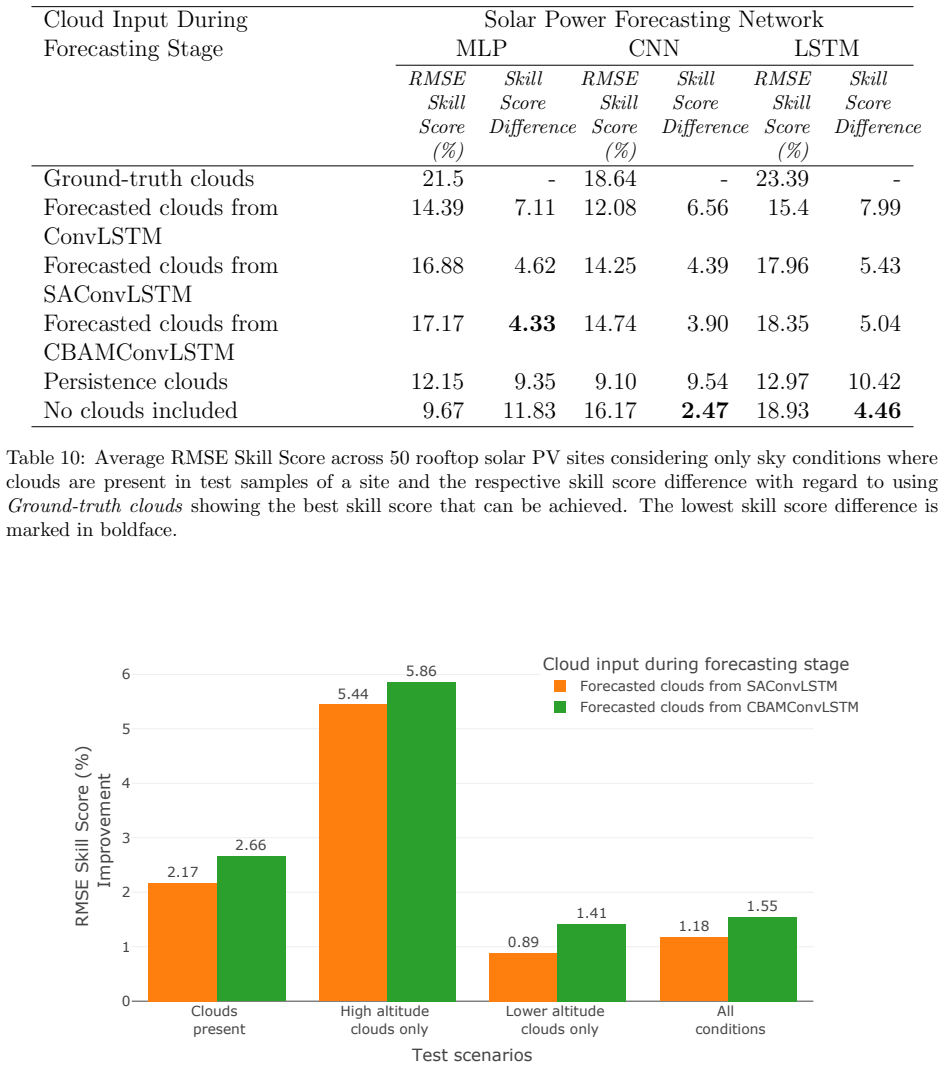
The central claim is that cloud forecasts produced by attention-based sequence predictors translate into measurably better hour-ahead solar power forecasts than cloud forecasts from a standard ConvLSTM. The proposed CBAMConvLSTM inserts a convolutional block attention module after each convolution inside a ConvLSTM, while SAConvLSTM adds a self-attention memory module; both are trained to predict the next six infrared satellite images. When the single cloud pixel above a PV site is extracted from these predicted images and fed, together with past power values, into MLP, CNN, or LSTM solar forecasters, the attention-produced cloud inputs consistently beat the ConvLSTM-produced inputs. In the high-altitude cloud test subset, the RMSE skill score improvements over ConvLSTM are 5.97%, 5.86%, and 6.67% for MLP, CNN, and LSTM, respectively, and SAConvLSTM achieves 5.97%, 5.44%, and 6.29%. The same comparison under low-altitude cloud conditions yields smaller improvements, between 0.89 and 1.54 percentage points, indicating that the benefit of attention is concentrated where the cloud signal in the infrared image is strongest.
Load-bearing premise
The pipeline assumes that the cloud pixel directly above a PV site in the satellite image represents the clouds that actually shade that site, although sunlight reaches the ground at an angle and the shading cloud can be displaced horizontally.
Editorial extensions
If this is right
- For cloudy periods, feeding attention-based cloud forecasts into any of the three solar forecasting networks yields higher RMSE skill scores than feeding ConvLSTM cloud forecasts or persistence cloud images.
- The largest attention benefit appears specifically in high-altitude cloud test samples, where LSTM solar forecasts gain 6.67 percentage points in skill score compared with ConvLSTM cloud inputs.
- Under clear-sky conditions, cloud forecasting method makes little difference, so the attention value is tied to cloudy-sky samples.
- Including ground-truth cloud values still beats all forecasted-cloud variants, so further gains in cloud prediction accuracy should keep improving solar forecasts.
Reading between the lines
- If the vertical-pixel assumption is corrected using solar azimuth, zenith angle, and cloud height, attention-based methods may show different (possibly larger or partially reduced) gains; testing that correction would separate prediction quality from input alignment effects.
- Combining infrared imagery with visible-band imagery, which carries cloud-thickness information, could extend the attention benefit to low-altitude clouds, where the current improvements are smaller.
- The concentration of gains in high-altitude clouds suggests attention networks are particularly good at reproducing near-white, high-pixel-value regions; a pixel-wise error analysis by cloud brightness would test this directly.
- The same two-stage pipeline could be applied to other image-driven renewable forecasting tasks, such as wind gust nowcasting or irradiance forecasting, whenever the relevant atmospheric feature moves across a satellite image.
Editorial analysis
A structured set of objections, weighed in public.
Referee Report
Summary. The paper proposes an attention-augmented cloud forecasting pipeline for hour-ahead solar generation forecasting at 50 rooftop PV sites in Perth, Australia, using Himawari-8 infrared satellite imagery. It introduces CBAMConvLSTM, applies the existing SAConvLSTM, and compares both against a standard ConvLSTM as cloud forecasters; cloud forecasts are then fed into MLP, CNN, and LSTM solar power predictors, with additional benchmark conditions using ground-truth clouds, persistence clouds, and no clouds. The central empirical claim is that attention-based cloud forecasts yield RMSE skill score improvements of 5.86% or more over ConvLSTM-derived cloud forecasts under high-altitude cloud conditions.
Significance. If the central claim is robust, the paper provides a useful large-scale empirical evaluation: 50 PV sites, three solar forecasting architectures, three cloud forecasting models, and multiple cloud-input benchmark scenarios. The explicit two-stage evaluation and the decomposition into clear-sky, high-altitude, and low-altitude conditions are valuable for practitioners, and the reported point estimates consistently favor the attention-based methods under cloudy conditions. The strengths are the breadth of the study, the inclusion of persistence and no-cloud baselines, and the investigation of downstream forecast impact rather than only image-quality metrics. The main caveat is that the headline quantitative claim rests on a post-hoc sample stratification whose robustness is not demonstrated.
major comments (3)
- [Section 6.2, Table 8 and Figures 8-10] The headline claim of 5.86% or greater skill score improvement depends entirely on the threshold of pixel value > 50 used to define high-altitude cloud conditions in Section 6.2. This threshold is introduced without justification, and Section 6.4 explicitly acknowledges that cloud altitude is not calculated in the work, making the threshold a proxy. Because high-altitude samples are only 16.24% of the test set, small changes in the threshold or a few outlier sites could materially change the reported 5.86-6.67 percentage-point improvements. I request a sensitivity analysis over a range of plausible thresholds, together with per-site confidence intervals or paired significance tests, before the abstract's quantitative claim can be accepted.
- [Section 5, Table 4] The training, validation, and testing split is not described beyond sample counts: no information is given on whether the split is temporal, random, site-level, or contiguous. Since solar power and satellite image data are 10-minute time series, a random split could place temporally adjacent samples from the same day in both training and testing sets, potentially inflating skill scores. Please specify the exact splitting procedure and confirm that no temporal overlap exists between training, validation, and test periods.
- [Tables 5-10] All reported skill scores are point estimates averaged over 50 PV sites, with no measure of cross-site variability, standard errors, confidence intervals, or significance tests. Differences of 1-2 percentage points between attention-based and non-attention methods may be within site-level noise, and the conclusion that attention-based methods provide 'meaningful benefits' is currently supported only by the magnitudes of the averaged differences. I request site-level error bars or paired statistical tests for the attention-versus-ConvLSTM comparison, at least for the high-altitude subsample that anchors the headline claim.
minor comments (4)
- [Section 3, Figure 4] The caption contains typographical errors: 'N 4 2020' should be 'Nov 4 2020' and 'F b14 2021' should be 'Feb 14 2021'.
- [Section 4.2.1] Several typos should be corrected: 'refereed' should be 'referred', 'investiage' should be 'investigate', and 'huperparameters' should be 'hyperparameters'.
- [Appendix A] The introduction to Table A.11 states that it shows the average RMSE skill score, but the table reports MAE skill scores; the text should refer to MAE consistently.
- [Section 6.3] Figure 8 labels one scenario 'Lower altitude clouds only'; for consistency with Section 6.2 and Tables 8-9, this should be 'low altitude clouds only'.
Circularity Check
No significant circularity: the skill-score improvements are empirical out-of-sample results, with only a non-load-bearing self-citation.
full rationale
This paper reports an empirical, out-of-sample comparison of attention-based versus non-attention-based cloud forecasting pipelines for solar power forecasting. The central headline (5.86% or more RMSE skill-score improvement for high-altitude conditions, Section 6.3) is computed from held-out test samples and skill scores relative to persistence; no parameter is fitted to that result and no equation defining the outcome is used to derive it. The high/low altitude split is a pixel-value threshold of 50 (Section 6.2), and the authors explicitly note in Section 6.4 that 'the cloud altitude is not explicitly calculated in our work'; this is a robustness/selection concern, not a circularity. The vertical-alignment limitation in Section 6.4 ('clouds covering the sunlight may not be vertically above the site') is symmetric across compared cloud inputs and does not make the attention-versus-ConvLSTM comparison definitional. The only self-citation is Ref. [42], a general RNN survey used for background on LSTM forecasting; it is not load-bearing. Therefore no circular step can be exhibited: the claims rest on independent test-set evaluation.
Assumptions & free parameters
free parameters (1)
- high vs low altitude cloud pixel threshold =
50
assumptions (4)
- domain assumption Infrared brightness temperature (pixel value) is a reliable proxy for cloud altitude.
- domain assumption The cloud pixel vertically above a PV site represents the clouds affecting solar generation at that site.
- domain assumption A single cloud forecasting network trained on the 60x60 Perth region generalizes across all 50 PV sites.
- domain assumption The train/validation/test split is appropriate and does not leak temporal autocorrelation.
Cite this review
Pith. "Pith review of Distributed solar generation forecasting using attention-based deep neural networks for cloud movement prediction." pith.science (2026). https://pith.science/paper/UC32DLDC
@misc{pith2026241110921,
  author       = {Pith},
  title        = {Pith review of: Distributed solar generation forecasting using attention-based deep neural networks for cloud movement prediction},
  year         = {2026},
  howpublished = {\url{https://pith.science/paper/UC32DLDC}},
  note         = {Machine review of arXiv:2411.10921}
}
read the original abstract
Accurate forecasts of distributed solar generation are necessary to maintain grid stability amid the increased uptake of distributed solar photovoltaic (PV) systems. However, the high variability of solar generation over short time intervals (seconds to minutes) caused by cloud movement makes this forecasting task difficult. To address this, using cloud images, which capture the second-to-second changes in cloud cover affecting solar generation, has shown promise. Recently, deep neural networks with attention that focus on important regions of an image have been applied with success in many computer vision applications. However, whether such methods provide meaningful benefits for cloud movement forecasting, and how such improvements propagate through to downstream solar generation forecasting accuracy, remains under-explored. In this study, we conduct a large-scale empirical investigation of the impact of attention-based cloud forecasting on solar generation forecasting, addressing a gap that has been overlooked in the literature. To this end, we develop a pipeline that incorporates an attention-enhanced convolutional long short-term memory network and an existing self-attention-based video prediction method to forecast cloud movement using satellite imagery. The effectiveness of the resulting cloud forecasts is evaluated through their downstream impact on solar forecasting across 50 PV sites in Australia. We further provide insights into the cloud conditions under which attention-based cloud forecasting methods yield the most significant improvements in downstream solar forecasting accuracy. We find that for clouds at high altitudes, the cloud predictions obtained using attention-based methods result in solar forecast skill score improvements of 5.86% or more compared to non-attention-based methods.
Figures


Figures from the paper (7 more)



Reference graph
Works this paper leans on
-
[1]
URL: https://www.iea.org/ reports/world-energy-outlook-2021
IEA, World Energy Outlook 2021, Technical Report, Paris, 2021. URL: https://www.iea.org/ reports/world-energy-outlook-2021
work page 2021
- [2]
-
[3]
Q. Hou, N. Zhang, E. Du, M. Miao, F. Peng, C. Kang, Probabilistic duck curve in high PV penetration power system: Concept, modeling, and empirical analysis in China, Applied Energy 242 (2019) 205–215. doi:10.1016/J.APENERGY.2019.03.067
-
[4]
D. Yang, E. Wu, J. Kleissl, Operational solar forecasting for the real-time market, International Journal of Forecasting 35 (2019) 1499–1519. URL: https://doi.org/10.1016/j.ijforecast.2019.03.009. doi:10.1016/j.ijforecast.2019.03.009
-
[5]
J. Antonanzas, N. Osorio, R. Escobar, R. Urraca, F. J. Martinez-de Pison, F. Antonanzas-Torres, Review of photovoltaic power forecasting, Solar Energy 136 (2016) 78–111. URL: http://dx.doi. org/10.1016/j.solener.2016.06.069. doi:10.1016/j.solener.2016.06.069
-
[6]
A. Nespoli, A. Niccolai, E. Ogliari, G. Perego, E. Collino, D. Ronzio, Machine Learning techniques for solar irradiation nowcasting: Cloud type classification forecast through satellite data and imagery, Applied Energy 305 (2022) 117834. URL: https://doi.org/10.1016/j.apenergy.2021.117834. doi:10.1016/j.apenergy.2021.117834
-
[7]
F. Barbieri, S. Rajakaruna, A. Ghosh, Very short-term photovoltaic power forecasting with cloud modeling: A review, Renewable and Sustainable Energy Reviews 75 (2017) 242–263. URL: http: //dx.doi.org/10.1016/j.rser.2016.10.068. doi:10.1016/j.rser.2016.10.068
- [9]
Show all 46 references
-
[10]
A. S. Bansal, T. Bansal, D. Irwin, A Moment in the Sun: Solar Nowcasting from Multispectral Satellite Data using Self-Supervised Learning, in: Proceedings of the Thirteenth ACM International Conference on Future Energy Systems, 2022, pp. 251–262. URL: http://arxiv.org/abs/2112.13974
2022 arXiv
-
[11]
Z. Si, M. Yang, Y. Yu, T. Ding, Photovoltaic power forecast based on satellite images considering effects of solar position, Applied Energy 302 (2021) 117514. URL: https://doi.org/10.1016/j.apenergy. 2021.117514. doi:10.1016/j.apenergy.2021.117514
2021
-
[12]
Cheng, H
L. Cheng, H. Zang, Z. Wei, T. Ding, R. Xu, G. Sun, Short-term Solar Power Prediction Learning Directly from Satellite Images with Regions of Interest, IEEE Transactions on Sustainable Energy 13 (2022) 629–639. doi: 10.1109/TSTE.2021.3123476
2022
-
[13]
Y. Fu, H. Chai, Z. Zhen, F. Wang, X. Xu, K. Li, M. Shafie-Khah, P. Dehghanian, J. P. Catalao, Sky Image Prediction Model Based on Convolutional Auto-Encoder for Minutely Solar PV Power Forecasting, IEEE Transactions on Industry Applications 57 (2021) 3272–3281. doi: 10.1109/TI...
2021
-
[14]
Vaswani, N
A. Vaswani, N. Shazeer, N. Parmar, J. Uszkoreit, L. Jones, A. N. Gomez, {\L}. Kaiser, I. Polosukhin, Attention Is All You Need, in: Advances in Neural Information Processing Systems, volume 30, 2017. doi:10.1109/2943.974352
2017
-
[15]
Huang, Z
G. Huang, Z. Liu, L. Van Der Maaten, K. Q. Weinberger, Densely connected convolutional networks, in: Proceedings - 30th IEEE Conference on Computer Vision and Pattern Recognition, CVPR 2017, volume 2017-Janua, 2017, pp. 2261–2269. doi: 10.1109/CVPR.2017.243
2017 doi
-
[16]
Y. Wang, M. Long, J. Wang, Z. Gao, P. S. Yu, PredRNN: Recurrent neural networks for predictive learning using spatiotemporal LSTMs, Advances in Neural Information Processing Systems 2017-Decem (2017) 880–889
2017
-
[17]
Chaudhari, V
S. Chaudhari, V. Mithal, G. Polatkan, R. Ramanath, An Attentive Survey of Attention Models, ACM 30 Transactions on Intelligent Systems and Technology 12 (2021) 53. URL: https://doi.org/10.1145/ 3465055. doi:10.1145/3465055
2021 doi
-
[18]
J. Qu, Z. Qian, Y. Pei, Day-ahead hourly photovoltaic power forecasting using attention-based CNN- LSTM neural network embedded with multiple relevant and target variables prediction pattern, En- ergy 232 (2021) 120996. URL: https://doi.org/10.1016/j.energy.2021.120996. doi: 1...
2021
-
[19]
C. S. Lai, C. Zhong, K. Pan, W. W. Ng, L. L. Lai, A deep learning based hybrid method for hourly solar radiation forecasting, Expert Systems with Applications 177 (2021) 114941. doi:10.1016/j.eswa. 2021.114941
2021
-
[20]
D. Yu, W. Choi, M. Kim, L. Liu, Forecasting Day-Ahead Hourly Photovoltaic Power Genera- tion Using Convolutional Self-Attention Based Long Short-Term Memory, Energies 13 (2020) 4017. URL: https://www.mdpi.com/1996-1073/13/15/4017/htmhttps://www.mdpi.com/1996-1073/13/ 15/4017. ...
2020 doi
-
[21]
Z. Lin, M. Li, Z. Zheng, Y. Cheng, C. Yuan, Self-attention ConvLSTM for spatiotemporal prediction, AAAI 2020 - 34th AAAI Conference on Artificial Intelligence (2020) 11531–11538. doi: 10.1609/aaai. v34i07.6819
2020 doi
-
[22]
D. Yang, J. Kleissl, C. A. Gueymard, H. T. Pedro, C. F. Coimbra, History and trends in solar irradiance and PV power forecasting: A preliminary assessment and review using text mining, Solar Energy 168 (2018) 60–101. URL: https://doi.org/10.1016/j.solener.2017.11.023. doi:10.1...
2018 doi
-
[23]
M. J. Mayer, G. Gr´ of, Extensive comparison of physical models for photovoltaic power forecasting, Applied Energy 283 (2021). doi: 10.1016/j.apenergy.2020.116239
2021
-
[24]
Fouilloy, C
A. Fouilloy, C. Voyant, G. Notton, F. Motte, C. Paoli, M. L. Nivet, E. Guillot, J. L. Duchaud, Solar irra- diation prediction with machine learning: Forecasting models selection method depending on weather variability, Energy 165 (2018) 620–629. URL: https://doi.org/10.1016/j....
2018 doi
-
[25]
Visser, T
L. Visser, T. AlSkaif, W. van Sark, Operational day-ahead solar power forecasting for aggregated PV systems with a varying spatial distribution, Renewable Energy 183 (2022) 267–282. URL: https: //doi.org/10.1016/j.renene.2021.10.102. doi:10.1016/j.renene.2021.10.102
2022 doi
-
[26]
Kumari, D
P. Kumari, D. Toshniwal, Long short term memoryconvolutional neural network based deep hybrid approach for solar irradiance forecasting, Applied Energy 295 (2021) 117061. URL: https://doi.org/ 10.1016/j.apenergy.2021.117061. doi:10.1016/j.apenergy.2021.117061
2021
-
[27]
Dolara, S
A. Dolara, S. Leva, G. Manzolini, Comparison of different physical models for PV power output prediction, Solar Energy (2015). doi: 10.1016/j.solener.2015.06.017
2015 doi
-
[28]
Sobri, S
S. Sobri, S. Koohi-Kamali, N. A. Rahim, Solar photovoltaic generation forecasting methods: A re- view, Energy Conversion and Management 156 (2018) 459–497. URL: https://doi.org/10.1016/j. enconman.2017.11.019. doi:10.1016/j.enconman.2017.11.019
2018 doi
-
[29]
Zhang, R
J. Zhang, R. Verschae, S. Nobuhara, J. F. Lalonde, Deep photovoltaic nowcasting, Solar En- ergy 176 (2018) 267–276. URL: https://doi.org/10.1016/j.solener.2018.10.024. doi: 10.1016/ j.solener.2018.10.024
2018 doi
-
[30]
W. Kong, Y. Jia, Z. Y. Dong, K. Meng, S. Chai, Hybrid approaches based on deep whole-sky-image learning to photovoltaic generation forecasting, Applied Energy 280 (2020) 115875. URL: https: //doi.org/10.1016/j.apenergy.2020.115875. doi:10.1016/j.apenergy.2020.115875
2020
-
[31]
X. Shi, Z. Chen, H. Wang, D. Y. Yeung, W. K. Wong, W. C. Woo, Convolutional LSTM network: A machine learning approach for precipitation nowcasting, in: Advances in Neural Information Processing Systems, volume 2015-Janua, 2015, pp. 802–810
2015
-
[32]
Y. Wang, H. Wu, J. Zhang, Z. Gao, J. Wang, P. S. Yu, M. Long, PredRNN: A Recurrent Neural Network for Spatiotemporal Predictive Learning, IEEE Transactions on Pattern Analysis and Machine Intelli- gence (2022) 1–16. URL: http://arxiv.org/abs/2103.09504. doi:10.1109/TPAMI.2022.3165153
2022 arXiv
-
[33]
X. Zhao, H. Wei, H. Wang, T. Zhu, K. Zhang, 3D-CNN-based feature extraction of ground-based cloud images for direct normal irradiance prediction, Solar Energy 181 (2019) 510–518. URL: https: 31 //doi.org/10.1016/j.solener.2019.01.096. doi:10.1016/j.solener.2019.01.096
2019 doi
-
[34]
M. H. Guo, T. X. Xu, J. J. Liu, Z. N. Liu, P. T. Jiang, T. J. Mu, S. H. Zhang, R. R. Martin, M. M. Cheng, S. M. Hu, Attention mechanisms in computer vision: A survey, Computational Visual Media 8 (2022) 331–368. doi: 10.1007/s41095-022-0271-y
2022 doi
-
[35]
A. M. Obeso, J. Benois-Pineau, M. S. Garc ´ ıa V´ azquez, A. . R. Acosta, Visual vs internal attention mechanisms in deep neural networks for image classification and object detection, Pattern Recog- nition 123 (2022) 108411. URL: https://doi.org/10.1016/j.patcog.2021.108411. ...
2022
-
[36]
Paletta, G
Q. Paletta, G. Arbod, J. Lasenby, Benchmarking of deep learning irradiance forecasting models from sky images An in-depth analysis, Solar Energy 224 (2021) 855–867. URL: https://doi.org/10.1016/ j.solener.2021.05.056. doi:10.1016/j.solener.2021.05.056
2021 doi
-
[37]
S. Woo, J. Park, J. Y. Lee, I. S. Kweon, CBAM: Convolutional block attention module, in: Pro- ceedings of the European conference on computer vision (ECCV), 2018, pp. 3–19. doi: 10.1007/ 978-3-030-01234-2{\_}1
2018
-
[38]
Z. Wang, A. C. Bovik, H. R. Sheikh, E. P. Simoncelli, Image quality assessment: From error visibility to structural similarity, IEEE Transactions on Image Processing 13 (2004) 600–612. doi: 10.1109/TIP. 2003.819861
2004
-
[39]
Svozil, V
D. Svozil, V. Kvasniˇ cka, J. Posp ´ ıchal, Introduction to multi-layer feed-forward neural networks, Chemo- metrics and Intelligent Laboratory Systems 39 (1997) 43–62. doi: 10.1016/S0169-7439(97)00061-0
1997 doi
-
[40]
A. A. du Plessis, J. M. Strauss, A. J. Rix, Short-term solar power forecasting: Investigating the ability of deep learning models to capture low-level utility-scale Photovoltaic system behaviour, Applied Energy 285 (2021) 116395. URL:https://doi.org/10.1016/j.apenergy.2020.116...
2021
-
[41]
Castangia, A
M. Castangia, A. Aliberti, L. Bottaccioli, E. Macii, E. Patti, A compound of feature selection techniques to improve solar radiation forecasting, Expert Systems with Applications 178 (2021) 114979. doi: 10. 1016/j.eswa.2021.114979
2021
-
[42]
Hewamalage, C
H. Hewamalage, C. Bergmeir, K. Bandara, Recurrent Neural Networks for Time Series Forecasting: Current status and future directions, International Journal of Forecasting 37 (2021) 388–427. doi: 10. 1016/j.ijforecast.2020.06.008
2021
-
[43]
W. Liu, Z. Wang, X. Liu, N. Zeng, Y. Liu, F. E. Alsaadi, A survey of deep neural network architectures and their applications, Neurocomputing 234 (2017) 11–26. doi: 10.1016/J.NEUCOM.2016.12.038
2017 doi
-
[44]
Mellit, A
A. Mellit, A. M. Pavan, V. Lughi, Deep learning neural networks for short-term photovoltaic power fore- casting, Renewable Energy 172 (2021) 276–288. URL: https://doi.org/10.1016/j.renene.2021. 02.166. doi:10.1016/j.renene.2021.02.166
2021 doi
-
[45]
Bergstra, D
J. Bergstra, D. Yamins, D. Cox, Making a Science of Model Search: Hyperparameter Optimization in Hundreds of Dimensions for Vision Architectures, 2013. URL: https://proceedings.mlr.press/ v28/bergstra13.html
2013
-
[46]
Voyant, G
C. Voyant, G. Notton, S. Kalogirou, M. L. Nivet, C. Paoli, F. Motte, A. Fouilloy, Machine learning methods for solar radiation forecasting: A review, Renewable Energy 105 (2017) 569–582. URL: http://dx.doi.org/10.1016/j.renene.2016.12.095. doi:10.1016/j.renene.2016.12.095
2017 doi
-
[47]
D. Yang, S. Alessandrini, J. Antonanzas, F. Antonanzas-Torres, V. Badescu, H. G. Beyer, R. Blaga, J. Boland, J. M. Bright, C. F. Coimbra, M. David, . Frimane, C. A. Gueymard, T. Hong, M. J. Kay, S. Killinger, J. Kleissl, P. Lauret, E. Lorenz, D. van der Meer, M. Paulescu, R. P...
2020
Reviewed August 12, 2026 · model on record in the stance chip above.
Discussion (0). Continue with ORCID to comment.