REVIEW 3 major objections 5 minor 1 cited by
Novel Application of Neutrinos to Evaluate U.S. Nuclear Weapons Performance
T0 review · 3 major / 5 minor · reviewed 2026-08-12 · deepseek-v4-flash
Pith's one-line read Neutrinos from a nuclear weapon test could be measured with 4% precision from 500 meters away.
desk verdict A serious and honest feasibility study for neutrino-based yield diagnostics; the rate arithmetic holds up, but the abstract overstates events per kiloton and the yield-error claim is deferred rather than derived. read the letter →
The pith
A machine-rendered reading of the paper's core claim, the machinery that carries it, and where it could break.
The reading
What carries the argument
The carrying mechanism is a coupled linear rate equation for the time-dependent fission-product yields, eq. (4), where each species is depleted by its decay, fed by branching decays of its parents, and sourced by the prompt fission pulse. With the pulse treated as zero-duration, independent yields are the initial condition and half-lives and branching ratios come from an evaluated nuclear database cited in the paper; all $\beta$ decays are approximated as allowed. From the yield evolution the paper builds the instantaneous antineutrino spectrum and the spectrally averaged cross section $\bar\sigma[t_0,t_1]$, which converts a measured event count into a fission count through $N_{\rm IBD}=N_p N_f \bar\sigma/(4\pi R^2)$. Steady-state columns computed with a constant fission rate expose the factor-of-two prompt-versus-steady-state difference and the time-window dependence of the spectrum.
What would settle it
At a pulsed-research-reactor demonstrator, the fission count per pulse is known to about 1% from reactor power instrumentation. A 20-ton detector at about 4 m should see 0.0068 IBD events per ton per pulse; running thousands of pulses and comparing the measured rate as a function of time after the pulse to the table-II prediction for $^{235}$U over 0.1–100 s ($\bar\sigma = 5.32\times 10^{-43}\,\mathrm{cm}^2$) would either confirm the decay-chain model or expose a deficit or surplus that invalidates the prompt-yield assumption.
Extended reading notes
Core claim
Working from a single prompt fission pulse initialized at evaluated independent yields, the paper tracks each fission product through its $\beta$-decay chain and folds the resulting antineutrino spectrum with the inverse $\beta$ decay cross section. The central quantitative claims are: a 1000-ton detector at 500 m sees thousands of IBD events per kiloton of yield; the rate can be measured to better than 4% statistically and the antineutrino energy to about 5%; and the total antineutrino emission per fission in the first $10^3$ s is $\sim 2.49$ for fast-neutron $^{239}$Pu fission and $\sim 2.89$ for $^{235}$U, both about half the steady-state values of 4.34 and 4.80. The spectrally averaged and time-integrated IBD cross sections remain comparable to steady-state reactor values (e.g. $4.24\times 10^{-43}\,\mathrm{cm}^2$ versus $4.65$ for fast $^{239}$Pu), because late-time low-energy antineutrinos fall below the 1.8 MeV IBD threshold. These tables are the paper's primary evidence that a pulsed source is distinguishable from a steady-state one and that neutrino time and energy information can constrain the fissioning isotope and the inducing neutron spectrum.
Load-bearing premise
The yield-extraction chain assumes the evaluated fission-product independent yields, half-lives, and branching ratios in the decay-chain calculation accurately describe a real weapon pulse; if those nuclear data or the allowed-decay approximation are wrong for fast-neutron fission, the inferred yield error exceeds the quoted 4%.
Editorial extensions
If this is right
- A 1000-ton IBD detector at 500 m standoff could measure the antineutrino rate from a single nuclear test to better than 4% and the energy spectrum to about 5%.
- The measured rate and time profile would constrain the fissioning isotope and the fraction of fissions induced by fast versus 14 MeV neutrons, since these change the spectrally averaged cross section by roughly 20%.
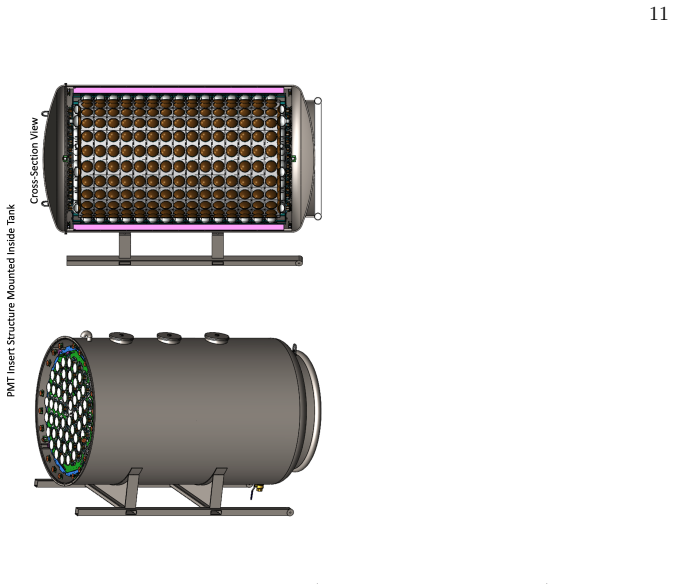
- A 20-ton demonstrator at a pulsed reactor would collect of order 200 IBD events per year, enough to test the yield-extraction chain and to produce the first pulsed-source antineutrino time spectrum.
- If sterile neutrino oscillations exist at the ~1 eV$^2$ scale, the resulting disappearance would become a systematic error floor for yield extraction from neutrino rates.
Reading between the lines
- The same decay-chain machinery could be turned around: a precisely measured neutrino time profile might benchmark and improve evaluated fission-product yield libraries, since the shape of the delay curve is set by the half-lives of the dominant decay parents.
- Extending the calculation to mixed uranium–plutonium fuels or to neutron spectra between fast and 14 MeV would likely produce interpolated $\bar\sigma$ values, allowing a two-parameter fit for fuel mix and neutron hardness rather than the single-isotope analysis presented.
- Relaxing the zero-duration pulse to a finite pulse width in eq. (4) would test whether the reactor pulse shape matters for the 0.1–100 s analysis window; at a few milliseconds this is likely a small correction.
- If a test ever occurred, combining the neutrino yield with radiochemical debris measurements would provide an independent cross-check, because the two methods read out different parts of the decay chain.
Signed reviews
Editorial analysis
A structured set of objections, weighed in public.
Referee Report
Summary. The manuscript proposes using a large (1000-ton) inverse-beta-decay (IBD) liquid-scintillator detector at 500 m standoff from a hypothetical underground U.S. nuclear test to detect antineutrinos from fission-product decay. It argues that the measured rate and energy spectrum could be inverted, via evaluated fission-product yields and a decay-chain calculation, into an estimate of explosive yield with roughly 4% rate accuracy and 5% energy resolution. The paper introduces an important distinction between pulsed and steady-state fission, finding that prompt-pulse antineutrino emission per fission is about a factor of two lower than steady-state emission, with time-dependent spectral shapes that differ. To de-risk the concept, the authors propose a 20-ton fiducial-mass Gd-loaded detector (νFLASH) at the TAMU TRIGA pulsed reactor, estimating 218 IBD events/year, together with parasitic sterile-neutrino and axion searches.
Significance. If the rate calculations hold, the paper identifies a genuinely new diagnostic channel for nuclear-test monitoring and provides a concrete, modest-cost validation path. The arithmetic of Section II is transparent and reproducible, the decay-chain treatment of Eq. (4) is clearly stated, and the comparison with Daya Bay steady-state cross sections is a useful external anchor. The proposed νFLASH measurement would produce falsifiable, time-resolved antineutrino data. No fitted parameters enter the claimed rates; the only efficiency input is an assumed 80% detection efficiency. However, the central yield-error claim is stronger than the supporting quantitative analysis, and one rate estimate in the demonstrator section appears to use fast-neutron yields for a thermal reactor.
major comments (3)
- [§II and Abstract] The abstract's claim of 'thousands of neutrino events per kTe' is inconsistent with the body's own arithmetic. Section II gives 0.41 events/kTe/ton at 100% efficiency at 500 m, then applies a 50% threshold factor and an 80% reconstruction efficiency to obtain 0.16 events/kTe/ton; for a 1000-ton detector this is 160 events per kTe, not thousands. A factor-of-six correction is needed somewhere, and this discrepancy directly affects the feasibility claim and the '4% statistical error' statement that follows from the event count.
- [§III.3, Eq. (2), and footnote 20] The extraction of yield from a measured IBD rate via Eq. (2) is controlled by the spectrally averaged cross section sigma_bar, which is computed from Eq. (4) under a zero-duration pulse and the assumption that all beta decays are allowed (footnote 20). This assumption is not benign for the IBD-weighted signal: Table III shows early-time average antineutrino energies near 2.8 MeV, where the IBD cross section is rising steeply, so sigma_bar is sensitive to high-energy transitions from short-lived fission products with known first-forbidden unique contributions. The only aggregate validation offered is the 239Pu steady-state value 4.65 x 10^-43 cm2 in Table II versus the Daya Bay result 4.27 ± 0.26 x 10^-43 cm2; the ~9% difference is larger than the quoted 4% error, and no validation is given for the prompt 0-0.1 s and 0.1-1 s windows. Since the fast and 14 MeV spectra are nearly identical in shape (Section III.1), the measured spectral shape cannot independently resolve this normalization uncertainty. The paper should either quantify this systematic, for example by repeating the calculation with first-forbidden shape factors and with alternative yield evaluations, or explicitly state that the 4% claim applies only to the measured IBD rate and not to the inferred yield.
- [§IV.2 and Table II] The TAMU TRIGA is a thermal reactor, and the text says the rate is computed for 'a prompt fissioning of 235U from thermal neutrons'; however, the value 5.32 x 10^-43 cm2 is taken from Table II's 235U row, which is explicitly labeled for fast-neutron-induced fission. Thermal-neutron independent yields and antineutrino spectra differ from fast-neutron ones, so the 218 events/year estimate and the resulting 4% demonstration projection are not justified as stated. The calculation should be redone with thermal 235U yields or supported by an explicit argument that the difference is negligible over the 0.1-100 s window.
minor comments (5)
- [Abstract and §IV.1] The abstract describes the TAMU TRIGA as a '1GW-10 millisecond pulsed facility', but Section IV.1 quotes a 250 MW peak power and a pulse width up to 40 ms; please reconcile these specifications.
- [§II] The phrase '50% cross section efficiency above this energy' is imprecise: the IBD threshold does not reduce the cross-section efficiency above threshold; rather, roughly half of the emitted antineutrino spectrum lies below threshold. Please rephrase to avoid confusion.
- [§II and reference [12]] The flux-averaged cross section of 0.5 x 10^-42 cm2 is attributed to an internal 'Simulation estimate'; a public reference or a statement of the inputs used would improve reproducibility.
- [§IV.2] The sentence 'A three year run will provide a 4% statistical error on the measured pulsed power yield' conflates a statistical error on the IBD rate with the yield-extraction error; the latter includes the model systematics discussed in Section III.3 and is not quantified here.
- [Throughout] Minor typographical and formatting issues include 'fiducal' for 'fiducial' (§IV.4), 'abreviated' for 'abbreviated' (§III), and the superscript rendering '10 3s' for 10^3 s (§II and §III.1).
Circularity Check
No significant circularity: event rates and spectra are forward-calculated from evaluated nuclear data, benchmarked against Daya Bay rather than fitted to it; the only self-reference (ref. [12]) is a minor back-of-envelope input superseded by the paper's own Table II calculation.
full rationale
The central derivation is self-contained: Eq. (2) computes IBD event counts from the fission-product decay-chain antineutrino spectrum built in Eqs. (4)-(7), using independent fission yields and half-lives/branching ratios from ENDF/RIPL-3, with no parameters fitted to the claimed event rates or to the final yield diagnostic. The Daya Bay steady-state comparison in Sec. III is an external benchmark: the paper's 239Pu steady-state value (4.65e-43 cm2) is compared with Daya Bay's 4.27 +/- 0.26e-43 cm2, and the resulting ~9% offset is a model-data discrepancy, not a fitted-input-as-prediction. The quoted 4% rate and 5% energy uncertainties follow from Poisson statistics for thousands of events and from the Geant4/CCM-based detector simulation, not from the yield model being tested. The only self-reference is ref. [12], a LANL simulation estimate used for the initial sigma ~ 0.5e-42 cm2 back-of-envelope in Sec. II.1; the same quantity is independently recomputed from evaluated databases in Table II (sigma_bar ~ 4.2-6.8e-43 cm2), so the conclusions do not reduce to that citation. Footnote 20's assumption that all beta decays are allowed is a stated limitation that creates model uncertainty in yield extraction, but it is not definitional circularity: no output is identical to an input by construction. No uniqueness theorem or ansatz is imported from prior author work, and no fitted parameter is renamed as a prediction. The skeptic's concern about unquantified systematics in converting rate to yield is a correctness/validation issue, not a circularity issue.
Assumptions & free parameters
free parameters (1)
- IBD detection efficiency =
0.8
assumptions (4)
- domain assumption Evaluated independent fission product yields (ENDF/B-VII.1) and decay data (RIPL-3) correctly describe a fast-neutron fission pulse.
- domain assumption All fissions in the pulse occur at t=0 with yields equal to independent yields (prompt fission assumption).
- ad hoc to paper All beta decays of fission products are treated as allowed decays.
- domain assumption Fission is induced only by fast and 14 MeV neutrons for plutonium, with weapon neutron flux represented by these two energies.
Cite this review
Pith. "Pith review of Novel Application of Neutrinos to Evaluate U.S. Nuclear Weapons Performance." pith.science (2026). https://pith.science/paper/HGGE5COL
@misc{pith2026241111804,
  author       = {Pith},
  title        = {Pith review of: Novel Application of Neutrinos to Evaluate U.S. Nuclear Weapons Performance},
  year         = {2026},
  howpublished = {\url{https://pith.science/paper/HGGE5COL}},
  note         = {Machine review of arXiv:2411.11804}
}
read the original abstract
There is a growing realization that neutrinos can be used as a diagnostic tool to better understand the inner workings of a nuclear weapon. Robust estimates demonstrate that an Inverse Beta Decay (IBD) neutrino scintillation detector built at the Nevada Test Site of 1000-ton active target mass at a standoff distance of 500 m would detect thousands of neutrino events per kTe of nuclear yield. This would provide less than 4% statistical error on measured neutrino rate and 5% error on neutrino energy. Extrapolating this to an error on the test device explosive yield requires knowledge from evaluated nuclear databases, non-equilibrium fission rates, and assumptions on internal neutron fluxes. Initial calculations demonstrate that prompt neutrino rates from a short pulse of Pu-239 fission is about a factor of two less than that from a steady state assumption. As well, there are significant energy spectral differences as a function of time after the pulse that needs to be considered. In the absence of nuclear weapons testing, many of the technical and theoretical challenges of a full nuclear test could be mitigated with a low cost smaller scale 20 ton fiducial mass IBD demonstration detector placed near a TRIGA pulsed reactor. The short duty cycle and repeatability of pulses would provide critical real environment testing and the measured neutrino rate as a function of time data would provide unique constraints on fission databases and equilibrium assumptions.
Figures


Figures from the paper (5 more)




Forward citations
Cited by 1 Pith paper
-
Enhancing Angular Sensitivity of Segmented Antineutrino Detectors for Reactor Monitoring
A Frobenius-norm template-matching algorithm estimates antineutrino direction from neutron-capture patterns in segmented detectors, with an optimal segment size near the mean neutron track length (~70 mm) at low counts.
Reference graph
Works this paper leans on
-
[12]
F. Reines and C. L. Cowan. A proposed experiment to detect the free neutrino. Physical Review, 90:492, 5 1953
work page 1953
-
[1]
to test experimental issues operating an IBD detector at a pulsed fission source, 2) to measure, for the first time, the antineutrino time and energy distributions from a pulsed source, and 3) to evaluate yield systematic errors from a pulsed non-equilibrium fission source using measured neutrino rates. This will be followed by discussing possible fundame...
-
[2]
S.S.” (abbreviating “steady state
Estimating the measurable antineutrino signal We can estimate the number of antineutrino events that a typical nuclear fission explosion would generate per kiloton of TNT explosive equivalent nuclear energy (kTe) released in an IBD detector of 1000-ton typical fiducial mass at a 500m typical standoff distance. First, the IBD event rate is given by Nν = ϕν...
-
[3]
S.S.” (abbreviating “steady state
Extracting fission yields from the emitted neutrinos The spectra of neutrinos emitted by the decay of fission products generated by fast and 14 MeV neutrons are nearly equal in shape, but can be differentiated by their total magnitudes. To see this, we assume that the fission event occurs in an extremely short duration at early time and then track the sub...
-
[4]
Prompt Fission Yield Assumption On the relatively slow timescale for neutrino emission from an nuclear explosion, the neutrinos are produced by the equivalent of a neutron pulse inducing the fission, and the shape, magnitude and timing of the spectrum is determined 6 by the direct population and subsequent β-decay of the fission fragments. The fission pro...
-
[5]
Systematic Errors in Nuclear Explosive Yield The neutrino measurement error depends on the number of antineutrino events detected (statistical), and systematic errors coming from detection threshold energy resolution and reconstruction efficiency (systematic). For statistics in the thousands of events and reasonable assumptions on systematic errors, we ca...
-
[6]
Pulsed Neutrino Sources One of the pulsed reactor sources that we have identified is TRIGA reactors, which can run in steady-state and pulsed mode [22]. The pulsed mode is accomplished by rapidly firing the control rod out of the core within a fraction of a second. The reactor quickly produces a super-criticality pulse from a low power baseline. As the te...
-
[7]
IBD and Background event rates at TAMU TRIGA The expected number of fissions per pulse at the TAMU TRIGA during normal operations is 3× 10¹⁷ fissions/pulse. Due to small neutrino rates per pulse, analysis will only take place between 0.1 and 100 seconds after a pulse to reduce prompt and steady state backgrounds (the DAQ window will still be active for at...
work page 2000
Show all 52 references
-
[8]
In the past all IBD neutrino detector experiments have been performed at steady state reactors
IBD Technical Tests Measurements at TAMU TRIGA The primary purpose of running an IBD detector at a pulsed reactor is to test and understand the characteristics and issues related to IBD neutrino detection from a short pulsed source. In the past all IBD neutrino detector experi...
-
[9]
Due to mass losses in the outer veto regions and lack of efficiency, a detector with 25-tons total mass is required
IBD Test Detector Design ( νFLASH) To achieve the estimated 654 IBD antineutrino event interactions in three years of pulsed running at the TAMU TRIGA reactor requires at least a 20-ton fiducal mass (see calculations above). Due to mass losses in the outer veto regions and lac...
-
[10]
Detector Simulation Results Preliminary simulations of the νFLASH mineral oil detector have been completed to show the feasibility of this method. Initial simulations used the existing CCM geometry [31, 32] and Geant4 [33] framework to test the ability of such a detector to id...
-
[11]
This has the added benefit of attracting university collaborators and students to participated in the open science and help make the overall project a success
Additional Fundamental Science Drivers Parasitic to testing technical capabilities of an IBD detector at the TAMU TRIGA pulsed source for weapons physics, there are a number of basic science measurements that can be pursued in parallel. This has the added benefit of attracting...
2000
-
[13]
The reines-cowan experiments: Detecting the poltergeist
Los Alamos. The reines-cowan experiments: Detecting the poltergeist. Los Alamos Science, 25:3, 1997
1997
-
[14]
C. L. Cowan, F. Reines, F. B. Harrison, H. W. Kruse, and A. D. McGuire. Detection of the free neutrino: a confirmation. Science, 124:103–4, 7 1956
1956
-
[15]
P. A. Zyla et al. Review of Particle Physics. PTEP, 2020(8):083C01, 2020
2020
-
[16]
The singing neutrino nobel laureate who nearly bombed nevada
Alison Abbott. The singing neutrino nobel laureate who nearly bombed nevada. Nature, 593:334–335, 5 2021
2021
-
[17]
Physics with Reactor Neutrinos
Xin Qian and Jen-Chieh Peng. Physics with Reactor Neutrinos. Rept. Prog. Phys., 82(3):036201, 2019
2019
-
[18]
Throughout this work we use the convention kTe for kilo-tons of explosive yield, while for neutrino detector mass we use ton
-
[19]
On the determination of anti-neutrino spectra from nuclear reactors
Patrick Huber. On the determination of anti-neutrino spectra from nuclear reactors. Phys. Rev. C , 84:024617, 2011. [Erratum: Phys.Rev.C 85, 029901 (2012)]
2012
-
[20]
Marti et al
Ll. Marti et al. Evaluation of gadolinium’s action on water Cherenkov detector systems with EGADS. Nucl. Instrum. Meth. A , 959:163549, 2020
2020
-
[21]
F. P. An et al. The Detector System of The Daya Bay Reactor Neutrino Experiment. Nucl. Instrum. Meth. A , 811:133–161, 2016
2016
-
[22]
de Kerret et al
H. de Kerret et al. The Double Chooz antineutrino detectors. Eur. Phys. J. C , 82(9):804, 2022
2022
-
[23]
Simulation estimate
Anna Hayes and Josh Martin (LANL T-2). Simulation estimate
-
[24]
Introductory nuclear physics
Kenneth S Krane. Introductory nuclear physics. John Wiley & Sons, 1991
1991
-
[25]
Miller, Jennifer A
Susan Kloek Hanson, Anthony Douglas Pollington, Christopher Russell Waidmann, William Scott Kinman, Allison Marie Wende, Jeffrey L. Miller, Jennifer A. Berger, Warren James Oldham, and Hugh D. Selby. Measurements of extinct fission products in nuclear bomb debris: Determinatio...
2016
-
[26]
Improved measurement of the reactor antineutrino flux and spectrum at daya bay
Feng Peng An, Akif Baha Balantekin, Henry Reyer Band, M Bishai, Simon Blyth, D Cao, Guo Fu Cao, Jun Cao, WR Cen, Yat Long Chan, et al. Improved measurement of the reactor antineutrino flux and spectrum at daya bay. Chinese Physics C, 41(1):013002, 2017
2017
-
[27]
Energy dependent calculations of fission product, prompt, and delayed neutron yields for neutron induced fission on 235u, 238u, and 239pu
Shin Okumura, Toshihiko Kawano, Amy Elizabeth Lovell, and Tadashi Yoshida. Energy dependent calculations of fission product, prompt, and delayed neutron yields for neutron induced fission on 235u, 238u, and 239pu. Journal of Nuclear Science and Technology, 59(1):96–109, 2022
2022
-
[28]
Ripl–reference input parameter library for calculation of nuclear reactions and nuclear data evaluations
Roberto Capote, Michel Herman, P Obloˇ zinsk` y, PG Young, St´ ephane Goriely, T Belgya, A V Ignatyuk, Arjan J Koning, St´ ephane Hilaire, Vladimir A Plujko, et al. Ripl–reference input parameter library for calculation of nuclear reactions and nuclear data evaluations. Nuclea...
2009
-
[29]
Chadwick, M
M.B. Chadwick, M. Herman, P. Obloˇ zinsk´ y, et al. ENDF/B-VII.1 nuclear data for science and technology: Cross sections, covariances, fission product yields and decay data. Nuclear Data Sheets , 112(12):2887 – 2996, 2011. Special Issue on ENDF/B-VII.1 Library
2011
-
[30]
Hayes and Petr Vogel
Anna C. Hayes and Petr Vogel. Reactor neutrino spectra. Annual Review of Nuclear and Particle Science , 66(1):219–244, 2016
2016
-
[31]
A more detailed analysis including shape factor corrections to forbidden decays will be presented in a future work
We have further assumed that all considered beta decays are allowed. A more detailed analysis including shape factor corrections to forbidden decays will be presented in a future work
-
[32]
F. P. An et al. Evolution of the Reactor Antineutrino Flux and Spectrum at Daya Bay. Phys. Rev. Lett., 118(25):251801, 2017
2017
-
[33]
TRIGA Reactor Characteristics, https://ansn.iaea.org/Common/documents/Training/TRIGA
-
[34]
Boeck, M
H. Boeck, M. Villa, and Vienna (Austria) Vienna University of Technology Atomic Institute of the Austrian Universities. Triga reactor characteristics, 1 2007
2007
-
[35]
Parma Jr
Edward J. Parma Jr. and Michael Warren Gregson. The Annular Core Research Reactor (ACRR) Description and Capabilities. https://www.osti.gov/servlets/purl/1761930 (2019)
2019
-
[36]
Communicated estimate based on pulsed running in the evenings
TAMU TRIGA Management. Communicated estimate based on pulsed running in the evenings
-
[37]
A. A. Aguilar-Arevalo et al. First dark matter search results from Coherent CAPTAIN-Mills. Phys. Rev. D, 106(1):012001, 2022
2022
-
[38]
R¨ uhm, U
W. R¨ uhm, U. Ackermann, C. Pioch, and V. Mares. Spectral neutron flux oscillations of cosmic radiation on the earth’s surface. Journal of Geophysical Research: Space Physics , 117(A8), 2012
2012
-
[39]
Study on the large area mcp-pmt glass radioactivity reduction
Xuantong Zhang, Jie Zhao, Shulin Liu, Shunli Niu, Xiaoming Han, Liangjian Wen, Jincheng He, and Tao Hu. Study on the large area mcp-pmt glass radioactivity reduction. Nuclear Instruments and Methods in Physics Research Section A: Accelerators, Spectrometers, Detectors and Asso...
2018
-
[40]
Eljen Technology (EJ-335), https://eljentechnology.com/products/liquid-scintillators/ej-331-ej-335
-
[41]
A. A. Aguilar-Arevalo et al. First Leptophobic Dark Matter Search from the Coherent–CAPTAIN-Mills Liquid Argon Detector. Phys. Rev. Lett. , 129(2):021801, 2022
2022
-
[42]
A. A. Aguilar-Arevalo et al. Prospects for detecting axionlike particles at the Coherent CAPTAIN-Mills experiment. Phys. Rev. D, 107(9):095036, 2023
2023
-
[43]
A search for axion-like particles at the coherent captain mills experiment (https://doi.org/10.7916/x9x1-ka48)
Dunton, Edward C. A search for axion-like particles at the coherent captain mills experiment (https://doi.org/10.7916/x9x1-ka48). 2022
2022 doi
-
[44]
NIM A 506 (2003), pg 250
Geant4 Physics Simulation Code. NIM A 506 (2003), pg 250. 15
2003
-
[45]
Measurements of neutron thermalization time constant of light water by pulsed neutron method
Michihira FUJINO and Kenji SUMITA and. Measurements of neutron thermalization time constant of light water by pulsed neutron method. Journal of Nuclear Science and Technology , 7(6):277–284, 1970
1970
-
[46]
Bertrand Matthieu Hamel Jonathan Dumazert, Romain Coulon
Quentin Lecomte Guillaume H.V. Bertrand Matthieu Hamel Jonathan Dumazert, Romain Coulon. Gadolinium for neutron detection in current nuclear instrumentation research: A review. Nuclear Instruments and Methods in Physics Research Section A: Accelerators, Spectrometers, Detector...
2018
-
[47]
NEOS Data and the Origin of the 5 MeV Bump in the Reactor Antineutrino Spectrum
Patrick Huber. NEOS Data and the Origin of the 5 MeV Bump in the Reactor Antineutrino Spectrum. Phys. Rev. Lett. , 118(4):042502, 2017
2017
-
[48]
Neutrino Oscillation Studies with Reactors
Petr Vogel, Liangjian Wen, and Chao Zhang. Neutrino Oscillation Studies with Reactors. Nature Commun., 6:6935, 2015
2015
-
[49]
A. P. Serebrov et al. Search for sterile neutrinos with the Neutrino-4 experiment and measurement results. Phys. Rev. D , 104(3):032003, 2021
2021
-
[50]
V. V. Barinov et al. Search for electron-neutrino transitions to sterile states in the BEST experiment. Phys. Rev. C , 105(6):065502, 2022
2022
-
[51]
Prompt fission γ-ray characteristics from neutron-induced fission on 239Pu and the time-dependence of prompt- γray emission
Ang´ elique Gatera, Alf G¨ o¨ ok, Franz-Josef Hambsch, Andr´ e Moens, Andreas Oberstedt, Stephan Oberstedt, Goedele Sibbens, David Vanleeuw, and Marzio Vidali. Prompt fission γ-ray characteristics from neutron-induced fission on 239Pu and the time-dependence of prompt- γray em...
2018
-
[52]
Dent, Bhaskar Dutta, Doojin Kim, Shu Liao, Rupak Mahapatra, Kuver Sinha, and Adrian Thompson
James B. Dent, Bhaskar Dutta, Doojin Kim, Shu Liao, Rupak Mahapatra, Kuver Sinha, and Adrian Thompson. New Directions for Axion Searches via Scattering at Reactor Neutrino Experiments. Phys. Rev. Lett. , 124(21):211804, 2020
2020
Reviewed August 12, 2026 · model on record in the stance chip above.
Discussion (0). Continue with ORCID to comment.