REVIEW 4 major objections 5 minor 1 cited by
LightFFDNets: Lightweight Convolutional Neural Networks for Rapid Facial Forgery Detection
T0 review · 4 major / 5 minor · reviewed 2026-08-12 · deepseek-v4-flash
Pith's one-line read Two tiny CNNs match deep networks at fake-face detection.
desk verdict A modest, honest benchmark; the speed claim is under-supported and the accuracy claim only holds on the small dataset, but with heavy revision it could pass at a low-tier venue. read the letter →
The pith
A machine-rendered reading of the paper's core claim, the machinery that carries it, and where it could break.
The reading
What carries the argument
The load-bearing mechanism is the layer-count definition of lightness: the paper counts only convolutional and fully connected layers, giving the proposed models 3 and 6 layers, versus 8 layers for AlexNet and up to roughly 100 for ResNet-101. Combined with training for at most 10 epochs, this yields the reported training-time reductions of roughly 2x to 17x. The individual components are standard CNN building blocks; the distinctive move is the deliberate minimalism of the stack rather than any new operation.
What would settle it
Compute and publish the trainable parameter count, FLOPs, and per-image inference time for LightFFDNet v1/v2 and the eight pretrained models on identical hardware; if the small models are not dramatically smaller by these standard measures, or if their training-time advantage disappears in a non-MATLAB framework, the central efficiency claim would be refuted.
Extended reading notes
Core claim
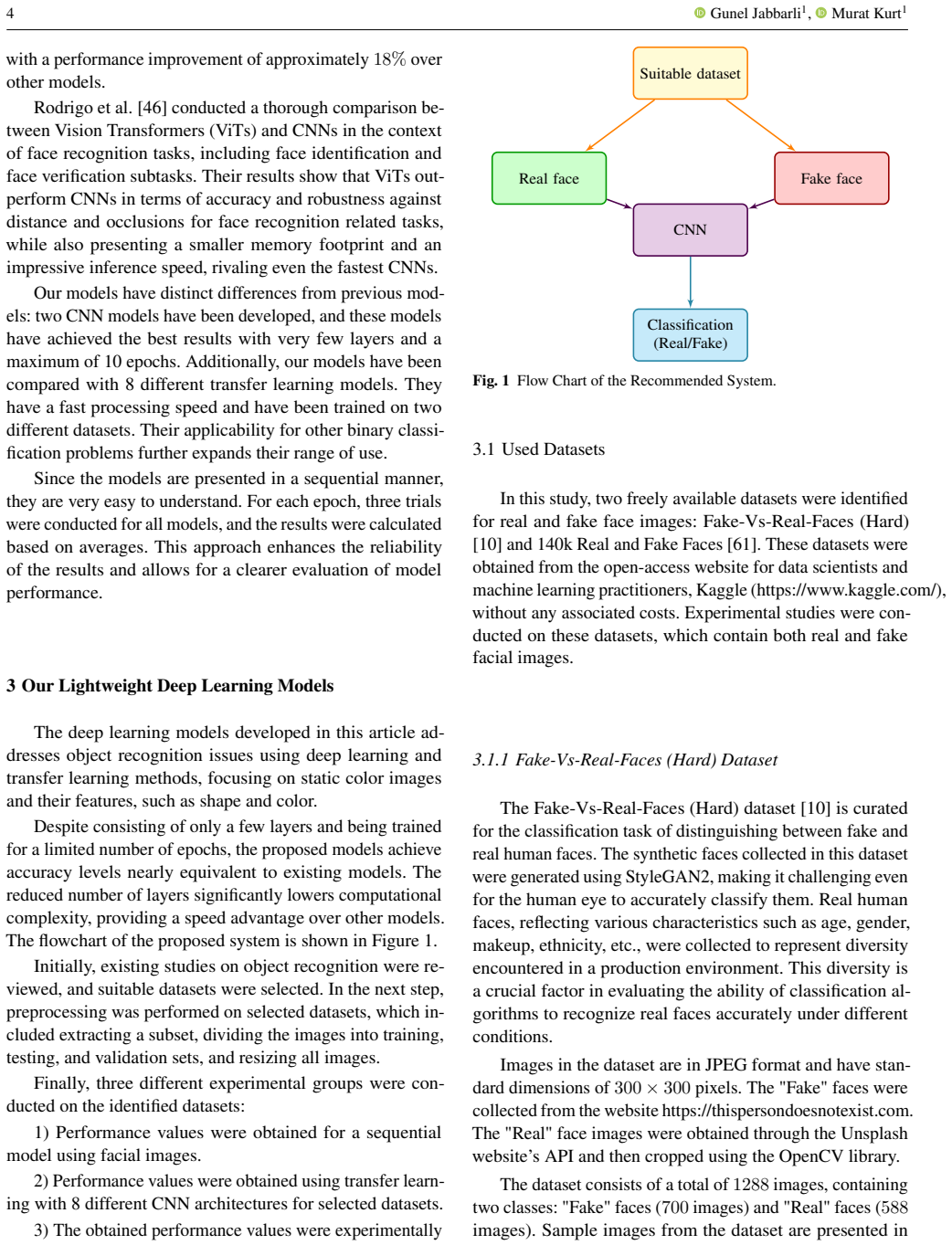
The paper's central claim is that facial forgery detection can be handled by a tiny sequential CNN without giving up accuracy. LightFFDNet v1, made of two convolutional layers and one fully connected layer, and LightFFDNet v2, made of five convolutional layers and one fully connected layer, both use 3x3 filters, batch normalization, ReLU activation, 2x2 max pooling, and a softmax output. Trained with Adam, a learning rate of 0.0001, and a batch size of 16 for 3, 5, or 10 epochs, they achieve near-perfect results on the Hard dataset: 99.74 percent and 99.87 percent average test accuracy, with F1, precision, and recall all at 1.0, while VGG-19 reaches 100 percent test accuracy and ResNet-50, DarkNet-53, and AlexNet trail slightly or match them. On the 140k dataset they reach 69.90 percent and 71.19 percent test accuracy, outperforming VGG-16, VGG-19, and AlexNet but falling behind ResNet-50, ResNet-101, MobileNet-V2, and DarkNet-53. The paper interprets these results as evidence that large pretrained architectures are unnecessary for two-class face forgery detection, and that the shallow models' speed advantage makes them a practical choice.
Load-bearing premise
The central 'lightweight and fast' claim rests on wall-clock training time measured in one MATLAB environment on one laptop, with model size judged only by counting convolutional and fully connected layers; if another implementation or hardware shows the small models are not actually cheaper, the paper's main advantage collapses.
Editorial extensions
If this is right
- On the Hard dataset, face forgery detection does not require deep networks: a 3-layer CNN reaches 99.74 percent test accuracy and a 6-layer CNN reaches 99.87 percent.
- Training time drops to tens of seconds on a laptop GPU, with reported speedups of 2x to 17x over the eight pretrained models.
- The small models achieve perfect F1, precision, and recall on the Hard test set, so the accuracy advantage is not limited to a single metric.
- The same architecture transfers to a second binary face dataset, where it is faster than all compared models, though less accurate than the strongest deep models.
- Because the architecture has no face-specific components, the authors claim it can be applied to other two-class object recognition problems.
Reading between the lines
- For the speed claim to hold as a statement about model efficiency, parameter counts and FLOPs should be reported; without them, wall-clock time on one laptop conflates model size with implementation and hardware details.
- The Hard dataset contains only 1,288 StyleGAN2-generated fake images, so the near-perfect results may reflect dataset simplicity; a stronger test would evaluate the same models on harder or more diverse forgery benchmarks.
- A direct measurement of per-image inference latency, not just training time, would clarify whether the speed advantage persists at deployment time, especially on CPU-only devices.
- The shallow architecture is a sensible baseline for other binary image tasks, but its accuracy edge over deep models is unlikely to survive on tasks with high intra-class variation, where deeper features become necessary.
Editorial analysis
A structured set of objections, weighed in public.
Referee Report
Summary. The paper proposes two small convolutional neural networks, LightFFDNet v1 (2 convolutional + 1 fully connected layer) and LightFFDNet v2 (5 + 1), for binary real-vs-fake face classification. The models are trained and evaluated on two public datasets: the Fake-Vs-Real-Faces (Hard) dataset and a 1288-image subset of the 140k Real and Fake Faces dataset. The authors compare their models against eight ImageNet-pretrained architectures (AlexNet, VGG-16, VGG-19, ResNet-50, ResNet-101, GoogleNet, MobileNet-V2, DarkNet-53) in terms of validation accuracy, test accuracy, F1/precision/recall, and wall-clock training time across 3, 5, and 10 epochs. The central claims are that the proposed models are lightweight, accurate, and computationally efficient, with v1 being the fastest model.
Significance. If the claims held, the paper would provide a simple, fast baseline for facial forgery detection that could be useful in resource-constrained settings. The experimental setup is transparent: publicly available datasets, a described hardware/software environment, and repeated trials for each configuration. The proposed models are genuinely small in layer count, and on the Hard dataset they reach test accuracies near 99.7-99.9%, competitive with the pretrained models. However, the evidence does not support the full strength of the claims: accuracy on the 140k subset is only about 70%, computational efficiency is measured only by wall-clock training time and layer count rather than parameter/FLOP counts, and the speed claims are internally inconsistent. The paper's contribution is better framed as a modest empirical comparison of small CNNs versus pretrained models on two Kaggle datasets, not as a demonstration of state-of-the-art accuracy or rigorously established computational efficiency.
major comments (4)
- [Section 5, Tables 5 and 7] The statement that LightFFDNet v1 is 'significantly faster than all other models' is contradicted by the paper's own tables. In Table 7 (140k dataset, 10 epochs), LightFFDNet v2 trains in 84 s while LightFFDNet v1 takes 94 s, so v1 is not the fastest model on that dataset. In Table 5 (Hard dataset, 10 epochs), AlexNet takes 78 s versus 66 s for v1, a factor of only 1.18, which does not support 'leaving all other models significantly behind.' The speed claims should be restated per model and per dataset, and the internal inconsistency between Section 5 and Tables 5/7 should be resolved.
- [Section 4.2 and Table 4] Computational efficiency is assessed only by wall-clock training time on one laptop and by counting only convolutional and fully connected layers. This is not a valid measure of model complexity: layer count ignores the number of filters, input resolution, and multiply-accumulate operations, and wall-clock time conflates implementation details (e.g., MATLAB's pretrained-model machinery, GPU utilization, data-loading overhead) with model efficiency. The central 'lightweight and computationally efficient' claim requires reporting parameter counts and FLOPs/MACs for all models, and ideally inference time per image, before the claim can be evaluated.
- [Abstract, Table 8, Section 5] The abstract claims that the proposed models 'detect forgeries of facial imagery accurately,' but Table 8 shows test accuracies of only 69.90% (v1) and 71.19% (v2) on the 140k dataset, while Section 5 concedes that 'all models, especially the sequential models, did not perform well' on that dataset. The accuracy claim must be qualified by dataset and by the fact that on the 140k subset the proposed models are substantially below DarkNet-53 (92.12%) and ResNet-50 (86.05%).
- [Section 4.4] The paper states that experiments were repeated three times and that 'the average of these trials was taken,' but later states that confusion matrices were 'calculated based on the trial that yielded the best results among three attempts over 10 epochs.' Additionally, the headline numbers in Tables 5-8 appear to be selected from a scan over 3, 5, and 10 epochs with no variance or confidence intervals reported. Because the number of layers was also tuned on the same validation sets, the reported best results are optimistic. Please report the mean and standard deviation over repetitions for each epoch count, and clarify whether the reported values are averages or best-of-three.
minor comments (5)
- [Table 9] The F1 entry for DarkNet-53 is '0.99640', which has an extra trailing zero; the precision entry in Table 10 for DarkNet-53 is '0.99457', which appears to be a typo (likely 0.9457 or 0.9946).
- [Section 4.4] The sentence 'it fell short of only the VGG-19 architecture by a difference of 0.26%' is misleading because Table 6 shows that ResNet-50 and AlexNet also achieve 99.74% test accuracy, so v1 is tied with them rather than being uniquely second to VGG-19.
- [References] Reference [36] is cited for VGG-16 and is a fruit-fly classification paper, not the original VGG architecture paper; VGG-16 should cite Simonyan and Zisserman (which appears as reference [48] for VGG-19).
- [Section 5] The final paragraph on future work mentions applying the models to BRDFs, BSDFs, and BSSRDFs in computer graphics; this is unrelated to facial forgery detection and should be removed or moved to a separate context, as it currently reads as boilerplate.
- [Throughout] There are several grammatical and typographical errors, such as 'It's shown' in the abstract and 'addresses' for 'address' in the first sentence of Section 3; a careful language edit is needed.
Circularity Check
Mild selection-circularity: model depth is chosen on the same validation set later quoted as 'best' accuracy; held-out test results and external baselines keep the central claim partly independent.
-
fitted input called prediction
[Section 3.2 (model design); reported as 'best' accuracy in Section 4.4 and Tables 5–8.]
"It should be noted that the number of layers in the models was decided based on the results of the application, by trying out 2, 3, 4, 5, and 6 layers to achieve the best results."
The depth of the proposed CNNs is a hyperparameter selected by maximizing validation accuracy, and the same validation accuracy is then quoted as evidence that the models 'achieve the best result.' The reported validation numbers are the criterion used to choose the architecture, not an independent estimate of its performance. This is a mild selection-circularity: the model is fit to the validation split and then evaluated on that same split. The held-out test accuracies in Tables 6 and 8 remain independent, so the circularity is partial rather than a full derivation-equivalence.
full rationale
The paper is an empirical study with no closed-form derivation, so the equation-level circularity patterns (self-definitional equations, imported uniqueness theorems, ansatz-via-citation) do not apply. The only mild circular pattern is empirical model selection: the number of layers and optimizer hyperparameters were chosen on the validation split, and the same validation accuracy is later cited as the headline 'best result.' This makes the validation numbers a selected optimum rather than an independent estimate, a mild selection-circularity. However, the paper also reports test-set accuracy on held-out splits, which is not determined by the architecture-selection step, and the comparison against eight pretrained networks is an external benchmark. There is no load-bearing self-citation: the authors' prior BRDF/BSDF references appear only in future-work and related-material contexts, not as support for the forgery-detection claims. The computational-efficiency claim rests on wall-clock time and layer counts rather than FLOPs or parameter counts; that is an evidence weakness, not a circular equivalence, so it does not raise the score further. The central claim therefore retains independent empirical content, and the score of 3 reflects only the validation-set selection issue.
Assumptions & free parameters
free parameters (8)
- Number of layers =
3 and 6
- Number of filters =
32
- Learning rate =
0.0001
- Mini-batch size =
16
- Dropout =
0.2 initial, not in final Table 3
- Epochs =
3, 5, 10
- Subset of 140k dataset =
1288 images
- Data split =
70/10/20
assumptions (4)
- domain assumption The datasets contain correctly labeled real and fake faces.
- domain assumption The selected 1288-image slice is representative of the full 140k Real and Fake Faces dataset.
- domain assumption ImageNet-pretrained weights and MATLAB's implementations provide fair baselines for the comparison.
- ad hoc to paper Wall-clock training time on a single laptop measures computational efficiency.
Cite this review
Pith. "Pith review of LightFFDNets: Lightweight Convolutional Neural Networks for Rapid Facial Forgery Detection." pith.science (2026). https://pith.science/paper/3LTLIYSV
@misc{pith2026241111826,
  author       = {Pith},
  title        = {Pith review of: LightFFDNets: Lightweight Convolutional Neural Networks for Rapid Facial Forgery Detection},
  year         = {2026},
  howpublished = {\url{https://pith.science/paper/3LTLIYSV}},
  note         = {Machine review of arXiv:2411.11826}
}
read the original abstract
Accurate and fast recognition of forgeries is an issue of great importance in the fields of artificial intelligence, image processing and object detection. Recognition of forgeries of facial imagery is the process of classifying and defining the faces in it by analyzing real-world facial images. This process is usually accomplished by extracting features from an image, using classifier algorithms, and correctly interpreting the results. Recognizing forgeries of facial imagery correctly can encounter many different challenges. For example, factors such as changing lighting conditions, viewing faces from different angles can affect recognition performance, and background complexity and perspective changes in facial images can make accurate recognition difficult. Despite these difficulties, significant progress has been made in the field of forgery detection. Deep learning algorithms, especially Convolutional Neural Networks (CNNs), have significantly improved forgery detection performance. This study focuses on image processing-based forgery detection using Fake-Vs-Real-Faces (Hard) [10] and 140k Real and Fake Faces [61] data sets. Both data sets consist of two classes containing real and fake facial images. In our study, two lightweight deep learning models are proposed to conduct forgery detection using these images. Additionally, 8 different pretrained CNN architectures were tested on both data sets and the results were compared with newly developed lightweight CNN models. It's shown that the proposed lightweight deep learning models have minimum number of layers. It's also shown that the proposed lightweight deep learning models detect forgeries of facial imagery accurately, and computationally efficiently. Although the data set consists only of face images, the developed models can also be used in other two-class object recognition problems.
Figures
Forward citations
Cited by 1 Pith paper
-
Mul2MAR: A Multi-Marker Mobile Augmented Reality Application for Improved Visual Perception
Mul2MAR combines ARToolKit markers, OpenGL rendering, and red-cyan anaglyph glasses to show virtual objects in apparent 3D on a mobile device, but gives no quantitative validation beyond the author's prior work.
Reference graph
Works this paper leans on
-
[1]
Adjabi, I., Ouahabi, A., Benzaoui, A., Taleb-Ahmed, A.: Past, present, and future of face recognition: A review. Electronics 9(8), 1188 (2020). DOI 10.3390/electronics9081188. URL https: //doi.org/10.3390/electronics9081188
-
[2]
arXiv preprint arXiv:2402.02246 arXiv:2402.02246 (2024)
Akdo˘gan, A., Kurt, M.: Exttnet: A deep learning algorithm for extracting table texts from invoice images. arXiv preprint arXiv:2402.02246 arXiv:2402.02246 (2024). DOI 10.48550/arXiv. 2402.02246. URL https://doi.org/10.48550/arXiv. 2402.02246
-
[3]
arXiv preprint arXiv:2401.12853 arXiv:2401.12853 (2024)
Akleman, E., Kurt, M., Akleman, D., Bruins, G., Deng, S., Sub- ramanian, M.: Hyper-realist rendering: A theoretical framework. arXiv preprint arXiv:2401.12853 arXiv:2401.12853 (2024). DOI 10.48550/arXiv.2401.12853. URL https://doi.org/10. 48550/arXiv.2401.12853
-
[4]
Alrimy, T., Alloqmani, A., Alotaibi, A., Aljohani, N., Kammoun, S.: Facial expression recognition based on well-known convnet architectures (2022)
work page 2022
-
[5]
arXiv preprint arXiv:2401.17972 arXiv:2401.17972 (2024)
Azadvatan, Y ., Kurt, M.: Melnet: A real-time deep learning al- gorithm for object detection. arXiv preprint arXiv:2401.17972 arXiv:2401.17972 (2024). DOI 10.48550/arXiv.2401.17972. URL https://doi.org/10.48550/arXiv.2401.17972
-
[6]
Computer Graphics Forum 30(8), 2427–2439 (2011)
Bilgili, A., Öztürk, A., Kurt, M.: A general BRDF representation based on tensor decomposition. Computer Graphics Forum 30(8), 2427–2439 (2011)
work page 2011
-
[8]
Wiley Interdisciplinary Reviews: Data Mining and Knowledge Discovery 13(2), 1484 (2023)
Bischl, B., Binder, M., Lang, M., Pielok, T., Richter, J., Coors, S., Lindauer, M.: Hyperparameter optimization: Foundations, algo- rithms, best practices, and open challenges. Wiley Interdisciplinary Reviews: Data Mining and Knowledge Discovery 13(2), 1484 (2023)
work page 2023
-
[9]
In: Neural Networks and Applications (NEUREL), 13th Symposium, pp
Bobi´c, V ., Tadi´c, P., Kvašˇcev, G.: Hand gesture recognition us- ing neural network based techniques. In: Neural Networks and Applications (NEUREL), 13th Symposium, pp. 1–4. IEEE (2016)
work page 2016
Show all 68 references
-
[10]
https: //www.kaggle.com/datasets/hamzaboulahia/ hardfakevsrealfaces (2023)
Boulahia, H.: Hard fake vs real faces dataset. https: //www.kaggle.com/datasets/hamzaboulahia/ hardfakevsrealfaces (2023). Accessed: 2024-10-23
2023
-
[11]
In: Proceedings of the 28th Spring Conference on Computer Graphics, SCCG ’12, pp
Ergun, S., Kurt, M., Öztürk, A.: Real-time kd-tree based importance sampling of environment maps. In: Proceedings of the 28th Spring Conference on Computer Graphics, SCCG ’12, pp. 77–84. ACM, New York, NY , USA (2012). DOI 10.1145/2448531.2448541. URL http://doi.acm.org/10.114...
2012
-
[12]
arXiv preprint arXiv:1704.06857 (2017)
Garcia-Garcia, A., Orts-Escolano, S., Oprea, S., Villena-Martinez, V ., Garcia-Rodriguez, J.: A review on deep learning techniques applied to semantic segmentation. arXiv preprint arXiv:1704.06857 (2017). URL https://arxiv.org/abs/1704.06857
2017 arXiv
-
[13]
In: Proceedings of the IEEE 31st Signal Processing and Communications Applications Conference, SIU ’23, pp
Gök, G., Küçük, S., Kurt, M., Tarı, E.: A u-net based segmentation and classification approach over orthophoto maps of archaeological sites. In: Proceedings of the IEEE 31st Signal Processing and Communications Applications Conference, SIU ’23, pp. 1–4. IEEE, Istanbul, Turkey (2023)
2023
-
[14]
Neurocomputing 187, 27–48 (2016)
Guo, Y ., Liu, Y ., Oerlemans, A., Lao, S., Wu, S., Lew, M.S.: Deep learning for visual understanding: A review. Neurocomputing 187, 27–48 (2016)
2016
-
[15]
International Journal of Information Technology15(1), 5–15 (2023)
Hamid, Y ., Elyassami, S., Gulzar, Y ., Balasaraswathi, V .R., Habuza, T., Wani, S.: An improvised cnn model for fake image detection. International Journal of Information Technology15(1), 5–15 (2023)
2023
-
[16]
In: Proceedings of the IEEE Conference on Computer Vision and Pattern Recognition (CVPR), pp
He, K., Zhang, X., Ren, S., Sun, J.: Deep residual learning for image recognition. In: Proceedings of the IEEE Conference on Computer Vision and Pattern Recognition (CVPR), pp. 770–778 (2016) 12 Gunel Jabbarli1, Murat Kurt1
2016
-
[17]
arXiv preprint arXiv:1704.04861 (2017)
Howard, A.G., Zhu, M., Chen, B., Kalenichenko, D., Wang, W., Weyand, T., Andreetto, M., Adam, H.: Mobilenets: Efficient con- volutional neural networks for mobile vision applications. arXiv preprint arXiv:1704.04861 (2017)
2017 arXiv
-
[18]
ACM Computing Surveys 55(5), 1–37 (2022)
Kammoun, A., Slama, R., Tabia, H., Ouni, T., Abid, M.: Gener- ative adversarial networks for face generation: A survey. ACM Computing Surveys 55(5), 1–37 (2022)
2022
-
[19]
In: Proceedings of the IEEE/CVF Conference on Computer Vision and Pattern Recogni- tion, pp
Karras, T., Laine, S., Aila, T.: A style-based generator architec- ture for generative adversarial networks. In: Proceedings of the IEEE/CVF Conference on Computer Vision and Pattern Recogni- tion, pp. 4401–4410 (2019)
2019
-
[20]
In: Advances in Neural Information Processing Systems, vol
Krizhevsky, A., Sutskever, I., Hinton, G.E.: Imagenet classification with deep convolutional neural networks. In: Advances in Neural Information Processing Systems, vol. 25 (2012)
2012
-
[21]
Mas- ter’s thesis, International Computer Institute, Ege University, Izmir, Turkey (2007)
Kurt, M.: A new illumination model in computer graphics. Mas- ter’s thesis, International Computer Institute, Ege University, Izmir, Turkey (2007). 140 pages
2007
-
[22]
Kurt, M.: An efficient model for subsurface scattering in translu- cent materials. Ph.D. thesis, International Computer Institute, Ege University, Izmir, Turkey (2014). 122 pages
2014
-
[23]
The Workshop on Light Redirection and Scatter: Measurement, Modeling, Simulation (2014)
Kurt, M.: Grand challenges in bsdf measurement and modeling. The Workshop on Light Redirection and Scatter: Measurement, Modeling, Simulation (2014). (Invited Talk)
2014
-
[24]
Kurt, M.: Experimental Analysis of BSDF Models. In: R. Klein, H. Rushmeier (eds.) Proceedings of the 5th Eurographics Workshop on Material Appearance Modeling: Issues and Acquisition, MAM ’17, pp. 35–39. The Eurographics Association, Helsinki, Finland (2017). DOI 10.2312/mam.2...
2017 doi
-
[25]
Journal of Science and Engineering 20(58), 87–102 (2018)
Kurt, M.: A survey of bsdf measurements and representations. Journal of Science and Engineering 20(58), 87–102 (2018)
2018
-
[26]
Journal of Science and Engineering 21(63), 859–867 (2019)
Kurt, M.: Real-time shading with phong brdf model. Journal of Science and Engineering 21(63), 859–867 (2019)
2019
-
[27]
Kurt, M.: A Genetic Algorithm Based Heterogeneous Subsur- face Scattering Representation. In: R. Klein, H. Rushmeier (eds.) Proceedings of the 8th Eurographics Workshop on Material Ap- pearance Modeling: Issues and Acquisition, MAM ’20, pp. 13–
-
[28]
DOI 10.2312/mam.20201140
The Eurographics Association, London, UK (2020). DOI 10.2312/mam.20201140. URL https://diglib.eg.org/ handle/10.2312/mam20201140
2020 doi
-
[29]
The Visual Computer 37(2), 307–323 (2021)
Kurt, M.: Gensss: a genetic algorithm for measured subsurface scattering representation. The Visual Computer 37(2), 307–323 (2021). DOI 10.1007/s00371-020-01800-0. URL https:// doi.org/10.1007/s00371-020-01800-0
2021 doi
-
[30]
SIGGRAPH Computer Graphics 42(3), 1–18 (2008)
Kurt, M., Cinsdikici, M.G.: Representing brdfs using soms and mans. SIGGRAPH Computer Graphics 42(3), 1–18 (2008). DOI http://doi.acm.org/10.1145/1408626.1408630
2008
-
[31]
SIGGRAPH Computer Graphics 43(2), 1–7 (2009)
Kurt, M., Edwards, D.: A survey of brdf models for computer graphics. SIGGRAPH Computer Graphics 43(2), 1–7 (2009). DOI http://doi.acm.org/10.1145/1629216.1629222
2009
-
[32]
In: Proceedings of the 24th Eurographics Symposium on Rendering, Posters, EGSR ’13
Kurt, M., Öztürk, A.: A heterogeneous subsurface scattering repre- sentation based on compact and efficient matrix factorization. In: Proceedings of the 24th Eurographics Symposium on Rendering, Posters, EGSR ’13. Eurographics Association, Zaragoza, Spain (2013)
2013
-
[33]
Kurt, M., Öztürk, A., Peers, P.: A compact tucker-based fac- torization model for heterogeneous subsurface scattering. In: S. Czanner, W. Tang (eds.) Proceedings of the 11th Theory and Practice of Computer Graphics, TPCG ’13, pp. 85–92. Eu- rographics Association, Bath, United...
2013 doi
-
[34]
SIGGRAPH Computer Graphics 44(1), 1–15 (2010)
Kurt, M., Szirmay-Kalos, L., K ˇrivánek, J.: An anisotropic brdf model for fitting and monte carlo rendering. SIGGRAPH Computer Graphics 44(1), 1–15 (2010). DOI http://doi.acm.org/10.1145/ 1722991.1722996
2010
-
[35]
In: Proceedings of the ACM SIGGRAPH 2016, Posters, SIGGRAPH ’16, pp
Kurt, M., Ward, G., Bonneel, N.: A data-driven bsdf framework. In: Proceedings of the ACM SIGGRAPH 2016, Posters, SIGGRAPH ’16, pp. 31:1–31:2. ACM, New York, NY , USA (2016). DOI 10.1145/2945078.2945109. URL http://doi.acm.org/10. 1145/2945078.2945109
2016
-
[36]
IEEE Transactions on Neural Networks 8(1), 98–113 (1997)
Lawrence, S., Giles, C.L., Tsoi, A.C., Back, A.D.: Face recognition: A convolutional neural-network approach. IEEE Transactions on Neural Networks 8(1), 98–113 (1997)
1997
-
[37]
In: 2018 31st SIBGRAPI Conference on Graphics, Patterns and Images (SIBGRAPI), pp
Leonardo, M.M., Carvalho, T.J., Rezende, E., Zucchi, R., Faria, F.A.: Deep feature-based classifiers for fruit fly identification (diptera: Tephritidae). In: 2018 31st SIBGRAPI Conference on Graphics, Patterns and Images (SIBGRAPI), pp. 41–47. IEEE (2018)
2018
-
[38]
In: Workshop on PaA at European Conference on Computer Vision (ECCV)
Li, L.J., Su, H., Lim, Y ., Fei-Fei, L.: Objects as attributes for scene classification. In: Workshop on PaA at European Conference on Computer Vision (ECCV). Heraklion, Crete, Greece (2010)
2010
-
[39]
Journal of Science and Engineering 24(72), 737–746 (2022)
Mir, S., Yıldırım, B., Kurt, M.: An analysis of goniochromatic and sparkle effects on multi-layered materials. Journal of Science and Engineering 24(72), 737–746 (2022)
2022
-
[40]
arXiv preprint arXiv:2304.02982 (2023)
Nowroozi, E., Habibi, Y ., Conti, M.: Spritz-ps: Validation of syn- thetic face images using a large dataset of printed documents. arXiv preprint arXiv:2304.02982 (2023)
2023 arXiv
-
[41]
In: V .˙I¸ sler, H
Önel, S., Kurt, M., Öztürk, A.: An efficient plugin for representing heterogeneous translucent materials. In: V .˙I¸ sler, H. Gürçay, H.K. Süher, G. Çatak (eds.) Contemporary Topics in Computer Graphics and Games: Selected Papers from the Eurasia Graphics Conference Series, ch...
2019
-
[42]
Öztürk, A., Bilgili, A., Kurt, M.: Polynomial approximation of blinn-phong model. In: L.M. Lever, M. McDerby (eds.) Pro- ceedings of the 4th Theory and Practice of Computer Graphics, TPCG ’06, pp. 55–61. Eurographics Association, Middlesbrough, United Kingdom (2006). DOI 10.23...
2006 doi
-
[43]
Com- puter Graphics Forum 29(6), 1795–1806 (2010)
Öztürk, A., Kurt, M., Bilgili, A.: A copula-based brdf model. Com- puter Graphics Forum 29(6), 1795–1806 (2010)
2010
-
[44]
In: Proceedings of the 20th International Conference on Computer Graphics and Vision, pp
Öztürk, A., Kurt, M., Bilgili, A.: Modeling brdf by a probability dis- tribution. In: Proceedings of the 20th International Conference on Computer Graphics and Vision, pp. 57–63. St. Petersburg, Russia (2010)
2010
-
[45]
Computers & Graphics 32(2), 149–158 (2008)
Ozturk, A., Kurt, M., Bilgili, A., Gungor, C.: Linear approximation of bidirectional reflectance distribution functions. Computers & Graphics 32(2), 149–158 (2008)
2008
-
[46]
arXiv preprint arXiv:1804.02767 (2018)
Redmon, J., Farhadi, A.: Yolov3: An incremental improvement. arXiv preprint arXiv:1804.02767 (2018)
2018 arXiv
-
[47]
Scientific Reports 14 (2024)
Rodrigo, M., Cuevas, C., García, N.: Comprehensive comparison between vision transformers and convolutional neural networks for face recognition tasks. Scientific Reports 14 (2024). DOI 10.1038/s41598-024-72254-w
2024 doi
-
[48]
In: 2019 IEEE/CVF International Conference on Computer Vision (ICCV), pp
Rossler, A., Cozzolino, D., Verdoliva, L., Riess, C., Thies, J., Niessner, M.: Faceforensics++: Learning to detect manipulated facial images. In: 2019 IEEE/CVF International Conference on Computer Vision (ICCV), pp. 1–11. IEEE Computer So- ciety, Los Alamitos, CA, USA (2019). ...
2019
-
[49]
arXiv preprint arXiv:1409.1556 (2014)
Simonyan, K., Zisserman, A.: Very deep convolutional networks for large-scale image recognition. arXiv preprint arXiv:1409.1556 (2014)
2014 arXiv
-
[50]
Dicle Üniversitesi Mühendislik Fakültesi Mühendislik Dergisi11(1), 123– 133 (2020)
Söylemez, O.F., Ergen, B.: Farklı evri¸ simsel sinir a˘gı mimarilerinin yüz ˙Ifade analizi alanındaki ba¸ sarımlarının˙Incelenmesi. Dicle Üniversitesi Mühendislik Fakültesi Mühendislik Dergisi11(1), 123– 133 (2020)
2020
-
[51]
Frontiers in Robotics and AI 2, 36 (2016)
Srinivas, S., Sarvadevabhatla, R.K., Mopuri, K.R., Prabhu, N., Kruthiventi, S.S., Babu, R.V .: A taxonomy of deep convolutional neural nets for computer vision. Frontiers in Robotics and AI 2, 36 (2016)
2016
-
[52]
In: Proceedings of the 26th LightFFDNets: Lightweight Convolutional Neural Networks for Rapid Facial Forgery Detection 13 Spring Conference on Computer Graphics, SCCG ’10, pp
Szécsi, L., Szirmay-Kalos, L., Kurt, M., Csébfalvi, B.: Adaptive sampling for environment mapping. In: Proceedings of the 26th LightFFDNets: Lightweight Convolutional Neural Networks for Rapid Facial Forgery Detection 13 Spring Conference on Computer Graphics, SCCG ’10, pp. 69–
-
[53]
URL https://www
The MathWorks, I.: Matlab r2023a (2023). URL https://www. mathworks.com. Accessed: 2024-11-07
2023
-
[54]
In: Proceed- ings of The IEEE Conference on Computer Vision and Pattern Recognition, pp
Szegedy, C., Liu, W., Jia, Y ., Sermanet, P., Reed, S., Anguelov, D., Rabinovich, A.: Going deeper with convolutions. In: Proceed- ings of The IEEE Conference on Computer Vision and Pattern Recognition, pp. 1–9 (2015)
2015
-
[55]
In: Proceedings of the IEEE International Conference on Com- puter Vision Workshops, ICCVW ’17, pp
Tongbuasirilai, T., Unger, J., Kurt, M.: Efficient BRDF sam- pling using projected deviation vector parameterization. In: Proceedings of the IEEE International Conference on Com- puter Vision Workshops, ICCVW ’17, pp. 153–158. IEEE Com- puter Society, Venice, Italy (2017). DOI...
2017 doi
-
[56]
The Visual Computer36(4), 855– 872 (2020)
Tongbuasirilai, T., Unger, J., Kronander, J., Kurt, M.: Compact and intuitive data-driven brdf models. The Visual Computer36(4), 855– 872 (2020). DOI 10.1007/s00371-019-01664-z. URL https: //doi.org/10.1007/s00371-019-01664-z
2020 doi
- [57]
-
[58]
1109/ICCVW.2017.26
URL http://doi.ieeecomputersociety.org/10. 1109/ICCVW.2017.26
2017
-
[59]
In: Proceedings of the IEEE 22nd Signal Processing and Communications Applications Conference, SIU ’14, pp
Töral, O.A., Ergun, S., Kurt, M., Öztürk, A.: Mobile gpu-based importance sampling. In: Proceedings of the IEEE 22nd Signal Processing and Communications Applications Conference, SIU ’14, pp. 510–513. IEEE, Trabzon, Turkey (2014)
2014
-
[60]
Ward, G., Kurt, M., Bonneel, N.: Reducing anisotropic bsdf measurement to common practice. In: R. Klein, H. Rushmeier (eds.) Proceedings of the 2nd Eurographics Workshop on Mate- rial Appearance Modeling: Issues and Acquisition, MAM ’14, pp. 5–8. Eurographics Association, Lyon...
2014 doi
-
[61]
Wang, Y ., Wu, Y .: Scene classification with deep convolutional neural networks. Tech. rep., University of California (2014)
2014
-
[62]
Ward, G., Kurt, M., Bonneel, N.: A practical framework for shar- ing and rendering real-world bidirectional scattering distribution functions. Tech. Rep. LBNL-5954E, Lawrence Berkeley National Laboratory (2012)
2012
-
[63]
arXiv preprint arXiv:2401.15245 arXiv:2401.15245 (2024)
Yıldırım, B., Kurt, M.: Genplusss: A genetic algorithm based plugin for measured subsurface scattering representation. arXiv preprint arXiv:2401.15245 arXiv:2401.15245 (2024). DOI 10.48550/arXiv.2401.15245. URL https://doi.org/10. 48550/arXiv.2401.15245
-
[64]
https: //www.kaggle.com/datasets/xhlulu/ 140k-real-and-fake-faces (2023)
Xhlulu: 140k real and fake faces dataset. https: //www.kaggle.com/datasets/xhlulu/ 140k-real-and-fake-faces (2023). Accessed: 2024-10- 23
2023
-
[65]
The Visual Computer 40, 8205–8225 (2024)
Yadav, N., Singh, S.K., Dubey, S.R.: Isa-gan: inception-based self- attentive encoder–decoder network for face synthesis using delin- eated facial images. The Visual Computer 40, 8205–8225 (2024). DOI 10.1007/s00371-023-03233-x
2024 doi
-
[66]
El-Cezeri 9(4), 1282–1289 (2022)
¸ Safak, E., Bari¸ sçi, N.: Hafif evri¸ simsel sinir a˘gları kullanılarak sahte yüz görüntülerinin tespiti. El-Cezeri 9(4), 1282–1289 (2022)
2022
-
[67]
arXiv preprint arXiv:1412.6856 (2014)
Zhou, B., Khosla, A., Lapedriza, A., Oliva, A., Torralba, A.: Object detectors emerge in deep scene cnns. arXiv preprint arXiv:1412.6856 (2014). URL https://arxiv.org/abs/ 1412.6856
2014 arXiv
-
[68]
In: Proceedings of the IEEE (2023)
Zou, Z., Chen, K., Shi, Z., Guo, Y ., Ye, J.: Object detection in 20 years: A survey. In: Proceedings of the IEEE (2023)
2023
-
[76]
DOI http://doi.acm.org/ 10.1145/1925059.1925073
ACM, New York, NY , USA (2010). DOI http://doi.acm.org/ 10.1145/1925059.1925073. URL http://doi.acm.org/10. 1145/1925059.1925073
2010
Reviewed August 12, 2026 · model on record in the stance chip above.
Discussion (0). Continue with ORCID to comment.