REVIEW 2 major objections 6 minor 1 cited by
Cartesian atomic moment machine learning interatomic potentials
T0 review · 2 major / 6 minor · reviewed 2026-08-12 · deepseek-v4-flash
Pith's one-line read The paper introduces CAMP, a graph-neural-network interatomic potential built entirely from Cartesian tensors, and claims it matches or beats leading spherical-tensor models on accuracy, stability, and speed across four benchmark classes.
desk verdict A solid, well-tested Cartesian MLIP whose empirical performance is real, but whose completeness claim is unsupported and needs revision. read the letter →
The pith
A machine-rendered reading of the paper's core claim, the machinery that carries it, and where it could break.
The reading
What carries the argument
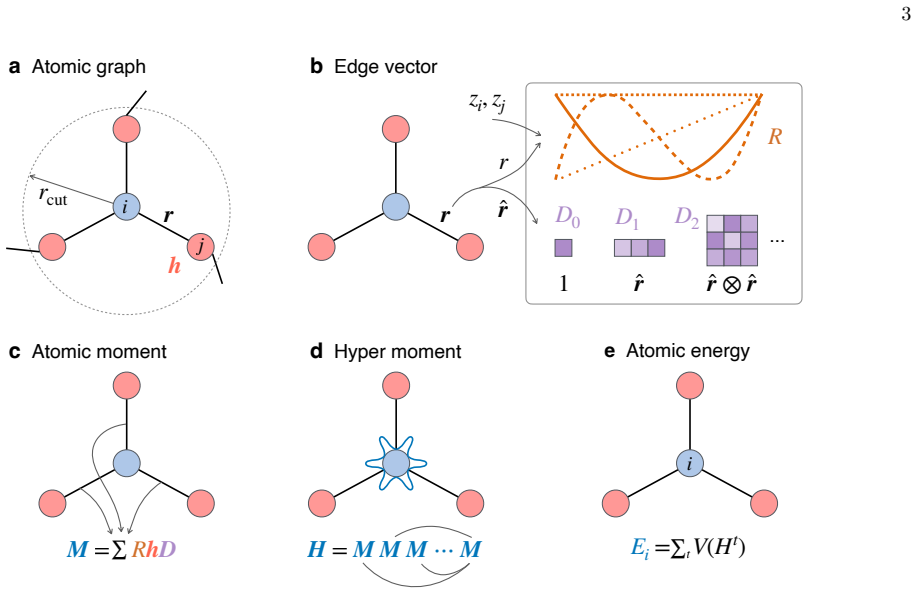
The load-bearing objects are the atomic moment tensor $M^i_{uv,p}=\sum_{j\in N_i} R_{uvv_1v_2} h^j_{uv_1}\odot_c D^{ij}_{v_2}$ and the hyper moment $H_{uv,p}=M_{uv_1}\odot_{c_1} M_{uv_2}\odot_{c_2}\cdots\odot_{c_{n-1}} M_{uv_n}$. Here $D_v=\hat r\otimes\cdots\otimes\hat r$ is a symmetric polyadic tensor built from the unit bond vector, $h$ is the atom feature, and $\odot_c$ contracts $c$ index pairs. A selection rule requires $c=v_1$ in atomic moments and, in hyper moments, that all lower-rank atomic moments are fully contracted against the highest-rank one; this routes information downward to scalars and cuts the number of tensor products. Chebyshev radial basis functions supply the distance dependence, and repeated message-passing layers refine the features. The construction cost scales as $O(3^{v_{\max}})$ per moment, versus $O(L^6)$ for Clebsch–Gordan products in spherical-tensor models, which is why CAMP is faster at the small ranks used here.
What would settle it
Train CAMP and an unrestricted Cartesian moment-tensor model, allowing arbitrary contractions among lower-rank moments, with the same $v_{\max}$, channels, and data on a system with strong many-body effects, and compare force errors. If the unrestricted model is substantially more accurate, or if CAMP's error stops decreasing as $v_{\max}$ goes from 3 to 4 on a broad benchmark, the restricted contraction rule has dropped information the paper's completeness argument requires.
Extended reading notes
Core claim
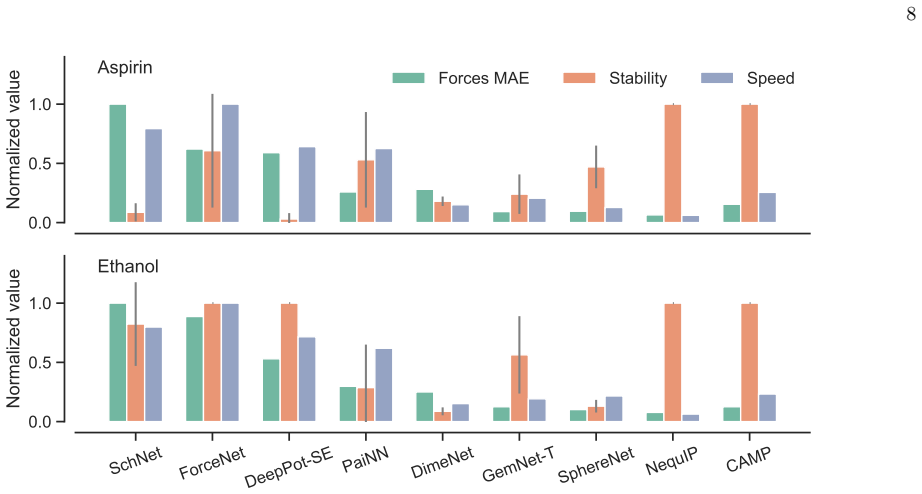
CAMP's central claim is that a complete, systematically improvable description of a local atomic environment can be built in Cartesian space, using symmetric moment tensors rather than spherical harmonics. Atomic moments are formed by summing over neighbors the radial-weighted contraction of the neighbor's feature tensor with a polyadic tensor of the unit bond vector; hyper moments then multiply these atomic moments together, with contraction rules that force information from higher-rank tensors down to scalars. The resulting features are updated through message-passing layers and mapped to atomic energies. Benchmarks show CAMP matches the accuracy of a leading spherical-tensor potential on the LiPS crystal, produces the lowest energy and force errors on the water test set among all compared models, is competitive on MD17, and reduces bilayer-graphene force errors to 6.3 meV/Å, accurately resolving AB versus AA stacking energetics that empirical carbon potentials miss.
Load-bearing premise
The paper assumes the restricted set of contractions it allows still describes the local environment completely enough for any target accuracy; that completeness is inherited from earlier moment-tensor theory for the unrestricted basis, not proved for CAMP's truncated rules.
Editorial extensions
If this is right
- A Cartesian-only architecture can serve as a practical alternative to spherical-tensor potentials for molecular dynamics, with accuracy that is at least competitive on standard benchmarks.
- CAMP's moment tensors can be extended to arbitrary ranks and body orders, so users can trade cost against accuracy by raising $v_{\max}$ instead of adding angular-momentum channels.
- Because only four hyperparameters are tuned per dataset, CAMP should transfer to new materials with minimal adjustment.
- The same symmetric Cartesian features can be repurposed for tensorial outputs such as NMR chemical-shielding tensors with small changes to the output layer.
Reading between the lines
- If the restricted contraction subspace is indeed sufficient, CAMP suggests that earlier failures of Cartesian approaches came from limiting tensors to rank two, not from Cartesian representations themselves: raising $v_{\max}$ to three appears to be the step that makes them competitive.
- A natural test is to train CAMP on systems with strong high-body-order or anisotropic many-body effects, such as liquid water at high temperature, and compare against an unrestricted moment-tensor basis at the same $v_{\max}$; a large gap would localize where the contraction rules lose information.
- The completeness argument, inherited from atomic-cluster-expansion theory, applies to the unrestricted moment basis; extending that guarantee to CAMP's restricted basis would require a dedicated proof, which the paper does not supply.
- A practical consequence is that future spherical-tensor results should be benchmarked against a Cartesian model at rank 3, since the default assumption that spherical representations are needed for top accuracy no longer holds.
Signed reviews
Editorial analysis
A structured set of objections, weighed in public.
Referee Report
Summary. The paper introduces CAMP, a graph-neural-network interatomic potential that represents atomic environments entirely in Cartesian space using symmetric tensors ('atomic moments') and builds higher-body-order features ('hyper moments') through restricted tensor-product contractions. The two central claims are (i) the construction provides a complete, systematically improvable description of the local atomic environment, and (ii) CAMP matches or surpasses leading spherical-tensor models in accuracy, speed, and molecular-dynamics stability on LiPS, water, MD17, and a new bilayer-graphene dataset. The empirical evaluation is carried out with five independent training seeds, standard train/validation/test splits, published baselines, and released code and data.
Significance. If the theoretical completeness claim were valid, this would be an important result: a fully Cartesian tensor architecture that is competitive with spherical-tensor models while being simpler and, in the tested regimes, faster. The empirical methodology is a real strength: the paper reports held-out energy and force errors, MD stability statistics over multiple runs, diffusion coefficients consistent with AIMD reference values, and speed measurements on the same GPU, and it releases code and data. The benchmark results do show CAMP to be competitive with NequIP and other leading models on several standard tests. However, the completeness and 'systematically improvable' claims are load-bearing for the paper's stated theoretical contribution, and as written they are not supported by the construction; this overstatement needs to be fixed before the manuscript can be accepted.
major comments (2)
- [Model Architecture, Hyper moment, Eq. (7); SI Sections 1-2] The completeness claim is not supported by the construction. The contraction rule in Eq. (7) and in SI Section 2 requires every lower-rank atomic moment to be fully contracted against the single highest-rank moment in the sequence. This generates only 'star' tensor-network contractions, and invariants requiring cycle contractions are excluded. A concrete counterexample is the scalar invariant tr(M2^3) for a rank-2 atomic moment M2: forming it requires three rank-2 factors, and under the rule v = vn - (v1+...+v_{n-1}) with vn=2 and v1+v2=4, the output rank is negative, so the invariant is inadmissible. Because the feature update in Eq. (9) is a linear combination of hyper moments (no nonlinear activation that could compose monomials in a non-polynomial way) and the final MLP in Eq. (10) sees only the generated scalar hyper moments, missing monomials such as tr(M2^3) are not manufactured in later layers. The abstract's claim of a 'complete description of local atomic environments' and the statement in the Hyper moment paragraph that the hyper moments 'can provide a complete description of the local atomic environment by increasing the order of interactions [36, 37]' are therefore unjustified. The completeness proofs in Refs. [36,37] apply to the unrestricted MTP/ACE product basis, not to the restricted star-contraction basis used here. Please either prove completeness of the restricted basis (including the multi-layer linear updates and channel mixing), or remove/downgrade the completeness and systematic-improvability claims to empirical statements about the specific star-contraction feature set, supported by convergence tests in vmax and T.
- [Discussion] The Discussion describes CAMP as 'systematically improvable' and the hyper moments as allowing a 'quick body order expansion of the potential energy surface' (SI Section 2). As noted above, the restricted contraction rule does not reproduce the full MTP/ACE invariant basis, so 'systematically improvable' in the sense of Refs. [36,37] is not established. Even if the basis were complete, the paper does not state a formal notion of improvement for the GNN architecture (e.g., whether increasing vmax, T, and channel count guarantees a decrease in approximation error on a fixed potential-energy surface). I ask the authors to give a precise characterization of what 'systematically improvable' means for CAMP, or to remove the term from the abstract, the hyper-moment paragraph, and the Discussion.
minor comments (6)
- [MD17, Table 4] The sentence 'It surpasses NequIP in energy predictions for three out of seven molecules and ranks second in both energy and force predictions across various cases' is not supported for every molecule in Table 4: for aspirin, CAMP's energy error (8.7 meV) ranks fifth behind NequIP, PaiNN, NewtonNet, and sGDML. Please rephrase to a molecule-by-molecule summary or a clear statement of the median/typical rank.
- [Table S2] In Table S2, the Aspirin 'Energy' row appears to list only the DeepPot-SE value (5.0) with the other model columns blank; the table seems truncated. Please complete the table or clearly indicate which entries are unavailable.
- [Eq. (2)] Chebyshev polynomials Q_beta are conventionally defined on the interval [-1,1], while the argument rij/rcut lies in [0,1]. Please specify the affine mapping used (e.g., 2(r/rcut)-1) or otherwise clarify the convention.
- [Methods, Eq. (16)] The stability criterion in Eq. (16) is written as an integral over r in [0,infinity), but in practice the RDF is only meaningful over a finite range up to the cutoff or a chosen maximum. Please state the integration range actually used, matching the protocol in Ref. [47].
- [Model Architecture] The statement that the models 'result in small, parameter-efficient models with fewer than 125k parameters' should be reconciled with the hyperparameters in Table S5 (e.g., u=64, vmax=3, T=3 for LiPS 2500). Please report the exact parameter count per dataset or state the approximate count more precisely.
- [Two-dimensional materials] The phrase 'we have thus constructed a new DFT dataset of bilayer graphene' is potentially misleading because the data are derived from Ref. [40]. Please clarify exactly what is new (e.g., additional configurations, different train/test split, or re-generation of the data with the same functional).
Circularity Check
No circularity: accuracy claims rest on external DFT benchmarks and published baselines; the completeness assertion is imported from external MTP/ACE theory and, though its applicability to the restricted contraction rule is a rigor concern, it is not a constructional circularity.
full rationale
The paper's central accuracy claims (LiPS, water, MD17, bilayer graphene) are evaluated against external DFT datasets (Refs. 17, 39, 8, and the newly generated PBE+MBD bilayer-graphene data) with standard train/validation/test splits, and all competing baselines except hNN are external published models; the hNN comparison (Ref. 40) is itself an independent published potential, so the mild self-reference does not make any CAMP result equal to an input by construction. Diffusion coefficients, RDFs, and MD stabilities are computed from CAMP trajectories and compared with AIMD/experimental references that were not used as fit targets, so no fitted parameter is renamed as a prediction. The only claim that relies on imported theory is the completeness/systematic-improvement statement, which cites Shapeev (MTP) and Dusson et al. (ACE) as external support; whether CAMP's restricted 'star-only' contraction rule in Eq. (7) actually inherits that completeness is a legitimate correctness concern (e.g., cyclic invariants like tr(M2^3) are not generated by the stated rule), but that is a failure of mathematical support, not a circular reduction in which the conclusion is built into the definition. No self-citation chain is used to forbid alternatives or to justify the core architecture. Hence no significant circularity.
Assumptions & free parameters
free parameters (6)
- Maximum tensor rank (vmax) =
3 for LiPS/MD17/bilayer graphene; 2 for water
- Number of channels (u) =
16, 32, 48, or 64 depending on dataset
- Number of layers (T) =
2 or 3
- Cutoff radius (rcut) =
5-6 Å (mostly 6)
- Chebyshev polynomial degree (Nβ) =
8
- Energy and force loss weights (wE, wF) =
1 and 1
assumptions (3)
- standard math Completeness of the moment tensor and product basis
- domain assumption Additive atomic energy and locality
- domain assumption Radial basis transferability across species
Cite this review
Pith. "Pith review of Cartesian atomic moment machine learning interatomic potentials." pith.science (2026). https://pith.science/paper/TLWWK6UI
@misc{pith2026241112096,
  author       = {Pith},
  title        = {Pith review of: Cartesian atomic moment machine learning interatomic potentials},
  year         = {2026},
  howpublished = {\url{https://pith.science/paper/TLWWK6UI}},
  note         = {Machine review of arXiv:2411.12096}
}
read the original abstract
Machine learning interatomic potentials (MLIPs) have substantially advanced atomistic simulations in materials science and chemistry by balancing accuracy and computational efficiency. While leading MLIPs rely on representing atomic environments using spherical tensors, Cartesian representations offer potential advantages in simplicity and efficiency. Here, we introduce the Cartesian Atomic Moment Potential (CAMP), an approach to building MLIPs entirely in Cartesian space. CAMP constructs atomic moment tensors from neighboring atoms and employs tensor products to incorporate higher body-order interactions, providing a complete description of local atomic environments. Integrated into a graph neural network (GNN) framework, CAMP enables physically motivated, systematically improvable potentials. The model demonstrates excellent performance across diverse systems, including periodic structures, small organic molecules, and two-dimensional materials, achieving accuracy, efficiency, and stability in molecular dynamics simulations that rival or surpass current leading models. CAMP provides a powerful tool for atomistic simulations to accelerate materials understanding and discovery.
Figures


Figures from the paper (3 more)


Forward citations
Cited by 1 Pith paper
-
The Evolution of Machine Learning Potentials for Molecules, Reactions and Materials
A structured review of machine learning interatomic potentials that organizes the field by descriptor type, message-passing architecture, long-range corrections, and universal models, with open challenges.
Reference graph
Works this paper leans on
-
[1]
L. Zhang, J. Han, H. Wang, W. Saidi, R. Car, and W. E, End-to-end symmetry preserving inter-atomic potential energy model for finite and extended systems, in Advances in Neural Information Processing Systems , Vol. 31, edited by S. Bengio, H. Wallach, H. Larochelle, K. Grauman, N. Cesa-Bianchi, and R. Garnett (Curran Associates, Inc., 2018)
work page 2018
-
[2]
K. T. Sch¨ utt, H. E. Sauceda, P.-J. Kindermans, A. Tkatchenko, and K.-R. M¨ uller, Schnet – a deep learning architecture for molecules and materials, Journal of Chemical Physics 148, 241722 (2018)
work page 2018
-
[3]
J. Gasteiger, J. Groß, and S. G¨ unnemann, Directional message passing for molecular graphs, in International Conference on Learning Representations (ICLR) (2020)
work page 2020
-
[4]
K. Sch¨ utt, O. Unke, and M. Gastegger, Equivariant message passing for the prediction of tensorial properties and molecular spectra, in Proceedings of the 38th International Conference on Machine Learning, Proceedings of Machine Learning Research, Vol. 139, edited by M. Meila and T. Zhang (PMLR, 2021) pp. 9377–9388
work page 2021
-
[5]
Y. Liu, L. Wang, M. Liu, Y. Lin, X. Zhang, B. Oztekin, and S. Ji, Spherical message passing for 3d molecular graphs, in International Conference on Learning Representations (2022)
work page 2022
-
[6]
W. Hu, M. Shuaibi, A. Das, S. Goyal, A. Sriram, J. Leskovec, D. Parikh, and C. L. Zit- nick, Forcenet: A graph neural network for large-scale quantum calculations, ArXiv e-prints 10.48550/arXiv.2103.01436 (2021), 2103.01436
work page Pith review arXiv doi:10.48550/arxiv.2103.01436 2021
-
[7]
J. Gasteiger, F. Becker, and S. G¨ unnemann, Gemnet: Universal directional graph neural networks for molecules, in Advances in Neural Information Processing Systems , Vol. 34, edited by M. Ranzato, A. Beygelzimer, Y. Dauphin, P. Liang, and J. W. Vaughan (Curran Associates, Inc., 2021) pp. 6790–6802
work page 2021
-
[8]
S. Batzner, A. Musaelian, L. Sun, M. Geiger, J. P. Mailoa, M. Kornbluth, N. Molinari, T. E. Smidt, and B. Kozinsky, E(3)-equivariant graph neural networks for data-efficient and accurate interatomic potentials, Nature Communications 13, 1 (2022)
work page 2022
Show all 13 references
-
[9]
Cheng, Cartesian atomic cluster expansion for machine learning interatomic potentials, npj Computational Materials 10, 1 (2024)
B. Cheng, Cartesian atomic cluster expansion for machine learning interatomic potentials, npj Computational Materials 10, 1 (2024)
2024
-
[10]
X. Fu, Z. Wu, W. Wang, T. Xie, S. Keten, R. Gomez-Bombarelli, and T. S. Jaakkola, Forces are not enough: Benchmark and critical evaluation for machine learning force fields with 12 molecular simulations, Transactions on Machine Learning Research (2023)
2023
-
[11]
A. S. Christensen and O. A. von Lilienfeld, On the role of gradients for machine learning of molecular energies and forces, Machine Learning: Science and Technology 1, 045018 (2020)
2020
-
[12]
Batatia, D
I. Batatia, D. P. Kovacs, G. Simm, C. Ortner, and G. Cs´ anyi, Mace: Higher order equivari- ant message passing neural networks for fast and accurate force fields, Advances in Neural Information Processing Systems 35, 11423 (2022)
2022
-
[13]
A. V. Shapeev, Moment tensor potentials: A class of systematically improvable interatomic potentials, Multiscale Modeling & Simulation (2016). 13
2016
Reviewed August 12, 2026 · model on record in the stance chip above.
Discussion (0). Continue with ORCID to comment.