REVIEW 3 major objections 4 minor 66 references
Exclusive $J/\psi$ photo-production on nuclei
T0 review · 3 major / 4 minor · reviewed 2026-08-12 · deepseek-v4-flash
Pith's one-line read Applying a Pomeron-plus-constituent-quark model to exclusive J/psi photoproduction on nuclei, this paper predicts that near threshold the deuteron cross section is governed by the d-state of the deuteron wave function, while the standard…
desk verdict Worth engaging for the deuteron d-state result; the FSA reliability claim needs a stronger test before it is used for A>2. read the letter →
The pith
A machine-rendered reading of the paper's core claim, the machinery that carries it, and where it could break.
The reading
What carries the argument
The central object is the multiple-scattering decomposition of the reaction amplitude into an impulse term $T^{\rm IMP}_{J/\psi A,\gamma A}$ and a final-state-interaction term $T^{\rm FSI}_{J/\psi A,\gamma A}$. For the deuteron, the impulse amplitude is computed exactly from realistic nucleon-nucleon wave functions with relativistic boost transformations, and it is this exact treatment that exposes the d-state sensitivity. The final-state interaction is built from a first-order optical potential formed by folding the $J/\psi$-nucleon scattering amplitude from the Pom-CQM model with the nuclear form factor, with a Lippmann-Schwinger equation solved for the $J/\psi$-nucleus scattering amplitude. The fixed-scatter approximation, which sets the struck nucleon momentum to zero and factorizes the amplitude as a nucleon amplitude times a nuclear form factor, is the simplifying device used for $A > 2$ nuclei; the paper tests its validity on the deuteron and finds that it fails near threshold.
What would settle it
A measurement of $d\sigma/dt$ for $\gamma d \to J/\psi d$ near $E_\gamma = 6$ GeV in the region $-t \approx 2$ to $4$ GeV$^2$ would settle the central claim: the full calculation including the d-state is much larger than the s-wave-only result in that region, so data matching the s-wave-only shape, or failing to show the expected enhancement, would refute the claimed d-state dominance.
Extended reading notes
Core claim
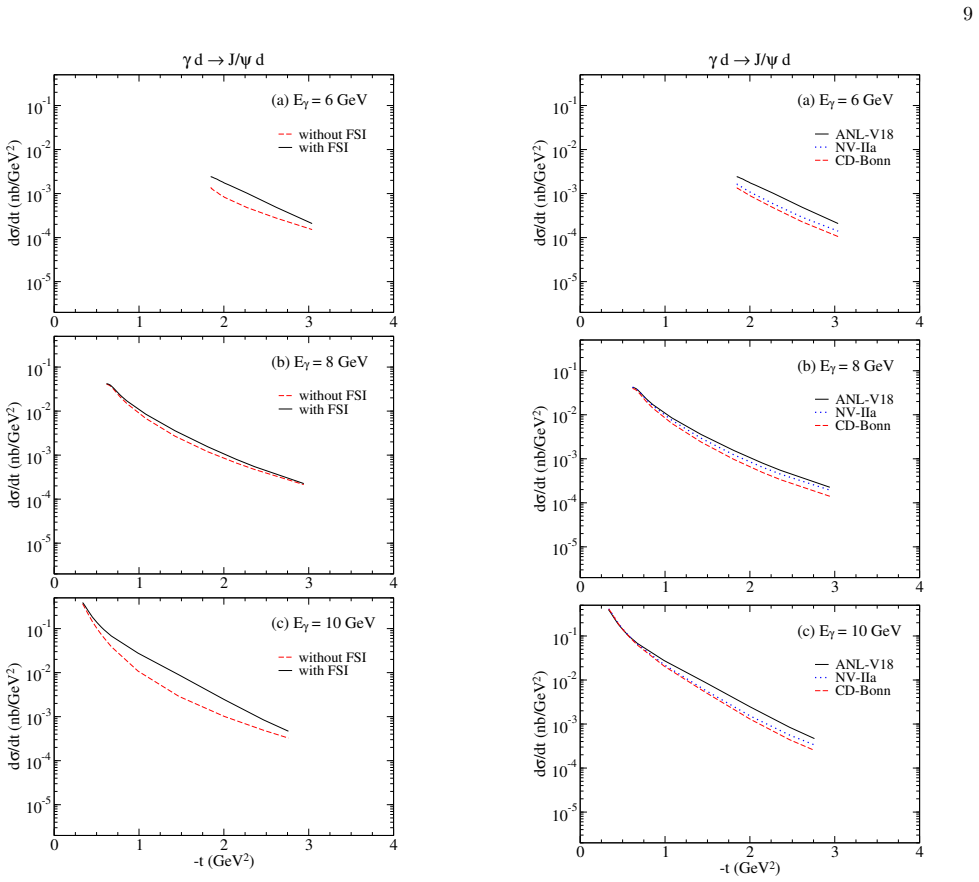
On the paper's own terms, exclusive $J/\psi$ photoproduction on the deuteron near threshold is strongly controlled by the d-state of the deuteron wave function. Using the relativistic impulse amplitude built from the Argonne-v18, NV-IIa, and CD-Bonn nucleon-nucleon potentials, the calculations show that at $E_\gamma = 6$ GeV, about 0.4 GeV above threshold, the differential cross section at large $-t$ is much larger than the s-wave-only result, tracing to the quadrupole form factor $F_2(t)$ peaking where $F_0(t)$ has its minimum. The same comparison shows that the fixed-scatter approximation, which factorizes the nuclear amplitude into an averaged nucleon amplitude times a form factor, reproduces the exact calculation only at small $-t$ and fails near threshold. The final state interaction amplitude, evaluated from a first-order optical potential using the fitted $J/\psi$-nucleon amplitude, raises the cross section significantly at large $-t$. The paper then applies the fixed-scatter approximation to spin-zero nuclei, predicting cross sections for $^{4}$He, $^{16}$O, and $^{40}$Ca with variational Monte-Carlo form factors, and notes that these near-threshold predictions are not reliable in the subthreshold region where hidden-charm bound states could appear.
Load-bearing premise
All results inherit the fitted Pom-CQM quark-nucleon potentials that were tuned to proton JLab data, so the entire nuclear calculation, especially the final-state interaction, stands on the assumption that the resulting $J/\psi$-nucleon amplitude remains correct for nucleons bound inside a nucleus.
Editorial extensions
If this is right
- Near-threshold $\gamma d \to J/\psi d$ measurements can directly probe the deuteron d-state at high momentum transfer, since the s-wave-only calculation is substantially smaller in the large-$-t$ region at $E_\gamma = 6$ GeV.
- The fixed-scatter approximation should not be trusted for threshold-region $J/\psi$ photoproduction on any nuclear target, and the paper's own $A > 2$ predictions are correspondingly approximate in that region.
- The $J/\psi$-nucleus final state interaction significantly increases cross sections at large momentum transfer for the deuteron and for the spin-zero nuclei near threshold.
- For $^{4}$He, $^{16}$O, and $^{40}$Ca, the predicted near-threshold cross sections are very small, while heavier targets give larger total cross sections at higher energy, so future JLab and EIC measurements are more feasible at higher energies.
- The predicted cross sections for $^{4}$He, $^{16}$O, and $^{40}$Ca provide concrete numbers for planning exclusive measurements at JLab and the EIC.
Reading between the lines
- If the d-state sensitivity holds, exclusive $J/\psi$ photoproduction on the deuteron could serve as a high-momentum filter for the deuteron quadrupole form factor $F_2(t)$, complementing electron-scattering measurements in the momentum region where $F_0(t)$ has a minimum; this use goes beyond what the paper states.
- The failure of the fixed-scatter approximation near threshold suggests that similar fixed-scatter treatments for other heavy-quarkonium photoproduction, such as $\Upsilon$ on light nuclei, would also need exact many-body impulse calculations because the threshold momentum transfer is even larger.
- Precise coherent deuteron data could be used to extract the $J/\psi$-nucleon scattering amplitude entering the optical potential, connecting these predictions to the hidden-charm bound-state question that the paper flags as an open direction.
- Because the paper explicitly states its subthreshold predictions are unreliable under the fixed-scatter approximation, a natural next step is a full many-body calculation with realistic nuclear wave functions and all multiple-scattering permutations, which could be tested against the near- and sub-threshold nuclear data now being collected at JLab.
Signed reviews
Editorial analysis
A structured set of objections, weighed in public.
Referee Report
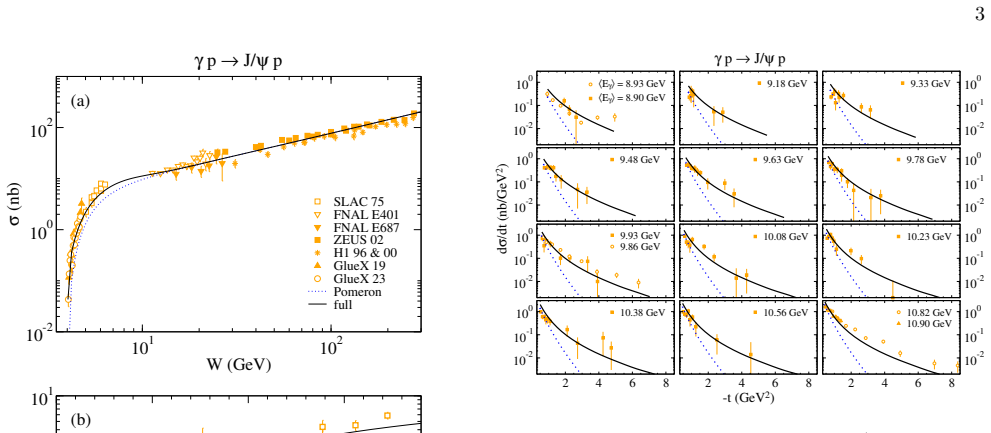
Summary. Applying the Pom-CQM model previously fitted to γp→J/ψp JLab data, the authors compute exclusive J/ψ photoproduction on the deuteron, 4He, 16O, and 40Ca within multiple scattering theory. The deuteron impulse amplitude is calculated exactly from realistic NN wave functions with relativistic boost corrections, a fixed-scatter approximation (FSA) is introduced, and the J/ψ-nucleus final-state interaction is generated from a first-order optical potential built from the same J/ψN amplitude. Heavy-nucleus predictions use variational Monte Carlo form factors. The main claims are that near-threshold cross sections depend strongly on the deuteron d-state, that the FSA fails near threshold but is a good approximation at higher energies, that FSI effects are significant at large momentum transfer, and that the A>2 cross sections provide predictions for future JLab and EIC experiments.
Significance. If the results hold, the paper provides concrete, falsifiable predictions for a program that is experimentally active, and it identifies deuteron d-state sensitivity as a potentially observable nuclear-structure effect in J/ψ photoproduction. The strengths are the exact impulse treatment on the deuteron with realistic NN potentials, the comparison across three NN interactions, the use of VMC nuclear form factors for heavier targets, and the honest reuse of a proton-level amplitude that was previously fitted to data. The central d-state-sensitivity finding near threshold appears robust because it is obtained from the exact impulse calculation. However, the FSA-validity claim is supported only by an s-wave-only comparison, and the FSI calculation relies on that same unvalidated approximation, so the higher-energy FSA claim and the numerical FSI predictions need additional support.
major comments (3)
- [IV.B, Fig. 10] The conclusion that the FSA is "a good approximation at higher energies" is based on a comparison in which only the s-wave part of the deuteron is retained. Near threshold the d-state dominates the cross section (Fig. 9), and the d-state has more high-momentum content than the s-state (Fig. 14), so freezing the initial nucleon momentum to p=0 in Eq. (34) is not tested for the full amplitude. Please compare the FSA of Eqs. (38)-(40) with the exact impulse calculation of Eq. (24) using the full s+d wave function, or restrict the FSA-validity claim to the s-wave sector and re-evaluate the FSA-based FSI and A>2 predictions.
- [IV.C, Eqs. (41)-(51) and Fig. 11] The FSI amplitude uses the T_IMP source term evaluated in the FSA by setting the initial nucleon momentum to p=0, as stated after Eq. (48). The comparison in Fig. 11 therefore mixes the exact relativistic impulse calculation (dashed curve) with a calculation in which the FSI source term is approximated by the FSA (solid curve). Since the FSA is shown to be invalid near threshold, the displayed FSI enhancement cannot be cleanly attributed to final-state interactions alone, and the near-threshold FSI predictions are not reliable. Please use the exact impulse amplitude as the source term in Eq. (41), or quantify the FSA error in the FSI contribution.
- [IV.C, Eq. (45)] The J/ψ-deuteron scattering equation uses a nonrelativistic propagator E - E_V(p") - E_d(p"), while the impulse amplitude and the boost transformations use relativistic kinematics (Eqs. (28)-(33)). Given that the FSI is significant near threshold where the momentum transfer is large, the magnitude of the FSI correction may depend on this inconsistency. Please justify this choice or estimate its numerical effect, for example by comparing with a relativistic propagator.
minor comments (4)
- [Eq. (34)] The symbol t is used both for the Mandelstam variable and for a momentum-transfer variable in the same sentence; the displayed relation "t = (|q| − E_V(k))^2 − t^2" is self-referential and should be rewritten with distinct notation for the three-momentum transfer.
- [Throughout] There are several typographical errors that should be corrected: "Relatvistic" in Sec. IV.A, "calulated" near Eq. (46), "gennerated" in the Fig. 14 caption, "variaioal" in Sec. VI, "previsous" in Sec. V, and "sufficent" in the Fig. 3 caption.
- [Fig. 15] The legend order in panel (a) reads "2H p 16O 40Ca 4He," which does not match the plotted curves or the order in panel (b); please check that the legend and curve styles are consistent.
- [Eq. (51)] The text says the full FSA cross section is obtained by using Eq. (39) to evaluate T_IMP inside Eq. (41), but Eq. (39) defines the factorized FSA amplitude for the observable cross section rather than an operator to be inserted into the loop integral; clarifying the operator definition would remove ambiguity.
Circularity Check
No significant circularity: the nuclear predictions use externally fitted elementary amplitudes and independent nuclear wave functions; the FSA-validity concern is an approximation gap, not a circular reduction.
full rationale
The paper's derivation chain is not circular. The elementary gamma+N -> J/psi+N amplitude and the J/psi-N t-matrix are taken from the previously published Pom-CQM model [1,11], whose parameters were fitted to external JLab proton data (Eq. (8), Ref. [11]); the nuclear calculations then use those amplitudes as inputs together with deuteron wave functions from independent NN potentials [41-43] and VMC nuclear form factors [52]. The central nuclear findings, namely the d-state sensitivity near threshold and the FSI effects at large momentum transfer, are computed from these inputs rather than re-derived from the outputs. The paper does not present the proton fits as new predictions, and the fixed-scatter approximation (FSA) is introduced as an approximation, not as a derived result: Eq. (34) defines the FSA by setting the initial nucleon momentum p = 0, and Fig. 10 compares FSA with an exact s-wave-only calculation. The conclusion that FSA is reasonable at higher energies may be incompletely validated, since the comparison omits the d-state, but that is a correctness or approximation-validity concern, not a circularity: no fitted parameter is renamed as a prediction and no equation reduces to its own output by construction. The paper's own limitation statement in Sec. VI, that the A > 2 near-threshold predictions are made only within FSA and are not reliable in the sub-threshold region, further indicates that the authors do not present the approximation as a derived fact. The reliance on the authors' previous model is substantial, but that model is benchmarked against external JLab data, so the self-citations are not load-bearing in a circular sense.
Assumptions & free parameters
free parameters (5)
- alpha_B (Born quark-nucleon potential strength) =
-0.145
- alpha_FSI (J/psi-N potential strength) =
-0.1
- mu_B and mu_FSI (Yukawa ranges) =
0.3 GeV
- N_B and N_FSI (Yukawa shape ratios) =
N_B=5, N_FSI=2
- Pomeron parameters (mu0, beta_u/d, beta_c, alpha0) =
mu0=1.1 GeV^2, beta_u/d=2.07 GeV^-1, beta_c=0.32 GeV^-1, alpha0=1.25
assumptions (5)
- domain assumption The first-order optical potential U = <Phi_A| sum_i t_{VN,VN}(i) |Phi_A> with t_{VN,VN} from the fitted Pom-CQM model is a valid basis for the J/psi-nucleus FSI.
- domain assumption The fixed-scatter approximation, validated against the exact deuteron calculation, remains sufficiently accurate for the heavier-nucleus predictions.
- domain assumption The relativistic treatment of the deuteron wave function includes the boost but ignores spin rotations, which are argued to be negligible.
- standard math The nuclear form factors for 4He, 16O, 40Ca from the VMC calculations of Lonardoni et al. [52] are used as the nuclear-structure input.
- domain assumption Non-relativistic multiple-scattering theory is valid for the deuteron FSI at the energies considered.
invented entities (1)
-
Phenomenological quark-nucleon potentials v_cN^B(r) and v_cN^{FSI}(r)
Cite this review
Pith. "Pith review of Exclusive $J/\psi$ photo-production on nuclei." pith.science (2026). https://pith.science/paper/47YKQQSS
@misc{pith2026241112187,
  author       = {Pith},
  title        = {Pith review of: Exclusive $J/\psi$ photo-production on nuclei},
  year         = {2026},
  howpublished = {\url{https://pith.science/paper/47YKQQSS}},
  note         = {Machine review of arXiv:2411.12187}
}
abstract
Motivated by the recent experimental developments, the Pom-CQM model of the $\gamma + N \to J/\psi + N$ reaction of Lee et al. [Eur. Phys. J. A. 58, 252 (2022)] and Sakinah et al. [Phys. Rev. C. 109, 065204 (2024)] has been applied to predict the exclusive $J/\psi$ photo-production on nuclei ($A$). Within the multiple scattering theory, the calculations have been performed by including the impulse amplitude $T^{\rm IMP}_{J/\psi A,\gamma A}$ and the $J/\psi$-nucleus final state interaction (FSI) amplitude $T^{\rm FSI}_{J/\psi A,\gamma A}$. For the deuteron target, $T^{\rm IMP}_{J/\psi d,\gamma d}$ is calculated exactly using the wave function generated from the realistic nucleon-nucleon potentials. It is found that, near the threshold region, the $J/\psi$ photo-production cross sections depend sensitively on the $d$-state of the deuteron wave function. The FSI amplitude $T^{\rm FSI}_{J/\psi A,\gamma A}$ is calculated using the first-order optical potential constructed from the $J/\psi$-$N$ scattering amplitude generated from the employed Pom-CQM model. It turns out that the FSI has significant effects in the large momentum-transfer region. By using the conventional fixed scatter approximation (FSA) and the nuclear form factors from the variational Monte-Carlo (VMC) calculations of Lonardoni et al. [Phys. Rev.C. 96, 024326 (2017)], the cross sections of the $J/\psi$ photo-production on ${^4\rm He}$, ${^{16}\rm O}$, and ${^{40}\rm Ca}$ are also predicted for future experimental investigations at JLab and EIC.
Figures


Figures from the paper (11 more)




Reference graph
Works this paper leans on
-
[1]
T. S. H. Lee, S. Sakinah, and Y. Oh, Models of J/ψ photo-production reactions on the nucleon, Eur. Phys. J. A 58, 252 (2022)
work page 2022
- [2]
-
[3]
= 1, as given in Eq. (21), Eqs. (24)-(27) are for the nonrelativistic calculations of the impulse amplitude. The main feature of the J/ψ photo-production at ener- gies near the threshold is that the momentum transfer−t is very large. For example, the contributions to the cross sections at photon energy Eγ = 6 GeV are from the −t ⩾ 2 GeV2 region where the ...
-
[4]
(27) by p′ = L(⃗β ′)p′ 1 = −L(⃗β ′)p′ 2, (32) where ⃗β ′ = t EN (p′
and replacing p′ of Eq. (27) by p′ = L(⃗β ′)p′ 1 = −L(⃗β ′)p′ 2, (32) where ⃗β ′ = t EN (p′
-
[5]
How- ever, it was found in Refs
(33) In addition to the above relativistic extension, the spin rotaions under Lorentz Boost transformation are also needed to have a complete relativistic approach. How- ever, it was found in Refs. [44, 45, 48] that the spin rota- tions have negligible effects on the spin-averaged observ- ables which are only considered in this work. Thus we will not acco...
-
[6]
= 1. Eq. (24) can then be approximately written as the following fac- torized form ⟨kmV , ΦJd P′,M ′ d |T IMP V d,γd(E)|qλ, ΦJd P,Md ⟩ ∼ Ad ⟨kmV , t ¯ms′ 1 |¯tV N,γN(ω0)|qλ, 0 ¯ms1 ⟩ FM ′ d,Md (t), (34) where ¯ms1 and ¯ms′ 1 are arbitrarily chosen spin compo- nents, t = (|q| −EV (k))2 − t2, and FM ′ d,Md (t) = X ms1 ,ms2 ,ms′ 1 ,ms′ 2 × Z dp ϕJd∗ M ′ d (p...
-
[7]
K. A. Mamo and I. Zahed, Diffractive photoproduction of J/ψ and Υ using holographic QCD: Gravitational form factors and GPD of gluons in the proton, Phys. Rev. D 101, 086003 (2020)
work page 2020
- [8]
Show all 66 references
-
[9]
Adhikari et al
S. Adhikari et al. (GlueX Collaboration), Measure- ment of the J/ψ photoproduction cross section over the full near-threshold kinematic region, Phys. Rev. C 108, 025201 (2023)
2023
-
[10]
The results using the nonrelativistic (dashed curves) and relativistic (solid curves) formulation of the deuteron wave function are compared
GeV. The results using the nonrelativistic (dashed curves) and relativistic (solid curves) formulation of the deuteron wave function are compared. B. Fixed scatter approximation (FSA) For understanding the results of differential cross sec- tions shown in Fig. 7, it is useful ...
-
[11]
Duran et al., Determining the gluonic gravitational form factors of the proton, Nature 615, 813 (2023)
B. Duran et al., Determining the gluonic gravitational form factors of the proton, Nature 615, 813 (2023)
2023
-
[12]
S. J. Brodsky, E. Chudakov, P. Hoyer, and J. M. Laget, Photoproduction of charm near threshold, Phys. Lett. B 498, 23 (2001)
2001
-
[13]
T. S. H. Lee, Pomeron-LQCD model of J/ψ photo- production on the nucleon, arXiv:2004.13934 [nucl-th]
2004 arXiv
-
[14]
M. L. Du, V. Baru, F. K. Guo, C. Hanhart, U. G. Meißner, A. Nefediev, and I. Strakovsky, Deci- phering the mechanism of near-threshold J/ψ photopro- duction, Eur. Phys. J. C 80, 1053 (2020)
2020
-
[15]
Y. Guo, X. Ji, and Y. Liu, QCD Analysis of near- threshold photon-proton production of heavy quarko- nium, Phys. Rev. D 103, 096010 (2021)
2021
-
[16]
Winney et al
D. Winney et al. (Joint Physics Analysis Center), Dy- namics in near-threshold J/ψ photoproduction, Phys. Rev. D 108, 054018 (2023)
2023
-
[17]
Sakinah, T
S. Sakinah, T. S. H. Lee, and H. M. Choi, Dynami- cal model of J/ψ photoproduction on the nucleon, Phys. Rev. C 109, 065204 (2024)
2024
-
[18]
L. Tang, Y. X. Yang, Z. F. Cui, and C. D. Roberts, J/ψ photoproduction: threshold to very high energy, Phys. Lett. B 856, 138904 (2024)
2024
-
[19]
Arrington et al., Physics with CEBAF at 12 GeV and future opportunities, Prog
J. Arrington et al., Physics with CEBAF at 12 GeV and future opportunities, Prog. Part. Nucl. Phys. 127, 103985 (2022)
2022
-
[20]
Accardi et al., Strong interaction physics at the lumi- nosity frontier with 22 GeV electrons at Jefferson Lab, Eur
A. Accardi et al., Strong interaction physics at the lumi- nosity frontier with 22 GeV electrons at Jefferson Lab, Eur. Phys. J. A 60, 173 (2024)
2024
-
[21]
T. Liu, Z. Zhao, M. Cai, D. Byer, and H. Gao, Sub- threshold production of J/ψ mesons from the deuteron with the proposed solenoidal large intensity device, Phys. Rev. C 109, 065206 (2024)
2024
-
[22]
Tyson, D
R. Tyson, D. G. Ireland, and B. McKinnon, Near- threshold J/ψ photoproduction off the proton and neu- tron with CLAS12, Nuovo Cim. C 47, 212 (2024)
2024
-
[23]
J. R. Pybus et al. , First measurement of near- and sub-threshold J/ψ photoproduction off nuclei, arXiv:2409.18463 [nucl-ex]
-
[24]
Accardi et al., Electron Ion Collider: The next QCD frontier: Understanding the glue that binds us all, Eur
A. Accardi et al., Electron Ion Collider: The next QCD frontier: Understanding the glue that binds us all, Eur. Phys. J. A 52, 268 (2016)
2016
-
[25]
Abir et al., The case for an EIC theory alliance: Theo- retical challenges of the EIC, arXiv:2305.14572 [hep-ph]
R. Abir et al., The case for an EIC theory alliance: Theo- retical challenges of the EIC, arXiv:2305.14572 [hep-ph]
-
[26]
X. Wang, X. Cao, A. Guo, L. Gong, X. S. Kang, Y. T. Liang, J. J. Wu, and Y. P. Xie, Exclusive char- monium production at the electron-ion collider in China, Eur. Phys. J. C 84, 684 (2024)
2024
-
[27]
A. K. Kerman, H. McManus, and R. M. Thaler, The scattering of fast nucleons from nuclei, Annals Phys. 8, 551 (1959)
1959
-
[28]
R. H. Landau, S. C. Phatak, and F. Tabakin, Improved theoretical pion-nucleus optical potentials, Annals Phys. 78, 299 (1973)
1973
-
[29]
T. S. H. Lee and F. Tabakin, Momentum-space study of pion-nucleus inelastic scattering, Nucl. Phys. A 226, 253 (1974)
1974
-
[30]
Feshbach, Theoretical Nuclear Physics: Nuclear Re- actions, John Wiley and Sons, Inc., New York, 1992
H. Feshbach, Theoretical Nuclear Physics: Nuclear Re- actions, John Wiley and Sons, Inc., New York, 1992
1992
-
[31]
Watson, Quantum mechanical transport theory
K.M. Watson, Quantum mechanical transport theory. I. Incoherent processes, Phys. Rev. 118, 886 (1960)
1960
-
[32]
S. H. Kim, T. S. H. Lee, S. i. Nam, and Y. Oh, Dynamical model of ϕ meson photoproduction on the nucleon and 4He, Phys. Rev. C 104, 045202 (2021)
2021
-
[33]
Hiraiwa et al
T. Hiraiwa et al. (LEPS Collaboration), First measure- ment of coherent ϕ-meson photoproduction from 4He near threshold, Phys. Rev. C 97, 035208 (2018)
2018
-
[34]
Hatta, M
Y. Hatta, M. Strikman, J. Xu, and F. Yuan, Sub- threshold J/ψ and Υ production in γA collisions, Phys. Lett. B 803, 135321 (2020)
2020
-
[35]
He and I
F. He and I. Zahed, Threshold photo-production of J/ψ off light nuclei, arXiv:2407.09991 [nucl-th]
-
[36]
M. L. Goldberger and K. M. Watson, Collision Theory, R. E. Krieger Pub. Co., Huntington, New York, 1975
1975
-
[37]
Sato and T
T. Sato and T. S. H. Lee, Meson exchange model for πN scattering and γN → πN reaction, Phys. Rev. C 54, 2660 (1996)
1996
-
[38]
Matsuyama, T
A. Matsuyama, T. Sato, and T. S. H. Lee, Dynami- cal coupled-channel model of meson production reactions in the nucleon resonance region, Phys. Rept. 439, 193 (2007)
2007
-
[39]
Kamano, S
H. Kamano, S. X. Nakamura, T. S. H. Lee, and T. Sato, Nucleon resonances within a dynamical coupled-channels model of πN and γN reactions, Phys. Rev. C 88, 035209 (2013)
2013
-
[40]
Segovia, D
J. Segovia, D. R. Entem, F. Fernandez, and E. Hernan- dez, Constituent quark model description of charmonium phenomenology, Int. J. Mod. Phys. E22, 1330026 (2013)
2013
-
[41]
M. E. Binkley et al., J/ψ photoproduction from 60 to 300 GeV/c, Phys. Rev. Lett. 48, 73 (1982)
1982
-
[42]
P. L. Frabetti et al., A Measurement of elastic J/ψ pho- toproduction cross section at Fermilab E687, Phys. Lett. B 316, 197 (1993)
1993
-
[43]
Chekanov et al.(ZEUS Collaboration), Exclusive pho- toproduction of J/ψ mesons at HERA, Eur
S. Chekanov et al.(ZEUS Collaboration), Exclusive pho- toproduction of J/ψ mesons at HERA, Eur. Phys. J. C 24, 345 (2002)
2002
-
[44]
Aid et al
S. Aid et al. (H1 Collaboration), Elastic and inelastic photoproduction of J/ψ mesons at HERA, Nucl. Phys. B 472, 3 (1996)
1996
-
[45]
Adloff et al.(H1 Collaboration), Elastic photoproduc- tion of J/ψ and Υ mesons at HERA, Phys
C. Adloff et al.(H1 Collaboration), Elastic photoproduc- tion of J/ψ and Υ mesons at HERA, Phys. Lett. B 483, 23 (2000)
2000
-
[46]
Camerini, J
U. Camerini, J. G. Learned, R. Prepost, C. M. Spencer, D. E. Wiser, W. Ash, R. L. Anderson, D. Ritson, D. Sher- den, and C. K. Sinclair, Photoproduction of the ψ Par- ticles, Phys. Rev. Lett. 35, 483 (1975)
1975
-
[47]
R. B. Wiringa, V. G. J. Stoks, and R. Schiavilla, An accurate nucleon-nucleon potential with charge indepen- 15 dence breaking, Phys. Rev. C 51, 38 (1995)
1995
-
[48]
Piarulli, L
M. Piarulli, L. Girlanda, R. Schiavilla, A. Kievsky, A. Lovato, L. E. Marcucci, S. C. Pieper, M. Viviani, and R. B. Wiringa, Local chiral potentials with ∆- intermediate states and the structure of light nuclei, Phys. Rev. C 94, 054007 (2016)
2016
-
[49]
Machleidt, The meson theory of nuclear forces and nuclear structure, Adv
R. Machleidt, The meson theory of nuclear forces and nuclear structure, Adv. Nucl. Phys. 19, 189 (1989)
1989
-
[50]
Kamada, W
H. Kamada, W. Gloeckle, J. Golak, and C. Elster, Lorentz boosted N Npotential for few body systems: Ap- plication to the three nucleon bound state, Phys. Rev. C 66, 044010 (2002)
2002
-
[51]
Witala, J
H. Witala, J. Golak, W. Glockle, and H. Kamada, Rel- ativistic effects in neutron-deuteron elastic scattering, Phys. Rev. C 71, 054001 (2005)
2005
-
[52]
Witala, J
H. Witala, J. Golak, R. Skibinski, W. Glockle, W. N. Polyzou, and H. Kamada, Relativity and the low- energy nd Ay puzzle, Phys. Rev. C 77, 034004 (2008)
2008
-
[53]
Grassi, J
A. Grassi, J. Golak, W. N. Polyzou, R. Skibi´ nski, H. Wita la, and H. Kamada, Electron and neutrino scat- tering off the deuteron in a relativistic framework, Phys. Rev. C 107, 024617 (2023)
2023
-
[54]
J. J. Wu and T. S. H. Lee, Production of J/ψ on the nu- cleon and on deuteron targets, Phys. Rev. C 88, 015205 (2013)
2013
-
[55]
P. A. M. Dirac, Forms of relativistic dynamics, Rev. Mod. Phys. 21, 392 (1949)
1949
-
[56]
B. D. Keister and W. N. Polyzou, Relativistic Hamilto- nian dynamics in nuclear and particle physics, Adv. Nucl. Phys. 20, 225 (1991)
1991
-
[57]
M. I. Haftel and F. Tabakin, Nuclear saturation and the smoothness of nucleon-nucleon potentials, Nucl. Phys. A 158, 1 (1970)
1970
-
[58]
Lonardoni, A
D. Lonardoni, A. Lovato, S. C. Pieper, and R. B. Wiringa, Variational calculation of the ground state of closed-shell nuclei up to A = 40, Phys. Rev. C 96, 024326 (2017)
2017
-
[59]
S. J. Brodsky, I. A. Schmidt, and G. F. de Teramond, Nuclear-bound quarkonium, Phys. Rev. Lett. 64, 1011 (1990)
1990
-
[60]
H. Gao, T. S. H. Lee, and V. Marinov, ϕ-N bound state, Phys. Rev. C 63, 022201 (2001)
2001
-
[61]
V. B. Belyaev, N. V. Shevchenko, A. I. Fix, and W. Sand- has, Binding of charmonium with two- and three-body nuclei, Nucl. Phys. A 780, 100 (2006)
2006
-
[62]
J. J. Wu and T. S. H. Lee, Photo-production of bound states with hidden charms, Phys. Rev. C 86, 065203 (2012)
2012
-
[63]
Donnachie and P
A. Donnachie and P. V. Landshoff, Elastic scattering and diffraction dissociation, Nucl. Phys. B 244, 322 (1984)
1984
-
[64]
Donnachie and P
A. Donnachie and P. V. Landshoff, Total cross sections, Phys. Lett. B 296, 227 (1992)
1992
-
[65]
Donnachie and P
A. Donnachie and P. V. Landshoff, Exclusive vector me- son production at HERA, Phys. Lett. B 348, 213 (1995)
1995
-
[66]
Donnachie and P
A. Donnachie and P. V. Landshoff, Small x: Two pomerons!, Phys. Lett. B 437, 408 (1998)
1998
Reviewed August 12, 2026 · model on record in the stance chip above.
Discussion (0). Continue with ORCID to comment.