REVIEW 4 major objections 4 minor 47 references
Leveraging MLLM Embeddings and Attribute Smoothing for Compositional Zero-Shot Learning
T0 review · 4 major / 4 minor · reviewed 2026-08-12 · deepseek-v4-flash
Pith's one-line read TRIDENT, a disentanglement framework with MLLM embeddings and attribute smoothing, sets new state-of-the-art results on MIT-States, C-GQA, and VAW-CZSL.
desk verdict A credible CZSL engineering paper with a useful trick and an honest ablation study, but the state-of-the-art claim is not supported because the comparison omits two strong VLM baselines the authors themselves cite. read the letter →
The pith
A machine-rendered reading of the paper's core claim, the machinery that carries it, and where it could break.
The reading
What carries the argument
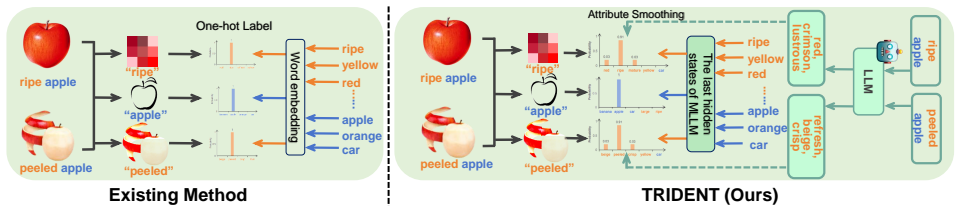
The load-bearing mechanism is a triplet-based weighted disentanglement module coupled to a softened semantic alignment. From a main image and two partner images sharing either the attribute or the object, two MLPs emit per-feature shared and exclusive weights, and the exclusive weights are computed as $1 - w$ so that each row of the visual feature matrix is split into attribute and object components rather than relying on spatial region separation. Visual extraction is itself split: $p$ feature adaptive aggregation modules use $1\times1$ convolution to weight patch tokens and suppress background, while $q$ learnable condition masks multiply the [CLS] token elementwise to spread global information across dimensions. For alignment, every attribute, object, and auxiliary word is mapped through the average-pooled last hidden states of LLaVA v1.5, its MLLM embeddings, and the cosine cross-entropy treats all non-ground-truth words as negatives. Finally, attribute smoothing replaces the one-hot attribute target with a distribution that puts weight $1-\alpha$ on the ground-truth attribute and $\alpha/t$ on $t$ auxiliary attributes generated by GPT-3.5, so the model is not trained to reject all other plausible attributes.
What would settle it
Run the identical TRIDENT pipeline with a frozen visual encoder trained only on ImageNet-1k, with no web-scale caption data, and compare the AUC on the three benchmarks; if the margin over CANet shrinks to near zero while the rest of the architecture is unchanged, the reported gains are attributable to pretraining-data overlap with the test splits rather than to disentanglement and attribute smoothing.
Extended reading notes
Core claim
The paper's central discovery is that replacing static word embeddings with the last hidden states of an MLLM and replacing one-hot attribute targets with smoothed targets derived from LLM-generated auxiliary attributes materially improves compositional zero-shot recognition. Concretely, TRIDENT reports area-under-curve of 14.2% on MIT-States, 8.0% on C-GQA, and 8.3% on VAW-CZSL, compared with 13.6%, 5.7%, and 6.7% for the previous best method CANet, and harmonic-mean improvements from 29.8%, 18.9%, and 21.0% to 30.9%, 22.6%, and 23.4%. The authors attribute the gains to three mechanisms working together: background suppression and multi-granularity feature splitting before disentanglement, word expanding that treats all non-ground-truth words as negatives in alignment, and attribute smoothing that prevents the model from overshooting its confidence in seen attribute-object pairs. The ablations show that switching word embeddings from Word2Vec plus FastText to LLaVA hidden states helps not only TRIDENT but also earlier models, and that the largest single contribution to unseen accuracy comes from the soft attribute labels.
Load-bearing premise
The load-bearing premise is that LLaVA v1.5, used frozen as the visual backbone and as the source of word embeddings, has not memorized the specific attribute-object labels or near-duplicate test images in the three benchmarks; the authors address this only in Appendix C by noting that its training objective was to produce captions about main image content, not attribute-object labels.
Editorial extensions
If this is right
- The best published non-CLIP CZSL result on MIT-States, C-GQA, and VAW-CZSL is now TRIDENT, with the previous CANet numbers replaced by AUC 14.2%, 8.0%, and 8.3% respectively.
- Switching word embeddings from Word2Vec plus FastText to LLaVA hidden states improves not only TRIDENT but also existing models such as SCEN and CANet, so MLLM embeddings are a drop-in upgrade for word-alignment-based CZSL.
- Attribute smoothing changes the training target for attributes from a single one-hot label to a soft distribution over plausible attributes, which reduces overconfidence on seen compositions and is the main driver of the unseen-accuracy gains.
- The disentanglement module contributes through both local background suppression with feature adaptive aggregation and dimensional splitting of global features with condition masks, with orthogonal regularization keeping the two streams complementary.
- Because the visual encoder stays frozen, TRIDENT can adopt newer MLLM visual backbones without retraining the disentanglement head, so the framework is forward-compatible with better encoders.
Reading between the lines
- A testable extension the paper leaves implicit: ablating LLaVA v1.5's visual encoder against an ImageNet-only ViT of the same size would separate gains from richer multimodal features versus gains from pretraining data overlap, which matters for any deployment domain outside the three benchmarks.
- Attribute smoothing is a general recipe: any recognition task with many-to-many attribute-object relations could generate auxiliary labels with a text LLM and soften targets, with CZSL being the setting where the benefit is easiest to measure because unseen accuracy tracks generalization directly.
- The word-expanding trick, treating every non-ground-truth primitive as a negative, is compatible with other disentanglement losses and could improve compositional retrieval beyond classification.
- The optimal number of visual features and smoothing factor are dataset-dependent, with more features helping on noisy MIT-States and fewer working better on cleaner C-GQA, suggesting the framework's components matter most when labels are noisy.
Editorial analysis
A structured set of objections, weighed in public.
Referee Report
Summary. The paper proposes TRIDENT, a compositional zero-shot learning (CZSL) framework built on a frozen LLaVA v1.5 visual encoder. The method extracts multi-granularity visual features through feature adaptive aggregation modules and learnable condition masks, disentangles attributes and objects using weighted shared/exclusive features from image triplets, and aligns visual features with MLLM last-hidden-state word embeddings. It additionally introduces attribute smoothing, where GPT-3.5-generated auxiliary attributes soften the attribute classification target. Experiments on MIT-States, C-GQA, and VAW-CZSL report improved AUC and harmonic-mean accuracy over the included baselines, and the paper claims state-of-the-art performance.
Significance. If the experimental comparison is complete and reproducible, the method would be a useful empirical contribution to CZSL. The paper deserves credit for a systematic ablation study, hyperparameter sensitivity analysis, and an auxiliary-attribute quality assessment, and for retraining the non-CLIP baselines with a common backbone. However, the significance currently rests on an unqualified state-of-the-art claim that is not supported by the comparison set as presented: two VLM-based CZSL methods cited in the paper itself, DSP and Troika, are absent from Table 2. In addition, the use of LLaVA v1.5 as both the visual backbone and the source of word embeddings raises a data-contamination risk that Appendix C addresses only by assertion. These issues are load-bearing for the paper's central claim.
major comments (4)
- [§4.1–4.2, Table 2] The unqualified "state-of-the-art" claim is not supported by the comparison set. The paper cites DSP (Lu et al., CVPR 2023) and Troika (Huang et al., CVPR 2024) as VLM-based CZSL methods in Related Work, but neither appears in Table 2, and Section 4.2 declares CANet the previous state of the art. Published results of DSP and Troika on the same three benchmarks are at least competitive with and in several cases higher than TRIDENT's reported AUC of 14.2, 8.0, and 8.3, so the sentence "TRIDENT boosts AUC from ... CANet ... to new state-of-the-art" is not verifiable as written. Including CLIP and CoOp rows does not cure this, and the fairness caveat about CLIP in Section 4.1 is not a justification for omitting two directly comparable VLM-based methods. Please extend Table 2 with DSP, Troika, and any other current CZSL methods, or remove the unqualified SOTA statement until such a comparison is performed.
- [Appendix C; §3.2] The zero-shot interpretation of the results depends on a premise that Appendix C states but does not support. The appendix concedes that "LLaVA v1.5 may have seen certain images during training", then asserts that the autoregressive captioning objective makes the model focus on main content rather than the attribute-object label. That assertion is not evidence: LLaVA v1.5's visual encoder is a CLIP ViT-L/14 trained on large-scale web image-text data, and its instruction-tuning data contains captioned images, so near-duplicate test images or attribute-object phrases could plausibly have been memorized. Because TRIDENT uses LLaVA-derived visual features and LLaVA-derived word embeddings, any such memorization would directly inflate unseen accuracy. Please add an empirical contamination check, such as LLaVA-based retrieval or zero-shot naming on the exact test splits, or a comparison with a backbone whose pretraining data is known to be disjoint; if such a check is infeasible, the paper should explicitly present this as a limitation and temper the generalization claims.
- [Table 2; §4.2] The headline improvements are reported from a single run without variance or significance estimates. On MIT-States the gain over CANet is 0.6 AUC absolute (14.2 vs 13.6), and several ablation deltas in Table 3 are of the same magnitude, so run-to-run variation could easily change the conclusion. Please report mean and standard deviation over at least three random seeds and indicate whether the TRIDENT-versus-CANet differences are significant; otherwise, the phrase "substantial margin" in Section 4.2 overstates the evidence.
- [§3.2; Appendix C; §3.3] The paper is internally inconsistent about whether the MLLM embeddings are frozen. Section 3.2 says "The auxiliary attributes and MLLM embeddings are obtained offline before training TRIDENT"; Appendix C says "we fine-tune the last hidden states with a low learning rate during the training phase"; and Section 3.3 lists a separate learning rate of 1.5e-6 for word embedding. Please state unambiguously which parameters are updated during training (LLaVA transformer, cross-modal connector, the projection MLP, or only a final linear layer) and clarify whether the word embeddings used in Eq. (9) and Eq. (10) change during training. This is essential for reproducibility and for interpreting Table 4, where "LLaVAlhs" may denote either frozen or fine-tuned embeddings.
minor comments (4)
- [Eq. (9)–(10)] Equation (10) applies a linear layer directly to LLaVA_lhs(a) and LLaVA_lhs(o), whereas Eq. (9) defines the word embedding as E_word(y) = MLP_word(LLaVA_lhs(y)); please make the composition embedding use E_word(a) and E_word(o) or explain why the MLP is skipped in Eq. (10).
- [Table 1; Appendix D] Table 1 and Appendix D disagree on VAW-CZSL: Table 1 lists 1,252 seen training compositions, while Appendix D states 11,175 seen compositions; please reconcile the numbers and report the exact split used.
- [§4.1, Table 2] It is stated that all baselines were retrained with a common ViT-Large-Patch14-336px backbone for fairness, but the CLIP and CoOp rows appear to be taken from a prior paper rather than retrained under the same protocol; please state explicitly which entries were re-run and which were copied.
- [Appendix E] The hyperparameter sensitivity curves for the number of visual features and the label smoothing factor do not state whether they are computed on the validation split; if the hyperparameters were selected using the test split, this should be disclosed.
Circularity Check
No significant circularity: the core training/inference chain is self-contained and evaluation is on held-out compositions; the minor self-citation and benchmark-leakage concerns are not construction-level reductions.
full rationale
The paper's derivation chain is a supervised cross-entropy fit on the seen split: visual features are extracted with the frozen LLaVA encoder and learnable aggregation modules, aligned to MLLM word embeddings through cosine-similarity cross-entropy (Eqs. 9-15), and evaluated on held-out compositions in Table 2. I could not exhibit any equation in which a reported test metric equals a fitted quantity by construction. The only self-citation with author overlap is [Zhang et al., 2024] in Appendix A, used to motivate composition-conditioned auxiliary-attribute generation; this is a design rationale, not the basis of the SOTA claim or of any tested prediction, so it is not load-bearing. Appendix C's admission that 'LLaVA v1.5 may have seen certain images during training' raises a benchmark-memorization risk, but that is an external-data-contamination concern, not an internal reduction of the derivation to its inputs. The main verification weakness is that Table 2 omits DSP [Lu et al., 2023] and Troika [Huang et al., 2024] even though both are cited in Related Work as VLM-based CZSL methods; this undermines the unqualified 'state-of-the-art' claim but is a comparison-set/completeness issue, not circularity. Overall, the paper shows no significant circularity.
Assumptions & free parameters
free parameters (6)
- label smoothing factor alpha =
0.09 (MIT-States), 0.03 (C-GQA), 0.03 (VAW-CZSL)
- number of global condition masks q =
6, 2, 4 for MIT-States, C-GQA, VAW-CZSL; p = 2q local features
- number of auxiliary attributes t =
3
- cosine temperature delta =
0.05
- loss weights gamma_ortho, gamma_comp, gamma_pri =
0.1, 1, 0.25
- learning rates =
1.5e-6 (word embedding), 2e-4 (other modules)
assumptions (6)
- domain assumption Attributes and objects can be disentangled by comparing an image with a same-attribute image and a same-object image.
- domain assumption Averaged last hidden states of LLaVA v1.5 are effective word embeddings for attribute and object words after an MLP projection.
- domain assumption GPT-3.5-generated auxiliary adjectives are mostly correct and diverse enough that label smoothing with them improves generalization.
- domain assumption The learnable FAA attention weights concentrate on composition-relevant patches and suppress background.
- domain assumption The standard CZSL data splits have no leakage, and the candidate test set is predefined.
- standard math The use of cross-entropy, cosine similarity, and label smoothing is standard practice in metric learning.
Cite this review
Pith. "Pith review of Leveraging MLLM Embeddings and Attribute Smoothing for Compositional Zero-Shot Learning." pith.science (2026). https://pith.science/paper/UKNWIUAO
@misc{pith2026241112584,
  author       = {Pith},
  title        = {Pith review of: Leveraging MLLM Embeddings and Attribute Smoothing for Compositional Zero-Shot Learning},
  year         = {2026},
  howpublished = {\url{https://pith.science/paper/UKNWIUAO}},
  note         = {Machine review of arXiv:2411.12584}
}
read the original abstract
Compositional zero-shot learning (CZSL) aims to recognize novel compositions of attributes and objects learned from seen compositions. Previous works disentangle attributes and objects by extracting shared and exclusive parts between the image pair sharing the same attribute (object), as well as aligning them with pretrained word embeddings to improve unseen attribute-object recognition. Despite the significant achievements of existing efforts, they are hampered by three limitations: (1) The efficacy of disentanglement is compromised due to the influence of the background and the intricate entanglement of attributes with objects in the same parts. (2) Existing word embeddings fail to capture complex multimodal semantic information. (3) Overconfidence exhibited by existing models in seen compositions hinders their generalization to novel compositions. Being aware of these, we propose a novel framework named multimodal large language model (MLLM) embeddings and attribute smoothing guided disentanglement for CZSL. First, we leverage feature adaptive aggregation modules to mitigate the impact of background, and utilize learnable condition masks to capture multi-granularity features for disentanglement. Moreover, the last hidden states of MLLM are employed as word embeddings for their superior representation capabilities. Furthermore, we propose attribute smoothing with auxiliary attributes generated by the large language model (LLM) for seen compositions to address the overconfidence challenge. Extensive experiments demonstrate that our method achieves state-of-the-art performance on three challenging datasets. The source code will be available at https://github.com/xud-yan/Trident .
Figures


Figures from the paper (4 more)


Reference graph
Works this paper leans on
-
[1]
write newline
" write newline "" before.all 'output.state := FUNCTION n.dashify 't := "" t empty not t #1 #1 substring "-" = t #1 #2 substring "--" = not "--" * t #2 global.max substring 't := t #1 #1 substring "-" = "-" * t #2 global.max substring 't := while if t #1 #1 substring * t #2 global.max substring 't := if while FUNCTION format.date year duplicate empty "emp...
-
[2]
Flamingo: a visual language model for few-shot learning
Jean-Baptiste Alayrac, Jeff Donahue, Pauline Luc, Antoine Miech, Iain Barr, Yana Hasson, Karel Lenc, Arthur Mensch, Katherine Millican, Malcolm Reynolds, Roman Ring, Eliza Rutherford, Serkan Cabi, Tengda Han, Zhitao Gong, Sina Samangooei, Marianne Monteiro, Jacob L Menick, Sebastian Borgeaud, Andy Brock, Aida Nematzadeh, Sahand Sharifzadeh, Miko aj Bi\' n...
work page 2022
-
[3]
A causal view of compositional zero-shot recognition
Yuval Atzmon, Felix Kreuk, Uri Shalit, and Gal Chechik. A causal view of compositional zero-shot recognition. In Advances in Neural Information Processing Systems, pages 1462--1473, 2020
work page 2020
-
[4]
Enriching word vectors with subword information
Piotr Bojanowski, Edouard Grave, Armand Joulin, and Tomas Mikolov. Enriching word vectors with subword information. Transactions of the Association for Computational Linguistics, 5: 0 135--146, 2017
work page 2017
-
[5]
Language models are few-shot learners
Tom Brown, Benjamin Mann, Nick Ryder, Melanie Subbiah, Jared D Kaplan, Prafulla Dhariwal, Arvind Neelakantan, Pranav Shyam, Girish Sastry, Amanda Askell, Sandhini Agarwal, Ariel Herbert-Voss, Gretchen Krueger, Tom Henighan, Rewon Child, Aditya Ramesh, Daniel Ziegler, Jeffrey Wu, Clemens Winter, Chris Hesse, Mark Chen, Eric Sigler, Mateusz Litwin, Scott Gr...
work page 1901
-
[6]
Gonzalez, Ion Stoica, and Eric P
Wei-Lin Chiang, Zhuohan Li, Zi Lin, Ying Sheng, Zhanghao Wu, Hao Zhang, Lianmin Zheng, Siyuan Zhuang, Yonghao Zhuang, Joseph E. Gonzalez, Ion Stoica, and Eric P. Xing. Vicuna: An open-source chatbot impressing gpt-4 with 90\
-
[7]
BERT : Pre-training of deep bidirectional transformers for language understanding
Jacob Devlin, Ming-Wei Chang, Kenton Lee, and Kristina Toutanova. BERT : Pre-training of deep bidirectional transformers for language understanding. In Proceedings of the Conference of the North A merican Chapter of the Association for Computational Linguistics: Human Language Technologies, Volume 1 (Long and Short Papers) , pages 4171--4186, 2019
work page 2019
-
[8]
An image is worth 16x16 words: Transformers for image recognition at scale
Alexey Dosovitskiy. An image is worth 16x16 words: Transformers for image recognition at scale. arXiv preprint arXiv:2010.11929, 2020
arXiv 2010
Show all 47 references
-
[9]
Shaozhe Hao, Kai Han, and Kwan-Yee K. Wong. Learning attention as disentangler for compositional zero-shot learning. In Proceedings of the IEEE/CVF Conference on Computer Vision and Pattern Recognition, pages 15315--15324, 2023
2023
-
[10]
Troika: Multi-path cross-modal traction for compositional zero-shot learning
Siteng Huang, Biao Gong, Yutong Feng, Min Zhang, Yiliang Lv, and Donglin Wang. Troika: Multi-path cross-modal traction for compositional zero-shot learning. In Proceedings of the IEEE/CVF Conference on Computer Vision and Pattern Recognition, pages 24005--24014, 2024
2024
-
[11]
Procc: Progressive cross-primitive compatibility for open-world compositional zero-shot learning
Fushuo Huo, Wenchao Xu, Song Guo, Jingcai Guo, Haozhao Wang, Ziming Liu, and Xiaocheng Lu. Procc: Progressive cross-primitive compatibility for open-world compositional zero-shot learning. In Proceedings of the AAAI Conference on Artificial Intelligence, pages 12689--12697, 2024
2024
-
[12]
Discovering states and transformations in image collections
Phillip Isola, Joseph J Lim, and Edward H Adelson. Discovering states and transformations in image collections. In Proceedings of the IEEE Conference on Computer Vision and Pattern Recognition, pages 1383--1391, 2015
2015
-
[13]
Grounding language models to images for multimodal inputs and outputs
Jing Yu Koh, Ruslan Salakhutdinov, and Daniel Fried. Grounding language models to images for multimodal inputs and outputs. In Proceedings of the International Conference on Machine Learning, pages 17283--17300, 2023
2023
-
[14]
Siamese contrastive embedding network for compositional zero-shot learning
Xiangyu Li, Xu Yang, Kun Wei, Cheng Deng, and Muli Yang. Siamese contrastive embedding network for compositional zero-shot learning. In Proceedings of the IEEE/CVF Conference on Computer Vision and Pattern Recognition, pages 9326--9335, 2022
2022
-
[15]
Agree to disagree: Exploring partial semantic consistency against visual deviation for compositional zero-shot learning
Xiangyu Li, Xu Yang, Xi Wang, and Cheng Deng. Agree to disagree: Exploring partial semantic consistency against visual deviation for compositional zero-shot learning. IEEE Transactions on Cognitive and Developmental Systems, 16 0 (4): 0 1433--1444, 2024
2024
-
[16]
Symmetry and group in attribute-object compositions
Yong-Lu Li, Yue Xu, Xiaohan Mao, and Cewu Lu. Symmetry and group in attribute-object compositions. In Proceedings of the IEEE/CVF Conference on Computer Vision and Pattern Recognition, page 11313–11322, 2020
2020
-
[17]
Improved baselines with visual instruction tuning
Haotian Liu, Chunyuan Li, Yuheng Li, and Yong Jae Lee. Improved baselines with visual instruction tuning. In Proceedings of the IEEE/CVF Conference on Computer Vision and Pattern Recognition, pages 26296--26306, 2024 a
2024
-
[18]
Visual instruction tuning
Haotian Liu, Chunyuan Li, Qingyang Wu, and Yong Jae Lee. Visual instruction tuning. Advances in neural information processing systems, 36, 2024 b
2024
-
[19]
Decomposed soft prompt guided fusion enhancing for compositional zero-shot learning
Xiaocheng Lu, Song Guo, Ziming Liu, and Jingcai Guo. Decomposed soft prompt guided fusion enhancing for compositional zero-shot learning. In Proceedings of the IEEE/CVF Conference on Computer Vision and Pattern Recognition, pages 23560--23569, 2023
2023
-
[20]
Open world compositional zero-shot learning
Massimiliano Mancini, Muhammad Ferjad Naeem, Yongqin Xian, and Zeynep Akata. Open world compositional zero-shot learning. In Proceedings of the IEEE/CVF Conference on Computer Vision and Pattern Recognition, pages 5222--5230, 2021
2021
-
[21]
Learning graph embeddings for open world compositional zero-shot learning
Massimiliano Mancini, Muhammad Ferjad Naeem, Yongqin Xian, and Zeynep Akata. Learning graph embeddings for open world compositional zero-shot learning. IEEE Transactions on Pattern Analysis and Machine Intelligence, 46 0 (3): 0 1545--1560, 2022
2022
-
[22]
Efficient estimation of word representations in vector space
Tomas Mikolov. Efficient estimation of word representations in vector space. arXiv preprint arXiv:1301.3781, 2013
2013 arXiv
-
[23]
From red wine to red tomato: Composition with context
Ishan Misra, Abhinav Gupta, and Martial Hebert. From red wine to red tomato: Composition with context. In Proceedings of the IEEE Conference on Computer Vision and Pattern Recognition, pages 1160--1169, 2017
2017
-
[24]
Sgpt: Gpt sentence embeddings for semantic search
Niklas Muennighoff. Sgpt: Gpt sentence embeddings for semantic search. arXiv preprint arXiv:2202.08904, 2022
2022 arXiv
-
[25]
Generative representational instruction tuning
Niklas Muennighoff, Hongjin Su, Liang Wang, Nan Yang, Furu Wei, Tao Yu, Amanpreet Singh, and Douwe Kiela. Generative representational instruction tuning. arXiv preprint arXiv:2402.09906, 2024
2024 arXiv
-
[26]
Learning graph embeddings for compositional zero-shot learning
Muhammad Ferjad Naeem, Yongqin Xian, Federico Tombari, and Zeynep Akata. Learning graph embeddings for compositional zero-shot learning. In Proceedings of the IEEE/CVF Conference on Computer Vision and Pattern Recognition, pages 953--962, 2021
2021
-
[27]
Attributes as operators: Factorizing unseen attribute-object compositions
Tushar Nagarajan and Kristen Grauman. Attributes as operators: Factorizing unseen attribute-object compositions. In Proceedings of the European Conference on Computer Vision, pages 169--185, 2018
2018
-
[28]
Recognizing unseen attribute-object pair with generative model
Zhixiong Nan, Yang Liu, Nanning Zheng, and Song-Chun Zhu. Recognizing unseen attribute-object pair with generative model. In Proceedings of the AAAI Conference on Artificial Intelligence, pages 8811--8818, 2019
2019
-
[29]
Nayak, Peilin Yu, and Stephen H
Nihal V. Nayak, Peilin Yu, and Stephen H. Bach. Learning to compose soft prompts for compositional zero-shot learning. In International Conference on Learning Representations, 2023
2023
-
[30]
Gpt-3.5-turbo api, 2023
OpenAI. Gpt-3.5-turbo api, 2023
2023
-
[31]
Training language models to follow instructions with human feedback
Long Ouyang, Jeffrey Wu, Xu Jiang, Diogo Almeida, Carroll Wainwright, Pamela Mishkin, Chong Zhang, Sandhini Agarwal, Katarina Slama, Alex Ray, John Schulman, Jacob Hilton, Fraser Kelton, Luke Miller, Maddie Simens, Amanda Askell, Peter Welinder, Paul F Christiano, Jan Leike, a...
2022
-
[32]
Pytorch: An imperative style, high-performance deep learning library
Adam Paszke, Sam Gross, Francisco Massa, Adam Lerer, James Bradbury, Gregory Chanan, Trevor Killeen, Zeming Lin, Natalia Gimelshein, Luca Antiga, Alban Desmaison, Andreas Kopf, Edward Yang, Zachary DeVito, Martin Raison, Alykhan Tejani, Sasank Chilamkurthy, Benoit Steiner, Lu ...
2019
-
[33]
G lo V e: Global vectors for word representation
Jeffrey Pennington, Richard Socher, and Christopher Manning. G lo V e: Global vectors for word representation. In Proceedings of the Conference on Empirical Methods in Natural Language Processing, pages 1532--1543, 2014
2014
-
[34]
Task-driven modular networks for zero-shot compositional learning
Senthil Purushwalkam, Maximilian Nickel, Abhinav Gupta, and Marc'Aurelio Ranzato. Task-driven modular networks for zero-shot compositional learning. In Proceedings of the IEEE/CVF International Conference on Computer Vision, pages 3592--3601, 2019
2019
-
[35]
Language models are unsupervised multitask learners, 2019
Alec Radford, Jeff Wu, Rewon Child, David Luan, Dario Amodei, and Ilya Sutskever. Language models are unsupervised multitask learners, 2019
2019
-
[36]
Learning transferable visual models from natural language supervision
Alec Radford, Jong Wook Kim, Chris Hallacy, Aditya Ramesh, Gabriel Goh, Sandhini Agarwal, Girish Sastry, Amanda Askell, Pamela Mishkin, Jack Clark, Gretchen Krueger, and Ilya Sutskever. Learning transferable visual models from natural language supervision. In Proceedings of th...
2021
-
[37]
Independent prototype propagation for zero-shot compositionality
Frank Ruis, Gertjan Burghouts, and Doina Bucur. Independent prototype propagation for zero-shot compositionality. In Advances in Neural Information Processing Systems, pages 10641--10653, 2021
2021
-
[38]
A systematic survey of prompt engineering in large language models: Techniques and applications
Pranab Sahoo, Ayush Kumar Singh, Sriparna Saha, Vinija Jain, Samrat Mondal, and Aman Chadha. A systematic survey of prompt engineering in large language models: Techniques and applications. arXiv preprint arXiv:2402.07927, 2024
2024 arXiv
-
[39]
Disentangling visual embeddings for attributes and objects
Nirat Saini, Khoi Pham, and Abhinav Shrivastava. Disentangling visual embeddings for attributes and objects. In Proceedings of the IEEE/CVF Conference on Computer Vision and Pattern Recognition, pages 13658--13667, 2022
2022
-
[40]
Detecting formal thought disorder by deep contextualized word representations
Justyna Sarzynska-Wawer, Aleksander Wawer, Aleksandra Pawlak, Julia Szymanowska, Izabela Stefaniak, Michal Jarkiewicz, and Lukasz Okruszek. Detecting formal thought disorder by deep contextualized word representations. Psychiatry Research, 304: 0 114135, 2021
2021
-
[41]
Llama: Open and efficient foundation language models
Hugo Touvron, Thibaut Lavril, Gautier Izacard, Xavier Martinet, Marie-Anne Lachaux, Timoth \'e e Lacroix, Baptiste Rozi \`e re, Naman Goyal, Eric Hambro, Faisal Azhar, et al. Llama: Open and efficient foundation language models. arXiv preprint arXiv:2302.13971, 2023
2023 arXiv
-
[42]
Bin Wang and C.-C. Jay Kuo. Sbert-wk: A sentence embedding method by dissecting bert-based word models. IEEE/ACM Transactions on Audio, Speech, and Language Processing, 28: 0 2146--2157, 2020
2020
-
[43]
Learning conditional attributes for compositional zero-shot learning
Qingsheng Wang, Lingqiao Liu, Chenchen Jing, Hao Chen, Guoqiang Liang, Peng Wang, and Chunhua Shen. Learning conditional attributes for compositional zero-shot learning. In Proceedings of the IEEE/CVF Conference on Computer Vision and Pattern Recognition, pages 11197--11206, 2023
2023
-
[44]
Mac: A benchmark for multiple attributes compositional zero-shot learning
Shuo Xu, Sai Wang, Xinyue Hu, Yutian Lin, Bo Du, and Yu Wu. Mac: A benchmark for multiple attributes compositional zero-shot learning. arXiv preprint arXiv:2406.12757, 2024
2024
-
[45]
Learning invariant visual representations for compositional zero-shot learning
Tian Zhang, Kongming Liang, Ruoyi Du, Xian Sun, Zhanyu Ma, and Jun Guo. Learning invariant visual representations for compositional zero-shot learning. In Proceedings of the European Conference on Computer Vision, pages 339--355, 2022
2022
-
[46]
Judging llm-as-a-judge with mt-bench and chatbot arena
Lianmin Zheng, Wei-Lin Chiang, Ying Sheng, Siyuan Zhuang, Zhanghao Wu, Yonghao Zhuang, Zi Lin, Zhuohan Li, Dacheng Li, Eric Xing, Hao Zhang, Joseph E Gonzalez, and Ion Stoica. Judging llm-as-a-judge with mt-bench and chatbot arena. In Advances in Neural Information Processing ...
2023
-
[47]
Conditional prompt learning for vision-language models
Kaiyang Zhou, Jingkang Yang, Chen Change Loy, and Ziwei Liu. Conditional prompt learning for vision-language models. In Proceedings of the IEEE/CVF Conference on Computer Vision and Pattern Recognition, pages 16816--16825, 2022
2022
Reviewed August 12, 2026 · model on record in the stance chip above.
Discussion (0). Continue with ORCID to comment.