REVIEW 3 major objections 6 minor 1 cited by
Low loss lumped-element inductors made from granular aluminum
T0 review · 3 major / 6 minor · reviewed 2026-08-12 · deepseek-v4-flash
Pith's one-line read Granular aluminum can form compact, linear, low-loss inductors for superconducting quantum circuits, with internal quality factors exceeding three million.
desk verdict Solid experimental advance: grAl lumped-element inductors with Q above 3e6 and a clean resistivity-loss trend, but the surface-loss claim is an upper bound, not a measured equality. read the letter →
The pith
A machine-rendered reading of the paper's core claim, the machinery that carries it, and where it could break.
The reading
What carries the argument
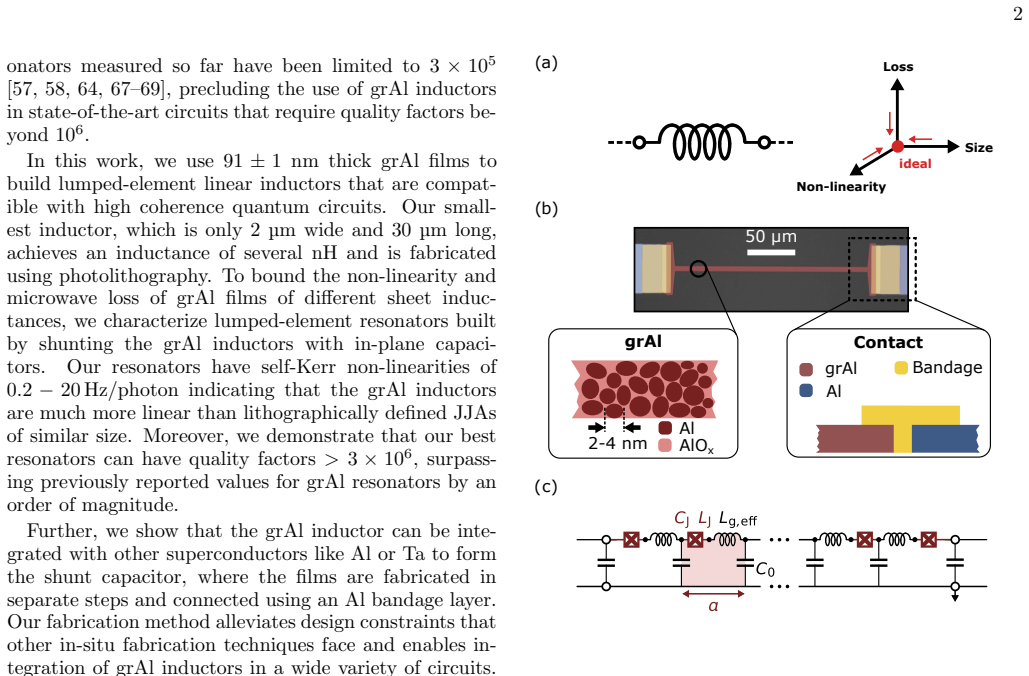
The argument runs through the kinetic inductance of granular aluminum and its description as a one-dimensional array of effective Josephson junctions. In the device, a narrow granular-aluminum strip carries more than 90 percent of the total inductance, so the resonator frequency is set by the sheet inductance times the number of squares; the self-Kerr coefficient is diluted roughly as $E_c/N_{\text{JJ}}^2$, which lets the authors infer an effective junction size of 10 to 30 nm from measured nonlinearities. For loss, the paper uses an energy-participation-ratio budget, $1/Q_{\text{int}} = 1/Q_{\text{bulk}} + 1/Q_{\text{surf}} + 1/Q_{\text{ind}} + 1/Q_{\text{contact}}$, with the substrate bulk term and surface participation computed by finite-element simulation, and the contact term relevant only for the hybrid devices.
What would settle it
Fabricate the same resonator layouts on sapphire substrates whose bulk dielectric loss is independently varied or measured, for example annealed versus unannealed wafers with known different loss tangents, and check whether the extracted residual loss of the granular-aluminum strip stays constant. If the residual-loss-versus-resistivity trend persists unchanged under a different substrate loss, the conductor-loss attribution is supported; if the trend tracks the substrate instead, the central loss conclusion is wrong.
Extended reading notes
Core claim
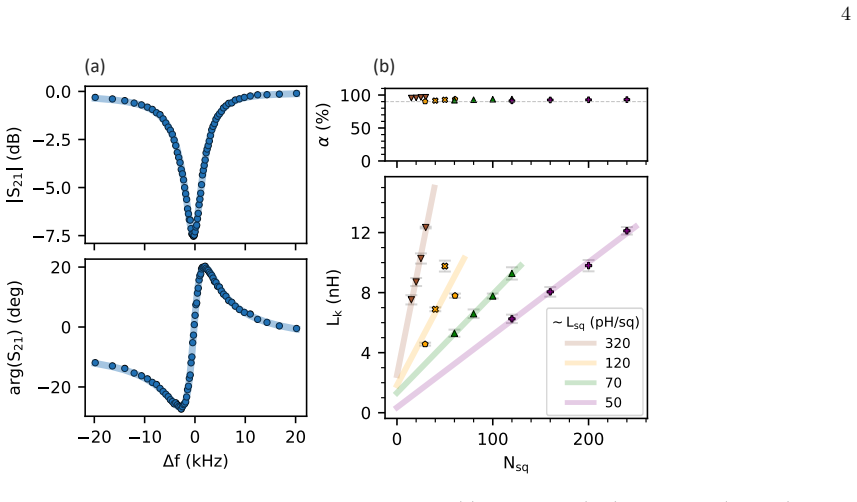
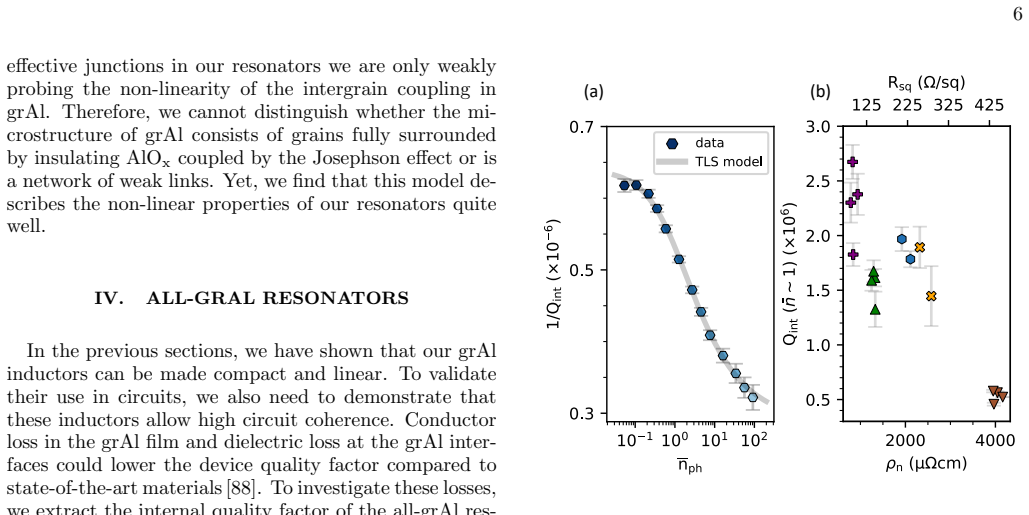
The central claim is that granular aluminum, in films about 90 nm thick, can serve as a linear inductive element whose performance is no longer the limiting factor in high-coherence circuits. The measured sheet inductance ranges from 30 to 320 pH/sq, so a few-nH inductor can be made in a strip only tens of micrometers long, up to 100 times more compact than a pure-aluminum geometric inductor; the self-Kerr nonlinearity stays at 0.2 to 20 Hz per photon, far below the linewidth. Internal quality factors at single-photon power reach $3.5 \times 10^6$ for all-granular-aluminum resonators and exceed $4.5 \times 10^6$ for hybrid granular-aluminum/tantalum devices. After subtracting the known bulk dielectric loss of the substrate, the remaining loss in the lowest-resistivity films is comparable to that of standard aluminum transmon circuits, and the increase of loss with film resistivity is attributed to conductor loss in the granular aluminum rather than to a worse surface dielectric. The paper also reports that quasiparticle relaxation after a high-energy impact occurs on millisecond timescales, matching aluminum transmons and contradicting earlier thin-film granular-aluminum results.
Load-bearing premise
The load-bearing premise is that the unannealed sapphire substrates have the bulk dielectric loss tangent measured previously, $(26.6 \pm 6.9) \times 10^{-8}$; because the best measured quality factors sit near the resulting bulk limit, a different substrate loss would change the attribution of the remaining loss and weaken the conclusion that low-resistivity granular-aluminum surface loss matches pure aluminum.
Editorial extensions
If this is right
- Granular-aluminum lumped-element inductors can serve as linear shunts in inductively shunted qubit designs without the footprint of geometric inductors.
- Compactness reduces the number of low-frequency parasitic modes compared with millimeter-long geometric inductors.
- Ex-situ bandage integration means granular-aluminum strips can be added to circuits whose capacitors are made from aluminum or tantalum with no measured increase in loss.
- Resistivity becomes a design knob with a known trade-off: lower resistivity gives higher internal quality factor and lower sheet inductance.
- At low resistivity, granular-aluminum surface loss is comparable to pure aluminum, so replacing aluminum with granular aluminum need not introduce extra surface dielectric losses.
Reading between the lines
- If the resistivity-loss trend is a general property of granular aluminum, coherence-critical qubit designs should favor low-resistivity strips even at the cost of area, while high-resistivity strips remain attractive for high-impedance applications such as spin-qubit readout.
- The ex-situ bandage contact is demonstrated only with aluminum and tantalum electrodes, but the same method may extend to other high-gap superconductors; that extension is not established by this paper.
- Because the inferred effective junction size is 10 to 30 nm, pushing strip dimensions toward that scale should eventually reveal single-junction nonlinear behavior, a regime the paper's model does not address.
- The fast millisecond quasiparticle relaxation, if reproduced in full qubit devices, would shorten the duration of radiation-induced frequency excursions compared with earlier thin-film granular-aluminum results.
Editorial analysis
A structured set of objections, weighed in public.
Referee Report
Summary. The manuscript reports the design, fabrication, and microwave characterization of lumped-element resonators whose inductance is dominated by the kinetic inductance of granular aluminum (grAl) films. The authors measure sheet inductances of 30–320 pH/sq, self-Kerr coefficients of 0.2–20 Hz/photon, and single-photon internal quality factors up to 3.5×10^6 for all-grAl devices and 4.7×10^6 for hybrid grAl/Ta devices. They also demonstrate ex-situ integration with Al and Ta capacitor electrodes using an Al bandage layer, study quasiparticle dynamics after high-energy impacts, and propose a loss budget separating bulk, surface, conductor, and contact losses. The central claim is that grAl inductors can be simultaneously compact, linear, low-loss, and compatible with standard Al/Ta circuit fabrication.
Significance. If the results hold, the paper delivers a practical solution to a recognized problem: a compact, linear, low-loss inductor for circuit QED that is lithographically simple and integrable with Al and Ta. The direct measurements are of high quality: Qint is extracted from transmission fits at single-photon powers, the self-Kerr from power-dependent frequency shifts, and Lk from frequency combined with FEM simulations of the geometry. The improvement over previous grAl resonators (best reported Q ~ 3×10^5) is substantial, and the large sample set with clear fabrication details in the appendices is a strength. The main weakness is the loss attribution: several conclusions rest on subtracting a literature bulk-loss value and on unmeasured contact losses. Nevertheless, the demonstrated Qint values themselves support the primary claim of low-loss inductors and should be of considerable interest to the circuit QED community.
major comments (3)
- [Sec. VI, Eq. (2), Fig. 6(c)] The conclusion that low-resistivity grAl has a surface loss factor similar to pure Al is not supported by the data as stated. For the best all-grAl device (GH23, rho_n = 555 uOhm cm, Qint = 3.66e6), subtracting the literature bulk loss of unannealed EFG sapphire (Gamma_bulk = (26.6 +/- 6.9)e-8, Qbulk ~ 4.5e6) gives a residual loss of about 5.1e-8, whereas the uncertainty in 1/Qbulk alone is about 5.8e-8. The residual is therefore consistent with zero, and the data can only place an upper bound on the grAl surface loss at this resistivity. Please propagate the bulk-loss uncertainty through Eq. (2) and rephrase the related claims in Sec. VI and the abstract (e.g., 'comparable to or lower than' instead of 'similar to').
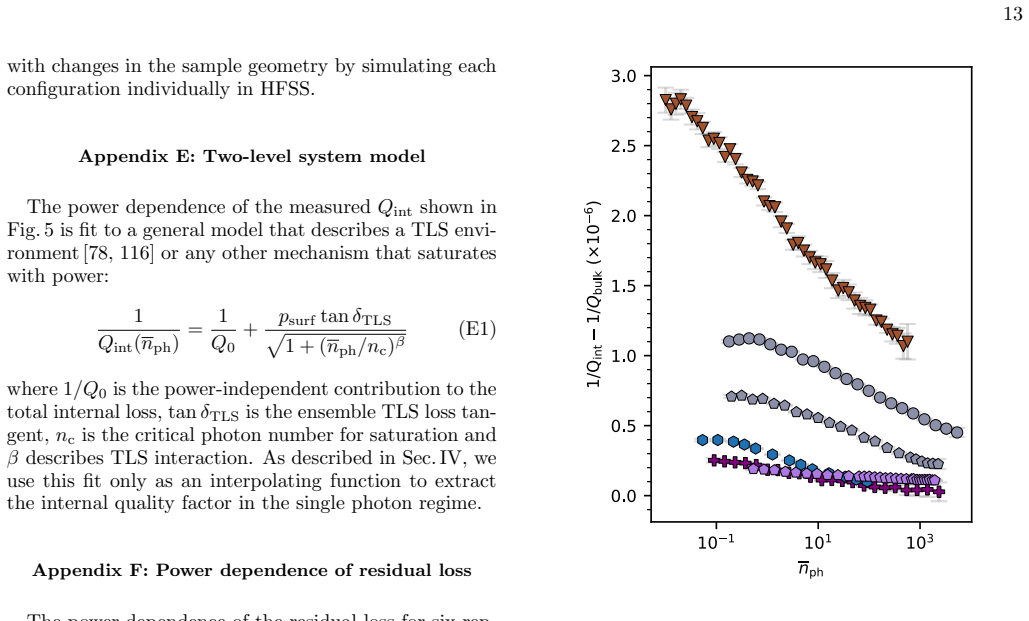
- [Sec. VI, App. F, Fig. 10] The attribution of the resistivity-dependent loss to conductor loss in the grAl strip is an inference rather than a unique conclusion. The residual loss shows a saturable power dependence (App. F), which is more typical of two-level-system or quasiparticle loss than of the classical conductor loss described by Q_ind in Eq. (2). In addition, the FEM participation calculation does not include dielectric loss in the AlOx grain-boundary network, whose volume fraction and disorder increase with oxygen content (i.e., with rho_n). The authors are appropriately cautious in the abstract ('could be explained'), but Sec. VI states 'we attribute their increasing losses with resistivity to an increase in conductor loss' without ruling out these alternatives. Please soften this claim and discuss how a multimodal analysis or an explicit grain-boundary loss model could distinguish the mechanisms.
- [Sec. V, Sec. VI] The claim that ex-situ hybrid integration does not increase total internal losses is not backed by an independent measurement of the bandage contact loss. As the authors state in Sec. I, contact losses are not measured separately, and Sec. VI acknowledges that Q_contact may have a resistivity dependence. While the comparable Qint of hybrid and all-grAl devices from the same wafers supports the practical utility of the bandage process, the loss budget in Eq. (2) is underdetermined for the hybrids: Q_contact is degenerate with Q_ind and Q_surf. An upper-bound estimate of contact loss (e.g., from devices with different numbers of contacts or contact areas) would strengthen the integration claim.
minor comments (6)
- [Sec. II vs App. B] The oxygen partial pressure during grAl deposition is given as ~5e-5 mbar in Sec. II and ~5e-5 Torr in App. B; these differ by a factor of 1.333. Please harmonize the units.
- [Sec. III.B] The equation for the self-Kerr coefficient appears as '|K| = p2Eca2/l2 strip' due to a typesetting error; it should read K = p^2 E_c a^2 / l_strip^2.
- [App. E, Eq. (E1)] The term 'psurf tan δTLSp' should be 'psurf tan δ_TLS' (missing underscore and space).
- [Table II] The header 'W afer' should be 'Wafer'.
- [Fig. 3(a)] The caption uses Q_i for internal quality factor while the text uses Qint; please unify the notation.
- [Sec. II] 'under coupled' should be 'undercoupled'.
Circularity Check
No significant circularity; the headline quantities are direct measurements and the loss decomposition rests on external benchmarks.
full rationale
The paper's central results—sheet inductance, self-Kerr coefficient, and single-photon internal quality factor—are directly measured. Qint and Qc are extracted by fitting the complex transmission (Eq. 1) with a circle-fit routine; Lk and Lsq are inferred from the measured resonance frequency plus FEM-simulated Lg and Cs; K is obtained from power-dependent frequency shifts. None of these quantities is defined in terms of a target conclusion. The effective-JJ model in Sec. III is used only to interpret K and to infer NJJ and Jc, and the authors explicitly state they cannot distinguish between competing microstructural pictures, so no conclusion is forced by that model. The loss analysis in Sec. VI subtracts the bulk dielectric loss of unannealed EFG sapphire using Gamma_bulk = (26.6 +/- 6.9) x 10^-8 from Refs. [10,76]. Those are prior measurements by overlapping authors, but they are independent, externally falsifiable material benchmarks, not outputs of the present fitting procedure. The grAl surface-loss comparison follows from comparing residual loss Q_res^-1 = Q_int^-1 - Q_bulk^-1 with FEM participation ratios; it is an inference, not a construction. The paper explicitly flags its limitations: it does not independently measure the bandage-contact loss, and the best-device residual loss is small relative to the uncertainty in the bulk-loss benchmark. These caveats weaken certainty in the loss attribution (correctness risk), but they do not make any step circular. No equation reduces to its own input, and no fitted parameter is renamed as a prediction.
Assumptions & free parameters
free parameters (3)
- Sheet inductance Lsq per wafer =
30-320 pH/sq
- TLS saturation model parameters (Q0, tanδ_TLS, nc, beta) =
not tabulated per device
- Quasiparticle recombination/trapping/generation rates =
all-grAl: r=1/(16±3 ns), s=1/(1.3±0.2 ms); grAl/Ta: r=1/(30±3 ns), s=1/(2.9±0.3 ms)
assumptions (6)
- standard math The hanger transmission model S21(ω) with complex external coupling and circle fitting yields unbiased estimates of Qint and Qc.
- domain assumption Kinetic inductance fraction alpha and total Lk are obtained from measured frequency and FEM-simulated geometric inductance Lg and capacitance Cs.
- domain assumption The loss budget separates into bulk, surface, inductor, and contact losses with known external loss factors, including bulk sapphire loss tangent (26.6±6.9)e-8 from Refs [10,76].
- domain assumption The grAl inductor strip is modeled as a 1D array of effective Josephson junctions with homogeneous phase drop, giving K = p^2 Ec/N_JJ^2.
- domain assumption The power dependence of internal loss follows a generic saturable model, 1/Q(nph)=1/Q0 + psurf tanδ_TLS / (1+(nph/nc)^beta), used to interpolate single-photon Qint.
- domain assumption Quasiparticle recombination-trapping-generation model dx/dt = -r x^2 - s x + g and the frequency-shift relation δf/f = -alpha/4 δx_qp describe post-impact recovery.
Cite this review
Pith. "Pith review of Low loss lumped-element inductors made from granular aluminum." pith.science (2026). https://pith.science/paper/FMVA5H4F
@misc{pith2026241112611,
  author       = {Pith},
  title        = {Pith review of: Low loss lumped-element inductors made from granular aluminum},
  year         = {2026},
  howpublished = {\url{https://pith.science/paper/FMVA5H4F}},
  note         = {Machine review of arXiv:2411.12611}
}
abstract
Lumped-element inductors are an integral component in the circuit QED toolbox. However, it is challenging to build inductors that are simultaneously compact, linear and low-loss with standard approaches that either rely on the geometric inductance of superconducting thin films or on the kinetic inductance of Josephson junctions arrays. In this work, we overcome this challenge by utilizing the high kinetic inductance offered by superconducting granular aluminum (grAl). We demonstrate lumped-element inductors with a few nH of inductance that are up to $100$ times more compact than inductors built from pure aluminum (Al). To characterize the properties of these linear inductors, we first report on the performance of lumped-element resonators built entirely out of grAl with sheet inductances varying from $30-320\,$pH/sq and self-Kerr non-linearities of $0.2-20\,\mathrm{Hz/photon}$. Further, we demonstrate ex-situ integration of these grAl inductors into hybrid resonators with Al or tantalum (Ta) capacitor electrodes without increasing total internal losses. Interestingly, the measured internal quality factors systematically decrease with increasing room-temperature resistivity of the grAl film for all devices, indicating a trade-off between compactness and internal loss. For our lowest resistivity grAl films, we measure quality factors reaching $3.5 \times 10^6$ for the all-grAl devices and $4.5 \times 10^6$ for the hybrid grAl/Ta devices, similar to state-of-the-art quantum circuits. Our loss analysis suggests that the surface loss factor of grAl is similar to that of pure Al for our lowest resistivity films, while the increasing losses with resistivity could be explained by increasing conductor loss in the grAl film.
Figures

Figures from the paper (10 more)





Forward citations
Cited by 1 Pith paper
-
A Blueprint for Equilibrium-Based Differentiable Continuous-Variable Thermodynamic Computing
Tunable energy landscapes whose thermal averages equal sigmoid, softmax, and matrix-vector products can, in principle, form the basis of a low-energy analog computer, with a superconducting double-well device as a fir...
Reference graph
Works this paper leans on
-
[1]
Arute, K
F. Arute, K. Arya, R. Babbush, D. Bacon, J. C. Bardin, R. Barends, R. Biswas, S. Boixo, F. G. S. L. Brandao, D. A. Buell, et al. , Quantum supremacy using a pro- grammable superconducting processor, Nature 574, 505 (2019)
2019
-
[2]
Z. Chen, K. J. Satzinger, J. Atalaya, A. N. Korotkov, A. Dunsworth, D. Sank, C. Quintana, M. McEwen, R. Barends, P. V. Klimov, et al. , Exponential suppres- sion of bit or phase errors with cyclic error correction, Nature 595, 383 (2021)
2021
-
[3]
Jurcevic, A
P. Jurcevic, A. Javadi-Abhari, L. S. Bishop, I. Lauer, D. F. Bogorin, M. Brink, L. Capelluto, O. G¨ unl¨ uk, T. Itoko, N. Kanazawa, A. Kandala, G. A. Keefe, K. Kr- sulich, W. Landers, E. P. Lewandowski, D. T. McClure, G. Nannicini, A. Narasgond, H. M. Nayfeh, E. Pritchett, M. B. Rothwell, S. Srinivasan, N. Sundaresan, C. Wang, K. X. Wei, C. J. Wood, J.-B....
2021
-
[4]
Bravyi, O
S. Bravyi, O. Dial, J. M. Gambetta, D. Gil, and Z. Nazario, The future of quantum computing with su- perconducting qubits, Journal of Applied Physics 132, 160902 (2022)
2022
-
[5]
Xu, Z.-Z
S. Xu, Z.-Z. Sun, K. Wang, L. Xiang, Z. Bao, Z. Zhu, F. Shen, Z. Song, P. Zhang, W. Ren, et al., Digital sim- ulation of projective non-abelian anyons with 68 super- conducting qubits, Chinese Physics Letters 40, 060301 (2023)
2023
-
[6]
R. Acharya, L. Aghababaie-Beni, I. Aleiner, T. I. An- dersen, M. Ansmann, F. Arute, K. Arya, A. Asfaw, N. Astrakhantsev, J. Atalaya,et al., Quantum error cor- rection below the surface code threshold, arXiv (2024), arXiv:2408.13687 [quant-ph]
arXiv 2024
-
[7]
Reagor, H
M. Reagor, H. Paik, G. Catelani, L. Sun, C. Axline, E. Holland, I. M. Pop, N. A. Masluk, T. Brecht, L. Frun- zio, M. H. Devoret, L. Glazman, and R. J. Schoelkopf, Reaching 10 ms single photon lifetimes for supercon- ducting aluminum cavities, Applied Physics Letters 102, 192604 (2013)
2013
-
[8]
Reagor, W
M. Reagor, W. Pfaff, C. Axline, R. W. Heeres, N. Ofek, K. Sliwa, E. Holland, C. Wang, J. Blumoff, K. Chou, M. J. Hatridge, L. Frunzio, M. H. Devoret, L. Jiang, and R. J. Schoelkopf, Quantum memory with millisec- ond coherence in circuit QED, Phys. Rev. B 94, 014506 (2016)
2016
Show all 124 references
-
[9]
Axline, M
C. Axline, M. Reagor, R. Heeres, P. Reinhold, C. Wang, K. Shain, W. Pfaff, Y. Chu, L. Frunzio, and R. J. Schoelkopf, An architecture for integrating planar and 3D cQED devices, Applied Physics Letters 109, 042601 (2016)
2016
-
[10]
Ganjam, Y
S. Ganjam, Y. Wang, Y. Lu, A. Banerjee, C. U. Lei, L. Krayzman, K. Kisslinger, C. Zhou, R. Li, Y. Jia, M. Liu, L. Frunzio, and R. J. Schoelkopf, Surpassing millisecond coherence in on chip superconducting quan- tum memories by optimizing materials and circuit de- sign, Nature ...
2024
-
[11]
A. O. Niskanen, K. Harrabi, F. Yoshihara, Y. Naka- mura, S. Lloyd, and J. S. Tsai, Quantum coherent tun- able coupling of superconducting qubits, Science 316, 723 (2007)
2007
-
[12]
Y. Chen, C. Neill, P. Roushan, N. Leung, M. Fang, R. Barends, J. Kelly, B. Campbell, Z. Chen, B. Chiaro, et al. , Qubit architecture with high coherence and fast tunable coupling, Phys. Rev. Lett. 113, 220502 (2014)
2014
-
[13]
I. N. Moskalenko, I. A. Simakov, N. N. Abramov, A. A. Grigorev, D. O. Moskalev, A. A. Pishchimova, N. S. Smirnov, E. V. Zikiy, I. A. Rodionov, and I. S. Besedin, High fidelity two-qubit gates on fluxoniums using a tun- able coupler, npj Quantum Information 8, 130 (2022)
2022
-
[14]
L. Ding, M. Hays, Y. Sung, B. Kannan, J. An, A. Di Paolo, A. H. Karamlou, T. M. Hazard, K. Azar, D. K. Kim, B. M. Niedzielski, A. Melville, M. E. Schwartz, J. L. Yoder, T. P. Orlando, S. Gustavsson, J. A. Grover, K. Serniak, and W. D. Oliver, High- fidelity, frequency-flexible...
2023
-
[15]
Marxer, A
F. Marxer, A. Veps¨ al¨ ainen, S. W. Jolin, J. Tuorila, A. Landra, C. Ockeloen-Korppi, W. Liu, O. Ahonen, A. Auer, L. Belzane, V. Bergholm, C. F. Chan, K. W. Chan, T. Hiltunen, J. Hotari, E. Hyypp¨ a, J. Ikonen, D. Janzso, M. Koistinen, J. Kotilahti, T. Li, J. Luus, M. Papic, ...
2023
-
[16]
Jeffrey, D
E. Jeffrey, D. Sank, J. Y. Mutus, T. C. White, J. Kelly, R. Barends, Y. Chen, Z. Chen, B. Chiaro, A. Dunsworth, A. Megrant, P. J. J. O’Malley, C. Neill, P. Roushan, A. Vainsencher, J. Wenner, A. N. Cleland, and J. M. Martinis, Fast accurate state measurement with superconducti...
2014
-
[17]
Walter, P
T. Walter, P. Kurpiers, S. Gasparinetti, P. Mag- nard, A. Potoˇ cnik, Y. Salath´ e, M. Pechal, M. Mondal, M. Oppliger, C. Eichler, and A. Wallraff, Rapid high- fidelity single-shot dispersive readout of superconduct- ing qubits, Phys. Rev. Appl. 7, 054020 (2017)
2017
-
[18]
Sunada, K
Y. Sunada, K. Yuki, Z. Wang, T. Miyamura, J. Ilves, K. Matsuura, P. A. Spring, S. Tamate, S. Kono, and Y. Nakamura, Photon-noise-tolerant dispersive readout of a superconducting qubit using a nonlinear Purcell filter, PRX Quantum 5, 010307 (2024)
2024
-
[19]
Hazra, W
S. Hazra, W. Dai, T. Connolly, P. D. Kurilovich, Z. Wang, L. Frunzio, and M. H. Devoret, Benchmark- ing the readout of a superconducting qubit for repeated measurements, arXiv (2024), arXiv:2407.10934 [quant- ph]
2024 arXiv
-
[20]
I. M. Pop, K. Geerlings, G. Catelani, R. J. Schoelkopf, L. I. Glazman, and M. H. Devoret, Coherent suppression of electromagnetic dissipation due to superconducting quasiparticles, Nature 508, 369 (2014)
2014
-
[21]
Hassani, M
F. Hassani, M. Peruzzo, L. N. Kapoor, A. Trioni, M. Zemlicka, and J. M. Fink, Inductively shunted trans- mons exhibit noise insensitive plasmon states and a fluxon decay exceeding 3 hours, Nature Communica- tions 14, 3968 (2023). 18
2023
-
[22]
Y. Xu, J. Chu, J. Yuan, J. Qiu, Y. Zhou, L. Zhang, X. Tan, Y. Yu, S. Liu, J. Li, F. Yan, and D. Yu, High-fidelity, high-scalability two-qubit gate scheme for superconducting qubits, Phys. Rev. Lett. 125, 240503 (2020)
2020
-
[23]
B. J. Chapman, S. J. de Graaf, S. H. Xue, Y. Zhang, J. Teoh, J. C. Curtis, T. Tsunoda, A. Eickbusch, A. P. Read, A. Koottandavida, S. O. Mundhada, L. Frunzio, M. Devoret, S. Girvin, and R. Schoelkopf, High-on-off- ratio beam-splitter interaction for gates on bosonically encode...
2023
-
[24]
Y. Lu, A. Maiti, J. W. O. Garmon, S. Ganjam, Y. Zhang, J. Claes, L. Frunzio, S. M. Girvin, and R. J. Schoelkopf, High-fidelity parametric beamsplitting with a parity-protected converter, Nature Communications 14, 5767 (2023)
2023
-
[25]
Verney, R
L. Verney, R. Lescanne, M. H. Devoret, Z. Leghtas, and M. Mirrahimi, Structural instability of driven Josephson circuits prevented by an inductive shunt, Phys. Rev. Appl. 11, 024003 (2019)
2019
-
[26]
Gusenkova, M
D. Gusenkova, M. Spiecker, R. Gebauer, M. Willsch, D. Willsch, F. Valenti, N. Karcher, L. Gr¨ unhaupt, I. Takmakov, P. Winkel, D. Rieger, A. V. Ustinov, N. Roch, W. Wernsdorfer, K. Michielsen, O. Sander, and I. M. Pop, Quantum Nondemolition Dispersive Readout of a Superconduct...
2021
-
[27]
Geisert, S
S. Geisert, S. Ihssen, P. Winkel, M. Spiecker, M. Fechant, P. Paluch, N. Gosling, N. Zapata, S. G¨ unzler, D. Rieger, D. B´ enˆ atre, T. Reisinger, W. Wernsdorfer, and I. M. Pop, Pure kinetic inductance coupling for cQED with flux qubits, Applied Physics Letters 125, 064002 (2024)
2024
-
[28]
J. E. Mooij, T. P. Orlando, L. Levitov, L. Tian, C. H. van der Wal, and S. Lloyd, Josephson persistent-current qubit, Science 285, 1036 (1999)
1999
-
[29]
V. E. Manucharyan, J. Koch, L. I. Glazman, and M. H. Devoret, Fluxonium: Single Cooper-pair circuit free of charge offsets, Science 326, 113 (2009)
2009
-
[30]
J. Koch, V. Manucharyan, M. H. Devoret, and L. I. Glazman, Charging effects in the inductively shunted Josephson junction, Phys. Rev. Lett. 103, 217004 (2009)
2009
-
[31]
F. Yan, Y. Sung, P. Krantz, A. Kamal, D. K. Kim, J. L. Yoder, T. P. Orlando, S. Gustavsson, and W. D. Oliver, Engineering framework for optimizing superconducting qubit designs (2020), arXiv:2006.04130 [quant-ph]
2020 arXiv
-
[32]
Y. Ye, K. Peng, M. Naghiloo, G. Cunningham, and K. P. O’Brien, Engineering purely nonlinear coupling between superconducting qubits using a quarton, Phys. Rev. Lett. 127, 050502 (2021)
2021
-
[33]
Kalacheva, G
D. Kalacheva, G. Fedorov, J. Zotova, S. Kadyrmetov, A. Kirkovskii, A. Dmitriev, and O. Astafiev, Kinemon: An inductively shunted transmon artificial atom, Phys. Rev. Appl. 21, 024058 (2024)
2024
-
[34]
N. E. Frattini, U. Vool, S. Shankar, A. Narla, K. M. Sliwa, and M. H. Devoret, 3-wave mixing Josephson dipole element, Applied Physics Letters 110, 222603 (2017)
2017
-
[35]
U. Vool, A. Kou, W. C. Smith, N. E. Frattini, K. Ser- niak, P. Reinhold, I. M. Pop, S. Shankar, L. Frunzio, S. M. Girvin, and M. H. Devoret, Driving forbidden transitions in the fluxonium artificial atom, Phys. Rev. Appl. 9, 054046 (2018)
2018
-
[36]
Lescanne, M
R. Lescanne, M. Villiers, T. Peronnin, A. Sarlette, M. Delbecq, B. Huard, T. Kontos, M. Mirrahimi, and Z. Leghtas, Exponential suppression of bit-flips in a qubit encoded in an oscillator, Nature Physics 16, 509 (2020)
2020
-
[37]
Peruzzo, A
M. Peruzzo, A. Trioni, F. Hassani, M. Zemlicka, and J. M. Fink, Surpassing the resistance quantum with a geometric superinductor, Phys. Rev. Appl. 14, 044055 (2020)
2020
-
[38]
Peruzzo, F
M. Peruzzo, F. Hassani, G. Szep, A. Trioni, E. Red- chenko, M. ˇZemliˇ cka, and J. M. Fink, Geometric su- perinductance qubits: Controlling phase delocalization across a single Josephson junction, PRX Quantum 2, 040341 (2021)
2021
-
[39]
N. A. Masluk, I. M. Pop, A. Kamal, Z. K. Minev, and M. H. Devoret, Microwave characterization of Joseph- son junction arrays: Implementing a low loss superin- ductance, Phys. Rev. Lett. 109, 137002 (2012)
2012
-
[40]
L. B. Nguyen, Y.-H. Lin, A. Somoroff, R. Mencia, N. Grabon, and V. E. Manucharyan, High-coherence fluxonium qubit, Phys. Rev. X 9, 041041 (2019)
2019
-
[41]
Kuzmin, R
R. Kuzmin, R. Mencia, N. Grabon, N. Mehta, Y.-H. Lin, and V. E. Manucharyan, Quantum electrodynamics of a superconductor–insulator phase transition, Nature Physics 15, 930 (2019)
2019
-
[42]
I. V. Pechenezhskiy, R. A. Mencia, L. B. Nguyen, Y.- H. Lin, and V. E. Manucharyan, The superconducting quasicharge qubit, Nature 585, 368 (2020)
2020
-
[43]
Zhang, S
H. Zhang, S. Chakram, T. Roy, N. Earnest, Y. Lu, Z. Huang, D. K. Weiss, J. Koch, and D. I. Schuster, Universal fast-flux control of a coherent, low-frequency qubit, Phys. Rev. X 11, 011010 (2021)
2021
-
[44]
D. G. Ferguson, A. A. Houck, and J. Koch, Symme- tries and collective excitations in large superconducting circuits, Phys. Rev. X 3, 011003 (2013)
2013
-
[45]
Weißl, B
T. Weißl, B. K¨ ung, E. Dumur, A. K. Feofanov, I. Matei, C. Naud, O. Buisson, F. W. J. Hekking, and W. Guichard, Kerr coefficients of plasma resonances in Josephson junction chains, Phys. Rev. B 92, 104508 (2015)
2015
-
[46]
Viola and G
G. Viola and G. Catelani, Collective modes in the flux- onium qubit, Phys. Rev. B 92, 224511 (2015)
2015
-
[47]
Di Paolo, T
A. Di Paolo, T. E. Baker, A. Foley, D. S´ en´ echal, and A. Blais, Efficient modeling of superconducting quan- tum circuits with tensor networks, npj Quantum Infor- mation 7, 11 (2021)
2021
-
[48]
A. J. Annunziata, D. F. Santavicca, L. Frunzio, G. Cate- lani, M. J. Rooks, A. Frydman, and D. E. Prober, Tunable superconducting nanoinductors, Nanotechnol- ogy 21, 445202 (2010)
2010
-
[49]
S. Ohya, B. Chiaro, A. Megrant, C. Neill, R. Barends, Y. Chen, J. Kelly, D. Low, J. Mutus, P. J. J. O’Malley, P. Roushan, D. Sank, A. Vainsencher, J. Wenner, T. C. White, Y. Yin, B. D. Schultz, C. J. Palmstrøm, B. A. Mazin, A. N. Cleland, and J. M. Martinis, Room tem- perature...
2014
-
[50]
Bruno, G
A. Bruno, G. De Lange, S. Asaad, K. L. Van Der En- den, N. K. Langford, and L. DiCarlo, Reducing intrinsic loss in superconducting resonators by surface treatment and deep etching of silicon substrates, Applied Physics Letters 106, 182601 (2015). 19
2015
-
[51]
Dupr´ e, A
O. Dupr´ e, A. Beno ˆ ıt, M. Calvo, A. Catalano, J. Goupy, C. Hoarau, T. Klein, K. L. Calvez, B. Sac´ ep´ e, A. Mon- fardini, and F. Levy-Bertrand, Tunable sub-gap radia- tion detection with superconducting resonators, Super- conductor Science and Technology 30, 045007 (2017)
2017
-
[52]
Shearrow, G
A. Shearrow, G. Koolstra, S. J. Whiteley, N. Earnest, P. S. Barry, F. J. Heremans, D. D. Awschalom, E. Shi- rokoff, and D. I. Schuster, Atomic layer deposition of titanium nitride for quantum circuits, Applied Physics Letters 113, 212601 (2018)
2018
-
[53]
Joshi, W
C. Joshi, W. Chen, H. G. LeDuc, P. K. Day, and M. Mirhosseini, Strong Kinetic-Inductance Kerr Non- linearity with Titanium Nitride Nanowires, Physical Re- view Applied 18, 064088 (2022)
2022
-
[54]
Frasca, I
S. Frasca, I. Arabadzhiev, S. B. de Puechredon, F. Oppliger, V. Jouanny, R. Musio, M. Scigliuzzo, F. Minganti, P. Scarlino, and E. Charbon, NbN films with high kinetic inductance for high-quality com- pact superconducting resonators, Phys. Rev. Appl. 20, 044021 (2023)
2023
-
[55]
A. Bahr, M. Boselli, B. Huard, and A. Bienfait, Im- proving magnetic-field resilience of NbTiN planar res- onators using a hard-mask fabrication technique, Ap- plied Physics Letters 124, 114004 (2024)
2024
-
[56]
Charpentier, D
T. Charpentier, D. Perconte, S. L´ eger, K. R. Amin, F. Blondelle, F. Gay, O. Buisson, L. Ioffe, A. Khvalyuk, I. Poboiko, M. Feigel’man, N. Roch, and B. Sac´ ep´ e, First-order quantum breakdown of superconductiv- ity in amorphous superconductors, arXiv (2024), arXiv:2404.0985...
2024 arXiv
-
[57]
Gr¨ unhaupt, N
L. Gr¨ unhaupt, N. Maleeva, S. T. Skacel, M. Calvo, F. Levy-Bertrand, A. V. Ustinov, H. Rotzinger, A. Mon- fardini, G. Catelani, and I. M. Pop, Loss Mechanisms and Quasiparticle Dynamics in Superconducting Mi- crowave Resonators Made of Thin-Film Granular Alu- minum, Physical ...
2018
-
[58]
Zhang, K
W. Zhang, K. Kalashnikov, W.-S. Lu, P. Kamenov, T. DiNapoli, and M. Gershenson, Microresonators Fab- ricated from High-Kinetic-Inductance Aluminum Films, Physical Review Applied 11, 011003 (2019)
2019
-
[59]
Kristen, J
M. Kristen, J. N. Voss, M. Wildermuth, H. Rotzinger, and A. V. Ustinov, Random telegraph fluctuations in granular microwave resonators, Applied Physics Letters 122, 202602 (2023)
2023
-
[60]
R. W. Cohen and B. Abeles, Superconductivity in gran- ular aluminum films, Phys. Rev. 168, 444 (1968)
1968
-
[61]
Deutscher, H
G. Deutscher, H. Fenichel, M. Gershenson, E. Gr¨ unbaum, and Z. Ovadyahu, Transition to zero dimensionality in granular aluminum supercon- ducting films, Journal of Low Temperature Physics 10, 231 (1973)
1973
-
[62]
Deutscher, M
G. Deutscher, M. Gershenson, E. Gr¨ unbaum, and Y. Imry, Granular Superconducting Films, Journal of Vacuum Science and Technology 10, 697 (1973)
1973
-
[63]
F. Yang, T. Gozlinski, T. Storbeck, L. Gr¨ unhaupt, I. M. Pop, and W. Wulfhekel, Microscopic charging and in-gap states in superconducting granular aluminum, Physical Review B 102, 104502 (2020)
2020
-
[64]
Maleeva, L
N. Maleeva, L. Gr¨ unhaupt, T. Klein, F. Levy-Bertrand, O. Dupre, M. Calvo, F. Valenti, P. Winkel, F. Friedrich, W. Wernsdorfer, A. V. Ustinov, H. Rotzinger, A. Mon- fardini, M. V. Fistul, and I. M. Pop, Circuit quantum electrodynamics of granular aluminum resonators, Na- ture...
2018
-
[65]
Gr¨ unhaupt, M
L. Gr¨ unhaupt, M. Spiecker, D. Gusenkova, N. Maleeva, S. T. Skacel, I. Takmakov, F. Valenti, P. Winkel, H. Rotzinger, W. Wernsdorfer, A. V. Ustinov, and I. M. Pop, Granular aluminium as a superconducting material for high-impedance quantum circuits, Nature Materials 18, 816 (2019)
2019
-
[66]
Rieger, S
D. Rieger, S. G¨ unzler, M. Spiecker, P. Paluch, P. Winkel, L. Hahn, J. K. Hohmann, A. Bacher, W. Wernsdorfer, and I. M. Pop, Granular aluminium nanojunction fluxonium qubit, Nature Materials22, 194 (2023)
2023
-
[67]
Rotzinger, S
H. Rotzinger, S. T. Skacel, M. Pfirrmann, J. N. Voss, J. M¨ unzberg, S. Probst, P. Bushev, M. P. Weides, A. V. Ustinov, and J. E. Mooij, Aluminium-oxide wires for su- perconducting high kinetic inductance circuits, Super- conductor Science and Technology 30, 025002 (2017)
2017
-
[68]
Borisov, D
K. Borisov, D. Rieger, P. Winkel, F. Henriques, F. Valenti, A. Ionita, M. Wessbecher, M. Spiecker, D. Gusenkova, I. M. Pop, and W. Wernsdorfer, Super- conducting granular aluminum resonators resilient to magnetic fields up to 1 Tesla, Applied Physics Letters 117, 120502 (2020)
2020
-
[69]
Q. He, P. OuYang, M. Dai, H. Guan, J. Hu, S. He, Y. Wang, and L. F. Wei, Lumped element granular alu- minum resonators with high kinetic inductances, AIP Advances 11, 065204 (2021)
2021
-
[70]
C. Wang, Y. Y. Gao, I. M. Pop, U. Vool, C. Axline, T. Brecht, R. W. Heeres, L. Frunzio, M. H. Devoret, G. Catelani, L. I. Glazman, and R. J. Schoelkopf, Mea- surement and control of quasiparticle dynamics in a su- perconducting qubit, Nature Communications 5, 5836 (2014)
2014
-
[71]
Henriques, F
F. Henriques, F. Valenti, T. Charpentier, M. Lagoin, C. Gouriou, M. Mart ´ ınez, L. Cardani, M. Vignati, L. Gr¨ unhaupt, D. Gusenkova, J. Ferrero, S. T. Skacel, W. Wernsdorfer, A. V. Ustinov, G. Catelani, O. Sander, and I. M. Pop, Phonon traps reduce the quasiparti- cle densit...
2019
-
[72]
H. Paik, D. I. Schuster, L. S. Bishop, G. Kirchmair, G. Catelani, A. P. Sears, B. Johnson, M. Reagor, L. Frunzio, L. I. Glazman, et al. , Observation of high coherence in Josephson junction qubits measured in a three-dimensional circuit QED architecture, Physical Review Letter...
2011
-
[73]
C. Wang, C. Axline, Y. Y. Gao, T. Brecht, Y. Chu, L. Frunzio, M. Devoret, and R. J. Schoelkopf, Sur- face participation and dielectric loss in superconducting qubits, Applied Physics Letters 107 (2015)
2015
-
[74]
C. U. Lei, S. Ganjam, L. Krayzman, A. Baner- jee, K. Kisslinger, S. Hwang, L. Frunzio, and R. J. Schoelkopf, Characterization of microwave loss using multimode superconducting resonators, Physical Re- view Applied 20, 024045 (2023)
2023
-
[75]
D. C. Mattis and J. Bardeen, Theory of the anomalous skin effect in normal and superconducting metals, Phys- ical Review 111, 412 (1958)
1958
-
[76]
A. P. Read, B. J. Chapman, C. U. Lei, J. C. Cur- tis, S. Ganjam, L. Krayzman, L. Frunzio, and R. J. Schoelkopf, Precision Measurement of the Microwave Dielectric Loss of Sapphire in the Quantum Regime with Parts-per-Billion Sensitivity, Physical Review Applied 19, 034064 (2023). 20
2023
-
[77]
Rieger, S
D. Rieger, S. G¨ unzler, M. Spiecker, A. Nambisan, W. Wernsdorfer, and I. Pop, Fano interference in mi- crowave resonator measurements, Phys. Rev. Appl. 20, 014059 (2023)
2023
-
[78]
Gao, The physics of superconducting microwave res- onators, PhD thesis (2008)
J. Gao, The physics of superconducting microwave res- onators, PhD thesis (2008)
2008
-
[79]
M. S. Khalil, M. Stoutimore, F. Wellstood, and K. Os- born, An analysis method for asymmetric resonator transmission applied to superconducting devices, Jour- nal of Applied Physics 111 (2012)
2012
-
[80]
Probst, F
S. Probst, F. Song, P. A. Bushev, A. V. Ustinov, and M. Weides, Efficient and robust analysis of complex scattering data under noise in microwave resonators, Re- view of Scientific Instruments 86 (2015)
2015
-
[81]
Eichler and A
C. Eichler and A. Wallraff, Controlling the dynamic range of a Josephson parametric amplifier, EPJ Quan- tum Technology 1, 2 (2014)
2014
-
[82]
Winkel, K
P. Winkel, K. Borisov, L. Gr¨ unhaupt, D. Rieger, M. Spiecker, F. Valenti, A. V. Ustinov, W. Wernsdorfer, and I. M. Pop, Implementation of a Transmon Qubit Using Superconducting Granular Aluminum, Physical Review X 10, 031032 (2020)
2020
-
[83]
J. Koch, T. M. Yu, J. Gambetta, A. A. Houck, D. I. Schuster, J. Majer, A. Blais, M. H. Devoret, S. M. Girvin, and R. J. Schoelkopf, Charge-insensitive qubit design derived from the Cooper pair box, Phys. Rev. A 76, 042319 (2007)
2007
-
[84]
Z. K. Minev, Z. Leghtas, S. O. Mundhada, L. Christakis, I. M. Pop, and M. H. Devoret, Energy-participation quantization of Josephson circuits, npj Quantum Infor- mation 7, 131 (2021)
2021
-
[85]
Friedrich, P
F. Friedrich, P. Winkel, K. Borisov, H. Seeger, C. S¨ urgers, I. M. Pop, and W. Wernsdorfer, Onset of phase diffusion in high kinetic inductance granular alu- minum micro-squids, Superconductor Science and Tech- nology 32, 125008 (2019)
2019
-
[86]
Winkel, Superconducting quantum circuits for hybrid architectures, PhD thesis (2020)
P. Winkel, Superconducting quantum circuits for hybrid architectures, PhD thesis (2020)
2020
-
[87]
Romijn, T
J. Romijn, T. Klapwijk, M. Renne, and J. Mooij, Criti- cal pair-breaking current in superconducting aluminum strips far below Tc, Physical Review B 26, 3648 (1982)
1982
-
[88]
C. R. H. McRae, H. Wang, J. Gao, M. R. Vissers, T. Brecht, A. Dunsworth, D. P. Pappas, and J. Mutus, Materials loss measurements using superconducting mi- crowave resonators, Review of Scientific Instruments91, 091101 (2020)
2020
-
[89]
R. C. Dynes, J. P. Garno, G. B. Hertel, and T. P. Or- lando, Tunneling study of superconductivity near the metal-insulator transition, Phys. Rev. Lett. 53, 2437 (1984)
1984
-
[90]
Bachar, S
N. Bachar, S. Lerer, A. Levy, S. Hacohen-Gourgy, B. Almog, H. Saadaoui, Z. Salman, E. Morenzoni, and G. Deutscher, Mott transition in granular aluminum, Phys. Rev. B 91, 041123 (2015)
2015
-
[91]
A. P. Place, L. V. Rodgers, P. Mundada, B. M. Smitham, M. Fitzpatrick, Z. Leng, A. Premkumar, J. Bryon, A. Vrajitoarea, S. Sussman, et al., New mate- rial platform for superconducting transmon qubits with coherence times exceeding 0.3 milliseconds, Nature com- munications 12, ...
2021
-
[92]
C. Wang, X. Li, H. Xu, Z. Li, J. Wang, Z. Yang, Z. Mi, X. Liang, T. Su, C. Yang, G. Wang, W. Wang, Y. Li, M. Chen, C. Li, K. Linghu, J. Han, Y. Zhang, Y. Feng, Y. Song, T. Ma, J. Zhang, R. Wang, P. Zhao, W. Liu, G. Xue, Y. Jin, and H. Yu, Towards practical quantum computers: t...
2022
-
[93]
K. D. Crowley, R. A. McLellan, A. Dutta, N. Shumiya, A. P. M. Place, X. H. Le, Y. Gang, T. Madhavan, M. P. Bland, R. Chang, N. Khedkar, Y. C. Feng, E. A. Um- barkar, X. Gui, L. V. H. Rodgers, Y. Jia, M. M. Feld- man, S. A. Lyon, M. Liu, R. J. Cava, A. A. Houck, and N. P. de Le...
2023
-
[94]
M. V. P. Alto´ e, A. Banerjee, C. Berk, A. Hajr, A. Schwartzberg, C. Song, M. Alghadeer, S. Aloni, M. J. Elowson, J. M. Kreikebaum, E. K. Wong, S. M. Griffin, S. Rao, A. Weber-Bargioni, A. M. Minor, D. I. Santiago, S. Cabrini, I. Siddiqi, and D. F. Ogletree, Localization and m...
2022
-
[95]
M. Bal, A. A. Murthy, S. Zhu, F. Crisa, X. You, Z. Huang, T. Roy, J. Lee, D. v. Zanten, R. Pilipenko, I. Nekrashevich, A. Lunin, D. Bafia, Y. Krasnikova, C. J. Kopas, E. O. Lachman, D. Miller, J. Y. Mutus, M. J. Reagor, H. Cansizoglu, J. Marshall, D. P. Pappas, K. Vu, K. Yadav...
2024
-
[96]
H. Wang, M. Hofheinz, J. Wenner, M. Ansmann, R. C. Bialczak, M. Lenander, E. Lucero, M. Neeley, A. D. O’Connell, D. Sank, M. Weides, A. N. Cleland, and J. M. Martinis, Improving the coherence time of super- conducting coplanar resonators, Applied Physics Letters 95, 233508 (2009)
2009
-
[97]
J. M. Sage, V. Bolkhovsky, W. D. Oliver, B. Turek, and P. B. Welander, Study of loss in superconducting copla- nar waveguide resonators, Journal of Applied Physics 109, 063915 (2011)
2011
-
[98]
Gr¨ unhaupt, U
L. Gr¨ unhaupt, U. von L¨ upke, D. Gusenkova, S. T. Ska- cel, N. Maleeva, S. Schl¨ or, A. Bilmes, H. Rotzinger, A. V. Ustinov, M. Weides, et al. , An argon ion beam milling process for native AlO x layers enabling coher- ent superconducting contacts, Applied Physics Letters 111 (2017)
2017
-
[99]
Dunsworth, A
A. Dunsworth, A. Megrant, C. Quintana, Z. Chen, R. Barends, B. Burkett, B. Foxen, Y. Chen, B. Chiaro, A. Fowler, et al. , Characterization and reduction of ca- pacitive loss induced by sub-micron Josephson junction fabrication in superconducting qubits, Applied Physics Letters...
2017
-
[100]
Zmuidzinas, Superconducting microresonators: Physics and applications, Annual Review of Condensed Matter Physics 3, 169 (2012)
J. Zmuidzinas, Superconducting microresonators: Physics and applications, Annual Review of Condensed Matter Physics 3, 169 (2012)
2012
-
[101]
Stockklauser, P
A. Stockklauser, P. Scarlino, J. V. Koski, S. Gas- parinetti, C. K. Andersen, C. Reichl, W. Wegscheider, T. Ihn, K. Ensslin, and A. Wallraff, Strong coupling cavity QED with gate-defined double quantum dots en- abled by a high impedance resonator, Phys. Rev. X 7, 011030 (2017)
2017
-
[102]
A. J. Landig, J. V. Koski, P. Scarlino, U. C. Mendes, A. Blais, C. Reichl, W. Wegscheider, A. Wallraff, K. En- sslin, and T. Ihn, Coherent spin–photon coupling using 21 a resonant exchange qubit, Nature 560, 179 (2018)
2018
-
[103]
Samkharadze, G
N. Samkharadze, G. Zheng, N. Kalhor, D. Brousse, A. Sammak, U. C. Mendes, A. Blais, G. Scappucci, and L. M. K. Vandersypen, Strong spin-photon coupling in silicon, Science 359, 1123 (2018)
2018
-
[104]
1 − 2r′x0 qp (1 − r′)xi # (I5) g = x0 qp τss
the resonator’s transmission coefficient as a function of drive detuning and fitting the response. is near the on-resonant point on the circle. Immediately after an impact, the resonator’s frequency decreases, and the complex response moves away from the on-resonant point (poi...
1920
-
[105]
C. G. L. Bøttcher, S. P. Harvey, S. Fallahi, G. C. Gard- ner, M. J. Manfra, U. Vool, S. D. Bartlett, and A. Ya- coby, Parametric longitudinal coupling between a high- impedance superconducting resonator and a semicon- ductor quantum dot singlet-triplet spin qubit, Nature Commu...
2022
-
[106]
Scarlino, D
P. Scarlino, D. J. van Woerkom, A. Stockklauser, J. V. Koski, M. C. Collodo, S. Gasparinetti, C. Reichl, W. Wegscheider, T. Ihn, K. Ensslin, and A. Wallraff, All-microwave control and dispersive readout of gate- defined quantum dot qubits in circuit quantum electro- dynamics, ...
2019
-
[107]
Jan ´ ık, K
M. Jan ´ ık, K. Roux, C. B. Espinosa, O. Sagi, A. Bagh- dadi, T. Adletzberger, S. Calcaterra, M. Botifoll, A. G. Manj´ on, J. Arbiol, D. Chrastina, G. Isella, I. M. Pop, and G. Katsaros, Strong charge-photon coupling in planar germanium enabled by granular aluminium su- perind...
2024
-
[108]
G. A. Oakes, V. N. Ciriano-Tejel, D. F. Wise, M. A. Fogarty, T. Lundberg, C. Lain´ e, S. Schaal, F. Martins, D. J. Ibberson, L. Hutin, B. Bertrand, N. Stelmashenko, J. W. A. Robinson, L. Ibberson, A. Hashim, I. Sid- diqi, A. Lee, M. Vinet, C. G. Smith, J. J. L. Morton, and M. ...
2023
-
[109]
Karatsu, A
K. Karatsu, A. Endo, J. Bueno, P. J. de Visser, R. Barends, D. J. Thoen, V. Murugesan, N. Tomita, and J. J. A. Baselmans, Mitigation of cosmic ray effect on microwave kinetic inductance detector arrays, Ap- plied Physics Letters 114, 032601 (2019)
2019
-
[110]
P. K. Day, H. G. LeDuc, B. A. Mazin, A. Vayonakis, and J. Zmuidzinas, A broadband superconducting detector suitable for use in large arrays, Nature 425, 817 (2003)
2003
-
[111]
Cardani, F
L. Cardani, F. Valenti, N. Casali, G. Catelani, T. Char- pentier, M. Clemenza, I. Colantoni, A. Cruciani, G. D’Imperio, L. Gironi, L. Gr¨ unhaupt, D. Gusenkova, F. Henriques, M. Lagoin, M. Martinez, G. Pettinari, C. Rusconi, O. Sander, C. Tomei, A. V. Ustinov, M. We- ber, W. W...
2021
-
[112]
A. P. Veps¨ al¨ ainen, A. H. Karamlou, J. L. Orrell, A. S. Dogra, B. Loer, F. Vasconcelos, D. K. Kim, A. J. Melville, B. M. Niedzielski, J. L. Yoder, S. Gustavs- son, J. A. Formaggio, B. A. VanDevender, and W. D. Oliver, Impact of ionizing radiation on superconducting qubit co...
2020
-
[113]
P. M. Harrington, M. Li, M. Hays, W. V. D. Pontseele, D. Mayer, H. D. Pinckney, F. Contipelli, M. Gingras, B. M. Niedzielski, H. Stickler, J. L. Yoder, M. E. Schwartz, J. A. Grover, K. Serniak, W. D. Oliver, and J. A. Formaggio, Synchronous detection of cosmic rays and correla...
2024 arXiv
-
[114]
To investigate QP lifetimes in our grAl resonators, we monitor the resonator response to a high energy impact
and would limit the applicability of grAl in quantum information processing schemes where frequency stability is important. To investigate QP lifetimes in our grAl resonators, we monitor the resonator response to a high energy impact. Fig. 7a shows the response of an all-grAl ...
-
[115]
Gusenkova, F
D. Gusenkova, F. Valenti, M. Spiecker, S. G¨ unzler, P. Paluch, D. Rieger, L.-M. Piora¸ s-T ¸ imbolma¸ s, L. P. Zˆ arbo, N. Casali, I. Colantoni, A. Cruciani, S. Pirro, L. Cardani, A. Petrescu, W. Wernsdorfer, P. Winkel, and I. M. Pop, Operating in a deep underground facility ...
2022
-
[116]
Barends, J
R. Barends, J. J. A. Baselmans, S. J. C. Yates, J. R. Gao, J. N. Hovenier, and T. M. Klapwijk, Quasiparticle relaxation in optically excited high-Q superconducting resonators, Phys. Rev. Lett. 100, 257002 (2008)
2008
-
[117]
S. E. de Graaf, L. Faoro, L. B. Ioffe, S. Mahashabde, J. J. Burnett, T. Lindstr¨ om, S. E. Kubatkin, A. V. Danilov, and A. Y. Tzalenchuk, Two-level systems in superconducting quantum devices due to trapped quasi- particles, Science Advances 6, eabc5055 (2020)
2020
-
[118]
D. P. Pappas, M. R. Vissers, D. S. Wisbey, J. S. Kline, and J. Gao, Two level system loss in superconducting microwave resonators, IEEE Transactions on Applied Superconductivity 21, 871 (2011)
2011
-
[119]
G¨ unzler, P
S. G¨ unzler, P. Winkel, D. Rieger, K. Borisov, M. Spiecker, A. V. Ustinov, I. M. Pop, and W. Werns- dorfer, Superconducting microwave magnetometer for absolute flux detection (2021), arXiv:2107.05929 [quant- ph]
2021 arXiv
-
[120]
Valenti, F
F. Valenti, F. Henriques, G. Catelani, N. Maleeva, L. Gr¨ unhaupt, U. Von L¨ upke, S. T. Skacel, P. Winkel, A. Bilmes, A. V. Ustinov, J. Goupy, M. Calvo, A. Beno ˆ ıt, F. Levy-Bertrand, A. Monfardini, and I. M. Pop, Interplay Between Kinetic Inductance, Nonlinear- ity, and Qua...
2019
-
[121]
J. M. Martinis, M. Ansmann, and J. Aumentado, Energy decay in superconducting Josephson-junction qubits from nonequilibrium quasiparticle excitations, Phys. Rev. Lett. 103, 097002 (2009)
2009
-
[122]
Barends, J
R. Barends, J. Wenner, M. Lenander, Y. Chen, R. C. Bialczak, J. Kelly, E. Lucero, P. O’Malley, M. Mariantoni, D. Sank, et al., Minimizing quasiparticle generation from stray infrared light in superconducting quantum circuits, Applied Physics Letters 99 (2011)
2011
-
[123]
L. V. Krayzman, Thin-film 3D resonators for supercon- ducting quantum circuits , Ph.D. thesis, Yale University (2022)
2022
-
[124]
Levy-Bertrand, T
F. Levy-Bertrand, T. Klein, T. Grenet, O. Dupr´ e, A. Beno ˆ ıt, A. Bideaud, O. Bourrion, M. Calvo, A. Cata- lano, A. Gomez, et al., Electrodynamics of granular alu- minum from superconductor to insulator: Observation of collective superconducting modes, Physical Review B 99, ...
2019
Reviewed August 12, 2026 · model on record in the stance chip above.
Discussion (0). Continue with ORCID to comment.