REVIEW 4 major objections 5 minor 1 cited by
Neurosymbolic Graph Enrichment for Grounded World Models
T0 review · 4 major / 5 minor · reviewed 2026-08-12 · deepseek-v4-flash
Pith's one-line read A single image becomes a formal graph enriched with eleven layers of implicit knowledge.
desk verdict A well-specified neurosymbolic pipeline with a genuine heuristic set, but the evaluation is a single hand-picked image with no baseline; the 'strong evidence' claim overreaches. read the letter →
The pith
A machine-rendered reading of the paper's core claim, the machinery that carries it, and where it could break.
The reading
What carries the argument
The load-bearing object is the XKG generation pipeline, specifically its feedback loop. A base graph is built by Text2AMR2FRED, which turns an LLM-generated description into an AMR graph and then into a motif-based RDF/OWL knowledge graph aligned to Framester, the linguistic linked-data hub connecting WordNet, FrameNet, PropBank, DOLCE, and related resources. This base graph, serialized in Turtle, is re-injected into an LLM with eleven heuristic-specific prompts; each heuristic produces a separate graph of new triples anchored to base-graph nodes, and all are merged into the extended XKG. The mechanism that carries the argument is anchoring: every new triple is attached to an existing node, which lets the symbolic layer keep the LLM's additions formally checkable by a reasoner.
What would settle it
Change the evaluation so annotators see unsourced triples without knowing which heuristic produced them, and expand the test to many images across domains; if expert ratings drop to neutral or the reasoner begins rejecting a substantial share of triples, the paper's evidence for capturing correct implicit knowledge would be refuted.
Extended reading notes
Core claim
Stated on the paper's own terms, the central claim is that LLMs can serve as reactive engines for implicit knowledge extraction rather than as expert systems: when prompted with a formally structured base graph, they produce plausible and logically grounded triples that expand the graph along cognitively motivated dimensions. On a single post-training-cutoff sports image, the pipeline produced a 293-axiom base graph and eleven extended knowledge graphs; the HermiT reasoner found only one inconsistency, in the Metonymic Coercion graph, and inferred event ordering from transitive properties of temporal precedence, while five RDF-literate annotators rated most heuristics at or above 'fairly plausible' on a five-point scale. The paper presents this as evidence that the method captures multilayered implicit knowledge, including emotions, moral values, spatial schemas, and causal and counterfactual structure, in a form that supports downstream reasoning.
Load-bearing premise
The central claim rests on the assumption that the average plausibility scores of five annotators who are not experts in the topic, judging one hand-picked image, actually measure whether the generated knowledge is correct and useful.
Editorial extensions
If this is right
- If the method is correct, implicit-knowledge enrichment of knowledge graphs no longer requires hand-crafted rules or expert annotation; it can be prompted from pretrained LLMs and validated automatically with reasoners.
- Because the heuristics are modular, new knowledge dimensions can be added simply by writing a new prompt, making graph enrichment scalable across domains such as politics, everyday life, and eventually robotics safety.
- The transitive ordering inference over temporal precedence shows that enriched graphs support conclusions not present in the original text, such as deriving that celebration follows competition and winning.
- Using an image released after the LLM's training cutoff indicates the pipeline is not merely retrieving memorized captions, at least when the description model has not seen the input.
- The approach repositions LLM hallucination: instead of treating unsupported generation as an error, the pipeline channels generation into plausible implicit-knowledge candidates subject to logical vetting.
Reading between the lines
- The paper leaves implicit that the same anchoring mechanism could be turned into an evaluation tool by scoring each LLM-generated triple on whether it survives reasoner consistency and alignment checks, rather than relying only on human ratings.
- A testable extension, not run in the paper, is to blind annotators to the heuristic that produced each triple; the paper's own closing section admits the current protocol may bias ratings, so a blinded rerun would separate content-driven plausibility from prompt-driven agreement.
- The single-image evaluation is too narrow to support the paper's cross-domain framing by itself; a broader image set with domain-expert judges would show whether high ratings reflect genuine knowledge capture or generalist annotators recognizing common sense.
- The method's stated model-agnosticism suggests a concrete stress test: running the same prompts through smaller or open models would reveal how much of the effect depends on proprietary model scale.
Editorial analysis
A structured set of objections, weighed in public.
Referee Report
Summary. The paper proposes a neurosymbolic pipeline (XKG) that takes an image, generates a natural-language caption with GPT-4o, converts the caption to an AMR graph and then to an RDF/OWL 'Base Graph' using Text2AMR2FRED and Framester, and then prompts Claude 3.5 Sonnet with 11 hand-defined heuristics to generate additional implied-knowledge triples. The resulting Extended Knowledge Graphs are evaluated with Hermit consistency checking, OOPS! pitfall scanning, and human plausibility ratings by five RDF-literate annotators on a single Olympic image. The authors claim that this multi-tiered evaluation provides strong evidence for the efficacy of the approach.
Significance. The pipeline is clearly specified, the code and demo are public, and the logical-consistency checks are a useful sanity layer. If the semantic enrichment were shown to be reliable across multiple domains and against baselines, the method would be a valuable contribution to neurosymbolic KG construction and grounding. However, the current evidence does not support the central claim of demonstrated efficacy: the only semantic-quality signal is plausibility ratings of triples from one hand-picked image, with no baseline, no blind protocol, and negative inter-rater agreement for several heuristics. The strengths (open resources, deterministic base-graph steps) do not compensate for the absence of a controlled evaluation.
major comments (4)
- [Section 4, first paragraph and 'Due to space constraints'] The entire efficacy evaluation rests on a single, hand-picked image from the sport domain. A single instance cannot support the paper's broad claims about 'multiple knowledge domains' or generalizable grounded world models. Please report results on the additional politics and everyday-life examples already in the GitHub repository, or explicitly limit the paper's claim to a system demonstration and remove 'strong evidence for the efficacy of our approach' from Section 6.
- [Section 4, 'XKGs Human Evaluation' and Section 5] The human evaluation is confounded. Annotators are told which heuristic each triple belongs to, and Section 5 acknowledges that this 'may be influencing results.' Without a blinded protocol or a baseline condition (e.g., triples from the LLM without the Base Graph, or generic commonsense triples), mean Likert ratings cannot distinguish triples that are genuinely grounded in the formal graph from fluent text that a prompted LLM would produce anyway. The claim that the XKG pipeline 'captures' implicit knowledge therefore lacks a discriminating test.
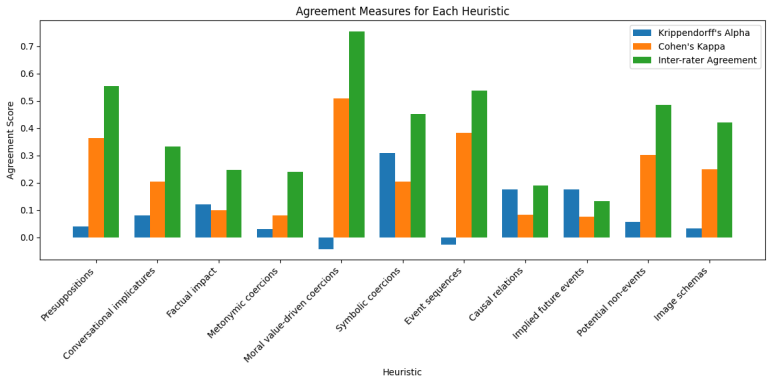
- [Section 4, 'Agreement Measures', Figure 8] Krippendorff's alpha is negative for several heuristics (including Metonymic Coercions and Moral Value-driven Coercions), which indicates systematic disagreement beyond chance and undermines the reliability of the mean ratings used as the primary evidence. The paper mentions this discrepancy but does not explain it or exclude unreliable heuristics from the aggregate claims of 'high plausibility ratings across most heuristics' in Section 6.
- [Section 3.1, Presuppositions heuristic and Table 2 discussion] The Presuppositions XKG introduces 11 new datatype properties that all take the boolean value 'true', e.g., fred:wasBuiltBefore true . This is semantically ill-formed: a property named wasBuiltBefore expects a temporal or event argument, not a truth value. The presence of such template-generated axioms in the graphs raises doubts about whether the human-rated 'plausibility' captures real semantic adequacy, and it suggests the LLM is sometimes producing syntactically neat but meaningless triples. Please address how the evaluation handles such cases and consider filtering or post-processing them.
minor comments (5)
- [Throughout Section 4 and figures] There are several typos and labeling inconsistencies, e.g., 'Agrement measures' in the caption of Figure 8 and 'vizualisation' in the text for Figure 5; please correct these.
- [Section 2 and Section 3, references] References have unresolved placeholders: 'AMR2FRED [?]' in Section 2 and 'Text2AMR2FRED [15 ?, 63]' in Section 3; these need to be fixed before publication.
- [Section 2, model agnosticism claim] The statement that the tool is 'model-agnostic' is not supported by experiments, since only GPT-4o and Claude 3.5 are used. If agnosticism is claimed, provide at least a small comparison with an open-weight model.
- [Section 4, human evaluation methodology] The annotation form is available online, but the paper does not describe the annotator instructions or any calibration procedure; without this, the Likert ratings are hard to interpret or reproduce.
- [Section 4, agreement measures] The text says 'inter-rater agreement of 0.75 and a Cohen's Kappa of 0.51' for Moral Value-driven Coercions; 'inter-rater agreement' is ambiguous here (percent agreement? another coefficient?), so please specify the exact metric.
Circularity Check
No significant circularity: the XKG pipeline is an implemented system with an external human evaluation; no prediction reduces to a fitted input or to a self-citation by construction.
full rationale
The paper's derivation chain is a pipeline, not a formal derivation: image, GPT-4o description, Text2AMR2FRED Base Graph, Claude-generated triples per 11 heuristics, and XKGs evaluated by Hermit consistency, OOPS!, and five annotators' plausibility ratings. No quantity is fitted to the evaluated data and then renamed as a prediction; the plausibility ratings are measurements, not outputs of the pipeline. The self-citations (FRED, AMR2FRED, Text2AMR2FRED, Framester, ImageSchemaNet, ValueNet) are code-reproduced tools and ontologies used as components, not invoked as uniqueness theorems to forbid alternatives, so they do not make the central claim circular. The Section 5 admission that telling annotators which heuristic they are validating 'may be influencing results' is a genuine external-validity limitation, but it does not exhibit a reduction of the claimed result to its inputs by construction: a triple can still be judged implausible even when the heuristic label is known, and the reported low or negative Krippendorff alphas show the ratings were not forced. Concerns about the single hand-picked image, the absence of baselines, and the non-expert annotators are correctness and evidential-weight issues, not circularity.
Assumptions & free parameters
free parameters (2)
- Set of 11 enrichment heuristics =
presuppositions, conversational implicatures, factual impact, image schemas, metonymic coercion, moral value coercion…
- LLM prompt templates =
Not specified in the paper; available on GitHub
assumptions (6)
- ad hoc to paper The 11 heuristic categories are the essential elements of daily human understanding.
- domain assumption LLMs can be prompted to generate correct implicit knowledge triples anchored to the base graph.
- domain assumption AMR graphs and Framester alignments provide a faithful formal semantics for natural language descriptions.
- domain assumption Human plausibility ratings by five non-domain-expert annotators are a valid measure of the quality of generated triples.
- ad hoc to paper The single Paris 2024 image is representative of the method's performance across domains.
- domain assumption The image captured after May 2024 is outside the training data of GPT-4o.
invented entities (2)
-
Extended Knowledge Graph (XKG)
-
Heuristic-specific object and datatype properties (e.g., impact:hasExpectedEmotion, impact:hasExpectedPhysicalState, fred:wasBuiltBefore, :hasVictory)
Cite this review
Pith. "Pith review of Neurosymbolic Graph Enrichment for Grounded World Models." pith.science (2026). https://pith.science/paper/FZSBFE4O
@misc{pith2026241112671,
  author       = {Pith},
  title        = {Pith review of: Neurosymbolic Graph Enrichment for Grounded World Models},
  year         = {2026},
  howpublished = {\url{https://pith.science/paper/FZSBFE4O}},
  note         = {Machine review of arXiv:2411.12671}
}
read the original abstract
The development of artificial intelligence systems capable of understanding and reasoning about complex real-world scenarios is a significant challenge. In this work we present a novel approach to enhance and exploit LLM reactive capability to address complex problems and interpret deeply contextual real-world meaning. We introduce a method and a tool for creating a multimodal, knowledge-augmented formal representation of meaning that combines the strengths of large language models with structured semantic representations. Our method begins with an image input, utilizing state-of-the-art large language models to generate a natural language description. This description is then transformed into an Abstract Meaning Representation (AMR) graph, which is formalized and enriched with logical design patterns, and layered semantics derived from linguistic and factual knowledge bases. The resulting graph is then fed back into the LLM to be extended with implicit knowledge activated by complex heuristic learning, including semantic implicatures, moral values, embodied cognition, and metaphorical representations. By bridging the gap between unstructured language models and formal semantic structures, our method opens new avenues for tackling intricate problems in natural language understanding and reasoning.
Figures


Figures from the paper (5 more)


Forward citations
Cited by 1 Pith paper
-
Logic Augmented Generation
The paper introduces LAG, a neuro-symbolic architecture in which LLMs act as reactive continuous knowledge graphs constrained by semantic knowledge graphs.
Reference graph
Works this paper leans on
-
[1]
LLM-assisted knowledge graph engineering: Experiments with ChatGPT,
Meyer, L.P., Stadler, C., Frey, J., Radtke, N., Junghanns, K., Meissner, R., Dziwis, G., Bulert, K., Martin, M., “LLM-assisted knowledge graph engineering: Experiments with ChatGPT,” in Working conference on Artificial Intelligence Development for a Resilient and Sustainable To- morrow, pp. 103–115, 2023
work page 2023
-
[2]
Identifying motifs for evaluating open knowledge extraction on the Web,
Gangemi, A., Recupero, D.R., Mongiov ` ı, M., Nuzzolese, A.G., Presutti, V., “Identifying motifs for evaluating open knowledge extraction on the Web,” Knowledge Based Systems, vol. 108, pp. 33–41, 2016. 28
work page 2016
-
[3]
LLMs for knowledge graph construction and reasoning: Recent capabilities and future opportunities,
Zhu, Y., Wang, X., Chen, J., Qiao, S., Ou, Y., Yao, Y., Deng, S., Chen, H., Zhang, N., “LLMs for knowledge graph construction and reasoning: Recent capabilities and future opportunities,” World Wide Web, vol. 27, no. 5, pp. 58, 2024
work page 2024
-
[4]
Knowledge graph-augmented lan- guage models for complex question answering,
Sen, P., Mavadia, S., Saffari, A., “Knowledge graph-augmented lan- guage models for complex question answering,” in Proceedings of the 1st Workshop on Natural Language Reasoning and Structured Expla- nations (NLRSE), pp. 1–8, 2023
work page 2023
-
[5]
From local to global: A graph rag approach to query- focused summarization,
Edge, D., Trinh, H., Cheng, N., Bradley, J., Chao, A., Mody, A., Truitt, S., Larson, J., “From local to global: A graph rag approach to query- focused summarization,” arXiv preprint arXiv:2404.16130, 2024
arXiv 2024
-
[6]
KG-BERT: BERT for knowledge graph completion,
Yao, L., Mao, C., Luo, Y., “KG-BERT: BERT for knowledge graph completion,” arXiv preprint arXiv:1909.03193, 2019
arXiv 1909
-
[7]
Utilizing textual information in knowledge graph embedding: A survey of methods and applications,
Lu, F., Cong, P., Huang, X., “Utilizing textual information in knowledge graph embedding: A survey of methods and applications,” IEEE Access, vol. 8, pp. 92072–92088, 2020
work page 2020
-
[8]
Preface for the International Work- shop on Knowledge Graph Generation from Text,
Tiwari, S., Mihindukulasooriya, N., Osborne, F., Kontokostas, D., D’Souza, J., Kejriwal, M., et al., “Preface for the International Work- shop on Knowledge Graph Generation from Text,” in CEUR WORK- SHOP PROCEEDINGS, vol. 3184, 2022
work page 2022
Show all 70 references
-
[9]
Oops!(ontology pitfall scanner!): An on-line tool for ontology evalua- tion,
Poveda-Villal´ on, M., G´ omez-P´ erez, A., Su´ arez-Figueroa, M.C., “Oops!(ontology pitfall scanner!): An on-line tool for ontology evalua- tion,” International Journal on Semantic Web and Information Systems (IJSWIS), vol. 10, no. 2, pp. 7–34, 2014
2014
-
[10]
NeOn-GPT: A Large Language Model-Powered Pipeline for Ontology Learning,
Fathallah, N., Das, A., De Giorgis, S., Poltronieri, A., Haase, P., Kovriguina, L., “NeOn-GPT: A Large Language Model-Powered Pipeline for Ontology Learning,” in The Extended Semantic Web Con- ference, 2024
2024
-
[11]
HermiT: an OWL 2 reasoner,
Glimm, B., Horrocks, I., Motik, B., Stoilos, G., Wang, Z., “HermiT: an OWL 2 reasoner,” Journal of automated reasoning, vol. 53, pp. 245–269, 2014. 29
2014
-
[12]
Serving DBpedia with DOLCE–more than just adding a cherry on top,
Paulheim, H., Gangemi, A., “Serving DBpedia with DOLCE–more than just adding a cherry on top,” in The Semantic Web-ISWC 2015: 14th International Semantic Web Conference, pp. 180–196, 2015
2015
-
[13]
One SPRING to rule them both: Symmetric AMR semantic parsing and generation without a com- plex pipeline,
Bevilacqua, M., Blloshmi, R., Navigli, R., “One SPRING to rule them both: Symmetric AMR semantic parsing and generation without a com- plex pipeline,” in Proceedings of the AAAI Conference on Artificial In- telligence, vol. 35, no. 14, pp. 12564–12573, 2021
2021
-
[14]
Scal- able zero-shot entity linking with dense entity retrieval,
Wu, L., Petroni, F., Josifoski, M., Riedel, S., Zettlemoyer, L., “Scal- able zero-shot entity linking with dense entity retrieval,” arXiv preprint arXiv:1911.03814, 2019
1911 arXiv
-
[15]
AMR2FRED, a tool for translating abstract meaning representation to motif-based linguistic knowledge graphs,
Meloni, A., Reforgiato Recupero, D., Gangemi, A., “AMR2FRED, a tool for translating abstract meaning representation to motif-based linguistic knowledge graphs,” in The Semantic Web: ESWC 2017 Satellite Events, pp. 43–47, 2017
2017
-
[16]
Breaking Through the 80% Glass Ceiling: Raising the State of the Art in Word Sense Disambiguation by Incor- porating Knowledge Graph Information,
Bevilacqua, M., Navigli, R., “Breaking Through the 80% Glass Ceiling: Raising the State of the Art in Word Sense Disambiguation by Incor- porating Knowledge Graph Information,” in Proceedings of the 58th Annual Meeting of the Association for Computational Linguistics, pp. 2854...
2020
-
[17]
Is neuro-symbolic ai meeting its promises in natural language processing? a structured re- view,
Hamilton, K., Nayak, A., Boˇ zi´ c, B., Longo, L., “Is neuro-symbolic ai meeting its promises in natural language processing? a structured re- view,” Semantic Web, pp. 1–42, 2022
2022
-
[18]
The third ai summer: AAAI robert s. engelmore memorial lecture,
Kautz, H., “The third ai summer: AAAI robert s. engelmore memorial lecture,” AI magazine, vol. 43, no. 1, pp. 105–125, 2022
2022
-
[19]
Framester: A wide coverage linguistic linked data hub,
Gangemi, A., Alam, M., Asprino, L., Presutti, V., Recupero, D.R., “Framester: A wide coverage linguistic linked data hub,” in Knowledge Engineering and Knowledge Management, pp. 239–254, 2016
2016
-
[20]
Symbolic logic meets machine learning: A brief survey in infinite domains,
Belle, V., “Symbolic logic meets machine learning: A brief survey in infinite domains,” in International conference on scalable uncertainty management, pp. 3–16, 2020
2020
-
[21]
Neural-symbolic learning and reasoning: A survey 30 and interpretation 1,
Besold, T.R., d’Avila Garcez, A., Bader, S., Bowman, H., Domingos, P., Hitzler, P., et al., “Neural-symbolic learning and reasoning: A survey 30 and interpretation 1,” in Neuro-Symbolic Artificial Intelligence: The State of the Art, pp. 1–51, 2021
2021
-
[22]
Neurosymbolic AI: The 3rd wave,
Garcez, A.d’A., Lamb, L.C., “Neurosymbolic AI: The 3rd wave,” Arti- ficial Intelligence Review, vol. 56, no. 11, pp. 12387–12406, 2023
2023
-
[23]
Graph neural networks meet neural-symbolic computing: A survey and perspective,
Lamb, L.C., Garcez, A., Gori, M., Prates, M., Avelar, P., Vardi, M., “Graph neural networks meet neural-symbolic computing: A survey and perspective,” arXiv preprint arXiv:2003.00330, 2020
2003 arXiv
-
[24]
Neuro-symbolic ar- tificial intelligence,
Sarker, M.K., Zhou, L., Eberhart, A., Hitzler, P., “Neuro-symbolic ar- tificial intelligence,” AI Communications, vol. 34, no. 3, pp. 197–209, 2021
2021
-
[25]
Learning to activate logic rules for textual reasoning,
Yao, Y., Xu, J., Shi, J., Xu, B., “Learning to activate logic rules for textual reasoning,” Neural Networks, vol. 106, pp. 42–49, 2018
2018
-
[26]
A survey on neural- symbolic learning systems,
Yu, D., Yang, B., Liu, D., Wang, H., Pan, S., “A survey on neural- symbolic learning systems,” Neural Networks, 2023
2023
-
[27]
Neural, symbolic and neural-symbolic reasoning on knowledge graphs,
Zhang, J., Chen, B., Zhang, L., Ke, X., Ding, H., “Neural, symbolic and neural-symbolic reasoning on knowledge graphs,” AI Open, vol. 2, pp. 14–35, 2021
2021
-
[28]
What’s in a concept: structural foundations for se- mantic networks,
Brachman, R.J., “What’s in a concept: structural foundations for se- mantic networks,” International journal of man-machine studies, vol. 9, no. 2, pp. 127–152, 1977
1977
-
[29]
A framework for representing knowledge,
Minsky, M., et al., “A framework for representing knowledge,” Mas- sachusetts Institute of Technology AI Laboratory Cambridge, 1974
1974
-
[30]
Frame semantics,
Fillmore, C.J., et al., “Frame semantics,” Cognitive linguistics: Basic readings, vol. 34, pp. 373–400, 2006
2006
-
[31]
Neurosymbolic Methods for Dy- namic Knowledge Graphs,
Alam, M., Gesese, G.A., Paris, P.H., “Neurosymbolic Methods for Dy- namic Knowledge Graphs,” arXiv preprint arXiv:2409.04572, 2024
2024 arXiv
-
[32]
Closing the Loop between knowledge patterns in cogni- tion and the Semantic Web,
Gangemi, A., “Closing the Loop between knowledge patterns in cogni- tion and the Semantic Web,” Semantic Web, vol. 11, no. 1, pp. 139–151, 2020. 31
2020
-
[33]
WordNet: An electronic lexical database,
Miller, G.A., “WordNet: An electronic lexical database,” MIT press, 1998
1998
-
[34]
VerbNet: A broad-coverage, comprehensive verb lexi- con,
Schuler, K.K., “VerbNet: A broad-coverage, comprehensive verb lexi- con,” University of Pennsylvania, 2005
2005
-
[35]
Amnestic Forgery: An Ontology of Conceptual Metaphors,
Gangemi, A., Presutti, V., Alam, M., “Amnestic Forgery: An Ontology of Conceptual Metaphors,” in Formal Ontology in Information Systems, 2018
2018
-
[36]
Imageschemanet: Formal- izing embodied commonsense knowledge providing an imageschematic layer to framester,
De Giorgis, S., Gangemi, A., Gromann, D., “Imageschemanet: Formal- izing embodied commonsense knowledge providing an imageschematic layer to framester,” Semantic Web Journal, 2022
2022
-
[37]
BabelNet: Building a very large multilin- gual semantic network,
Navigli, R., Ponzetto, S.P., “BabelNet: Building a very large multilin- gual semantic network,” in Proceedings of the 48th annual meeting of the association for computational linguistics, pp. 216–225, 2010
2010
-
[38]
Dbpedia: A nucleus for a web of open data,
Auer, S., Bizer, C., Kobilarov, G., Lehmann, J., Cyganiak, R., Ives, Z., “Dbpedia: A nucleus for a web of open data,” in The semantic web, pp. 722–735, 2007
2007
-
[39]
Yago: a core of seman- tic knowledge,
Suchanek, F.M., Kasneci, G., Weikum, G., “Yago: a core of seman- tic knowledge,” in Proceedings of the 16th international conference on World Wide Web, pp. 697–706, 2007
2007
-
[40]
Sweetening wordnet with dolce,
Gangemi, A., Guarino, N., Masolo, C., Oltramari, A., “Sweetening wordnet with dolce,” AI magazine, vol. 24, no. 3, pp. 13–13, 2003
2003
-
[41]
Unifying large language models and knowledge graphs: A roadmap,
Pan, S., Luo, L., Wang, Y., Chen, C., Wang, J., Wu, X., “Unifying large language models and knowledge graphs: A roadmap,” IEEE Transac- tions on Knowledge and Data Engineering, 2024
2024
-
[42]
Semantic web machine reading with FRED,
Gangemi, A., Presutti, V., Reforgiato Recupero, D., Nuzzolese, A.G., Draicchio, F., Mongiov ` ı, M., “Semantic web machine reading with FRED,” Semantic Web, vol. 8, no. 6, pp. 873–893, 2017
2017
-
[43]
The berkeley framenet project,
Baker, C.F., Fillmore, C.J., Lowe, J.B., “The berkeley framenet project,” in Proceedings of the 17th international conference on Com- putational linguistics, pp. 86–90, 1998. 32
1998
-
[44]
From TreeBank to PropBank,
Kingsbury, P.R., Palmer, M., “From TreeBank to PropBank,” in LREC, pp. 1989–1993, 2002
1989
-
[45]
Presupposition: What went wrong?,
Karttunen, L., “Presupposition: What went wrong?,” in Semantics and Linguistic Theory, pp. 705–731, 2016
2016
-
[46]
On sense and reference,
Frege, G., “On sense and reference,” 1892
-
[47]
On referring,
Strawson, P.F., “On referring,” Mind, vol. 59, no. 235, pp. 320–344, 1950
1950
-
[48]
Logic and conversation,
Grice, H.P., “Logic and conversation,” Syntax and semantics, vol. 3, 1975
1975
-
[49]
Presumptive meanings: The theory of generalized con- versational implicature,
Levinson, S.C., “Presumptive meanings: The theory of generalized con- versational implicature,” MIT press, 2000
2000
-
[50]
Article commentary: Judgment and decision making: A personal view,
Kahneman, D., “Article commentary: Judgment and decision making: A personal view,” Psychological science, vol. 2, no. 3, pp. 142–145, 1991
1991
-
[51]
The Body in the Mind: The Bodily Basis of Meaning, Imagination, and Reason,
Johnson, M., “The Body in the Mind: The Bodily Basis of Meaning, Imagination, and Reason,” The University of Chicago Press, 1987
1987
-
[52]
Metaphors we live by,
Lakoff, G., Johnson, M., “Metaphors we live by,” University of Chicago press, 1980
1980
-
[53]
Philosophy in the flesh: The embodied mind and its challenge to western thought,
Lakoff, G., Johnson, M., et al., “Philosophy in the flesh: The embodied mind and its challenge to western thought,” Basic books New York, 1999
1999
-
[54]
A narrative in three acts: Using combinations of image schemas to model events,
Besold, T.R., Hedblom, M.M., Kutz, O., “A narrative in three acts: Using combinations of image schemas to model events,” Biologically inspired cognitive architectures, vol. 19, pp. 10–20, 2017
2017
-
[55]
Image schemas and concept invention: cognitive, log- ical, and linguistic investigations,
Hedblom, M.M., “Image schemas and concept invention: cognitive, log- ical, and linguistic investigations,” Springer Nature, 2020
2020
-
[56]
ChainNet: Structured Metaphor and Metonymy in WordNet,
Maudslay, R.H., Teufel, S., Bond, F., Pustejovsky, J., “ChainNet: Structured Metaphor and Metonymy in WordNet,” arXiv preprint arXiv:2403.20308, 2024. 33
2024 arXiv
-
[57]
Moral foundations theory: The pragmatic validity of moral pluralism,
Graham, J., Haidt, J., Koleva, S., Motyl, M., Iyer, R., Wojcik, S.P., Ditto, P.H., “Moral foundations theory: The pragmatic validity of moral pluralism,” Advances in experimental social psychology, vol. 47, pp. 55– 130, 2013
2013
-
[58]
The CAD triad hypothesis: a mapping between three moral emotions (contempt, anger, disgust) and three moral codes (community, autonomy, divinity),
Rozin, P., Lowery, L., Imada, S., Haidt, J., “The CAD triad hypothesis: a mapping between three moral emotions (contempt, anger, disgust) and three moral codes (community, autonomy, divinity),” Journal of personality and social psychology, vol. 76, no. 4, pp. 574, 1999
1999
-
[59]
Extending the cross-cultural validity of the theory of ba- sic human values with a different method of measurement,
Schwartz, S.H., Melech, G., Lehmann, A., Burgess, S., Harris, M., Owens, V., “Extending the cross-cultural validity of the theory of ba- sic human values with a different method of measurement,” Journal of cross-cultural psychology, vol. 32, no. 5, pp. 519–542, 2001
2001
-
[60]
Logic as semiotic: The theory of signs,
Peirce, C.S., Buchler, J., “Logic as semiotic: The theory of signs,” Philo- sophical Writings of Peirce, pp. 100, 1902
1902
-
[61]
Hamlet and his problems,
Eliot, T.S., et al., “Hamlet and his problems,” The sacred wood: Essays on poetry and criticism, vol. 4, pp. 95–104, 1920
1920
-
[62]
Counterintuitive behavior of social systems,
Forrester, J.W., “Counterintuitive behavior of social systems,” Theory and decision, vol. 2, no. 2, pp. 109–140, 1971
1971
-
[63]
Text2AMR2FRED, a Tool for Transforming Text into RDF/OWL Knowledge Graphs via Abstract Meaning Representation,
Gangemi, A., Graciotti, A., Meloni, A., Nuzzolese, A.G., Presutti, V., Reforgiato Recupero, D., Russo, A., Tripodi, R., “Text2AMR2FRED, a Tool for Transforming Text into RDF/OWL Knowledge Graphs via Abstract Meaning Representation,” in Proceedings of the ISWC 2023 Posters, Dem...
2023
-
[64]
World models,
Ha, D., Schmidhuber, J., “World models,” arXiv preprint arXiv:1803.10122, 2018
2018 arXiv
-
[65]
On the unexpected abilities of large language models,
Nolfi, S., “On the unexpected abilities of large language models,” Adap- tive Behavior, 2023
2023
-
[66]
Categorial and categorical grammars,
Lambek, J., “Categorial and categorical grammars,” in Categorial gram- mars and natural language structures, pp. 297–317, 1988
1988
-
[67]
Wide-coverage semantic analysis with boxer,
Bos, J., “Wide-coverage semantic analysis with boxer,” in Semantics in text processing. STEP 2008 conference proceedings, pp. 277–286, 2008. 34
2008
-
[68]
OWL 2: The next step for OWL,
Grau, B.C., Horrocks, I., Motik, B., Parsia, B., Patel-Schneider, P., Sat- tler, U., “OWL 2: The next step for OWL,” Journal of Web Semantics, vol. 6, no. 4, pp. 309–322, 2008
2008
-
[69]
Basic human values and moral foundations theory in valuenet ontology,
De Giorgis, S., Gangemi, A., Damiano, R., “Basic human values and moral foundations theory in valuenet ontology,” in International confer- ence on knowledge engineering and knowledge management, pp. 3–18, 2022
2022
-
[70]
Qlever: A query engine for efficient sparql+ text search,
Bast, H., Buchhold, B., “Qlever: A query engine for efficient sparql+ text search,” in Proceedings of the 2017 ACM on Conference on Infor- mation and Knowledge Management, pp. 647–656, 2017. 35
2017
Reviewed August 12, 2026 · model on record in the stance chip above.
Discussion (0). Continue with ORCID to comment.