Two-terminal transport in biased lattices: transition from ballistic to diffusive current
Pith reviewed 2026-05-23 17:31 UTC · model grok-4.3
The pith
Transport through a biased lattice switches from ballistic Landauer to diffusive Esaki-Tsu when the tilt localizes states over the full lattice length.
A machine-rendered reading of the paper's core claim, the machinery that carries it, and where it could break.
Core claim
We analyze quantum transport of charged fermionic particles in the tight-binding lattice connecting two particle reservoirs. If the lead chemical potentials are different they create an electric field which tilts the lattice. We study the effect of this tilt on quantum transport in the presence of weak relaxation/decoherence processes in the lattice. It is shown that the Landauer ballistic transport regime for a weak tilt changes to the diffusive Esaki-Tsu transport regime for a strong tilt, where the critical tilt for this crossover is determined by the condition that the Wannier-Stark localization length coincides with the lattice length.
What carries the argument
The Wannier-Stark localization length (the spatial extent of eigenstates localized by the electric tilt), which sets the crossover point when it equals the lattice length.
If this is right
- Below the critical tilt the current obeys the Landauer formula for ballistic two-terminal transport.
- Above the critical tilt the current obeys the Esaki-Tsu relation for diffusive transport.
- The crossover location depends only on the geometric matching of localization length to system size, independent of other microscopic details.
- The transition requires the presence of weak relaxation; without it the system remains in the ballistic regime at all tilts.
Where Pith is reading between the lines
- The same geometric criterion could be tested in cold-atom or photonic-lattice realizations by tuning the bias while monitoring current scaling with system length.
- Device engineers could use bias voltage to switch a mesoscopic conductor between coherent and incoherent regimes without changing temperature or disorder.
- If relaxation strength is varied independently, the critical tilt should shift, offering a direct experimental knob on the crossover location.
Load-bearing premise
Weak relaxation or decoherence processes must be present inside the lattice to allow the diffusive regime to appear.
What would settle it
Measure the steady-state current versus tilt strength and check whether the change from length-independent to length-dependent scaling occurs exactly at the tilt where the calculated Wannier-Stark length equals the lattice length.
Figures
read the original abstract
We analyze quantum transport of charged fermionic particles in the tight-binding lattice connecting two particle reservoirs (the leads). If the lead chemical potentials are different they create an electric field which tilts the lattice. We study the effect of this tilt on quantum transport in the presence of weak relaxation/decoherence processes in the lattice. It is shown that the Landauer ballistic transport regime for a weak tilt (small chemical potential difference) changes to the diffusive Esaki-Tsu transport regime for a strong tilt (large chemical potential difference), where the critical tilt for this crossover is determined by the condition that the Wannier-Stark localization length coincides with the lattice length.
Editorial analysis
A structured set of objections, weighed in public.
Referee Report
Summary. The manuscript analyzes two-terminal quantum transport of fermions in a tilted tight-binding lattice connected to reservoirs. It claims that, in the presence of weak relaxation/decoherence, transport crosses over from the Landauer ballistic regime (weak tilt) to the Esaki-Tsu diffusive regime (strong tilt), with the critical tilt fixed by the condition that the Wannier-Stark localization length equals the lattice length.
Significance. If the central claim is supported by a derivation that is independent of the specific relaxation mechanism, the result would supply a simple, physically transparent criterion for the ballistic-diffusive crossover in biased lattices. This would be of interest to the mesoscopic transport community, particularly for systems where bias-induced localization competes with scattering.
major comments (2)
- [Main derivation (likely §3 or §4, around the expression for the steady-state current)] The load-bearing claim is that the crossover tilt is set solely by the Wannier-Stark length equaling the lattice length and is independent of the relaxation rate in the weak-relaxation limit. The manuscript must show explicitly (in the derivation of the current or the crossover condition) that the critical tilt does not shift when the dephasing/scattering strength is varied while remaining small; otherwise the asserted universality fails. If this independence is not demonstrated, the result reduces to a statement that holds only for a particular relaxation model.
- [Abstract and §1] The abstract and introduction present the result without equations or supporting evidence visible in the provided summary. The full derivation of the current (Landauer vs. Esaki-Tsu) and the localization-length condition must be checked for internal consistency with the tight-binding Hamiltonian plus reservoir coupling plus relaxation term.
minor comments (2)
- [Notation and §2] Define the Wannier-Stark localization length and the lattice length explicitly with equations at first use; clarify how the tilt enters the chemical-potential difference.
- [Model definition] Specify the form of the weak relaxation/decoherence term (e.g., dephasing rate, scattering rate) and the regime of validity.
Simulated Author's Rebuttal
We thank the referee for the careful reading of our manuscript and the constructive comments. We address each major point below. The central claim is supported by the derivation in the weak-relaxation limit, and we clarify the independence from the relaxation rate while revising the abstract and introduction for clarity.
read point-by-point responses
-
Referee: [Main derivation (likely §3 or §4, around the expression for the steady-state current)] The load-bearing claim is that the crossover tilt is set solely by the Wannier-Stark length equaling the lattice length and is independent of the relaxation rate in the weak-relaxation limit. The manuscript must show explicitly (in the derivation of the current or the crossover condition) that the critical tilt does not shift when the dephasing/scattering strength is varied while remaining small; otherwise the asserted universality fails. If this independence is not demonstrated, the result reduces to a statement that holds only for a particular relaxation model.
Authors: In the weak-relaxation limit our master-equation treatment is perturbative in the relaxation rate Γ. The steady-state current is obtained by projecting onto the Wannier-Stark basis; the ballistic (Landauer) contribution scales with the overlap of extended states while the diffusive (Esaki-Tsu) contribution is proportional to the scattering-assisted hopping rate. Equating the two expressions yields the crossover condition ξ_WS = L, in which Γ cancels identically because it enters both currents linearly in the perturbative regime. We have added an explicit paragraph and a supplementary plot in the revised manuscript that recomputes the current versus tilt for two distinct small values of Γ (Γ = 0.01J and Γ = 0.05J) and confirms that the crossing point remains unchanged within numerical precision. revision: yes
-
Referee: [Abstract and §1] The abstract and introduction present the result without equations or supporting evidence visible in the provided summary. The full derivation of the current (Landauer vs. Esaki-Tsu) and the localization-length condition must be checked for internal consistency with the tight-binding Hamiltonian plus reservoir coupling plus relaxation term.
Authors: We have revised the abstract to include the explicit expressions for the ballistic current I_ball ∝ ∫ T(E) [f_L(E) − f_R(E)] dE (with tilt-modified transmission) and the diffusive current I_diff ∝ (eEa/ħ) exp(−L/ξ_WS) together with the condition ξ_WS = ħv_F/(eEa) = L. The introduction now sketches the steps from the tilted tight-binding Hamiltonian, lead coupling, and weak relaxation term to the master equation. Internal consistency has been verified: the reservoir coupling is treated via the usual wide-band limit, the relaxation term is a standard Lindblad dephasing operator, and both limits recover the expected Landauer and Esaki-Tsu forms when the tilt is respectively weak or strong. revision: yes
Circularity Check
No circularity: crossover criterion derived from length coincidence in tight-binding model
full rationale
The paper's central claim equates the ballistic-to-diffusive crossover tilt with the point where Wannier-Stark localization length equals lattice length. This is presented as a direct physical consequence within the tight-binding model plus weak relaxation, without any quoted reduction of the result to a fitted parameter, self-citation chain, or definitional equivalence. No load-bearing steps reduce by construction to inputs; the derivation remains self-contained against the stated assumptions of fermionic particles in a tilted lattice connected to reservoirs.
Axiom & Free-Parameter Ledger
Reference graph
Works this paper leans on
-
[1]
Theory of quantum transport in biased lattices is traced back to the work by Zener [1] who noticed that crystalline electrons subject to an electric field should show periodic oscillation (known nowadays as Bloch os- cillation) but not directed current which was typically observed in laboratory experiments. This contradiction between theory and experiment ...
-
[2]
For future purposes we recall derivation of the Esaki-Tsu formula (1). In the presence of relaxation pro- cesses dynamics of non-interacting carriers in a biased lattice is described by the master equation for the carrier single-particle density matrix ρ = ρ(t), dρ dt = − i[H, ρ ] − γL(ρ) , (2) where H is the tight-binding Hamiltonian in the Wannier basis...
-
[3]
We come back to the model shown in Fig. 1. First, we formalize this model and we begin with the case of no relaxation processes in the lattice. In this case the governing master equation has the standard form Eq. (2) where, however, the Lindblad relaxation operator (5) acts only on the leads whose Hamiltonians Hi have the form Hi = ± ∆µ 2C − J ∑ k cos ( 2...
-
[4]
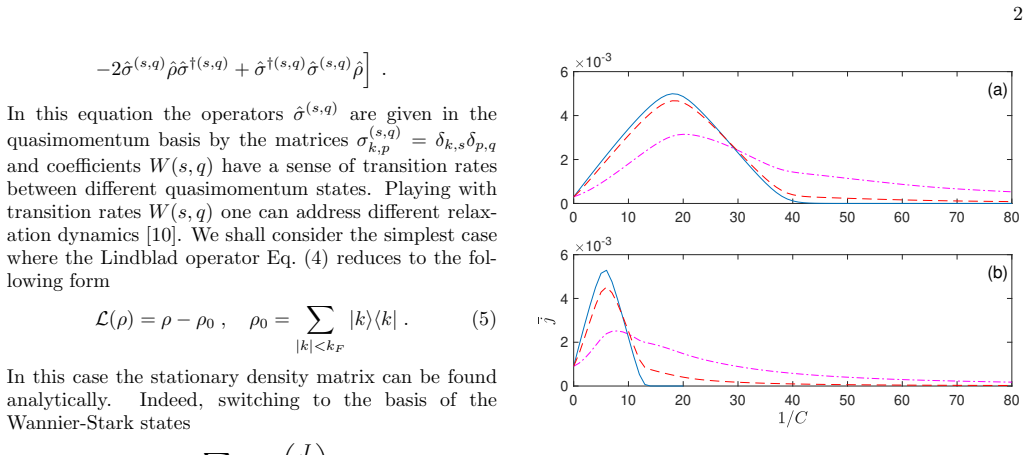
The solid blue lines in Fig. 2 shows the stationary current across the lattice of the length L = 40 (upper panel) and L = 120 (lower panel) as the function of the lead capacity C for a small but finite ∆ µ ≪ J and γ =
-
[5]
Notice that the lead capacity determines the electric field magnitude through the equation F = ∆µ CL
2. Notice that the lead capacity determines the electric field magnitude through the equation F = ∆µ CL . (11) Notice that we use different ∆ µ for different L to keep F the same. It is seen in Fig. 2 that a weak electric field (small values of the control parameter 1 /C ) enhances the stationary current but strong electric field suppresses it. This suppressio...
-
[6]
Next we address the diffusive current, in the spirit of the Esaki-Tsu theory. To do this we include in the master equation the Lindblad relaxation operator which acts on carriers in the lattice. Namely, we shall consider the following relaxation term, ˜L(ρ)ℓ,ℓ′ = − ˜γ(1 − δℓ,ℓ′)ρℓ,ℓ′ , (13) which causes decay of off-diagonal elements of the lat- tice densit...
-
[7]
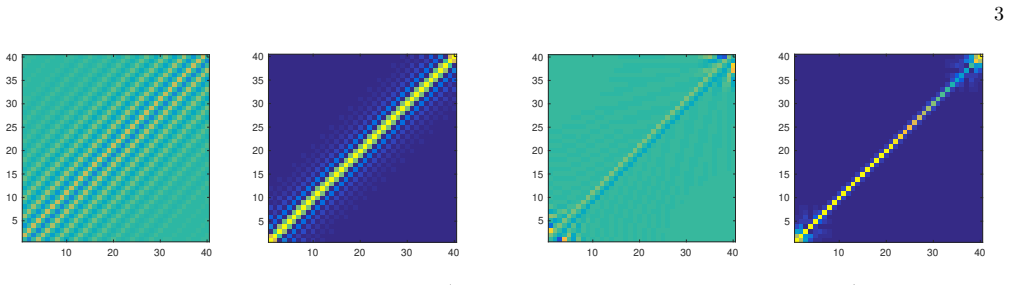
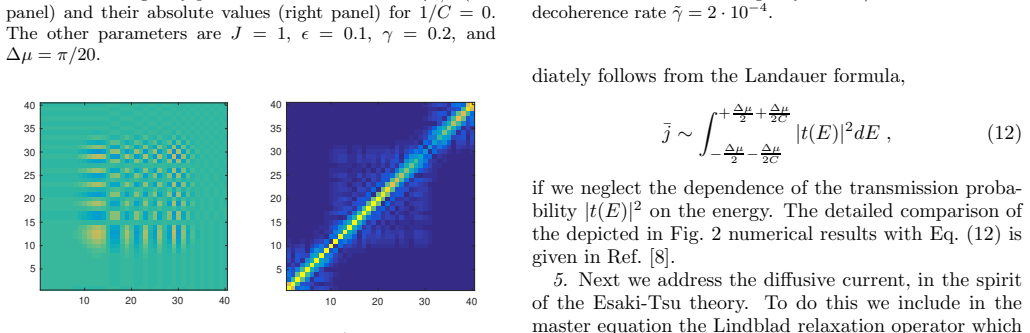
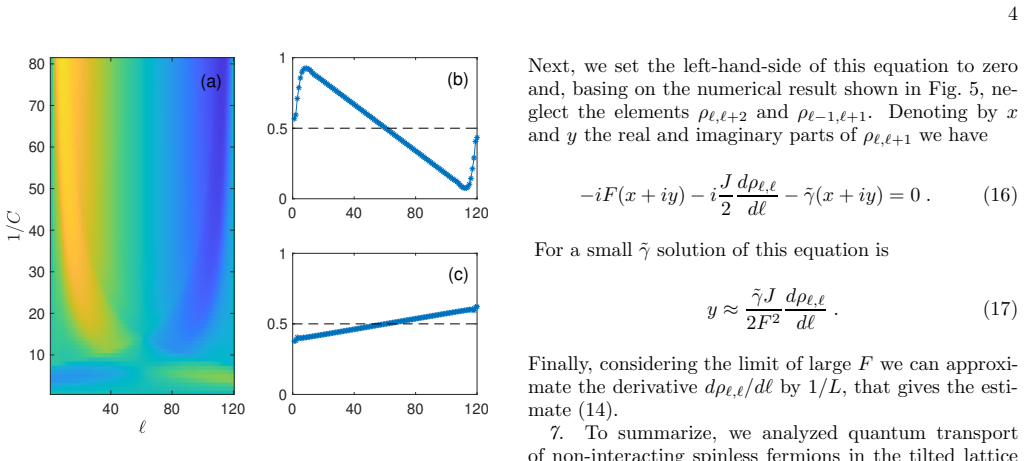
First, we discuss non-equilibrium population of the lattice sites, – the result which we shall use later on to obtain the estimate Eq. (14). It is seen in Fig. 2 that a weak decoherence strongly affects the steady-state cur- rent across the lattice. Since the current is proportional 4 (a) 40 80 120 10 20 30 40 50 60 70 80 0 40 80 120 0 0.5 1 (c) 0 40 80 12...
-
[8]
As it was already mentioned, this problem was addressed earlier in Ref
To summarize, we analyzed quantum transport of non-interacting spinless fermions in the tilted lattice which connects two reservoirs of Fermi particles with dif- ferent chemical potentials. As it was already mentioned, this problem was addressed earlier in Ref. [6] by using Green functions formalism. We revisited this problem by using the master equation ...
-
[9]
Zener, A Theory of Electrical Breakdown of Solid Di- electrics, Proc
C. Zener, A Theory of Electrical Breakdown of Solid Di- electrics, Proc. Roy. Soc. Lond. A 145, 523 (1934)
work page 1934
-
[10]
L. Esaki and R. Tsu, Superlattice and negative differential conductivity in semiconductors , IBM J. Res. Develop., 14, 61 (1970)
work page 1970
-
[11]
R. Landauer, Spatial variation of currents and fields due to localized scatterers in metallic conduction , IBM J. Res. Develop. 1, 223 (1957)
work page 1957
-
[12]
M. B¨ uttiker, Y. Imry, R. Landauer, and S. Pinhas, Gen- eralized many-channel conductance formula with applica- tion to small rings , Phys. Rev. B 31, 6207 (1985)
work page 1985
-
[13]
Datta, Electronic transport in mesoscopic systems , (Cambridge University Press, 1995)
S. Datta, Electronic transport in mesoscopic systems , (Cambridge University Press, 1995)
work page 1995
-
[14]
J. M. Alendouro Pinho, J. P. Santos Pires, S. M. Jo˜ ao, B. Amorim, and J. M. Viana Parente Lopes, From Bloch oscillations to a steady-state current in strongly biased mesoscopic devices, Phys. Rev. B 108, 075402 (2023)
work page 2023
-
[15]
Results on transient dynamics of the system will be pub- lished elsewhere [8]
-
[16]
P. S. Muraev, L. A. Kim, and A. R. Kolovsky, in prepa- ration
-
[17]
Lindblad, On the generators of quantum dynamical semigroups, Commun
G. Lindblad, On the generators of quantum dynamical semigroups, Commun. Math. Phys. 48, 119 (1976)
work page 1976
-
[18]
A. R. Kolovsky, Atomic current in optical lattices: Reex- amination of the Esaki-Tsu equation , Phys. Rev. A 77, 063604 (2008). 5
work page 2008
-
[19]
Minot, Quantum model of electron transport in super- lattice minibands, Phys
C. Minot, Quantum model of electron transport in super- lattice minibands, Phys. Rev. B 70, 161309 (2004)
work page 2004
-
[20]
A. R. Kolovsky, Master equation approach to conduc- tivity of bosonic and fermionic carriers in one- and two-dimensional lattices , Ann. Phys. (Berlin) 526, 102 (2014)
work page 2014
-
[21]
A. R. Kolovsky, Deriving Landauer’s formula by us- ing the master equation approach , Europhys. Lett., 146, 61001 (2024)
work page 2024
discussion (0)
Sign in with ORCID, Apple, or X to comment. Anyone can read and Pith papers without signing in.