REVIEW 4 major objections 5 minor 28 references
Incremental Label Distribution Learning with Scalable Graph Convolutional Networks
T0 review · 4 major / 5 minor · reviewed 2026-08-12 · deepseek-v4-flash
Pith's one-line read This paper introduces Incremental Label Distribution Learning (ILDL) and a scalable graph method, SGLDL, that keeps old-label relationships fixed while adding new labels, and it reports the best Euclidean-distance results on IMDB-WIKI age…
desk verdict A genuinely new ILDL problem framing and a plausible method, but the old-label preservation guarantee is not established by the equations and the experiments are too thin to carry it. read the letter →
The pith
A machine-rendered reading of the paper's core claim, the machinery that carries it, and where it could break.
The reading
What carries the argument
The load-bearing mechanism is the scalable correlation matrix (SCM), a block-structured label graph $A_S^t = \begin{pmatrix} A_S^{t-1} & E^t \\ R^t & M^t \end{pmatrix}$ whose upper-left block is the unchanged old-label relation matrix; the new blocks are estimated from co-occurrence statistics as coefficients of variation. The label graph makes inter-label relations explicit and growable: labels are graph nodes initialized with pretrained word embeddings, and a two-layer graph convolutional network (SGCN) maps the graph to label-specific classifiers, so a new label is one new node rather than a fully relearned classifier. The other load-bearing piece is the new-label-aware gradient compensation loss $\ell_{NC}$, which normalizes old and new label gradients separately and amplifies new-label gradients in the Canberra-distance prediction loss; a distillation loss $\ell_{DT}$ and a relation-preserving loss $\ell_{RP}$ limit forgetting of old outputs and old graph embeddings.
What would settle it
Split the same data into two ILDL sequences: in one the new label is independent of old labels, in the other the new label is engineered to change old-label co-occurrence statistics; if SGLDL's Euclidean distance on old labels degrades in the second sequence while a from-scratch relearned model does not, the frozen old block is responsible.
Extended reading notes
Core claim
The central claim is that incremental label distribution learning can avoid the label attention trap by separating inter-label relations from feature extraction and freezing the old relations. Concretely, SGLDL stores old-label relations in the upper-left block of a scalable correlation matrix $A_S^t = \begin{pmatrix} A_S^{t-1} & E^t \\ R^t & M^t \end{pmatrix}$, copies that block unchanged when new labels arrive, and computes only the new-to-new, old-to-new, and new-to-old blocks. A two-layer graph convolutional classifier consumes this matrix, and a new-label-aware gradient compensation loss re-weights gradients so that new labels learn faster while old labels are protected by distillation and relation-preserving losses. On IMDB-WIKI age estimation, split into ten incremental tasks, SGLDL achieves the best Euclidean-distance errors among the tested combinations of Adam-LDL-SCL, iCaRL, BiC, and SS-IL, and the ablations show every loss component contributes.
Load-bearing premise
The method's load-bearing premise is that adding a new label does not change the relationships among old labels, so the old part of the label graph can be copied forward; if a new label changes old-label relationships, the copied block introduces systematic error.
Editorial extensions
If this is right
- An LDL model can accept a new label without retraining all old-label parameters: only the graph rows and columns connecting the new label to the existing labels must be learned.
- Sequences of tasks with growing label sets can be handled as long as every task's training distribution contains all labels the model has seen, which is the ILDL setting defined in the paper.
- The new-label-aware gradient compensation loss, together with distillation and relation-preserving losses, should reduce both underfitting of new labels and catastrophic forgetting of old labels.
- Because the classifier is a GCN over a scalable label graph, parameter growth when labels are added is concentrated near the new label instead of spread over the full classifier.
- The IMDB-WIKI experiments show a dedicated ILDL method can beat generic CIL-plus-LDL combinations, and the ablations attribute the gain to all three loss terms.
Reading between the lines
- Editorial extension: if a real domain violates the frozen-relation assumption, the natural repair is to detect drift in old-label co-occurrence statistics and refresh only the affected block, preserving the graph's sparsity.
- Editorial extension: the gradient compensation loss is not tied to age estimation and should transfer to other growing-label taxonomies, such as medical codes or product tags; a test on such a dataset would show how far the IMDB-WIKI result generalizes.
- Editorial extension: the paper's coefficient-of-variation construction yields a direct diagnostic — if the ratio statistics among old labels change when a new label arrives, the fixed-relation assumption is violated and the frozen block should be updated.
Editorial analysis
A structured set of objections, weighed in public.
Referee Report
Summary. The paper introduces Incremental Label Distribution Learning (ILDL), where the label set grows over tasks and each training instance carries a distribution over all labels seen so far. It argues that the key difficulty is a 'label attention trap': adding new labels biases old-label predictions and causes naive retraining to rebuild old-label relationships that should be unchanged. The proposed SGLDL method combines a scalable correlation matrix (SCM) that extends an old adjacency block with new blocks, a two-layer GCN classifier (SGCN), and a new-label-aware gradient compensation loss, together with distillation and relationship-preserving losses. Experiments are reported on the IMDB-WIKI dataset for ten incremental tasks, with ablation of the three loss terms.
Significance. If the central mechanism could be established, ILDL would address a real gap: current LDL assumes a fixed label space, and the disease-diagnosis motivation is compelling. The SCM/SGCN design is an interesting way to make the classifier's label graph explicit and expandable, and the ablation studies target the right components. However, the paper's core claim that copying the old SCM block preserves old-label relationships is not supported by the model equations, and the experimental evidence is currently too thin to validate it. The contribution is potentially useful but needs substantial theoretical or architectural clarification and stronger empirical grounding.
major comments (4)
- [Section III-B, Eq. (9)] Copying A^{t-1}_S into A^t_S in Eq. (2) does not preserve old-label relationships because SGCN's weights are shared across all label nodes in Eq. (9). When task t updates the network, the old rows H^t_j are recomputed through a changed GCN mapping even though the old adjacency block is unchanged; Fig. 3's statement that only new-label parameters are modified is therefore inconsistent with the equations. The relationship-preserving loss ℓRP in Eq. (16) is a soft regularizer, not a hard constraint, and no bound on old-node drift is given. The paper should either freeze the old-node computation, separate old/new GCN parameters, provide a formal drift guarantee, or directly measure old-relationship drift.
- [Section I, Eq. (2)] The stationarity premise that 'the inter-label relationship of old labels is not changed' is asserted but never tested. On IMDB-WIKI, the label distributions are Gaussian age labels; truncating and renormalizing the support when labels are added preserves the relative ratios by construction, so the benchmark cannot validate the assumption in settings where a new label can absorb probability mass from old labels. The authors should add a controlled experiment with constructed distribution shift, or a real dataset where new labels plausibly alter old-label correlations, and test whether the copied block remains accurate.
- [Section IV-C, Table II] The experimental support is not yet sufficient. Only Euclidean distance is reported even though Table I defines four metrics; no standard deviations, seeds, or significance tests are given, and the 100-label row shows SGLDL at 0.551 versus 0.552 for BiC and 0.553 for SGLDL-w/oLRP, so the advantage is within the likely run-to-run variation. The Human Gene experiment promised in Section IV-B is also absent. The paper should report all metrics with multiple seeds and standard deviations, and either include the Human Gene results or remove the promise.
- [Section III-D, Eq. (17)] The final loss weights λ1, λ2, and λ3 in Eq. (17) are never specified in Section IV, and no sensitivity analysis is provided. Because the method's benefit rests on balancing gradient compensation, distillation, and relationship preservation, the missing hyperparameters materially affect reproducibility and make it impossible to tell whether the result is robust or tuned. Please report the values and a sensitivity study.
minor comments (5)
- [Article contributions] The contributions bullet says 'We tackle a real-world FL problem' but the paper is about ILDL, and the sentence 'which using a scalable label graph' is ungrammatical.
- [Section II-A, Eq. (13)] The notation for new labels in Eq. (13) assumes they are appended contiguously as indices c_{t-1}+1 through c_t, but the problem definition in Section II-A does not state this; please make the indexing explicit.
- [Section III-A, Eqs. (5) and (7)] The formulas for e_{ij}^k and r_{ij}^k are difficult to parse because of the radical/division structure and the conditions in parentheses; please rewrite them unambiguously.
- [Section III-B] The GloVe embedding citation appears unresolved as '[cite]' and must be completed.
- [Section IV-C, Table II] Table II contains typographical artifacts such as '0. 372', '.281', and '.635'; please reformat the table.
Circularity Check
No derivation reduces to its own inputs; the one self-citation (ref. [24]) is not load-bearing, so circularity is minimal.
full rationale
The paper's central claim is an empirical comparison on the IMDB-WIKI benchmark. The SCM (Eqs. 3-8), SGCN (Eqs. 9-10), and the losses ℓNC, ℓDT, and ℓRP (Eqs. 14-17) are constructive design choices or regularizers, not fitted parameters that are later reported as predictions: no quantity in Table II is obtained by plugging the method's own fitted constants back in. The statement in Section I that 'the inter-label relationship of old labels is not changed' is an assumption, and on this benchmark it holds by construction because the age distributions are Gaussian and renormalization preserves old-label ratios; this is a support/validity gap for the general ILDL claim, but it is not a circular derivation because the reported Euclidean distances are evaluated on held-out test labels. The only self-citation is reference [24] (IncPrompt), used in Related Work for the general fact of catastrophic forgetting alongside the external survey [25]; it does not justify SGLDL's architecture or results. There is an internal inconsistency between Fig. 3's claim that only new-label parameters change and the shared-weight SGCN equations, but that is a correctness concern, not circularity. Accordingly no circular step meets the quote-and-reduction bar; score 2 reflects only the minor, non-load-bearing self-citation.
Assumptions & free parameters
free parameters (2)
- Loss weights lambda_1, lambda_2, lambda_3
- SGD learning rate =
2.0
assumptions (5)
- domain assumption Old inter-label relationships do not change when new labels are added.
- domain assumption Every new-task training sample carries label distributions over all accumulated labels, including old ones.
- ad hoc to paper The coefficient of variation of label ratios in Eqs. (3) to (8) captures inter-label relationships.
- domain assumption Test label distributions are renormalized after removing unseen labels.
- domain assumption Age labels follow a discrete Gaussian with sigma = 3.
Cite this review
Pith. "Pith review of Incremental Label Distribution Learning with Scalable Graph Convolutional Networks." pith.science (2026). https://pith.science/paper/4K5EMJV2
@misc{pith2026241113097,
  author       = {Pith},
  title        = {Pith review of: Incremental Label Distribution Learning with Scalable Graph Convolutional Networks},
  year         = {2026},
  howpublished = {\url{https://pith.science/paper/4K5EMJV2}},
  note         = {Machine review of arXiv:2411.13097}
}
read the original abstract
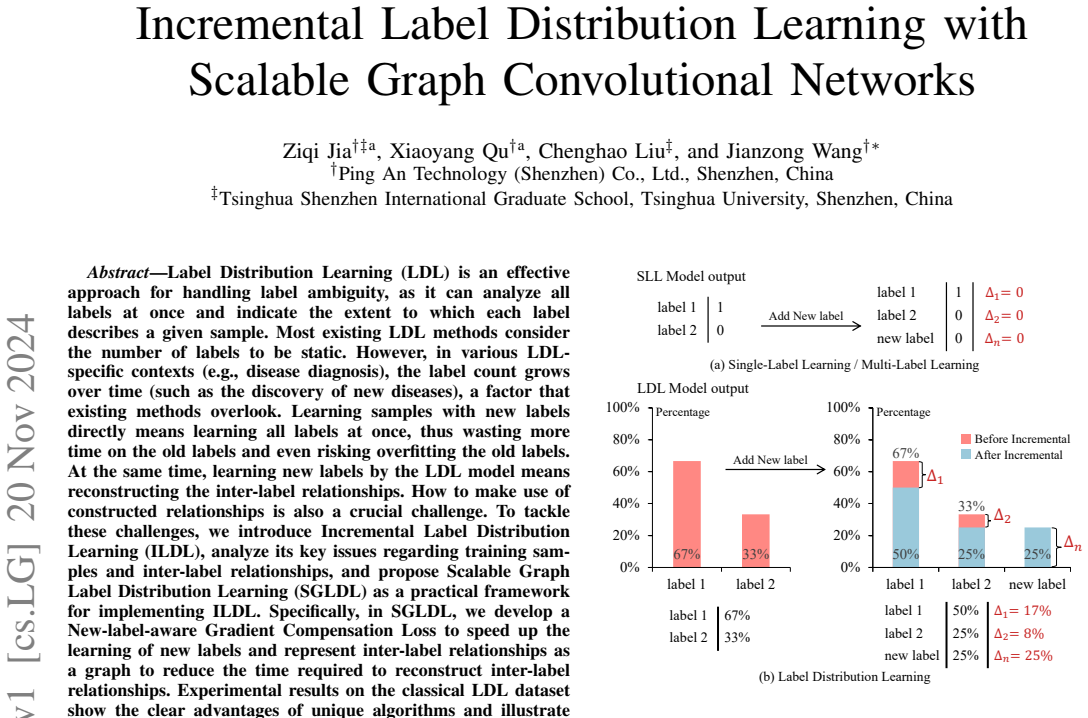
Label Distribution Learning (LDL) is an effective approach for handling label ambiguity, as it can analyze all labels at once and indicate the extent to which each label describes a given sample. Most existing LDL methods consider the number of labels to be static. However, in various LDL-specific contexts (e.g., disease diagnosis), the label count grows over time (such as the discovery of new diseases), a factor that existing methods overlook. Learning samples with new labels directly means learning all labels at once, thus wasting more time on the old labels and even risking overfitting the old labels. At the same time, learning new labels by the LDL model means reconstructing the inter-label relationships. How to make use of constructed relationships is also a crucial challenge. To tackle these challenges, we introduce Incremental Label Distribution Learning (ILDL), analyze its key issues regarding training samples and inter-label relationships, and propose Scalable Graph Label Distribution Learning (SGLDL) as a practical framework for implementing ILDL. Specifically, in SGLDL, we develop a New-label-aware Gradient Compensation Loss to speed up the learning of new labels and represent inter-label relationships as a graph to reduce the time required to reconstruct inter-label relationships. Experimental results on the classical LDL dataset show the clear advantages of unique algorithms and illustrate the importance of a dedicated design for the ILDL problem.
Figures


Figures from the paper (2 more)


Reference graph
Works this paper leans on
-
[1]
Label distribution learning,
X. Geng, “Label distribution learning,” IEEE Transactions on Knowl- edge and Data Engineering , vol. 28, no. 7, pp. 1734–1748, 2016
2016
-
[2]
Deep streaming label learning,
Z. Wang, L. Liu, and D. Tao, “Deep streaming label learning,” in International Conference on Machine Learning . PMLR, 2020, pp. 9963–9972
work page 2020
-
[3]
Multi-label attention map assisted deep feature learning for medical image classification,
D. Mahapatra and M. Reyes, “Multi-label attention map assisted deep feature learning for medical image classification,” in European Confer- ence on Computer Vision . Springer, 2022, pp. 722–734
work page 2022
-
[4]
Label distribution learning with label correlations on local samples,
X. Jia, Z. Li, X. Zheng, W. Li, and S.-J. Huang, “Label distribution learning with label correlations on local samples,” IEEE Transactions on Knowledge and Data Engineering , vol. 33, no. 4, pp. 1619–1631, 2019
work page 2019
-
[5]
Few-shot charge prediction with discriminative legal attributes,
Z. Hu, X. Li, C. Tu, Z. Liu, and M. Sun, “Few-shot charge prediction with discriminative legal attributes,” in Proceedings of the 27th interna- tional conference on computational linguistics , 2018, pp. 487–498
work page 2018
-
[6]
Learnable distribution calibration for few-shot class-incremental learning,
B. Liu, B. Yang, L. Xie, R. Wang, Q. Tian, and Q. Ye, “Learnable distribution calibration for few-shot class-incremental learning,” IEEE Transactions on Pattern Analysis and Machine Intelligence , vol. 45, no. 10, pp. 12 699–12 706, 2023
work page 2023
-
[7]
Incremental learning in semantic segmentation from image labels,
F. Cermelli, D. Fontanel, A. Tavera, M. Ciccone, and B. Caputo, “Incremental learning in semantic segmentation from image labels,” in Proceedings of the IEEE/CVF Conference on Computer Vision and Pattern Recognition, 2022, pp. 4371–4381
work page 2022
-
[8]
Label-aware attention network with multi-scale boosting for medical image segmentation,
L. Wang, P. Xu, X. Cao, M. Nappi, and S. Wan, “Label-aware attention network with multi-scale boosting for medical image segmentation,” Expert Systems with Applications , vol. 255, p. 124698, 2024
work page 2024
Show all 28 references
-
[9]
Class-incremental learning: A survey,
D.-W. Zhou, Q.-W. Wang, Z.-H. Qi, H.-J. Ye, D.-C. Zhan, and Z. Liu, “Class-incremental learning: A survey,” IEEE Transactions on Pattern Analysis and Machine Intelligence , 2024
2024
-
[10]
Gldl: Graph label distribution learn- ing,
Y . Jin, R. Gao, Y . He, and X. Zhu, “Gldl: Graph label distribution learn- ing,” in Proceedings of the AAAI Conference on Artificial Intelligence , vol. 38, no. 11, 2024, pp. 12 965–12 974
2024
-
[11]
Scal- able robust covariance and correlation estimates for data mining,
F. A. Alqallaf, K. P. Konis, R. D. Martin, and R. H. Zamar, “Scal- able robust covariance and correlation estimates for data mining,” in Proceedings of the eighth ACM SIGKDD international conference on Knowledge discovery and data mining , 2002, pp. 14–23
2002
-
[12]
Lifelong learning via progressive distillation and retrospection,
S. Hou, X. Pan, C. C. Loy, Z. Wang, and D. Lin, “Lifelong learning via progressive distillation and retrospection,” in Proceedings of the European Conference on Computer Vision (ECCV) , 2018, pp. 437–452
2018
-
[13]
Deep expectation of real and apparent age from a single image without facial landmarks,
R. Rothe, R. Timofte, and L. Van Gool, “Deep expectation of real and apparent age from a single image without facial landmarks,” International Journal of Computer Vision , vol. 126, no. 2, pp. 144–157, 2018
2018
-
[14]
icarl: Incremental classifier and representation learning,
S.-A. Rebuffi, A. Kolesnikov, G. Sperl, and C. H. Lampert, “icarl: Incremental classifier and representation learning,” in Proceedings of the IEEE conference on Computer Vision and Pattern Recognition, 2017, pp. 2001–2010
2017
-
[15]
Large scale incremental learning,
Y . Wu, Y . Chen, L. Wang, Y . Ye, Z. Liu, Y . Guo, and Y . Fu, “Large scale incremental learning,” in Proceedings of the IEEE/CVF conference on computer vision and pattern recognition , 2019, pp. 374–382
2019
-
[16]
Ss- il: Separated softmax for incremental learning,
H. Ahn, J. Kwak, S. Lim, H. Bang, H. Kim, and T. Moon, “Ss- il: Separated softmax for incremental learning,” in Proceedings of the IEEE/CVF International conference on computer vision , 2021, pp. 844– 853
2021
-
[17]
Age estimation using expectation of label distribution learning
B.-B. Gao, H.-Y . Zhou, J. Wu, and X. Geng, “Age estimation using expectation of label distribution learning.” in IJCAI, vol. 1, 2018, p. 3
2018
-
[18]
Adaptive variance based label distribution learning for facial age estimation,
X. Wen, B. Li, H. Guo, Z. Liu, G. Hu, M. Tang, and J. Wang, “Adaptive variance based label distribution learning for facial age estimation,” in Computer Vision–ECCV 2020: 16th European Conference, Glasgow, UK, August 23–28, 2020, Proceedings, Part XXIII 16 . Springer, 2020, pp...
2020
-
[19]
Facial emotion distribution learning by exploiting low-rank label correlations locally,
X. Jia, X. Zheng, W. Li, C. Zhang, and Z. Li, “Facial emotion distribution learning by exploiting low-rank label correlations locally,” in Proceedings of the IEEE/CVF Conference on computer vision and pattern recognition, 2019, pp. 9841–9850
2019
-
[20]
Facial age estimation by learning from label distributions,
X. Geng, C. Yin, and Z.-H. Zhou, “Facial age estimation by learning from label distributions,” IEEE transactions on pattern analysis and machine intelligence, vol. 35, no. 10, pp. 2401–2412, 2013
2013
-
[21]
Sparsity conditional energy label dis- tribution learning for age estimation,
X. Yang, X. Geng, and D. Zhou, “Sparsity conditional energy label dis- tribution learning for age estimation,” in Proceedings of the Twenty-Fifth International Joint Conference on Artificial Intelligence , ser. IJCAI’16. AAAI Press, 2016, p. 2259–2265
2016
-
[22]
Pre-release prediction of crowd opinion on movies by label distribution learning,
X. Geng and P. Hou, “Pre-release prediction of crowd opinion on movies by label distribution learning,” in Proceedings of the 24th International Conference on Artificial Intelligence, ser. IJCAI’15. AAAI Press, 2015, p. 3511–3517
2015
-
[23]
Deep label distribution learning with label ambiguity,
B.-B. Gao, C. Xing, C.-W. Xie, J. Wu, and X. Geng, “Deep label distribution learning with label ambiguity,” IEEE Transactions on Image Processing, vol. 26, no. 6, pp. 2825–2838, 2017
2017
-
[24]
Incprompt: Task-aware incremental prompting for rehearsal-free class-incremental learning,
Z. Wang, X. Qu, J. Xiao, B. Chen, and J. Wang, “Incprompt: Task-aware incremental prompting for rehearsal-free class-incremental learning,” in ICASSP 2024-2024 IEEE International Conference on Acoustics, Speech and Signal Processing (ICASSP) . IEEE, 2024, pp. 7240–7244
2024
-
[25]
A continual learning survey: Defying forgetting in classification tasks,
M. De Lange, R. Aljundi, M. Masana, S. Parisot, X. Jia, A. Leonardis, G. Slabaugh, and T. Tuytelaars, “A continual learning survey: Defying forgetting in classification tasks,” IEEE transactions on pattern analysis and machine intelligence , vol. 44, no. 7, pp. 3366–3385, 2021
2021
-
[26]
Learning without forgetting,
Z. Li and D. Hoiem, “Learning without forgetting,” IEEE transactions on pattern analysis and machine intelligence , vol. 40, no. 12, pp. 2935– 2947, 2017
2017
-
[27]
Piggyback: Adapting a single network to multiple tasks by learning to mask weights,
A. Mallya, D. Davis, and S. Lazebnik, “Piggyback: Adapting a single network to multiple tasks by learning to mask weights,” in Proceedings of the European conference on computer vision (ECCV) , 2018, pp. 67– 82
2018
-
[28]
Simplifying graph convolutional networks,
F. Wu, A. Souza, T. Zhang, C. Fifty, T. Yu, and K. Weinberger, “Simplifying graph convolutional networks,” in International conference on machine learning . PMLR, 2019, pp. 6861–6871
2019
Reviewed August 12, 2026 · model on record in the stance chip above.
Discussion (0). Continue with ORCID to comment.