REVIEW 2 major objections 5 minor 45 references
ViSTa Dataset: Do vision-language models understand sequential tasks?
T0 review · 2 major / 5 minor · reviewed 2026-08-12 · deepseek-v4-flash
Pith's one-line read The paper claims that current vision-language models, including GPT-4o, cannot reliably understand multi-step sequential tasks, despite strong object recognition.
desk verdict ViSTa is a genuinely useful benchmark for testing sequential understanding in VLMs, but the headline claim is not fully supported because the virtual-home videos are stitched from different ALFRED episodes and no control verifies that stitching artifacts aren't driving the order-related failures. read the letter →
The pith
A machine-rendered reading of the paper's core claim, the machinery that carries it, and where it could break.
The reading
What carries the argument
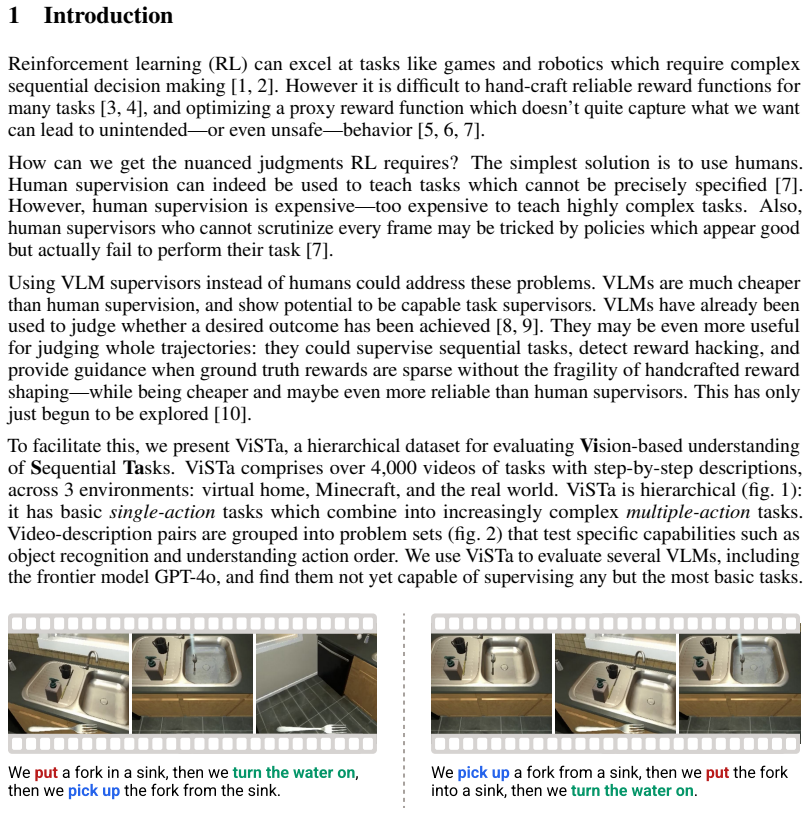
ViSTa's hierarchical structure is the central mechanism: level-1 single-action videos are composed into levels 2 through 8, and video-description pairs are grouped into problem sets that test object recognition, object properties, action understanding, and, through permutation problem sets, action order. The scoring protocol samples 8 to 32 frames per video, standardizes softmax scores across classes, and picks the highest-scoring description. The permutation problem sets are the load-bearing part of the benchmark because they keep objects and actions the same and vary only their order.
What would settle it
Have human annotators watch the automatically stitched virtual home permutation videos and try to identify the correct action order. If humans cannot reliably do so, the videos do not contain the order information ViSTa claims to measure, and the reported model failures would reflect dataset artifacts rather than a lack of sequential understanding.
Extended reading notes
Core claim
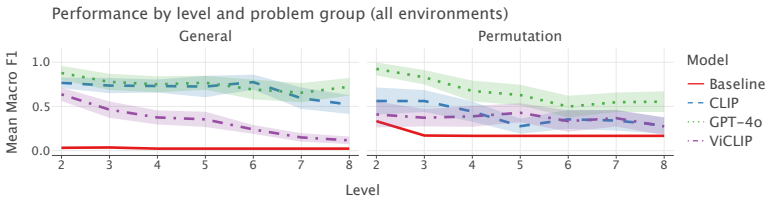
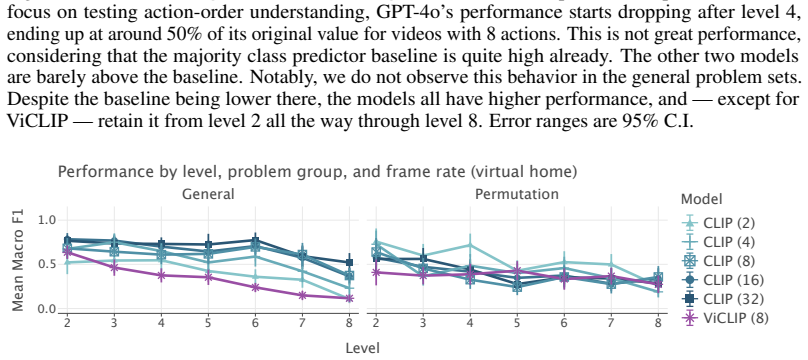
On ViSTa's permutation problem sets, the only tested model that beats the majority-class baseline is GPT-4o, and its macro F1 begins to fall after level 4, ending at roughly half of its original value for eight-action videos. CLIP and ViCLIP stay barely above baseline throughout. In general multi-step problem sets, CLIP can match videos to descriptions without any sense of order, which the paper attributes to the models relying on object recognition rather than on action order. The paper's central claim is that current VLMs cannot yet supervise sequential tasks and lack robust action-order understanding.
Load-bearing premise
The load-bearing assumption is that the automatically stitched virtual home videos in ViSTa, which contain visual glitches such as sudden teleportation and changes in held objects, still carry valid, human-recoverable action-order information; the paper does not verify this.
Editorial extensions
If this is right
- VLM-based process reward models are not yet viable for reinforcement learning on multi-step tasks, because the model cannot reliably tell whether steps happened in the correct order.
- Evaluation of task understanding must separate order understanding from object recognition; ViSTa's permutation problem sets do this, while general problem sets do not.
- Improving frame rate or model scale may improve general task matching, but the permutation results show that these levers do not fix order understanding for the tested models.
- For now, a frontier model like GPT-4o can be considered for supervision only of single-step or very short tasks, and its drop on eight-action videos shows why.
- If the failures are general, benchmark designers should treat 'matches the objects' and 'understands the sequence' as distinct capabilities rather than one skill.
Reading between the lines
- A testable extension is to fine-tune a VLM on order-contrastive pairs like ViSTa's permutation sets; success on held-out environments would suggest the failure is a training gap rather than a fundamental architectural limit.
- The finding that general multi-step problems can be solved without order understanding implies that earlier VLM reward-model successes on trajectory-style tasks may have been driven by object recognition; this could be checked by testing those reward models on wrong-order videos with identical objects.
- Because the glitch concern applies to the largest split, the paper's strongest evidence for the conclusion comes from the smaller real-world and Minecraft sets; scaling those up would directly test whether the virtual-home results generalize.
Editorial analysis
A structured set of objections, weighed in public.
Referee Report
Summary. The paper introduces ViSTa, a hierarchical dataset of over 4,000 videos with step-by-step task descriptions in virtual home, Minecraft, and real-world environments. The dataset is organized into problem sets and levels, enabling evaluation of vision-language models on single-action and multi-action sequential tasks. The authors evaluate CLIP, ViCLIP, and GPT-4o on video-description matching, finding that all models perform well on object recognition but poorly on action-order understanding, with GPT-4o showing non-trivial but declining performance on longer sequences. The central claim is that current VLMs are not yet capable of supervising sequential tasks, with implications for using VLMs as process reward models in reinforcement learning.
Significance. If the results hold, ViSTa would be a valuable benchmark for studying VLM capabilities on process-based supervision, complementing existing outcome-based reward-model evaluations. The hierarchical structure and the separation of object recognition, object properties, actions, general sequential understanding, and permutation-based order understanding are thoughtful design choices. The paper also tests models across three environments, including real-world videos that are human-validated, and provides open-source code and data. The strongest evidence is the consistent near-baseline performance of CLIP and ViCLIP on permutation problems and the decline of GPT-4o with level, which would support the conclusion that current VLMs cannot reliably supervise multi-step tasks.
major comments (2)
- [3.2 and A.1.2] The virtual-home multiple-action videos are created by stitching clips from different ALFRED episodes, and the paper asserts that the resulting 'small visual glitches' are 'not problematic for our evaluations, since the models all have low frame-rates.' This assertion is load-bearing because the majority of ViSTa consists of these stitched videos. A low frame rate does not remove semantic mismatches (e.g., a pick-up clip and a put-down clip of a banana from different episodes can depict different objects), nor does it prevent stitch boundaries from making segment order artificially salient. No control is provided: there is no comparison between stitched videos and continuous re-renderings of the same tasks, no human baseline on the virtual-home data, and no analysis of whether model errors concentrate on videos with detectable discontinuities. Without such a control, the level-dependent drop in Fig. 3b and Fig. 13a may reflect video-construction artifacts rather than model limitations in understanding action order.
- [A.1.4 and Author contribution statement] Human validation at 100% accuracy is claimed only for the real-world videos, not for the virtual-home or Minecraft data. Since the virtual-home videos are automatically generated and constitute the majority of the dataset, the ground truth for those videos is not independently verified. If the stitched videos are ambiguous even to humans, the measured 'failure' of VLMs would be an artifact of the dataset rather than a model deficiency. The paper should provide a human baseline on a sample of virtual-home videos (and ideally Minecraft) to establish that the intended task is actually entailed by the videos.
minor comments (5)
- [Abstract and Section 5] The phrase 'they fail to understand sequential tasks' is stronger than the reported results, which show GPT-4o achieving non-trivial (though declining) performance on permutation problems, while CLIP and ViCLIP are near baseline. Consider softening the wording to 'models are not yet reliable at supervising sequential tasks' to match the evidence.
- [Section 4.1, Eq. (1)] The score standardization computes µ and σ from the evaluation videos themselves, which could in principle leak information about the test set. The footnote says results did not meaningfully differ when excluding the video being tested, but this leave-one-out variant should be reported in the main text or appendix to make the protocol unambiguous.
- [Section 4.2 and Figure 17] The claim that 'real videos are easier than simulations' rests on a comparison of only 9 real-world videos against an unspecified number of virtual-home videos. This is a small sample, and the conclusion should be hedged accordingly.
- [Section 4.2 and Figure 5] The attribution of CLIP-8's advantage over ViCLIP to 'larger scale' is speculative, since the models differ in architecture, training data, and other factors beyond parameter count. Please phrase this as a hypothesis rather than a conclusion.
- [Appendix C, Figure 10] The prompt text in Figure 10 contains a typo ('sligthly' should be 'slightly').
Circularity Check
No significant circularity: ViSTa is an external evaluation instrument, and the reported VLM failures are measured against it rather than derived from its construction.
full rationale
The paper's central claim is an empirical evaluation result: ViSTa videos are scored by CLIP, ViCLIP, and GPT-4o against problem-set descriptions, and performance is reported as macro F1. No parameter or label is fitted to the target conclusion. The only preprocessing step, standardization in Sec. 4.1, normalizes per-class model scores with a mean and standard deviation, and the footnote explicitly checks leave-one-out robustness; it does not encode the level hierarchy or the action-order ground truth into the scores. The hierarchical design (levels 1-8) is an experimental manipulation, and the finding that longer tasks are harder is read off the models' outputs, so it is not true by construction. The one overlapping-author reference, Rocamonde et al. [8], is used only as background motivation for VLM-based reward models and is never invoked to justify the ViSTa evaluation or the failure conclusions. The stitching-discontinuity discussion in Sec. A.1.2 is a data-validity assumption about the stimulus ('small visual glitches... are not problematic for our evaluations, since the models all have low frame-rates'), but that is an unverified empirical claim about the videos, not a circular derivation: even if the glitches confound the measurement, the evaluation would still be an external measurement of model behavior. No step in the paper's derivation chain reduces to its own inputs, so there is no circularity.
Assumptions & free parameters
free parameters (4)
- Score standardization statistics mu and sigma =
computed from evaluation videos, per class
- Number of input frames =
GPT-4o: 16; CLIP: 32; ViCLIP: 8
- GPT-4o prompting scheme =
two-conversation, one-shot, exactly-one-highest-score
- Minecraft action taxonomy =
7 basic actions: place, break, craft, combat, find, mine, pick up
assumptions (3)
- domain assumption Forced-choice video-description matching is a valid measure of sequential task understanding
- domain assumption Visual discontinuities in remixed ALFRED videos do not affect VLM judgments
- domain assumption Ground-truth descriptions are correct and unambiguous for virtual home and Minecraft videos
Cite this review
Pith. "Pith review of ViSTa Dataset: Do vision-language models understand sequential tasks?." pith.science (2026). https://pith.science/paper/Q37YGDT2
@misc{pith2026241113211,
  author       = {Pith},
  title        = {Pith review of: ViSTa Dataset: Do vision-language models understand sequential tasks?},
  year         = {2026},
  howpublished = {\url{https://pith.science/paper/Q37YGDT2}},
  note         = {Machine review of arXiv:2411.13211}
}
read the original abstract
Using vision-language models (VLMs) as reward models in reinforcement learning holds promise for reducing costs and improving safety. So far, VLM reward models have only been used for goal-oriented tasks, where the agent must reach a particular final outcome. We explore VLMs' potential to supervise tasks that cannot be scored by the final state alone. To this end, we introduce ViSTa, a dataset for evaluating Vision-based understanding of Sequential Tasks. ViSTa comprises over 4,000 videos with step-by-step descriptions in virtual home, Minecraft, and real-world environments. Its novel hierarchical structure -- basic single-step tasks composed into more and more complex sequential tasks -- allows a fine-grained understanding of how well VLMs can judge tasks with varying complexity. To illustrate this, we use ViSTa to evaluate state-of-the-art VLMs, including CLIP, ViCLIP, and GPT-4o. We find that, while they are all good at object recognition, they fail to understand sequential tasks, with only GPT-4o achieving non-trivial performance.
Figures


Figures from the paper (14 more)


Reference graph
Works this paper leans on
-
[1]
Mas- tering the game of go with deep neural networks and tree search
David Silver, Aja Huang, Chris J Maddison, Arthur Guez, Laurent Sifre, George Van Den Driess- che, Julian Schrittwieser, Ioannis Antonoglou, Veda Panneershelvam, Marc Lanctot, et al. Mas- tering the game of go with deep neural networks and tree search. nature, 529(7587):484–489, 2016
2016
-
[2]
Deep reinforcement learning for robotics: A survey of real-world successes
Chen Tang, Ben Abbatematteo, Jiaheng Hu, Rohan Chandra, Roberto Martín-Martín, and Peter Stone. Deep reinforcement learning for robotics: A survey of real-world successes. arXiv preprint arXiv:2408.03539, 2024
arXiv 2024
-
[3]
Specification gaming: the flip side of ai ingenuity
Victoria Krakovna, Jonathan Uesato, Vladimir Mikulik, Matthew Rahtz, Tom Everitt, Ramana Kumar, Zac Kenton, Jan Leike, and Shane Legg. Specification gaming: the flip side of ai ingenuity. DeepMind Blog, 3, 2020
work page 2020
-
[4]
Defining and characterizing reward gaming
Joar Skalse, Nikolaus Howe, Dmitrii Krasheninnikov, and David Krueger. Defining and characterizing reward gaming. Advances in Neural Information Processing Systems, 35:9460– 9471, 2022. 6
work page 2022
-
[5]
On the importance of hyperparameter optimization for model-based reinforcement learning
Baohe Zhang, Raghu Rajan, Luis Pineda, Nathan Lambert, André Biedenkapp, Kurtland Chua, Frank Hutter, and Roberto Calandra. On the importance of hyperparameter optimization for model-based reinforcement learning. In International Conference on Artificial Intelligence and Statistics, pages 4015–4023. PMLR, 2021
work page 2021
-
[6]
Variational inverse control with events: A general framework for data-driven reward definition
Justin Fu, Avi Singh, Dibya Ghosh, Larry Yang, and Sergey Levine. Variational inverse control with events: A general framework for data-driven reward definition. Advances in neural information processing systems, 31, 2018
work page 2018
-
[7]
Deep reinforcement learning from human preferences
Paul F Christiano, Jan Leike, Tom Brown, Miljan Martic, Shane Legg, and Dario Amodei. Deep reinforcement learning from human preferences. Advances in neural information processing systems, 30, 2017
2017
-
[8]
Vision- Language Models are Zero-Shot Reward Models for Reinforcement Learning, 2023
Juan Rocamonde, Victoriano Montesinos, Elvis Nava, Ethan Perez, and David Lindner. Vision- Language Models are Zero-Shot Reward Models for Reinforcement Learning, 2023. URL http://arxiv.org/abs/2310.12921
arXiv 2023
Show all 45 references
-
[9]
Sontakke, Jesse Zhang, Sébastien M
Sumedh A. Sontakke, Jesse Zhang, Sébastien M. R. Arnold, Karl Pertsch, Erdem Bıyık, Dorsa Sadigh, Chelsea Finn, and Laurent Itti. RoboCLIP: One Demonstration is Enough to Learn Robot Policies, 2023. URL http://arxiv.org/abs/2310.07899
2023 arXiv
-
[10]
Task Success
Lin Guan, Yifan Zhou, Denis Liu, Yantian Zha, Heni Ben Amor, and Subbarao Kambhampati. "Task Success" is not Enough: Investigating the Use of Video-Language Models as Behavior Critics for Catching Undesirable Agent Behaviors, 2024. URL http://arxiv.org/abs/ 2402.04210
2024 arXiv
-
[11]
in-the-wild
Annie S Chen, Suraj Nair, and Chelsea Finn. Learning generalizable robotic reward functions from" in-the-wild" human videos. arXiv preprint arXiv:2103.16817, 2021
2021 arXiv
-
[12]
The unsur- prising effectiveness of pre-trained vision models for control
Simone Parisi, Aravind Rajeswaran, Senthil Purushwalkam, and Abhinav Gupta. The unsur- prising effectiveness of pre-trained vision models for control. In international conference on machine learning, pages 17359–17371. PMLR, 2022
2022
-
[13]
Reward design with language models
Minae Kwon, Sang Michael Xie, Kalesha Bullard, and Dorsa Sadigh. Reward design with language models. arXiv preprint arXiv:2303.00001, 2023
2023 arXiv
-
[14]
Smith, and Han- naneh Hajishirzi
Nathan Lambert, Valentina Pyatkin, Jacob Morrison, LJ Miranda, Bill Yuchen Lin, Khy- athi Chandu, Nouha Dziri, Sachin Kumar, Tom Zick, Yejin Choi, Noah A. Smith, and Han- naneh Hajishirzi. Rewardbench: Evaluating reward models for language modeling. CoRR, abs/2403.13787, 2024....
-
[15]
Reward learning from narrated demonstrations
Hsiao-Yu Tung, Adam W Harley, Liang-Kang Huang, and Katerina Fragkiadaki. Reward learning from narrated demonstrations. In Proceedings of the IEEE Conference on Computer Vision and Pattern Recognition, pages 7004–7013, 2018
2018
-
[16]
Zero-shot reward specification via grounded natural language
Parsa Mahmoudieh, Deepak Pathak, and Trevor Darrell. Zero-shot reward specification via grounded natural language. In International Conference on Machine Learning, pages 14743– 14752. PMLR, 2022
2022
-
[17]
RL-VLM-F: Reinforcement Learning from Vision Language Foundation Model Feedback, 2024
Yufei Wang, Zhanyi Sun, Jesse Zhang, Zhou Xian, Erdem Biyik, David Held, and Zackory Erickson. RL-VLM-F: Reinforcement Learning from Vision Language Foundation Model Feedback, 2024. URL http://arxiv.org/abs/2402.03681
2024 arXiv
-
[18]
PCA-Bench: Evaluating Multimodal Large Language Models in Perception-Cognition-Action Chain, 2024
Liang Chen, Yichi Zhang, Shuhuai Ren, Haozhe Zhao, Zefan Cai, Yuchi Wang, Peiyi Wang, Xiangdi Meng, Tianyu Liu, and Baobao Chang. PCA-Bench: Evaluating Multimodal Large Language Models in Perception-Cognition-Action Chain, 2024. URL http://arxiv.org/ abs/2402.15527
2024 arXiv
-
[19]
Paxion: Patching Action Knowledge in Video-Language Foundation Models,
Zhenhailong Wang, Ansel Blume, Sha Li, Genglin Liu, Jaemin Cho, Zineng Tang, Mohit Bansal, and Heng Ji. Paxion: Patching Action Knowledge in Video-Language Foundation Models,
-
[20]
Matthews, Ivan Villa-Renteria, Jerry Huayang Tang, Claire Tang, Fei Xia, Yunzhu Li, Silvio Savarese, Hyowon Gweon, C
Chengshu Li, Ruohan Zhang, Josiah Wong, Cem Gokmen, Sanjana Srivastava, Roberto Martín- Martín, Chen Wang, Gabrael Levine, Wensi Ai, Benjamin Martinez, Hang Yin, Michael Lingelbach, Minjune Hwang, Ayano Hiranaka, Sujay Garlanka, Arman Aydin, Sharon Lee, Jiankai Sun, Mona Anvar...
2024 arXiv
-
[21]
VirtualHome: Simulating Household Activities via Programs, 2018
Xavier Puig, Kevin Ra, Marko Boben, Jiaman Li, Tingwu Wang, Sanja Fidler, and Antonio Torralba. VirtualHome: Simulating Household Activities via Programs, 2018. URL http: //arxiv.org/abs/1806.07011
2018 arXiv
-
[22]
Habitat: A Platform for Embodied AI Research, 2019
Manolis Savva, Abhishek Kadian, Oleksandr Maksymets, Yili Zhao, Erik Wijmans, Bhavana Jain, Julian Straub, Jia Liu, Vladlen Koltun, Jitendra Malik, Devi Parikh, and Dhruv Batra. Habitat: A Platform for Embodied AI Research, 2019. URL http://arxiv.org/abs/1904. 01201
2019
-
[23]
Turner, Oleksandr Maksymets, Zsolt Kira, Mrinal Kalakrishnan, Jitendra Malik, Devendra Singh Chaplot, Unnat Jain, Dhruv Batra, Akshara Rai, and Roozbeh Mottaghi
Xavier Puig, Eric Undersander, Andrew Szot, Mikael Dallaire Cote, Tsung-Yen Yang, Ruslan Partsey, Ruta Desai, Alexander William Clegg, Michal Hlavac, So Yeon Min, Vladimír V ondruš, Theophile Gervet, Vincent-Pierre Berges, John M. Turner, Oleksandr Maksymets, Zsolt Kira, Mrina...
2023 arXiv
-
[24]
ALFRED: A Benchmark for Interpreting Grounded Instructions for Everyday Tasks, 2020
Mohit Shridhar, Jesse Thomason, Daniel Gordon, Yonatan Bisk, Winson Han, Roozbeh Mot- taghi, Luke Zettlemoyer, and Dieter Fox. ALFRED: A Benchmark for Interpreting Grounded Instructions for Everyday Tasks, 2020. URL http://arxiv.org/abs/1912.01734
2020 arXiv
-
[25]
A short note on the kinetics- 700 human action dataset
Joao Carreira, Eric Noland, Chloe Hillier, and Andrew Zisserman. A short note on the kinetics- 700 human action dataset. arXiv preprint arXiv:1907.06987, 2019
1907 arXiv
-
[26]
BEDD: the minerl BASALT evaluation and demonstrations dataset for training and benchmarking agents that solve fuzzy tasks
Stephanie Milani, Anssi Kanervisto, Karolis Ramanauskas, Sander Schulhoff, Brandon Houghton, and Rohin Shah. BEDD: the minerl BASALT evaluation and demonstrations dataset for training and benchmarking agents that solve fuzzy tasks. In Alice Oh, Tris- tan Naumann, Amir Globerso...
2023
-
[27]
Plan4mc: Skill reinforcement learning and planning for open-world minecraft tasks
Haoqi Yuan, Chi Zhang, Hongcheng Wang, Feiyang Xie, Penglin Cai, Hao Dong, and Zongqing Lu. Plan4mc: Skill reinforcement learning and planning for open-world minecraft tasks. CoRR, abs/2303.16563, 2023. doi: 10.48550/ARXIV .2303.16563. URL https://doi.org/10. 48550/arXiv.2303.16563
-
[28]
Learning transferable visual models from natural language supervision
Alec Radford, Jong Wook Kim, Chris Hallacy, Aditya Ramesh, Gabriel Goh, Sandhini Agarwal, Girish Sastry, Amanda Askell, Pamela Mishkin, Jack Clark, et al. Learning transferable visual models from natural language supervision. In International conference on machine learning, pa...
2021
-
[29]
Reproducible scaling laws for contrastive language-image learning, 2022
Mehdi Cherti, Romain Beaumont, Ross Wightman, Mitchell Wortsman, Gabriel Ilharco, Cade Gordon, Christoph Schuhmann, Ludwig Schmidt, and Jenia Jitsev. Reproducible scaling laws for contrastive language-image learning, 2022. URL http://arxiv.org/abs/2212.07143
2022 arXiv
-
[30]
LAION-5B: An open large-scale dataset for training next generation image-text models, 2022
Christoph Schuhmann, Romain Beaumont, Richard Vencu, Cade Gordon, Ross Wightman, Mehdi Cherti, Theo Coombes, Aarush Katta, Clayton Mullis, Mitchell Wortsman, Patrick Schramowski, Srivatsa Kundurthy, Katherine Crowson, Ludwig Schmidt, Robert Kaczmarczyk, and Jenia Jitsev. LAION...
2022 arXiv
-
[31]
InternVid: A Large-scale Video-Text Dataset for Multimodal Understanding and Generation, 2024
Yi Wang, Yinan He, Yizhuo Li, Kunchang Li, Jiashuo Yu, Xin Ma, Xinhao Li, Guo Chen, Xinyuan Chen, Yaohui Wang, Conghui He, Ping Luo, Ziwei Liu, Yali Wang, Limin Wang, and Yu Qiao. InternVid: A Large-scale Video-Text Dataset for Multimodal Understanding and Generation, 2024. UR...
2024 arXiv
-
[32]
break-craft
Aaron Hurst, Adam Lerer, Adam P Goucher, Adam Perelman, Aditya Ramesh, Aidan Clark, AJ Ostrow, Akila Welihinda, Alan Hayes, Alec Radford, et al. Gpt-4o system card. arXiv preprint arXiv:2410.21276, 2024. 9 Author contribution statement Evžen Wybitul: • Implemented the current ...
2024 arXiv
-
[34]
First conversation, to get frame-by-frame descriptions: (a) First and only message: system prompt (figure 6) + frame-by-frame prompt (figure 7)
-
[35]
likely does not describe the video
In a second conversation, separate from the first one: (a) First message: The same system prompt (figure 6) + class match prompt (figure 8) (b) Second message, same conversation, after GPT-4o replies: scoring prompt (figure 9) 13 Level Group Task Classes, videos per problem Ba...
-
[36]
Player holds an oak fence block in their hands
We see a flat grassy area with small houses and trees nearby. Player holds an oak fence block in their hands
-
[37]
Same scene from a sligthly different angle
-
[38]
Player breaks a tuft of grass using an oak fence block
-
[39]
Player proceeds removing grass
-
[40]
Player places a fence block next to a house
-
[41]
Player places more fence blocks, building a straight fence line
-
[42]
Player turns around and finds a pig
-
[43]
Player places one more fence block in the line
-
[44]
Player breaks another tuft of grass
-
[45]
Figure 10: The prompt used to obtain frame-by-frame descriptions for Minecraft videos
Player proceeds removing grass. Figure 10: The prompt used to obtain frame-by-frame descriptions for Minecraft videos. frames refer to the actual frames, which are base64 encoded and passed through the OpenAI API as detailed in their documentation. 17 Then, given the original ...
-
[2023]
URL http://arxiv.org/abs/2305.10683. 7
Reviewed August 12, 2026 · model on record in the stance chip above.
Discussion (0). Continue with ORCID to comment.