REVIEW 1 major objections 5 minor 2 cited by
Two-pion exchange for coupled-channel scattering of two heavy mesons
T0 review · 1 major / 5 minor · reviewed 2026-08-12 · deepseek-v4-flash
Pith's one-line read This paper derives the missing two-pion exchange terms for heavy-meson scattering at next-to-leading order and shows they are nearly equivalent to simple contact interactions.
desk verdict Solid technical completion of the NLO two-pion-exchange potential for heavy-meson scattering; the main caveat is the unquantified vertex-correction suppression, but the derivation itself is careful and worth refereeing. read the letter →
The pith
A machine-rendered reading of the paper's core claim, the machinery that carries it, and where it could break.
The reading
What carries the argument
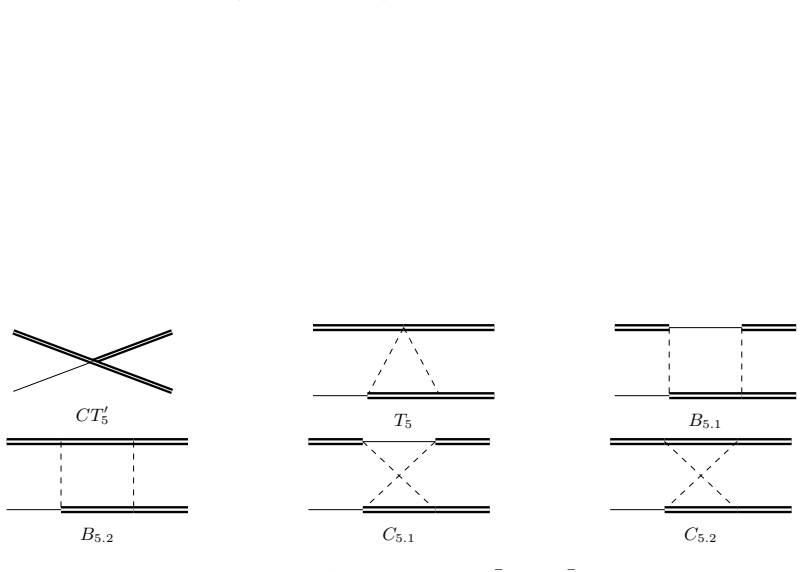
The argument is carried by the momentum counting scheme, which promotes the coupled-channel momentum scale $p_{\rm typ} = \sqrt{m_B\,\delta} \simeq 500$ MeV (with $\delta = m_{B^*} - m_B$ the vector–pseudoscalar splitting) to a soft scale, so that loop integrals are dominated by momenta of order $p_{\rm typ}$ rather than by the pion mass. This selects a specific subclass of one-loop diagrams — triangle, football, box, and crossed box built from the Weinberg–Tomozawa vertex and the axial $\pi BB^*$ vertices — while relegating vertex corrections to next-to-next-to-next-to-leading order. The explicit closed-form integrals $I_{tr}$, $I_{fb}$, and $I^{(2)}_{\rm box}$ play the central role: their leading $O(Q^2)$ parts are polynomial in the transferred momentum $q$ plus a logarithmic function $L(q)$, and their ultraviolet divergences (the $R$ terms) are absorbed into the three spin-symmetry-allowed counterterms.
What would settle it
Evaluate the suppressed vertex-correction diagrams of Fig. 2 at physical masses: if their numerical contribution at momenta near $p_{\rm typ} \simeq 500$ MeV is comparable to the retained two-pion exchange diagrams, the counting assumption collapses and the claimed $O(Q^2)$ potential is incomplete. A cleaner long-term test is high-precision lattice data on $DD^*$ scattering in both isospin channels at $m_\pi \simeq 280$ MeV, which should show the TPE-predicted pattern of attraction for $I=0$ and repulsion for $I=1$.
Extended reading notes
Core claim
The central claim is that all one-loop two-pion exchange contributions to $B^{(*)}\bar B^{(*)}$ and $B^{(*)}B^{(*)}$ scattering at order $O(Q^2)$ can be computed within the momentum counting scheme and are dominated by polynomial, contact-like terms. Three structural results carry the argument: the triangle diagrams cancel completely for meson–antimeson systems but survive for meson–meson systems; the box diagrams are the sole source of $S$–$D$ transitions; and the divergent parts of all loop integrals can be absorbed into just three contact interactions, as required by heavy-quark spin symmetry, even though the number of open transitions is much larger. The paper verifies the cancellation and the renormalization pattern explicitly for the $J^{PC} = 0^{++}, 1^{++}, 1^{+-}, 2^{++}$ channels, and notes that the resulting TPE potentials reproduce the isovector–isoscalar pattern of the $DD^*$ interactions seen on the lattice.
Load-bearing premise
Everything rests on treating momenta of about 500 MeV as a soft scale with the pion mass one order smaller; that single assumption pushes all vertex-correction diagrams (Fig. 2) down to next-to-next-to-next-to-leading order, and if it fails numerically the $O(Q^2)$ potential is missing an entire class of diagrams.
Editorial extensions
If this is right
- The earlier analyses of the $Z_b$ line shapes, which used only contact terms and one-pion exchange, can be reinterpreted as close to the full NLO result, so their extracted pole positions are not expected to shift dramatically once TPE is included.
- Fitting the full NLO potential to data will produce pole positions for $Z_b(10610)$ and $Z_b(10650)$ and parameter-free predictions for their spin partners with controlled uncertainty estimates.
- The TPE potentials apply unchanged to $D^{(*)}D^{(*)}$ scattering, so the $T_{cc}$ state can be analyzed at the same order; at the physical pion mass the three-body cuts contribute to the $T_{cc}$ width at higher order.
- The isovector-versus-isoscalar difference in $J^P = 1^+$ $DD^*$ potentials observed in lattice QCD is naturally explained by TPE: attraction for $I=0$, repulsion for $I=1$.
Reading between the lines
- Editorial inference: if TPE is genuinely contact-dominated, the $O(Q^2)$ contact couplings fitted in one transition should transfer to the others; a future high-statistics mismatch in any single $J^{PC}$ partial wave would localize where the effective theory breaks down.
- Editorial inference: contact dominance of the intermediate-range force is consistent with (though not proof of) a molecular, rather than compact, nature of these states, since a compact core would typically introduce non-local effects at this order.
- Editorial inference: a direct test would be to apply the same momentum-counting TPE calculation to the $X(3872)$ channel, where the one-pion tensor force must be iterated; contact dominance there is not guaranteed.
- Editorial inference: comparing sharp-cutoff and semilocal-momentum regularizations of the completed NLO potential would quantify how much of the contact-like finding depends on the regulator choice.
Editorial analysis
A structured set of objections, weighed in public.
Referee Report
Summary. This paper derives two-pion exchange (TPE) contributions to the coupled-channel scattering potentials of B(*)Bbar(*) and B(*)B(*) systems up to O(Q^2) in a chiral EFT with a momentum-counting scheme where ptyp ~ sqrt(m_B delta) ~ 500 MeV is treated as a soft scale. The authors present closed-form expressions for football, triangle, planar and crossed box diagrams, their partial-wave decomposition for JPC = 0++, 1++, 1+-, and 2++, and a renormalization analysis showing all divergences are absorbed by three O(Q^2) contact terms. They report that the sum of triangle diagrams vanishes for the meson-antimeson case but not for the meson-meson case. They compare with earlier EFT works and find disagreements with Ref. [66] on the triangle/box content. Finally, they show numerically that the TPE potentials are well represented by contact terms at O(Q^2) and use this to argue that previous contact-only analyses are close to the NLO result.
Significance. If the completeness claim holds, the paper completes the NLO potential for B(*)Bbar(*) and B(*)B(*) scattering in the momentum counting scheme, a prerequisite for systematic uncertainty estimates for the Zb states and for the Tcc. The derivation is internally checked by the cancellation of triangle diagrams, the planar/crossed box identity, and the consistent absorption of all divergences into exactly the three contact terms allowed by heavy-quark spin symmetry. The contact-dominance analysis is diagnostic and explicitly not fitted to physical data, so there is no circularity in the main derivation. The heavy-mass independence of the TPE expressions extends the results to D(*)D(*), which is relevant for lattice QCD analyses.
major comments (1)
- [Sec. III (Power Counting), Fig. 2, and Sec. IX] The central claim of completing the O(Q^2) potential (Sec. IX) rests on the assignment of all vertex-correction loops (Fig. 2) to N3LO. The argument in Sec. III is that the pion propagator in this topology does not contain the external momentum q, so the loop momentum is set by m_pi, giving a suppression (m_pi/ptyp)^2 ~ 0.08 relative to the NLO TPE. With chi ~ 1/2 the numerical margin is thin (0.08 vs the formal chi^4 ~ 0.06), and no vertex-correction integral is actually evaluated in the paper. The internal checks in Sec. VI (renormalization, triangle cancellation) do not exercise this diagram class. Since the abstract and Sec. IX state completeness rather than 'completeness of the TPE diagrams', please provide a quantitative power-counting estimate that includes numerator factors and the delta scale of the heavy-meson propagator, or explicitly qualify the claim to 'the TPE diagrams at O(Q^2) under the assumed suppression of vertex corrections'.
minor comments (5)
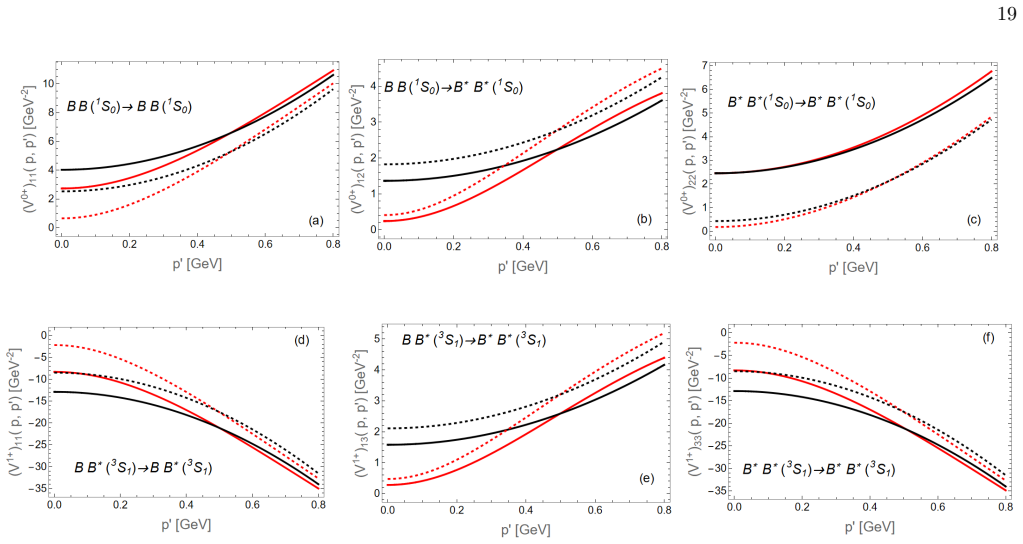
- [Sec. VII and figure captions] The text refers to red dashed lines for the potential expanded to O(Q^2), while the captions of Figs. 12-17 say 'dotted' (e.g., 'solid (dotted) red lines'); please make the line-style terminology consistent.
- [Eq. (8) and surrounding text] The notation for the expansion parameters is confusing because chi2 appears both as the pion-mass ratio m_pi/Lambda and as the second expansion parameter; please use distinct symbols (e.g., chi_pi) for m_pi/Lambda.
- [Eq. (D28) (K51/K15)] The expression for K51 contains a repeated '3Qx' term; please check whether one of these should be Qn or Qn'.
- [Appendix E, Eq. (E10)] The term '59p'^2/(240p'^2)' is dimensionless and likely a typo for 59/240; please correct.
- [Sec. VII] The diagnostic contact fits are said to fix DSD from one S-D transition, but the extracted values of the fitted LECs (even if unphysical) are not tabulated; providing them would improve reproducibility.
Circularity Check
No significant circularity: the TPE potentials are derived from the chiral Lagrangian with externally fixed constants, and the contact-term fits are explicitly diagnostic rather than predictive of data.
full rationale
The paper's central claim is the derivation of previously missing two-pion-exchange (TPE) operators at O(Q^2) in the momentum counting scheme. Walking the derivation chain: the vertices follow from the chiral Lagrangian, Eq. (3), with the pion coupling g=0.57 taken from the external PDG D*→Dπ width (Ref. [71]) and f_pi=92.4 MeV; the loop integrals (triangle, football, box) are evaluated in Appendix A from those Feynman rules, giving closed forms in Eqs. (18), (28), and (35). The renormalization checks in Sec. VI enforce that divergences are absorbed into the three allowed contact LECs and verify the remaining transitions are finite; this is an internal consistency condition, not an input-output identity. The Sec. VII demonstration that contact terms approximate the TPE potentials involves fitting Cd, Cf, Dd, Df to the TPE potential itself, but the paper states explicitly that 'the values of the LECs extracted above are not their physical values' and that a data analysis including TPE is still needed for accurate pole positions; the fits are diagnostic of the polynomial nature of the TPE at this order, and the agreement across momentum ranges and partial waves is not forced by construction. The paper builds on the same authors' earlier framework (Refs. [39,40,84]), and the claim that the earlier contact-only analyses are a fair representation of NLO physics is self-referential, but that claim is not load-bearing for the TPE derivation itself. The suppression of vertex-correction loops (Sec. III, Eqs. (8)-(9), Fig. 2) is a power-counting assumption about scale separation (m_pi/ptyp ~ O(chi)); this is a modeling assumption subject to numerical plausibility checks, not a circular step, and the comparison with external works Refs. [65,66] plus the disagreement on triangle and box contributions provides independent falsifiable content. No step was found where a quantity is defined in terms of the claimed output, or a fitted parameter is renamed as a prediction of the data used to fix it.
Assumptions & free parameters
assumptions (5)
- domain assumption The heavy-meson chiral Lagrangian with heavy-quark spin symmetry (Eq. 3) generates the relevant vertices and contact interactions up to O(Q2).
- domain assumption In the momentum counting scheme, ptyp ~ sqrt(mB delta) ~ 500 MeV is a soft scale, mpi/ptyp ~ O(chi), and vertex corrections are suppressed by (mpi/ptyp)^2.
- standard math The reducible part of the planar box is exactly the iterated one-pion exchange and is removed; the irreducible planar box equals the crossed box.
- standard math Dimensional regularization with divergent R terms absorbed by contact terms; only three independent contact terms appear at NLO due to heavy-quark spin symmetry.
- domain assumption The pion coupling g = 0.57 determined from D* -> D pi applies to bottom mesons via heavy-quark flavor symmetry.
Cite this review
Pith. "Pith review of Two-pion exchange for coupled-channel scattering of two heavy mesons." pith.science (2026). https://pith.science/paper/MUTZNEXU
@misc{pith2026241113303,
  author       = {Pith},
  title        = {Pith review of: Two-pion exchange for coupled-channel scattering of two heavy mesons},
  year         = {2026},
  howpublished = {\url{https://pith.science/paper/MUTZNEXU}},
  note         = {Machine review of arXiv:2411.13303}
}
abstract
To improve the theoretical understanding of multiquark states like $Z_b(10610)$ and $Z_b(10650)$, we calculate the heavy-meson heavy-(anti)meson scattering potential up to next-to-leading order, $O(Q^2)$, within chiral effective field theory ($\chi$EFT) employing a power counting scheme that explicitly keeps track with the large momentum scale $Q \sim \sqrt{2\mu \delta}$ (where $\delta = m_V - m_P$ is the vector-pseudoscalar mass difference and $\mu$ their reduced mass) introduced by the coupled channel dynamics. We provide expressions for the two-pion exchange (TPE) terms up to $O(Q^2)$ and their partial-wave decomposition. We show that these potentials are well-approximated by contact terms at $O(Q^2)$, with minor residual non-analytic TPE contributions, supporting $\chi$EFT convergence in the theoretical predictions for $Z_b(10610)$ and $Z_b(10650)$, as well as their spin partners. These findings are also relevant for $D^{(*)}D^{(*)}$ scattering, especially for the $T_{cc}$ state, for both physical and lattice QCD data with moderately larger pion masses. We further demonstrate that the differences between isovector and isoscalar potentials for heavy mesons are naturally explained by the TPE contributions.
Figures


Figures from the paper (15 more)






Forward citations
Cited by 2 Pith papers
-
Dispersive Analysis of $D$- and $B$-Meson Form Factors with Chiral and Heavy-Quark Constraints
The isovector D/D*/B/B* electromagnetic form factors are reconstructed dispersively with ππ rescattering, yielding ρ(770) coupling constants from pole residues.
-
Investigating the two-pion exchange of the double charm $DD^*$ chiral interactions and $T_{cc}$
In this chiral EFT calculation the I=0 DD* two-pion-exchange potential is repulsive, and its near-cancellation with attractive contact and one-pion terms provides the weak binding of Tcc.
Reference graph
Works this paper leans on
-
[66]
J. M. Dias, F. Aceti, and E. Oset, Study of B ¯B∗ and B∗ ¯B∗ interactions in I = 1 and relationship to the Zb(10610), Zb(10650) states, Phys. Rev. D 91, 076001 (2015), arXiv:1410.1785 [hep-ph]
work page Pith review arXiv 2015
-
[1]
Symmetries and the Emergence of Structure in QCD
JPC = 0++ V 0++,I CT = CI d + 1 2 CI f + (DI d + 1 2 DI f )(p2 + p′2) 1 2 √ 3(CI f + DI f (p2 + p′2)) − √ 3DI SD p′2 1 2 √ 3(CI f + DI f (p2 + p′2)) CI d − 1 2 CI f + (DI d − 1 2 DI f )(p2 + p′2) −DI SD p′2 − √ 3DI SD p2 −DI SD p2 0 , (45) where the index I stands for isospin and the parameters are convenient linear combinations of the Lagrangia...
-
[2]
In this section we demonstrate this explicitly for the B ¯B → B ¯B channel, however, the same pattern applies to all the other potentials analogously
Triangle and Football diagrams For the B(∗) ¯B(∗) case, the sum of all triangle diagrams vanishes. In this section we demonstrate this explicitly for the B ¯B → B ¯B channel, however, the same pattern applies to all the other potentials analogously. For the B ¯B → B ¯B potential, as shown in Fig. 4, we have two triangle diagrams denoted as T1.1 and T1.2. ...
-
[3]
g 2fπ ϵi(λ1)(−q2)i (τ1)d # i −l0 + iϵ
Box diagrams The box diagrams are made from four pion–heavy- meson vertices contracted with two pion propagators. These form either a planar box or a crossed box. To avoid double counting, only the irreducible two-heavy meson part of the planar box is kept in the potential, as the reducible parts are generated through iterations in the Lippmann-Schwinger ...
-
[4]
R. F. Lebed, R. E. Mitchell, and E. S. Swanson, Heavy- Quark QCD Exotica, Prog. Part. Nucl. Phys. 93, 143 (2017), arXiv:1610.04528 [hep-ph]
arXiv 2017
-
[5]
A. Esposito, A. Pilloni, and A. D. Polosa, Multiquark Resonances, Phys. Rept. 668, 1 (2017), arXiv:1611.07920 [hep-ph]
arXiv 2017
-
[6]
A. Ali, J. S. Lange, and S. Stone, Exotics: Heavy Pen- taquarks and Tetraquarks, Prog. Part. Nucl. Phys. 97, 123 (2017), arXiv:1706.00610 [hep-ph]
arXiv 2017
-
[7]
F.-K. Guo, C. Hanhart, U.-G. Meißner, Q. Wang, Q. Zhao, and B.-S. Zou, Hadronic molecules, Rev. Mod. Phys. 90, 015004 (2018), arXiv:1705.00141 [hep-ph]
arXiv 2018
Show all 110 references
-
[8]
S. L. Olsen, T. Skwarnicki, and D. Zieminska, Nonstan- dard heavy mesons and baryons: Experimental evidence, Rev. Mod. Phys. 90, 015003 (2018), arXiv:1708.04012 [hep-ph]
2018 arXiv
-
[9]
Liu, H.-X
Y.-R. Liu, H.-X. Chen, W. Chen, X. Liu, and S.-L. Zhu, Pentaquark and Tetraquark states, Prog. Part. Nucl. Phys. 107, 237 (2019), arXiv:1903.11976 [hep-ph]
2019 arXiv
-
[10]
Brambilla, S
N. Brambilla, S. Eidelman, C. Hanhart, A. Nefediev, 22 C.-P. Shen, C. E. Thomas, A. Vairo, and C.-Z. Yuan, The XY Z states: experimental and theoretical sta- tus and perspectives, Phys. Rept. 873, 1 (2020), arXiv:1907.07583 [hep-ex]
2020 arXiv
-
[11]
Guo, X.-H
F.-K. Guo, X.-H. Liu, and S. Sakai, Threshold cusps and triangle singularities in hadronic reactions, Prog. Part. Nucl. Phys. 112, 103757 (2020), arXiv:1912.07030 [hep- ph]
2020 arXiv
-
[12]
H.-X. Chen, W. Chen, X. Liu, Y.-R. Liu, and S.-L. Zhu, An updated review of the new hadron states, Rept. Prog. Phys. 86, 026201 (2023), arXiv:2204.02649 [hep-ph]
2023 arXiv
-
[13]
L. Meng, B. Wang, G.-J. Wang, and S.-L. Zhu, Chi- ral perturbation theory for heavy hadrons and chiral ef- fective field theory for heavy hadronic molecules, Phys. Rept. 1019, 1 (2023), arXiv:2204.08716 [hep-ph]
2023 arXiv
-
[14]
Bondar et al
A. Bondar et al. (Belle), Observation of two charged bottomonium-like resonances in Y(5S) decays, Phys. Rev. Lett. 108, 122001 (2012), arXiv:1110.2251 [hep-ex]
2012 arXiv
-
[15]
Ablikim et al
M. Ablikim et al. (BESIII), Observation of a Charged Charmoniumlike Structure in e+e− → π+π−J/ψ at√s =4.26 GeV, Phys. Rev. Lett. 110, 252001 (2013), arXiv:1303.5949 [hep-ex]
2013 arXiv
-
[16]
Z. Q. Liu et al. (Belle), Study of e+e−ßπ+π−J/ψ and Observation of a Charged Charmoniumlike State at Belle, Phys. Rev. Lett. 110, 252002 (2013), [Erratum: Phys.Rev.Lett. 111, 019901 (2013)], arXiv:1304.0121 [hep-ex]
2013 arXiv
-
[17]
Ablikim et al
M. Ablikim et al. (BESIII), Observation of a Charged Charmoniumlike Structure Zc(4020) and Search for the Zc(3900) in e+e− → π+π−hc, Phys. Rev. Lett. 111, 242001 (2013), arXiv:1309.1896 [hep-ex]
2013 arXiv
-
[18]
S. K. Choi et al. (Belle), Observation of a resonance- like structure in the pi±ψ′ mass distribution in exclu- sive B → Kπ ±ψ′ decays, Phys. Rev. Lett. 100, 142001 (2008), arXiv:0708.1790 [hep-ex]
2008 arXiv
-
[19]
Mizuk et al
R. Mizuk et al. (Belle), Dalitz analysis of B — > K pi+ psi-prime decays and the Z(4430)+, Phys. Rev. D 80, 031104 (2009), arXiv:0905.2869 [hep-ex]
2009 arXiv
-
[20]
Chilikin et al
K. Chilikin et al. (Belle), Experimental constraints on the spin and parity of the Z(4430)+, Phys. Rev. D 88, 074026 (2013), arXiv:1306.4894 [hep-ex]
2013 arXiv
-
[21]
Aaij et al
R. Aaij et al. (LHCb), Observation of the resonant char- acter of the Z(4430)− state, Phys. Rev. Lett.112, 222002 (2014), arXiv:1404.1903 [hep-ex]
2014 arXiv
-
[22]
Adachi (Belle), Observation of two charged bottomonium-like resonances, in 9th Conference on Flavor Physics and CP Violation(2011) arXiv:1105.4583 [hep-ex]
I. Adachi (Belle), Observation of two charged bottomonium-like resonances, in 9th Conference on Flavor Physics and CP Violation(2011) arXiv:1105.4583 [hep-ex]
2011 arXiv
-
[23]
Adachi et al
I. Adachi et al. (Belle), Study of Three-Body Y(10860) Decays (2012) arXiv:1209.6450 [hep-ex]
2012 arXiv
-
[24]
Garmash et al.(Belle), Observation of Zb(10610) and Zb(10650) Decaying to B Mesons, Phys
A. Garmash et al.(Belle), Observation of Zb(10610) and Zb(10650) Decaying to B Mesons, Phys. Rev. Lett. 116, 212001 (2016), arXiv:1512.07419 [hep-ex]
2016 arXiv
-
[25]
A. E. Bondar, A. Garmash, A. I. Milstein, R. Mizuk, and M. B. Voloshin, Heavy quark spin structure in Zb reso- nances, Phys. Rev. D 84, 054010 (2011), arXiv:1105.4473 [hep-ph]
2011 arXiv
-
[26]
R. M. Albuquerque, J. M. Dias, K. P. Khemchandani, A. Mart ´ ınez Torres, F. S. Navarra, M. Nielsen, and C. M. Zanetti, QCD sum rules approach to the X, Y and Z states, J. Phys. G 46, 093002 (2019), arXiv:1812.08207 [hep-ph]
2019 arXiv
-
[27]
Weinberg, Evidence That the Deuteron Is Not an El- ementary Particle, Phys
S. Weinberg, Evidence That the Deuteron Is Not an El- ementary Particle, Phys. Rev. 137, B672 (1965)
1965
-
[28]
Morgan, Pole counting and resonance classification, Nucl
D. Morgan, Pole counting and resonance classification, Nucl. Phys. A 543, 632 (1992)
1992
-
[29]
V. Baru, J. Haidenbauer, C. Hanhart, Y. Kalashnikova, and A. E. Kudryavtsev, Evidence that the a0(980) and f0(980) are not elementary particles, Phys. Lett. B 586, 53 (2004), arXiv:hep-ph/0308129
2004 arXiv
-
[30]
Matuschek, V
I. Matuschek, V. Baru, F.-K. Guo, and C. Hanhart, On the nature of near-threshold bound and virtual states, Eur. Phys. J. A 57, 101 (2021), arXiv:2007.05329 [hep- ph]
2021 arXiv
-
[31]
P. C. Bruns, Spatial interpretation of ”compositeness” for finite-range potentials, (2019), arXiv:1905.09196 [hep- ph]
2019 arXiv
-
[32]
J. A. Oller, New results from a number operator inter- pretation of the compositeness of bound and resonant states, Annals Phys. 396, 429 (2018), arXiv:1710.00991 [hep-ph]
2018 arXiv
-
[33]
Kang and J
X.-W. Kang and J. A. Oller, Different pole structures in line shapes of the X(3872), Eur. Phys. J. C 77, 399 (2017), arXiv:1612.08420 [hep-ph]
2017 arXiv
-
[34]
Sekihara, Two-body wave functions and composite- ness from scattering amplitudes
T. Sekihara, Two-body wave functions and composite- ness from scattering amplitudes. I. General properties with schematic models, Phys. Rev. C 95, 025206 (2017), arXiv:1609.09496 [quant-ph]
2017 arXiv
-
[35]
Kamiya and T
Y. Kamiya and T. Hyodo, Generalized weak-binding re- lations of compositeness in effective field theory, PTEP 2017, 023D02 (2017), arXiv:1607.01899 [hep-ph]
2017 arXiv
-
[36]
Guo and J
Z.-H. Guo and J. A. Oller, Probabilistic interpretation of compositeness relation for resonances, Phys. Rev. D 93, 096001 (2016), arXiv:1508.06400 [hep-ph]
2016 arXiv
-
[37]
Sekihara, T
T. Sekihara, T. Hyodo, and D. Jido, Comprehensive analysis of the wave function of a hadronic resonance and its compositeness, PTEP 2015, 063D04 (2015), arXiv:1411.2308 [hep-ph]
2015 arXiv
-
[38]
Aceti and E
F. Aceti and E. Oset, Wave functions of composite hadron states and relationship to couplings of scatter- ing amplitudes for general partial waves, Phys. Rev. D 86, 014012 (2012), arXiv:1202.4607 [hep-ph]
2012 arXiv
-
[39]
Gamermann, J
D. Gamermann, J. Nieves, E. Oset, and E. Ruiz Arriola, Couplings in coupled channels versus wave functions: ap- plication to the X(3872) resonance, Phys. Rev. D 81, 014029 (2010), arXiv:0911.4407 [hep-ph]
2010 arXiv
-
[40]
Kinugawa and T
T. Kinugawa and T. Hyodo, Compositeness of near- threshold s-wave resonances, (2024), arXiv:2403.12635 [hep-ph]
2024 arXiv
-
[41]
Possibility of Deeply Bound Hadronic Molecules from Single Pion Exchange
A. A. Filin, A. Romanov, V. Baru, C. Hanhart, Y. S. Kalashnikova, A. E. Kudryavtsev, U.-G. Meißner, and A. V. Nefediev, Comment on “Possibility of Deeply Bound Hadronic Molecules from Single Pion Exchange”, Phys. Rev. Lett. 105, 019101 (2010), arXiv:1004.4789 [hep-ph]
2010 arXiv
-
[42]
Q. Wang, V. Baru, A. A. Filin, C. Hanhart, A. V. Nefediev, and J.-L. Wynen, Line shapes of the Zb(10610) and Zb(10650) in the elastic and inelastic channels revis- ited, Phys. Rev. D 98, 074023 (2018), arXiv:1805.07453 [hep-ph]
2018 arXiv
-
[43]
V. Baru, E. Epelbaum, A. A. Filin, C. Hanhart, A. V. Nefediev, and Q. Wang, Spin partners WbJ from the line shapes of the Zb(10610) and Zb(10650), Phys. Rev. D 99, 094013 (2019), arXiv:1901.10319 [hep-ph]
2019 arXiv
-
[44]
Weinberg, Nuclear forces from chiral Lagrangians, Phys
S. Weinberg, Nuclear forces from chiral Lagrangians, Phys. Lett. B 251, 288 (1990)
1990
-
[45]
S. R. Beane, P. F. Bedaque, M. J. Savage, and U. van Kolck, Towards a perturbative theory of nuclear forces, 23 Nucl. Phys. A 700, 377 (2002), arXiv:nucl-th/0104030
2002 arXiv
-
[46]
Epelbaum, H.-W
E. Epelbaum, H.-W. Hammer, and U.-G. Meissner, Mod- ern Theory of Nuclear Forces, Rev. Mod. Phys. 81, 1773 (2009), arXiv:0811.1338 [nucl-th]
2009 arXiv
-
[47]
V. Baru, E. Epelbaum, A. A. Filin, F.-K. Guo, H.- W. Hammer, C. Hanhart, U.-G. Meißner, and A. V. Nefediev, Remarks on study of X(3872) from effective field theory with pion-exchange interaction, Phys. Rev. D 91, 034002 (2015), arXiv:1501.02924 [hep-ph]
2015 arXiv
-
[48]
Hanhart, Y
C. Hanhart, Y. S. Kalashnikova, P. Matuschek, R. V. Mizuk, A. V. Nefediev, and Q. Wang, Practical Parametrization for Line Shapes of Near- Threshold States, Phys. Rev. Lett. 115, 202001 (2015), arXiv:1507.00382 [hep-ph]
2015 arXiv
-
[49]
Dong, F.-K
X.-K. Dong, F.-K. Guo, and B.-S. Zou, Explaining the Many Threshold Structures in the Heavy-Quark Hadron Spectrum, Phys. Rev. Lett. 126, 152001 (2021), arXiv:2011.14517 [hep-ph]
2021 arXiv
-
[50]
Baru, F.-K
V. Baru, F.-K. Guo, C. Hanhart, and A. Nefediev, How does the X(3872) show up in e+e- collisions: Dip versus peak, Phys. Rev. D 109, L111501 (2024), arXiv:2404.12003 [hep-ph]
2024 arXiv
-
[51]
Baru, X.-K
V. Baru, X.-K. Dong, M.-L. Du, A. Filin, F.- K. Guo, C. Hanhart, A. Nefediev, J. Nieves, and Q. Wang, Effective range expansion for narrow near- threshold resonances, Phys. Lett. B 833, 137290 (2022), arXiv:2110.07484 [hep-ph]
2022 arXiv
-
[52]
V. Baru, C. Hanhart, Y. S. Kalashnikova, A. E. Kudryavtsev, and A. V. Nefediev, Interplay of quark and meson degrees of freedom in a near-threshold resonance, Eur. Phys. J. A 44, 93 (2010), arXiv:1001.0369 [hep-ph]
2010 arXiv
-
[53]
V. Baru, E. Epelbaum, A. A. Filin, C. Hanhart, R. V. Mizuk, A. V. Nefediev, and S. Ropertz, In- sights into Zb(10610) and Zb(10650) from dipion tran- sitions from Υ(10860), Phys. Rev. D 103, 034016 (2021), arXiv:2012.05034 [hep-ph]
2021 arXiv
-
[54]
V. Baru, E. Epelbaum, A. A. Filin, C. Hanhart, and A. V. Nefediev, Emergence of heavy quark spin symmetry breaking in heavy quarkonium decays, Phys. Rev. D107, 014027 (2023), arXiv:2211.08038 [hep-ph]
2023 arXiv
-
[55]
V. Baru, E. Epelbaum, A. A. Filin, C. Hanhart, and A. V. Nefediev, Spin partners of the Z b (10610) and Zb (10650) revisited, JHEP 06, 158, arXiv:1704.07332 [hep-ph]
-
[56]
L. Meng, V. Baru, E. Epelbaum, A. A. Filin, and A. M. Gasparyan, Solving the left-hand cut problem in lattice QCD: Tcc(3875)+ from finite volume energy levels, Phys. Rev. D 109, L071506 (2024), arXiv:2312.01930 [hep-lat]
2024 arXiv
-
[57]
Padmanath and S
M. Padmanath and S. Prelovsek, Signature of a Dou- bly Charm Tetraquark Pole in DD∗ Scattering on the Lattice, Phys. Rev. Lett. 129, 032002 (2022), arXiv:2202.10110 [hep-lat]
2022 arXiv
-
[58]
M.-L. Du, A. Filin, V. Baru, X.-K. Dong, E. Epel- baum, F.-K. Guo, C. Hanhart, A. Nefediev, J. Nieves, and Q. Wang, Role of Left-Hand Cut Contributions on Pole Extractions from Lattice Data: Case Study for Tcc(3875)+, Phys. Rev. Lett. 131, 131903 (2023), arXiv:2303.09441 [hep-ph]
2023 arXiv
-
[59]
Collins, A
S. Collins, A. Nefediev, M. Padmanath, and S. Prelovsek, Towards the quark mass dependence of T + cc from lattice QCD, (2024), arXiv:2402.14715 [hep-lat]
2024 arXiv
-
[60]
Abolnikov, V
M. Abolnikov, V. Baru, E. Epelbaum, A. A. Filin, C. Hanhart, and L. Meng, Internal structure of the Tcc(3875)+ from its light-quark mass dependence, (2024), arXiv:2407.04649 [hep-ph]
2024 arXiv
-
[61]
Hanhart, Meson production in nucleon-nucleon colli- sions close to the threshold, Phys
C. Hanhart, Meson production in nucleon-nucleon colli- sions close to the threshold, Phys. Rept. 397, 155 (2004), arXiv:hep-ph/0311341
2004 arXiv
-
[62]
V. Baru, C. Hanhart, and F. Myhrer, Effective field the- ory calculations of N N→ N N π, Int. J. Mod. Phys. E 23, 1430004 (2014), arXiv:1310.3505 [nucl-th]
2014 arXiv
-
[63]
A. A. Filin, V. Baru, E. Epelbaum, H. Krebs, C. Han- hart, and F. Myhrer, Pion production in nucleon-nucleon collisions in chiral effective field theory with ∆(1232) degrees of freedom, Phys. Rev. C 88, 064003 (2013), arXiv:1307.6187 [nucl-th]
2013 arXiv
-
[64]
A. A. Filin, V. Baru, E. Epelbaum, H. Krebs, C. Hanhart, A. E. Kudryavtsev, and F. Myhrer, Pion production in nucleon-nucleon collisions in chiral effective field theory: next-to-next-to-leading order contributions, Phys. Rev. C 85, 054001 (2012), arXiv:1201.4331 [nucl-th]
2012 arXiv
-
[65]
V. Baru, E. Epelbaum, A. A. Filin, C. Hanhart, H. Krebs, and F. Myhrer, Threshold pion production in proton- proton collisions at NNLO in chiral EFT, Eur. Phys. J. A 52, 146 (2016), arXiv:1602.07333 [nucl-th]
2016 arXiv
-
[67]
Aceti, M
F. Aceti, M. Bayar, E. Oset, A. Martinez Torres, K. P. Khemchandani, J. M. Dias, F. S. Navarra, and M. Nielsen, Prediction of an I = 1 D ¯D∗ state and rela- tionship to the claimed Zc(3900), Zc(3885), Phys. Rev. D 90, 016003 (2014), arXiv:1401.8216 [hep-ph]
2014 arXiv
-
[68]
Wang, Z.-W
B. Wang, Z.-W. Liu, and X. Liu, ¯B(∗) ¯B(∗) interactions in chiral effective field theory, Phys. Rev. D 99, 036007 (2019), arXiv:1812.04457 [hep-ph]
2019 arXiv
-
[69]
B. Wang, L. Meng, and S.-L. Zhu, Deciphering the charged heavy quarkoniumlike states in chiral effec- tive field theory, Phys. Rev. D 102, 114019 (2020), arXiv:2009.01980 [hep-ph]
2020 arXiv
-
[70]
Wang and L
B. Wang and L. Meng, Revisiting the DD* chiral interac- tions with the local momentum-space regularization up to the third order and the nature of Tcc+, Phys. Rev. D 107, 094002 (2023), arXiv:2212.08447 [hep-ph]
2023 arXiv
-
[71]
H. Xu, B. Wang, Z.-W. Liu, and X. Liu, DD∗ poten- tials in chiral perturbation theory and possible molecu- lar states, Phys. Rev. D 99, 014027 (2019), [Erratum: Phys.Rev.D 104, 119903 (2021)], arXiv:1708.06918 [hep- ph]
2019 arXiv
-
[72]
Mehen and J
T. Mehen and J. W. Powell, Heavy Quark Symmetry Predictions for Weakly Bound B-Meson Molecules, Phys. Rev. D 84, 114013 (2011), arXiv:1109.3479 [hep-ph]
2011 arXiv
-
[73]
Mehen and J
T. Mehen and J. Powell, Line shapes in Υ(5S)→B(*)B¯(*)π with Z(10610) and Z(10650) using effective field theory, Phys. Rev. D 88, 034017 (2013), arXiv:1306.5459 [hep-ph]
2013 arXiv
-
[74]
R. L. Workman et al. (Particle Data Group), Review of Particle Physics, PTEP 2022, 083C01 (2022)
2022
-
[75]
Bernardoni, J
F. Bernardoni, J. Bulava, M. Donnellan, and R. Som- mer (ALPHA), Precision lattice QCD computation of the B∗Bπ coupling, Phys. Lett. B 740, 278 (2015), arXiv:1404.6951 [hep-lat]
2015 arXiv
-
[76]
Fleming, M
S. Fleming, M. Kusunoki, T. Mehen, and U. van Kolck, Pion interactions in the X(3872), Phys. Rev. D 76, 034006 (2007), arXiv:hep-ph/0703168
2007 arXiv
-
[77]
Machleidt and D
R. Machleidt and D. R. Entem, Chiral effective field theory and nuclear forces, Phys. Rept. 503, 1 (2011), 24 arXiv:1105.2919 [nucl-th]
2011 arXiv
-
[78]
Reinert, H
P. Reinert, H. Krebs, and E. Epelbaum, Semilocal momentum-space regularized chiral two-nucleon poten- tials up to fifth order, Eur. Phys. J. A 54, 86 (2018), arXiv:1711.08821 [nucl-th]
2018 arXiv
-
[79]
X.-K. Dong, V. Baru, F.-K. Guo, C. Hanhart, A. Nefediev, and B.-S. Zou, Is the existence of a J/ ψJ/ψ bound state plausible?, Sci. Bull. 66, 2462 (2021), arXiv:2107.03946 [hep-ph]
2021 arXiv
-
[80]
M.-L. Du, V. Baru, X.-K. Dong, A. Filin, F.- K. Guo, C. Hanhart, A. Nefediev, J. Nieves, and Q. Wang, Coupled-channel approach to T + cc including three-body effects, Phys. Rev. D 105, 014024 (2022), arXiv:2110.13765 [hep-ph]
2022 arXiv
-
[81]
L. Meng, E. Ortiz-Pacheco, V. Baru, E. Epelbaum, M. Padmanath, and S. Prelovsek, Doubly charm tetraquark channel with isospin 1 from lattice QCD, (2024), arXiv:2411.06266 [hep-lat]
2024 arXiv
-
[82]
H.-X. Chen, W. Chen, X. Liu, and S.-L. Zhu, The hidden- charm pentaquark and tetraquark states, Phys. Rept. 639, 1 (2016), arXiv:1601.02092 [hep-ph]
2016 arXiv
-
[83]
Whyte, D
T. Whyte, D. J. Wilson, and C. E. Thomas, Near- threshold states in coupled DD∗ − D∗D∗ scattering from lattice QCD, (2024), arXiv:2405.15741 [hep-lat]
2024 arXiv
-
[84]
Y. Lyu, S. Aoki, T. Doi, T. Hatsuda, Y. Ikeda, and J. Meng, Doubly charmed tetraquark T + cc from Lattice QCD near Physical Point, (2023), arXiv:2302.04505 [hep-lat]
2023 arXiv
-
[85]
Weinberg, Effective chiral Lagrangians for nucleon - pion interactions and nuclear forces, Nucl
S. Weinberg, Effective chiral Lagrangians for nucleon - pion interactions and nuclear forces, Nucl. Phys. B 363, 3 (1991)
1991
-
[86]
Kaiser, R
N. Kaiser, R. Brockmann, and W. Weise, Peripheral nucleon-nucleon phase shifts and chiral symmetry, Nucl. Phys. A 625, 758 (1997), arXiv:nucl-th/9706045
1997 arXiv
-
[87]
S. L. Krug and C. Hanhart, The Complete Next-to- Leading Order Potential of B(∗) ¯B(∗) → B(∗) ¯B(∗), Bull. Lebedev Phys. Inst. 47, 334 (2020). Appendix A: Calculation of Pertinent Integrals
2020
-
[88]
(A2) Executing the l0- integration with the residue theorem and setting ϵ → 0, Itr = i2 4 ˆ 1 0 dx ˆ d3l (2π)3 l2 − q 2x(1 − x) l2 + q 2x(1 − x) + m2π 3/2
Calculation of T riangle Integral Itr = i ˆ d4l (2π)4 l0 (l0 − iϵ) (l + q) · l (l + q)2 − m2π + iϵ l2 − m2π + iϵ (A1) Introducing Feynman parameters, shifting l → l − qx, dropping all odd powers of l due to symmetry and using q0 = 0, one finds Itr = i ˆ 1 0 dx ˆ d3l (2π)3 ˆ dl...
-
[89]
(A10) Going to ( D − 1) - dimensional spherical coordinates and inserting µ, If b= √π (4π)D/2 µ4−D Γ( D−1 2 ) ˆ 1 0 dx ˆ ∞ 0 dl lD−2 l2 + q 2x(1 − x) + m2π + iϵ 1/2
Calculation of football integral If b= i ˆ d4l (2π)4 (l0)2 (l + q)2 − m2π + iϵ l2 − m2π + iϵ (A9) Introducing Feynman parameters, shifting l → l − qx, dropping all odd powers of l due to symmetry and exe- cuting the l0-integration, If b= 1 4 ˆ 1 0 dx ˆ d3l (2π)3 1 l2 + q 2x(1 ...
-
[90]
Calculation of Crossed Box Integrals a. I (2) box We encounter the I (2) box integral in the crossed box di- agrams contributing to B ¯B → B ¯B, B∗ ¯B → B∗ ¯B and B∗ ¯B∗ → B∗ ¯B∗ and accordingly to the B(∗)B(∗) counter- parts. The I (2) box integral is given by I (2) box = i ˆ...
-
[91]
Calculation of Planar Box integral As mentioned earlier, the I (1) box integral splits into a reducible and an irreducible TPE contribution. Be- cause the iterations of the OPE within the Lippmann- Schwinger equation take care of the reducible part, it is omitted here and one ...
-
[92]
B ¯B → B ¯B VOPE(B ¯B → B ¯B) = 0 (C1) 30 VTPE(B ¯B → B ¯B) = 1 2f 4π (τ1 · τ2) If b− g4 2 I (2) box = q 2 16π2f 4π τ1 · τ2 ( R 23 48 g4 + 1 24 + 5 144 g4 − 5 72 + 23 24 g4 + 1 12 ln mπ µ + L(q) 23 24 g4 + 1 12 ) (C2)
-
[93]
B ¯B → B∗ ¯B∗ VOPE(B ¯B → B∗ ¯B∗) = − g2 4f 2π (τ1 · τ2)(ϵ∗ 1′,kϵ∗ 2′,n) qkqn q 2 + m2π (C3) VTPE(B ¯B → B∗ ¯B∗) = 3 128π2f 4π g4(ϵ∗ 1′,kϵ∗ 2′,n) δknq 2 − qk qn ( − R+ 1 − 2L(q) − 2 ln mπ µ ) (C4)
-
[94]
B∗ ¯B → B∗ ¯B VOPE(B∗ ¯B → B∗ ¯B) = 0 (C5) VTPE(B∗ ¯B → B∗ ¯B) = (ϵ∗ 1′ · ϵ1)VTPE(B ¯B → B ¯B) (C6)
-
[95]
B∗ ¯B → B ¯B∗ VOPE(B∗ ¯B → B ¯B∗) = − g2 4f 2π (τ1 · τ2)(ϵ∗ 2′,nϵ1,i) qiqn q 2 + m2π (C7) VTPE(B∗ ¯B → B ¯B∗) = 3 128π2f 4π g4(ϵ∗ 2′,nϵ1,i)(δinq 2 − qiqn) ( − R+ 1 − 2L(q) − 2 ln mπ µ ) (C8)
-
[96]
B∗ ¯B → B∗ ¯B∗ VOPE(B∗ ¯B → B∗ ¯B∗) = i g2 4f 2π (τ1 · τ2)ϵikr(ϵ1,iϵ∗ 1′,kϵ∗ 2′,n) qrqn q 2 + m2π (C9) VTPE(B∗ ¯B → B∗ ¯B∗) = i 3 128π2f 4π g4(ϵ1,iϵ∗ 1′,kϵ∗ 2′,n) ϵnkuquqi − ϵniuquqk ( − R+ 1 − 2L(q) − 2 ln mπ µ ) (C10)
-
[97]
B ¯B∗ → B∗ ¯B∗ VOPE(B ¯B∗ → B∗ ¯B∗) = i g2 4f 2π (τ1 · τ2)ϵlns(ϵ2,lϵ∗ 1′,kϵ∗ 2′,n) qkqs q 2 + m2π (C11) 31 VTPE(B ¯B∗ → B∗ ¯B∗) = i 3 128π2f 4π g4(ϵ2,lϵ∗ 1′,kϵ∗ 2′,n) ϵknuquql − ϵkluquqn ( − R+ 1 − 2L(q) − 2 ln mπ µ ) (C12)
-
[98]
B∗ ¯B∗ → B∗ ¯B∗ VOPE(B∗ ¯B∗ → B∗ ¯B∗) = g2 4f 2π (τ1 · τ2)ϵikrϵlns(ϵ1,iϵ∗ 1′,k ϵ2,lϵ∗ 2′,n) qrqs q 2 + m2π (C13) VTPE(B∗ ¯B∗ → B∗ ¯B∗) = q 2 16π2f 4π τ1 · τ2 (ϵ1 · ϵ∗ 1′)(ϵ2 · ϵ∗ 2′) ( R 23 48 g4 + 1 24 + 5 144 g4 − 5 72 + ln mπ µ 23 24 g4 + 1 12 + L(q) 23 24 g4 + 1 12 ) + q 2...
-
[99]
B ¯B∗ → B ¯B VOPE(B ¯B∗ → B ¯B) = VTPE(B ¯B∗ → B ¯B) = 0 (C15)
-
[100]
BB → BB VOPE(BB → BB ) = 0 (C16) VTPE(BB → BB ) = 1 2f 4π (τ1 · τ2) − If b+ g2Itr − g4 2 I (2) box = q 2 16π2f 4π τ1 · τ2 ( R 23 48 g4 − 5 24 g2 − 1 24 + 5 144 g4 + 13 72 g2 + 5 72 + ln mπ µ 23 24 g4 − 5 12 g2 − 1 12 + L(q) 23 24 g4 − 5 12 g2 − 1 12 ) (C17)
-
[101]
BB → B∗B∗ VOPE(BB → B∗B∗) = g2 4f 2π (τ1 · τ2)(ϵ∗ 1′,kϵ∗ 2′,n) qkqn q 2 + m2π (C18) VTPE(BB → B∗B∗) = 3 128π2f 4π g4(ϵ∗ 1′,kϵ∗ 2′,n) δknq 2 − qk qn ( − R+ 1 − 2L(q) − 2 ln mπ µ ) (C19)
-
[102]
B∗B → B∗B VOPE(B∗B → B∗B) = 0 (C20) 32 VTPE(B∗B → B∗B) = (ϵ∗ 1′ · ϵ1)VTPE(BB → BB ) (C21)
-
[103]
B∗B → BB ∗ VOPE(B∗B → BB ∗) = g2 4f 2π (τ1 · τ2)(ϵ∗ 2′,nϵ1,i) qiqn q 2 + m2π (C22) VTPE(B∗B → BB ∗) = 3 128π2f 4π g4(ϵ∗ 2′,nϵ1,i)(δinq 2 − qiqn) ( − R+ 1 − 2L(q) − 2 ln mπ µ ) (C23)
-
[104]
B∗B → B∗B∗ VOPE(B∗B → B∗B∗) = −i g2 4f 2π (τ1 · τ2)ϵikr(ϵ1,iϵ∗ 1′,kϵ∗ 2′,n) qrqn q 2 + m2π (C24) VTPE(B∗B → B∗B∗) = i 3 128π2f 4π g4(ϵ1,iϵ∗ 1′,kϵ∗ 2′,n) ϵnkuquqi − ϵniuquqk ( − R+ 1 − 2L(q) − 2 ln mπ µ ) (C25)
-
[105]
BB ∗ → B∗B∗ VOPE(BB ∗ → B∗B∗) = −i g2 4f 2π (τ1 · τ2)ϵlns(ϵ2,lϵ∗ 1′,kϵ∗ 2′,n) qkqs q 2 + m2π (C26) VTPE(BB ∗ → B∗B∗) = i 3 128π2f 4π g4(ϵ2,lϵ∗ 1′,kϵ∗ 2′,n) ϵknuquql − ϵkluquqn ( − R+ 1 − 2L(q) − 2 ln mπ µ ) (C27)
-
[106]
B∗B∗ → B∗B∗ VOPE(B∗B∗ → B∗B∗) = − g2 4f 2π (τ1 · τ2)ϵikrϵlns(ϵ1,iϵ∗ 1′,k ϵ2,lϵ∗ 2′,n) qrqs q 2 + m2π (C28) VTPE(B∗B∗ → B∗B∗) = q 2 16π2f 4π τ1 · τ2 (ϵ1 · ϵ∗ 1′)(ϵ2 · ϵ∗ 2′) ( R 23 48 g4 − 5 24 g2 − 1 24 + 5 144 g4 + 13 72 g2 + 5 72 + ln mπ µ 23 24 g4 − 5 12 g2 − 1 12 + L(q) 23...
-
[107]
BB ∗ → BB VOPE(BB ∗ → BB ) = VTPE(BB ∗ → BB ) = 0 (C30) Appendix D: Partial wave decomposition Here, we present the partial wave projected potentials for the rest of the channels, apart from with J P C= 0 ++, which is given in the main text. a. JPC = 1++ V 1++,I CT = CI d...
-
[108]
Q-integrals Q2(p′, p) = ˆ 1 −1 dx 2 q 2 q 2 + m2π = 1 + O(χ4) (E3) Qn(p′, p) = ˆ 1 −1 dx 2 (n · q)2 q 2 + m2π = 1 − p′2 + p2 4p2 + (p′2 − p2)2 8p′p3 arctanh 2p′p p′2 + p2 + m2π + O(χ4) (E4) Qn′(p′, p) = ˆ 1 −1 dx 2 (n′ · q)2 q 2 + m2π = 1 − p′2 + p2 4p′2 + (−p′2 + p2)2 8p′3p a...
-
[109]
R-integrals Since q 2 = p′2 + p2 − 2p′px, we can substitute x inside the R-integrals: dx 2 = − q 2p′p dq (E11) 39 In the following, q is relabeled as ρ to avoid ambiguity between the transferred momentum and the integration variable. The limits of integration are: xb = 1 → ρb ...
-
[110]
¯S-integrals and S-integrals The ¯S-integrals can be written in general as, ¯Sk(p′, p) = ˆ 1 −1 dx 2 Pk(x) τ1·τ2 q 2 ( R 23 48 g4+ 1 24 + 5 144 g4− 5 72 +ln mπ µ 23 24 g4+ 1 12 +L(q) 23 24 g4+ 1 12 ) (E30) where Pk(x) denotes the k-th Legendre polynomial. ¯S0(p′, p) = τ1 · τ2 ...
Reviewed August 12, 2026 · model on record in the stance chip above.
Discussion (0). Continue with ORCID to comment.