REVIEW 3 major objections 6 minor 16 references
Fact-Level Confidence Calibration and Self-Correction
T0 review · 3 major / 6 minor · reviewed 2026-08-12 · deepseek-v4-flash
Pith's one-line read The paper claims that a language model can use its own high-confidence facts as internal knowledge to correct its low-confidence facts, reducing hallucinations without external retrieval.
desk verdict The fact-level calibration metric and observations are a genuine contribution, but the self-correction claim is under-supported because confidence increases are not shown to track factuality and the evaluation is not objective. read the letter →
The pith
A machine-rendered reading of the paper's core claim, the machinery that carries it, and where it could break.
The reading
What carries the argument
The load-bearing mechanism is the fact-level confidence vector and the three-step ConFix correction loop. Facts are split into a high-confidence set and a low-confidence set at the mean confidence threshold; the high-confidence set functions as an internal knowledge base. Step two extracts modifiable 'factors' from each low-confidence fact and asks the model to correct only those factors using the high-confidence facts as reference knowledge. Step three re-estimates confidence for the revised fact and accepts it only if new confidence exceeds old confidence, otherwise iterating until a maximum number of rounds. The evaluation metric F-ECE, a binning error between confidence and relevance-weighted correctness, is what lets the paper claim fact-level calibration is a stricter and more informative standard than response-level ECE.
What would settle it
Run ConFix on a well-calibrated model, verify every accepted rewrite against an external gold-standard fact base, and compare verified fact-level accuracy before and after; if accepted rewrites do not raise verified accuracy, the confidence-increase rule does not track correctness.
Extended reading notes
Core claim
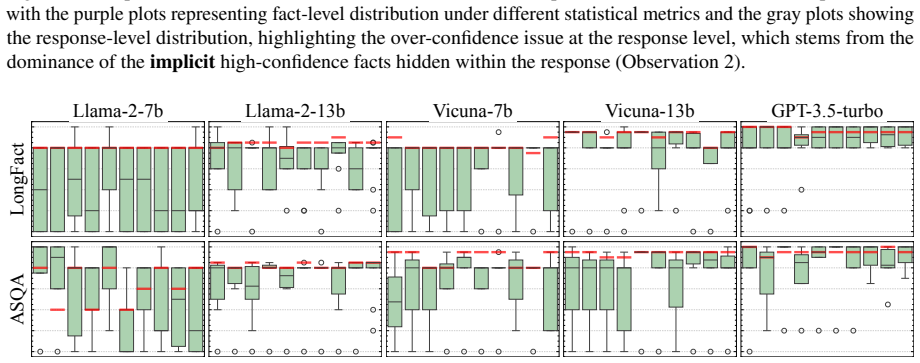
The central discovery is that a model's confidence, when measured at the granularity of individual facts rather than whole responses, exposes hallucination patterns that response-level calibration hides. The paper defines relevance-weighted correctness per fact and F-ECE, and shows that response-level confidence distributions track only the most confident fact in an answer, which explains overconfidence. It further observes that low-confidence facts are outliers inside otherwise confident responses, making them identifiable targets for correction. ConFix operationalises this by splitting a response into high- and low-confidence facts, rewriting the low-confidence facts with the high-confidence ones as in-context references, and accepting the revision only when the re-estimated confidence exceeds the original. The paper claims this loop improves fact-level accuracy for sufficiently well-calibrated models while requiring no external knowledge.
Load-bearing premise
The load-bearing premise is that the model's self-reported confidence is reliable enough both to pick out facts that are actually correct as references and to signal genuine improvement when re-estimated confidence rises after a rewrite.
Editorial extensions
If this is right
- If fact-level calibration is the right lens, response-level ECE scores understate hallucination risk and should be supplemented by F-ECE in model evaluation.
- If ConFix works as claimed, long-form answers can be improved at generation time with no retrieval and no fine-tuning, which lowers the cost of hallucination mitigation.
- The method's success is conditional on baseline calibration: models with poor fact-level calibration, such as LLaMA-2-7b in the paper's tables, can regress rather than improve, so calibration quality becomes a precondition for self-correction.
- The high-confidence-facts-as-knowledge idea implies that a model's own response contains reusable internal knowledge, which can be exploited repeatedly as the correction loop iterates.
Reading between the lines
- Editorial note: the abstract advertises four datasets and six models, while the body's main tables report two datasets and five base models, so the breadth of the empirical claim is not fully visible in this version.
- Beyond the paper: a hybrid design could use the confidence split to decide which facts need external retrieval, reserving the ConFix loop for facts whose re-estimated confidence stays low instead of trusting the loop alone.
- Beyond the paper: the accept-if-confidence-rises rule could reward rewrites that merely sound more fluent or generic; an external factuality check on accepted revisions would separate confidence gain from correctness gain.
Editorial analysis
A structured set of objections, weighed in public.
Referee Report
Summary. The paper proposes a fact-level confidence calibration framework that decomposes long-form responses into atomic facts, estimates a confidence score for each fact, and introduces F-ECE, a fact-level expected calibration error that compares confidence to relevance-weighted correctness. Using this framework, the authors report three observations: fact-level calibration imposes a stricter standard than response-level calibration; response-level overconfidence arises from high-confidence implicit facts; and fact-level confidence has high variance within a single response. These observations motivate ConFix, a self-correction method that treats high-confidence facts in a response as internal reference knowledge for revising low-confidence facts, accepting a revision only when the model's re-estimated confidence for that fact increases. Experiments on ASQA and LongFact with five base models and three confidence estimators evaluate calibration and, for self-correction, use GPT-4 pairwise judgments to classify outcomes as improved, same, or regressed. The abstract claims that ConFix 'effectively mitigates hallucinations without requiring external knowledge sources.'
Significance. The calibration contribution is meaningful and reproducible: F-ECE is a natural extension of ECE to the fact level, the three observations are clearly stated and supported by the presented tables and figures, and the code is released, which strengthens reproducibility. If the self-correction claim were rigorously validated, ConFix would be an important result because it would show that a model can improve its own factuality using only its internal confidence signals, without retrieval or external knowledge. However, as submitted, the central self-correction claim rests on an unvalidated assumption that a rise in self-estimated confidence corresponds to genuine factual improvement, and the evaluation of correction outcomes uses GPT-4 as a judge rather than an objective factuality benchmark. The calibration analysis can stand on its own, but the hallucination-mitigation claim requires substantially stronger evidence.
major comments (3)
- [Section 5.3, Table 3, and Eq. (8)] The acceptance rule in S3 (Eq. 8) accepts a revision only if the re-estimated confidence exceeds the old confidence, but the paper never verifies that confidence increases track objective factuality. The outcome evaluation in Table 3 is based on GPT-4 pairwise judgments (Appendix C.5), not an external factuality verifier, so the improved/regressed labels themselves may reflect fluency or assertiveness rather than factual accuracy. The paper's own data underscore the risk: Llama-2-7b regresses on 80.68% of 207 revised facts, and even the best model, Llama-2-13b, regresses on 27.07% of revised facts while improving on 53.35%. Without an objective before/after factuality measurement (e.g., SAFE or human annotation) and a direct analysis of the confidence-factuality correlation, the abstract's claim that ConFix 'effectively mitigates hallucinations' is not supported.
- [Section 5.2 (S1) and Table 2] The high-confidence facts are used as reference knowledge to correct low-confidence facts, but the paper does not establish that high-confidence facts are actually factually correct. Table 2 shows that error-detection recall is at most 30.62% and as low as 0.15% (Vicuna-7b), which means that many false facts are not low-confidence and may be included in the high-confidence set f_h. If the reference set contains hallucinations, the correction step may propagate or reinforce errors. This is load-bearing because the entire ConFix mechanism depends on the trustworthiness of the high-confidence facts, and the paper provides no measurement of the factuality of f_h.
- [Abstract and Section 4.1] The abstract claims experiments 'across four datasets and six models,' but Section 4.1 describes only two datasets (ASQA and LongFact) and five base models (LLaMA-2-7b, LLaMA-2-13b, Vicuna-7b, Vicuna-13b, GPT-3.5-turbo). No additional datasets or models appear in the main text or the appendix. If the experiments were run on only two datasets and five models, the claims of breadth should be corrected; if additional experiments exist, they should be described explicitly. This discrepancy affects the credibility of the reported scope and should be resolved.
minor comments (6)
- [Abstract] The first sentence is a sentence fragment ('Confidence calibration in LLMs, i.e., aligning their self-assessed confidence with the actual accuracy of their responses, enabling them to self-evaluate the correctness of their outputs.'); it needs a main verb and should be rewritten as a complete sentence.
- [Eq. (3)] The summation in Eq. (3) is written as running from n=1 to N, but the terms use the bin index k and the bin set B_k; the summation should be over the number of bins, i.e., k=1 to B.
- [Table 1, Consistency] The row for Vicuna-13b in the Consistency block is labeled 'Vicuna-13bw'; this appears to be a typo for 'Vicuna-13b'.
- [Section 3.2] The sentence 'Once facts are extracted, we evaluates both the correctness and relevance of each fact' contains a subject-verb agreement error; it should be 'we evaluate.'
- [Section 5.2, S3] The stopping rule is ambiguous: after the maximum number of iterations N is reached, does the model accept the last candidate fact even if its confidence is not higher than the original, or does it revert to the original fact? The current wording says the model will 'return "NoError" and make no modifications,' which should be clarified with a precise algorithmic description.
- [References] Several references are duplicated: Kadavath et al. appears as both 2022a and 2022b, and Guo et al. appears as both 2017a and 2017b. These duplicates should be consolidated.
Circularity Check
No significant circularity: ConFix's confidence-gated loop is an unverified proxy for factuality, not an equation-level reduction, and the calibration contributions rest on external correctness labels.
full rationale
The paper's fact-level calibration framework computes F-ECE (Eq. 3) by comparing model confidence against correctness scores obtained from GPT-4 plus retrieval/ground-truth evidence, so the calibration claims are not defined in terms of the model's own confidence. The ConFix loop does use the model's self-confidence both to select reference facts (Eqs. 4-5) and to accept revisions (Eq. 8: accept if new confidence exceeds old confidence), but the paper does not equate confidence increase with factual improvement by construction; instead, the self-correction outcome is separately evaluated by GPT-4 pairwise judgments in Table 3, which is an external, if imperfect, judge. The limitation that confidence increases may not track objective factuality — and the poor LLaMA-2-7b regression results — is a validity concern about the proxy, not a circular derivation. No fitted parameter is renamed as a prediction, no load-bearing self-citation or imported uniqueness theorem is used, and the few self-citations (e.g., Xiao et al. 2024a,b in the introduction) are not central to the argument. The paper even acknowledges in Section 7 that ConFix requires the model to be adequately calibrated. Thus the central claims are empirical and independently evaluated rather than equivalent to their inputs by definition.
Assumptions & free parameters
free parameters (3)
- confidence threshold tau =
mean of per-fact confidence scores in each response
- maximum correction iterations N =
not specified
- bin count B for F-ECE =
10, standard ECE binning
assumptions (6)
- domain assumption GPT-4 and SAFE produce reliable correctness and relevance labels for facts.
- domain assumption Verbalized, logit-based, or consistency-based confidence correlates with factual accuracy.
- domain assumption Atomic fact decomposition by GPT-4 is stable and complete.
- ad hoc to paper High-confidence facts in a response are correct enough to serve as reference knowledge for correcting low-confidence facts.
- ad hoc to paper An increase in re-estimated confidence is a valid proxy for a factual improvement.
- standard math ECE-style binning is a valid way to summarize calibration.
Cite this review
Pith. "Pith review of Fact-Level Confidence Calibration and Self-Correction." pith.science (2026). https://pith.science/paper/A6QJCWHR
@misc{pith2026241113343,
  author       = {Pith},
  title        = {Pith review of: Fact-Level Confidence Calibration and Self-Correction},
  year         = {2026},
  howpublished = {\url{https://pith.science/paper/A6QJCWHR}},
  note         = {Machine review of arXiv:2411.13343}
}
abstract
Confidence calibration in LLMs, i.e., aligning their self-assessed confidence with the actual accuracy of their responses, enabling them to self-evaluate the correctness of their outputs. However, current calibration methods for LLMs typically estimate two scalars to represent overall response confidence and correctness, which is inadequate for long-form generation where the response includes multiple atomic facts and may be partially confident and correct. These methods also overlook the relevance of each fact to the query. To address these challenges, we propose a Fact-Level Calibration framework that operates at a finer granularity, calibrating confidence to relevance-weighted correctness at the fact level. Furthermore, comprehensive analysis under the framework inspired the development of Confidence-Guided Fact-level Self-Correction ($\textbf{ConFix}$), which uses high-confidence facts within a response as additional knowledge to improve low-confidence ones. Extensive experiments across four datasets and six models demonstrate that ConFix effectively mitigates hallucinations without requiring external knowledge sources such as retrieval systems.
Figures


Figures from the paper (3 more)


Reference graph
Works this paper leans on
-
[1]
The following STATEMENT has been extracted from the broader context of the given RESPONSE to the given QUESTION
-
[2]
Indicate how confident you are in the accuracy of the STATEMENT when answering the QUESTION, based on your knowledge
-
[3]
Vicuna is an open-source chatbot trained by fine-tuning LLaMA on user-shared conversations collected from ShareGPT. Preliminary evaluation using GPT-4 as a judge shows Vicuna-13B achieves more than 90% quality of ChatGPT and Bard while outperforming other models like LLaMA and Stan- ford Alpaca (Li et al., 2023b; Dubois et al., 2024,
work page 2024
-
[4]
GPT-3.5-turbo (Brown et al., 2020) This model is part of OpenAI’s well-known GPT series
in more than 90% of cases. GPT-3.5-turbo (Brown et al., 2020) This model is part of OpenAI’s well-known GPT series. GPT- 3.5-turbo is an enhanced version of GPT-3, offer- ing improved performance and efficiency. It is designed to handle a wide range of language tasks, from text generation to comprehension and trans- lation. The "turbo" variant is optimize...
work page 2020
-
[7]
The confidence evaluation should be a value between 0 and 1 (with two decimal places retained), based on the following scoring criterion: {Criterion} 4. Your task is to do this for the STATEMENT, RESPONSE and QUESTION under "Your Task". Some examples have been provided for you to learn how to do this task. {Some Examples} Your Task: QUESTION: {Question} R...
-
[8]
The following RESPONSE is the answer to the given QUESTION
-
[9]
Indicate how confident you are in the accuracy of the RESPONSE when answering the QUESTION, based on your knowledge
-
[10]
The confidence evaluation should be a value between 0 and 1 (with two decimal places retained), based on the following scoring criterion: {Criterion}
Show all 16 references
-
[11]
Your Task
Your task is to do this for the RESPONSE and QUESTION under “Your Task”. Some examples have been provided for you to learn how to do this task. {Some Examples} Your Task: QUESTION: {Question} RESPONSE: {Response} Table 5: Prompt for response-level confidence estima- tion {Crit...
2020
-
[12]
More accurate information
-
[13]
Greater relevance to the question
-
[14]
A regression implies: 1
Minimal overlap with other facts in ALL FACTS. A regression implies: 1. Introduction of erroneous or inaccurate information
-
[15]
Lower relevance to the question
-
[16]
IMPROVED
Repetition or introduction of information that is already provided with other facts in ALL FACTS. QUESTION: {Question} RESPONSE: {Response} ALL FACTS: {All Facts} TARGET FACT 1: {Original Fact} TARGET FACT 2: {New Fact} First, provide a one-sentence comparison of the two facts...
2023
-
[2020]
In Advances in Neural Information Processing Systems 33: Annual Conference on Neural Information Processing Systems 2020, NeurIPS 2020, December 6-12, 2020, virtual
Language models are few-shot learners. In Advances in Neural Information Processing Systems 33: Annual Conference on Neural Information Processing Systems 2020, NeurIPS 2020, December 6-12, 2020, virtual. Silei Cheng, Zhe Gan, Zhengyuan Yang, Shuohang Wang, Jianfeng Wang, Jord...
2020 arXiv
-
[2023]
In Proceedings of the 2023 Conference on Empirical Methods in Natural Language Processing, pages 9004–9017, Singapore
SelfCheckGPT: Zero-resource black-box hal- lucination detection for generative large language models. In Proceedings of the 2023 Conference on Empirical Methods in Natural Language Processing, pages 9004–9017, Singapore. Association for Com- putational Linguistics. Sewon Min, ...
2023 arXiv
Reviewed August 12, 2026 · model on record in the stance chip above.
Discussion (0). Continue with ORCID to comment.