REVIEW 4 major objections 5 minor 1 cited by
Geometric Algebra Planes: Convex Implicit Neural Volumes
T0 review · 4 major / 5 minor · reviewed 2026-08-12 · deepseek-v4-flash
Pith's one-line read GA-Planes introduces a family of implicit neural volume models—features on line, plane, and volume grids decoded by an MLP—that can be trained by convex optimization, with convex and semiconvex formulations whose local optima are global.
desk verdict A genuinely useful convexification of volume grids with a sound 2D analysis, but the global-optimality claims are overstated and one theorem describes a different model than the one being trained. read the letter →
The pith
A machine-rendered reading of the paper's core claim, the machinery that carries it, and where it could break.
The reading
What carries the argument
The load-bearing structure is the GA-Planes parameterization itself—interpolated line, plane, and volume feature grids combined by concatenation, addition, or elementwise multiplication and decoded by an MLP—together with the convexification recipe borrowed from convex neural network theory: freeze a random sample of ReLU activation patterns as fixed gates, then optimize the remaining weights. The semiconvex variant is a Burer-Monteiro factorization of a convex objective, in which every local minimum is claimed to be global. The 2D analysis converts these models into low-rank plus low-resolution matrix completion, which is the mechanism that yields the rank bounds, the equivalence theorems, and the interpretation of GA-Planes as first fitting a low-resolution volume and then completing the high-frequency residual.
What would settle it
One concrete check is to fit a small 2D image with the convex GA-Planes model while exhaustively enumerating all possible ReLU activation patterns for that problem, then compare that true global optimum with the optimum found by the paper's randomly subsampled convex program; if the two objectives diverge substantially, the surrogate optimum is not the original problem's optimum. For the semiconvex model, one can run many random initializations of the frozen gating grids on a fixed segmentation task and test whether every run converges to the same objective value; a spread of final values would contradict the claim that all local optima are global.
Extended reading notes
Core claim
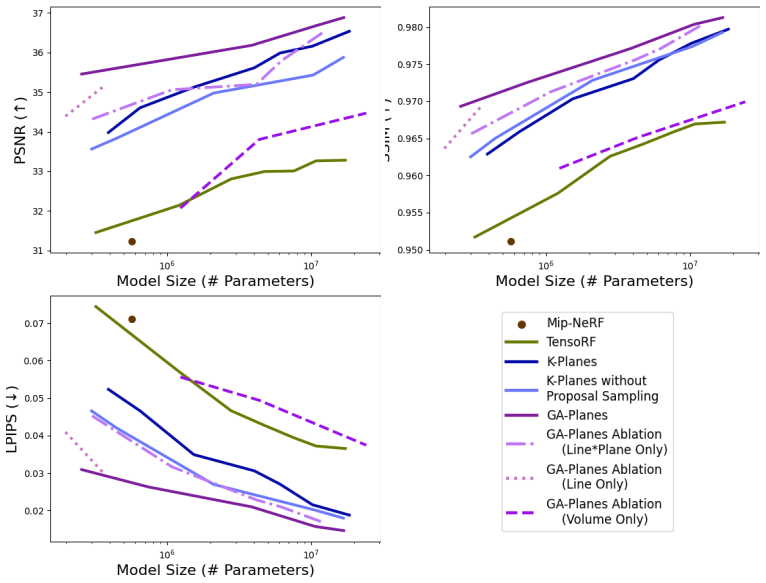
On its own terms, the paper's discovery is that implicit neural volume fitting does not have to be nonconvex. GA-Planes parameterizes a volume by interpolating features from 1D line grids, 2D plane grids, and a 3D volume grid, combining them by concatenation, addition, or geometric-algebra multiplication, and decoding with an MLP. When features are concatenated rather than multiplied, the decoder's ReLU gates can be frozen at random initialization so that the entire training objective becomes a convex program; the semiconvex variant keeps the decoder weights separate but factorizes the convex objective in the Burer-Monteiro style, and the fully convex variant fuses decoder weights into the feature grids. The paper proves the 2D versions are exactly low-rank, or low-rank plus low-resolution, matrix completion, with MLP decoders raising the attainable rank from the feature dimension to the grid resolution. Experiments then show nonconvex GA-Planes matches or exceeds established radiance-field baselines across model sizes, and that the convex and semiconvex versions match nonconvex performance on segmentation tasks where a standard tri-plane baseline degrades sharply under convex training.
Load-bearing premise
The load-bearing premise is that randomly freezing a sample of ReLU activation patterns yields a convex program whose global optimum stays close to the true optimum of the original GA-Planes problem, and, for the semiconvex variant, that the factored model meets the theoretical condition that makes every local minimum globally optimal—a condition the paper asserts but does not prove.
Editorial extensions
If this is right
- Volume segmentation and other convex fitting tasks can be trained with convex or semiconvex GA-Planes and are guaranteed to reach a global optimum regardless of initialization.
- The 2D analysis identifies GA-Planes as low-rank plus low-resolution matrix approximation, so design choices of grid resolution and feature dimension directly control attainable rank and error floors.
- GA-Planes generalizes existing volume representations such as voxels, tensor factorizations, tri-plane, K-Planes, and mixture-of-primitives models, so the convexification applies to those architectures whenever they avoid feature multiplication.
- Nonconvex GA-Planes with feature multiplication retains competitive radiance-field quality at small model sizes, extending the size, expressiveness, and optimizability tradeoff frontier.
- The convex and semiconvex formulations are compatible with off-the-shelf convex solvers, not only first-order gradient training.
Reading between the lines
- The author does not pursue it, but the same frozen-gate convexification could apply to 2D and other implicit neural representations beyond volumes, since the 2D analysis already casts GA-Planes as matrix approximation.
- The low-rank plus low-resolution view suggests an allocation rule the paper only demonstrates by hand: spend parameter budget on high-resolution line grids for high-frequency content and low-resolution volume grids for smooth background; this rule could be tested as an automatic architecture search.
- Because the semiconvex guarantee rests on an unproved condition, a numerical check—random restarts on an ill-conditioned segmentation task—would reveal whether non-global local minima actually occur in practice.
- The image-fitting comparison hints that low-rank plus low-resolution may generally beat low-rank plus sparse for natural imagery, a claim broader than this paper's single-image experiment and worth testing on other image classes and medical volumes.
Editorial analysis
A structured set of objections, weighed in public.
Referee Report
Summary. The paper introduces GA-Planes, a family of volume representations that combine line, plane, and volume feature grids with an MLP decoder. It derives convex and semiconvex training formulations by convexifying the decoder via frozen ReLU gates, proves 2D equivalences to low-rank plus low-resolution matrix completion, states lower bounds on fitting error, and evaluates the models on radiance field reconstruction, 3D segmentation, and video segmentation. The central claim is that GA-Planes is the first class of implicit neural volume representations that can be trained by convex optimization, with guarantees that all local optima are global.
Significance. If the global-optimality claims are correct, the paper would be significant: it would offer a principled way to avoid nonconvex optimization instability in a broad family of volume models, backed by a clean 2D theoretical characterization. Theorems 1 and 2 are correct and provide a useful interpretation of GA-Planes as low-rank plus low-resolution approximation. The empirical study is extensive, spans three tasks, and includes code release. However, the key global-optimality guarantee for the semiconvex formulation is inherited from prior work without verification for this model, and Theorem 3 appears inconsistent with the convex model it claims to describe. The lower bounds in Section 4.2 are also stated without proof. These issues are load-bearing for the paper's headline claims and need to be addressed before the paper can be accepted.
major comments (4)
- [Section 4.1, Theorem 3 / Eq. (12)] The mask matrix B_i in Eq. (12) is defined as B_i = 1[Σ_j W̄_{i,j} U_j V_j^T ≥ 0], where U and V are optimization variables. The objective is therefore not convex, and it does not match the frozen-gate convex model of Eq. (7), where the gates are evaluated at the initialization of the grids and remain fixed. The proof in Appendix A.2.3 (Eq. (36)) confirms that the masks depend on the trainable grids g1, g2. As stated, Theorem 3 describes a nonconvex masked low-rank problem, and the claimed equivalence to the convex MLP decoder is not established. Please reformulate the theorem to match the frozen-gate model or explicitly state that it applies to a different, nonconvex problem.
- [Section 6 / Appendix A.1] The assertion that 'both the convex and semiconvex GA-Planes formulations come with guarantees that all local optima are also global (Sahiner et al., 2024)' is not supported for the semiconvex model in Eq. (6). The objective is biconvex in the grid features f(q) and decoder weights W, and it is not shown that this problem is a Burer-Monteiro factorization of a convex program satisfying the conditions of Sahiner et al. (2024). In particular, the input features f(q) are themselves trainable parameters, unlike the standard BM setting for convex neural networks where the data matrix is fixed. Without verifying these conditions, the global-optimality guarantee is unproven. The paper should either provide a derivation for this specific model or restrict the claim to the fully convex frozen-gate surrogate.
- [Section 2, last paragraph] The paper states that subsampling ReLU patterns 'results in a convex program with tractable size, whose solution is one of the stationary points of the original non-convex problem' (citing Pilanci & Ergen 2020), yet the abstract, Section 6, and Appendix A.1 imply global optimality for the convex and semiconvex GA-Planes formulations. This is a mismatch: the convex program is a surrogate, and its global optimum need not be the global optimum of the original nonconvex GA-Planes problem. Please clarify that the global-optimality guarantee applies to the frozen-gate surrogate, not to the original nonconvex problem, and discuss what this implies for the practical value of the convex formulation.
- [Section 4.2, Eqs. (14)-(19)] The lower bounds on the Frobenius norm error are asserted without proof. They are load-bearing for the paper's interpretation that MLP decoders increase attainable rank, yet no derivation or reference is supplied in the main text or appendix. Please add proofs or provide a detailed reference for each bound, including the definitions of L* and the conditions under which the bounds are tight or loose.
minor comments (5)
- [Appendix A.6, Figures 10-17] The captions for Figures 10-17 are essentially identical and do not identify the scene, making them hard to navigate; please add the scene name to each caption.
- [Section 3.2, Eq. (6)] The notation W for the trainable weights and W̄ for the frozen gate weights is easy to confuse; consider using a more distinct symbol for the frozen weights, such as W_gate or W_0.
- [Section 4.1, Theorem 4] The equivalence in Theorem 4 is essentially a reparameterization and the statement 'U* = g1*, V* = g2*, W* = W*, α* = α*' is tautological. Consider phrasing it explicitly as a reparameterization of the optimization variables rather than an equivalence of two distinct optimization problems.
- [Section 4.1, Assumptions paragraph] The theorem statements would be clearer if the assumptions on interpolation linearity, feature-grid resolution matching the target, and the Frobenius objective were repeated in each theorem statement or stated as a single set of formal assumptions immediately before Theorem 1.
- [Section 5.3, video segmentation] The phrase 'temporal superresolution of object masks' is used, but the task is essentially interpolation of masks between labeled frames; consider clarifying the relationship to classical video segmentation to avoid overclaiming.
Circularity Check
The semiconvex GA-Planes global-optimality guarantee is imported from the authors' own Burer-Monteiro framework (Sahiner et al. 2024) without verifying eq. (6) fits it; the fully convex guarantee is trivial convexity and the 2D equivalences are self-contained, so the paper is only partially circular.
-
self citation load bearing
[Section 1; also Appendix A.1]
"We adopt the term semiconvex for Burer-Monteiro (BM) factorizations of a convex objective, as introduced in Sahiner et al. (2024), within the context of convex neural networks. BM factorized problems have the property that every local minimum is globally optimal (Sahiner et al., 2024)."
This is the load-bearing justification for the paper's central promise that the semiconvex GA-Planes model optimizes globally regardless of initialization. Sahiner et al. (2024) is prior work by the present authors (Mert Pilanci is a coauthor), so the guarantee is imported from the authors' own framework. The paper never shows that the biconvex objective in eq. (6), with frozen gating weights but trainable grid features in the indicator, is a Burer-Monteiro factorization of a convex program satisfying the conditions under which Sahiner et al. prove every local minimum is global.
full rationale
The 2D matrix-completion equivalences (Theorems 1-4) are self-contained algebraic rewrites of the model definitions; they do not fit parameters to data and are not circular. The fully convex formulation in eq. (7) is convex by construction because the gating grids are frozen at initialization, so its 'all local optima are global' property is just convexity, not a derived claim about the original nonconvex GA-Planes problem. The experiments are benchmarked against external baselines and do not rename fitted values as predictions. The only load-bearing self-citation is the semiconvex global-optimality guarantee, which depends on Sahiner et al. (2024) without verification that eq. (6) satisfies the Burer-Monteiro conditions; this is a circularity-relevant gap because the central premise is justified by the authors' own prior theorem. Separately, Theorem 3's mask formula B_i = 1[sum_j Wbar_ij U_j V_j^T >= 0] depends on trainable U,V, which is a correctness inconsistency with the frozen-gate convex model, but that is an internal-consistency issue rather than a reduction-to-inputs circularity. Because the convex trainability claim and the empirical and algebraic contributions have independent content, the score is 4 rather than higher.
Assumptions & free parameters
free parameters (4)
- Feature grid resolutions [r1,r2,r3] and feature dimensions [d1,d2,d3] per task =
3D segmentation: [128,32,24] and [36,24,8]; video: [128,128,64] and [32,16,8]; radiance: varies, e.g.
- Multiresolution upsampling factors [m1,m2,m3] =
[1,2,4] for radiance field GA-Planes
- Random initialization of frozen gating grids (seed) for convex and semiconvex models =
Not reported; 3 seeds only in Appendix A.4 small-model study
- Interpolation scheme phi for low-resolution grids =
Bilinear in 3D; nearest neighbor in some 2D theorem settings
assumptions (5)
- standard math Two-layer ReLU MLPs are equivalent to a finite convex program over activation patterns (Pilanci & Ergen 2020).
- standard math Burer-Monteiro factorized convex problems have no spurious local minima (Sahiner et al. 2024).
- standard math Randomly subsampling activation patterns yields a convex program whose solution is a stationary point of the original nonconvex problem.
- domain assumption Space Carving produces a valid 3D occupancy ground truth for supervision.
- domain assumption Frobenius norm in the theorems is the appropriate proxy for the MSE objectives used in experiments.
Cite this review
Pith. "Pith review of Geometric Algebra Planes: Convex Implicit Neural Volumes." pith.science (2026). https://pith.science/paper/DRHNC7ZA
@misc{pith2026241113525,
  author       = {Pith},
  title        = {Pith review of: Geometric Algebra Planes: Convex Implicit Neural Volumes},
  year         = {2026},
  howpublished = {\url{https://pith.science/paper/DRHNC7ZA}},
  note         = {Machine review of arXiv:2411.13525}
}
read the original abstract
Volume parameterizations abound in recent literature, from the classic voxel grid to the implicit neural representation and everything in between. While implicit representations have shown impressive capacity and better memory efficiency compared to voxel grids, to date they require training via nonconvex optimization. This nonconvex training process can be slow to converge and sensitive to initialization and hyperparameter choices that affect the final converged result. We introduce a family of models, GA-Planes, that is the first class of implicit neural volume representations that can be trained by convex optimization. GA-Planes models include any combination of features stored in tensor basis elements, followed by a neural feature decoder. They generalize many existing representations and can be adapted for convex, semiconvex, or nonconvex training as needed for different inverse problems. In the 2D setting, we prove that GA-Planes is equivalent to a low-rank plus low-resolution matrix factorization; we show that this approximation outperforms the classic low-rank plus sparse decomposition for fitting a natural image. In 3D, we demonstrate GA-Planes' competitive performance in terms of expressiveness, model size, and optimizability across three volume fitting tasks: radiance field reconstruction, 3D segmentation, and video segmentation.
Figures


Figures from the paper (15 more)




Forward citations
Cited by 1 Pith paper
-
Grids Often Outperform Implicit Neural Representations at Compressing Dense Signals
Simple interpolated grids beat tested INRs at equal parameter count on dense 2D and 3D signals, while INRs retain an edge on sparse, lower-dimensional signals.
Reference graph
Works this paper leans on
-
[3]
URL https://arxiv.org/abs/2304.02643. K.N. Kutulakos and S.M. Seitz. A theory of shape by space carving. InProceedings of the Seventh IEEE International Conference on Computer Vision, volume 1, pp. 307–314 vol.1,
-
[5]
ISSN 0730-0301. doi: 10.1145/3450626.3459863. URL https://doi.org/10.1145/3450626.3459863. Valent´ın Masero, JUAN M LE ´ON-ROJAS, and Jos ´e Moreno. V olume reconstruction for health care: a survey of computational methods. Annals of the New York Academy of Sciences, 980(1):198–211,
-
[8]
Nerfstudio: A modular framework for neural radiance field development
Matthew Tancik, Ethan Weber, Evonne Ng, Ruilong Li, Brent Yi, Justin Kerr, Terrance Wang, Alexander Kristoffersen, Jake Austin, Kamyar Salahi, Abhik Ahuja, David McAllister, and Angjoo Kanazawa. Nerfstudio: A modular framework for neural radiance field development. In ACM SIGGRAPH 2023 Conference Proceedings, SIGGRAPH ’23,
work page 2023
-
[9]
A review of 3d reconstruction techniques for deformable tissues in robotic surgery
Mengya Xu, Ziqi Guo, An Wang, Long Bai, and Hongliang Ren. A review of 3d reconstruction techniques for deformable tissues in robotic surgery. arXiv preprint arXiv:2408.04426,
-
[11]
parameterize the volume implic- itly through the weights of a neural network, typically a multilayer perceptron (MLP) with some modification to overcome spectral bias and represent high frequency content. These models tend to provide decent expres- siveness with very small model size; their main draw- back is slow optimization. Voxel grids (Kutulakos & Se...
work page 1999
-
[12]
parameterize a 3D volume as a combination of lower-dimension objects, namely vectors and matrices (lines and planes). Tensor factorizations tend to balance the three attributes somewhat evenly, offering decent expressiveness and optimizability while using more memory than an INR but less than a high resolution voxel grid. Hash embeddings (M¨uller et al., ...
work page 2022
-
[13]
are similar to voxels, but replace the explicit voxel grid in 3D with a multiresolution 3D hash function followed by a small MLP decoder to disambiguate hash collisions. They can optimize very quickly and with better memory efficiency compared to voxels; quality is mixed with good high-resolution details but also some high-frequency noise likely arising f...
work page 2023
-
[15]
and GA-Planes. We emphasize that all of these existing methods (except perhaps voxels) require nonconvex optimization, often for a feature decoder MLP, and thus risk getting stuck in suboptimal local minima depending on the randomness of initialization and the trajectory of stochastic gradients. In practice, as described above, some of the prior methods e...
work page 2024
Show all 15 references
-
[1999]
Labelbox.com
doi: 10 .1109/ICCV.1999.791235. Labelbox.com. Using meta’s segment anything (sam) model on video with labelbox’s model-assisted la- beling. https://labelbox.com/guides/using-metas-segment-anything-sam-model-on- video-with-labelbox-model-assisted-labeling/ . Accessed: 2024-10-0...
1999
-
[2016]
They are highly expressive and less memory-intensive than voxels (but still more so than some other methods)
represent a volume as a collection of 3D points or blobs, where the points need not be arranged on a regular grid. They are highly expressive and less memory-intensive than voxels (but still more so than some other methods). They can optimize very quickly but often require heu...
2023
-
[2018]
All volume models face a tradeoff between memory efficiency, expressiveness, and optimiz- ability
16 A Appendix A.1 Context for GA-Planes Model Size Expressiveness Optimizability Coordinate MLP (NeRF, SRN) ✓ ∼ ✗ V oxels (Space Carving, Plenoxels, DVGO) ✗ ✓ ✓ Tensor Factorization (TensoRF, K-Planes) ∼ ∼ ∼ Hash Embedding (Instant-NGP) ∼ ✓ ∼ Point Cloud / Splat (3D Gaussian S...
2020
-
[2020]
Bench- marking neural radiance fields for autonomous robots: An overview
Yuhang Ming, Xingrui Yang, Weihan Wang, Zheng Chen, Jinglun Feng, Yifan Xing, and Guofeng Zhang. Bench- marking neural radiance fields for autonomous robots: An overview. arXiv preprint arXiv:2405.05526,
-
[2021]
URL https://doi.org/10.1109/ICCV48922.2021.00580
doi: 10.1109/ICCV48922.2021.00580. URL https://doi.org/10.1109/ICCV48922.2021.00580. Jiazhong Cen, Zanwei Zhou, Jiemin Fang, Chen Yang, Wei Shen, Lingxi Xie, Dongsheng Jiang, Xiaopeng Zhang, and Qi Tian. Segment anything in 3d with nerfs. In NeurIPS,
2021
-
[2022]
URL https://doi.org/10.1145/3528223.3530127
doi: 10 .1145/3528223.3530127. URL https://doi.org/10.1145/3528223.3530127. Alan V Oppenheim. Discrete-time signal processing. Pearson Education India,
-
[2023]
A review on process of 3d model reconstruction
Aditya M Intwala and Atul Magikar. A review on process of 3d model reconstruction. In 2016 International Confer- ence on Electrical, Electronics, and Optimization Techniques (ICEEOT), pp. 2851–2855. IEEE,
2016
Reviewed August 12, 2026 · model on record in the stance chip above.
Discussion (0). Continue with ORCID to comment.