REVIEW 4 major objections 6 minor 40 references
Grids Often Outperform Implicit Neural Representations at Compressing Dense Signals
T0 review · 4 major / 6 minor · reviewed 2026-08-07 · deepseek-v4-flash
Pith's one-line read A simple regularized grid with interpolation trains faster and reaches equal or higher quality than any implicit neural representation with the same parameter count, across most dense 2D and 3D signals and tasks tested.
desk verdict A broad, useful benchmark showing grids beat most INRs on dense signals, but duplicated tables and a fixed-learning-rate protocol demand fixes before the quantitative details can be trusted. read the letter →
The pith
A machine-rendered reading of the paper's core claim, the machinery that carries it, and where it could break.
The reading
What carries the argument
The load-bearing object is the 'Basic Interpolated Grid': parameters stored at lattice points, queried by bicubic (2D) or trilinear (3D) interpolation, with total-variation regularization applied for noisy or underdetermined tasks; its theoretical anchor is Nyquist–Shannon sampling theory, which guarantees faithful reconstruction of bandlimited signals from sufficiently dense grid samples. The comparison machinery is a controlled capacity sweep: every model is scaled to identical parameter budgets ($10^{4}$ to 3×$10^{6}$) using a quadratic equation that solves for hidden width, and hyperparameters are fixed by tuning only on the Star Target image at the smallest size. The paper's explanatory hypothesis for grid dominance is that many dense natural signals have spectra closer to bandlimited noise, where interpolation is provably near-optimal, whereas INRs' capacity is best allocated to sparse, lower-dimensional structure like edges and surfaces.
What would settle it
Retrain each INR at the 3×$10^{6}$-parameter budget with a learning rate and schedule optimized at that size (rather than carried over from $10^{4}$), on DIV2K and the 3D Dragon, and compare against the Grid at equal parameter count; if SIREN or BACON's collapses are cured and the Grid no longer leads, the paper's 'any INR with the same number of parameters' claim would need substantial qualification.
Extended reading notes
Core claim
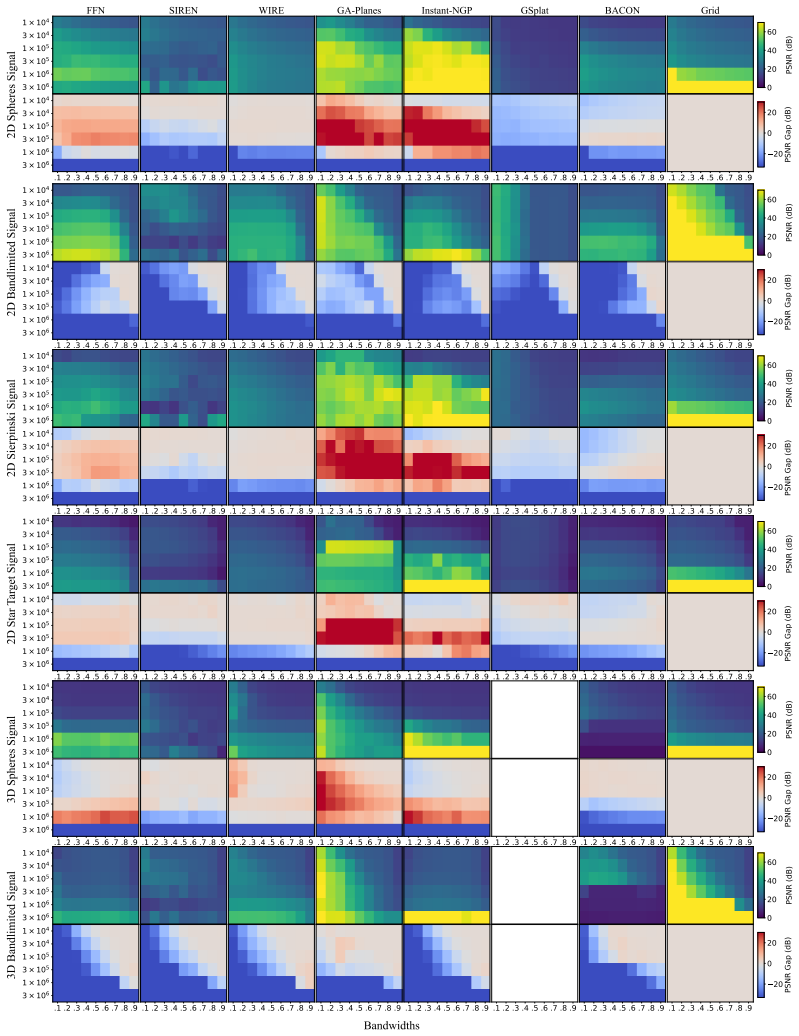
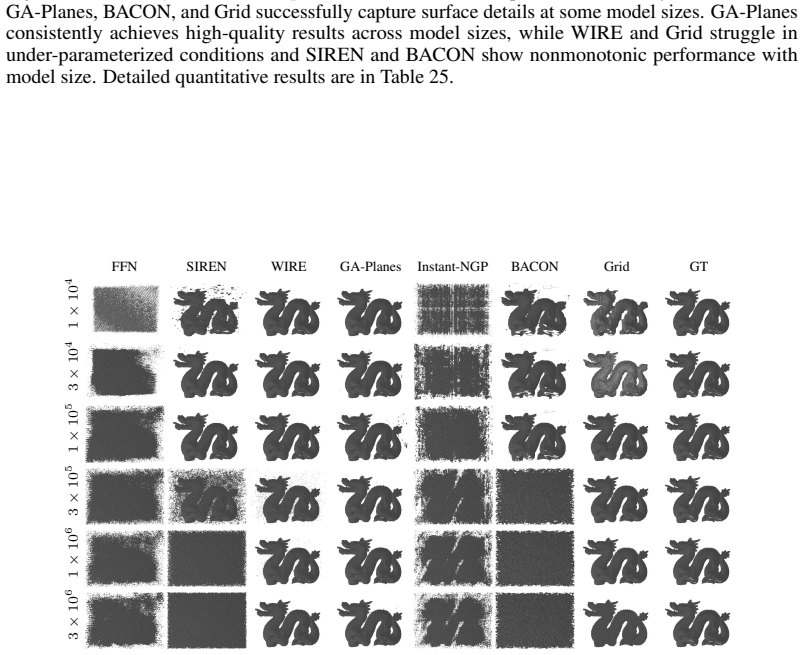
The authors claim that the implicit bias of INRs is not suited to dense signals: for 2D and 3D bandlimited signals, no INR, hybrid, or discrete model reliably outperforms the simple interpolated Grid baseline at any model size, and most models show a power-law relationship between parameter count and the signal bandwidth they can represent. On real dense data — natural images, CT scans, volumetric occupancy — the TV-regularized Grid is the Pareto-optimal choice for both overfitting and generalization (CT, denoising, super-resolution). INRs and hybrids (notably GA-Planes and WIRE) do win on signals with lower-dimensional structure such as solid 3D shapes and their surfaces, where a 2D surface embedded in 3D or a 1D edge embedded in 2D concentrates the signal's complexity. The paper concludes that dense natural signals behave more like bandlimited noise than like sparse structured scenes, and that current INRs are not meeting the goal of compressing them.
Load-bearing premise
Every INR's learning rate and hyperparameters were tuned on a single image (the Star Target) at the smallest model size ($10^{4}$ parameters) and then held fixed across all sizes and signals, so the grid-vs-INR gap at large sizes rests on the assumption that size-appropriate tuning would not substantially recover INR performance.
Editorial extensions
If this is right
- For compressing natural images, volumes, and CT scans, a regularized interpolated grid is the practical default: equal or better reconstruction quality at the same parameter count, with training and inference an order of magnitude or more faster.
- For bandlimited signal classes, capacity can be budgeted in advance: the power-law relationship between model size and representable bandwidth gives practitioners a rule for choosing grid resolution or network size.
- INR and hybrid research should target signals with lower-dimensional structure — occupancy, surfaces, contours — where GA-Planes, WIRE, and SIREN genuinely beat grids, rather than dense natural signals.
- On binary signals such as shape contours and occupancy masks, the INR advantage is consistent enough that applications fitting such signals can prefer INR-family models without sacrificing parameter efficiency.
- Grids remain subject to the curse of dimensionality, so very high-dimensional signals are the territory where INRs could still be indispensable; the paper's results are at 2D and 3D.
Reading between the lines
- The most direct way to test whether the grid-vs-INR gap is real or an artifact of protocol is to retune learning rates per model size; several INRs collapse at 3×10^6 parameters (SIREN at 11.22 dB on DIV2K, BACON near 3–10 dB on the 3D Dragon), which is exactly where a fixed small-size learning rate would hurt most.
- The documented power law could be inverted into a capacity predictor — fit the exponent per model family and estimate the parameter budget needed for a target bandwidth — a quantitative tool the paper does not build.
- If dense natural signals truly behave like bandlimited noise, then adaptive and multi-resolution grid variants should exceed the plain grid by even more, which would tell us whether the grid's edge comes from interpolation theory or merely from its parameterization.
- The results suggest a division of labor — grids for dense fields, small networks for level sets — which a hybrid that attaches a network only near detected boundaries could exploit, though no such design is proposed here.
Editorial analysis
A structured set of objections, weighed in public.
Referee Report
Summary. The paper presents a large empirical benchmark comparing interpolated grids, pure INRs (FFN, SIREN, WIRE, BACON), hybrid models (GA-Planes, Instant-NGP), and a discrete method (GSplat) across 2D/3D synthetic signals, natural images, CT, and volumetric Dragon data. Model sizes are matched from 1e4 to 3e6 parameters. The main claims are that a simple regularized grid with interpolation trains faster and achieves higher or comparable quality than any INR with the same parameter count for most dense signals, that no model reliably outperforms the grid on bandlimited 2D/3D signals regardless of model size, and that INRs win mainly on signals with lower-dimensional structure such as shape occupancy. The paper also reports a power-law relationship between model size and achievable bandwidth for several models.
Significance. If the central claims hold, the paper provides useful, practical guidance: for dense natural signals, grid representations are a strong default, and INR research should target signals with lower-dimensional structure. The benchmark is unusually broad, with parameter-count matching, multiple metrics, error bars over seeds/images in many tables, and public code. The reported grid-vs-INR margins on bandlimited signals are large enough that the qualitative conclusion is likely to survive refinements. However, the strongest wording ('any INR', 'regardless of model size', 'optimal across all model sizes') currently rests on optimization-fairness assumptions and on at least one data-integrity error, so the universal claims are not yet supported.
major comments (4)
- [Section 5.5 and Table 2] The learning-rate protocol is load-bearing for the universal claims. Section 5.5 states that all models are tuned on the Star Target at 1e4 parameters and that the resulting learning rate is frozen across all model sizes, signals, and tasks. Table 2 itself shows extreme learning-rate sensitivity at larger sizes (e.g., FFN drops from 38.81 dB to 6.36 dB at 3e6 when the learning rate increases from 5e-4 to 1e-2), and the appendix reports collapsed large-size results for SIREN on DIV2K (11.22 dB, Table 20) and BACON on 3D signals (3-10 dB, Tables 17-19). These values are consistent with optimization failure rather than representational capacity. Because the abstract and Section 3.1 claim 'any INR' and 'regardless of model size', the authors should retune the learning rate per model size or use a size-invariant schedule and show whether the collapsed entries recover; otherwise the universal wording is unsupported.
- [Tables 11-16] The quantitative results for Sierpinski and Star Target are numerically identical at every entry for PSNR, SSIM, and LPIPS. Two different signals cannot produce identical tables, so the Star Target quantitative analysis is currently invalid. This also undermines the statement in Section 2.1 that all models were tuned on the Star Target image. The authors must regenerate the Star Target tables and verify that the reported tuning results come from the correct signal.
- [Section 3.2 and Table 22] The claim that the TV-regularized Grid is 'optimal across all model sizes' for all natural 2D inverse problems is contradicted by the paper's own numbers. For DIV2K denoising with epsilon=0.05 at 3e6 parameters, GA-Planes achieves 28.74 dB versus Grid's 26.73 dB; with epsilon=0.1 at 3e6, GA-Planes achieves 25.14 dB versus Grid's 25.12 dB; and for super-resolution at 1e6-3e6, FFN and WIRE exceed Grid by about 0.3-1.7 dB. The claim should be weakened to 'generally outperforms' or restricted to the compressive regime, with explicit exceptions.
- [Section 5.5 and Table 3] BACON's architecture is not documented reproducibly. The text says the architecture was 'manually swept' to achieve the target model sizes, but Table 3 gives only the learning rate for BACON, with no layer counts, frequency ranges, or channel configuration. Since BACON collapses to about 3 dB at large model sizes in Tables 17-19, the reader cannot determine whether this is a property of BACON or of an undocumented configuration. Provide the full architecture for every BACON model size, or point to exact code that fixes the configuration.
minor comments (6)
- [Table 19] Section 3.1's 'no model can reliably outperform' is stronger than the data supports at Table 19, row 1e4, bandwidth 0.5, where GA-Planes reports 21.30 dB versus Grid's 21.11 dB; since the claim is about reliability, a statistical test or an explicit statement about overlapping error bars would help.
- [Section 5.5 and Table 2] Table 2 reports the learning-rate grid search only for Grid and FFN, while Section 5.5 states that all models were tuned; please provide the full sweep for SIREN, WIRE, GA-Planes, Instant-NGP, GSplat, and BACON.
- [Section 5.5, below Table 4] The quadratic parameter-count equation is referenced as 'Equation 5.5' but is not numbered; add a number to the equation so the reference is meaningful.
- [Figure 4(b)] The caption reports training and inference time comparisons but does not specify the batch size or the exact evaluation protocol for timing; please state these details since computational efficiency is one of the paper's stated contributions.
- [Section 5.5] There is a typo: '48GM VRAM' should read '48GB VRAM'.
- [Abstract and Section 3.2] The abstract says 'for most tasks and signals' while Section 3.2 says 'optimal across all model sizes'; after the numerical corrections above, align the strength of these statements.
Circularity Check
No circularity: the paper's claims are empirical benchmark observations against external data, and the only self-citations (Plenoxels-derived grid baseline, co-authored INR baselines) are not load-bearing reductions.
full rationale
This is an empirical comparison paper, not a derivation. No predicted quantity is computed from a fitted parameter, and no result is defined in terms of the quantity it claims to establish. The grid baseline is described as 'similar to [5]' (Plenoxels, co-authored by Fridovich-Keil), but the interpolated grid is a standard, parameter-free representation with independent sampling-theory grounding (Bracewell, reference [9]), and its performance is measured on external DIV2K, CT, and Stanford Dragon data rather than imported through the citation. The co-authored INR/hybrid baselines (GA-Planes, K-Planes) are evaluated as competitors, not invoked as evidence for the paper's conclusions. The closest step to a concern is the fixed learning-rate protocol: 'All models are tuned by optimizing hyperparameters on our Star Target image' and 'we use the optimal learning rate for each model tuned at the smallest model size' (Sections 2.1 and 5.5). This is a protocol-fairness assumption that could affect validity of the universal 'any INR' / 'regardless of model size' wording, since large-size INR collapses (e.g., SIREN at 11.22 dB on DIV2K, BACON near 3-10 dB on 3D Dragon) may reflect optimization failure rather than capacity limits. But that is an experimental-design concern, not circularity: the reported PSNR values are measurements of external signals under a disclosed protocol, not quantities forced by construction or by self-citation. Consistently with the reader's assessment, the circularity burden is minimal, and no circular step can be exhibited with a specific equation-level reduction.
Assumptions & free parameters
free parameters (6)
- SIREN frequency omega =
90
- WIRE frequency omega and scale s =
omega=15, s=10
- FFN embedding sigma =
20
- Per-model learning rates =
Grid 1e-1, FFN 1e-3, SIREN 1e-4, WIRE 5e-4, Instant-NGP 1e-2, GA-Planes 1e-2, GSplat 5e-2, BACON 5e-2
- Grid TV regularization weight =
not stated numerically
- BACON architecture =
manually swept
assumptions (4)
- domain assumption Effective bandwidth labels 0.1 to 0.9 on synthetic signals are comparable across signal types and usefully stratify difficulty.
- domain assumption Hyperparameters tuned on Star Target at 1e4 parameters remain near-optimal for all signals, tasks, and model sizes.
- domain assumption PSNR differences near 140 dB are treated as meaningful evidence of grid superiority.
- standard math Nyquist-Shannon sampling theory explains grid dominance on bandlimited signals.
Cite this review
Pith. "Pith review of Grids Often Outperform Implicit Neural Representations at Compressing Dense Signals." pith.science (2026). https://pith.science/paper/MLNPIZU7
@misc{pith2026250611139,
  author       = {Pith},
  title        = {Pith review of: Grids Often Outperform Implicit Neural Representations at Compressing Dense Signals},
  year         = {2026},
  howpublished = {\url{https://pith.science/paper/MLNPIZU7}},
  note         = {Machine review of arXiv:2506.11139}
}
read the original abstract
Implicit Neural Representations (INRs) have recently shown impressive results, but their fundamental capacity, implicit biases, and scaling behavior remain poorly understood. We investigate the performance of diverse INRs across a suite of 2D and 3D real and synthetic signals with varying effective bandwidth, as well as both overfitting and generalization tasks including tomography, super-resolution, and denoising. By stratifying performance according to model size as well as signal type and bandwidth, our results shed light on how different INR and grid representations allocate their capacity. We find that, for many tasks involving dense signals, a simple regularized grid with interpolation trains faster and to higher or comparable quality than any INR with the same number of parameters. We also find limited settings -- namely fitting binary signals such as shape contours -- where INRs outperform grids, to guide future development and use of INRs towards the most advantageous applications.
Figures


Figures from the paper (23 more)



Reference graph
Works this paper leans on
-
[1]
Where do we stand with implicit neural representations? a technical and performance survey, 2024
Amer Essakine, Yanqi Cheng, Chun-Wun Cheng, Lipei Zhang, Zhongying Deng, Lei Zhu, Carola-Bibiane Schönlieb, and Angelica I Aviles-Rivero. Where do we stand with implicit neural representations? a technical and performance survey, 2024. URL https://arxiv.org/ abs/2411.03688
arXiv 2024
-
[2]
Frank Ong, Xucheng Zhu, Joseph Y Cheng, Kevin M Johnson, Peder EZ Larson, Shreyas S Vasanawala, and Michael Lustig. Extreme mri: Large-scale volumetric dynamic imaging from continuous non-gated acquisitions.Magnetic resonance in medicine, 84(4):1763–1780, 2020
work page 2020
-
[3]
3d representation methods: A survey.arXiv preprint arXiv:2410.06475, 2024
Zhengren Wang. 3d representation methods: A survey.arXiv preprint arXiv:2410.06475, 2024
arXiv 2024
-
[4]
Neural networks for implicit representations of 3d scenes
Luiz Schirmer, Guilherme Schardong, Vinícius da Silva, Hélio Lopes, Tiago Novello, Daniel Yukimura, Thales Magalhaes, Hallison Paz, and Luiz Velho. Neural networks for implicit representations of 3d scenes. In2021 34th SIBGRAPI Conference on Graphics, Patterns and Images (SIBGRAPI), pages 17–24. IEEE, 2021
work page 2021
-
[5]
Plenoxels: Radiance fields without neural networks
Sara Fridovich-Keil, Alex Yu, Matthew Tancik, Qinhong Chen, Benjamin Recht, and Angjoo Kanazawa. Plenoxels: Radiance fields without neural networks. InProceedings of the IEEE/CVF conference on computer vision and pattern recognition, pages 5501–5510, 2022
2022
-
[6]
Pierre-Antoine Comby, Guillaume Daval-Frérot, Caini Pan, Asma Tanabene, Léna Oudjman, Matteo Cencini, Philippe Ciuciu, and Chaithya Gr. Mri-nufft: Doing non-cartesian mri has never been easier.Journal of Open Source Software, 10(108):7743, 2025. doi: 10.21105/joss.07743. URLhttps://doi.org/10.21105/joss.07743
-
[7]
On nufft-based gridding for non-cartesian mri.Journal of magnetic resonance, 188(2):191–195, 2007
Jeffrey A Fessler. On nufft-based gridding for non-cartesian mri.Journal of magnetic resonance, 188(2):191–195, 2007
work page 2007
-
[8]
Differentiable voxel-based x-ray rendering improves sparse-view 3d cbct reconstruction,
Mohammadhossein Momeni, Vivek Gopalakrishnan, Neel Dey, Polina Golland, and Sarah Frisken. Differentiable voxel-based x-ray rendering improves sparse-view 3d cbct reconstruction,
Show all 40 references
-
[9]
The fourier transform and its applications.American Journal of Physics, 34(8):712–712, 1966
Ron Bracewell and Peter B Kahn. The fourier transform and its applications.American Journal of Physics, 34(8):712–712, 1966
1966
-
[10]
3D Gaussian splatting for real-time radiance field rendering.ACM Trans
Bernhard Kerbl, Georgios Kopanas, Thomas Leimkühler, and George Drettakis. 3D Gaussian splatting for real-time radiance field rendering.ACM Trans. Graph., 42(4):139–1, 2023
2023
-
[11]
Structure-from-motion revisited
Johannes L Schonberger and Jan-Michael Frahm. Structure-from-motion revisited. InProceed- ings of the IEEE conference on computer vision and pattern recognition, pages 4104–4113, 2016. 10
2016
-
[12]
Gvkf: Gaussian voxel kernel functions for highly efficient surface reconstruction in open scenes.arXiv preprint arXiv:2411.01853, 2024
Gaochao Song, Chong Cheng, and Hao Wang. Gvkf: Gaussian voxel kernel functions for highly efficient surface reconstruction in open scenes.arXiv preprint arXiv:2411.01853, 2024
2024 arXiv
-
[13]
Triplet: Triangle patchlet for mesh-based inverse rendering and scene parameters approximation.arXiv preprint arXiv:2410.12414, 2024
Jiajie Yang. Triplet: Triangle patchlet for mesh-based inverse rendering and scene parameters approximation.arXiv preprint arXiv:2410.12414, 2024
2024 arXiv
-
[14]
Im- plicit neural representations with periodic activation functions.Advances in neural information processing systems, 33:7462–7473, 2020
Vincent Sitzmann, Julien Martel, Alexander Bergman, David Lindell, and Gordon Wetzstein. Im- plicit neural representations with periodic activation functions.Advances in neural information processing systems, 33:7462–7473, 2020
2020
-
[15]
Fourier features let networks learn high frequency functions in low dimensional domains.Advances in neural information processing systems, 33:7537–7547, 2020
Matthew Tancik, Pratul Srinivasan, Ben Mildenhall, Sara Fridovich-Keil, Nithin Raghavan, Utkarsh Singhal, Ravi Ramamoorthi, Jonathan Barron, and Ren Ng. Fourier features let networks learn high frequency functions in low dimensional domains.Advances in neural information proce...
2020
-
[16]
Wire: Wavelet implicit neural representations
Vishwanath Saragadam, Daniel LeJeune, Jasper Tan, Guha Balakrishnan, Ashok Veeraraghavan, and Richard G Baraniuk. Wire: Wavelet implicit neural representations. InProceedings of the IEEE/CVF Conference on Computer Vision and Pattern Recognition, pages 18507–18516, 2023
2023
-
[17]
Lindell, Dave Van Veen, Jeong Joon Park, and Gordon Wetzstein
David B. Lindell, Dave Van Veen, Jeong Joon Park, and Gordon Wetzstein. Bacon: Band-limited coordinate networks for multiscale scene representation. InCVPR, 2022
2022
-
[18]
Progressive encoding for neural optimization.CoRR, abs/2104.09125, 2021
Amir Hertz, Or Perel, Raja Giryes, Olga Sorkine-Hornung, and Daniel Cohen-Or. Progressive encoding for neural optimization.CoRR, abs/2104.09125, 2021. URL https://arxiv.org/ abs/2104.09125
2021 arXiv
-
[19]
Neural sparse voxel fields.Advances in Neural Information Processing Systems, 33:15651–15663, 2020
Lingjie Liu, Jiatao Gu, Kyaw Zaw Lin, Tat-Seng Chua, and Christian Theobalt. Neural sparse voxel fields.Advances in Neural Information Processing Systems, 33:15651–15663, 2020
2020
-
[20]
Tensorf: Tensorial radiance fields, 2022
Anpei Chen, Zexiang Xu, Andreas Geiger, Jingyi Yu, and Hao Su. Tensorf: Tensorial radiance fields, 2022. URLhttps://arxiv.org/abs/2203.09517
2022 arXiv
-
[21]
Direct voxel grid optimization: Super-fast convergence for radiance fields reconstruction
Cheng Sun, Min Sun, and Hwann-Tzong Chen. Direct voxel grid optimization: Super-fast convergence for radiance fields reconstruction. InProceedings of the IEEE/CVF conference on computer vision and pattern recognition, pages 5459–5469, 2022
2022
-
[22]
Instant neural graphics primitives with a multiresolution hash encoding.ACM transactions on graphics (TOG), 41(4): 1–15, 2022
Thomas Müller, Alex Evans, Christoph Schied, and Alexander Keller. Instant neural graphics primitives with a multiresolution hash encoding.ACM transactions on graphics (TOG), 41(4): 1–15, 2022
2022
-
[23]
K-planes: Explicit radiance fields in space, time, and appearance, 2023
Sara Fridovich-Keil, Giacomo Meanti, Frederik Warburg, Benjamin Recht, and Angjoo Kanazawa. K-planes: Explicit radiance fields in space, time, and appearance, 2023. URL https://arxiv.org/abs/2301.10241
2023 arXiv
-
[24]
Hexplane: A fast representation for dynamic scenes, 2023
Ang Cao and Justin Johnson. Hexplane: A fast representation for dynamic scenes, 2023. URL https://arxiv.org/abs/2301.09632
2023 arXiv
-
[25]
Merf: Memory-efficient radiance fields for real-time view synthesis in unbounded scenes.ACM Transactions on Graphics (TOG), 42(4):1–12, 2023
Christian Reiser, Rick Szeliski, Dor Verbin, Pratul Srinivasan, Ben Mildenhall, Andreas Geiger, Jon Barron, and Peter Hedman. Merf: Memory-efficient radiance fields for real-time view synthesis in unbounded scenes.ACM Transactions on Graphics (TOG), 42(4):1–12, 2023
2023
-
[26]
Geometric algebra planes: Convex implicit neural volumes, 2024
Irmak Sivgin, Sara Fridovich-Keil, Gordon Wetzstein, and Mert Pilanci. Geometric algebra planes: Convex implicit neural volumes, 2024. URL https://arxiv.org/abs/2411.13525
2024 arXiv
-
[27]
Ntire 2017 challenge on single image super-resolution: Dataset and study
Eirikur Agustsson and Radu Timofte. Ntire 2017 challenge on single image super-resolution: Dataset and study. InThe IEEE Conference on Computer Vision and Pattern Recognition (CVPR) Workshops, July 2017
2017
-
[28]
The cancer imaging archive (tcia): maintaining and operating a public information repository.Journal of digital imaging, 26:1045–1057, 2013
Kenneth Clark, Bruce Vendt, Kirk Smith, John Freymann, Justin Kirby, Paul Koppel, Stephen Moore, Stanley Phillips, David Maffitt, Michael Pringle, et al. The cancer imaging archive (tcia): maintaining and operating a public information repository.Journal of digital imaging, 26...
2013
-
[29]
A volumetric method for building complex models from range images
Brian Curless and Marc Levoy. A volumetric method for building complex models from range images. InProceedings of the 23rd annual conference on Computer graphics and interactive techniques, pages 303–312, 1996
1996
-
[30]
gsplat: An open-source library for gaussian splatting.Journal of Machine Learning Research, 26(34):1–17, 2025
Vickie Ye, Ruilong Li, Justin Kerr, Matias Turkulainen, Brent Yi, Zhuoyang Pan, Otto Seiskari, Jianbo Ye, Jeffrey Hu, Matthew Tancik, and Angjoo Kanazawa. gsplat: An open-source library for gaussian splatting.Journal of Machine Learning Research, 26(34):1–17, 2025
2025
-
[31]
Ghesu, and Ali Kamen
Riqiang Gao, Mamadou Diallo, Han Liu, Anthony Magliari, Jonathan Sackett, Wilko Verbakel, Sandra Meyers, Rafe Mcbeth, Masoud Zarepisheh, Simon Arberet, Martin Kraus, Florin C. Ghesu, and Ali Kamen. Automating rt planning at scale: High quality data for ai training, 2025. URLht...
2025 arXiv
-
[32]
Implicit neural representation in medical imaging: A comparative survey
Amirali Molaei, Amirhossein Aminimehr, Armin Tavakoli, Amirhossein Kazerouni, Bobby Azad, Reza Azad, and Dorit Merhof. Implicit neural representation in medical imaging: A comparative survey. InProceedings of the IEEE/CVF International Conference on Computer Vision, pages 2381...
2023
-
[33]
Srinivasan, Matthew Tancik, Jonathan T
Ben Mildenhall, Pratul P. Srinivasan, Matthew Tancik, Jonathan T. Barron, Ravi Ramamoorthi, and Ren Ng. Nerf: Representing scenes as neural radiance fields for view synthesis. InECCV, 2020
2020
-
[34]
D-nerf: Neural radiance fields for dynamic scenes
Albert Pumarola, Enric Corona, Gerard Pons-Moll, and Francesc Moreno-Noguer. D-nerf: Neural radiance fields for dynamic scenes. InProceedings of the IEEE/CVF Conference on Computer Vision and Pattern Recognition, pages 10318–10327, 2021
2021
-
[35]
Signal processing for implicit neural representations
Dejia Xu, Peihao Wang, Yifan Jiang, Zhiwen Fan, and Zhangyang Wang. Signal processing for implicit neural representations. InAdvances in Neural Information Processing Systems (NeurIPS), 2022
2022
-
[36]
3d convex splatting: Radiance field rendering with 3d smooth convexes, 2024
Jan Held, Renaud Vandeghen, Abdullah Hamdi, Adrien Deliege, Anthony Cioppa, Silvio Giancola, Andrea Vedaldi, Bernard Ghanem, and Marc Van Droogenbroeck. 3d convex splatting: Radiance field rendering with 3d smooth convexes, 2024. URL https://arxiv.org/abs/ 2411.14974
2024 arXiv
-
[37]
infinite resolution
Lawrence A Shepp and Benjamin F Logan. The fourier reconstruction of a head section.IEEE Transactions on nuclear science, 21(3):21–43, 1974. 12 5 Appendix 5.1 Related Work Discussion Representing and recovering image, volume, and higher-dimensional signals using a compact yet ...
1974
-
[39]
bandwidth
or compressed via a hash table [22] or tensor factorization [20, 23, 24, 26], with a lightweight neural feature decoder. Although hybrid methods can achieve performance gains over purely implicit or explicit representations, it is often unclear when and why specific combinatio...
-
[40]
Guidelines: • The answer NA means that the paper does not involve crowdsourcing nor research with human subjects
Institutional review board (IRB) approvals or equivalent for research with human subjects Question: Does the paper describe potential risks incurred by study participants, whether such risks were disclosed to the subjects, and whether Institutional Review Board (IRB) approvals...
2025
-
[2024]
URLhttps://arxiv.org/abs/2411.19224
Reviewed August 7, 2026 · model on record in the stance chip above.
Discussion (0). Sign in to comment.