REVIEW 2 major objections 5 minor 26 references
Entropy Bootstrapping for Weakly Supervised Nuclei Detection
T0 review · 2 major / 5 minor · reviewed 2026-08-12 · deepseek-v4-flash
Pith's one-line read One random point per nucleus lets a Bayesian network's entropy map stand in for a full segmentation mask, cutting labels 95% while keeping most detection accuracy.
desk verdict Honest weak-supervision pipeline with a theory that oversimplifies the actual sampling—worth reviewing, but the theoretical claim needs tightening. read the letter →
The pith
A machine-rendered reading of the paper's core claim, the machinery that carries it, and where it could break.
The reading
What carries the argument
The central object is the proportionality identity H ∝ P(CT) (Eq. 22), derived in Appendix A from the assumption that foreground point labels occur with small probability epsilon and background labels are exact. This identity is what lets an entropy map double as a segmentation prior. The rest of the pipeline is a deterministic conversion: subtract Voronoi edges of the point labels, apply adaptive thresholding, watershed within regions of interest, then keep only masks that coincide with the original point labels. Mask-RCNN is the final refinement stage that turns the rough watershed instances into the reported detection outputs.
What would settle it
Train the same Bayesian segmentation network on point labels that violate the sparsification model, for example labels biased toward nuclear centers or with a small fraction of background pixels deliberately labeled as nucleus, and compare the thresholded entropy map directly with ground-truth masks. The paper's derivation predicts the H ∝ P(CT) proportionality should degrade under such violations, so a large drop in peak Dice or AUROC would confirm that the identity is doing the work; if performance is unchanged, the entropy map would be learning something more general than the claimed mechanism.
Extended reading notes
Core claim
Under the paper's sparsification model, each nucleus is represented by a small randomly placed labeled neighborhood of probability epsilon, and background pixels are assumed labeled correctly. The paper derives that the predictive entropy of a Bayesian segmentation network trained on these labels behaves as H = -epsilon log(epsilon) P(CT) for small epsilon, so the entropy map is a constant multiple of the true nucleus probability. This identity turns the network's uncertainty output into a binary nuclei prior without any contour supervision. The prior is then thresholded and separated with Voronoi edges, adaptive thresholding, and watershed, and the resulting instance masks are used as training targets for Mask-RCNN. The paper reports that this pipeline localises nuclei nearly as well as full-mask training at the IoU 0.5 level, with the main shortfall appearing at stricter IoU thresholds.
Load-bearing premise
The load-bearing premise is that the Bayesian segmentation network's predictive entropy faithfully estimates the entropy of the input label distribution; if that estimate drifts, the claimed proportionality between entropy and nucleus probability collapses.
Editorial extensions
If this is right
- With roughly 5% of the pixel labels (epsilon ≈ 0.05), the bootstrapped masks train Mask-RCNN to a bounding-box mAP50 of 0.724 on PanNuke, compared with 0.834 from full masks; segmentation mAP50 is 0.632 versus 0.826.
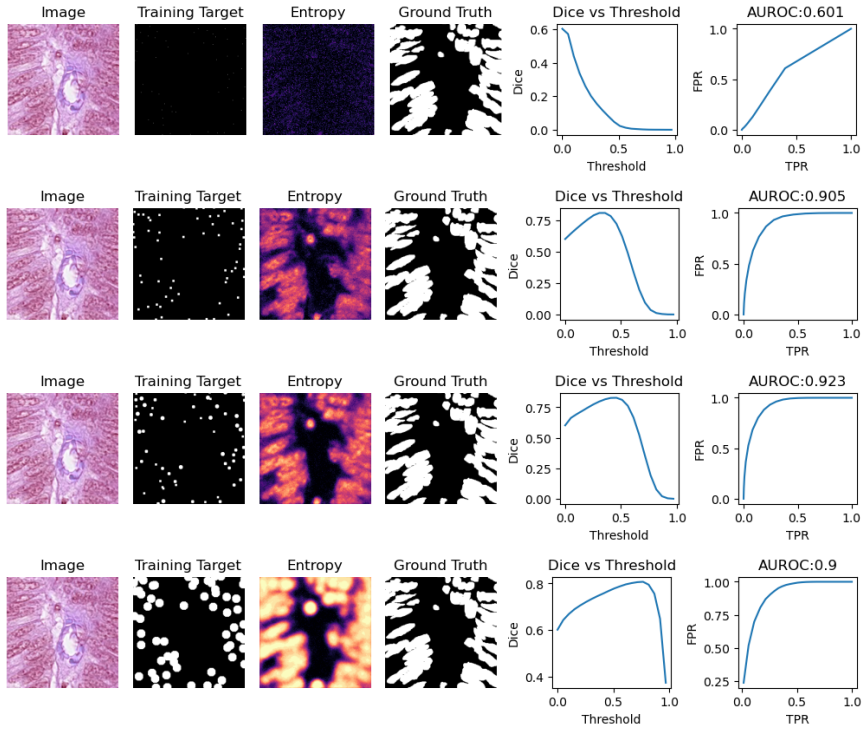
- The entropy map remains a useful discriminator under weaker labels: halving the number of point annotations lowers mean AUROC only from 0.944 to 0.904, and adding up to 5 pixels of position error lowers it to 0.926.
- The deterministic watershed output alone detects nuclei at a rate of 0.61 at IoU 0.5, so most of the detection signal is present before the learned refinement step.
- Because the first stages are statistically grounded rather than learned, the pipeline is transparent up to the Mask-RCNN step, where calibrated uncertainty is lost.
Reading between the lines
- Beyond the paper: the proportionality identity suggests the bootstrap is not specific to nuclei; any point-labeled structure detection task where a sparse foreground label model holds could reuse the same entropy-to-prior conversion.
- Beyond the paper: the derivation exposes an annotation-budget trade-off the paper only samples: epsilon must be small enough for the -epsilon log(epsilon) term to dominate the entropy, but large enough for the network to learn from the sparse labels; a systematic sweep over epsilon could locate the optimal operating point for other datasets.
- Beyond the paper: using the entropy map directly as a soft target or as an uncertainty weighting during Mask-RCNN training could preserve more information than the hard thresholded masks, potentially narrowing the gap to the full-mask baseline.
- Beyond the paper: the loss of calibrated uncertainty at the Mask-RCNN stage, acknowledged in the paper, suggests that replacing the final detector with an uncertainty-aware head would restore the transparent error estimates the earlier stages provide.
Editorial analysis
A structured set of objections, weighed in public.
Referee Report
Summary. The paper proposes a weakly supervised nuclei instance detection pipeline. Starting from point annotations (one random pixel per nucleus plus a radius-3 disk), a Bayesian segmentation network is trained to output per-pixel predictive entropy. The paper argues in Appendix A that this entropy is proportional to the true nucleus probability with constant of proportionality -ε log ε, and uses this to justify converting the entropy map into a binary nucleus prior. The prior is then converted into instance masks through adaptive thresholding, Voronoi-edge subtraction, watershed, and filtering against the point annotations. These pseudo-masks are used to train Mask-RCNN, which achieves bounding-box mAP50 of 0.724 on PanNuke, compared to 0.834 when trained on full ground-truth masks, using about 5% of the pixel labels.
Significance. The paper's strength is the clean, transparent pipeline and the empirical demonstration that a weakly supervised model can approach full-supervision detection performance. The ablation studies (point radius, label percentage, position noise) are useful. The theoretical derivation, if made correct, would be a valuable contribution. However, as written, the derivation does not apply to the actual labeling procedure, and the key assumption that the network estimates the label-distribution entropy is not directly verified. These issues must be resolved before the theoretical claims can be accepted.
major comments (2)
- [Appendix A, Eqs. (12), (13), (16)] The derivation assumes a constant per-pixel label probability ε and zero probability of labeling background pixels as nucleus. The procedure in Section 3.2 samples one random point per nucleus and adds a radius-3 disk, so the conditional label probability at a true-nucleus pixel is ε(x) = area(B(x,3) ∩ nucleus)/area(nucleus), which depends on nucleus size and pixel location; for small nuclei this can be substantially larger than the reported average ε ≈ 0.05. The disk also spills over nucleus boundaries, labeling some background pixels as nucleus, violating Eq. (12)/(16). As a result, the entropy of the input label distribution is not of the form H ≈ -ε log ε P(CT) with a fixed constant, and Eq. (22) is not established for the implemented procedure. The theoretical justification of the bootstrap step therefore needs to be revised: either the labeling procedure should be changed to satisfy the assumptions (e.g., independent pixel-wise labeling with probability ε), or the derivation should be reworked for the actual variable-ε procedure, with appropriate approximation guarantees.
- [Section 3.2] The assumption that the Bayesian network is 'a good estimator of the entropy over the input label distribution' is not directly tested. The reported peak Dice (0.71) and AUROC (0.944) demonstrate that the entropy map separates nuclei from background, but they do not establish that the network's predictive entropy matches the analytical label-distribution entropy, which is what Eq. (22) requires. I recommend a direct comparison on a validation subset: compute the label-distribution entropy analytically from the sampling procedure and the ground-truth masks, and plot it against the network's predictive entropy (e.g., a binned scatter plot with correlation coefficient). This would provide direct evidence for the proportionality claim.
minor comments (5)
- [Appendix A, Eqs. (20)-(21)] The two limit statements are incorrect as written: the ratio (εx log ε)/(εx log x) diverges as ε→0 (the denominator is a fixed negative constant for x<1), and the ratio (1-εx)log(1-εx)/(εx log x) tends to a constant, not 0. The final approximation H ≈ -ε log ε P(CT) is still correct, but the proof needs to be corrected to compare the terms properly.
- [Throughout] There are many typographical errors, including 'cell deection' (Section 1), 'Ee are only able' (Section 1), 'crefined' and 'crefer' (Section 3.2), and inconsistent spelling ('V oiculescu' in the author list). The manuscript would benefit from careful proofreading.
- [Section 3.2] The mapping from the radius-3 neighborhood to ε ≈ 0.05 is not explained; please state how this number is computed (e.g., average disk area divided by average nucleus area) and report the variance across nuclei.
- [Section 4.2/4.3] The paper does not compare against any existing weakly supervised cell/nuclei detection methods; a brief quantitative or qualitative comparison with one or two representative methods (even if on a different dataset) would help position the contribution.
- [Section 4.1] The 'peak Dice' is the maximum Dice over thresholds; this should be defined explicitly to avoid confusion with the Dice at a fixed threshold.
Circularity Check
No significant circularity: the entropy-bootstrap derivation and the final Mask-RCNN evaluation are independent of any fitted parameter or self-citation chain.
full rationale
The paper's central theoretical claim, H ≈ −ε log ε P(CT) (Eq. 22), is derived in Appendix A from an explicit modeling assumption, P(xL=Nucleus|xT=Nucleus)=ε, plus the assumption that background labels are reliable. The proportionality constant is derived asymptotically, not fitted to the detection benchmark, and the entropy network used is the externally published FVI method of Carvalho et al., not the authors' own prior work. The point-annotation radius in Appendix B is tuned to intermediate entropy-quality metrics (peak Dice and AUROC), and the final Mask-RCNN mAP50 of 0.724 is measured against full PanNuke ground-truth masks; it is not a re-reporting of those tuned values. The acknowledged limitation in Section 3.2, that the network is assumed to be a good estimator of entropy over the input label distribution, is an estimation-quality assumption in a bootstrap pipeline, not a self-definitional loop or a fitted input renamed as prediction. A possible mismatch between the constant-ε assumption and the actual radius-based sampling would be a correctness or validity concern about Eq. (22), not a circularity. No load-bearing step reduces, by the paper's own equations or by self-citation, to its own inputs.
Assumptions & free parameters
free parameters (1)
- point annotation radius =
3 pixels
assumptions (3)
- domain assumption The Bayesian segmentation network is a good estimator of the entropy over the input label distribution
- domain assumption Background pixels are correctly labeled with probability 1 in the point-label process
- domain assumption The Voronoi-edge and watershed pipeline separates nuclei without learning systematic errors
Cite this review
Pith. "Pith review of Entropy Bootstrapping for Weakly Supervised Nuclei Detection." pith.science (2026). https://pith.science/paper/S6564ULB
@misc{pith2026241113528,
  author       = {Pith},
  title        = {Pith review of: Entropy Bootstrapping for Weakly Supervised Nuclei Detection},
  year         = {2026},
  howpublished = {\url{https://pith.science/paper/S6564ULB}},
  note         = {Machine review of arXiv:2411.13528}
}
read the original abstract
Microscopy structure segmentation, such as detecting cells or nuclei, generally requires a human to draw a ground truth contour around each instance. Weakly supervised approaches (e.g. consisting of only single point labels) have the potential to reduce this workload significantly. Our approach uses individual point labels for an entropy estimation to approximate an underlying distribution of cell pixels. We infer full cell masks from this distribution, and use Mask-RCNN to produce an instance segmentation output. We compare this point--annotated approach with training on the full ground truth masks. We show that our method achieves a comparatively good level of performance, despite a 95% reduction in pixel labels.
Figures


Figures from the paper (5 more)




Reference graph
Works this paper leans on
-
[1]
Eduardo D. C. Carvalho, Ronald Clark, Andrea Nicastro, and Paul H. J. Kelly. Scalable uncertainty for computer vision with functional variational inference. In IEEE/CVF Confer- ence on Computer Vision and Pattern Recognition (CVPR) ,
-
[2]
Weakly supervised multi- task learning for cell detection and segmentation
Alireza Chamanzar and Yao Nie. Weakly supervised multi- task learning for cell detection and segmentation. In 2020 IEEE 17th International Symposium on Biomedical Imaging (ISBI), pages 513–516. IEEE, 2020. 2
work page 2020
-
[3]
The pascal visual object classes (voc) challenge
Mark Everingham, Luc Van Gool, Christopher KI Williams, John Winn, and Andrew Zisserman. The pascal visual object classes (voc) challenge. International journal of computer vision, 88:303–338, 2010. 7
2010
-
[4]
Split and merge watershed: A two-step method for cell segmentation in fluorescence microscopy images
Margarita Gamarra, Eduardo Zurek, Hugo Jair Escalante, Leidy Hurtado, and Homero San-Juan-Vergara. Split and merge watershed: A two-step method for cell segmentation in fluorescence microscopy images. Biomedical signal pro- cessing and control, 53:101575, 2019. 2
work page 2019
-
[5]
Pannuke: an open pan- cancer histology dataset for nuclei instance segmentation and classification
Jevgenij Gamper, Navid Alemi Koohbanani, Ksenija Benet, Ali Khuram, and Nasir Rajpoot. Pannuke: an open pan- cancer histology dataset for nuclei instance segmentation and classification. In Digital Pathology: 15th European Congress, ECDP 2019, Warwick, UK, April 10–13, 2019, Proceedings 15, pages 11–19. Springer, 2019. 3
work page 2019
-
[6]
Noah F Greenwald, Geneva Miller, Erick Moen, Alex Kong, Adam Kagel, Thomas Dougherty, Christine Camacho Full- away, Brianna J McIntosh, Ke Xuan Leow, Morgan Sarah Schwartz, et al. Whole-cell segmentation of tissue images with human-level performance using large-scale data anno- tation and deep learning. Nature biotechnology, 40(4):555– 565, 2022. 2
work page 2022
-
[7]
Deep residual learning for image recognition
Kaiming He, Xiangyu Zhang, Shaoqing Ren, and Jian Sun. Deep residual learning for image recognition. CoRR, abs/1512.03385, 2015. 5
arXiv 2015
-
[8]
Mask r-cnn
Kaiming He, Georgia Gkioxari, Piotr Doll ´ar, and Ross Gir- shick. Mask r-cnn. In Proceedings of the IEEE international conference on computer vision, pages 2961–2969, 2017. 5
2017
Show all 26 references
-
[9]
Histopathology of prostate cancer
Peter A Humphrey. Histopathology of prostate cancer. Cold Spring Harbor perspectives in medicine , 7(10):a030411,
-
[10]
Limits of applicability of the voronoi tessellation determined by centers of cell nuclei to epithe- lium morphology
Sara Kaliman, Christina Jayachandran, Florian Rehfeldt, and Ana-Sunˇcana Smith. Limits of applicability of the voronoi tessellation determined by centers of cell nuclei to epithe- lium morphology. Frontiers in physiology, 7:551, 2016. 2
2016
-
[11]
Smart mark- ers for watershed-based cell segmentation
Can Fahrettin Koyuncu, Salim Arslan, Irem Durmaz, Ren- gul Cetin-Atalay, and Cigdem Gunduz-Demir. Smart mark- ers for watershed-based cell segmentation. PloS one, 7(11): e48664, 2012. 2
2012
-
[12]
Swin trans- former: Hierarchical vision transformer using shifted win- dows
Ze Liu, Yutong Lin, Yue Cao, Han Hu, Yixuan Wei, Zheng Zhang, Stephen Lin, and Baining Guo. Swin trans- former: Hierarchical vision transformer using shifted win- dows. CoRR, abs/2103.14030, 2021. 5
2021 arXiv
-
[13]
Uncertainty-aware deep learning in healthcare: a scoping review
Tyler J Loftus, Benjamin Shickel, Matthew M Ruppert, Jeremy A Balch, Tezcan Ozrazgat-Baslanti, Patrick J Tighe, Philip A Efron, William R Hogan, Parisa Rashidi, Gilbert R Upchurch Jr, et al. Uncertainty-aware deep learning in healthcare: a scoping review. PLOS digital health ,...
2022
-
[14]
Fixing weight decay reg- ularization in adam
Ilya Loshchilov and Frank Hutter. Fixing weight decay reg- ularization in adam. CoRR, abs/1711.05101, 2017. 5
2017 arXiv
-
[15]
Sig- nificance of nuclear morphometry in benign and malignant breast aspirates
Aparna Narasimha, B Vasavi, and Harendra ML Kumar. Sig- nificance of nuclear morphometry in benign and malignant breast aspirates. International Journal of Applied and Basic Medical Research, 3(1):22–26, 2013. 2
2013
-
[16]
Weakly supervised cell instance segmentation by propagat- ing from detection response
Kazuya Nishimura, Dai Fei Elmer Ker, and Ryoma Bise. Weakly supervised cell instance segmentation by propagat- ing from detection response. In Medical Image Computing and Computer Assisted Intervention–MICCAI 2019: 22nd International Conference, Shenzhen, China, October 13– 17...
2019
-
[17]
Weakly super- vised deep nuclei segmentation using partial points annota- tion in histopathology images
Hui Qu, Pengxiang Wu, Qiaoying Huang, Jingru Yi, Zhen- nan Yan, Kang Li, Gregory M Riedlinger, Subhajyoti De, Shaoting Zhang, and Dimitris N Metaxas. Weakly super- vised deep nuclei segmentation using partial points annota- tion in histopathology images. IEEE transactions on m...
2020
-
[18]
Automated training of deep convolutional neural networks for cell segmentation
Sajith Kecheril Sadanandan, Petter Ranefall, Sylvie Le Guyader, and Carolina W ¨ahlby. Automated training of deep convolutional neural networks for cell segmentation. Scientific reports, 7(1):7860, 2017. 2
2017
-
[19]
Weakly-supervised nucleus segmentation based on point an- notations: A coarse-to-fine self-stimulated learning strat- egy
Kuan Tian, Jun Zhang, Haocheng Shen, Kezhou Yan, Pei Dong, Jianhua Yao, Shannon Che, Pifu Luo, and Xiao Han. Weakly-supervised nucleus segmentation based on point an- notations: A coarse-to-fine self-stimulated learning strat- egy. In Medical Image Computing and Computer Assis...
2020
-
[20]
Breast cancer histopathology image analysis: A review
Mitko Veta, Josien PW Pluim, Paul J Van Diest, and Max A Viergever. Breast cancer histopathology image analysis: A review. IEEE transactions on biomedical engineering, 61(5): 1400–1411, 2014. 1
2014
-
[21]
A delaunay triangulation approach for segmenting clumps of nuclei
Quan Wen, Hang Chang, and Bahram Parvin. A delaunay triangulation approach for segmenting clumps of nuclei. In 2009 IEEE International symposium on biomedical imaging: From Nano to Macro, pages 9–12. IEEE, 2009. 2
2009
-
[22]
An automatic learning-based framework for robust nucleus segmentation
Fuyong Xing, Yuanpu Xie, and Lin Yang. An automatic learning-based framework for robust nucleus segmentation. IEEE Transactions on Medical Imaging , 35(2):550–566,
-
[23]
Evolving generalized voronoi diagrams for accurate cellular image segmentation
Weimiao Yu, Hwee Kuan Lee, Srivats Hariharan, Wenyu Bu, and Sohail Ahmed. Evolving generalized voronoi diagrams for accurate cellular image segmentation. Cytometry Part A: The Journal of the International Society for Advancement of Cytometry, 77(4):379–386, 2010. 2
2010
-
[24]
Weakly supervised cell segmentation by point annotation
Tianyi Zhao and Zhaozheng Yin. Weakly supervised cell segmentation by point annotation. IEEE Transactions on Medical Imaging, 40(10):2736–2747, 2020. 2, 3 Entropy Bootstrapping for Weakly Supervised Nuclei Detection Supplementary Material
2020
-
[25]
Our labeling approach is such that we accurately label all the background pixels
Appendix A Starting from our entropy definition of: H = − X x∈C p(x)log(p(x)) (7) We use the fact that we are doing a binary labelling process to define: P(xL = nucleus) =P(CL) (8) P(xL = background) =P(C c L) = 1− P(CL) (9) P(xT = nucleus) =P(CT ) (10) P(xT = background) =P(C...
-
[26]
weakening
Appendix B We also report the results of ablation studies into varying parameters in the sampling procedure. 7.1. Varying Point Radius In our point annotation creation procedure we sample our random point from within each ground truth instance mask and then convert it into an ...
Reviewed August 12, 2026 · model on record in the stance chip above.
Discussion (0). Continue with ORCID to comment.