REVIEW 6 minor 38 references
Quantum Friction near the Instability Threshold
T0 review · 0 major / 6 minor · reviewed 2026-08-12 · deepseek-v4-flash
Pith's one-line read Near the instability threshold, the quantum friction force between two laterally sliding plates diverges logarithmically with the distance to criticality.
desk verdict A clean analytical derivation of the logarithmic divergence of quantum friction near the instability threshold; the central claim holds up and the paper deserves refereeing. read the letter →
The pith
A machine-rendered reading of the paper's core claim, the machinery that carries it, and where it could break.
The reading
What carries the argument
The central object is the multiple-scattering denominator $\Delta(\omega,k_x,k_y)$ of Eq. (12), whose zeros are the surface-plasmon dispersion relation of Eq. (4). Near threshold, one root sits very close to the real frequency axis, and because the friction-force integrand contains $1/|\Delta|^2$, that soft mode dominates the integral. The derivation then uses the quasi-static reflection coefficients of Eq. (9), the narrow instability window of Eq. (2), and a Taylor expansion of the mode growth rate in $k_y$; the quadratic $k_y$ correction is what changes an apparent square-root singularity into the final logarithmic law.
What would settle it
Compute the same geometry with fully retarded reflection coefficients and dispersion (finite speed of light) and compare the resulting $F(\epsilon)$ to Eq. (18) near $\gamma = \gamma_c$; finding a different singularity, such as a power law, or a shifted threshold would disprove the central claim. Alternatively, a force-microscopy measurement of the drag versus collision rate that shows no logarithmic growth as $\gamma \to \gamma_c^+$ would rule it out.
Extended reading notes
Core claim
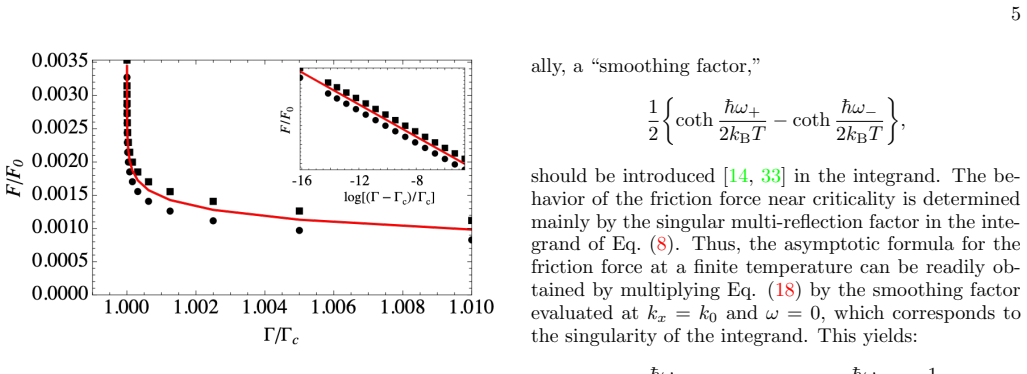
On the paper's own terms, the friction force is controlled near threshold by the unstable hybridized surface-plasmon branch that appears at wavevector $k_0 = 2\omega_s/v$. As the collision frequency $\gamma$ approaches $\gamma_c$ from the stable side, the multiple-scattering denominator in the force integral approaches zero, and the force grows as $\log(1/\epsilon)$. Keeping the $k_y$ dependence of the mode's growth rate is essential: it turns a would-be $1/\sqrt{\epsilon}$ singularity into the weaker logarithmic divergence. Numerical evaluation of the exact force integral confirms both the intermediate formula (16) and the final asymptotic result (18).
Load-bearing premise
The load-bearing premise is that the quasi-static (non-retarded) approximation for the reflection coefficients and dispersion relation, Eq. (4), stays valid in the near-threshold regime where $k_0 = 2\omega_s/v$ can be large; if retardation changes the mode structure or the instability threshold, the coefficient in Eq. (18) would change.
Editorial extensions
If this is right
- For a fixed velocity, plate separation, and material parameters, the steady-state drag force has no finite upper bound as $\gamma \to \gamma_c^+$; it grows as $\log(1/\epsilon)$.
- For fixed dissipation, the same logarithmic divergence is predicted as $v$ approaches its critical value $v_c(\Gamma)$, making the normalized velocity another tuning knob for the singularity.
- At temperature $T$, the near-threshold force is Eq. (18) multiplied by $\coth(\hbar\omega_s/2k_B T)$; in the high-temperature classical limit the drag is enhanced by a factor $2k_B T/\hbar\omega_s$.
- Because the perpendicular Casimir–Lifshitz force shares the same multiple-scattering denominator, the paper expects that force to diverge at the same instability threshold.
- In the deep stable regime the force reduces to the known $F \propto v^3$ law, so the two approximate schemes together cover both the small-velocity and near-critical limits.
Reading between the lines
- The divergence mechanism is likely generic: any fluctuating-force calculation whose integrand carries a $1/|\Delta|^2$ resonance controlled by a single soft mode will produce a logarithmic singularity when that mode becomes marginally stable, with material specifics entering only through the prefactor.
- A retarded (finite-speed-of-light) extension could locate the $\epsilon$ range where the quasi-static approximation breaks down; if retardation shifts $\gamma_c$ or regularizes the divergence, that crossover would be the natural place to test the universality of the log law.
- The electrical-drift analogue—plates at rest with a stationary drift current—may be the most practical platform to observe the divergence, since the required $v_c \sim 10^5$ m/s is a realistic saturation drift velocity but not a mechanical speed.
- If the vertical Casimir–Lifshitz force also diverges, the near-critical pull on the plates could become mechanically detectable, coupling the quantum-friction instability to force-microscopy experiments.
Editorial analysis
A structured set of objections, weighed in public.
Referee Report
Summary. The manuscript develops an analytical treatment of quantum friction between two parallel plates in relative motion, described by quasi-static reflection coefficients. In the deep stable regime it recovers the v^3 friction law (Eq. 10). The central result is the asymptotic formula Eq. (18): as the dissipation parameter Γ approaches the instability threshold Γ_c from the stable side, ε = Γ/Γ_c − 1 → 0+, the friction force diverges as F ≈ −(ħω_s)/(2π√2 d^3) η^{−5/2} e^{−4/η} log(1/ε). The derivation expands the exact multiple-scattering integral (8) around the soft pole at k_x = k_0, k_y = 0, ω = 0, and shows that the k_y integration converts a would-be 1/√ε singularity into a logarithm. The result is verified by comparison with exact numerical integration in Fig. 3 and extended to finite temperature in Eq. (19).
Significance. If correct, the result is significant because it identifies a critical divergence in a nonequilibrium fluctuation-induced force with a parameter-free coefficient. The paper's strengths are the absence of fitted constants, the explicit reduction of the exact integral (8) to the asymptotic form, the robustness of the logarithmic divergence to the cutoff choice, and the numerical verification in Fig. 3. The main physical caveat—that quasi-static reflection coefficients and neglect of velocity backreaction could regularize the divergence extremely close to threshold—is standard for this type of model calculation and does not undermine the model-specific claim. The paper is likely to be of interest to researchers working on quantum friction, Casimir physics, and nonequilibrium fluctuation-induced phenomena.
minor comments (6)
- [Sec. III, Eq. (17)] The truncation at k_y,max with k_y,max^2 d/(2k_0) = 1/4 is introduced without showing that the contribution from |k_y| > k_y,max is finite as ε → 0. Because the leading logarithm is independent of the cutoff scale, this does not affect the central claim, but a sentence justifying the neglected tail would make the derivation complete.
- [Sec. II, Eq. (4)] The quasi-static approximation is invoked without a quantitative estimate of retardation corrections near k_x = k_0. For the quoted parameters (v = 10^5 m/s), (v/(2c))^2 ≈ 3×10^−8, so a one-line estimate would make the assumption controlled.
- [Sec. III, Eq. (16)] The replacement of the arcsin term by π/2 and the evaluation of the prefactor at k_y = 0 are valid only in the dominant region |k_y| ≲ sqrt(k_0 ε/d); stating this explicitly would clarify why the error is subleading.
- [Sec. III, Fig. 3] The text says the result agrees with previous numerical results [25], but Fig. 3 compares with the exact integral (8) rather than with Ref. [25]; please clarify the comparison or cite the numerical data source.
- [Sec. III, Eq. (19)] The thermal generalization is obtained by multiplying the zero-temperature result by coth(ħω_s/(2k_B T)) evaluated at the singular point; a short derivation of this factor from the smoothing function would be helpful.
- [Throughout] There are several typographical issues: 'logaarithmic' should be 'logarithmic', 'researches' should be 'research' in the introduction, and the parentheses in 'FIG. 1(a)' are misplaced.
Circularity Check
No significant circularity: the logarithmic divergence is obtained from the published friction formula and dispersion relation by a parameter-free asymptotic expansion, with no fitted constant renamed as a prediction.
full rationale
The central claim (Eq. 18) follows from the standard quantum-friction expression (Eq. 8), the quasi-static reflection coefficients (Eq. 9), and the dissipative dispersion relation (Eq. 4). The instability threshold Gamma_c is rederived self-containedly in Eqs. (5)-(7) from the condition Im{omega_b}<0, so the near-threshold parameter epsilon is not an imported fitting parameter: it is defined as Gamma/Gamma_c - 1 and the expansion is carried out in the small quantity epsilon. The divergence emerges from the explicit integrations: the omega integral yields pi/(gamma Omega''_{b+} Omega''_{b-}), the q integral gives an arcsin, and the remaining ky integral behaves as integral dky / sqrt(2 epsilon + ky^2 d/k0) ~ log(1/epsilon). The paper explicitly notes that retaining the ky^2 correction is essential to convert a spurious 1/sqrt(epsilon) into the logarithmic divergence, and the cutoff ky,max is chosen at the boundary of the Taylor expansion validity and does not alter the leading log coefficient. Figure 3 checks the approximations against the exact integral (8), so the result is not a fit. The self-citations (Refs. 22, 26, 27, 29) supply the prior model, instability threshold, and quasi-static approximation; these are parameter-free inputs with stated assumptions, and the threshold is rederived here, so they do not carry circular weight. The quasi-static approximation is a physical-model limitation and would require a retardation estimate for a fully quantitative prediction, but that is a correctness/robustness caveat, not a circular step. No equation in the paper is equivalent to its input by construction.
Assumptions & free parameters
assumptions (6)
- domain assumption Quasi-static (non-retarded) approximation for reflection coefficients R± and the dispersion relation Eq. (4).
- domain assumption Friction force formula Eq. (8) is valid for the NESS.
- ad hoc to paper The singular contribution to the force is dominated by the near-unstable root at omega≈0 in the denominator of Eq. (8).
- ad hoc to paper The denominator can be approximated as a product of Lorentzians: |Delta|^2 ≈ 16*omega_s^4 [omega^2 + (Omega''_{b+})^2][omega^2 + (Omega''_{b-})^2].
- ad hoc to paper The ky integration can be truncated at ky,max chosen by ky,max^2 d/(2 k0) = 1/4, and the resulting logarithmic divergence is independent of the cutoff.
- domain assumption Stability criterion and existence of NESS for parameters with Gamma > Gamma_c.
Cite this review
Pith. "Pith review of Quantum Friction near the Instability Threshold." pith.science (2026). https://pith.science/paper/VYV5BCVI
@misc{pith2026241113737,
  author       = {Pith},
  title        = {Pith review of: Quantum Friction near the Instability Threshold},
  year         = {2026},
  howpublished = {\url{https://pith.science/paper/VYV5BCVI}},
  note         = {Machine review of arXiv:2411.13737}
}
read the original abstract
In this work, we develop an analytical framework to understand quantum friction across distinct stability regimes, providing approximate expressions for frictional forces both in the deep stable regime and near the critical threshold of instability. Our primary finding is analytical proof that, near the instability threshold, the quantum friction force diverges logarithmically. This result, verified through numerical simulations, sheds light on the behavior of frictional instabilities as the system approaches criticality. Our findings offer new insights into the role of instabilities, critical divergence and temperature in frictional dynamics across quantum and classical regimes.
Figures


Reference graph
Works this paper leans on
-
[1]
H. B. Casimir and D. Polder, The influence of retardation on the London-van der Waals forces, Physical Review73, 360 (1948)
work page 1948
-
[2]
H. B. Casimir, On the attraction between two perfectly conducting plates, in Proc. Kon. Ned. Akad. Wet., Vol. 51 (1948) p. 793
work page 1948
-
[3]
H. B. Chan, Y. Bao, J. Zou, R. Cirelli, F. Klemens, W. Mansfield, and C. Pai, Measurement of the Casimir force between a gold sphere and a silicon surface with nanoscale trench arrays, Physical Review Letters 101, 030401 (2008)
work page 2008
-
[4]
Y. Bao, R. Gu´ erout, J. Lussange, A. Lambrecht, R. A. Cirelli, F. Klemens, W. M. Mansfield, C. Pai, and H. B. Chan, Casimir force on a surface with shallow nanoscale corrugations: Geometry and finite conductivity effects, Physical review letters 105, 250402 (2010)
work page 2010
-
[5]
F. Intravaia, S. Koev, I. W. Jung, A. A. Talin, P. S. Davids, R. S. Decca, V. A. Aksyuk, D. A. Dalvit, and D. L´ opez, Strong Casimir force reduction through metal- lic surface nanostructuring, Nature Communications 4, 2515 (2013)
work page 2013
-
[6]
M. Wang, L. Tang, C. Ng, R. Messina, B. Guizal, J. Crosse, M. Antezza, C. T. Chan, and H. B. Chan, Strong geometry dependence of the Casimir force be- tween interpenetrated rectangular gratings, Nature Com- munications 12, 600 (2021)
work page 2021
-
[7]
D. A. Somers, J. L. Garrett, K. J. Palm, and J. N. Mun- day, Measurement of the Casimir torque, Nature 564, 386 (2018)
work page 2018
- [8]
Show all 38 references
-
[9]
K¨ u¸ c¨ uk¨ oz, O
B. K¨ u¸ c¨ uk¨ oz, O. V. Kotov, A. Canales, A. Y. Polyakov, A. V. Agrawal, T. J. Antosiewicz, and T. O. She- gai, Quantum trapping and rotational self-alignment in triangular Casimir microcavities, Science Advances 10, eadn1825 (2024)
2024
-
[10]
G. T. Moore, Quantum theory of the electromagnetic field in a variable-length one-dimensional cavity, Journal of Mathematical Physics 11, 2679 (1970)
1970
-
[11]
S. A. Fulling and P. C. Davies, Radiation from a mov- ing mirror in two dimensional space-time: conformal anomaly, Proceedings of the Royal Society of London. A. Mathematical and Physical Sciences 348, 393 (1976)
1976
-
[12]
C. M. Wilson, G. Johansson, A. Pourkabirian, M. Simoen, J. R. Johansson, T. Duty, F. Nori, and P. Delsing, Observation of the dynamical Casimir effect in a superconducting circuit, nature 479, 376 (2011)
2011
-
[13]
Volokitin and B
A. Volokitin and B. Persson, Theory of the interaction forces and the radiative heat transfer between moving bodies, Physical Review B 78, 155437 (2008)
2008
-
[14]
G. V. Dedkov and A. A. Kyasov, Fluctuation- electromagnetic interaction under dynamic and ther- mal nonequilibrium conditions, Physics-Uspekhi 60, 559 (2017)
2017
-
[15]
Milton, J
K. Milton, J. Høye, and I. Brevik, The reality of Casimir friction, Symmetry 8, 29 (2016)
2016
-
[16]
Reiche, F
D. Reiche, F. Intravaia, and K. Busch, Wading through the void: Exploring quantum friction and nonequilibrium fluctuations, APL Photonics 7, 030902 (2022)
2022
-
[17]
J. S. Høye and I. Brevik, Friction force between mov- ing harmonic oscillators, Physica A: Statistical Mechan- ics and its Applications 181, 413 (1992)
1992
-
[18]
Brevik et al., Friction force with non-instantaneous in- teraction between moving harmonic oscillators, Physica A: Statistical Mechanics and its Applications 196, 241 (1993)
I. Brevik et al., Friction force with non-instantaneous in- teraction between moving harmonic oscillators, Physica A: Statistical Mechanics and its Applications 196, 241 (1993)
1993
-
[19]
J. B. Pendry, Shearing the vacuum-quantum friction, Journal of Physics: Condensed Matter 9, 10301 (1997)
1997
-
[20]
J. B. Pendry, Can sheared surfaces emit light?, Journal of Modern Optics 45, 2389 (1998)
1998
-
[21]
Volokitin and B
A. Volokitin and B. Persson, Theory of friction: the con- tribution from a fluctuating electromagnetic field, Jour- nal of Physics: Condensed Matter 11, 345 (1999)
1999
-
[22]
S. I. Maslovski and M. G. Silveirinha, Quantum friction on monoatomic layers and its classical analogue, Phys. Rev. B 88, 035427 (2013)
2013
-
[23]
M. G. Silveirinha, Quantization of the electromagnetic field in non-dispersive polarizable moving media above the cherenkov threshold, Phys. Rev. A88, 043846 (2013)
2013
-
[24]
M. G. Silveirinha, Theory of quantum friction, New J. Phys. 16, 063011 (2014)
2014
-
[25]
Guo and Z
Y. Guo and Z. Jacob, Singular evanescent wave reso- nances in moving media, Optics express22, 26193 (2014)
2014
-
[26]
Brevik, B
I. Brevik, B. Shapiro, and M. G. Silveirinha, Fluctua- tional electrodynamics in and out of equilibrium, Interna- tional Journal of Modern Physics A 37, 2241012 (2022)
2022
-
[27]
D. Oue, J. Pendry, and M. G. Silveirinha, Stable-to- 7 unstable transition in quantum friction, Phys. Rev. Re- search 6, 043074 (2024)
2024
-
[28]
Guo and Z
Y. Guo and Z. Jacob, Giant non-equilibrium vacuum fric- tion: role of singular evanescent wave resonances in mov- ing media, Journal of Optics 16, 114023 (2014)
2014
-
[29]
M. G. Silveirinha, Optical instabilities and spontaneous light emission by polarizable moving matter, Physical Re- view X 4, 031013 (2014)
2014
-
[30]
Palik, R
E. Palik, R. Kaplan, R. Gammon, H. Kaplan, R. Wallis, and J. Quinn, Coupled surface magnetoplasmon-optic- phonon polariton modes on InSb, Physical Review B 13, 2497 (1976)
1976
-
[31]
Majorel, V
C. Majorel, V. Paillard, A. Patoux, P. R. Wiecha, A. Cuche, A. Arbouet, C. Bonafos, and C. Girard, The- ory of plasmonic properties of hyper-doped silicon nanos- tructures, Optics Communications 453, 124336 (2019)
2019
-
[32]
G´ omez Rivas, C
J. G´ omez Rivas, C. Janke, P. H. Bolivar, and H. Kurz, Transmission of THz radiation through InSb gratings of subwavelength apertures, Optics express 13, 847 (2005)
2005
-
[33]
[14] hold in the frame where one of the plates is at rest, and they must be translated to the frame used in the present paper
The formulas in Ref. [14] hold in the frame where one of the plates is at rest, and they must be translated to the frame used in the present paper
-
[34]
Volokitin and B
A. Volokitin and B. Persson, Quantum friction, Physical Review Letters 106, 094502 (2011)
2011
-
[35]
Shapiro, Fluctuation-induced forces in the presence of mobile carrier drift, Physical Review B 96, 075407 (2017)
B. Shapiro, Fluctuation-induced forces in the presence of mobile carrier drift, Physical Review B 96, 075407 (2017)
2017
-
[36]
T. A. Morgado and M. G. Silveirinha, Drift-induced uni- directional graphene plasmons, ACS Photonics 5, 4253 (2018)
2018
-
[37]
R. Quay, C. Moglestue, V. Palankovski, and S. Selber- herr, A temperature dependent model for the saturation velocity in semiconductor materials, Materials Science in Semiconductor Processing 3, 149 (2000)
2000
-
[38]
Sydoruk, E
O. Sydoruk, E. Shamonina, V. Kalinin, and L. Solymar, Terahertz instability of surface optical-phonon polaritons that interact with surface plasmon polaritons in the pres- ence of electron drift, Physics of Plasmas 17, 102103 (2010)
2010
Reviewed August 12, 2026 · model on record in the stance chip above.
Discussion (0). Continue with ORCID to comment.