REVIEW 2 major objections 4 minor 1 cited by
Conditional t-independent spectral gap for random quantum circuits and implications for t-design depths
T0 review · 2 major / 4 minor · reviewed 2026-08-12 · deepseek-v4-flash
Pith's one-line read A t-independent spectral gap for 1D random quantum circuits is established when q ≥ t
desk verdict Real advance with a fixable gap: the small-t numerical bounds need certification before Theorem 1 is fully proven. read the letter →
The pith
A machine-rendered reading of the paper's core claim, the machinery that carries it, and where it could break.
The reading
What carries the argument
The load-bearing object is the effective three-site operator K_m = Π_m G_m Π_m, where Π_m projects onto permutation states uniform on the first m sites and G_m is a two-site Haar-averaged gate. A matrix-block argument shows that the N-site staircase transfer matrix has largest non-unit eigenvalue at most (1 + $\sqrt$(1 − λ))² λ, where λ is the supremum over m of ||K_m − Π_{m+1}||. The rest of the proof bounds λ by decomposing the eigenspaces: a block-triangular hierarchy from the subgroup structure of the symmetric group isolates the deranged subspace, global left- and right-actions diagonalize into isotypic components, and the gate factorizes as $D_ν^{{-1}}$ W(Q1Q2) D(Q2) C(Q1) D_ν W(Q2Q3) D(Q2) C(Q3). Analytic bounds on the derangement polynomial cover t > 28, a numerical polynomial bound covers 7 ≤ t ≤ 28, and direct numerical diagonalization of a half-operator covers t = 3, 4, 5, 6.
What would settle it
Evaluate the half-operator norm ||H(t)||_D for t = 3, 4, 5, 6 using interval arithmetic or high-precision certified computation on the matrix H(t)_{στ} = (1/f_t($t^{{-2}}$)) Σ_{ij} |$h^{{(ij)}}$_{στ}| $t^{{-(i+j)}}$. If any value exceeds the Table II entries (0.1845, 0.1018, 0.01818, 8.297×$10^{{-3}}$) after rescaling by (t/q)^{ceil(t/2)}, or if the product condition h(t)² ≤ $t^{{2 ceil(t/2)}}$/(1+t²) fails, then Theorem 1's claim for that t collapses. Alternatively, an explicit eigenvalue of K_m on the deranged subspace for q = t = 3 larger than 1/(q²+1) would refute the bound.
Extended reading notes
Core claim
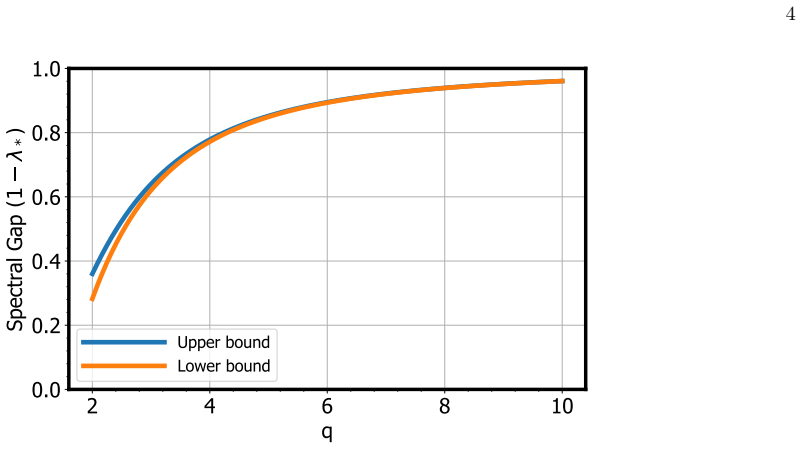
The central claim is Theorem 1: when t ≤ q, the spectral gap of the 1D brickwork architecture with N sites of local Hilbert space dimension q is at least 1 − [(2q/(q²+1))(1 + sqrt(1 + 1/q²))/2]². This bound is independent of both N and t, and Theorem 2 supplies an upper bound of 1 − (2q/(q²+1) cos(pi/N))², so the two bounds differ by at most 0.0473 and converge as q grows. The gap bounds translate into depth bounds: Corollary 3 gives ℓ* ≤ 1 + C(2Nt log q + log(1/epsilon)) with C ≤ 6.032, and Corollary 4 shows ℓ* = (C(N,q,t) + o(1)) log(1/epsilon) as epsilon goes to zero, with explicit upper and lower constants. A semi-numerical version, Theorem 5, extends the gap bound to q = 2, t ≤ 6, and N ≤ 1000.
Load-bearing premise
The theorem's coverage of small moments t = 3, 4, 5, 6 rests on numerically computed operator norms reported to four significant figures without interval arithmetic; if any of those numbers is not a rigorous upper bound, the gap bound is not proven for that t.
Editorial extensions
If this is right
- If Theorem 1 holds, the 1D brickwork forms an epsilon-approximate t-design in O(Nt log q + log(1/epsilon)) layers with a constant factor at most 6.032, for every t ≤ q.
- The small-epsilon asymptotic depth is exactly (C + o(1)) log(1/epsilon), with the constant C bounded between two explicitly computable numbers that depend only on q and N, not on t.
- The lower bound on the spectral gap is within at most 15% of the conjectured optimal value 1 − (2q/(q²+1))², so the mixing rate of the 1D brickwork is nearly settled in the regime t ≤ q.
- Known approximate t-design depth bounds for generic circuit architectures and for O(log N)-depth scrambling architectures inherit improved constants through the reduction from arbitrary architectures to the 1D brickwork.
- For q = 2 with t ≤ 6 and N ≤ 1000, the semi-numerical bound gives the same gap estimate, covering finite-size regimes beyond the strictly analytic theorem.
Reading between the lines
- If the small-t numerical bounds were replaced by interval-arithmetic-verified computations, the t = 3,...,6 case would become fully rigorous and the same pipeline could extend the finite-size numerics to larger N, t, and q.
- The deranged-subspace and isotypic decomposition is likely portable to other circuit architectures or to properties such as anticoncentration, because the reduction to three-site operators is driven by block structure rather than by the specific brickwork layout.
- The paper's own numerics suggest the 1/(q²+1) eigenvalue bound may survive beyond t ≤ q except for a small exceptional case, so removing the t ≤ q cutoff is a plausible near-term target.
- Tightening the factor (1 + sqrt(1 + 1/q²))/2 toward 1, perhaps by optimizing the Gershgorin weighting in the matrix-block bound, would directly close the remaining gap to the conjectured optimum.
Editorial analysis
A structured set of objections, weighed in public.
Referee Report
Summary. The paper develops a new method for bounding the spectral gap of the t-th moment operator of a 1D brickwork random quantum circuit on N qudits of local dimension q. The main result (Theorem 1) states that for t ≤ q the spectral gap is at least 1 - ( (2q/(q^2+1)) * (1+√(1+1/q^2))/2 )^2, which is independent of both N and t. The proof reduces the N-site problem to bounding 3-site operators, then uses a block-triangular hierarchy, the representation theory of the symmetric group, and the derangement subspace. Analytic bounds are given for t=2 and for t>28, while intermediate regimes (3≤t≤6 and 7≤t≤28) are handled with numerical evaluations reported in Table II and Fig. 6. The paper also proves an upper bound on the gap (Theorem 2), nearly matching the lower bound, and derives improved t-design depth bounds (Corollaries 3 and 4).
Significance. If the proof is made fully rigorous, this is a significant contribution: it gives the first t-independent spectral gap bound for all t ≤ q, nearly saturating the conjectured optimal value, and yields large constant-factor improvements for approximate t-design depths. The analytic machinery—the reduction to 3-site operators, the derangement-subspace decomposition, and the use of symmetric-group isotypic components—is novel and likely to be useful beyond the specific result. However, the dependence of the core theorem on uncertified numerical computations for the intermediate t regimes is a serious gap that must be addressed before the result can be considered proven.
major comments (2)
- [Section VI B, Lemma 41, Table II] The proof of Theorem 1 for 3≤t≤6 rests entirely on the numerical values of ||H(t)||_D reported in Table II (0.1845, 0.1018, 0.01818, 8.297×10^-3). These are presented to four significant figures with no interval arithmetic, no error analysis, and no accompanying code. Because the inequality ||K_m||_D ≤ 1/(q^2+1) is asserted for every q≥t on the strength of these values, a single underestimated norm would invalidate the theorem in that t-sector. Please replace these numbers with certified interval bounds (e.g., rational enclosures from the computation of the matrix entries and a verified norm bound) or provide machine-checkable code that reproduces rigorous bounds. Alternatively, state Theorem 1 only for t=2 and t>28, with the intermediate t as a conditional result contingent on the numerical values.
- [Appendix D C, Lemma 45, Fig. 6] The proof of Lemma 45 uses the numerical values of d_t(t^{-2}) for 7≤t≤28 and the observation, from Fig. 6, that these values decrease monotonically for t≥7. Since the range is finite, each d_t(t^{-2}) is an exactly computable rational number (via Lemma 60), so certified upper bounds are straightforward to provide. The monotonicity claim should either be proved analytically or replaced by a certified table of values over the finite range. Without such certification, the bound for 7≤t≤28 is an unverified numerical assertion rather than a proof.
minor comments (4)
- [Abstract] The abstract contains a duplicated word: 'and and have little in common'.
- [Section V and Appendix B E] There are stray spaces in headings: 'F actorization' in Section V and 'W eingarten' in Appendix B E; these should be corrected.
- [Section I B, Fig. 1] The claim that the upper and lower bounds differ by at most 0.0473 appears only in the text; adding the maximum difference to the figure caption would improve clarity.
- [Section III, Lemma 13] The proof of Lemma 13 invokes the spectral mapping theorem for operator norms without a reference; citing a standard source would help the reader.
Circularity Check
No circularity: the spectral-gap bound is derived from independent representation-theoretic and Weingarten estimates; the only self-citations concern downstream applications, and the semi-numerical lemmas are direct finite evaluations rather than fitted inputs.
full rationale
The derivation chain for Theorem 1 is self-contained rather than circular. The proof reduces the N-site brickwork to 3-site operators through the block-triangular hierarchy (Lemmas 12-17, Theorem 19), then uses representation theory and the deranged-subspace decomposition (Corollary 29, Theorem 26) to isolate the new eigenvalues for t<=q. The t=2 case is solved analytically in Theorem 37. For t>2, the q-dependence is obtained analytically from bounds on the Weingarten matrix (Lemma 42), the derangement polynomial (Lemmas 43-45, 60-65), and an elementwise Weingarten bound (Lemma 46). The small-t cases t=3,...,6 rest on the numerical norms ||H(t)||_D reported in Table II, and the 7<=t<=28 case rests on numerical evaluations of d_t(t^{-2}) in Lemma 45 and Fig. 6. These are not fitted inputs or renamed predictions: each reported number is the norm or polynomial value of an explicitly defined finite matrix or polynomial, independent of the target inequality 1/(q^2+1), and the subsequent comparison is a direct inequality check. The lack of interval arithmetic or deposited machine-checkable code is a genuine rigor limitation for Lemmas 41 and 45, but it is a correctness concern, not circularity. The paper's own self-citations are limited to ref. 14, used for downstream generic-architecture depth bounds and as part of a cited conjecture; ref. 14 is not load-bearing for the 1D brickwork spectral gap itself. Theorem 2's upper bound uses external results (refs. 16 and 19). No equation in the proof is assumed to prove itself, and no fit parameter is later called a prediction. Accordingly, no circular step is identified.
Assumptions & free parameters
assumptions (5)
- standard math Haar integration and Weingarten calculus for moments of random unitaries
- domain assumption Spectra of brickwork LOLE and staircase Tstair coincide (Lemma 11, from ref. 21)
- domain assumption Permutation basis states are linearly independent when t ≤ q (Lemma 28)
- ad hoc to paper Numerical values in Table II and Fig. 6 are exact enough to serve as rigorous bounds
- domain assumption Known exact spectral gap results for t=2 in refs. 16 and 19 (Theorem 2 upper bound)
Cite this review
Pith. "Pith review of Conditional t-independent spectral gap for random quantum circuits and implications for t-design depths." pith.science (2026). https://pith.science/paper/DEF66TUL
@misc{pith2026241113739,
  author       = {Pith},
  title        = {Pith review of: Conditional t-independent spectral gap for random quantum circuits and implications for t-design depths},
  year         = {2026},
  howpublished = {\url{https://pith.science/paper/DEF66TUL}},
  note         = {Machine review of arXiv:2411.13739}
}
read the original abstract
A fundamental question is understanding the rate at which random quantum circuits converge to the Haar measure. One quantity which is important in establishing this rate is the spectral gap of a random quantum ensemble. In this work we establish a new bound on the spectral gap of the t-th moment of a one-dimensional brickwork architecture on N qudits. This bound is independent of both t and N, provided t does not exceed the qudit dimension q. We also show that the bound is nearly optimal. The improved spectral gaps gives large improvements to the constant factors in known results on the approximate t-design depths of the 1D brickwork, of generic circuit architectures, and of specially-constructed architectures which scramble in depth O(log N). We moreover show that the spectral gap gives the dominant epsilon-dependence of the t-design depth at small epsilon. Our spectral gap bound is obtained by bounding the N-site 1D brickwork architecture by the spectra of 3-site operators. We then exploit a block-triangular hierarchy and a global symmetry in these operators in order to efficiently bound them. The technical methods used are a qualitatively different approach for bounding spectral gaps and and have little in common with previous techniques.
Figures


Figures from the paper (3 more)


Forward citations
Cited by 1 Pith paper
-
Apparent Universal Behavior in Second Moments of Random Quantum Circuits
Most random circuit geometries form approximate 2-designs in O(log n) depth with explicit constants; bridge/lollipop graphs need Ω(n²) gates, and 10-20 layers suffice for 50-qubit near-random circuits.
Reference graph
Works this paper leans on
-
[1]
Sergio Boixo, Sergei V. Isakov, Vadim N. Smelyanskiy, Ryan Babbush, Nan Ding, Zhang Jiang, Michael J. Bremner, John M. Martinis, and Hartmut Neven. Characterizing quantum supremacy in near-term devices. Nature Physics , 14(6):595–600, 2018
work page 2018
-
[2]
Bardin, Rami Barends, Rupak Biswas, Sergio Boixo, Fernando G.S.L
Frank Arute, Kunal Arya, Ryan Babbush, Dave Bacon, Joseph C. Bardin, Rami Barends, Rupak Biswas, Sergio Boixo, Fernando G.S.L. Brandao, David A. Buell, Brian Burkett, Yu Chen, Zijun Chen, Ben Chiaro, Roberto Collins, William Courtney, Andrew Dunsworth, Edward Farhi, Brooks Foxen, Austin Fowler, Craig Gidney, Marissa Giustina, Rob Graff, Keith Guerin, Stev...
work page 2019
-
[3]
Quantum supremacy and random circuits
Ramis Movassagh. Quantum supremacy and random circuits. 2019
work page 2019
-
[4]
Adam R. Brown and Leonard Susskind. Second law of quantum complexity. Physical Review D , 97(8), 2018
work page 2018
-
[5]
Black holes as mirrors: Quantum information in random subsystems
Patrick Hayden and John Preskill. Black holes as mirrors: Quantum information in random subsystems. Journal of High Energy Physics , 2007(9):120, 9 2007
work page 2007
-
[6]
Measurement-Induced Phase Transitions in the Dynamics of Entanglement
Brian Skinner, Jonathan Ruhman, and Adam Nahum. Measurement-Induced Phase Transitions in the Dynamics of Entanglement. Physical Review X , 9(3), 2019
work page 2019
-
[7]
Theory of the phase transition in random unitary circuits with measure- ments
Yimu Bao, Soonwon Choi, and Ehud Altman. Theory of the phase transition in random unitary circuits with measure- ments. Physical Review B , 101(10), 3 2020
work page 2020
-
[8]
Daniel Jafferis, Alexander Zlokapa, Joseph D. Lykken, David K. Kolchmeyer, Samantha I. Davis, Nikolai Lauk, Hartmut Neven, and Maria Spiropulu. Traversable wormhole dynamics on a quantum processor. Nature, 612(7938):51–55, 2022
work page 2022
Show all 24 references
-
[9]
Brand˜ ao, Aram W
Fernando G.S.L. Brand˜ ao, Aram W. Harrow, and Micha l Horodecki. Local Random Quantum Circuits are Approximate Polynomial-Designs. Communications in Mathematical Physics , 346(2):397–434, 2016
2016
-
[10]
Random quantum circuits are approximate unitary t-designs in depth O(nt5+o(1))
Jonas Haferkamp. Random quantum circuits are approximate unitary t-designs in depth O(nt5+o(1)). Quantum, 6, 2022
2022
-
[11]
Incompressibility and spectral gaps of random circuits
Chi-Fang Chen, Jeongwan Haah, Jonas Haferkamp, Yunchao Liu, Tony Metger, and Xinyu Tan. Incompressibility and spectral gaps of random circuits. 2024
2024
-
[12]
Random unitaries in extremely low depth
Thomas Schuster, Jonas Haferkamp, and Hsin-Yuan Huang. Random unitaries in extremely low depth. 2024
2024
-
[13]
Approximate Unitary k-Designs from Shallow, Low-Communication Circuits
Nicholas LaRacuente and Felix Leditzky. Approximate Unitary k-Designs from Shallow, Low-Communication Circuits. 2024
2024
-
[14]
Daniel Belkin, James Allen, Soumik Ghosh, Christopher Kang, Sophia Lin, James Sud, Fred Chong, Bill Fefferman, and Bryan K. Clark. Approximate t-designs in generic circuit architectures. 2023. 25
2023
-
[15]
Dalzell, Nicholas Hunter-Jones, and Fernando G.S.L
Alexander M. Dalzell, Nicholas Hunter-Jones, and Fernando G.S.L. Brand˜ ao. Random Quantum Circuits Anticoncen- trate in Log Depth. PRX Quantum , 3(1):10333, 2022
2022
-
[16]
Deneris, Pablo Bermejo, Paolo Braccia, Lukasz Cincio, and Marco Cerezo
Andrew E. Deneris, Pablo Bermejo, Paolo Braccia, Lukasz Cincio, and Marco Cerezo. Exact spectral gaps of random one-dimensional quantum circuits. 2024
2024
-
[17]
Improved spectral gaps for random quantum circuits: Large local dimen- sions and all-to-all interactions
Jonas Haferkamp and Nicholas Hunter-Jones. Improved spectral gaps for random quantum circuits: Large local dimen- sions and all-to-all interactions. Physical Review A , 104(2), 2021
2021
-
[18]
Unitary designs from statistical mechanics in random quantum circuits
Nicholas Hunter-Jones. Unitary designs from statistical mechanics in random quantum circuits. 2019
2019
-
[19]
Solvable non-Hermitian skin effect in many-body unitary dynamics
Marko Znidaric. Solvable non-Hermitian skin effect in many-body unitary dynamics. 5 2022
2022
-
[20]
Integration with respect to the Haar measure on unitary, orthogonal and symplectic group
Beno ˆ ıt Collins and Piotr´Sniady. Integration with respect to the Haar measure on unitary, orthogonal and symplectic group. Communications in Mathematical Physics , 264(3):773–795, 2006
2006
-
[21]
Fastest local entanglement scrambler, multistage thermalization, and a non-Hermitian phantom
Jas Bensa and Marko Znidaric. Fastest local entanglement scrambler, multistage thermalization, and a non-Hermitian phantom. 1 2021
2021
-
[22]
Jucys-Murphy elements and weingarten matrices
Paul Zinn-Justin. Jucys-Murphy elements and weingarten matrices. Letters in Mathematical Physics , 91(2):119–127, 2010
2010
-
[23]
even” and “odd
Georg K¨ ostenberger. Weingarten Calculus. 2021. A. RELA TIONSHIP BETWEEN SPECTRAL GAP AND t-DESIGN DEPTH This material is generally standard, but we include it here for completeness. Definition 47. An ensemble ε of random quantum circuits is an additive-error ϵ-approximate t-...
2021
-
[24]
1 2 + 3 t t + 4√ t t# (232) Furthermore, when t ≤ q, this bound can be simplified to dt(q−2) ≤ t2 2 e 1 2t2
|v⟩ = |0⟩ if and only if Xv = 0 38 4. X = X ν⊢t:|ν|≤q Pν where Pν is the canonical idempotent with elements Pν,στ = χν(1) t! X ρ χν(ρ−1)δσ,ρ◦τ Proof. We first prove claim (4). Xστ = ⟨σ|eτ ⟩ = X ρ q−|σρ−1|Wg(τ ρ−1, q) (195) = X ρ∈St,λ⊢t:|λ|≤q,ν ⊢t:|ν|≤q cλ(q)Pλ,σρc−1 ν (q)Pν,ρτ...
Reviewed August 12, 2026 · model on record in the stance chip above.
Discussion (0). Continue with ORCID to comment.