REVIEW 1 major objections 5 minor 71 references
Xenon-metal pair formation in UO2 investigated using DFT+U
T0 review · 1 major / 5 minor · reviewed 2026-08-12 · deepseek-v4-flash
Pith's one-line read DFT+U calculations in a 96-atom UO2 supercell show that Xe–metal pairs are more stable than isolated defects for all five NMP metals, with Pd and Mo the strongest binders.
desk verdict A competent DFT+U pair-energetics study whose ranking of Xe–metal binding in UO2 is a plausible new result, but the paper overreaches when it claims this explains the observed 7 nm bubble–NMP pair. read the letter →
The pith
A machine-rendered reading of the paper's core claim, the machinery that carries it, and where it could break.
The reading
What carries the argument
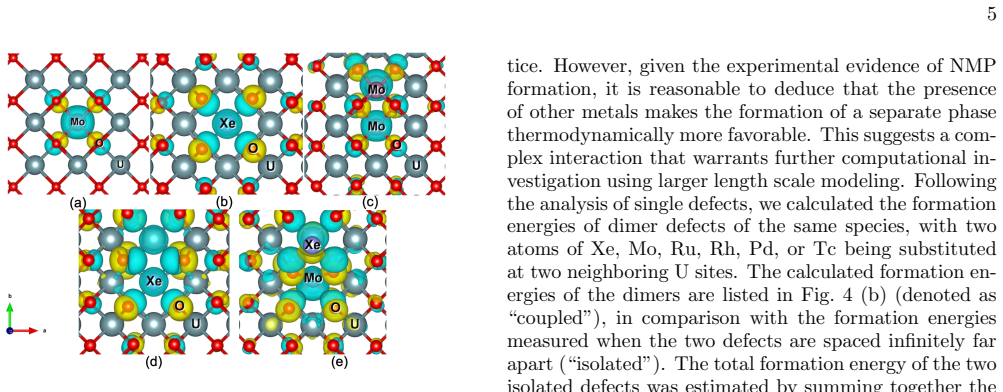
The central object is the Xe–M defect pair: one xenon atom and one metal atom replacing two neighbouring uranium sites in a 96-atom 2×2×2 UO2 supercell with fixed volume. The argument runs on the formation energy difference between this coupled pair and the two isolated defects, computed with DFT+U (U = 4 eV) plus spin-orbit coupling, occupation-matrix control to lock in the antiferromagnetic state, and the O-rich chemical potential condition. Charge-density differences and Bader charges identify the stabilising mechanism: electron transfer from the metal (especially Mo) and strain relief from matching atomic radii (especially Pd).
What would settle it
Map the chemistry right at the Xe–NMP interface in the BR3 sample by atom-probe or energy-dispersive X-ray spectroscopy: if the metal atoms adjacent to Xe bubbles are not enriched in Pd and Mo, the predicted binding ranking is contradicted. Alternatively, recompute the pair binding energy in a larger supercell (e.g., 324 atoms) with charged defect states; a sign reversal or reordering of binding energies would falsify the neutral point-defect picture.
Extended reading notes
Core claim
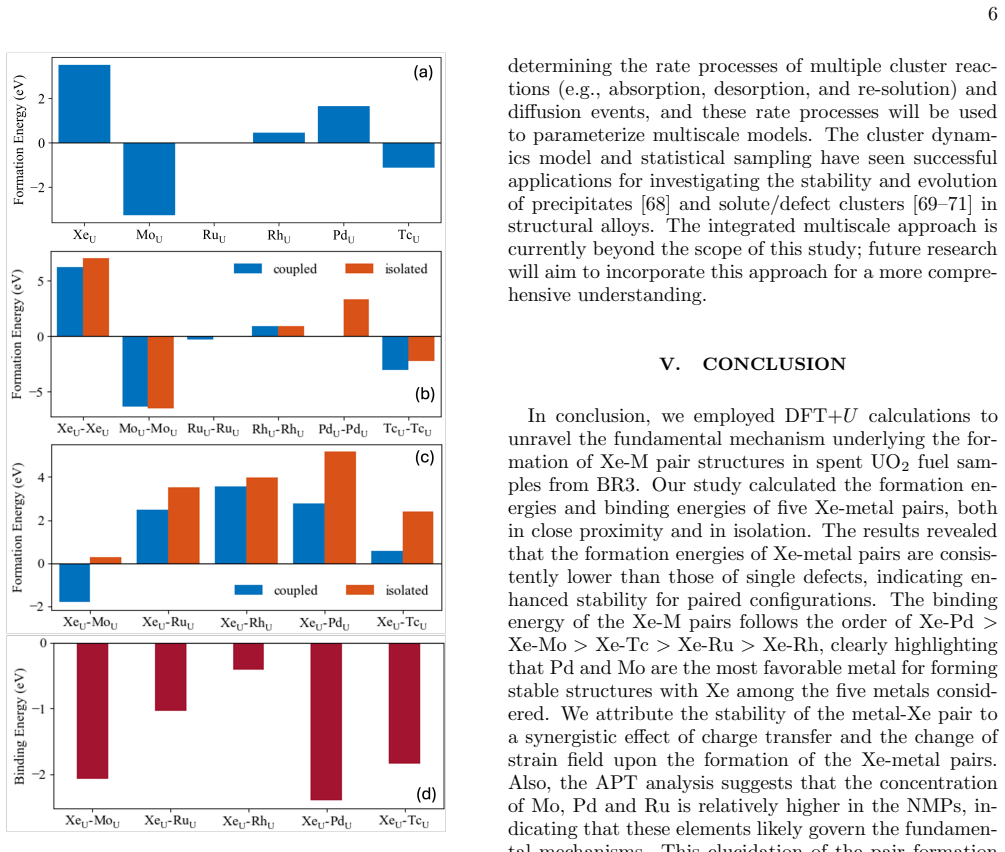
On its own terms, the paper claims that in uranium dioxide a xenon atom and a metal atom from the noble metal phase, placed on neighbouring uranium substitutional sites, form a pair whose formation energy is lower than the sum of the two isolated single defects under all five metals considered. The binding energy ordering is Xe–Pd > Xe–Mo > Xe–Tc > Xe–Ru > Xe–Rh, which the authors interpret as a synergistic effect: charge redistribution and delocalization stabilize the Xe–Mo pair, while the close match between Pd and Xe atomic radii reduces strain. Single Mo and Tc substitutions already have negative formation energies in the O-rich limit, indicating solution in the lattice, yet all Xe–metal pairs are still more stable than separated defects. The paper therefore proposes that this nearest-neighbour pair energetics is the fundamental mechanism behind the experimentally observed pair structures in spent fuel from Belgium Reactor 3.
Load-bearing premise
The load-bearing premise is that a pair of neutral single atoms at neighbouring uranium sites in a small fixed-volume perfect crystal captures the interaction that attaches real ~7 nm xenon bubbles to metal precipitates, so if interfaces, bubble surfaces, cluster size, or charged defects govern that attachment, the computed pair stability would not transfer to the observed microstructure.
Editorial extensions
If this is right
- All five Xe–metal pairs are predicted to be thermodynamically stable relative to separated single defects, so Xe and NMP metals should co-locate at the atomic scale in UO2.
- Pd and Mo are the strongest binding partners, so experimental searches for the pairing chemistry should focus on Xe–Pd and Xe–Mo contacts.
- Because the pair energy is lower than isolated defects, the first step of cluster nucleation is energetically allowed; the paper states that full Xe–M cluster evolution needs multiscale modeling beyond this DFT study.
- The relative stability ranking Xe–Pd > Xe–Mo > Xe–Tc > Xe–Ru > Xe–Rh gives a quantitative target for future experiments or higher-level theory to confirm or disprove.
Reading between the lines
- If the pairwise attraction persists in larger clusters, metal precipitates may act as heterogeneous nucleation sites for Xe bubbles; a testable extension is computing pair and cluster binding as a function of cluster size and metal concentration.
- The strain-match explanation for Pd suggests a broader design rule: fission-gas atoms with atomic radii close to a metal solute should show enhanced pair binding, which could be tested for Kr or I substituents.
- The paper's neutral-defect, constant-volume 96-atom model leaves open whether the same ordering survives with charged defects, larger supercells, and surfaces or grain boundaries; those are the first computations that could overturn the ranking.
- Planned energy-dispersive X-ray mapping of the BR3 interface can directly test the prediction that Pd and Mo will be enriched at the Xe–NMP boundary.
Editorial analysis
A structured set of objections, weighed in public.
Referee Report
Summary. The paper uses DFT+U with occupation-matrix-controlled 1k antiferromagnetic ordering to compute formation and binding energies of substitutional Xe and noble-metal (Mo, Ru, Rh, Tc, Pd) point defects and nearest-neighbor defect pairs in a 96-atom UO2 supercell. The authors report that Xe-metal pair formation energies are lower than the sum of the isolated single-defect formation energies for all five metals, with Xe-Pd and Xe-Mo showing the largest binding energies. They connect this result to a previously observed ~7 nm fission-gas bubble / noble-metal-phase (NMP) pair in spent BR3 fuel and propose that the computed pair stability likely accounts for the observed microstructure.
Significance. If the computed energetic ordering is robust, the paper provides a plausible microscopic mechanism for Xe-metal association in UO2 and identifies Pd and Mo as the most promising candidates for further study. The methodology is standard and largely transparent: direct total-energy differences are used without fitting any parameter to the target pair data, elemental reference energies include corrections from the literature, and all calculations are explicitly constrained to the intended AFM state via occupation-matrix control. These are genuine strengths. However, the practical significance of the result depends on two load-bearing assumptions: that a single neutral substitutional nearest-neighbor pair in a small fixed-volume bulk cell captures the relevant physics, and that this pair energetics governs a 7 nm-scale bubble/particle structure with interfaces and irradiation-induced microstructure. The first assumption is only partially tested, and the second is acknowledged by the authors as requiring multiscale modeling. The paper is a useful contribution to defect-energetics data, but the strength of the central claim currently exceeds what the calculations alone demonstrate.
major comments (1)
- [Section III and Fig. 5(d)] The experimental bubbles are described as 'Xe/Kr' gas bubbles (Section II), but the calculations consider only Xe. Since Kr is also a significant fission gas and its interaction with metals could differ, the experimental comparison involving Xe/Kr should be stated with this caveat, and the title/abstract should not imply that the full observed fission-gas content has been modeled.
minor comments (5)
- [Section IV, Figure references] The figure numbering is inconsistent. The text says formation energies are shown in 'Fig. 4' and 'Fig. 4 (b)-(d)', but the caption for Fig. 4 describes the charge density difference plot, while the formation-energy data are in Fig. 5. Likewise, the charge density difference for Xe-Mo is said to be 'illustrated in Fig. 3', but Fig. 3 shows relaxed structures and Fig. 4 shows charge density. The figure references should be corrected throughout.
- [Section IV, 'TaU-TaU'] In the dimer discussion, 'TaU-TaU' should presumably be 'TcU-TcU', since Ta is not among the five metals studied and Tc is. Please correct this typo.
- [Section IV, single-defect interpretation] The statement that negative formation energies for single Mo and Tc 'indicate a solution in the lattice' is presented without a definition of the reference chemical potential beyond O-rich conditions; a brief clarification that this refers to the O-rich energy scale would avoid confusion.
- [Section III, chemical potentials] The paper uses only the O-rich condition throughout. Since the environmental oxygen potential can shift the relative stability of metal dopants (particularly Mo, which oxdizes readily, as noted in the Introduction), a comment on the sensitivity of the ordering to U-rich vs O-rich conditions would be useful.
- [Throughout] The phrase 'formation energy of Xe-metal pairs is lower than that of the isolated single defects' is imprecise: the comparison is between the pair formation energy and the sum of two single-defect formation energies. This should be stated explicitly in the abstract and conclusions to avoid appearing to compare a pair to a single defect.
Circularity Check
No significant circularity: the binding energies are direct DFT total-energy differences; self-citations are methodological or contextual and not load-bearing.
full rationale
The central result, the binding energy of Xe-metal pairs, is computed as the total-energy difference between the coupled Xe-M pair and the sum of the isolated single-defect systems (Section IV, Fig. 5(d); Eq. (1) gives the standard defect formation energy). No parameter is fitted to the pair data: the Hubbard U=4 eV, the 1k antiferromagnetic occupation-matrix initialization, and the elemental-phase reference corrections come from prior literature or the authors' earlier methodological work (Refs. [56] and [60]), and none of these inputs encodes the Xe-M binding-energy ordering. The paper does cite the same group's experimental characterization of the BR3 spent fuel (Refs. [27, 28]) as motivation and comparison, but the DFT calculation is not derived from those observations; the comparison is an external consistency check. The conclusion that Pd and Mo are most favorable follows directly from the calculated energy ordering, not from any definitional identity. The acknowledged limitations—small 96-atom supercell, fixed volume, neutral defects only, and the need for multiscale modeling to connect to the observed ~7 nm bubble/NMP pair—are validity/extrapolation concerns rather than circularity. The occupation-matrix initialization from the authors' prior work is a minor self-citation, but it is methodological and does not determine the physical conclusion.
Assumptions & free parameters
free parameters (2)
- Hubbard U for U 5f electrons =
4 eV
- Elemental reference energy corrections =
not reported in text
assumptions (5)
- domain assumption The 1k antiferromagnetic state with occupation matrix control approximates the UO2 ground state well enough for defect energetics.
- domain assumption Xe and metal atoms occupy uranium substitutional sites.
- domain assumption Neutral defects only; charged defects would not change the conclusion.
- domain assumption A 96-atom fixed-volume supercell is large enough to avoid significant finite-size effects.
- domain assumption The nearest-neighbor pair configuration captures the relevant Xe-M interaction.
Cite this review
Pith. "Pith review of Xenon-metal pair formation in UO2 investigated using DFT+U." pith.science (2026). https://pith.science/paper/RLIJUNEF
@misc{pith2026241113744,
  author       = {Pith},
  title        = {Pith review of: Xenon-metal pair formation in UO2 investigated using DFT+U},
  year         = {2026},
  howpublished = {\url{https://pith.science/paper/RLIJUNEF}},
  note         = {Machine review of arXiv:2411.13744}
}
read the original abstract
A recent experimental study on a spent uranium dioxide (UO2) fuel sample from Belgium Reactor 3 (BR3) identified a unique pair structure formed by the noble metal phase (NMP) and fission gas (xenon [Xe]) precipitate. However, the fundamental mechanism behind this structure remains unclear. The present study aims to provide an understanding of the interaction between five different metal precipitates (molybdenum [Mo], ruthenium [Ru], palladium [Pd], technetium [Tc], and rhodium [Rh]) and the Xe fission gas atoms in UO2, by using density functional theory (DFT) in combination with the Hubbard U correction to compute the formation energies involved. All DFT+U calculations were performed with occupation matrix control to ensure antiferromagnetic ordering of UO2. The calculated formation and binding energies of the Xe and solid fission products in the NMP reveal that these metal precipitates form stable pair structures with Xe. Notably, the formation energy of Xe-metal pairs is lower than that of the isolated single defects in all instances, with Pd and Mo showing the most favourable binding energy, likely accounting for the observed pair structure formation.
Figures


Figures from the paper (1 more)
Reference graph
Works this paper leans on
-
[1]
Xenon-metal pair formation in UO2 investigated using DFT+U
and mixed oxide fuels [2] are metallic precipitates pri- marily composed of molybdenum (Mo) and ruthenium (Ru), with smaller amounts of technetium (Tc), rhodium (Rh), and palladium (Pd). The literature refers to these metallic precipitates by various names, including white inclusion [1, 3], epsilon particles [4, 5], fission product al- loys, the five meta...
work page Pith review arXiv 2025
-
[2]
B. Bradbury, J. Demant, P. Martin, and D. Poole, Elec- tron probe micro-analysis of irradiated UO 2, Journal of Nuclear Materials 17, 227 (1965)
work page 1965
-
[3]
D. O’boyle, F. Brown, and A. Dwtght, Analysis of fission product ingots formed in uranium-plutonium oxide irra- diated in EBR-II, Journal of Nuclear Materials 35, 257 (1970)
work page 1970
-
[4]
J. Bramman, R. Sharpe, D. Thom, and G. Yates, Metallic fission-product inclusions in irradiated oxide fuels, Jour- nal of Nuclear Materials 25, 201 (1968)
work page 1968
-
[5]
S. Imoto, Chemical state of fission products in irradiated UO2, Journal of Nuclear Materials 140, 19 (1986)
work page 1986
-
[6]
M. Kaye, B. Lewis, and W. Thompson, Thermodynamic treatment of noble metal fission products in nuclear fuel, Journal of Nuclear Materials 366, 8 (2007)
work page 2007
-
[7]
R. Scheele, B. McNamara, A. M. Casella, and A. Kozelisky, On the use of thermal NF 3 as the fluori- nation and oxidation agent in treatment of used nuclear fuels, Journal of Nuclear Materials 424, 224 (2012)
work page 2012
-
[9]
E. C. Buck, E. J. Mausolf, B. K. McNamara, C. Z. Soderquist, and J. M. Schwantes, Nanostructure of metallic particles in light water reactor used nuclear fuel, Journal of Nuclear Materials 461, 236 (2015)
work page 2015
Show all 71 references
-
[10]
S. H. Kessler, T. G. Lach, K. E. Garrett, M. A. Conroy, D. G. Abrecht, J. M. Schwantes, and R. A. Clark, Direct observations of Pd–Te compound formation within noble metal inclusions in spent nuclear fuel, Journal of Nuclear Materials 538, 152249 (2020)
2020
-
[11]
K. L. Pellegrini, C. Z. Soderquist, S. D. Shen, E. J. Krogstad, C. J. Palmer, K. R. Gerez, E. C. Buck, T. G. Lach, J. M. Schwantes, and R. A. Clark, Chem- ical and isotopic characterization of noble metal phase from commercial UO 2 fuel, Analytical Chemistry 91, 10.1021/acs.an...
2019 doi
-
[12]
I. Ray, H. Thiele, and H. Matzke, Transmission electron microscopy study of fission product behaviour in high burnup UO2, in Nuclear Materials for Fission Reactors, European Materials Research Society Symposia Proceed- ings, edited by H. Matzke and G. Schumacher (Elsevier, Oxf...
1992
-
[13]
D. Cui, J. Low, V. Rondinella, and K. Spahiu, Hydrogen catalytic effects of nanostructured alloy particles in spent fuel on radionuclide immobilization, Applied Catalysis B: Environmental 94, 173 (2010)
2010
-
[14]
Saunders and A
N. Saunders and A. Miodownik, CALPHAD (calculation of Phase Diagrams): A Comprehensive Guide, Pergamon materials series (Elsevier Science & Technology Books, 1998)
1998
-
[15]
Chattopadhyay, Y
G. Chattopadhyay, Y. Bhatt, and S. Khera, Phase dia- gram of the Pd-Te system, Journal of the Less Common Metals 123, 251 (1986)
1986
-
[16]
Kleykamp, Constitution and thermodynamics of the Mo-Ru, Mo-Pd, Ru-Pd and Mo-Ru-Pd systems, Journal of Nuclear Materials 167, 49 (1989)
H. Kleykamp, Constitution and thermodynamics of the Mo-Ru, Mo-Pd, Ru-Pd and Mo-Ru-Pd systems, Journal of Nuclear Materials 167, 49 (1989)
1989
-
[17]
M. Kelm, A. G¨ ortzen, H. Kleykamp, and H. Pentinghaus, On the constitution of the Pd-Te system up to 28 at.% Te, Journal of the Less Common Metals 166, 125 (1990)
1990
-
[18]
Matsui and K
T. Matsui and K. Naito, Vaporization study on fission- produced noble metal alloys by mass-spectrometric method, Thermochimica Acta 139, 299 (1989)
1989
-
[19]
Matsui, T
T. Matsui, T. Hoshikawa, and K. Naito, Oxidation of simulated fission-produced noble metals and alloy, Solid State Ionics 40-41, 996 (1990)
1990
-
[20]
A. E. Kissavos, S. Shallcross, M. V., K. L., and I. A. Abrikosov, A critical test of ab initio and CALPHAD methods: The structural energy difference between bcc and hcp molybdenum, Calphad 29, 17 (2005)
2005
-
[21]
A. E. Kissavos, S. Shallcross, L. Kaufman, O. Gr ˚ an¨ as, A. V. Ruban, and I. A. Abrikosov, Thermodynamics of ordered and disordered phases in the binary Mo-Ru sys- tem, Phys. Rev. B 75, 184203 (2007)
2007
-
[22]
Dwight and D
A. Dwight and D. O’Boyle, Phase studies on fission prod- uct alloys, Journal of Nuclear Materials 136, 280 (1985)
1985
-
[23]
Cornish and J
L. Cornish and J. Pratt, Constitutional studies of the molybdenum-ruthenium-palladium ternary system, Journal of Alloys and Compounds 247, 66 (1997)
1997
-
[24]
S.C.Middleburgh, D. M. King, and G. Lumpkin, Atomic scale modelling of hexagonal structured metallic fission product alloys, Royal Society 2 (2015)
2015
-
[25]
D. King, P. Burr, E. Obbard, and S. Middleburgh, DFT study of the hexagonal high-entropy alloy fission product system, Journal of Nuclear Materials 488, 70 (2017)
2017
-
[26]
Kleykamp, J
H. Kleykamp, J. Paschoal, R. Pejsa, and F. Th¨ ummler, Composition and structure of fission product precipitates in irradiated oxide fuels: Correlation with phase stud- ies in the Mo-Ru-Rh-Pd and BaO-UO 2-ZrO2-MoO2 sys- tems, Journal of Nuclear Materials 130, 426 (1985)
1985
-
[27]
Kleykamp, The chemical state of the fission prod- ucts in oxide fuels, Journal of Nuclear Materials 131, 221 (1985)
H. Kleykamp, The chemical state of the fission prod- ucts in oxide fuels, Journal of Nuclear Materials 131, 221 (1985)
1985
-
[28]
A. S. Ditter, D. E. Smiles, D. Lussier, A. B. Altman, M. Bachhav, L. He, M. W. Mara, C. Degueldre, S. G. Minasian, and D. K. Shuh, Chemical and elemental map- ping of spent nuclear fuel sections by soft X-ray spec- tromicroscopy, Journal of Synchrotron Radiation 29, 67 (2022)
2022
-
[29]
R. Yuan, J. Zhang, L. He, and J.-M. Zuo, Training arti- ficial neural networks for precision orientation and strain mapping using 4D electron diffraction datasets, Ultrami- croscopy 231, 113256 (2021)
2021
-
[30]
Y. Yun, H. Kim, H. Kim, and K. Park, Atomic diffusion mechanism of Xe in UO 2, Journal of Nuclear Materials 378, 40 (2008)
2008
-
[31]
Nerikar, T
P. Nerikar, T. Watanabe, J. S. Tulenko, S. R. Phillpot, and S. B. Sinnott, Energetics of intrinsic point defects in uranium dioxide from electronic-structure calculations, Journal of Nuclear Materials 384, 61 (2009)
2009
-
[32]
Crocombette, D
J.-P. Crocombette, D. Torumba, and A. Chartier, Charge states of point defects in uranium oxide calculated with a local hybrid functional for correlated electrons, Phys. Rev. B 83, 184107 (2011). 8
2011
-
[33]
D. A. Andersson, B. P. Uberuaga, P. V. Nerikar, C. Unal, and C. R. Stanek, U and Xe transport in UO2±x: Density functional theory calculations, Phys. Rev. B 84, 054105 (2011)
2011
-
[34]
A. E. Thompson and C. Wolverton, First-principles study of noble gas impurities and defects in UO 2, Phys. Rev. B 84, 134111 (2011)
2011
-
[35]
M. Hong, S. R. Phillpot, C.-W. Lee, P. Nerikar, B. P. Uberuaga, C. R. Stanek, and S. B. Sinnott, Solubility and clustering of ruthenium fission products in uranium dioxide as determined by density functional theory, Phys. Rev. B 85, 144110 (2012)
2012
-
[36]
Cooper, S
M. Cooper, S. Murphy, and D. Andersson, The defect chemistry of UO 2±x from atomistic simulations, Journal of Nuclear Materials 504, 251 (2018)
2018
-
[37]
J. Rest, M. Cooper, J. Spino, J. Turnbull, P. Van Uffelen, and C. Walker, Fission gas release from UO2 nuclear fuel: A review, Journal of Nuclear Materials 513, 310 (2019)
2019
-
[38]
Singh, Y
S. Singh, Y. Sonvane, K. Nekrasov, A. Kupryazhkin, P. Gajjar, and S. K. Gupta, A first principles investiga- tion of defect energetics and diffusion in actinide dioxides, Journal of Nuclear Materials 591, 154901 (2024)
2024
-
[39]
W. D. Neilson, J. Rizk, M. W. D. Cooper, and D. A. Andersson, Oxygen potential, uranium diffusion, and de- fect chemistry in UO 2±x: A density functional theory study, Journal of Physical Chemistry C 128, 21559 – 21571 (2024), cited by: 0
2024
-
[40]
Herrmann, L
S. Herrmann, L. Shelly, and M. Simpson, Electrolytic reduction of spent light water reactor fuel bench-scale experiment results, Journal of Nuclear Science and Tech- nology 44, 361 (2007)
2007
-
[41]
Sakib, Y
S. Sakib, Y. Lu, C. B.Howard, C. Jiang, S. Biswas, D. Yushu, J. Burns, W.-Y. Chen, and L. He, In-situ ion irradiation of a spent UO2 fuel, in Proceedings of the ANS (American Nuclear Society, Las Vegas Nevada, 2024) pp. 642–643
2024
-
[42]
Vurpillot, A
F. Vurpillot, A. Bostel, and D. Blavette, Trajectory over- laps and local magnification in three-dimensional atom probe, Applied Physics Letters 76, 3127 (2000)
2000
-
[43]
E. A. Marquis and F. Vurpillot, Chromatic aberrations in the field evaporation behavior of small precipitates, Microscopy and Microanalysis 14, 561 (2008)
2008
-
[44]
De Geuser, W
F. De Geuser, W. Lefebvre, F. Danoix, F. Vurpillot, B. Forbord, and D. Blavette, An improved reconstruc- tion procedure for the correction of local magnification effects in three-dimensional atom-probe, Surface and In- terface Analysis 39, 268 (2007)
2007
-
[45]
P. E. Bl¨ ochl, Projector augmented-wave method, Physi- cal Review B 50, 17953 (1994)
1994
-
[46]
Kresse and D
G. Kresse and D. Joubert, From ultrasoft pseudopoten- tials to the projector augmented-wave method, Physical Review B 59, 1758 (1999)
1999
-
[47]
Kresse and J
G. Kresse and J. Hafner, Ab initio molecular dynamics for liquid metals, Physical Review B 47, 558 (1993)
1993
-
[48]
Kresse and J
G. Kresse and J. Furthm¨ uller, Efficient iterative schemes for ab initio total-energy calculations using a plane-wave basis set, Physical Review B 54, 11169 (1996)
1996
-
[49]
J. P. Perdew, K. Burke, and M. Ernzerhof, Generalized Gradient Approximation Made Simple, Physical Review Letters 77, 3865 (1996)
1996
-
[50]
S. L. Dudarev, G. A. Botton, S. Y. Savrasov, C. J. Humphreys, and A. P. Sutton, Electron-energy-loss spec- tra and the structural stability of nickel oxide: An LSDA+U study, Physical Review B 57, 1505 (1998)
1998
-
[51]
Burlet, J
P. Burlet, J. Rossat-Mignod, S. vuevel, O. Vogt, J. C. Spirlet, and J. Rebivant, Neutron diffraction on actinides, Journal of the Less Common Metals Proceedings of Ac- tinides 85, Aix en Provence - Part I, 121, 121 (1986)
1986
-
[52]
Ikushima, S
K. Ikushima, S. Tsutsui, Y. Haga, H. Yasuoka, R. E. Walstedt, N. M. Masaki, A. Nakamura, S. Nasu, and Y. ¯Onuki, First-order phase transition in UO 2: 235U and 17O NMR study, Physical Review B 63, 104404 (2001)
2001
-
[53]
Blackburn, R
E. Blackburn, R. Caciuffo, N. Magnani, P. Santini, P. J. Brown, M. Enderle, and G. H. Lander, Spherical neutron spin polarimetry of anisotropic magnetic fluctuations in UO2, Physical Review B 72, 184411 (2005)
2005
-
[54]
Wilkins, R
S. Wilkins, R. Caciuffo, C. Detlefs, J. Rebizant, E. Col- ineau, F. Wastin, and G. H. Lander, Direct observation of electric-quadrupolar order in UO 2, Physical Review B 73, 060406 (2006)
2006
-
[55]
Crocombette, Influence of charge states on energies of point defects and clusters in uranium dioxide, Physical Review B—Condensed Matter and Materials Physics 85, 144101 (2012)
J.-P. Crocombette, Influence of charge states on energies of point defects and clusters in uranium dioxide, Physical Review B—Condensed Matter and Materials Physics 85, 144101 (2012)
2012
-
[56]
Dorado, M
B. Dorado, M. Freyss, B. Amadon, M. Bertolus, G. Jo- mard, and P. Garcia, Advances in first-principles mod- elling of point defects in UO 2: f electron correlations and the issue of local energy minima, Journal of Physics: Condensed Matter 25, 333201 (2013)
2013
-
[57]
S. Zhou, H. Ma, E. Xiao, K. Gofryk, C. Jiang, M. E. Manley, D. H. Hurley, and C. A. Marianetti, Capturing the ground state of uranium dioxide from first principles: Crystal distortion, magnetic structure, and phonons, Physical Review B 106, 125134 (2022)
2022
-
[58]
H. J. Monkhorst and J. D. Pack, Special points for brillouin-zone integrations, Phys. Rev. B13, 5188 (1976)
1976
-
[59]
Sezen, S
E. Sezen, S. M. Oner, C. Deger, and I. Yavuz, Defect pair formation in F APbI3 perovskite solar cell absorbers, The Journal of Physical Chemistry Letters 13, 9718 (2022)
2022
-
[60]
Droghetti, C
A. Droghetti, C. D. Pemmaraju, and S. Sanvito, Predict- ing d 0 magnetism: Self-interaction correction scheme, Physical Review B 78, 140404 (2008)
2008
-
[61]
Stevanovi´ c, S
V. Stevanovi´ c, S. Lany, X. Zhang, and A. Zunger, Cor- recting density functional theory for accurate predictions of compound enthalpies of formation: Fitted elemental- phase reference energies, Physical Review B 85, 115104 (2012)
2012
-
[62]
J. P. Crocombette, F. Jollet, L. T. Nga, and T. Petit, Plane-wave pseudopotential study of point defects in ura- nium dioxide, Phys. Rev. B 64, 104107 (2001)
2001
-
[63]
H. Zhu, C. Tang, and R. Ramprasad, Phase equilibria at HfO2 and Pt-HfO 2 interfaces from first principles ther- modynamics, Phys. Rev. B 82, 235413 (2010)
2010
-
[64]
Reuter and M
K. Reuter and M. Scheffler, Composition, structure, and stability of RuO2 as a function of oxygen pressure, Phys. Rev. B 65, 035406 (2001)
2001
-
[65]
S. Zhou, Z. Hua, K. K. Bawane, H. Zhou, and T. Feng, Impacts of point defects on shallow doping in cubic boron arsenide: A first principles study, Computational Mate- rials Science 247, 113483 (2025)
2025
-
[66]
Momma and F
K. Momma and F. Izumi, VESTA3 for three-dimensional visualization of crystal, volumetric and morphology data, Journal of Applied Crystallography 44, 1272 (2011)
2011
-
[67]
Brillant, F
G. Brillant, F. Gupta, and A. Pasturel, Fission products stability in uranium dioxide, Journal of Nuclear Materials 412, 170 (2011)
2011
-
[68]
Ke, Microstructure modeling of nuclear structural materials: Recent progress and future directions, Com- 9 putational Materials Science 230, 112503 (2023)
J.-H. Ke, Microstructure modeling of nuclear structural materials: Recent progress and future directions, Com- 9 putational Materials Science 230, 112503 (2023)
2023
-
[69]
Lepinoux, Modelling precipitation in binary alloys by cluster dynamics, Acta Materialia 57, 1086 (2009)
J. Lepinoux, Modelling precipitation in binary alloys by cluster dynamics, Acta Materialia 57, 1086 (2009)
2009
-
[70]
Ke and B
J.-H. Ke and B. W. Spencer, Cluster dynamics modeling of Mn-Ni-Si precipitates coupled with radiation-induced segregation in low-Cu reactor pressure vessel steels, Jour- nal of Nuclear Materials 569, 153910 (2022)
2022
-
[71]
M. Jin, C. Permann, and M. P. Short, Breaking the power law: Multiscale simulations of self-ion irradiated tung- sten, Journal of Nuclear Materials 504, 33 (2018)
2018
-
[72]
Ke and A
J.-H. Ke and A. M. Jokisaari, Effects of aluminum and molybdenum on the phase stability of iron-chromium al- loys: A first-principles study, JOM 75, 3208 (2023)
2023
Reviewed August 12, 2026 · model on record in the stance chip above.
Discussion (0). Continue with ORCID to comment.