REVIEW 4 major objections 5 minor 12 references
AutoMixQ: Self-Adjusting Quantization for High Performance Memory-Efficient Fine-Tuning
T0 review · 4 major / 5 minor · reviewed 2026-08-12 · deepseek-v4-flash
Pith's one-line read AutoMixQ claims that an automated per-layer bit-width search lets pruned LLMs fine-tune with less memory and better or equal accuracy than LoRA and LoftQ.
desk verdict Memory savings are credible, but the accuracy advantage is probably a selection artifact: the reported score is the best of ~50 configs tuned on the same benchmark, with no held-out split or error bars. read the letter →
The pith
A machine-rendered reading of the paper's core claim, the machinery that carries it, and where it could break.
The reading
What carries the argument
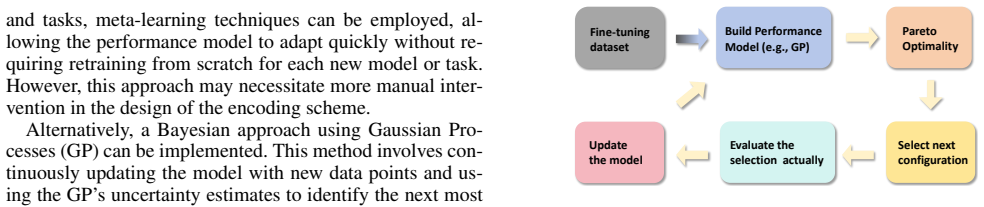
The load-bearing object is the Gaussian-process performance model trained on actual fine-tuning outcomes, used with Pareto optimality to navigate the exponentially large space of per-layer bit-width assignments. Each candidate configuration $q$ is a vector of 4-bit or 8-bit choices across layers; the GP predicts $P(q)$, memory $M(q)$ is computed from the bit-widths, and configurations that no other configuration dominates in both objectives form the Pareto frontier. The objective $q^{*} = \arg\min_{q} (M(q) - \lambda P(q))$ picks one point on that frontier, balancing memory savings against predicted accuracy.
What would settle it
Run the AutoMixQ search with a held-out validation set; if the configuration selected on validation accuracy does not reproduce the reported gains on the test benchmarks, or if uniform 8-bit quantization matches it at equal memory, the central claim of a superior trade-off collapses.
Extended reading notes
Core claim
The central claim is that AutoMixQ, an end-to-end optimization loop, can find per-layer 4/8-bit quantization configurations for a pruned LLM that dominate uniform-precision baselines on the memory-accuracy trade-off. The loop starts with a few randomly configured fine-tuning runs, fits a Gaussian-process model to predict task performance $P(q)$ from the configuration vector $q$, builds the Pareto frontier over predicted performance and measured memory $M(q)$, and fine-tunes the model under the configuration that best fits the objective $M(q) - \lambda P(q)$. Repeating this cycle for about 40 iterations yields configurations that, the paper reports, cut peak memory by roughly a third relative to LoRA and a quarter relative to LoftQ while often improving zero-shot accuracy, such as 66.21% versus 62.45% and 58.96% on BoolQ at 30% pruning of LLaMA-7B.
Load-bearing premise
The framework assumes the benchmark accuracy used to steer the search is a stable and unbiased measure of real performance, because the same test scores choose the configuration and are then reported as the result.
Editorial extensions
If this is right
- At equal or better accuracy, AutoMixQ reports peak memory reductions around 30% versus LoRA and roughly 25% versus LoftQ across LLaMA-7B, LLaMA-13B, and Vicuna-7B.
- Because the search is self-adjusting, the same pipeline can be applied to other pruning methods, models, and tasks without redesigning the quantization scheme.
- Higher pruning rates (up to 50%) still leave AutoMixQ competitive with or ahead of LoRA and LoftQ, so aggressive compression does not erase the benefit of refined quantization.
- The framework deliberately restricts choices to 4-bit and 8-bit, since 2-bit quantization does not reduce memory usage under the LoftQ-style initialization used here.
Reading between the lines
- Beyond the paper: the same GP-guided Pareto loop could be extended to search over LoRA ranks, activation bit-widths, or pruning ratios jointly, since the objective already treats memory and performance as separable costs.
- Beyond the paper: the reported scores come from optimizing on the same benchmark used for the final comparison; a held-out split or repeated seeds would test whether the search is genuinely finding better configurations rather than selecting noise.
- Beyond the paper: if benchmark scores are noisy, a GP that models observation noise explicitly, or an acquisition function that penalizes variance, would make the reported trade-off more trustworthy.
Editorial analysis
A structured set of objections, weighed in public.
Referee Report
Summary. The paper proposes AutoMixQ, a framework that combines structured pruning (LLM-Pruner), LoRA fine-tuning, and mixed-precision layer-wise quantization for LLMs. A Gaussian-process surrogate model guides an iterative search over per-layer 4/8-bit quantization configurations, using Pareto optimality to balance memory and downstream accuracy, with the final configuration selected by a weighted objective (Eq. 5). Experiments on LLaMA-7B, LLaMA-13B, and Vicuna-7B across seven commonsense zero-shot benchmarks report lower peak memory than LoRA and LoftQ and, in many cells, higher accuracy.
Significance. The idea of automatically determining per-layer bit-widths for pruned models during LoRA fine-tuning is practically motivated, and the reported memory reductions are credible because AutoMixQ uses 4-bit layers. The paper includes useful implementation details, ablation studies on initialization and data types, and reproducible software versions. If the accuracy claim were properly validated, the GP-guided Pareto search could be a useful tool for resource-constrained fine-tuning. However, the current evaluation does not support the 'superior performance' half of the central claim because the search is optimized directly on the same benchmark used for reporting, and the paper's own tables contain multiple counterexamples to the claim of consistent outperformance.
major comments (4)
- [Section 3.3, Section 4.2, Table 2] The reported AutoMixQ accuracy is the result of selecting a configuration from up to 50 actual fine-tuning runs, where the selection objective (Eq. 5) is evaluated on the same downstream benchmark later reported in Table 2. The workflow in Section 3.3 and the implementation in Section 4.2 make clear that the GP is trained on P(q) measured on the target benchmark, and the final configuration is chosen from the Pareto front using that same benchmark's performance. There is no held-out validation split and no repeated seeds. Consequently, the reported AutoMixQ scores are effectively the best-of-50 on the test set, while the LoRA and LoftQ baselines are single runs. This selection protocol inflates AutoMixQ's apparent accuracy and invalidates the claim that AutoMixQ 'consistently outperforms' the baselines.
- [Abstract, Section 4.3, Table 2] The claim that AutoMixQ 'consistently outperforms both LoRA and LoftQ' in accuracy is contradicted by the paper's own data. For example, LLaMA-7B at 30% pruning shows AutoMixQ worse than LoRA on HellaSwag (61.14 vs 63.14), ARC-e (58.12 vs 59.22), and OBQA (39.00 vs 39.60); at 20% pruning it is worse on HellaSwag and WinoGrande. Even ignoring the selection artifact, the reported numbers do not support a claim of consistent outperformance. The authors should either soften the claim to match the evidence or provide statistically meaningful comparisons (multiple seeds, error bars) that demonstrate an advantage.
- [Section 3.1, Eq. (5), Section 4.2] The trade-off parameter λ that selects the final configuration from the Pareto front is never specified in the experimental section. Because memory and accuracy of the reported configuration depend directly on λ, the absence of its value makes the main results irreproducible. The paper should state the value(s) of λ used for each benchmark or, better, report the entire Pareto front and how the reported point was chosen.
- [Section 4.2, Table 2] No repeated seeds or variance estimates are reported for any method. On small zero-shot benchmarks such as OBQA (~500 examples) and BoolQ (~3.2k instances), per-seed accuracy differences of several percentage points are common. Without error bars, the observed gaps between AutoMixQ and baselines (some as small as 0.1-0.5 points) cannot be distinguished from noise. A valid comparison requires multiple seeds and reporting mean ± standard deviation, ideally on a held-out test split after model selection on a validation split.
minor comments (5)
- [Section 3.1] The description of the search space as 'a tensor with dimensions L × n^L' is confusing and technically incorrect; the number of possible configurations is n^L, not L × n^L.
- [Section 4.1] There is a typo: 'performes' should be 'performs'.
- [Appendix E] The sample generation results in Figures 3a and 3b are anecdotal; the claim that they demonstrate 'significant superiority' is not supported by any quantitative metric.
- [References] Some references are incomplete, e.g., the 'Meng 2024' citation for PiSSA lists only a first name, and the Alpaca citation lacks a proper author list.
- [Section 2.3, Table 1] The motivating example in Table 1 reports a single random mixed-precision configuration; the paper should clarify whether the performance of that configuration is from one random draw and how representative it is, since the motivating example is used to justify the entire search approach.
Circularity Check
No equation-level circularity: reported results are measured after actual fine-tuning; GP/Pareto search is an internal heuristic.
full rationale
No circularity found. AutoMixQ's headline numbers are empirical measurements: Section 3.3 states that after selecting a configuration from the Pareto frontier, "the model undergoes actual fine-tuning to obtain real performance and memory data," and Table 2 reports those measured zero-shot accuracies and peak memory. The Gaussian-process surrogate is trained by Eq. 6 to approximate the measured P(q), but the GP's predictions are never used as the reported results; they only propose candidate configurations inside the search loop. Eq. 5 is an optimization objective, not a derivation of the final score. There are no self-citations or imported uniqueness theorems; the load-bearing external components (LLM-Pruner, LoftQ, QLoRA's NF4) are cited to independent prior work. The only substantive concern---that the same benchmarks serve as both the search objective and the evaluation set---is a statistical selection/overfitting issue, not a circularity of the kind where a result equals its input by construction, and no equation in the paper exhibits such a reduction.
Assumptions & free parameters
free parameters (3)
- Trade-off parameter lambda in Eq. 5 =
not reported
- GP evaluation budget =
10 initial points + 40 iterations = 50 fine-tuned configurations
- GP kernel and acquisition hyperparameters =
not reported
assumptions (4)
- domain assumption Only 4-bit and 8-bit quantization are considered for each layer; 2-bit is excluded because '2-bit quantization does not reduce memory usage' (Section 4.1).
- domain assumption LLM-Pruner's structured pruning produces a suitable pruned model and is the only pruning method used in the main experiments.
- domain assumption Downstream zero-shot benchmark accuracy is a stable, low-noise objective suitable for guiding the search without a held-out split.
- domain assumption A Gaussian process trained on 50 fine-tuning results can predict performance of unseen quantization configurations well enough for Pareto selection.
Cite this review
Pith. "Pith review of AutoMixQ: Self-Adjusting Quantization for High Performance Memory-Efficient Fine-Tuning." pith.science (2026). https://pith.science/paper/IZWXMWLE
@misc{pith2026241113814,
  author       = {Pith},
  title        = {Pith review of: AutoMixQ: Self-Adjusting Quantization for High Performance Memory-Efficient Fine-Tuning},
  year         = {2026},
  howpublished = {\url{https://pith.science/paper/IZWXMWLE}},
  note         = {Machine review of arXiv:2411.13814}
}
read the original abstract
Fine-tuning large language models (LLMs) under resource constraints is a significant challenge in deep learning. Low-Rank Adaptation (LoRA), pruning, and quantization are all effective methods for improving resource efficiency. However, combining them directly often results in suboptimal performance, especially with uniform quantization across all model layers. This is due to the complex, uneven interlayer relationships introduced by pruning, necessitating more refined quantization strategies. To address this, we propose AutoMixQ, an end-to-end optimization framework that selects optimal quantization configurations for each LLM layer. AutoMixQ leverages lightweight performance models to guide the selection process, significantly reducing time and computational resources compared to exhaustive search methods. By incorporating Pareto optimality, AutoMixQ balances memory usage and performance, approaching the upper bounds of model capability under strict resource constraints. Our experiments on widely used benchmarks show that AutoMixQ reduces memory consumption while achieving superior performance. For example, at a 30\% pruning rate in LLaMA-7B, AutoMixQ achieved 66.21\% on BoolQ compared to 62.45\% for LoRA and 58.96\% for LoftQ, while reducing memory consumption by 35.5\% compared to LoRA and 27.5\% compared to LoftQ.
Figures


Figures from the paper (1 more)

Reference graph
Works this paper leans on
-
[1]
2.Open the project and create a new folder named "ios" in the project folder
Create a new project in Xcode. 2.Open the project and create a new folder named "ios" in the project folder
-
[2]
Create a new folder in the project folder to store your app's assets
Create a new folder in the project folder to store your app's resources. Create a new folder in the project folder to store your app's assets. Create a new folder in the project folder to store your app's resources
- [3]
-
[4]
Add the following code to the file:``` {"name": "MyApp","version": "1.0","author": "Me", "app_name": "... Vicuna-7B with LoRA: Vicuna-7B with LoftQ: 10 steps to build an ios app:
-
[5]
Start by creating a new project in Xcode,
-
[7]
Create a new folder in the project folder to store your app's files… Vicuna-7B with AutoMixQ 10 steps to build an ios app: nobody knows what you are doing
-
[8]
Choose a platform: iOS or Android
-
[9]
Choose a programming language: Swift or Kotlin
Show all 12 references
-
[10]
Design the app: Use design tools like Sketch, Adobe Illustrator, or Xcode to create the app's layout, graphics, and animations
-
[11]
Develop the app: Write the code for the app using the chosen programming language
-
[12]
Figure 3: Sample generation for LLaMA-7B and Vicuna-7B models with a 20% pruning rate
Test the app: Use a testing device or emulator to test the app and make sure it works correctly… (b) Sample generation for the Vicuna-7B model with a 20% pruning rate and a maximum of 128 tokens. Figure 3: Sample generation for LLaMA-7B and Vicuna-7B models with a 20% pruning ...
-
[2021]
Communications of the ACM, 64(9): 99–106
Winogrande: An adversarial winograd schema chal- lenge at scale. Communications of the ACM, 64(9): 99–106. Santacroce, M.; Wen, Z.; Shen, Y .; and Li, Y . 2023. What matters in the structured pruning of generative language models? arXiv preprint arXiv:2302.03773. Sato, S.; Sak...
2023 arXiv
Reviewed August 12, 2026 · model on record in the stance chip above.
Discussion (0). Continue with ORCID to comment.