REVIEW 4 major objections 7 minor 46 references
Heterophilic Graph Neural Networks Optimization with Causal Message-passing
T0 review · 4 major / 7 minor · reviewed 2026-08-12 · deepseek-v4-flash
Pith's one-line read CausalMP claims that the asymmetry of conditional entropy between connected nodes reveals causal, heterophilic edges, and rewiring the graph this way improves link prediction and node classification.
desk verdict CausalMP is a useful graph-rewiring heuristic with real empirical gains, but the causal-structure claim is not supported by the estimator as written; treat it as augmentation, not causal discovery. read the letter →
The pith
A machine-rendered reading of the paper's core claim, the machinery that carries it, and where it could break.
The reading
What carries the argument
The load-bearing object is the cause-effect significance score $\delta_H(i,j)=|H(X_j|X_i)-H(X_i|X_j)|$, the absolute difference of conditional entropies in the two directions of an edge; a large value flags a prominent cause-effect relationship and a high probability of heterophily. It is estimated by Gaussian-noise interventions on node features, Monte Carlo repetition, and kernel density estimation of the embedding distribution. Around this score, CausalMP builds an iterative loop that directs high-$\delta_H$ edges, adds high-mutual-information edges, and optimizes a weighted sum of reconstruction losses on the original and modified graphs plus an embedding-consistency penalty.
What would settle it
Run CausalMP on a synthetic graph where the ground-truth causal directions and heterophily labels are known. Compute $\delta_H$ for all edges and check whether it ranks heterophilic edges above homophilic ones and recovers the true direction. A second decisive test: replace $\delta_H$ with a symmetric score (e.g., $I(X_i;X_j)$) in the identical pipeline; if AUC on heterophilic datasets does not drop, the directional causal claim is unsupported.
Extended reading notes
Core claim
The paper's central claim is that intervention-based causal inference can identify heterophilic message-passing: a node pair whose two conditional entropies differ markedly, $\delta_H(i,j)=|H(X_j|X_i)-H(X_i|X_j)|$ large, is likely to be a causal, heterophilic pair, with the cause being the endpoint that better predicts the other. CausalMP operationalizes this by rescaling node features with Gaussian noise (the intervention), embedding the intervened graphs with an unsupervised GNN, estimating conditional entropies by kernel density estimation, and iteratively pruning and directing edges whose $\delta_H$ exceeds a threshold while adding edges whose mutual information exceeds another. The resulting causal adjacency matrix $A_c$ is trained jointly with the original graph through two encoders with shared weights, a reconstruction loss on each graph, and a consistency penalty that keeps the embeddings of the two structures aligned. The paper argues this aligns the graph topology with true node dependencies, mitigating feature smoothing over heterophilic neighbors.
Load-bearing premise
The claim stands on the idea that the absolute difference between the two conditional entropies of a connected node pair reveals which node causes the other and that this asymmetry marks heterophilic edges; if that signal is not causally informative, the rewiring is just another graph augmentation.
Editorial extensions
If this is right
- If the entropy-asymmetry criterion is valid, heterophilic edges can be identified without labels, since only the node features and the graph are needed.
- The learned causal structure is explicit and task-agnostic, so the same rewired graph can be reused for link prediction, node classification, and potentially other downstream tasks.
- Because the method improves few-shot node classification substantially more than full-label settings, it supplies a practical route for label-scarce heterophilic graphs.
- The consistency penalty keeps the modified topology close to the original embedding space, so gains are attributable to the rewiring rather than to a collapse of representations.
- The approach works on both heterophilic and homophilic graphs, so it is not a heterophily-specific repair but a general message-passing optimizer.
Reading between the lines
- One implicit testable extension is to replace the entropy-asymmetry score with a symmetric dependence measure (e.g., mutual information alone) in the same pipeline; if link prediction gains persist, the causal direction is not the operative ingredient, which would suggest the benefit comes from topology augmentation rather than cause discovery.
- The $\delta_H$ criterion could serve as a standalone, label-free heterophily detector for graph datasets, complementing homophily-ratio statistics that require ground-truth labels.
- The method quantifies cause-effect with conditional entropy of embeddings; in very high-dimensional feature spaces the KDE estimation may become unstable, so a parametric or learned estimator is a natural next step the authors do not explore.
- Because the paper frames the learned structure as causal, a strong out-of-distribution test would be to train on one heterophilic graph and transfer the rewiring rule to another; the invariance assumption (Assumption 3.1) predicts this should generalize better than task-specific rewiring.
Editorial analysis
A structured set of objections, weighed in public.
Referee Report
Summary. The paper proposes CausalMP, a method for heterophilic graph learning that iteratively rewires the input graph based on a claimed causal structure estimated from conditional-entropy asymmetries between connected nodes. The authors formulate the problem in a Bayesian experimental-design framework, define a cause-effect significance score δH (Eq. 11), and use it to orient or prune edges and to add edges via mutual information. They report superior link prediction on nine datasets (Table 1) and consistent but modest node-classification gains when training base models on the learned structure (Table 2). The paper includes ablations of the loss coefficients, the intervention ratio, and the edge-modification components, plus a case study on Texas.
Significance. If the causal interpretation were justified, the paper would offer a novel bridge between causal discovery and heterophilic GNN design, with a potentially generalizable way to detect asymmetric dependencies. The empirical results are reasonably strong: CausalMP outperforms all baselines on link prediction on both homophilic and heterophilic graphs, and the node-classification gains are consistent across six base models, with ablations indicating that both the δH-based rewiring and the MI-based edge addition contribute. The complexity analysis is useful, and the case study provides some evidence that δH is higher on label-heterophilic edges. However, the central conceptual claim—that the method learns an explicit causal structure—is not substantiated, and the theoretical derivation from the Bayesian objective to the δH estimator is asserted rather than derived.
major comments (4)
- [§3.2, Eq. (11), Definition 3.4; §4.1] The causal-identification claim is load-bearing and unsupported. Definition 3.4 defines δH(i,j) as the absolute value |H(X_j|X_i) − H(X_i|X_j)|, yet the text immediately states that 'X_j is a cause of X_i if it is positive inside the absolute-value sign'; the absolute value erases the sign needed to orient an edge. More fundamentally, conditional-entropy asymmetry is not a causal identifiability criterion without additional structural assumptions (e.g., additive noise, non-Gaussianity, or invariance across environments). For independent variables X,Y, δH = |H(X) − H(Y)|, which can be arbitrarily large, so the score conflates dependency with marginal-entropy imbalance rather than isolating cause-effect. Because the pruning and edge-orientation rules in §4.1 rely entirely on this score, the claimed causal structure A_c is not established. I recommend a concrete test on synthetic data with known ground-truth causal directions (e.g., additive-noise models) and on independent variables with unequal entropies, to show whether δH recovers orientation or merely asymmetry.
- [§3.3, Eq. (12)] The analytical justification for linking δH to heterophily is not valid as written. Eq. (12) states H(N_i^-|x_i) + H(x_i|N_i^-) = H(x_i,N_i^+,N_i^-) − H(N_i^+|x_i) − I(x_i,N_i^-). This identity does not follow from standard entropy relations, and H(N_i^+|x_i) is not conditioned on N_i^- as it should be if the joint entropy is to be decomposed consistently. The subsequent claim that the left-hand side becomes larger under heterophily because the joint entropy and H(N_i^+|x_i) 'remain the same' is therefore unsupported. Since this is the only analytical bridge between the δH score and the paper's heterophily criterion, it needs to be either rigorously derived or replaced with a direct empirical characterization.
- [§3.2–§4.1, Propositions 3.2–3.3] The transition from the Bayesian experimental-design objective to the conditional-entropy estimator in Eq. (11) is asserted rather than derived. Proposition 3.2 and 3.3 present an information-gain utility U(B|ξ) and a Monte Carlo approximation in Eq. (10), but the text does not show how maximizing Eq. (10) reduces to computing pairwise differences of conditional entropies. Moreover, the 'intervention' in §4.1 rescales node features with Gaussian noise; this is not a do-type intervention that sets variables or modifies the data-generating mechanism, so it does not identify causal effects in the Pearl sense. The equivalence claimed between the objective and δH therefore remains unsupported and is central to the paper's causal framing.
- [§5.3, Case study] The case study on Texas does not validate the causal interpretation. It shows that δH is larger on label-heterophilic edges than on homophilic edges (δ1 = 0.2434 vs δ0 = 0.1534) and that the number of directed edges modified is mostly on heterophilic edges, but this only demonstrates correlation of δH with label disagreement, not that the identified orientation corresponds to true cause-effect relationships. No ground-truth causal graph is available, and the method's structural modifications are not benchmarked against an oracle or against a non-causal asymmetry heuristic. Without such a comparison, the reported gains in Table 4 could be attributed to generic graph augmentation rather than to causal discovery.
minor comments (7)
- [Abstract] In the abstract, 'the our model' should be 'our model'.
- [Keywords] The keyword 'Heterophiliy' is a typo and should be 'Heterophily'.
- [§4.2, Algorithm 1] The notation 'N_I nodes' is not defined; the algorithm should clarify whether this is the node-intervention ratio r_c or an absolute count.
- [§4.3, Complexity analysis] The simplification 'O(|V|^2+|E|) = O(N^2)' is misleading because |E| can itself be O(N^2); the statement should read O(|V|^2 + |E|) rather than implying equality to O(N^2).
- [Table 2] The column header 'Chameron' should be 'Chameleon'.
- [§5.3, Case study] The sentence 'As first train an unsupervised node embedding network f in CausalMP, we here calculate node dependency metric by Eq.11 on all the edges. We firstly only train the node embedding network f and calculate the node dependency metric by Eq.(11) on all the edges.' is duplicated and should be reduced to a single coherent statement.
- [§5.3, Case study] The lists 'the numbers of edges transferred to directed edges are [6,7,8,4,3]' and '[6,7,8,4,1] of them are heterophilic edges' are inconsistent: the first list has five entries and the second list has five as well, but the last entries (3 vs 1) do not match; the intended numbers should be clarified.
Circularity Check
No significant circularity: the heterophily indicator is empirically validated on labeled edges and downstream link prediction is evaluated on a held-out split, so the central claims do not reduce to their inputs.
full rationale
Definition 3.4 introduces δH(i,j)=|H(X_j|X_i)−H(X_i|X_j)| and asserts that high values indicate cause-effect and heterophily. This is a stipulated estimator, but the paper does not define heterophily in terms of δH; heterophily is defined by the label-based homophily ratio in Section 2. The Texas case study independently checks the estimator against ground-truth edge labels (δ0=0.1534±0.1388 on homophilic edges versus δ1=0.2434±0.1894 on heterophilic edges, with a reported Z-test), so the link between δH and heterophily is an empirical finding that could have failed, not an identity. The directed-edge modification is then used to produce a causal structure A_c, and link prediction is trained on 85% of edges with 5% validation and 10% test, so the reported AUC is not a restatement of the training fit. The self-citations ([3], [26], [32]) appear only in related work or experimental setup and are not load-bearing; the causal-identification justification cites external work ([24], [30]). The theoretical derivation around Eq. (12) contains logical gaps, but those are correctness and rigor concerns, not circularity, because the downstream claims are not assumed as premises. Thresholds and loss coefficients are tuned and reported in ablations rather than being relabeled as predictions. Overall, no step in the derivation chain is equivalent by construction to its input.
Assumptions & free parameters
free parameters (8)
- lambda1 =
not reported
- lambda2 =
not reported
- alpha =
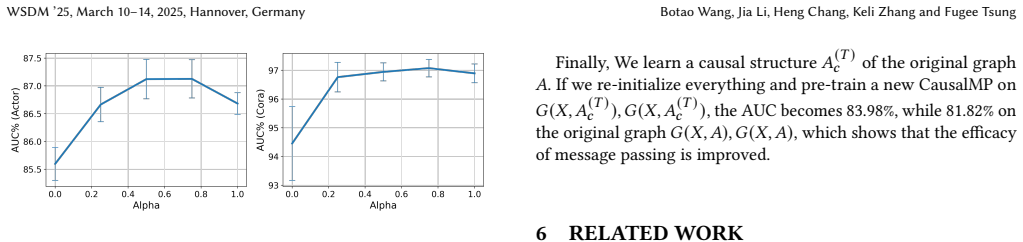
0.5
- beta =
0.05
- r_c =
0.02-0.1
- M =
8
- T =
5
- KDE binning and bandwidth =
not reported
assumptions (5)
- ad hoc to paper Assumption 3.1 (Aggregation Invariant): there exists an optimal parent set S* that satisfies the SEM across all contexts
- standard math Local Markov property
- domain assumption Gaussian noise intervention is sufficient to identify causal connections
- domain assumption Connections are label-dependent with expected heterophilic edge probability E[P_i^+] = 1 - R_h
- domain assumption The lower bound of mutual information between heterophilic node pairs is negatively correlated with P_i^+
invented entities (1)
-
Causal structure A_c
Cite this review
Pith. "Pith review of Heterophilic Graph Neural Networks Optimization with Causal Message-passing." pith.science (2026). https://pith.science/paper/KUTWIVS4
@misc{pith2026241113821,
  author       = {Pith},
  title        = {Pith review of: Heterophilic Graph Neural Networks Optimization with Causal Message-passing},
  year         = {2026},
  howpublished = {\url{https://pith.science/paper/KUTWIVS4}},
  note         = {Machine review of arXiv:2411.13821}
}
read the original abstract
In this work, we discover that causal inference provides a promising approach to capture heterophilic message-passing in Graph Neural Network (GNN). By leveraging cause-effect analysis, we can discern heterophilic edges based on asymmetric node dependency. The learned causal structure offers more accurate relationships among nodes. To reduce the computational complexity, we introduce intervention-based causal inference in graph learning. We first simplify causal analysis on graphs by formulating it as a structural learning model and define the optimization problem within the Bayesian scheme. We then present an analysis of decomposing the optimization target into a consistency penalty and a structure modification based on cause-effect relations. We then estimate this target by conditional entropy and present insights into how conditional entropy quantifies the heterophily. Accordingly, we propose CausalMP, a causal message-passing discovery network for heterophilic graph learning, that iteratively learns the explicit causal structure of input graphs. We conduct extensive experiments in both heterophilic and homophilic graph settings. The result demonstrates that the our model achieves superior link prediction performance. Training on causal structure can also enhance node representation in classification task across different base models.
Figures


Figures from the paper (3 more)


Reference graph
Works this paper leans on
-
[1]
Sami Abu-El-Haija, Bryan Perozzi, Amol Kapoor, Nazanin Alipourfard, Kristina Lerman, Hrayr Harutyunyan, Greg Ver Steeg, and Aram Galstyan. 2019. Mixhop: Higher-order graph convolutional architectures via sparsified neighborhood mixing. In international conference on machine learning . PMLR, 21–29
work page 2019
-
[2]
Beatrice Bevilacqua, Yangze Zhou, and Bruno Ribeiro. 2021. Size-invariant graph representations for graph classification extrapolations. InInternational Conference on Machine Learning. PMLR, 837–851
work page 2021
-
[3]
Heng Chang, Jie Cai, and Jia Li. 2023. Knowledge Graph Completion with Counterfactual Augmentation. In Proceedings of the ACM Web Conference 2023 . 2611–2620
work page 2023
-
[4]
Jiashun Cheng, Man Li, Jia Li, and Fugee Tsung. 2023. Wiener graph deconvo- lutional network improves graph self-supervised learning. In Proceedings of the AAAI conference on artificial intelligence , Vol. 37. 7131–7139
work page 2023
-
[5]
Eli Chien, Jianhao Peng, Pan Li, and Olgica Milenkovic. 2020. Adaptive Universal Generalized PageRank Graph Neural Network. In International Conference on Learning Representations
work page 2020
-
[6]
Leonardo Cotta, Beatrice Bevilacqua, Nesreen Ahmed, and Bruno Ribeiro. 2023. Causal Lifting and Link Prediction. Proceedings of the Royal Society A: Mathemat- ical, Physical and Engineering Sciences 479 (2023), 1–30
work page 2023
-
[7]
Enyan Dai, Shijie Zhou, Zhimeng Guo, and Suhang Wang. 2022. Label-Wise Graph Convolutional Network for Heterophilic Graphs. In Learning on Graphs Conference. PMLR, 1–26
work page 2022
-
[8]
Shaohua Fan, Xiao Wang, Yanhu Mo, Chuan Shi, and Jian Tang. 2022. Debiasing graph neural networks via learning disentangled causal substructure. Advances in Neural Information Processing Systems 35 (2022), 24934–24946
work page 2022
Show all 46 references
-
[9]
Zhichun Guo, William Shiao, Shichang Zhang, Yozen Liu, Nitesh V Chawla, Neil Shah, and Tong Zhao. 2023. Linkless link prediction via relational distillation. In International Conference on Machine Learning . PMLR, 12012–12033
2023
-
[10]
Markus Kalisch and Peter Bühlmann. 2014. Causal structure learning and infer- ence: a selective review. Quality Technology & Quantitative Management 11, 1 (2014), 3–21
2014
-
[11]
Thomas N Kipf and Max Welling. 2016. Variational Graph Auto-Encoders. NIPS Workshop on Bayesian Deep Learning (2016)
2016
-
[12]
Kezhi Kong, Jiuhai Chen, John Kirchenbauer, Renkun Ni, C Bayan Bruss, and Tom Goldstein. 2023. GOAT: A Global Transformer on Large-scale Graphs. In Proceedings of the 40th International Conference on Machine Learning
2023
-
[13]
Runlin Lei, Zhen Wang, Yaliang Li, Bolin Ding, and Zhewei Wei. 2022. Evennet: Ignoring odd-hop neighbors improves robustness of graph neural networks. Advances in Neural Information Processing Systems 35 (2022), 4694–4706
2022
-
[14]
Derek Lim, Felix Hohne, Xiuyu Li, Sijia Linda Huang, Vaishnavi Gupta, Omkar Bhalerao, and Ser Nam Lim. 2021. Large scale learning on non-homophilous graphs: New benchmarks and strong simple methods. Advances in Neural Infor- mation Processing Systems 34 (2021), 20887–20902
2021
-
[15]
Wanyu Lin, Hao Lan, and Baochun Li. 2021. Generative causal explanations for graph neural networks. In International Conference on Machine Learning . PMLR, 6666–6679
2021
-
[16]
Wanyu Lin, Hao Lan, Hao Wang, and Baochun Li. 2022. Orphicx: A causality- inspired latent variable model for interpreting graph neural networks. In Pro- ceedings of the IEEE/CVF Conference on Computer Vision and Pattern Recognition . 13729–13738
2022
-
[17]
Yixin Liu, Yizhen Zheng, Daokun Zhang, Vincent CS Lee, and Shirui Pan. 2023. Beyond smoothing: Unsupervised graph representation learning with edge het- erophily discriminating. In Proceedings of the AAAI conference on artificial intelli- gence, Vol. 37. 4516–4524
2023
-
[18]
Sitao Luan, Chenqing Hua, Qincheng Lu, Jiaqi Zhu, Mingde Zhao, Shuyuan Zhang, Xiao-Wen Chang, and Doina Precup. 2022. Revisiting heterophily for graph neural networks. Advances in neural information processing systems 35 (2022), 1362–1375
2022
-
[19]
Costas Mavromatis and George Karypis. 2021. Graph InfoClust: Maximizing Coarse-Grain Mutual Information in Graphs. In 25th Pacific-Asia Conference on Knowledge Discovery and Data Mining, PAKDD 2021 . Springer Science and Business Media Deutschland GmbH, 541–553
2021
-
[20]
Hesham Mostafa, Marcel Nassar, and Somdeb Majumdar. 2021. On local aggrega- tion in heterophilic graphs. arXiv preprint arXiv:2106.03213 (2021)
2021 arXiv
-
[21]
Judea Pearl. 2009. Causality. Cambridge university press
2009
-
[22]
Judea Pearl. 2010. Causal inference. Causality: objectives and assessment (2010), 39–58
2010
-
[23]
Jean-Philippe Pellet and André Elisseeff. 2008. Using markov blankets for causal structure learning. Journal of Machine Learning Research 9, 7 (2008)
2008
-
[24]
Jonas Peters, Peter Bühlmann, and Nicolai Meinshausen. 2016. Causal inference by using invariant prediction: identification and confidence intervals. Journal of the Royal Statistical Society. Series B (Statistical Methodology) (2016), 947–1012
2016
-
[25]
Mingchen Sun, Kaixiong Zhou, Xin He, Ying Wang, and Xin Wang. 2022. Gppt: Graph pre-training and prompt tuning to generalize graph neural networks. In Proceedings of the 28th ACM SIGKDD Conference on Knowledge Discovery and Data Mining. 1717–1727
2022
-
[26]
Xiangguo Sun, Hong Cheng, Jia Li, Bo Liu, and Jihong Guan. 2023. All in One: Multi-Task Prompting for Graph Neural Networks. InProceedings of the 26th ACM SIGKDD international conference on knowledge discovery & data mining (KDD’23) (Long Beach, CA, USA). 2120–2131. https://do...
2023
-
[27]
Xiangguo Sun, Jiawen Zhang, Xixi Wu, Hong Cheng, Yun Xiong, and Jia Li. 2023. Graph Prompt Learning: A Comprehensive Survey and Beyond. arXiv:2311.16534 (2023). arXiv:2311.16534
2023 arXiv
-
[28]
Mark J van der Laan. 2010. Targeted maximum likelihood based causal inference: Part I. The international journal of biostatistics 6, 2 (2010)
2010
-
[29]
Petar Velickovic, Guillem Cucurull, Arantxa Casanova, Adriana Romero, Pietro Lio, Yoshua Bengio, et al. 2017. Graph attention networks. stat 1050, 20 (2017), 10–48550
2017
-
[30]
Julius von Kügelgen, Paul K Rubenstein, Bernhard Schölkopf, and Adrian Weller
-
[31]
Minh Vu and My T Thai. 2020. Pgm-explainer: Probabilistic graphical model explanations for graph neural networks.Advances in neural information processing systems 33 (2020), 12225–12235
2020
-
[32]
Botao WANG, Jia Li, Yang Liu, Jiashun Cheng, Yu Rong, Wenjia Wang, and Fugee Tsung. 2023. Deep Insights into Noisy Pseudo Labeling on Graph Data. In Thirty-seventh Conference on Neural Information Processing Systems . https: //openreview.net/forum?id=XhNlBvb4XV
2023
-
[33]
Yuelin Wang, Kai Yi, Xinliang Liu, Yu Guang Wang, and Shi Jin. 2022. ACMP: Allen-cahn message passing with attractive and repulsive forces for graph neural networks. In The Eleventh International Conference on Learning Representations
2022
-
[34]
Ying-Xin Wu, Xiang Wang, An Zhang, Xiangnan He, and Tat-Seng Chua. 2022. Discovering invariant rationales for graph neural networks. arXiv preprint arXiv:2201.12872 (2022)
2022 arXiv
-
[35]
Jun Xia, Lirong Wu, Jintao Chen, Bozhen Hu, and Stan Z Li. 2022. Simgrace: A simple framework for graph contrastive learning without data augmentation. In Proceedings of the ACM Web Conference 2022 . 1070–1079
2022
-
[36]
Yujun Yan, Milad Hashemi, Kevin Swersky, Yaoqing Yang, and Danai Koutra
-
[37]
Liuyi Yao, Zhixuan Chu, Sheng Li, Yaliang Li, Jing Gao, and Aidong Zhang. 2021. A survey on causal inference. ACM Transactions on Knowledge Discovery from Data (TKDD) 15, 5 (2021), 1–46
2021
-
[38]
Hengrui Zhang, Qitian Wu, Junchi Yan, David Wipf, and S Yu Philip. 2021. From canonical correlation analysis to self-supervised graph neural networks. InThirty- Fifth Conference on Neural Information Processing Systems
2021
-
[39]
Tong Zhao, Gang Liu, Daheng Wang, Wenhao Yu, and Meng Jiang. 2022. Learning from Counterfactual Links for Link Prediction. In International Conference on Machine Learning. PMLR, 26911–26926
2022
-
[40]
Yizhen Zheng, He Zhang, Vincent Lee, Yu Zheng, Xiao Wang, and Shirui Pan. 2023. Finding the Missing-half: Graph Complementary Learning for Homophily-prone and Heterophily-prone Graphs. Proceedings of the 40th International Conference on Machine Learning (2023)
2023
-
[41]
Shijie Zhou, Zhimeng Guo, Charu Aggarwal, Xiang Zhang, and Suhang Wang
-
[42]
Zhengyang Zhou, Gengyu Lin, Kuo Yang, LEI BAI, Yang Wang, et al. 2022. GReTo: Remedying dynamic graph topology-task discordance via target homophily. In The Eleventh International Conference on Learning Representations
2022
-
[43]
Jiong Zhu, Yujun Yan, Lingxiao Zhao, Mark Heimann, Leman Akoglu, and Danai Koutra. 2020. Beyond homophily in graph neural networks: Current limitations and effective designs. Advances in neural information processing systems 33 (2020), 7793–7804. A DETAILS ON EXPERIMENT We con...
2020
-
[44]
arXiv preprint arXiv:2208.01820 (2022)
Link Prediction on Heterophilic Graphs via Disentangled Representation Learning. arXiv preprint arXiv:2208.01820 (2022)
2022 arXiv
-
[2019]
Optimal experimental design via Bayesian optimization: active causal structure learning for Gaussian process networks.arXiv preprint arXiv:1910.03962 (2019)
2019 arXiv
-
[2022]
In 2022 IEEE International Conference on Data Mining (ICDM)
Two sides of the same coin: Heterophily and oversmoothing in graph convolutional neural networks. In 2022 IEEE International Conference on Data Mining (ICDM). IEEE, 1287–1292
2022
Reviewed August 12, 2026 · model on record in the stance chip above.
Discussion (0). Continue with ORCID to comment.