REVIEW 4 major objections 6 minor 48 references
Arm Robot: AR-Enhanced Embodied Control and Visualization for Intuitive Robot Arm Manipulation
T0 review · 4 major / 6 minor · reviewed 2026-08-12 · deepseek-v4-flash
Pith's one-line read Arm Robot claims that seeing the robot's next pose in AR and adjusting the hand-to-robot mapping helps users bridge the speed and reach gaps between humans and robot arms.
desk verdict A genuine HCI systems contribution whose user-study findings are worth refereeing; the AR tracking-drift risk is real but does not sink the qualitative core. read the letter →
The pith
A machine-rendered reading of the paper's core claim, the machinery that carries it, and where it could break.
The reading
What carries the argument
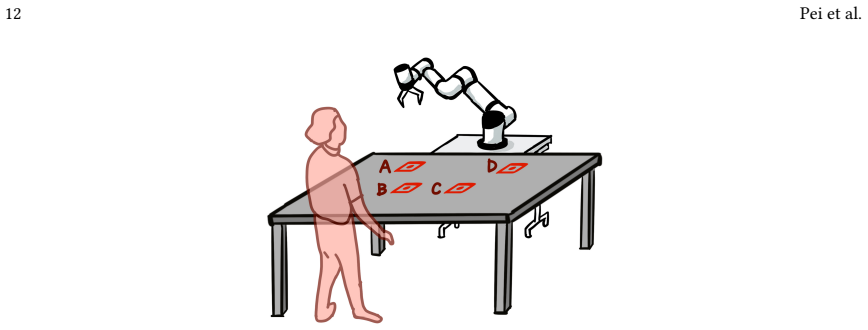
The carrying mechanism is a perception-action loop in which the user's command passes through an adjustable hand-to-gripper mapping and then through an inverse-kinematics solver that produces the same joint angles for both the virtual and physical robots. The virtual robot is the loop's feedback device: because it renders the target pose instantly while the physical robot lags, it turns the temporal discrepancy into a visible gap the user can close. The three mapping adjustments are the action-space controls: Freeze/Unfreeze is a pinchable line between wrist and gripper whose color signals control on or off; Scale is a two-hand resizable disk whose radius sets the motion ratio; Mirror is a pair of arrows on the disk whose 180-degree flip reverses motion on one axis. The empirical load is carried by the zero-delay preview, which participants used conditionally and strategically.
What would settle it
A direct check is to run the same pick-and-place task with users who squat, walk, and change viewpoints, then measure whether the zero-delay virtual robot's predicted grasp point drifts relative to the physical gripper; if drift of the magnitude P6 reported occurs regularly, the central claim that the preview reliably resolves temporal and spatial discrepancy fails for mobile users. A simpler version is to have users align the virtual and physical grippers after each position change and record the alignment error.
Extended reading notes
Core claim
The central claim is that human-robot discrepancies, not the lack of an intuitive body metaphor, are the main barrier to embodied robot arm control, and that AR feedback plus adjustable spatial mapping removes that barrier. Concretely, Arm Robot superposes a translucent virtual copy of the robot, with no delay, exactly on the physical robot; because both share the same inverse-kinematics solution, the user sees where the arm is heading before the real arm arrives, and the virtual copy turns orange when the requested pose is impossible. The Freeze/Unfreeze line pauses and resumes the mapping so users can move, reposition, and inspect from new angles; the Scale disk multiplies or divides hand motion relative to gripper motion; and the Mirror arrows reverse motion on one axis. The paper's evidence is a mixed-method study: all 18 participants used Freeze/Unfreeze, 17 of 18 considered the digital robot useful, 15 of 18 found Scale useful, and 12 of 18 preferred the freehand version over the controller version even though the controller was significantly faster in rotation and rated higher for ease of learning, comfort, and efficiency. The authors conclude that predictive path visualization and user-editable spatial mapping should be standard components of embodied teleoperation systems.
Load-bearing premise
The load-bearing premise is that the headset's hand tracking and the calibrated coordinate alignment between the virtual and physical robot stay accurate while the user moves; participant P6's report of accumulated drift after squatting and walking shows what happens when that premise fails.
Editorial extensions
If this is right
- If the claim is right, co-located embodied teleoperation should include a predictive display: users need to see the robot's target pose with zero delay, not just a delayed video or a command queue.
- Freeze/Unfreeze should be treated as a core safety and reach-extension control, since every participant used it to pause the robot, change viewing angle, or reposition before resuming.
- Scale and Mirror are not universal preferences but context-dependent tools: users scale up for speed and visibility, scale down for precision, and a minority naturally prefer mirrored motion.
- Embodied freehand control can be preferred over a faster, more comfortable controller, so evaluation metrics that only measure completion time and comfort will miss why users choose an interface.
- Designers should consider dynamic or quick-toggle scaling, since several participants independently requested scaling up for translation and down for grasping.
Reading between the lines
- My inference: the success of the zero-delay preview implies that its value grows with the physical robot's latency; on a faster or less laggy arm, the same visualization would be less necessary, so the feature should be evaluated at multiple latency levels.
- My inference: the reported drift failure after squatting and walking suggests that the system's core promise is conditional on tracking robustness; a testable extension would add periodic recalibration or use both controller and hand tracking as cross-checks.
- My inference: the finding that participants developed conditional attention strategies, using the preview for translation and the physical arm for precise grasping, points toward adaptive visualization that fades or brightens depending on task phase rather than a static overlay.
- My inference: the mirror-mode preference correlating with trackpad scrolling direction hints that user-specific mapping defaults could be learned from a short calibration instead of being chosen universally.
Editorial analysis
A structured set of objections, weighed in public.
Referee Report
Summary. The paper presents Arm Robot, an AR-based teleoperation system for a 6-DOF robot arm that combines embodied control (freehand or controller) with AR visualizations (a zero-delay virtual robot and a virtual gripper overlay) and adjustable spatial mappings (Freeze/Unfreeze, Scale, Mirror). The system aims to help users cope with human-robot discrepancies in range of motion and response latency. The authors report an iterative design process with pilot studies and a main mixed-method user study (N=18) in which participants completed timed cube translation and rotation tasks plus exploratory daily-object tasks, with completion times, Likert ratings, and semi-structured interviews collected. Main findings are that all participants considered Freeze/Unfreeze necessary, 15/18 found Scale useful, 17/18 regarded the zero-delay virtual robot as useful, and 12/18 preferred the freehand version despite the controller version being faster and rated more comfortable on several metrics.
Significance. If the results hold, Arm Robot is a useful contribution to embodied teleoperation, offering concrete, adjustable interaction techniques that novice users can adopt. The iterative design, pilot testing, and mixed-method evaluation are genuine strengths, and the interview data provide rich qualitative insights into how users reason about embodiment and AR feedback. The paper does not provide reproducible code or quantitative models; its value lies in the system design and the user study findings. However, the absence of a non-AR baseline, unadjusted multiple comparisons, and an unquantified tracking-drift failure weaken the quantitative support, so the contribution is better characterized as an exploratory feasibility demonstration than as a causal validation of AR-specific benefits.
major comments (4)
- [5.2, 7.2, 7.3.1] The system's accuracy depends on the AR headset's world-locking transform, which is established only once at startup by having the user stand on a floor marker and face the Y+ axis (Section 5.2). Section 7.2 reports that participant P6, after squatting and walking frequently, experienced accumulated tracking error that shifted the robot visualization's location and made the predictive path unreliable, while Section 7.3.1 reports that all participants used Freeze/Unfreeze to walk around and change viewing angles. The paper provides no quantitative tracking-error data and no re-anchoring mechanism, and this failure mode is not addressed in the Discussion. Because every interaction is computed from the tracked hand pose and the assumed fixed transform, this is a load-bearing reliability concern for the central claim that AR visualization and spatial mapping help users; the authors should either add quantitative drift measurement under locomotion, implement a re-anchoring procedure, or explicitly temper the claim and discuss the limitation.
- [7.1] The quantitative comparisons between the freehand and controller-based Arm Robot rely on paired one-tailed t-tests applied separately to completion times and to each of six Likert items, without correction for multiple comparisons (Section 7.1, with p-values reported for ease of learning, comfort, efficiency, and rotation time). With N=18, the reported significant differences are presented without effect sizes or confidence intervals. The one-tailed direction is not justified by a pre-registered hypothesis, and the multiple-comparison issue makes the significance claims exploratory. The paper should either apply a correction (e.g., Holm-Bonferroni) or explicitly present these as exploratory findings, and should report effect sizes or confidence intervals for the comparisons in Figure 8 and Figure 9.
- [6.3, 7] The claim that Arm Robot "helps users tackle human-robot discrepancies" is not supported by a baseline condition without AR visualization or without the adjustable spatial mapping. All study conditions included the zero-delay virtual robot, the virtual gripper overlay, Freeze/Unfreeze, Scale, and Mirror, so the observed usability and satisfaction cannot be causally attributed to these AR features. A comparison with a non-AR or standard controller teleoperation condition would substantiate the central claim; alternatively, the paper should frame the contribution as a feasibility study and soften the causal language in the abstract and conclusion.
- [6.4, 7.3] The paper states in Section 6.4 that the authors "logged their adjustment of spatial correlation in embodiment" during the exploration tasks, but no log data are reported in the Results. All evidence on feature use is based on self-report or researcher observation. Reporting objective usage logs (e.g., frequency, duration, and timing of Freeze/Unfreeze, Scale adjustments, and Mirror toggles) would strengthen the findings and would allow verification of strong statements such as "All users reported that the ability to Freeze/Unfreeze was necessary" (Section 7.3.1).
minor comments (6)
- [Throughout] There are many typos and informal phrasings, e.g., "the the HCI challenges" (Section 1), "botton's side up" (Section 7.4.2), "wasthe" (Section 8), and "as shwon" (Section 7.5). The paper would benefit from a careful proofreading pass.
- [Figure 8] Figure 8 reports success rate, but the text does not define or discuss this measure. Please clarify how success rate was computed and summarize the results in the text.
- [Figure 9] Figure 9 marks statistically significant differences with asterisks but does not show the corresponding p-values or indicate which test was used. Adding the exact p-values and a note on the multiple-comparison issue would help the reader.
- [6.3.1] The timing procedure says participants counted down from three when the gripper was about one inch above the cube, then the experimenter started timing. This manual procedure could introduce inconsistency; please describe whether the study coordinator also timed independently and how the final measurement was determined.
- [2.1] The statement "The bases of virtual and physical robots always align" is contradicted by the P6 drift report in Section 7.2. Please qualify this claim.
- [8] The Discussion makes prescriptive recommendations (e.g., "future designers should incorporate a predictive path model") that go beyond what the data can support. These could be reframed as tentative design implications given the exploratory nature of the study.
Circularity Check
No circularity found; the paper's claims rest on a user study and iterative design, not on a derivation that reduces to its inputs.
full rationale
Arm Robot is a systems/HCI paper: it proposes AR interaction techniques and evaluates them in a user study (N=18) against real tabletop tasks. There is no formal derivation, fitted model, or predictive equation whose output is defined by its input. The interaction features (Freeze/Unfreeze, Scale, Mirror, zero-delay robot visualization) were motivated by prior literature and refined through low-, mid-, and high-fidelity pilot iterations (Sec. 3), then assessed by external participants with quantitative completion times, Likert ratings, and semi-structured interviews (Secs. 6-7). Self-citations to the authors' prior XR work (Refs. [23], [24]) appear only as related-work context and are not load-bearing for the central claims. The paper also candidly reports a limitation: P6 experienced accumulated head-tracking error after squatting and walking, shifting the robot visualization (Sec. 7.2). That is an honest negative data point and a reliability concern, not circularity; the absence of quantitative tracking-error measurements affects evidence strength, but does not make any claim equivalent to its own input. No quoted equation or construction step shows a prediction forced by a fit or by self-citation. Therefore the appropriate finding is no significant circularity (score 0).
Assumptions & free parameters
free parameters (4)
- Scale range (0.5x to 2x) =
0.5 to 2.0
- Virtual robot transparency =
20% opacity
- Gripper rotation offset =
20 degrees
- BioIK solver parameters =
3 generations/frame, 120 solutions, smoothing 0.5
assumptions (5)
- domain assumption Embodied interaction makes robot control more intuitive for non-technical users than conventional programming
- domain assumption A zero-delay virtual robot is a valid preview of the physical robot's intended motion
- domain assumption The AR coordinate calibration stays valid during user movement
- domain assumption The perception-action cycle model describes teleoperation behavior
- domain assumption BioIK returns valid inverse kinematics solutions for all reachable target poses
Cite this review
Pith. "Pith review of Arm Robot: AR-Enhanced Embodied Control and Visualization for Intuitive Robot Arm Manipulation." pith.science (2026). https://pith.science/paper/7YNVUDFU
@misc{pith2026241113851,
  author       = {Pith},
  title        = {Pith review of: Arm Robot: AR-Enhanced Embodied Control and Visualization for Intuitive Robot Arm Manipulation},
  year         = {2026},
  howpublished = {\url{https://pith.science/paper/7YNVUDFU}},
  note         = {Machine review of arXiv:2411.13851}
}
read the original abstract
Embodied interaction has been introduced to human-robot interaction (HRI) as a type of teleoperation, in which users control robot arms with bodily action via handheld controllers or haptic gloves. Embodied teleoperation has made robot control intuitive to non-technical users, but differences between humans' and robots' capabilities \eg ranges of motion and response time, remain challenging. In response, we present Arm Robot, an embodied robot arm teleoperation system that helps users tackle human-robot discrepancies. Specifically, Arm Robot (1) includes AR visualization as real-time feedback on temporal and spatial discrepancies, and (2) allows users to change observing perspectives and expand action space. We conducted a user study (N=18) to investigate the usability of the Arm Robot and learn how users perceive the embodiment. Our results show users could use Arm Robot's features to effectively control the robot arm, providing insights for continued work in embodied HRI.
Figures


Figures from the paper (6 more)



Reference graph
Works this paper leans on
-
[2]
Alissa N Antle, Paul Marshall, and Elise van den Hoven. 2011. Embodied Interaction: Theory and Practice in HCI. In Proc. CHI, Vol. 11. https: //doi.org/10.1145/1979742.1979592
arXiv 2011
-
[3]
Sridhar Pandian Arunachalam, Irmak Güzey, Soumith Chintala, and Lerrel Pinto. 2022. Holo-Dex: Teaching Dexterity With Immersive Mixed Reality. http://arxiv.org/abs/2210.06463 arXiv:2210.06463 [cs]
arXiv 2022
-
[4]
Daniel Bambuˆsek, Zdeněk Materna, Michal Kapinus, Vítězslav Beran, and Pavel Smrž. 2019. Combining Interactive Spatial Augmented Reality With Head-Mounted Display for End-User Collaborative Robot Programming. In 2019 28th IEEE International Conference on Robot and Human Interactive Communication (RO-MAN). 1–8. https://doi.org/10.1109/RO-MAN46459.2019.8956...
arXiv 2019
-
[5]
Claire Blackett, Alexandra Fernandes, Espen Teigen, and Thomas Thoresen. 2022. Effects of Signal Latency on Human Performance in Teleoperations. In Human Interaction, Emerging Technologies and Future Systems V , Tareq Ahram and Redha Taiar (Eds.). Springer International Publishing, Cham, 386–393. https://doi.org/10.1007/978-3-030-85540-_50
-
[6]
Maxime Cordeil, Benjamin Bach, Andrew Cunningham, Bastian Montoya, Ross T. Smith, Bruce H. Thomas, and Tim Dwyer. 2020. Embodied Axes: Tangible, Actuated Interaction for 3D Augmented Reality Data Spaces. In Proceedings of the 2020 CHI Conference on Human Factors in Computing Systems. ACM, Honolulu HI USA, 1–12. https://doi.org/10.1145/3313831.3376613
arXiv 2020
-
[7]
Vassilis Cutsuridis, Amir Hussain, and John G Taylor. 2011. Perception-action cycle: Models, architectures, and hardware . Springer Science & Business Media
work page 2011
-
[8]
Lipton, Lindsay Sanneman, Aidan J
Joseph DelPreto, Jeffrey I. Lipton, Lindsay Sanneman, Aidan J. Fay, Christopher Fourie, Changhyun Choi, and Daniela Rus. 2020. Helping Robots Learn: A Human-Robot Master-Apprentice Model Using Demonstrations via Virtual Reality Teleoperation. In 2020 IEEE International Conference on Robotics and Automation (ICRA) . 10226–10233. https://doi.org/10.1109/ICR...
arXiv 2020
-
[9]
Jose Enrique Domínguez-Vidal, Nicolas Rodriguez, Rene Alquezar, and Alberto Sanfeliu. 2022. Perception-Intention-Action Cycle in Human-Robot Collaborative Tasks. arXiv preprint arXiv:2206.00304 (2022)
work page Pith review arXiv 2022
Show all 48 references
-
[10]
Paul Dourish. 2001. Where the Action Is: The Foundations of Embodied Interaction . MIT Press. Google-Books-ID: DCIy2zxrCqcC. Manuscript submitted to ACM 22 Pei et al
2001
-
[11]
Jiafei Duan, Yi Ru Wang, Mohit Shridhar, Dieter Fox, and Ranjay Krishna. 2023. AR2-D2:Training a Robot Without a Robot. http://arxiv.org/abs/ 2306.13818 arXiv:2306.13818 [cs]
2023 arXiv
-
[12]
Henrikke Dybvik, Martin Løland, Achim Gerstenberg, Kristoffer Bjørnerud Slåttsveen, and Martin Steinert. 2021. A Low-Cost Predictive Display for Teleoperation: Investigating Effects on Human Performance and Workload. International Journal of Human-Computer Studies 145 (2021), ...
2021
-
[13]
Tiare Feuchtner and Jörg Müller. 2017. Extending the Body for Interaction With Reality. In Proceedings of the 2017 CHI Conference on Human Factors in Computing Systems. ACM, Denver Colorado USA, 5145–5157. https://doi.org/10.1145/3025453.3025689
2017
-
[14]
Lars Fritsche, Felix Unverzag, Jan Peters, and Roberto Calandra. 2015. First-Person Tele-Operation of a Humanoid Robot. In 2015 IEEE-RAS 15th International Conference on Humanoid Robots (Humanoids) . 997–1002. https://doi.org/10.1109/HUMANOIDS.2015.7363475
2015
-
[15]
Sanket Gaurav, Zainab Al-Qurashi, Amey Barapatre, George Maratos, Tejas Sarma, and Brian D. Ziebart. 2019. Deep Correspondence Learning for Effective Robotic Teleoperation Using Virtual Reality. In 2019 IEEE-RAS 19th International Conference on Humanoid Robots (Humanoids) . 47...
2019
-
[16]
Karst T Geurs and Bert Van Wee. 2004. Accessibility evaluation of land-use and transport strategies: review and research directions. Journal of Transport geography 12, 2 (2004), 127–140
2004
-
[17]
Tero Kaarlela, Paulo Padrao, Tomi Pitkäaho, Sakari Pieskä, and Leonardo Bobadilla. 2022. Digital twins utilizing XR-technology as robotic training tools. Machines 11, 1 (2022), 13
2022
-
[18]
Chaowanan Khundam, Varunyu Vorachart, Patibut Preeyawongsakul, Witthaya Hosap, and Frédéric Noël. 2021. A comparative study of interaction time and usability of using controllers and hand tracking in virtual reality training. In Informatics, Vol. 8. MDPI, 60
2021
-
[19]
2017.3D User Interfaces: Theory and Practice
Joseph J LaViola Jr, Ernst Kruijff, Ryan P McMahan, Doug Bowman, and Ivan P Poupyrev. 2017.3D User Interfaces: Theory and Practice. Addison-Wesley Professional
2017
-
[20]
Shuang Li, Jiaxi Jiang, Philipp Ruppel, Hongzhuo Liang, Xiaojian Ma, Norman Hendrich, Fuchun Sun, and Jianwei Zhang. 2020. A Mobile Robot Hand-Arm Teleoperation System by Vision and IMU. In2020 IEEE/RSJ International Conference on Intelligent Robots and Systems (IROS) . 10900–...
2020
-
[21]
Mitchell J. H. Lum, Jacob Rosen, Hawkeye King, Diana C. W. Friedman, Thomas S. Lendvay, Andrew S. Wright, Mika N. Sinanan, and Blake Hannaford. 2009. Teleoperation in Surgical Robotics-Network Latency Effects on Surgical Performance. Annual International Conference of the IEEE...
2009
-
[22]
Elias Matsas and George-Christopher Vosniakos. 2017. Design of a Virtual Reality Training System for Human–robot Collaboration in Manufacturing Tasks. International Journal on Interactive Design and Manufacturing (IJIDeM) 11, 2 (2017), 139–153. https://doi.org/10.1007/s12008-0...
2017 doi
-
[23]
Siyou Pei, Alexander Chen, Chen Chen, Franklin Mingzhe Li, Megan Fozzard, Hao-Yun Chi, Nadir Weibel, Patrick Carrington, and Yang Zhang
-
[24]
Siyou Pei, Alexander Chen, Jaewook Lee, and Yang Zhang. 2022. Hand Interfaces: Using Hands to Imitate Objects in AR/VR for Expressive Interactions. In CHI Conference on Human Factors in Computing Systems . ACM, New Orleans LA USA, 1–16. https://doi.org/10.1145/3491102.3501898
2022
-
[25]
Lee, and Mark Billinghurst
Thammathip Piumsomboon, Gun A. Lee, and Mark Billinghurst. 2018. Snow Dome: A Multi-Scale Interaction in Mixed Reality Remote Collaboration. In Extended Abstracts of the 2018 CHI Conference on Human Factors in Computing Systems (CHI EA ’18) . Association for Computing Machiner...
2018
-
[26]
Lee, Jonathon D
Thammathip Piumsomboon, Gun A. Lee, Jonathon D. Hart, Barrett Ens, Robert W. Lindeman, Bruce H. Thomas, and Mark Billinghurst. 2018. Mini-Me: An Adaptive Avatar for Mixed Reality Remote Collaboration. In Proceedings of the 2018 CHI Conference on Human Factors in Computing Syst...
2018
-
[27]
Felix Johan Pot, Bert van Wee, and Taede Tillema. 2021. Perceived accessibility: What it is and why it differs from calculated accessibility measures based on spatial data. Journal of Transport Geography 94 (2021), 103090
2021
-
[28]
Yuzhe Qin, Wei Yang, Binghao Huang, Karl Van Wyk, Hao Su, Xiaolong Wang, Yu-Wei Chao, and Dieter Fox. 2023. AnyTeleop: A General Vision-Based Dexterous Robot Arm-Hand Teleoperation System. http://arxiv.org/abs/2307.04577 arXiv:2307.04577 [cs]
2023 arXiv
-
[29]
Radalytica. 2020. Precise Real-Time Universal Robot Control Using 3D Move - Pouring a Water. https://www.youtube.com/watch?v=3C3JtE3glnk
2020
-
[30]
Hanna-Riikka Rantamaa, Jari Kangas, Sriram Kishore Kumar, Helena Mehtonen, Jorma Järnstedt, and Roope Raisamo. 2023. Comparison of a vr stylus with a controller, hand tracking, and a mouse for object manipulation and medical marking tasks in virtual reality. Applied Sciences 1...
2023
-
[31]
Universal Robot. 2024. Collaborative robotic automation | Cobots from Universal Robots. https://www.universal-robots.com/,https://www.universal- robots.com/products/ur5-robot/
2024
-
[32]
Franka Robotics. 2024. Franka Emika Robot Specifications. https://franka.de/research
2024
-
[33]
Nordbo Robotics. 2022. Mimic With IR Tracker: Demonstration | Nordbo Robotics. https://www.youtube.com/watch?v=WqaS1p9BVHA
2022
-
[34]
Jonas Schjerlund, Kasper Hornbæk, and Joanna Bergström. 2021. Ninja Hands: Using Many Hands to Improve Target Selection in VR. In Proceedings of the 2021 CHI Conference on Human Factors in Computing Systems . ACM, Yokohama Japan, 1–14. https://doi.org/10.1145/3411764.3445759
2021
-
[35]
Andrew B Schwartz. 2016. Movement: how the brain communicates with the world. Cell 164, 6 (2016), 1122–1135. Manuscript submitted to ACM Arm Robot: AR-Enhanced Embodied Control and Visualization for Intuitive Robot Arm Manipulation 23
2016
- [36]
-
[37]
Inês Soares, Marcelo Petry, and António Paulo Moreira. 2021. Programming Robots by Demonstration Using Augmented Reality. Sensors 21, 17 (2021), 5976. https://doi.org/10.3390/s21175976
2021 doi
-
[38]
Maurício Sousa, Rafael Kufner dos Anjos, Daniel Mendes, Mark Billinghurst, and Joaquim Jorge. 2019. Warping Deixis: Distorting Gestures to Enhance Collaboration. In Proceedings of the 2019 CHI Conference on Human Factors in Computing Systems . 1–12. https://doi.org/10.1145/329...
2019
-
[39]
Sebastian Starke, Norman Hendrich, Dennis Krupke, and Jianwei Zhang. 2017. Evolutionary Multi-Objective Inverse Kinematics on Highly Articulated and Humanoid Robots. In 2017 IEEE/RSJ International Conference on Intelligent Robots and Systems (IROS) . IEEE, IEEE, 6959–6966. htt...
2017
-
[40]
Sebastian Starke, Norman Hendrich, Sven Magg, and Jianwei Zhang. 2016. An Efficient Hybridization of Genetic Algorithms and Particle Swarm Optimization for Inverse Kinematics. In 2016 IEEE International Conference on Robotics and Biomimetics (ROBIO) . IEEE, IEEE, 1782–1789. ht...
2016 doi
-
[41]
Yun-Peng Su, Xiao-Qi Chen, Tony Zhou, Christopher Pretty, and Geoffrey Chase. 2022. Mixed-Reality-Enhanced Human–Robot Interaction With an Imitation-Based Mapping Approach for Intuitive Teleoperation of a Robotic Arm-Hand System. Applied Sciences 12, 9 (2022), 4740. https://do...
2022 doi
-
[42]
Ryo Suzuki, Adnan Karim, Tian Xia, Hooman Hedayati, and Nicolai Marquardt. 2022. Augmented Reality and Robotics: A Survey and Taxonomy for AR-Enhanced Human-Robot Interaction and Robotic Interfaces. In CHI Conference on Human Factors in Computing Systems . ACM, New Orleans LA ...
2022
-
[43]
Yujie Tao, Cheng Yao Wang, Andrew D Wilson, Eyal Ofek, and Mar Gonzalez-Franco. 2023. Embodying Physics-Aware Avatars in Virtual Reality. In Proceedings of the 2023 CHI Conference on Human Factors in Computing Systems (CHI ’23) . Association for Computing Machinery, New York, ...
2023
-
[44]
Theodoros Togias, Christos Gkournelos, Panagiotis Angelakis, George Michalos, and Sotiris Makris. 2021. Virtual Reality Environment for Industrial Robot Control and Path Design. Procedia CIRP 100 (2021), 133–138. https://doi.org/10.1016/j.procir.2021.05.021
2021 doi
-
[45]
Chao Wang, Anna Belardinelli, Stephan Hasler, Theodoros Stouraitis, Daniel Tanneberg, and Michael Gienger. 2023. Explainable Human-Robot Training and Cooperation With Augmented Reality. In Extended Abstracts of the 2023 CHI Conference on Human Factors in Computing Systems (CHI...
2023
-
[46]
Yang Xu, Chenguang Yang, Junpei Zhong, Ning Wang, and Lijun Zhao. 2018. Robot Teaching by Teleoperation Based on Visual Interaction and Extreme Learning Machine. Neurocomputing 275 (2018), 2093–2103. https://doi.org/10.1016/j.neucom.2017.10.034
2018 doi
-
[47]
Lai Sum Yim, Quang Tn Vo, Ching-I Huang, Chi-Ruei Wang, Wren McQueary, Hsueh-Cheng Wang, Haikun Huang, and Lap-Fai Yu. 2022. WFH-VR: Teleoperating a Robot Arm to Set a Dining Table Across the Globe via Virtual Reality. In 2022 IEEE/RSJ International Conference on Intelligent R...
2022
-
[48]
Tianhao Zhang, Zoe McCarthy, Owen Jow, Dennis Lee, Xi Chen, Ken Goldberg, and Pieter Abbeel. 2018. Deep Imitation Learning for Complex Manipulation Tasks From Virtual Reality Teleoperation. In 2018 IEEE International Conference on Robotics and Automation (ICRA) . 5628–5635. ht...
2018
-
[2023]
In Proceedings of the 25th International ACM SIGACCESS Conference on Computers and Accessibility (ASSETS ’23)
Embodied Exploration: Facilitating Remote Accessibility Assessment for Wheelchair Users With Virtual Reality. In Proceedings of the 25th International ACM SIGACCESS Conference on Computers and Accessibility (ASSETS ’23) . Association for Computing Machinery, New York, NY, USA,...
Reviewed August 12, 2026 · model on record in the stance chip above.
Discussion (0). Continue with ORCID to comment.