REVIEW 3 major objections 5 minor 35 references
Exponentially Consistent Nonparametric Linkage-Based Clustering of Data Sequences
T0 review · 3 major / 5 minor · reviewed 2026-08-12 · deepseek-v4-flash
Pith's one-line read The paper proves that single-linkage clustering of i.i.d. data sequences from unknown distributions is exponentially consistent whenever $d_I < d_H$, where $d_I$ is the largest, over all partitions of a true cluster into two parts, of the…
desk verdict The main MMD proof for SLINK under d_I < d_H is sound and the sequential extension is real; fix the missing KSD proof and the d_I <= d_L typo. read the letter →
The pith
A machine-rendered reading of the paper's core claim, the machinery that carries it, and where it could break.
The reading
What carries the argument
The load-bearing object is the cluster-splitting distance $d_I$: for each true cluster, take every partition of its distributions into two nonempty parts, record the smallest distance between the parts, and let $d_I$ be the largest such value over all clusters. The single-linkage merging rule always joins the two current clusters separated by the smallest estimated distance, and the condition $d_I < d_H$ ensures that at every merge step the closest pair of current clusters lies inside one true cluster. The proof's workhorse is the concentration inequality from [20, Thm. 7], which bounds $P(|\hat{d}(i,j,n)-d(p_i,p_j)| > 4\sqrt{G/n}+\epsilon) \le 2\exp(-n\epsilon^2/(4G))$ for the MMD estimator; Lemma 1 and Lemma 2 convert this into exponential bounds on the events $\hat{d}_H < d_{th}$ and $\hat{d}_I > d_{th}$, giving the rate $b_f = (d_H-d_I)^2/(64G)$. SLINK-SEQ adds a stopping rule that compares the minimum inter-cluster distance of the current clustering with the threshold $C/\sqrt{n}$.
What would settle it
Run fixed-sample-size SLINK on a configuration with known $d_I < d_H$ (for instance the Gaussian Example 1 of the paper) and estimate $P_e$ for increasing $n$; if the magnitude of the slope of $\ln P_e$ versus $n$ is smaller than $(d_H-d_I)^2/(64G)$ for infinitely many $n$, the upper bound of Theorem 1 is violated and the claimed exponential rate is wrong.
Extended reading notes
Core claim
On the paper's own terms, the discovery is Theorem 1: if $d_I < d_H$, then the probability that fixed-sample-size SLINK returns the wrong partition of the $M$ sequences is upper bounded by $P_e \le a_f e^{-b_f n}$ for large $n$. The quantity $d_I$ measures the largest gap that must be crossed to split any true cluster into two nonempty parts; the condition says that every such intra-cluster split is closer than the nearest inter-cluster pair. Consequently SLINK's nearest-neighbour merging finishes every true cluster before it can merge across clusters. The authors extend the same argument to a sequential algorithm SLINK-SEQ, proving almost-sure finite stopping, universal consistency as the threshold constant grows, and exponential consistency in the sense $E[N] \le -\frac{1}{\alpha}\log P_{\max}(1+o(1))$.
Load-bearing premise
The load-bearing premise is a concentration inequality saying that each estimated pairwise distance is exponentially unlikely to deviate from its true value by a fixed margin; if that bound fails or has a slower rate for the estimator actually used, the exponential consistency proofs collapse.
Editorial extensions
If this is right
- Fixed-sample-size SLINK is guaranteed to return the true clusters with probability of error at most $a_f e^{-b_f n}$ whenever $d_I < d_H$, so clusters with large internal diameter and small inter-cluster gaps are no longer excluded.
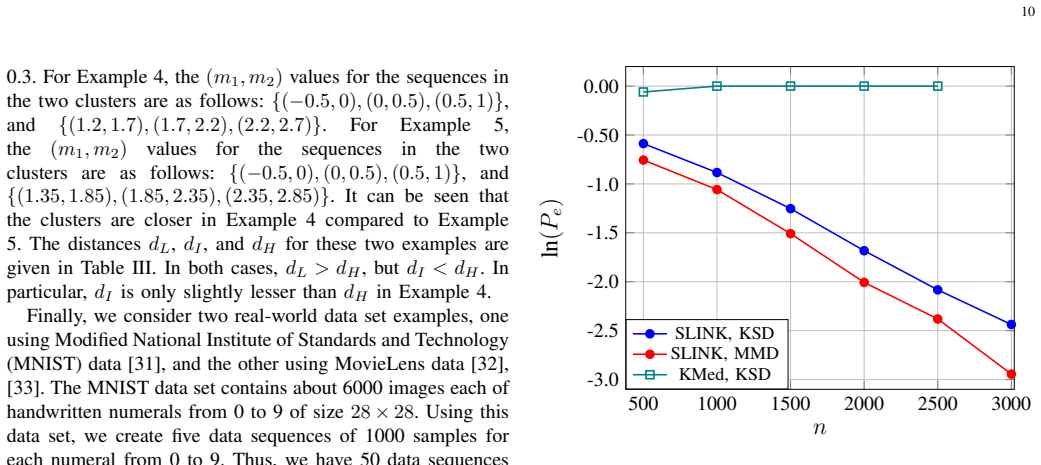
- The result extends the class of distribution-clustering problems known to be exponentially solvable by a linkage algorithm, since $d_I < d_H$ can hold while the earlier condition $d_L < d_H$ fails; for CLINK the same proof collapses to $d_I = d_L$, recovering the old condition.
- The sequential algorithm SLINK-SEQ stops almost surely, and its error probability satisfies $E[N] \le -\frac{1}{\alpha}\log P_{\max}(1+o(1))$, so the expected stopping time scales with $1/d_H^2$ while the error probability decays exponentially in the stopping time.
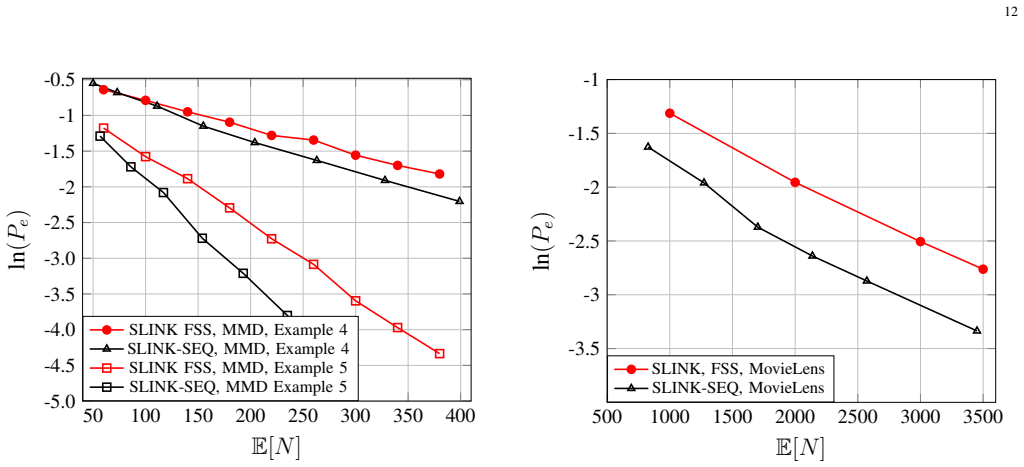
- In simulations on Gaussian, Gaussian-mixture, MNIST, and MovieLens data, SLINK-SEQ reaches a given probability of error with fewer expected samples than fixed-sample-size SLINK, and the improvement is observed for both MMD- and KSD-based distances.
Reading between the lines
- If the concentration inequality holds for the biased MMD estimator exactly as used, the same $d_I < d_H$ argument should transfer to any distance between distributions whose empirical estimate concentrates exponentially, broadening the method beyond MMD and KSD.
- The $d_I$ quantity is a property of a cluster's internal geometry rather than its diameter, which suggests linkage-based clustering is especially suited to elongated or size-imbalanced clusters where centroid-based algorithms fail.
- A direct testable extension is to replace the threshold $C/\sqrt{n}$ with an adaptive or estimated threshold; the proof indicates the error exponent would still be governed by the gap $(d_H-d_I)^2$, and simulations could check whether the empirical optimum remains $\alpha=1/2$.
- For overlapping clusters, the partition-based definition of $d_I$ no longer applies; extending the condition to soft partitions would determine whether the exponential consistency result survives outside the disjoint-cluster setting.
Editorial analysis
A structured set of objections, weighed in public.
Referee Report
Summary. The paper studies fixed-sample-size (FSS) and sequential clustering of i.i.d. data sequences generated from unknown distributions. Its main theoretical contribution is a new separation condition, d_I < d_H, where d_I is the maximum, over bipartitions of a true cluster, of the minimal distance between the two parts, and it proves that FSS single-linkage clustering (SLINK) using MMD estimates is exponentially consistent under this condition, which is weaker than the previously used d_L < d_H. It then proposes a sequential variant, SLINK-SEQ, with a C/√n stopping threshold, and claims universal consistency and exponential consistency in the expected stopping time. The paper includes simulations on Gaussian, Gaussian-mixture, MNIST, and MovieLens data comparing SLINK to k-medoids and SLINK-SEQ to FSS SLINK.
Significance. The d_I < d_H condition is a genuine conceptual weakening of d_L < d_H because d_I can be much smaller than the cluster diameter, so the paper enlarges the class of distribution-clustering problems for which SLINK is provably exponentially consistent. The deterministic argument in Section III-B is correct, and the probabilistic proof for the biased MMD estimator is sound provided the cited concentration result in [20, Thm. 7] holds as stated; the authors also provide code and reproducible simulation settings. The main weaknesses are that the KSD version is asserted rather than proved, Theorem 3's universality statement overclaims the assumptions used in its proof, and one step in the sequential proof needs a union bound to be valid. These are fixable without affecting the central MMD result, which I find convincing.
major comments (3)
- [Theorem 3, Section IV-A] The statement that SLINK-SEQ is universally consistent 'under any configuration of the true clusters' is not supported by the proof. The proof begins from Assumption 1 (d_I < d_H) and requires δ with d_I < (1−δ)^2 d_H, so the theorem as proved is restricted to configurations satisfying d_I < d_H. The unrestricted claim is also false: if d_I > d_H, even SLINK with exact distances can merge two true clusters before completing an intra-cluster merge (for example, a cluster with a large internal gap and a nearby cluster inside that gap), so the error probability need not go to zero as C→∞. Please restate the theorem with the d_I < d_H assumption, or clarify that 'universal' means only that the distributions are unknown and nonparametric.
- [Theorem 3 proof, around Eq. (11)] The inequality P[Γ_n > T_n, E_n] ≤ P[\hat d(i,j,n) > T_n] is not valid as written, because the pair (i,j) is selected after seeing the event and can depend on the outcome. The correct argument is to take a union bound over all same-cluster pairs whose true distance is at most d_I; the existence of at least one such pair with estimated distance above T_n follows from the definition of d_I when E_n occurs. This introduces only an O(M^2) factor, which does not change the exponential decay in C^2. Please add this union-bound step explicitly.
- [Sections III-C, VI and Theorems 1, 3–5] The formal results are proved only for the MMD estimator, while the abstract and conclusions claim exponential consistency for SLINK 'with MMD or KSD distance measures.' The sentence before Theorem 1 says a similar proof can be given for KSD using concentration results in [19], but no KSD concentration lemma or proof is supplied, and Lemmas 1–2 concern MMD only. As written, the KSD claims are assertions rather than theorems. Either restrict the formal claims to MMD or add the KSD concentration bound and adapt Lemmas 1–2 and the sequential theorems accordingly.
minor comments (5)
- [Algorithm 1, line 5] The loop condition 'while Γn < C√n' contradicts the stopping threshold T_n = C/√n used in Section IV and in all proofs; with the printed condition the threshold grows with n and the algorithm need not stop. The condition should be 'Γn < C/√n'.
- [Section II-D and contribution bullet] The claim that d_I < d_L whenever there are more than two distinct points in a cluster is false for an equilateral three-point configuration, where d_I = d_L. The statement should be qualified, e.g., 'in general' or 'for configurations without ties in the bipartition minima.'
- [Appendix A, Lemma 2] The hypothesis states MMD(p_j, p_{j'}) < d_I, but the same concentration bound holds when this distance equals d_I, and the proof of Theorem 1 may need the non-strict version when the minimizing pair in a partition attains the maximum exactly. Please relax the inequality to ≤ d_I.
- [Theorem 1 proof and Eq. (8)] In the bound for P[\hat d_I > d_{th}], the sentence 'Here i,j are chosen such that d(i,j,n) < d_I' should refer to the true distance and should be '≤ d_I'; the display in Eq. (8) also appears to be missing parentheses, since the derivation leading to n > ((C+8√G)/((1−δ)d_H))^2 treats (d_H − T_n)/2 as a single term.
- [Section V] The text contains a typo: 'true clusrers' should be 'true clusters.'
Circularity Check
No significant circularity: Theorem 1 and the SLINK-SEQ consistency proofs derive exponential bounds from the independent MMD concentration inequality of Gretton et al. and from the definitional separation condition dI < dH; threshold parameters are free algorithm constants, not fitted to make the theorem true.
full rationale
The paper's central claim, Theorem 1, is derived in a self-contained way: the error event is contained in the union of the events that some inter-cluster MMD estimate falls below a freely chosen threshold dth with dI < dth < dH, or that some dI-defining intra-cluster pair estimate exceeds dth. Both probabilities are bounded by the concentration inequality cited from the external reference [20, Thm. 7] for the biased MMD V-statistic, giving exponents bH = (dH - dth)^2/(16G) and bI = (dth - dI)^2/(16G). No parameter is fitted to data, and dth is an arbitrary analytical slack variable (Remark 1 even fixes dth = (dI + dH)/2). The deterministic part of the argument (if dIhat < dHhat then SLINK merges only within true clusters) follows directly from the definitions of dI and dH and the single-linkage merge rule. The sequential results use only the FSS bound, the same concentration inequality, and standard uniform-integrability arguments adapted from [24, 26]; the self-citation to [26] concerns technique, not the target result, and is not load-bearing circularity. The KSD analogue is asserted rather than proved, and the remark that dI < dL 'in general' is factually false for an equilateral three-point cluster (where dI = dL), but these are correctness or completeness concerns, not circularity. The theorem does not reduce to its inputs by definition, and no fitted quantity is renamed as a prediction.
Assumptions & free parameters
free parameters (2)
- C (SLINK-SEQ threshold constant) =
chosen in simulations; proof requires C > C_M
- α (threshold exponent in simulations) =
1/2
assumptions (6)
- domain assumption The true distribution clusters satisfy d_I < d_H.
- standard math The MMD concentration inequality of [20, Thm. 7] holds for the biased V-statistic estimator (2).
- domain assumption Each data sequence is i.i.d. from its unknown distribution.
- domain assumption The kernel satisfies 0 ≤ k(x,y) ≤ G.
- domain assumption The number of clusters K is known.
- ad hoc to paper The KSD version of the results follows by an analogous proof using concentration results in [19].
Cite this review
Pith. "Pith review of Exponentially Consistent Nonparametric Linkage-Based Clustering of Data Sequences." pith.science (2026). https://pith.science/paper/BAK4XBZW
@misc{pith2026241113922,
  author       = {Pith},
  title        = {Pith review of: Exponentially Consistent Nonparametric Linkage-Based Clustering of Data Sequences},
  year         = {2026},
  howpublished = {\url{https://pith.science/paper/BAK4XBZW}},
  note         = {Machine review of arXiv:2411.13922}
}
abstract
In this paper, we consider nonparametric clustering of $M$ independent and identically distributed (i.i.d.) data sequences generated from {\em unknown} distributions. The distributions of the $M$ data sequences belong to $K$ underlying distribution clusters. Existing results on exponentially consistent nonparametric clustering algorithms, like single linkage-based (SLINK) clustering and $k$-medoids distribution clustering, assume that the maximum intra-cluster distance ($d_L$) is smaller than the minimum inter-cluster distance ($d_H$). First, in the fixed sample size (FSS) setting, we show that exponential consistency can be achieved for SLINK clustering under a less strict assumption, $d_I < d_H$, where $d_I$ is the maximum distance between any two sub-clusters of a cluster that partition the cluster. Note that $d_I < d_L$ in general. Thus, our results show that SLINK is exponentially consistent for a larger class of problems than previously known. In our simulations, we also identify examples where $k$-medoids clustering is unable to find the true clusters, but SLINK is exponentially consistent. Then, we propose a sequential clustering algorithm, named SLINK-SEQ, based on SLINK and prove that it is also exponentially consistent. Simulation results show that the SLINK-SEQ algorithm requires fewer expected number of samples than the FSS SLINK algorithm for the same probability of error.
Figures


Figures from the paper (9 more)





Reference graph
Works this paper leans on
-
[28]
On sequence clustering and supervised dimensionality reduc- tion,
T. Wang, “On sequence clustering and supervised dimensionality reduc- tion,” Ph.D. dissertation, Syracuse University, 2020
work page 2020
-
[19]
K-medoids clustering of data sequences with composite distributions,
T. Wang, Q. Li, D. J. Bucci, Y . Liang, B. Chen, and P. K. Varshney, “K-medoids clustering of data sequences with composite distributions,” IEEE Transactions on Signal Processing, vol. 67, no. 8, pp. 2093–2106, 2019
work page 2019
-
[26]
Nonparametric sequential clustering of data streams with com- posite distributions,
——, “Nonparametric sequential clustering of data streams with com- posite distributions,” Signal Processing, vol. 204, p. 108827, 2023
work page 2023
-
[1]
Exponentially consistent non- parametric clustering of data streams with composite distributions,
B. Singh, A. Ram, and S. Bhashyam, “Exponentially consistent non- parametric clustering of data streams with composite distributions,” in ICASSP 2024 - 2024 IEEE International Conference on Acoustics, Speech and Signal Processing (ICASSP) , 2024, pp. 9401–9405
work page 2024
-
[2]
Y . Sakurai, L. Li, R. Chong, and C. Faloutsos, Efficient Distribution Mining and Classification , pp. 632–643. [Online]. Available: https: //epubs.siam.org/doi/abs/10.1137/1.9781611972788.58
-
[3]
Optimal clustering with bandit feedback,
J. Yang, Z. Zhong, and V . Y . F. Tan, “Optimal clustering with bandit feedback,” Journal of Machine Learning Research, vol. 25, no. 186, pp. 1–54, 2024. [Online]. Available: http://jmlr.org/papers/v25/22-1088.html
work page 2024
-
[4]
Fast k-means algorithm based on a level histogram for image retrieval,
C.-H. Lin, C.-C. Chen, H.-L. Lee, and J.-R. Liao, “Fast k-means algorithm based on a level histogram for image retrieval,” Expert Systems with Applications , vol. 41, no. 7, pp. 3276–3283, 2014. [Online]. Available: https://www.sciencedirect.com/science/article/pii/ S0957417413009299
work page 2014
-
[5]
Outlying sequence detection in large data sets: A data-driven approach,
A. Tajer, V . V . Veeravalli, and H. V . Poor, “Outlying sequence detection in large data sets: A data-driven approach,” IEEE Signal Processing Magazine, vol. 31, no. 5, pp. 44–56, 2014
work page 2014
Show all 35 references
-
[6]
Clustering with bregman divergences,
A. Banerjee, S. Merugu, I. S. Dhillon, and J. Ghosh, “Clustering with bregman divergences,” Journal of Machine Learning Research , vol. 6, no. 58, pp. 1705–1749, 2005. [Online]. Available: http: //jmlr.org/papers/v6/banerjee05b.html
2005
-
[7]
Clustering by means of medoids,
L. Kaufmann and P. Rousseeuw, “Clustering by means of medoids,” Data Analysis based on the L1-Norm and Related Methods , pp. 405– 416, 01 1987
1987
-
[8]
Minimum spanning trees and single linkage cluster analysis,
J. C. Gower and G. J. Ross, “Minimum spanning trees and single linkage cluster analysis,” Journal of the Royal Statistical Society: Series C (Applied Statistics) , vol. 18, no. 1, pp. 54–64, 1969
1969
-
[9]
Hierarchical clustering schemes,
S. C. Johnson, “Hierarchical clustering schemes,” Psychometrika, vol. 32, no. 3, pp. 241–254, 1967
1967
-
[10]
Shalev-Shwartz and S
S. Shalev-Shwartz and S. Ben-David, Understanding Machine Learning: From Theory to Algorithms . Cambridge University Press, 2014
2014
-
[11]
Hierarchical clustering given confidence intervals of metric distances,
W. Huang and A. Ribeiro, “Hierarchical clustering given confidence intervals of metric distances,” IEEE Transactions on Signal Processing , vol. 66, no. 10, pp. 2600–2615, 2018
2018
-
[12]
C. M. Bishop, Pattern recognition and machine learning . Springer, vol. 4, no. 4
-
[13]
Data clustering: application and trends,
G. J. Oyewole and G. A. Thopil, “Data clustering: application and trends,” Artificial Intelligence Review , vol. 56, no. 7, pp. 6439–6475, 2023
2023
-
[14]
Data stream clustering: A survey,
J. A. Silva, E. R. Faria, R. C. Barros, E. R. Hruschka, A. C. P. L. F. d. Carvalho, and J. a. Gama, “Data stream clustering: A survey,” ACM Comput. Surv. , vol. 46, no. 1, Jul. 2013. [Online]. Available: https://doi.org/10.1145/2522968.2522981
2013
-
[15]
Data stream clustering: a review,
A. Zubaro ˘glu and V . Atalay, “Data stream clustering: a review,” Artif. Intell. Rev. , vol. 54, no. 2, p. 1201–1236, Feb. 2021. [Online]. Available: https://doi.org/10.1007/s10462-020-09874-x
2021 doi
-
[16]
A systematic review of density grid-based clustering for data streams,
M. Tareq, E. A. Sundararajan, A. Harwood, and A. A. Bakar, “A systematic review of density grid-based clustering for data streams,” IEEE Access, vol. 10, pp. 579–596, 2022
2022
-
[17]
A novel streaming data clustering algorithm based on fitness proportionate sharing,
X. Yan, M. Razeghi-Jahromi, A. Homaifar, B. A. Erol, A. Girma, and E. Tunstel, “A novel streaming data clustering algorithm based on fitness proportionate sharing,” IEEE Access, vol. 7, pp. 184 985–185 000, 2019
2019
-
[18]
Finding and tracking multi-density clusters in online dynamic data streams,
C. Fahy and S. Yang, “Finding and tracking multi-density clusters in online dynamic data streams,” IEEE Transactions on Big Data , vol. 8, no. 1, pp. 178–192, 2022
2022
-
[20]
A kernel two-sample test,
A. Gretton, K. M. Borgwardt, M. J. Rasch, B. Sch ¨olkopf, and A. Smola, “A kernel two-sample test,” Journal of Machine Learning Research, vol. 13, no. 25, pp. 723–773, 2012. [Online]. Available: http://jmlr.org/papers/v13/gretton12a.html
2012
-
[21]
On the empirical estimation of integral probability metrics,
B. K. Sriperumbudur, K. Fukumizu, A. Gretton, B. Sch ¨olkopf, and G. R. G. Lanckriet, “On the empirical estimation of integral probability metrics,” Electronic Journal of Statistics , vol. 6, no. none, pp. 1550 – 1599, 2012. [Online]. Available: https://doi.org/10.1214/12-EJS722
2012 doi
-
[22]
On exponentially consistency of linkage- based hierarchical clustering algorithm using kolmogrov-smirnov dis- tance,
T. Wang, Y . Liu, and B. Chen, “On exponentially consistency of linkage- based hierarchical clustering algorithm using kolmogrov-smirnov dis- tance,” in ICASSP 2020-2020 IEEE International Conference on Acous- tics, Speech and Signal Processing (ICASSP) . IEEE, 2020, pp. 3997– 4001
2020
-
[23]
Linear-complexity exponentially- consistent tests for universal outlying sequence detection,
Y . Bu, S. Zou, and V . V . Veeravalli, “Linear-complexity exponentially- consistent tests for universal outlying sequence detection,” IEEE Trans- actions on Signal Processing , vol. 67, no. 8, pp. 2115–2128, 2019
2019
-
[24]
Universal sequential outlier hypothesis testing,
Y . Li, S. Nitinawarat, and V . V . Veeravalli, “Universal sequential outlier hypothesis testing,” Sequential Analysis , vol. 36, no. 3, pp. 309–344, 2017. [Online]. Available: https://doi.org/10.1080/07474946. 2017.1360086
2017
-
[25]
Sequential nonparametric detection of anomalous data streams,
S. C. Sreenivasan and S. Bhashyam, “Sequential nonparametric detection of anomalous data streams,” IEEE Signal Processing Letters , vol. 28, pp. 932–936, 2021
2021
-
[27]
Maxgap bandit: Adaptive algorithms for approximate ranking,
S. Katariya, A. Tripathy, and R. Nowak, “Maxgap bandit: Adaptive algorithms for approximate ranking,” in Advances in Neural Informa- tion Processing Systems , H. Wallach, H. Larochelle, A. Beygelzimer, F. d'Alch ´e-Buc, E. Fox, and R. Garnett, Eds., vol. 32. Curran Associates,...
2019
-
[29]
Scalable clustering algorithms for big data: A review,
M. A. Mahdi, K. M. Hosny, and I. Elhenawy, “Scalable clustering algorithms for big data: A review,” IEEE Access , vol. 9, pp. 80 015– 80 027, 2021
2021
-
[30]
Learning from distributions via support measure machines,
K. Muandet, K. Fukumizu, F. Dinuzzo, and B. Sch ¨olkopf, “Learning from distributions via support measure machines,” in Proceedings of the 26th International Conference on Neural Information Processing Systems - Volume 1 , ser. NIPS’12. Red Hook, NY , USA: Curran Associates In...
2012
-
[31]
Gradient-based learning applied to document recognition,
Y . Lecun, L. Bottou, Y . Bengio, and P. Haffner, “Gradient-based learning applied to document recognition,” Proceedings of the IEEE , vol. 86, no. 11, pp. 2278–2324, 1998
1998
-
[32]
Second workshop on infor- mation heterogeneity and fusion in recommender systems (hetrec2011),
I. Cantador, P. Brusilovsky, and T. Kuflik, “Second workshop on infor- mation heterogeneity and fusion in recommender systems (hetrec2011),” in Proceedings of the fifth ACM conference on Recommender systems , 2011, pp. 387–388
2011
-
[33]
Almost cost-free communication in federated best arm identification,
S. R. Kota, P. N. Karthik, and V . Y . F. Tan, “Almost cost-free communication in federated best arm identification,” Proceedings of the AAAI Conference on Artificial Intelligence , vol. 37, no. 7, pp. 8378–8385, Jun. 2023. [Online]. Available: https://ojs.aaai.org/index. php/...
2023
-
[34]
Sequential controlled sensing for composite multihypothesis testing,
A. Deshmukh, V . V . Veeravalli, and S. Bhashyam, “Sequential controlled sensing for composite multihypothesis testing,” Sequential Analysis, vol. 40, no. 2, pp. 259–289, 2021. [Online]. Available: https://doi.org/10.1080/07474946.2021.1912525
2021
-
[35]
Sequential multi-hypothesis testing in multi-armed bandit problems: An approach for asymptotic optimality,
G. R. Prabhu, S. Bhashyam, A. Gopalan, and R. Sundaresan, “Sequential multi-hypothesis testing in multi-armed bandit problems: An approach for asymptotic optimality,” IEEE Transactions on Information Theory , vol. 68, no. 7, pp. 4790–4817, 2022
2022
Reviewed August 12, 2026 · model on record in the stance chip above.
Discussion (0). Continue with ORCID to comment.