REVIEW 3 major objections 5 minor 100 references
Assessing data-driven predictions of band gap and electrical conductivity for transparent conducting materials
T0 review · 3 major / 5 minor · reviewed 2026-08-12 · deepseek-v4-flash
Pith's one-line read A composition-only ML model recovers 90% of held-out transparent-conductor families.
desk verdict A useful evaluation scheme and honest data curation, but the headline discovery metric is too fragile to support the paper's strongest claim on its own. read the letter →
The pith
A machine-rendered reading of the paper's core claim, the machinery that carries it, and where it could break.
The reading
What carries the argument
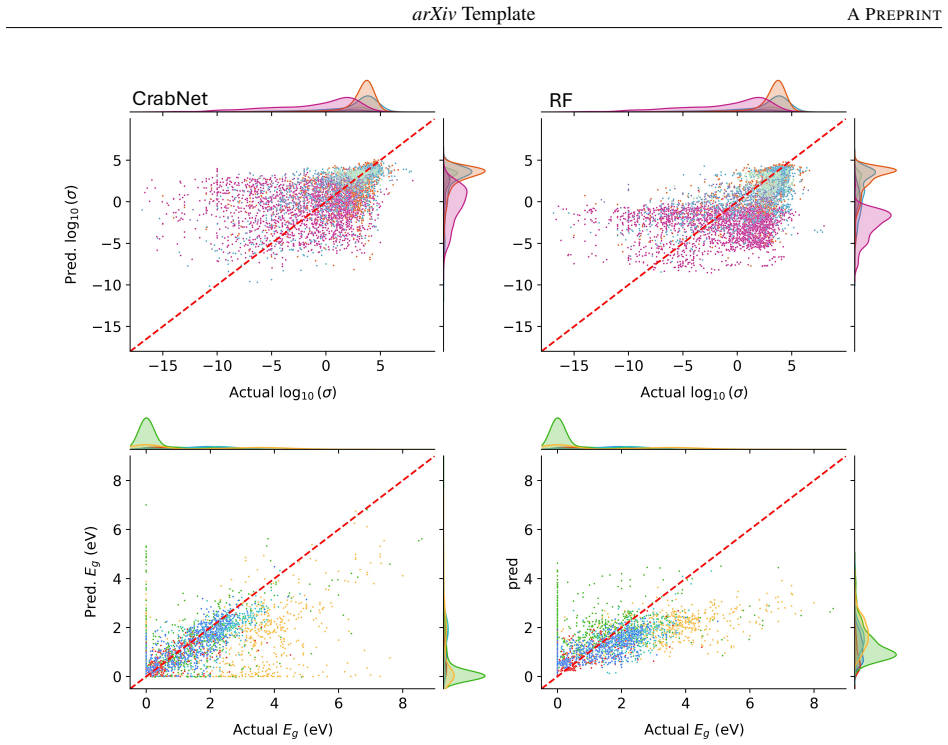
The load-bearing machinery is CrabNet, a transformer-style neural network that treats the elements of a chemical formula as tokens and uses self-attention to build a composition representation; the paper finds that attention assigned to dopant-host and dopant-dopant interactions carries the conductivity signal. Around it sit three supports: two curated experimental datasets (6,592 conductivity entries and 4,767 band-gap entries), a transfer-learning step that pretrains CrabNet on a large DFT band-gap database before fine-tuning on the experimental gaps, and a bespoke evaluation protocol, leave-one-TCM-family-out, with a family-discovery-rate metric defined as the percentage of held-out TCM families whose at least one representative is correctly predicted above the $10^2$ S/cm and 3 eV thresholds.
What would settle it
An independent test: compile a fresh set of, say, twenty TCM families from recent experimental reports, run the same leave-one-family-out protocol, and count how many families are recovered; a discovery rate well below 90% would show the reported result is tied to the nine chosen families. A second check: model GaInZnO$_4$ with the same stoichiometry-only input; the paper predicts roughly $10^{-7}$ S/cm against a measured value near 500 S/cm, so any claim that the pipeline finds mechanism-diverse TCMs can be refuted by a single such counterexample.
Extended reading notes
Core claim
The paper's central claim, stated on its own terms, is that a machine-learning model trained on stoichiometry alone can identify most known TCM families even when each family is absent from the training set, and can usefully rank candidate materials from a database search. CrabNet achieves a family-discovery-rate of 90% under leave-one-TCM-family-out evaluation, compared with 40% for a random forest, and its attention scores concentrate on dopant-related interactions. On a list of 55 oxide compositions built from elements common in known TCMs, the model ranks doped binary oxides and several three-cation phases at the top of a risk-adjusted figure of merit, including at least one composition, Al$_{0.67}$Ga$_{1.33}$Zn$_{37}$O$_{40}$, whose band gap and conductivity had not been reported. The authors interpret this as evidence that ML can accelerate the identification of previously overlooked stoichiometric combinations, while explicitly limiting the claim to materials that resemble the training distribution in composition.
Load-bearing premise
The load-bearing premise is that band gap and electrical conductivity can be predicted with useful accuracy from the bare chemical formula alone, because no crystal structure, dopant site, defect chemistry, or doping mechanism is provided to the model.
Editorial extensions
If this is right
- CrabNet is a practical screening tool: feed it a candidate list of oxide formulas and it ranks them by a risk-adjusted figure of merit that trades predicted band gap against predicted conductivity.
- The leave-one-family-out protocol gives researchers a sharper way to measure extrapolation than K-fold or LOCO-CV for materials-discovery claims.
- The attention weights can be read as an indication of which chemical interactions the model relies on, here dopant contributions, giving a partial window into why a composition is predicted conductive.
- Success on the 55-composition search is expected mainly when candidates are compositionally similar to known TCMs; mechanism-diverse candidates, like GaInZnO$_4$ with its defect-driven conductivity, will be missed.
- The curated experimental datasets themselves are a contribution that lets other models be evaluated on real measured values rather than DFT-computed gaps and conductivities.
Reading between the lines
- Editorial: the 90% versus 40% FDR is measured on only nine families, and all share the same handful of cations (Zn, Ga, Sn, Al, In); a wider family set could move the number substantially.
- If the attention-dopant pattern is causal, a model trained with explicit structural or doping-site information should close the GaInZnO$_4$ gap; this is a testable extension the paper itself points toward.
- The ranking table singles out Al$_{0.67}$Ga$_{1.33}$Zn$_{37}$O$_{40}$ as an unmeasured candidate; experimental measurement of its conductivity and band gap would be a direct check of the screening pipeline.
- The deeper lesson is that this kind of ML discovery is interpolation in composition space, which is valuable for triage but should not be read as mechanistic understanding of why a material conducts.
Editorial analysis
A structured set of objections, weighed in public.
Referee Report
Summary. The paper proposes a data-driven framework for accelerating the discovery of transparent conducting materials (TCMs). The authors create two curated experimental datasets for room-temperature electrical conductivity and band gap, train random forest (RF) and CrabNet models on stoichiometry-only inputs, and evaluate them with K-fold cross-validation, LOCO-CV, and a bespoke leave-one-TCM-family-out scheme. In the latter, they report a family-discovery-rate (FDR) of 90% for CrabNet versus 40% for RF across 10 known TCM families. They also screen 55 database compositions containing common TCM elements, rank them with a risk-adjusted figure of merit, and highlight several candidate materials. The central claims are that CrabNet is more robust than RF at identifying previously unseen stoichiometric combinations and that the framework can accelerate the identification of promising TCM candidates.
Significance. If the claims are supported, the paper would make a useful contribution by releasing curated experimental datasets and proposing a dedicated evaluation scheme for discovery-oriented ML in materials science. The attention-score analysis offers an interpretability angle that is rare in this literature. However, the headline result rests on a small-sample, threshold-based family-discovery-rate that is not accompanied by uncertainty quantification or comparison to trivial baselines, and the practical discovery section lacks a quantitative evaluation of the ranking quality. The contributions are valuable but the main quantitative claim needs strengthening before the paper can be fully credited.
major comments (3)
- [§5.3, Eq. (2), Table 1, Figure 6] The family-discovery-rate is computed on only 10 families, and the reported 90% vs. 40% difference is not accompanied by any uncertainty estimate or statistical test. With N=10, a single family changes the FDR by 10 percentage points; the absence of confidence intervals, bootstrap, or permutation testing means the claimed superiority of CrabNet over RF is not established at the reported precision. Please report per-family predictions, provide a bootstrap confidence interval, and ideally a permutation test over family labels.
- [§4.2, §5.3] The success criterion is threshold crossing for at least one representative, with thresholds (σ>10^2 S/cm, Eg>3 eV) chosen 'drawing insights from the statistics of reported TCMs' — i.e., calibrated to the same families in Table 1 that form the test set. All ten held-out families have mean conductivities at or above ~10^2 S/cm and band gaps above 3.6 eV, so a model that systematically overpredicts conductivity and band gap for doped oxides could achieve a high FDR without genuine extrapolation. Also, the 'at least one representative' rule introduces a multiple-comparison effect: families with more representatives (up to 6 in Table 1) have more chances to exceed the threshold. The paper should report the full distribution of predictions per family, compare with trivial baselines (e.g., predicting every oxide containing Al, Ga, In, or Sn as a TCM, or a constant predictor that always exceeds both thresholds), and state how many representatives in each family exceed the thresholds, not just a binary success.
- [§6, §8] The 55-composition search is presented as evidence that the framework can highlight previously overlooked TCM candidates, but only CrabNet is applied, no baseline or quantitative evaluation of the ranking is given, and the two illustrative cases are not validated experimentally. Moreover, one of the examples discussed (GaInZnO4, Table 4 entry 51) is a known TCM whose predicted conductivity (-6.6 log10 S/cm) is over nine orders of magnitude below the measured value (2.7 log10 S/cm); the paper explains this by anti-site defects, but this failure is not factored into the assessment of the discovery pipeline. The abstract's claim that the framework 'empirically demonstrates that it can highlight material candidates that may have been previously overlooked' needs a more systematic evaluation, e.g., precision at top-k against known TCMs or comparison with random ranking.
minor comments (5)
- [§3] There is a typo in the sentence 'to accomodate φTCM within a data-driven perspective' — 'accomodate' should be 'accommodate'.
- [§9] The text refers to 'scikit learn' as 'sci-kit learn'; the correct spelling is 'scikit-learn'.
- [§4.2, Eq. (2)] The definition of FDR would benefit from clearer notation; the symbol N*_f is difficult to read and the equation formatting is awkward. Please define each variable explicitly.
- [Table 4] Entry 26 lists '5.038' for the ΦM value, which appears to be a typo; also consider aligning the decimal points in the numeric columns for readability.
- [§10] The curated experimental datasets are not made directly available; the authors only link to the original sources. Providing the curated datasets as supplementary data would greatly improve reproducibility.
Circularity Check
No significant circularity: the central FDR claim is an empirical held-out-family benchmark with fixed physical thresholds, not a fit renamed as a prediction.
full rationale
The paper's central claim is that CrabNet achieves a family-discovery-rate of 90% versus 40% for random forest when entire known TCM families are held out of training (Section 5.3). This is a direct empirical comparison: the models are trained on curated experimental conductivity and band-gap data, and the held-out families' labels are not used in training. The success thresholds (sigma > 10^2 S/cm and Eg > 3 eV) are fixed domain criteria rather than fitted model parameters; the text states they are established "Drawing insights from the statistics of reported TCMs and from prior scientific knowledge", which is a justification for a benchmark threshold, not an optimization of the FDR on the test set. The band-gap transfer-learning step uses external DFT data from the Materials Project with equivalent formulas explicitly removed, so no test information is smuggled in. Self-citations ([68], [72]) concern data aggregation and kernelised LOCO-CV methodology and are not load-bearing for the FDR claim. The acknowledged limitations, including the stoichiometry-only inputs and the GaInZnO4 failure, are honest statements of scope rather than circular reductions. Statistical concerns about the small N=10 sample and the absence of a trivial baseline are validity and correctness issues, not circularity.
Assumptions & free parameters
free parameters (5)
- TCM conductivity threshold =
10^2 S/cm
- TCM band gap threshold =
3 eV
- Minimum metallic conductivity =
10^3 S/cm
- Conductivity duplicate exclusion standard deviation =
10 S/cm
- Outlier exclusion number of standard deviations =
4 standard deviations
assumptions (5)
- domain assumption Band gap greater than approximately 3 eV implies transparency to visible light
- domain assumption Stoichiometry alone contains sufficient information to predict band gap and conductivity
- domain assumption Experimental measurements in the curated databases are accurate after the specified filtering and expert review
- domain assumption Mott minimum metallic conductivity of 10^3 S/cm is a meaningful metal/non-metal boundary
- domain assumption RF and CrabNet are representative SOTA composition-only models
Cite this review
Pith. "Pith review of Assessing data-driven predictions of band gap and electrical conductivity for transparent conducting materials." pith.science (2026). https://pith.science/paper/L7CQEQZR
@misc{pith2026241114034,
  author       = {Pith},
  title        = {Pith review of: Assessing data-driven predictions of band gap and electrical conductivity for transparent conducting materials},
  year         = {2026},
  howpublished = {\url{https://pith.science/paper/L7CQEQZR}},
  note         = {Machine review of arXiv:2411.14034}
}
read the original abstract
Machine Learning (ML) has offered innovative perspectives for accelerating the discovery of new functional materials, leveraging the increasing availability of material databases. Despite the promising advances, data-driven methods face constraints imposed by the quantity and quality of available data. Moreover, ML is often employed in tandem with simulated datasets originating from density functional theory (DFT), and assessed through in-sample evaluation schemes. This scenario raises questions about the practical utility of ML in uncovering new and significant material classes for industrial applications. Here, we propose a data-driven framework aimed at accelerating the discovery of new transparent conducting materials (TCMs), an important category of semiconductors with a wide range of applications. To mitigate the shortage of available data, we create and validate unique experimental databases, comprising several examples of existing TCMs. We assess state-of-the-art (SOTA) ML models for property prediction from the stoichiometry alone. We propose a bespoke evaluation scheme to provide empirical evidence on the ability of ML to uncover new, previously unseen materials of interest. We test our approach on a list of 55 compositions containing typical elements of known TCMs. Although our study indicates that ML tends to identify new TCMs compositionally similar to those in the training data, we empirically demonstrate that it can highlight material candidates that may have been previously overlooked, offering a systematic approach to identify materials that are likely to display TCMs characteristics.
Figures


Figures from the paper (6 more)



Reference graph
Works this paper leans on
-
[1]
From DFT to machine learning: recent approaches to materials science–a review
Gabriel R Schleder, Antonio C M Padilha, Carlos Mera Acosta, Marcio Costa, and Adalberto Fazzio. From DFT to machine learning: recent approaches to materials science–a review. Journal of Physics: Materials, 2(3):032001, may 2019. doi:10.1088/2515-7639/ab084b. URL https://dx.doi.org/10.1088/2515-7639/ab084b
-
[2]
Robert Pollice, Gabriel dos Passos Gomes, Matteo Aldeghi, Riley J. Hickman, Mario Krenn, Cyrille Lavigne, Michael Lindner-D’Addario, AkshatKumar Nigam, Cher Tian Ser, Zhenpeng Yao, and Alán Aspuru-Guzik. Data- driven strategies for accelerated materials design.Accounts of Chemical Research, 54(4):849–860, Feb 2021. ISSN 0001-4842. doi:10.1021/acs.accounts...
-
[3]
Anubhav Jain, Shyue Ping Ong, Geoffroy Hautier, Wei Chen, William Davidson Richards, Stephen Dacek, Shreyas Cholia, Dan Gunter, David Skinner, Gerbrand Ceder, and Kristin a. Persson. The Materials Project: A materials genome approach to accelerating materials innovation. APL Materials, 1(1):011002, 2013. ISSN 2166532X. doi:10.1063/1.4812323. URL http://li...
-
[4]
Evgeny Blokhin and Pierre Villars. The PAULING FILE Project and Materials Platform for Data Science: From Big Data Toward Materials Genome, pages 1–26. Springer International Publishing, Cham, 2018. ISBN 978-3-319- 42913-7. doi:10.1007/978-3-319-42913-7_62-1. URL https://doi.org/10.1007/978-3-319-42913-7_ 62-1
-
[5]
The open quantum materials database (oqmd): assessing the accuracy of DFT formation energies
Scott Kirklin, James E Saal, Bryce Meredig, Alex Thompson, Jeff W Doak, Muratahan Aykol, Stephan Rühl, and Chris Wolverton. The open quantum materials database (oqmd): assessing the accuracy of DFT formation energies. npj Computational Materials, 1(1):15010, 2015. doi:10.1038/npjcompumats.2015.10. URL https: //doi.org/10.1038/npjcompumats.2015.10
-
[6]
Discovery of high-performance dielectric materials with machine-learning-guided search
Janosh Riebesell, Todd Wesley Surta, Rhys Edward Andrew Goodall, Michael William Gaultois, et al. Discovery of high-performance dielectric materials with machine-learning-guided search. Cell Reports Physical Science, 2024. 18 arXiv Template A PREPRINT
2024
-
[7]
B.D. Conduit, T. Illston, S. Baker, D. Vadegadde Duggappa, S. Harding, H.J. Stone, and G.J. Conduit. Probabilistic neural network identification of an alloy for direct laser deposition. Materials & Design, 168:107644, 2019. ISSN 0264-1275. doi:https://doi.org/10.1016/j.matdes.2019.107644. URL https://www.sciencedirect. com/science/article/pii/S0264127519300814
-
[8]
Oliynyk, Marcus Parry, Zeshan Rizvi, Samantha Couper, Feng Lin, Lowell Miyagi, Taylor D
Aria Mansouri Tehrani, Anton O. Oliynyk, Marcus Parry, Zeshan Rizvi, Samantha Couper, Feng Lin, Lowell Miyagi, Taylor D. Sparks, and Jakoah Brgoch. Machine learning directed search for ultraincompressible, superhard materials. Journal of the American Chemical Society, 140(31):9844–9853, 2018. doi:10.1021/jacs.8b02717. URL https://doi.org/10.1021/jacs.8b02...
Show all 100 references
-
[9]
Norquist, Tonio Buonassisi, and Jakoah Brgoch
Joshua Schrier, Alexander J. Norquist, Tonio Buonassisi, and Jakoah Brgoch. In pursuit of the exceptional: Research directions for machine learning in chemical and materials science. Journal of the American Chemical Society, 145(40):21699–21716, 10 2023. doi:10.1021/jacs.3c047...
2023 doi
-
[10]
Evans, Zhe Li, Ji-Seon Kim, James R
Amirah Way, Joel Luke, Alex D. Evans, Zhe Li, Ji-Seon Kim, James R. Durrant, Harrison Ka Hin Lee, and Wing C. Tsoi. Fluorine doped tin oxide as an alternative of indium tin oxide for bottom electrode of semi-transparent organic photovoltaic devices. AIP Advances, 9(8):085220, ...
2019 doi
-
[11]
Recent progress in transparent conductive materials for photovoltaics
Sandeep Kumar Maurya, Hazel Rose Galvan, Gaurav Gautam, and Xiaojie Xu. Recent progress in transparent conductive materials for photovoltaics. Energies, 15(22), 2022. ISSN 1996-1073. doi:10.3390/en15228698. URL https://www.mdpi.com/1996-1073/15/22/8698
2022 doi
-
[12]
Ager, and Christophe Bal- lif
Monica Morales-Masis, Stefaan De Wolf, Rachel Woods-Robinson, Joel W. Ager, and Christophe Bal- lif. Transparent electrodes for efficient optoelectronics. Advanced Electronic Materials , 3(5):1600529,
-
[13]
Dwaraknath, and Kristin A
Rachel Woods-Robinson, Danny Broberg, Alireza Faghaninia, Anubhav Jain, Shyam S. Dwaraknath, and Kristin A. Persson. Assessing high-throughput descriptors for prediction of transparent conductors. Chemistry of Materi- als, 30(22):8375–8389, 2018. doi:10.1021/acs.chemmater.8b03...
2018 doi
-
[14]
Xiong, Y
X. Xiong, Y . Sun, Y . Xing, and T. Hato. Investigate Machine Learning Methods for Transparent Conductors Prediction. 2018. URL http://noiselab.ucsd.edu/ECE228_2018/
2018
-
[15]
Evaluation of Machine Learning Methods for the Prediction of Key Properties for Novel Transparent Semiconductors
Christopher Sutton, Christopher Bartel, Xiangyue Liu, Mario Boley, Matthias Rupp, Luca Ghiringhelli, Matthias Scheffler, and Christopher Sutton Team. Evaluation of Machine Learning Methods for the Prediction of Key Properties for Novel Transparent Semiconductors. In APS March ...
2018
-
[16]
Pierre Villars, Karin Cenzual, and William B. Pearson. Pearson’s crystal data : crystal structure database for inorganic compounds. 2007
2007
-
[17]
The Inorganic Crystal Structure Database ( ICSD ): A Tool for Materials Sciences, pages 41–54
Stephan Rühl. The Inorganic Crystal Structure Database ( ICSD ): A Tool for Materials Sciences, pages 41–54. 10 2019. ISBN 9783527341214. doi:10.1002/9783527802265.ch2
2019 doi
-
[18]
How does chem- istry influence electron effective mass in oxides? a high-throughput computational analysis.Chemistry of Materials, 26(19):5447–5458, 10 2014
Geoffroy Hautier, Anna Miglio, David Waroquiers, Gian-Marco Rignanese, and Xavier Gonze. How does chem- istry influence electron effective mass in oxides? a high-throughput computational analysis.Chemistry of Materials, 26(19):5447–5458, 10 2014. doi:10.1021/cm404079a. URL htt...
2014 doi
-
[19]
Investigate machine learning methods for transparent conductors prediction, 2018
Yan Sun, Yiyuan Xing, Xufan Xiong, and Tianduo Hao. Investigate machine learning methods for transparent conductors prediction, 2018. URL http://noiselab.ucsd.edu/ECE228_2018/Reports/Report3.pdf
2018
-
[20]
Antunes, Vikram, Jose J
Luis M. Antunes, Vikram, Jose J. Plata, Anthony V . Powell, Keith T. Butler, and Ricardo Grau-Crespo.Machine Learning Approaches for Accelerating the Discovery of Thermoelectric Materials, volume 1416 ofACS Symposium 19 arXiv Template A PREPRINT Series, doi:10.1021/bk-2022-141...
-
[21]
Gaultois, Taylor D
Michael W. Gaultois, Taylor D. Sparks, Christopher K. H. Borg, Ram Seshadri, William D. Bonificio, and David R. Clarke. Data-driven review of thermoelectric materials: Performance and resource considerations. Chemistry of Materials , 25(15):2911–2920, Aug 2013. ISSN 0897-4756....
2013 doi
-
[22]
Predicting the band gaps of inorganic solids by machine learning
Ya Zhuo, Aria Mansouri Tehrani, and Jakoah Brgoch. Predicting the band gaps of inorganic solids by machine learning. The Journal of Physical Chemistry Letters, 9(7):1668–1673, 2018. doi:10.1021/acs.jpclett.8b00124. URL https://doi.org/10.1021/acs.jpclett.8b00124. PMID: 29532658
2018 doi
-
[23]
Accurate prediction of band gap of materials using stacking machine learning model
Teng Wang, Kefei Zhang, Jesse Thé, and Hesheng Yu. Accurate prediction of band gap of materials using stacking machine learning model. Computational Materials Science , 201:110899, 2022. ISSN 0927-0256. doi:https://doi.org/10.1016/j.commatsci.2021.110899. URL https://www.scien...
2022
-
[26]
Jeffrey Snyder, Gian-Marco Rignanese, Anubhav Jain, and Geoffroy Hautier
Francesco Ricci, Wei Chen, Umut Aydemir, G. Jeffrey Snyder, Gian-Marco Rignanese, Anubhav Jain, and Geoffroy Hautier. An ab initio electronic transport database for inorganic materials. Scientific Data, 4(1):170085,
-
[27]
Garrity, Andrew C
Kamal Choudhary, Kevin F. Garrity, Andrew C. E. Reid, Brian DeCost, Adam J. Biacchi, Angela R. Hight Walker, Zachary Trautt, Jason Hattrick-Simpers, A. Gilad Kusne, Andrea Centrone, Albert Davydov, Jie Jiang, Ruth Pachter, Gowoon Cheon, Evan Reed, Ankit Agrawal, Xiaofeng Qian,...
2020
-
[28]
URL https://doi.org/10.1038/sdata.2017.85
doi:10.1038/sdata.2017.85. URL https://doi.org/10.1038/sdata.2017.85
2017 doi
-
[29]
Machine learning based prediction of lattice thermal conductivity for half-heusler compounds using atomic information
Hidetoshi Miyazaki, Tomoyuki Tamura, Masashi Mikami, Kosuke Watanabe, Naoki Ide, Osman Murat Ozkendir, and Yoichi Nishino. Machine learning based prediction of lattice thermal conductivity for half-heusler compounds using atomic information. Scientific Reports, 11(1):13410, 20...
2021 doi
-
[30]
Materials informatics platform with three dimensional structures, workflow and thermoelectric applications
Mingjia Yao, Yuxiang Wang, Xin Li, Ye Sheng, Haiyang Huo, Lili Xi, Jiong Yang, and Wenqing Zhang. Materials informatics platform with three dimensional structures, workflow and thermoelectric applications. Scientific Data, 8(1):236, 2021. doi:10.1038/s41597-021-01022-6. URL ht...
2021 doi
-
[31]
Pikee Priya and N. R. Aluru. Accelerated design and discovery of perovskites with high conductivity for energy applications through machine learning. npj Computational Materials, 7(1):90, 2021. doi:10.1038/s41524-021- 00551-3. URL https://doi.org/10.1038/s41524-021-00551-3 . 2...
2021 doi
-
[32]
Data-driven analysis of electron relaxation times in pbte-type thermoelectric materials
Takushi Kodani Mitsunori Kaneshige Yuki Ando Sakiko Gunji Yoji Imai Hideyasu Ouchi Kazuki Tobita Kaoru Kimura Yukari Katsura, Masaya Kumagai and Koji Tsuda. Data-driven analysis of electron relaxation times in pbte-type thermoelectric materials. Science and Technology of Advan...
2019
-
[33]
Hart, Michal Jahnatek, Roman V
Stefano Curtarolo, Wahyu Setyawan, Gus L.W. Hart, Michal Jahnatek, Roman V . Chepulskii, Richard H. Taylor, Shidong Wang, Junkai Xue, Kesong Yang, Ohad Levy, Michael J. Mehl, Harold T. Stokes, Denis O. Demchenko, and Dane Morgan. Aflow: An automatic framework for high-throughp...
2012 doi
-
[34]
Na and Hyunju Chang
Gyoung S. Na and Hyunju Chang. A public database of thermoelectric materials and system-identified material representation for data-driven discovery. npj Computational Materials, 8(1):214, 2022. doi:10.1038/s41524-022- 00897-2. URL https://doi.org/10.1038/s41524-022-00897-2
2022 doi
-
[35]
Roy G. Gordon. Criteria for choosing transparent conductors. MRS Bulletin , 25(8):52–57, 2000. doi:10.1557/mrs2000.151
2000 doi
-
[36]
Cohen, Paula Mori-Sánchez, and Weitao Yang
Aron J. Cohen, Paula Mori-Sánchez, and Weitao Yang. Insights into current limitations of density functional theory. Science, 321(5890):792–794, 2008. doi:10.1126/science.1158722. URL https://www.science.org/ doi/abs/10.1126/science.1158722
2008 doi
-
[37]
N.F. Mott. Is there ever a minimum metallic conductivity? Solid-State Electronics, 28(1):57–59, 1985. ISSN 0038-1101. doi:https://doi.org/10.1016/0038-1101(85)90210-2. URL https://www.sciencedirect.com/ science/article/pii/0038110185902102
1985
-
[38]
Clymo, C
J. Clymo, C. M. Collins, K. Atkinson, M. S. Dyer, M. W. Gaultois, V . V . Gusev, and et al. Exploration of chemical space through automated reasoning. ChemRxiv, 2024. doi:10.26434/chemrxiv-2024-2bhfw. This content is a preprint and has not been peer-reviewed
2024 doi
-
[39]
Benchmarking materials property prediction methods: the matbench test set and automatminer reference algorithm
Alexander Dunn, Qi Wang, Alex Ganose, Daniel Dopp, and Anubhav Jain. Benchmarking materials property prediction methods: the matbench test set and automatminer reference algorithm. npj Computational Materials, 6 (1):138, 2020. doi:10.1038/s41524-020-00406-3. URL https://doi.or...
2020 doi
-
[40]
The minimum conductivity and electron localisation in the metallic phase of transition metal compounds in the vicinity of a metal-insulator transition
F A Chudnovskii. The minimum conductivity and electron localisation in the metallic phase of transition metal compounds in the vicinity of a metal-insulator transition. Journal of Physics C: Solid State Physics, 11(3):L99, feb 1978. doi:10.1088/0022-3719/11/3/003. URL https://...
1978 doi
-
[41]
Effect of indium doping on the uv photoluminescence emission, structural, electrical and optical properties of spin-coating deposited SnO2 thin films
Boucherka Teldja, Brihi Noureddine, Berbadj Azzeddine, and Touati Meriem. Effect of indium doping on the uv photoluminescence emission, structural, electrical and optical properties of spin-coating deposited SnO2 thin films. Optik, 209:164586, 2020. ISSN 0030-4026. doi:https:/...
2020
-
[42]
Ranjeth Kumar Reddy, G
Peddavarapu Sivakumar, Harish Sharma Akkera, T. Ranjeth Kumar Reddy, G. Srinivas Reddy, Naga- iah Kambhala, and N. Nanda Kumar Reddy. Influence of Ga doping on structural, optical and elec- trical properties of transparent conducting SnO2 thin films. Optik, 226:165859, 2021. I...
2021
-
[43]
Vedaste Uwihoreye, Zhenni Yang, Jia-Ye Zhang, Yu-Mei Lin, Xuan Liang, Lu Yang, and Kelvin H. L. Zhang. Transparent conductive SnO2 thin films via resonant Ta doping. Science China Materials, 66(1):264–271, 2023. doi:10.1007/s40843-022-2122-9. URL https://doi.org/10.1007/s40843...
2023 doi
-
[44]
Ranjeth Kumar Reddy, Yugandhar Bitla, V
Peddavarapu Sivakumar, Harish Sharma Akkera, T. Ranjeth Kumar Reddy, Yugandhar Bitla, V . Ganesh, P. Mohan Kumar, G. Srinivas Reddy, and Madhukar Poloju. Effect ofTi doping on structural, optical and electrical properties of SnO2 transparent conducting thin films deposited by ...
2021
-
[45]
Structural, optical and electrical charac- terization of spin coated SnO2:Mn thin films
Isha Arora, Kamini Malhotra, Alish Mahajan, and Praveen Kumar. Structural, optical and electrical charac- terization of spin coated SnO2:Mn thin films. Materials Today: Proceedings, 36:697–700, 2021. ISSN 2214-
2021
-
[46]
Enhanced room-temperature ferromagnetism on (In0.98−xCoxSn0.02)2O3 films: magnetic mechanism, optical and transport properties
Luhang Shen, Yukai An, Rukang Zhang, Pan Zhang, Zhonghua Wu, Hui Yan, and Jiwen Liu. Enhanced room-temperature ferromagnetism on (In0.98−xCoxSn0.02)2O3 films: magnetic mechanism, optical and transport properties. Phys. Chem. Chem. Phys., 19:29472–29482, 2017. doi:10.1039/C7CP0...
2017 doi
-
[47]
The effect of annealing on structural, electrical and optical properties of nanostructured ITO films prepared by e-beam evaporation
Hamid Reza Fallah, Mohsen Ghasemi, Ali Hassanzadeh, and Hadi Steki. The effect of annealing on structural, electrical and optical properties of nanostructured ITO films prepared by e-beam evaporation. Materials Research Bulletin, 42(3):487–496, 2007. ISSN 0025-5408. doi:https:...
2007 doi
-
[48]
Poeppelmeier, Melissa Lane, Carl R
Andrea Ambrosini, Angel Duarte, Kenneth R. Poeppelmeier, Melissa Lane, Carl R. Kannewurf, and Thomas O. Mason. Electrical, optical, and structural properties of tin-doped In2O3–M2O3 solid solutions (M=Y, Sc). Journal of Solid State Chemistry, 153(1):41–47, 2000. ISSN 0022-4596...
-
[49]
Trans- parent and conductive W-doped SnO2 thin films fabricated by an aqueous solution process
Mi Wang, Yanfeng Gao, Zhang Chen, Chuanxiang Cao, Jiadong Zhou, Lei Dai, and Xuhong Guo. Trans- parent and conductive W-doped SnO2 thin films fabricated by an aqueous solution process. Thin Solid Films, 544:419–426, 2013. ISSN 0040-6090. doi:https://doi.org/10.1016/j.tsf.2013....
2013 doi
-
[50]
Shukla, Anchal Srivastava, Atul Srivastava, and K.C
R.K. Shukla, Anchal Srivastava, Atul Srivastava, and K.C. Dubey. Growth of transparent conducting nanocrys- talline Al doped ZnO thin films by pulsed laser deposition. Journal of Crystal Growth, 294(2):427–431, 2006. ISSN 0022-0248. doi:https://doi.org/10.1016/j.jcrysgro.2006....
2006 doi
-
[51]
Ajimsha, Amit K
R.S. Ajimsha, Amit K. Das, P. Misra, M.P. Joshi, L.M. Kukreja, R. Kumar, T.K. Sharma, and S.M. Oak. Observation of low resistivity and high mobility in Ga doped ZnO thin films grown by buffer assisted pulsed laser deposition. Journal of Alloys and Compounds , 638:55–58, 2015. ...
2015
-
[52]
Random forests
Leo Breiman. Random forests. Machine Learning, 45(1):5–32, 2001. doi:10.1023/A:1010933404324. URL https://doi.org/10.1023/A:1010933404324
2001 doi
-
[53]
Biphase effect on structural, optical, and electrical properties of Al-Sn codoped ZnO thin films deposited by sol-gel spin-coating technique
Hassan Guendouz, Abdelhamid Bouaine, and Noureddine Brihi. Biphase effect on structural, optical, and electrical properties of Al-Sn codoped ZnO thin films deposited by sol-gel spin-coating technique. Optik, 158:1342–1348,
-
[54]
Probabilistic Data-Driven Discovery of Thermoelectric Materials
Janosh Riebesell. Probabilistic Data-Driven Discovery of Thermoelectric Materials. MPhil thesis, University of Cambridge, 2019. URL https://github.com/janosh/thermo
2019
-
[55]
Prediction of mechanical strength by using an artificial neural network and random forest algorithm
Samson Jerold Samuel Chelladurai, Kamal Upreti, Manvendra Verma, Meena Agrawal, Jatinder Garg, Rekha Kaushik, Chinmay Agrawal, Divakar Singh, and Rajamani Narayanasamy. Prediction of mechanical strength by using an artificial neural network and random forest algorithm. Journal...
2022 doi
-
[56]
A general-purpose machine learning framework for predicting properties of inorganic materials
Logan Ward, Ankit Agrawal, Alok Choudhary, and Christopher Wolverton. A general-purpose machine learning framework for predicting properties of inorganic materials. npj Computational Materials, 2(1):16028, Aug 2016. ISSN 2057-3960. doi:10.1038/npjcompumats.2016.28. URL https:/...
2016 doi
-
[57]
Aditya Sonpal, Mohammad Atif Faiz Afzal, Yuling An, Anand Chandrasekaran, and Mathew D. Halls. Bench- marking Machine Learning Descriptors for Crystals, volume 1416 of ACS Symposium Series, doi:10.1021/bk- 2022-1416.ch006 6, pages 111–126. American Chemical Society, 2023/02/14...
2022 doi
-
[58]
Kauwe, Ryan J
Anthony Yu-Tung Wang, Steven K. Kauwe, Ryan J. Murdock, and Taylor D. Sparks. Compositionally restricted attention-based network for materials property predictions.npj Computational Materials, 7(1):77, May 2021. ISSN 2057-3960. doi:10.1038/s41524-021-00545-1. URL https://doi.o...
2021 doi
-
[59]
The utility of composition-based machine learning models for band gap prediction
Vishwesh Venkatraman. The utility of composition-based machine learning models for band gap prediction. Computational Materials Science , 197:110637, 2021. ISSN 0927-0256. doi:https://doi.org/10.1016/j.commatsci.2021.110637. URL https://www.sciencedirect.com/science/ article/p...
2021
-
[60]
Baird, Tran Q
Sterling G. Baird, Tran Q. Diep, and Taylor D. Sparks. Discover: a materials discovery screening tool for high performance, unique chemical compositions. Digital Discovery, 1:226–240, 2022. doi:10.1039/D1DD00028D
2022 doi
-
[61]
Hargreaves, Michael W
Cameron J. Hargreaves, Michael W. Gaultois, Luke M. Daniels, Emma J. Watts, Vitaliy A. Kurlin, Michael Moran, Yun Dang, Rhun Morris, Alexandra Morscher, Kate Thompson, Matthew A. Wright, Beluvalli-Eshwarappa Prasad, Frédéric Blanc, Chris M. Collins, Catriona A. Crawford, Benja...
2023
-
[62]
Predicting thermoelectric transport properties from composition with attention-based deep learning
Luis M Antunes, Keith T Butler, and Ricardo Grau-Crespo. Predicting thermoelectric transport properties from composition with attention-based deep learning. Machine Learning: Science and Technology, 4(1):015037, apr
-
[63]
CLCS : Contrastive learning between compositions and structures for practical Li-ion battery electrodes design
Jaewan Lee, Changyoung Park, Hongjun Yang, Sehui Han, and Woohyung Lim. CLCS : Contrastive learning between compositions and structures for practical Li-ion battery electrodes design. In AI for Accelerated Materials Design - NeurIPS 2023 Workshop, 2023. URL https://openreview....
2023
-
[64]
Madhubanti Mukherjee, Swanti Satsangi, and Abhishek K. Singh. A statistical approach for the rapid prediction of electron relaxation time using elemental representatives, Jul 2020. URL https://acs.figshare.com/collections/A_Statistical_Approach_for_the_Rapid_Prediction_ of_Ele...
2020
-
[65]
Gomez, Lukasz Kaiser, and Illia Polosukhin
Ashish Vaswani, Noam Shazeer, Niki Parmar, Jakob Uszkoreit, Llion Jones, Aidan N. Gomez, Lukasz Kaiser, and Illia Polosukhin. Attention is all you need, 2017. URL https://arxiv.org/abs/1706.03762
2017 arXiv
-
[66]
The Elements of Statistical Learning
Trevor Hastie, Robert Tibshirani, and Jerome Friedman. The Elements of Statistical Learning. Springer Series in Statistics. Springer New York Inc., New York, NY , USA, 2001
2001
-
[67]
Can machine learning identify the next high-temperature superconductor? examining extrapolation performance for materials discovery.Mol
Bryce Meredig, Erin Antono, Carena Church, Maxwell Hutchinson, Julia Ling, Sean Paradiso, Ben Blaiszik, Ian Foster, Brenna Gibbons, Jason Hattrick-Simpers, Apurva Mehta, and Logan Ward. Can machine learning identify the next high-temperature superconductor? examining extrapola...
2018 doi
-
[68]
Gusev, and Taylor D
Federico Ottomano, Giovanni De Felice, Vladimir V . Gusev, and Taylor D. Sparks. Not as simple as we thought: a rigorous examination of data aggregation in materials informatics. Digital Discovery, pages –, 2024. doi:10.1039/D3DD00207A. URL http://dx.doi.org/10.1039/D3DD00207A
2024 doi
-
[69]
A critical examination of robustness and generalizability of machine learning prediction of materials properties
Kangming Li, Brian DeCost, Kamal Choudhary, Michael Greenwood, and Jason Hattrick-Simpers. A critical examination of robustness and generalizability of machine learning prediction of materials properties. npj Computational Materials, 9(1):55, 2023. doi:10.1038/s41524-023-01012...
2023 doi
-
[70]
Structure-based out-of-distribution (ood) materials property prediction: a benchmark study, 2024
Sadman Sadeed Omee, Nihang Fu, Rongzhi Dong, Ming Hu, and Jianjun Hu. Structure-based out-of-distribution (ood) materials property prediction: a benchmark study, 2024
2024
-
[71]
Stuart P. Lloyd. Least squares quantization in pcm. IEEE Trans. Inf. Theory, 28:129–136, 1982
1982
-
[72]
Predicting the electrical conductivity of brine-saturated rocks using machine learning methods
Tuan Nguyen-Sy, Quy-Dong To, Minh-Ngoc Vu, The-Duong Nguyen, and Thoi-Trung Nguyen. Predicting the electrical conductivity of brine-saturated rocks using machine learning methods. Journal of Applied Geophysics, 184:104238, 2021. ISSN 0926-9851. doi:https://doi.org/10.1016/j.ja...
2021
-
[73]
Thomas Hofmann, Bernhard Schölkopf, and Alexander J. Smola. Kernel methods in machine learning. The Annals of Statistics, 36(3):1171 – 1220, 2008. doi:10.1214/009053607000000677. URL https://doi.org/10. 1214/009053607000000677
2008 doi
-
[74]
RBF kernel based support vector machine with universal approximation and its application
Junping Wang, Quanshi Chen, and Yong Chen. RBF kernel based support vector machine with universal approximation and its application. In Fu-Liang Yin, Jun Wang, and Chengan Guo, editors, Advances in Neural Networks – ISNN 2004, pages 512–517, Berlin, Heidelberg, 2004. Springer ...
2004
-
[75]
Kitchin, Zachary W
Nima Shoghi, Adeesh Kolluru, John R. Kitchin, Zachary W. Ulissi, C. Lawrence Zitnick, and Brandon M. Wood. From molecules to materials: Pre-training large generalizable models for atomic property prediction, 2023
2023
-
[76]
Leveraging large language models for predictive chemistry
Kevin Jablonka, Philippe Schwaller, Andrés Ortega-Guerrero, and Berend Smit. Leveraging large language models for predictive chemistry. Nature Machine Intelligence, 6:1–9, 02 2024. doi:10.1038/s42256-023-00788-1
2024 doi
-
[77]
The advantages of the matthews correlation coefficient (mcc) over f1 score and accuracy in binary classification evaluation
Davide Chicco and Giuseppe Jurman. The advantages of the matthews correlation coefficient (mcc) over f1 score and accuracy in binary classification evaluation. BMC Genomics, 21(1):6, 2020. doi:10.1186/s12864-019-6413-7. URL https://doi.org/10.1186/s12864-019-6413-7
2020 doi
-
[78]
Explainable AI: A review of machine learning interpretability methods
Pantelis Linardatos, Vasilis Papastefanopoulos, and Sotiris Kotsiantis. Explainable AI: A review of machine learning interpretability methods. Entropy, 23(1), 2021. ISSN 1099-4300. doi:10.3390/e23010018. URL https://www.mdpi.com/1099-4300/23/1/18
2021 doi
-
[79]
Gaultois, Vladimir V
Samantha Durdy, Michael W. Gaultois, Vladimir V . Gusev, Danushka Bollegala, and Matthew J. Rossein- sky. Random projections and kernelised leave one cluster out cross validation: universal baselines and eval- uation tools for supervised machine learning of material properties...
2022 doi
-
[80]
Effect of Na doping on microstructures, optical and electrical properties of ZnO thin films grown by sol-gel method
NH Erdogan, T Kutlu, N Sedefoglu, and HAM˙IDE Kavak. Effect of Na doping on microstructures, optical and electrical properties of ZnO thin films grown by sol-gel method. Journal of Alloys and Compounds, 881:160554, 2021
2021
-
[81]
Enhanced gas sensing properties of spin-coated Na-doped ZnO nanostructured films
Mohamed A Basyooni, Mohamed Shaban, and Adel M El Sayed. Enhanced gas sensing properties of spin-coated Na-doped ZnO nanostructured films. Scientific reports, 7(1):41716, 2017
2017
-
[82]
Synthesis and characteristics ofCa-doped ZnO thin films by rf magnetron sputtering at low temperature
H Mahdhi, K Djessas, and Z Ben Ayadi. Synthesis and characteristics ofCa-doped ZnO thin films by rf magnetron sputtering at low temperature. Materials Letters, 214:10–14, 2018. 24 arXiv Template A PREPRINT
2018
-
[83]
Subsolidus phase relations in the Ga2O3-In2O3-SnO2 system
Doreen D Edwards and Thomas O Mason. Subsolidus phase relations in the Ga2O3-In2O3-SnO2 system. Journal of the American Ceramic Society, 81(12):3285–3292, 1998
1998
-
[84]
A new transparent conducting oxide in the Ga2O3-In2O3-SnO2 system
a DD Edwards, TO Mason, F Goutenoire, and KR Poeppelmeier. A new transparent conducting oxide in the Ga2O3-In2O3-SnO2 system. Applied physics letters, 70(13):1706–1708, 1997
1997
-
[85]
Phase stability and optoelec- tronic properties of the bixbyite phase in the gallium–indium–tin–oxide system
Alex Dolgonos, Spencer A Wells, Kenneth R Poeppelmeier, and Thomas O Mason. Phase stability and optoelec- tronic properties of the bixbyite phase in the gallium–indium–tin–oxide system. Journal of the American Ceramic Society, 98(2):669–674, 2015
2015
-
[86]
Attention is all you need
Ashish Vaswani, Noam Shazeer, Niki Parmar, Jakob Uszkoreit, Llion Jones, Aidan N Gomez, Ł ukasz Kaiser, and Illia Polosukhin. Attention is all you need. In I. Guyon, U. V on Luxburg, S. Bengio, H. Wallach, R. Fergus, S. Vishwanathan, and R. Garnett, editors, Advances in Neural...
2017
-
[87]
Al-doped zinc stannate films for photovoltaic applications
Hyunmin Jung, Youngsang Park, Sreedevi Gedi, Vasudeva Reddy Minnam Reddy, Gérald Ferblantier, and Woo Kyoung Kim. Al-doped zinc stannate films for photovoltaic applications. Korean Journal of Chemical Engineering, 37:730–735, 2020
2020
-
[88]
Mechanism of electrical conductivity of transparent InGaZnO4
Masahiro Orita, Hiroaki Tanji, Masataka Mizuno, Hirohiko Adachi, and Isao Tanaka. Mechanism of electrical conductivity of transparent InGaZnO4. Physical Review B, 61(3):1811, 2000
2000
-
[89]
Carrier generation in multicomponent wide-bandgap oxides: InGaZnO 4
Murat Altynbek et al. Carrier generation in multicomponent wide-bandgap oxides: InGaZnO 4. 2013
2013
-
[90]
Kauwe, Jake Graser, Ryan Murdock, and Taylor D
Steven K. Kauwe, Jake Graser, Ryan Murdock, and Taylor D. Sparks. Can machine learning find extraordinary materials? Computational Materials Science , 174:109498, 2020. ISSN 0927-0256. doi:https://doi.org/10.1016/j.commatsci.2019.109498. URL https://www.sciencedirect.com/scien...
2020
-
[91]
Large language models as master key: unlocking the secrets of materials science
Tong Xie, Yuwei Wan, Yufei Zhou, Wei Huang, Yixuan Liu, Qingyuan Linghu, Shaozhou Wang, Chunyu Kit, Clara Grazian, Wenjie Zhang, et al. Large language models as master key: unlocking the secrets of materials science. Available at SSRN 4534137, 2023
2023
-
[92]
Stoichiometry representation learning with polymorphic crystal structures
Namkyeong Lee, Heewoong Noh, Gyoung S Na, Tianfan Fu, Jimeng Sun, and Chanyoung Park. Stoichiometry representation learning with polymorphic crystal structures. arXiv preprint arXiv:2312.13289, 2023
2023 arXiv
-
[93]
Utilizing a unified structure model in (3+1)-dimensional superspace to identify a homologous phase (Ga1−αAlα)2O3(ZnO)m in ZnO-based thermoelectric composites
Yuichi Michiue, H-W Son, and Takao Mori. Utilizing a unified structure model in (3+1)-dimensional superspace to identify a homologous phase (Ga1−αAlα)2O3(ZnO)m in ZnO-based thermoelectric composites. Journal of Applied Crystallography, 53(6):1542–1549, 2020
2020
-
[94]
Simple and scalable predictive uncertainty estimation using deep ensembles, 2016
Balaji Lakshminarayanan, Alexander Pritzel, and Charles Blundell. Simple and scalable predictive uncertainty estimation using deep ensembles, 2016. URL https://arxiv.org/abs/1612.01474
2016 arXiv
-
[95]
A primer on bayesian neural networks: Review and debates, 2023
Julyan Arbel, Konstantinos Pitas, Mariia Vladimirova, and Vincent Fortuin. A primer on bayesian neural networks: Review and debates, 2023. URL https://arxiv.org/abs/2309.16314. 25 arXiv Template A PREPRINT Appendix A Uncertainty quantification Uncertainty quantification is cri...
2023 arXiv
-
[100]
Rhys E. A. Goodall and Alpha A. Lee. Predicting materials properties without crystal structure: deep rep- resentation learning from stoichiometry. Nature Communications, 11(1):6280, Dec 2020. ISSN 2041-1723. doi:10.1038/s41467-020-19964-7. URL https://doi.org/10.1038/s41467-02...
2020 doi
-
[2017]
URL https://onlinelibrary.wiley.com/doi/abs/10
doi:https://doi.org/10.1002/aelm.201600529. URL https://onlinelibrary.wiley.com/doi/abs/10. 1002/aelm.201600529
-
[2018]
doi:https://doi.org/10.1016/j.ijleo.2018.01.025
ISSN 0030-4026. doi:https://doi.org/10.1016/j.ijleo.2018.01.025. URL https://www.sciencedirect. com/science/article/pii/S0030402618300287
2018 doi
-
[2023]
URL https://dx.doi.org/10.1088/2632-2153/acc4a9
doi:10.1088/2632-2153/acc4a9. URL https://dx.doi.org/10.1088/2632-2153/acc4a9
-
[4026]
URL https://www.sciencedirect.com/science/ article/pii/S0030402620316764
doi:https://doi.org/10.1016/j.ijleo.2020.165859. URL https://www.sciencedirect.com/science/ article/pii/S0030402620316764
2020
-
[7853]
URL https://www.sciencedirect.com/science/ article/pii/S2214785320333988
doi:https://doi.org/10.1016/j.matpr.2020.04.750. URL https://www.sciencedirect.com/science/ article/pii/S2214785320333988. National Conference on Advanced Functional Materials 2019
2020 doi
-
[8388]
URL https://www.sciencedirect.com/science/ article/pii/S0925838815006027
doi:https://doi.org/10.1016/j.jallcom.2015.02.162. URL https://www.sciencedirect.com/science/ article/pii/S0925838815006027
2015 doi
Reviewed August 12, 2026 · model on record in the stance chip above.
Discussion (0). Continue with ORCID to comment.