REVIEW 3 major objections 3 minor 88 references
Exploration of new experimental strategies for the detection of ultralight dark matter : laboratory searches on ground and in space
T0 review · 3 major / 3 minor · reviewed 2026-08-12 · deepseek-v4-flash
Pith's one-line read A spherical dish antenna will not focus all dark-photon power at its center; the received power can be only a few percent of the emitted power.
desk verdict A genuinely useful thesis whose central new result — the dish-antenna power correction — is plausible but needs a full-wave check before the field adopts it. read the letter →
The pith
A machine-rendered reading of the paper's core claim, the machinery that carries it, and where it could break.
The reading
What carries the argument
The central object is the Kirchhoff integral with a Dirichlet Green function, used to propagate the electric field emitted by a spherical dish: the dish is treated as a thin optical element that imprints a phase factor $e^{ikf(\rho)}$ on the field (Eq. (11.7)), and the field is then propagated from the closing plane to the receiver via Eq. (11.15). This two-step decomposition makes an analytical calculation possible, since no Dirichlet Green function for a portion of a sphere is known. Supporting machinery includes the dilaton and axion 'charges' that relate atomic mass and frequency oscillations to couplings, and the quadratic Stark effect in Rydberg atoms used to measure the squared total field in the cavity scheme.
What would settle it
Build a tabletop spherical reflector with radius $r$ an order of magnitude larger than the wavelength and a source at its curvature center, then measure the power at the receiver at several frequencies; matching the full-focus formula of the standard assumption rather than the Kirchhoff prediction of Eq. (11.15) would falsify the thesis's dish result.
Extended reading notes
Core claim
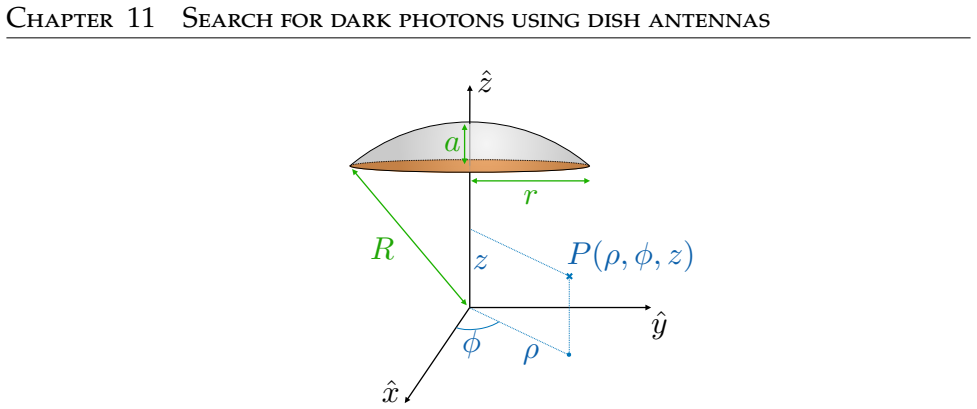
The central claim is that the standard full-focus assumption for dish-antenna dark photon searches is wrong. The thesis derives, in Chapter 11, the electric field at a receiver placed at the curvature center of a spherical dish by propagating the field in two steps: first from the dish to a closing plane with the thin optical element approximation, then from that plane to the receiver with an exact Kirchhoff integral and a Dirichlet Green function. The result, Eq. (11.15), shows that the focused power is a strong function of the dark photon Compton frequency; for dish radii well above the wavelength it can fall to a few percent of the emitted power. The thesis also establishes complementary results: an optical-cavity phase shift from axion birefringence that is independent of laser frequency and resonantly enhanced at even modes, a microwave-cavity signal linear in the dark photon kinetic mixing and amplified near odd resonances, and concrete sensitivity projections for atom interferometry, equivalence-principle tests, and LISA.
Load-bearing premise
The load-bearing premise is that the dish can be treated as a thin optical element, requiring its radius to be much smaller than its curvature radius and transverse field modes to be much smaller than the longitudinal wavevector; if a realistic spherical dish violates these conditions, the few-percent focusing result may change.
Editorial extensions
If this is right
- Dish-antenna exclusion limits that assume full focusing will need revision; the true sensitivity is frequency-dependent and may be worse by more than an order of magnitude in the affected mass range.
- The proposed Rydberg-atom microwave-cavity experiment can scan a continuous band of dark photon masses by sweeping the applied field frequency, with the signal enhanced by the cavity quality factor near odd resonances.
- For axion-photon searches, the optical-cavity phase-shift formula gives a signal independent of the laser frequency, so the same cavity can probe a broad range of axion masses near even modes rather than a single resonant frequency.
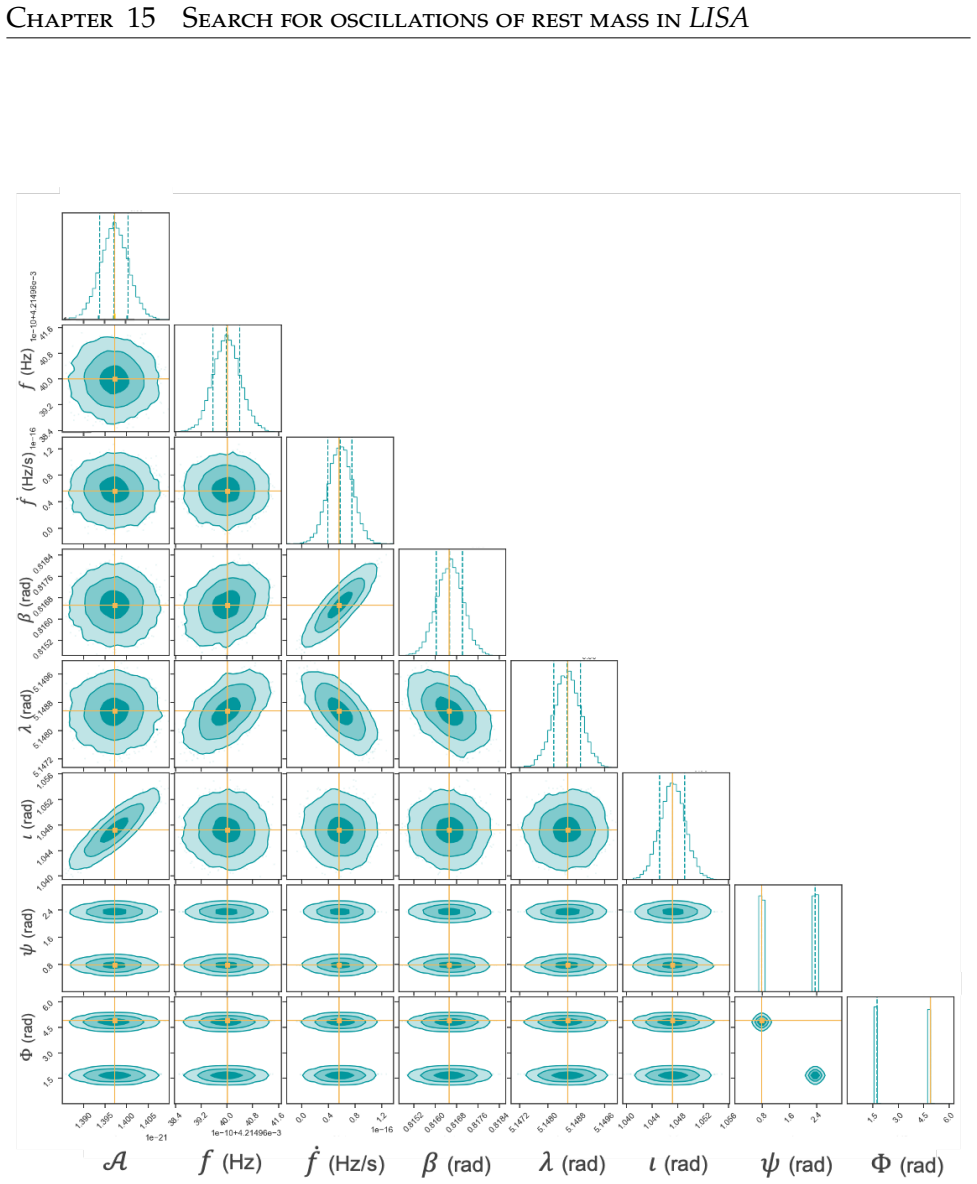
- In LISA, a Bayesian likelihood that discriminates oscillating-mass dark matter signals from gravitational waves yields realistic sensitivity limits on scalar and vector couplings, including cases where the two signals overlap.
Reading between the lines
- Editorial extension: if the dish result holds, reanalysing past dish-antenna limits with the Kirchhoff efficiency curve would be a direct test of whether any excluded dark-photon parameter space actually remains open.
- Editorial extension: the same two-step Kirchhoff method could be applied to other curved emitters, such as parabolic dishes or lens-coupled receivers, where the thin optical element approximation may be better or worse controlled.
- Editorial extension: a tabletop radio-frequency analogue with a point source and spherical reflector would measure the focusing efficiency as a function of $R/r$ and wavelength, giving a clean laboratory check of the few-percent prediction.
Editorial analysis
A structured set of objections, weighed in public.
Referee Report
Summary. This PhD thesis investigates experimental strategies for detecting ultralight dark matter (ULDM), focusing on three phenomenologies: dark-photon kinetic mixing with electromagnetism (probed with cavities, Rydberg atoms, and dish antennas), scalar/axion couplings that oscillate atomic masses and transition frequencies (probed with equivalence-principle tests, atom interferometry, and LISA), and axion-photon coupling effects such as vacuum birefringence and dichroism (probed with optical cavities, fibers, and LISA). The manuscript derives signal amplitudes and estimates sensitivities for these schemes. Its most distinctive new claim, developed in Chapter 11, is that for dish antennas the dark-photon-induced field is not fully focused at the curvature center: the power received there can be only a few percent of the emitted power, even when the dish radius exceeds the wavelength by more than an order of magnitude. This is presented as a correction to the standard assumption quoted from Ref. [10] that the emitted power is entirely focused at the curvature center.
Significance. If correct, the dish-antenna result would materially affect the design and sensitivity projections of dish-based dark-photon searches, including experiments of the SHUKET/FUNK type. The thesis also contains useful derivations for optical-cavity and fiber searches for axion-photon coupling, a Rydberg-atom microwave-cavity detection scheme for dark photons, and a framework for LISA-based searches. Strengths include the explicit statement of approximations, the use of standard astrophysical inputs (local density, velocity distribution, coherence time, stochastic amplitude correction), and forward sensitivity projections rather than fits. However, the central dish claim rests on a two-step approximate Green-function calculation whose validity is not independently established, and the sensitivity chapters and appendices were not available in the provided text, so the projected sensitivity curves could not be checked.
major comments (3)
- [Section 11.2, Eqs. (11.7), (11.10), (11.15)] The chapter's central claim—that the power received at the curvature center is only a few percent of P_emit even for r/λ>10—is obtained by replacing the spherical dish with a thin phase screen (Eq. (11.7), stated in Section 11.2.2 to be valid only for r<<R) and then propagating from the fictional plane using the Dirichlet Green function of an infinite plane (Eqs. (11.10)-(11.15)). The second step is equivalent to diffraction by an aperture in an opaque screen: the field on the fictional plane outside the projected disk is set to zero. There is no physical screen in the actual setup, and the boundary condition is only on the dish surface. The manuscript itself states in Section 11.2.1 that no exact analytical solution for the spherical geometry exists, and realistic dish antennas can have r comparable to R, outside the stated validity of the phase-screen approximation. The stress-test concern about the opaque-plane model is partly legitimate: while the phase factor e^{ikf} in Eq. (11.7) preserves the constant optical path to the curvature center in the paraxial limit, the artificial zero boundary condition on the fictional plane outside the disk is an unvalidated modeling choice that can alter the diffracted field and the power coupled into the receiver. I therefore ask for an independent quantitative validation (for example, a full-wave or boundary-integral calculation for a spherical cap with the relevant f-number) and for an assessment of how much the sensitivity projections in Chapter 18 change under this modeling uncertainty.
- [Chapters 15-18 and Appendices A-E] The text made available for review stops at Section 11.3.1. The sensitivity estimates in Chapter 18 and the supporting derivations in Appendices A-E, including the phase-shift derivation leading to Eq. (9.7) and the cavity-field derivation leading to Eq. (10.12), are therefore not checkable from the provided material. Since those sensitivity projections are a central output of the thesis, the complete manuscript should be supplied, and every equation used to produce a sensitivity curve should be derivable either in the main text or in an appendix.
- [Section 11.1 and Section 11.3] The phrase "power received at the curvature center" is not precisely defined in the available text. Section 11.1 defines emitted power P_emit (Eq. (11.2)), and Section 11.3 begins a mode-overlap calculation for a horn antenna, but the relation between the electric field from Eq. (11.15), the total power crossing a detector plane, and the power actually coupled into the antenna mode is not stated. The chapter's headline correction to Ref. [10] ("only a few percent of emitted power") depends on this relation; without it, the reader cannot tell whether the suppression is a propagation effect, a detection-efficiency effect, or both.
minor comments (3)
- [Section 11.2.2, after Eq. (11.8)] The notation Δx, Δy for the dish extent is introduced without definition; the order-of-magnitude estimate p~q~1/Δx~1 m^-1 should be stated in terms of the dish radius r and the angular aperture r/R.
- [Eq. (9.7)] As typeset, the fraction containing sqrt(1−2r^2 cos(2ω_aℓ/c)+r^4) and sin^2(ω_aℓ/(2c)) is ambiguous; please check the equation image in the arXiv source.
- [Fig. 11.1 and Section 11.2.1] The caption states that the closing surfaces A2 and A3 are chosen so that their contributions vanish at the curvature center; since Eq. (11.15) is used for general receiver positions, the text should explain why those contributions can be neglected at the receiver location actually considered.
Circularity Check
Self-contained forward sensitivity calculations; no circular step identified.
full rationale
The thesis is a forward-calculation pipeline. Couplings such as chi, g_agamma, d_e, and d_g are free parameters that are scanned, not fitted to the target signals. The amplitudes of the ULDM fields are fixed by the stated local density and velocity distribution (Eqs. 7.17 and 7.26), which are external inputs, and the signals are then propagated through Maxwell and Klein-Gordon equations in standard ways. The sensitivity estimates in Chapters 17-18 compare predicted signal power spectral densities to experimental noise models, so the 'predictions' are not obtained by construction from the fitted parameters. The self-citations that appear, notably the published versions of the cavity and dish proposals, are pointers to the same derivations presented in the thesis and are not load-bearing justifications. The strongest new claim, the dish-antenna result of Chapter 11, rests on the thin optical element approximation of Eq. (11.7) and the Dirichlet Green function propagation of Eq. (11.15); these are stated approximations with stated validity conditions (p,q << k and r << R), and the resulting few-percent power estimate follows from integrating the assumed source field rather than by circular reduction. The thesis itself acknowledges that no exact analytical solution exists for the spherical dish, which is a legitimate model-risk caveat, but it is not a circularity. Overall, the derivation chain is self-contained and no specific step reduces to its own inputs.
Assumptions & free parameters
free parameters (3)
- Local dark matter energy density rho_DM =
0.4 GeV/cm^3
- Galactic dark matter mean velocity v_DM and velocity dispersion sigma_v =
v_DM = 3e5 m/s; sigma_v = 1.5e5 m/s
- Stochastic amplitude correction factor for T_obs much less than tau =
1.51 at 68% confidence
assumptions (4)
- domain assumption The ULDM field oscillates as a classical coherent field with amplitude fixed by rho_DM and behaves as cold dark matter.
- domain assumption The field is monochromatic and spatially homogeneous over each experiment; velocity dispersion is neglected except through the coherence time.
- ad hoc to paper For the dish calculation, the spherical dish can be treated as a thin optical element with transverse modes much smaller than the longitudinal wavevector and radius much smaller than curvature radius.
- domain assumption The scalar and axion couplings to matter are described by the low-energy linear Lagrangians Eq. (8.1) and Eq. (8.16), with atom charge tables computed in the cited literature.
Cite this review
Pith. "Pith review of Exploration of new experimental strategies for the detection of ultralight dark matter : laboratory searches on ground and in space." pith.science (2026). https://pith.science/paper/CFYYJ5N5
@misc{pith2026241114128,
  author       = {Pith},
  title        = {Pith review of: Exploration of new experimental strategies for the detection of ultralight dark matter : laboratory searches on ground and in space},
  year         = {2026},
  howpublished = {\url{https://pith.science/paper/CFYYJ5N5}},
  note         = {Machine review of arXiv:2411.14128}
}
read the original abstract
Ultralight dark matter (ULDM), as a class of low mass (< 1 eV) dark matter (DM) candidates, is a compelling alternative to historically dominant models such as WIMPs and has recently gained significant attention in the scientific community. In this thesis, we study various experimental schemes for the direct detection of ULDM, both on ground and in space. More precisely, we propose a theoretical modeling of current and futuristic experiments, and we derive an estimation of their respective sensitivity. We mainly concentrate on three distinct phenomenologies. The first one is the coupling between a DM U(1) field, known as the dark photon (DP), and electromagnetism, which induces a small electric field oscillating at the DP Compton frequency. We study how to detect this electric field using atoms inside a cavity and through dish antennas. The second main phenomenology considered in this thesis is the oscillation of rest mass and transition frequencies of atoms and test masses. These oscillations could be produced by the non-universal coupling of standard matter with a scalar ULDM candidate (dilaton or axion-like particle). We study how to detect such couplings in classical tests of the universality of free fall (UFF), atom interferometry and using LISA. Finally, we study the effect of vacuum birefringence and dichroism induced by the coupling between axions and photons, and how it could be detected with optical cavities, fibers, and LISA.
Figures


Figures from the paper (31 more)






Reference graph
Works this paper leans on
-
[10]
Stefan Knirck et al. “First results from a hidden photon dark matter search in the meV sectorusingaplane-parabolicmirrorsystem”.In: JournalofCosmologyandAstroparticle Physics 2018.11 (Nov. 2018), p. 031.doi: 10 . 1088 / 1475 - 7516 / 2018 / 11 / 031. url: https://dx.doi.org/10.1088/1475-7516/2018/11/031
-
[1]
Searching for Dark Matter with an Optical Cavity and an Unequal-Delay Interferometer
Etienne Savalle et al. “Searching for Dark Matter with an Optical Cavity and an Unequal-Delay Interferometer”. In:Phys. Rev. Lett.126 (5 Feb. 2021), p. 051301.doi: 10.1103/PhysRevLett.126.051301 . url: https://link.aps.org/doi/10.1103/ PhysRevLett.126.051301
-
[2]
Novel approaches to dark-matter detection using space-time separated clocks
Etienne Savalle et al.Novel approaches to dark-matter detection using space-time separated clocks. 2019.doi: 10.48550/ARXIV.1902.07192. url: https://arxiv.org/abs/1902. 07192
work page Pith review arXiv doi:10.48550/arxiv.1902.07192 2019
-
[3]
Long-distancefrequencytransferoveranurbanfiberlinkusingoptical phase stabilization
H.Jiangetal.“Long-distancefrequencytransferoveranurbanfiberlinkusingoptical phase stabilization”. In:Journal of the Optical Society of America B25.12 (Nov. 2008), p. 2029.issn: 1520-8540.doi: 10.1364/josab.25.002029 . url: http://dx.doi.org/ 10.1364/JOSAB.25.002029
-
[4]
TheMeasurementofAMnoiseofOscillators .2005
EnricoRubiola. TheMeasurementofAMnoiseofOscillators .2005. doi: 10.48550/ARXIV. PHYSICS/0512082.url: https://doi.org/10.48550/ARXIV.PHYSICS/0512082
-
[5]
The Virgo Physics Book : Optics and related Topics
J-Y Vinet. The Virgo Physics Book : Optics and related Topics. 2020
2020
-
[6]
DirectSearchesforHidden- Photon Dark Matter with the SHUKET Experiment
PierreBrun,LaurentChevalier,andChristopheFlouzat.“DirectSearchesforHidden- Photon Dark Matter with the SHUKET Experiment”. In:Phys. Rev. Lett.122 (20 May 2019), p. 201801.doi: 10.1103/PhysRevLett.122.201801 . url: https://link.aps. org/doi/10.1103/PhysRevLett.122.201801
-
[7]
Searching for Dark Matter with a Superconducting Qubit
Akash V. Dixit et al. “Searching for Dark Matter with a Superconducting Qubit”. In: Phys. Rev. Lett.126 (14 Apr. 2021), p. 141302.doi: 10.1103/PhysRevLett.126.141302. url: https://link.aps.org/doi/10.1103/PhysRevLett.126.141302
Show all 88 references
-
[9]
Experimental search for hidden photon CDM in the eV mass range with a dish antenna
J. Suzuki et al. “Experimental search for hidden photon CDM in the eV mass range with a dish antenna”. In:Journal of Cosmology and Astroparticle Physics2015.09 (Sept. 2015), p. 042.doi: 10.1088/1475-7516/2015/09/042. url: https://dx.doi.org/10. 1088/1475-7516/2015/09/042
2015 doi
-
[11]
LimitsfromtheFUNKexperimentonthemixing strength of hidden-photon dark matter in the visible and near-ultraviolet wavelength range
ArnaudAndrianavalomahefaetal.“LimitsfromtheFUNKexperimentonthemixing strength of hidden-photon dark matter in the visible and near-ultraviolet wavelength range”. In:Phys. Rev. D102 (4 Aug. 2020), p. 042001.doi: 10.1103/PhysRevD.102. 042001.url: https://link.aps.org/doi/10.1103...
2020 doi
-
[12]
Wideband Direct Detection Constraints on Hidden Photon Dark Matter with the QUALIPHIDE Experiment
K. Ramanathan et al. “Wideband Direct Detection Constraints on Hidden Photon Dark Matter with the QUALIPHIDE Experiment”. In:Phys. Rev. Lett.130 (23 June 2023), p. 231001.doi: 10.1103/PhysRevLett.130.231001 . url: https://link.aps. org/doi/10.1103/PhysRevLett.130.231001
2023 doi
- [13]
-
[14]
Tunable cw UV laser with <35 kHz absolute frequency instability for precision spectroscopy of Sr Rydberg states
Elizabeth M. Bridge et al. “Tunable cw UV laser with <35 kHz absolute frequency instability for precision spectroscopy of Sr Rydberg states”. In:Opt. Express 24.3 (Feb. 2016), pp. 2281–2292.doi: 10 . 1364 / OE . 24 . 002281. url: https : / / opg . optica.org/oe/abstrac...
2016
-
[15]
Anoise-immunecavity-assistednon-destructivedetectionforanoptical lattice clock in the quantum regime
GValletetal.“Anoise-immunecavity-assistednon-destructivedetectionforanoptical lattice clock in the quantum regime”. en. In:New Journal of Physics19.8 (Aug. 2017), p. 083002.issn: 1367-2630.doi: 10.1088/1367-2630/aa7c84
2017 doi
-
[16]
Spectroscopy of a cold strontium Rydberg gas
J Millen et al. “Spectroscopy of a cold strontium Rydberg gas”. In:Journal of Physics B: Atomic, Molecular and Optical Physics44.18 (Sept. 2011), p. 184001.doi: 10.1088/0953- 4075/44/18/184001.url: https://dx.doi.org/10.1088/0953-4075/44/18/184001
2011 doi
-
[17]
Revealing the dark matter halo with axion direct detection
J. W. Foster, N. L. Rodd, and B. R. Safdi. “Revealing the dark matter halo with axion direct detection”. In:Physical Review D97.12, 123006 (2018), p. 123006.doi: 10.1103/ PhysRevD.97.123006. arXiv:1711.10489
2018 arXiv
-
[18]
Progress in atomic fountains at LNE-SYRTE
J. Guena et al. “Progress in atomic fountains at LNE-SYRTE”. In:IEEE Transactions on Ultrasonics, Ferroelectrics and Frequency Control59.3 (Mar. 2012), pp. 391–409.doi: 10. 1109/tuffc.2012.2208. url: https://doi.org/10.1109%5C%2Ftuffc.2012.2208
2012
-
[20]
Then, Eq.(11.28)isusedtoestimatenumericallythe efficiency coefficient 𝛾(𝑓, Δ𝑧)AF= 𝑍0𝑀2 dish(𝜌= 0,Δ𝑧, 𝑓) 2𝑅0AF(𝑓)2
to infer the value of the antenna factor as function of the frequency AF(𝑓). Then, Eq.(11.28)isusedtoestimatenumericallythe efficiency coefficient 𝛾(𝑓, Δ𝑧)AF= 𝑍0𝑀2 dish(𝜌= 0,Δ𝑧, 𝑓) 2𝑅0AF(𝑓)2 . (18.29) The behavior of this efficiency coefficient as a function of the DP frequenc...
-
[21]
url: https: //www.schwarzbeck.de/en/antennas/broadband-horn-antennas/double-ridged- horn-antenna/404-bbha-9120-d-double-ridged-broadband-horn-antenna.html
DoubleRidgedBroadband HornAntenna .BBHA 9120D.Schwarzbeck.2023. url: https: //www.schwarzbeck.de/en/antennas/broadband-horn-antennas/double-ridged- horn-antenna/404-bbha-9120-d-double-ridged-broadband-horn-antenna.html
2023
-
[23]
MICROSCOPE mission scenario, ground segment and data processing
Manuel Rodrigues et al. “MICROSCOPE mission scenario, ground segment and data processing”. In:Classical and Quantum Gravity39.20 (Sept. 2022), p. 204004.doi: 10. 1088/1361-6382/ac4b9a.url: https://dx.doi.org/10.1088/1361-6382/ac4b9a
2022 doi
-
[25]
MICROSCOPE’sviewatgravitation
JoelBergé.“MICROSCOPE’sviewatgravitation”.In: ReportsonProgressinPhysics 86.6 (May 2023), p. 066901.doi: 10.1088/1361-6633/acd203. url: https://dx.doi.org/ 10.1088/1361-6633/acd203
2023 doi
-
[27]
The Feynman path integral approach to atomic interferometry. A tutorial
Pippa Storey and Claude Cohen-Tannoudji. “The Feynman path integral approach to atomic interferometry. A tutorial”. In:Journal de Physique II4.11 (1994), pp. 1999–
1994
-
[28]
Refined ultralight scalar dark matter searches with compact atom gradiometers
Leonardo Badurina, Diego Blas, and Christopher McCabe. “Refined ultralight scalar dark matter searches with compact atom gradiometers”. In:Phys. Rev. D105 (2 Jan. 2022), p. 023006.doi: 10.1103/PhysRevD.105.023006. url: https://link.aps.org/ doi/10.1103/PhysRevD.105.023006
2022 doi
-
[29]
AION:anatominterferometerobservatoryandnetwork
L.Badurinaetal.“AION:anatominterferometerobservatoryandnetwork”.In: Journal of Cosmology and Astroparticle Physics2020.05 (May 2020), p. 011.doi: 10.1088/1475- 7516/2020/05/011. url: https://dx.doi.org/10.1088/1475-7516/2020/05/011
2020 doi
-
[30]
Inter-spacecraft frequency distribution for future gravitational wave obser- vatories
S. Barke. “Inter-spacecraft frequency distribution for future gravitational wave obser- vatories”. PhD thesis. Leibniz U., 2015
2015
-
[31]
Matter-wave Atomic Gradiometer Interferometric Sensor (MAGIS- 100)
Mahiro Abe et al. “Matter-wave Atomic Gradiometer Interferometric Sensor (MAGIS- 100)”.In: QuantumScienceandTechnology 6.4(July2021),p.044003. doi: 10.1088/2058- 9565/abf719. url: https://dx.doi.org/10.1088/2058-9565/abf719
-
[32]
Photonic microwave signals with zeptosecond-level absolute tim- ing noise
Xiaopeng Xie et al. “Photonic microwave signals with zeptosecond-level absolute tim- ing noise”. In:Nature Photonics11.1 (2017), pp. 44–47.issn: 1749-4893. url: https : //doi.org/10.1038/nphoton.2016.215
2017 doi
-
[33]
Ultra-low-phase-noise cryocooled microwave dielectric-sapphire-resonator oscillators
John G. Hartnett, Nitin R. Nand, and Chuan Lu. “Ultra-low-phase-noise cryocooled microwave dielectric-sapphire-resonator oscillators”. In:Applied Physics Letters100.18 (Apr. 2012), p. 183501.issn: 0003-6951. doi: 10 . 1063 / 1 . 4709479. eprint: https : / / pubs . aip . org / ...
2012 doi
-
[34]
Stochastic gravitational wave background reconstruction for a nonequilateral and unequal-noise LISA constellation
Olaf Hartwig et al. “Stochastic gravitational wave background reconstruction for a nonequilateral and unequal-noise LISA constellation”. In:Physical Review D107.12 (June 2023).issn: 2470-0029.doi: 10.1103/physrevd.107.123531 . url: http://dx. doi.org/10.1103/PhysRevD.107.123531
2023 doi
-
[35]
Stanislav Babak, Martin Hewitson, and Antoine Petiteau.LISA Sensitivity and SNR Calculations. 2021. arXiv:2108.01167 [astro-ph.IM]
2021 arXiv
-
[37]
LISADefinitionStudyReport .2024.arXiv: 2402.07571 [astro-ph.CO]
MonicaColpietal. LISADefinitionStudyReport .2024.arXiv: 2402.07571 [astro-ph.CO]
2024 arXiv
-
[38]
Searching for an Oscillating Massive Scalar Field as a Dark Matter Candidate Using Atomic Hyperfine Frequency Comparisons
A. Hees et al. “Searching for an Oscillating Massive Scalar Field as a Dark Matter Candidate Using Atomic Hyperfine Frequency Comparisons”. In:Phys. Rev. Lett.117 (6Aug.2016),p.061301. doi: 10.1103/PhysRevLett.117.061301.url: https://link. aps.org/doi/10.1103/PhysRevLett.117.0...
2016 doi
-
[39]
Torsion-balancetestsoftheweakequivalenceprinciple
TAWagneretal.“Torsion-balancetestsoftheweakequivalenceprinciple”.In: Classical and Quantum Gravity29.18 (Aug. 2012), p. 184002.doi: 10.1088/0264-9381/29/18/ 184002. url: https://dx.doi.org/10.1088/0264-9381/29/18/184002
2012 doi
-
[40]
New Limit on Axionlike Dark Matter Using Cold Neutrons
Ivo Schulthess et al. “New Limit on Axionlike Dark Matter Using Cold Neutrons”. In: Phys. Rev. Lett.129.19 (2022), p. 191801.doi: 10.1103/PhysRevLett.129.191801 . arXiv: 2204.01454 [hep-ex]
2022
-
[41]
PrecisionMetrologyMeetsCosmology:ImprovedConstraints on Ultralight Dark Matter from Atom-Cavity Frequency Comparisons
ColinJ.Kennedyetal.“PrecisionMetrologyMeetsCosmology:ImprovedConstraints on Ultralight Dark Matter from Atom-Cavity Frequency Comparisons”. In:Phys. Rev. Lett. 125 (20 Nov. 2020), p. 201302.doi: 10 . 1103 / PhysRevLett . 125 . 201302. url: https://link.aps.org/doi/10.1103/Phys...
2020 doi
-
[42]
Searchforultralightdarkmatterwithspectroscopyofradio-frequency atomic transitions
XueZhangetal.“Searchforultralightdarkmatterwithspectroscopyofradio-frequency atomic transitions”. In: (Dec. 2022). arXiv:2212.04413 [physics.atom-ph]
2022 arXiv
-
[43]
Experimental Constraint on Axionlike Particles over Seven Orders of Magnitude in Mass
Tanya S. Roussy et al. “Experimental Constraint on Axionlike Particles over Seven Orders of Magnitude in Mass”. In:Phys. Rev. Lett.126.17 (2021), p. 171301.doi: 10. 1103/PhysRevLett.126.171301. arXiv:2006.15787 [hep-ph]
2021 arXiv
-
[44]
cajohare/AxionLimits: AxionLimits
Ciaran O’Hare. cajohare/AxionLimits: AxionLimits. https : / / cajohare . github . io / AxionLimits/. Version v1.0. July 2020.doi: 10.5281/zenodo.3932430
2020 doi
-
[45]
Search for Axionlike Dark Matter through Nuclear Spin Precession in Electric and Magnetic Fields
C. Abel et al. “Search for Axionlike Dark Matter through Nuclear Spin Precession in Electric and Magnetic Fields”. In:Phys. Rev. X 7 (4 Nov. 2017), p. 041034.doi: 10.1103/PhysRevX.7.041034.url: https://link.aps.org/doi/10.1103/PhysRevX. 7.041034
2017 doi
-
[46]
A Search for Invisible Axion Dark Matter with the Axion Dark Matter Experiment
N. Du et al. “A Search for Invisible Axion Dark Matter with the Axion Dark Matter Experiment”. In:Phys. Rev. Lett.120.15 (2018), p. 151301.doi: 10.1103/PhysRevLett. 120.151301. arXiv:1804.05750 [hep-ex]
2018 arXiv
-
[47]
SQUID-Based Microwave Cavity Search for Dark-Matter Axions
S. J. Asztalos et al. “SQUID-Based Microwave Cavity Search for Dark-Matter Axions”. In: Phys. Rev. Lett.104.4, 041301 (Jan. 2010), p. 041301.doi: 10.1103/PhysRevLett. 104.041301. arXiv:0910.5914 [astro-ph.CO]
2010 arXiv
-
[49]
Extended Search for the Invisible Axion with the Axion Dark Matter Experiment
T. Braine et al. “Extended Search for the Invisible Axion with the Axion Dark Matter Experiment”. In:Phys. Rev. Lett.124.10 (2020), p. 101303.doi: 10.1103/PhysRevLett. 124.101303. arXiv:1910.08638 [hep-ex]
2020 arXiv
-
[50]
AxionDarkMatterSearcharound6.7 𝜇eV
S.Leeetal.“AxionDarkMatterSearcharound6.7 𝜇eV”.In:Phys.Rev.Lett. 124.10(2020), p. 101802.doi: 10.1103/PhysRevLett.124.101802. arXiv:2001.05102 [hep-ex]
2020 arXiv
-
[51]
Piezoelectrically Tuned Multimode Cavity Search for Axion Dark Matter
C. Boutan et al. “Piezoelectrically Tuned Multimode Cavity Search for Axion Dark Matter”. In:Phys. Rev. Lett.121.26 (2018), p. 261302.doi: 10.1103/PhysRevLett.121. 261302. arXiv:1901.00920 [hep-ex]
2018 arXiv
-
[52]
Searching for Invisible Axion Dark Matter with an 18 T Magnet Haloscope
Youngjae Lee et al. “Searching for Invisible Axion Dark Matter with an 18 T Magnet Haloscope”. In:Phys. Rev. Lett.128.24 (2022), p. 241805.doi: 10.1103/PhysRevLett. 128.241805. arXiv:2206.08845 [hep-ex]. 203
2022 arXiv
-
[53]
Search for Invisible Axion Dark Matter with a Multiple-Cell Halo- scope
Junu Jeong et al. “Search for Invisible Axion Dark Matter with a Multiple-Cell Halo- scope”. In:Phys. Rev. Lett.125.22 (2020), p. 221302.doi: 10.1103/PhysRevLett.125. 221302. arXiv:2008.10141 [hep-ex]
2020 arXiv
-
[54]
Near-Quantum-NoiseAxionDarkMatterSearchatCAPParound9.5 𝜇eV
JinsuKimetal.“Near-Quantum-NoiseAxionDarkMatterSearchatCAPParound9.5 𝜇eV”. In: (July 2022). arXiv:2207.13597 [hep-ex]
2022 arXiv
-
[55]
FirstResultsfromanAxionHaloscopeatCAPParound10.7 𝜇eV
OhjoonKwonetal.“FirstResultsfromanAxionHaloscopeatCAPParound10.7 𝜇eV”. In: Phys. Rev. Lett.126.19 (2021), p. 191802.doi: 10.1103/PhysRevLett.126.191802 . arXiv: 2012.10764 [hep-ex]
2021 arXiv
-
[56]
Results from phase 1 of the HAYSTAC microwave cavity axion exper- iment
L. Zhong et al. “Results from phase 1 of the HAYSTAC microwave cavity axion exper- iment”. In:Phys. Rev. D97.9 (2018), p. 092001.doi: 10.1103/PhysRevD.97.092001 . arXiv: 1803.03690 [hep-ex]
2018 arXiv
-
[57]
DFSZAxionDarkMatterSearcharound4.55 𝜇eV
AndrewK.Yietal.“DFSZAxionDarkMatterSearcharound4.55 𝜇eV”.In:(Oct.2022). arXiv: 2210.10961 [hep-ex]
2022 arXiv
-
[58]
DirectsearchfordarkmatteraxionsexcludingALPcogenesis inthe63-to67- 𝜇eVrangewiththeORGANexperiment
AaronQuiskampetal.“DirectsearchfordarkmatteraxionsexcludingALPcogenesis inthe63-to67- 𝜇eVrangewiththeORGANexperiment”.In: ScienceAdvances 8.27(July 2022).doi: 10.1126/sciadv.abq3765.url: https://doi.org/10.1126%5C%2Fsciadv. abq3765
2022 doi
-
[59]
A quantum-enhanced search for dark matter axions
K. M. Backes et al. “A quantum-enhanced search for dark matter axions”. In:Nature 590.7845 (2021), pp. 238–242.doi: 10.1038/s41586-021-03226-7 . arXiv:2008.01853 [quant-ph]
2021 arXiv
-
[60]
Search for invisible axion dark matter of mass m𝑎 = 43 𝜇eV with the QUAX–𝑎𝛾 experiment
D. Alesini et al. “Search for invisible axion dark matter of mass m𝑎 = 43 𝜇eV with the QUAX–𝑎𝛾 experiment”. In:Phys. Rev. D103.10 (2021), p. 102004.doi: 10.1103/ PhysRevD.103.102004. arXiv:2012.09498 [hep-ex]
2021 arXiv
-
[61]
Galactic axions search with a superconducting resonant cavity
D. Alesini et al. “Galactic axions search with a superconducting resonant cavity”. In: Phys. Rev. D99.10 (2019), p. 101101.doi: 10.1103/PhysRevD.99.101101 . arXiv: 1903.06547 [physics.ins-det]
2019 arXiv
-
[62]
First Results from ABRACADABRA-10 cm: A Search for Sub-𝜇eVAxionDarkMatter
Jonathan L. Ouellet et al. “First Results from ABRACADABRA-10 cm: A Search for Sub-𝜇eVAxionDarkMatter”.In: Phys.Rev.Lett. 122.12(2019),p.121802. doi: 10.1103/ PhysRevLett.122.121802. arXiv:1810.12257 [hep-ex]
2019 arXiv
-
[63]
Search for Galactic axions with a high-Q dielectric cavity
D. Alesini et al. “Search for Galactic axions with a high-Q dielectric cavity”. In:Phys. Rev.D 106.5(2022),p.052007. doi: 10.1103/PhysRevD.106.052007.arXiv: 2208.12670 [hep-ex]
2022 arXiv
-
[64]
Search for Invisible Axion Dark Matter in the 3.3–4.2𝜇eV Mass Range
C. Bartram et al. “Search for Invisible Axion Dark Matter in the 3.3–4.2𝜇eV Mass Range”. In:Phys. Rev. Lett.127.26 (2021), p. 261803.doi: 10.1103/PhysRevLett.127. 261803. arXiv:2110.06096 [hep-ex]
2021 arXiv
-
[65]
SearchforLow-MassAxionDarkMatterwithABRACADABRA- 10 cm
ChiaraP.Salemietal.“SearchforLow-MassAxionDarkMatterwithABRACADABRA- 10 cm”. In:Phys. Rev. Lett.127.8 (2021), p. 081801.doi: 10.1103/PhysRevLett.127. 081801. arXiv:2102.06722 [hep-ex]
2021 arXiv
-
[66]
Search for Dark Matter Axions with CAST-CAPP
C. M. Adair et al. “Search for Dark Matter Axions with CAST-CAPP”. In:Nature Commun. 13.1 (2022), p. 6180.doi: 10.1038/s41467-022-33913-6. arXiv:2211.02902 [hep-ex]. 204
2022 arXiv
-
[67]
ADMX SLIC: Results from a Superconducting𝐿𝐶 Circuit Inves- tigating Cold Axions
N. Crisosto et al. “ADMX SLIC: Results from a Superconducting𝐿𝐶 Circuit Inves- tigating Cold Axions”. In:Phys. Rev. Lett.124.24 (2020), p. 241101.doi: 10 . 1103 / PhysRevLett.124.241101. arXiv:1911.05772 [astro-ph.CO]
2020 arXiv
-
[68]
Extended Axion Dark Matter Search Using the CAPP18T Halo- scope
Byeongsu Yang et al. “Extended Axion Dark Matter Search Using the CAPP18T Halo- scope”. In: (Aug. 2023). arXiv:2308.09077 [hep-ex]
2023 arXiv
-
[69]
Experimental search for invisible axions as a test of axion cosmology around 22 ueV
Younggeun Kim et al. “Experimental search for invisible axions as a test of axion cosmology around 22 ueV”. In: (Dec. 2023). arXiv:2312.11003 [hep-ex]
2023 arXiv
-
[70]
Axion haloscope using an 18 T high temperature superconducting magnet
Hojin Yoon et al. “Axion haloscope using an 18 T high temperature superconducting magnet”.In: Phys.Rev.D 106.9(2022),p.092007. doi: 10.1103/PhysRevD.106.092007. arXiv: 2206.12271 [hep-ex]
2022 arXiv
-
[71]
Extensive search for axion dark matter over 1 GHz with CAPP’s Main Axion eXperiment
Saebyeok Ahn et al. “Extensive search for axion dark matter over 1 GHz with CAPP’s Main Axion eXperiment”. In: (Feb. 2024). arXiv:2402.12892 [hep-ex]
2024 arXiv
-
[72]
Exclusion of ALP Cogenesis Dark Matter in a Mass Window Above 100𝜇eV
Aaron Quiskamp et al. “Exclusion of ALP Cogenesis Dark Matter in a Mass Window Above 100𝜇eV”. In: (Oct. 2023). arXiv:2310.00904 [hep-ex]
2023 arXiv
-
[73]
ConstraintsontheCouplingbetweenAxionlikeDarkMatterand PhotonsUsinganAntiprotonSuperconductingTunedDetectionCircuitinaCryogenic Penning Trap
JackA.Devlinetal.“ConstraintsontheCouplingbetweenAxionlikeDarkMatterand PhotonsUsinganAntiprotonSuperconductingTunedDetectionCircuitinaCryogenic Penning Trap”. In:Phys. Rev. Lett.126.4 (2021), p. 041301.doi: 10.1103/PhysRevLett. 126.041301. arXiv:2101.11290 [astro-ph.CO]
2021 arXiv
-
[74]
New Results from HAYSTAC’s Phase II Operation with a Squeezed State Receiver
M. J. Jewell et al. “New Results from HAYSTAC’s Phase II Operation with a Squeezed State Receiver”. In: (Jan. 2023). arXiv:2301.09721 [hep-ex]
2023 arXiv
-
[75]
TheORGANExperiment:Anaxionhaloscopeabove15GHz
BenT.McAllisteretal.“TheORGANExperiment:Anaxionhaloscopeabove15GHz”. In: Phys. Dark Univ.18 (2017), pp. 67–72.doi: 10.1016/j.dark.2017.09.010 . arXiv: 1706.00209 [physics.ins-det]
2017 arXiv
-
[76]
Search for axion-like dark matter with ferromagnets
Alexander V. Gramolin et al. “Search for axion-like dark matter with ferromagnets”. In: Nature Phys.17.1 (2021), pp. 79–84.doi: 10 . 1038 / s41567 - 020 - 1006 - 6. arXiv: 2003.03348 [hep-ex]
2021 arXiv
-
[77]
Searchforgalacticaxionswithatravelingwaveparametricamplifier
R.DiVoraetal.“Searchforgalacticaxionswithatravelingwaveparametricamplifier”. In: Phys. Rev. D108.6 (2023), p. 062005.doi: 10.1103/PhysRevD.108.062005 . arXiv: 2304.07505 [hep-ex]
2023 arXiv
-
[78]
Results of a Laboratory Search for Cosmic Axions and Other Weakly Coupled Light Particles
Walter Wuensch et al. “Results of a Laboratory Search for Cosmic Axions and Other Weakly Coupled Light Particles”. In:Phys. Rev. D40 (1989), p. 3153.doi: 10.1103/ PhysRevD.40.3153
1989
-
[79]
Limits on the abundance and coupling of cosmic axions at 4.5< 𝑚𝑎 <5.0 𝜇eV
S. DePanfilis et al. “Limits on the abundance and coupling of cosmic axions at 4.5< 𝑚𝑎 <5.0 𝜇eV”. In: Phys. Rev. Lett. 59 (7 Aug. 1987), pp. 839–842. doi: 10 . 1103 / PhysRevLett.59.839 . url: https://link.aps.org/doi/10.1103/PhysRevLett. 59.839
1987 doi
-
[80]
Resultsfromasearchforcosmicaxions
C.Hagmannetal.“Resultsfromasearchforcosmicaxions”.In: Phys.Rev.D 42(4Aug. 1990), pp. 1297–1300.doi: 10.1103/PhysRevD.42.1297. url: https://link.aps.org/ doi/10.1103/PhysRevD.42.1297. 205
1990 doi
-
[81]
First results from a second generation galactic axion experiment
C. Hagmann et al. “First results from a second generation galactic axion experiment”. In: Nucl. Phys. B Proc. Suppl.51 (1996). Ed. by D. B. Cline, pp. 209–212.doi: 10.1016/ S0920-5632(96)00516-6. arXiv:astro-ph/9607022
1996 arXiv
-
[82]
Cosmicraysatearth:Researcher’sreference,manualanddatabook .Amster- dam: Elsevier, 2001.isbn: 978-0-444-50710-5
P.K.F.Grieder. Cosmicraysatearth:Researcher’sreference,manualanddatabook .Amster- dam: Elsevier, 2001.isbn: 978-0-444-50710-5
2001
-
[83]
DE LA SIMULATION DE LISA A L’ANALYSE DES DONNEES. Détection d’ondes gravitationnelles par interférométrie spatiale (LISA : Laser Interfer- ometer Space Antenna)
Antoine Petiteau. “DE LA SIMULATION DE LISA A L’ANALYSE DES DONNEES. Détection d’ondes gravitationnelles par interférométrie spatiale (LISA : Laser Interfer- ometer Space Antenna)”. Theses. Université Paris-Diderot - Paris VII, June 2008.url: https://theses.hal.science/tel-00383222
2008
-
[84]
WISPy cold dark matter
Paola Arias et al. “WISPy cold dark matter”. In:Journal of Cosmology and Astroparticle Physics 2012.06 (June 2012), p. 013.doi: 10 . 1088 / 1475 - 7516 / 2012 / 06 / 013. url: https://dx.doi.org/10.1088/1475-7516/2012/06/013
2012 doi
-
[85]
Dark photon limits: A handbook
Andrea Caputo et al. “Dark photon limits: A handbook”. In:Phys. Rev. D104 (9 Nov. 2021), p. 095029.doi: 10.1103/PhysRevD.104.095029. url: https://link.aps.org/ doi/10.1103/PhysRevD.104.095029
2021 doi
-
[86]
Interpreting Antenna PerformanceParametersforEMCApplications:Part3:AntennaFactor
James S. Mclean, Robert Sutton, and Robert William Hoffman. “Interpreting Antenna PerformanceParametersforEMCApplications:Part3:AntennaFactor”.In:2002. url: https://api.semanticscholar.org/CorpusID:1097498
2002
-
[87]
ADMX-Orpheus first search for70 𝜇eVdark photon dark matter: Detaileddesign,operations,andanalysis
R. Cervantes et al. “ADMX-Orpheus first search for70 𝜇eVdark photon dark matter: Detaileddesign,operations,andanalysis”.In: Phys.Rev.D 106(10Nov.2022),p.102002. doi: 10.1103/PhysRevD.106.102002 . url: https://link.aps.org/doi/10.1103/ PhysRevD.106.102002
2022 doi
-
[88]
Smoothing and differentiation of data by simplified least squares procedures
“Smoothing and differentiation of data by simplified least squares procedures.” In: Analytical Chemistry36.8 (1964), pp. 1627–1639. 206 Part VIII Conclusion 207 General relativity and the Standard Model of particle physics are regarded today as the most successful theories in ...
1964
-
[89]
Constantine. A. Balanis. Antenna theory : Analysis and Design, 3rd edition. John Wiley and Sons, 2005
2005
-
[91]
reverseengineering-like
for consistent comparison. C.2 MICROSCOPE ForMICROSCOPE, the axis of measurement is alongside the test masses cylinders’ longitu- dinalsymmetryaxis[4]. TheorbitalmotionofthesatellitearoundEarthissun-synchronous, which means that the orientation of the orbital plane evolves wit...
-
[92]
(11.1), i.e®𝑈𝐷(®𝑥) = 𝑖𝜒𝜔𝑈®𝑌∥,𝐷(®𝑥),
Consider the field on the dish using boundary conditions Eq. (11.1), i.e®𝑈𝐷(®𝑥) = 𝑖𝜒𝜔𝑈®𝑌∥,𝐷(®𝑥),
-
[93]
Computethefield ateach point®𝑥′ onthe planeclosing thedish ®𝑈𝑃(®𝑥′)fromEq. (11.7),
-
[94]
Computenumericallythefieldonthedish ®𝑈test 𝐷 (®𝑥)from®𝑈𝑃(®𝑥′)usingKirchhoffintegral theorem Eq. (11.6),
-
[95]
Compute the relative error between®𝑈𝐷(®𝑥) and®𝑈test 𝐷 (®𝑥). We consider the plane located at𝑧′ = 𝑅−𝑎, then the field at a point(𝜌′,𝜙′,𝑧′) on the plane going towards the dish, located at𝑧≥ 𝑧′, is given by ®𝑈P→D(𝜌′,𝜙′,𝑧′)=𝑖𝜒𝜔𝑈𝑒−𝑖𝑘𝑓(𝜌′)®𝑌∥,𝐷(𝜌′,𝜙′, 𝑓(𝜌′)+ 𝑧′). (E.1) Notice the ch...
-
[2027]
url: https://hal.archives-ouvertes.fr/jpa- 00248106
doi: 10.1051/jp2:1994103 . url: https://hal.archives-ouvertes.fr/jpa- 00248106
Reviewed August 12, 2026 · model on record in the stance chip above.
Discussion (0). Continue with ORCID to comment.