REVIEW 3 major objections 4 minor 1 cited by
Superconducting $p$-wave pairing effects on one-dimensional non-Hermitian quasicrystals with power law hopping
T0 review · 3 major / 4 minor · reviewed 2026-08-12 · deepseek-v4-flash
Pith's one-line read Pairing turns quasicrystal edge modes into Majorana zeros
desk verdict A plausible numerical study of a new model combination; the central gap physics is credible, but the plateau-reduction claim needs finite-size and phase-averaged support before I'd trust it. read the letter →
The pith
A machine-rendered reading of the paper's core claim, the machinery that carries it, and where it could break.
The reading
What carries the argument
The machinery is the Bogoliubov-de Gennes Hamiltonian of a chain with power-law hopping $t/s^\xi$, a complex onsite potential $f(j)=\cos(2\pi\beta j)+ih\sin(2\pi\beta j)$, and real nearest-neighbor $p$-wave pairing $\Delta$. Particle-hole symmetry forces the spectrum to come in $(E,-E^*)$ pairs and is what makes zero-energy edge modes possible, while $\xi$ controls whether hopping is effectively short range or long range. To distinguish genuine crossings from avoided ones the authors compute the ground-state fermion parity from the Pfaffian of the Hamiltonian in a Majorana basis, and to quantify localization they use the box-counting fractal dimension $D_2$ over eigenstates with box sizes $d=2$ to $20$.
What would settle it
Compute the same spectra and fractal dimensions at larger Fibonacci sizes such as $N=2584$, $4181$, and $6765$ and for several phases $\theta$; if the five-to-two-to-none plateau sequence no longer holds, or the short-range edge modes do not separate into two non-overlapping zero modes as $\Delta$ grows, the central claim would be shown to be a finite-size artifact. A second check is the ground-state fermion parity at the alleged crossings: if the sign stops switching at larger $N$, the oscillating quasi-Majorana modes are not genuine.
Extended reading notes
Core claim
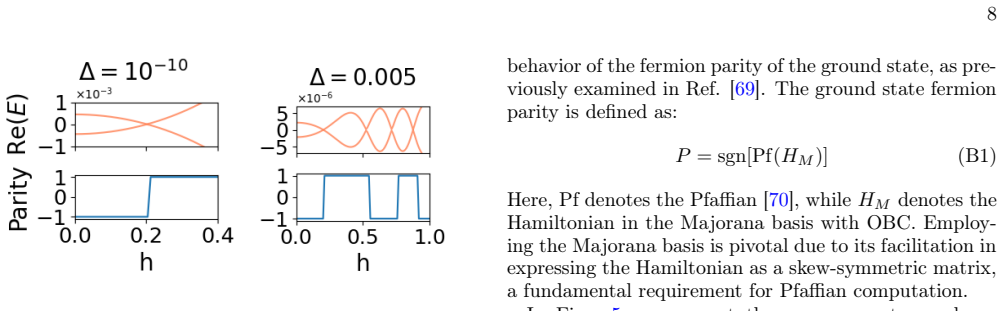
The central discovery is a pairing-controlled crossover in the non-Hermitian power-law AAH chain. With short-range hopping set by $\xi=5.0$, even an infinitesimal pairing $\Delta=10^{-10}$ opens a particle-hole symmetric spectrum with oscillating quasi-Majorana zero modes; these oscillations are accompanied by genuine zero-energy crossings where the ground-state fermion parity switches, and increasing $\Delta$ to $0.5$ fully separates the two edge modes into non-overlapping Majorana zero modes. For long-range hopping set by $\xi=0.2$, the central gap contains no exact zero modes; instead the near-gap states are massive Dirac modes with oscillatory character that progressively localize at both edges as $\Delta$ grows. In the long-range case with weak non-Hermiticity $h=0.1$, the fractal dimension $D_2$ of energy eigenstates shows five plateaus at fractions $\beta^l$ when $\Delta=0$, only two plateaus for up to $\Delta=0.13$, destruction of the first plateau by $\Delta=0.16$--$0.17$, and complete disappearance by $\Delta=0.25$. The paper further maps real-to-complex transitions and shows that for $h\lesssim 1.0$ the real-energy window and delocalized states coincide for short-range hopping but not for long-range hopping.
Load-bearing premise
The numerical results assume that exact diagonalization at $N=1597$ with quasiperiodic phase $\theta=0$ and box sizes $d=2$ through $20$ captures the thermodynamic-limit behavior, without finite-size scaling or phase averaging.
Editorial extensions
If this is right
- Short-range chains with weak pairing host oscillating quasi-Majorana zero modes whose zero-energy crossings are genuine parity-switching events, so weak pairing already equips the non-Hermitian AAH chain with the spectral signature of Majorana physics.
- Raising the pairing strength from $\Delta=10^{-10}$ to $0.5$ converts those oscillating near-zero modes into two spatially separated Majorana zero modes, one at each edge.
- Long-range hopping replaces exact zero modes with massive Dirac modes, and increasing $\Delta$ drives them from oscillatory nonlocal states to edge-localized states, so long-range hopping changes the topological edge content qualitatively.
- The five $\beta^l$ plateaus in the fractal dimension of the long-range AAH model are progressively erased by pairing: two survive to $\Delta=0.13$, one to about $\Delta=0.17$, and none at $\Delta=0.25$.
- In the $h\lesssim 1$ regime the real-to-complex energy boundary and the delocalized-to-multifractal boundary overlap for short-range hopping but not for long-range hopping, meaning measurement of the energy spectrum alone does not predict localization in the long-range case.
Reading between the lines
- The paper implicitly treats pairing as a controller of the delocalized-to-multifractal edge; a natural test is whether the plateau destruction collapses onto a scaling curve when $N$ is varied, which would show whether pairing acts like an effective non-Hermiticity or like a distinct symmetry-preserving perturbation.
- Because only $N=1597$ and phase $\theta=0$ are used, the MZM/MDM classification and the plateau sequence are finite-size statements unless verified at larger Fibonacci sizes and other phases; that is an extension rather than a claim of the paper.
- For long-range hopping the absence of exact zero modes suggests that power-law hopping effectively breaks the chiral condition protecting MZMs even though the pairing term is local; a topological invariant in the BdG band would test whether the massive Dirac modes are topologically protected.
Editorial analysis
A structured set of objections, weighed in public.
Referee Report
Summary. The paper studies a one-dimensional non-Hermitian Aubry-André-Harper model with power-law hopping and p-wave pairing. For short-range hopping it reports that weak pairing produces oscillating quasi-Majorana zero modes that evolve into edge-localized Majorana zero modes as the pairing strength increases; for long-range hopping it reports massive Dirac modes with oscillatory behavior that localize at the edges with increasing pairing. The main quantitative claim is that superconducting pairing reduces the number of fractal-dimension plateaus from five to two to none as Δ increases, and the paper also presents phase diagrams for the real-to-complex transition and the delocalized-to-multifractal transition. The analysis is numerical, based on exact diagonalization at N=1597 with θ=0, box-counting fractal dimensions, and a Pfaffian parity check for short-range zero-energy crossings.
Significance. If the reported effects are robust, the paper would extend the understanding of how p-wave pairing modifies localization, multifractality, and edge modes in non-Hermitian quasicrystals. The work has clear strengths: it uses a concrete model with explicit symmetry analysis, provides direct numerical evidence for the central-gap modes, and includes a Pfaffian-based parity check that supports the genuineness of the short-range zero-energy crossings. The phase diagrams in Fig. 4 are useful as a first mapping of the h-Δ plane. The principal weakness is that the central plateau-reduction claim and the MZM/MDM classifications rest on a single system size and a single potential phase, with no finite-size scaling for the Δ>0 regime; this limits the current support for the thermodynamic-limit conclusions.
major comments (3)
- [Sec. IV, Figs. 3(c)-(h)] The central plateau-reduction claim (five plateaus to two to none) rests on a single realization with N=1597, θ=0, h=0.1, and box sizes d=2..20. Appendix C verifies finite-size invariance only for Δ=0, not for the Δ>0 plateau counts. Because AAH-type systems with Fibonacci N and irrational β are known to exhibit finite-N commensurability effects, and because d≤20 cannot resolve plateaus narrower than about 1/20 in the fraction i/N, the apparent disappearance of P1 at Δ=0.16-0.17 and of all plateaus at Δ=0.25 could be a resolution or commensurability artifact. Please provide finite-size scaling for these Δ values, e.g., at N=2584, 4181, and 6765, and either phase-averaged results or an argument that θ=0 is representative.
- [Sec. IV, Eqs. (3)-(5)] For Δ≠0 the BdG Hamiltonian is 2N×2N, but the text states that the Hamiltonian is an N×N matrix and identifies plateau positions as i/N. It is not specified whether D2 is computed for all 2N eigenstates, for the N positive-energy eigenstates, or for some other subset. If all 2N eigenstates are used, the counting of states entering the fractions i/N requires explicit justification; if half the spectrum is used, the selection rule must be stated. This ambiguity directly affects the claimed β, β², ... plateau positions and should be clarified before the quantitative plateau statement can be assessed.
- [Sec. III and Appendix B] The identification of a qMZM-to-MZM crossover for short-range hopping and of MDM for long-range hopping is based on visual inspection of Re(E) versus h plots and density profiles at N=1597. The Pfaffian parity check in Appendix B validates genuine zero-energy crossings only for Δ=10^-10 and Δ=0.005 in the short-range case; it does not validate the Δ=0.5 MZM claim or the long-range MDM interpretation. Please provide a quantitative criterion, for example exponential decay of the edge-mode splitting with N, a Majorana polarization, or a topological invariant, to distinguish MZM and MDM from finite-size near-zero modes.
minor comments (4)
- [Sec. III A] In the paragraph after Fig. 1, the text says 'In Figs. 2 (k)-(n), we present the edge modes', but the edge-mode panels for the short-range case are in Fig. 1(k)-(n); please correct the cross-reference.
- [Appendix A, Eq. (A2)] The relation 'where N−j=j' used in the parity transformation is not a valid index substitution; the equality should be completed by relabeling the summation index and using fermionic anticommutation. Please rewrite this step for clarity.
- [Sec. IV] The sentence 'Consequently, the Hamiltonian of the system is a N × N matrix' is inaccurate for Δ≠0, where the BdG Hamiltonian is 2N×2N; this should be corrected for consistency with Eq. (3).
- [Fig. 3] The color maps in Fig. 3 would benefit from an explicit color bar or a statement of the D2 scale; the text says D2 is 'shown in color' but the range and mapping are not defined in the caption.
Circularity Check
No significant circularity: the MZM/MDM identifications, plateau-reduction sequence, and phase diagrams are direct numerical outputs with no fitted parameters; the only self-citation is contextual and non-load-bearing.
full rationale
All central claims are obtained by exact diagonalization of the model defined in Eqs. (1)-(4): the qMZM/MZM/MDM classification in Sec. III follows from computed spectra and eigenstate profiles (Figs. 1-2), corroborated by an independent Pfaffian/fermion-parity calculation in Appendix B; the plateau analysis in Sec. IV is a box-counting evaluation of D2 over computed eigenstates, with no parameter fitted to the reported five-to-two-to-none sequence. The plateau fractions i/N=β^l are prior known values from Ref. [17], used as benchmarks for the computed maps rather than being imposed by the model. The phase diagrams in Sec. V are direct scans in (h, Δ) of |Im E| and mean D2. The one self-citation (Ref. [68]) is invoked for background on unconventional real-complex transitions in similar systems; the present numerical phase diagrams do not reduce to that citation. Caveats such as fixed N=1597, θ=0, d=2..20, and the Appendix C finite-size check being restricted to Δ=0 are robustness/resolution concerns, not evidence that a result is equivalent to its inputs by construction. No quoted equation or parameter-fitting step exhibits self-definitional or forced circularity.
Assumptions & free parameters
free parameters (3)
- Quasiperiodic phase θ =
0
- System size N =
1597
- Weak non-Hermiticity h =
0.1
assumptions (3)
- domain assumption Particle-hole (PC) symmetry of the BdG Hamiltonian pairs energies as (E, -E*) and protects zero-energy edge modes.
- domain assumption The box-counting fractal dimension D2 computed with d from 2 to 20 for N=1597 is a faithful proxy for the thermodynamic-limit multifractal dimension.
- domain assumption Nonzero-energy edge states localized at both ends of the long-range hopping chain correspond to massive Dirac modes of Refs. [63-66].
Cite this review
Pith. "Pith review of Superconducting $p$-wave pairing effects on one-dimensional non-Hermitian quasicrystals with power law hopping." pith.science (2026). https://pith.science/paper/ZSURX2O7
@misc{pith2026241114144,
  author       = {Pith},
  title        = {Pith review of: Superconducting $p$-wave pairing effects on one-dimensional non-Hermitian quasicrystals with power law hopping},
  year         = {2026},
  howpublished = {\url{https://pith.science/paper/ZSURX2O7}},
  note         = {Machine review of arXiv:2411.14144}
}
abstract
We study the effects of superconducting $p$-wave pairing on the non-Hermitian Aubry-Andr\'e-Harper model with power-law hopping. For the case of short-range hopping, weak pairing leads to oscillating quasi-Majorana zero modes, turning to edge-localized Majorana zero modes as pairing strength increases. For the case of long-range hopping, we observe the emergence of massive Dirac modes having oscillatory behavior, similar to Majorana modes with weak pairing. The massive Dirac modes localize at the edges as the pairing strength grows. The superconducting pairing spoils the plateaus observed in the fractal dimension of all the energy eigenstates of the Aubry-Andr\'e-Harper model with power-law hopping. The number of plateaus decreases with the increasing pairing strength for the weak non-Hermiticity in the system. The phase diagram of the system reveals that real and complex energy spectrums correlate differently with the localization properties of the eigenstates depending on the strength of pairing and hopping range.
Figures


Figures from the paper (3 more)


Forward citations
Cited by 1 Pith paper
-
Investigating topological in-gap states in non-Hermitian quasicrystal with unconventional $p$-wave pairing
In a non-Hermitian Aubry-André-Harper chain with p-wave pairing, weak pairing makes topological, localization, and real-to-complex transitions coincide, while asymmetric hopping replaces Majorana zero modes with disor...
Reference graph
Works this paper leans on
-
[1]
P. W. Anderson, Absence of diffusion in certain random lattices, Phys. Rev.109, 1492 (1958)
1958
-
[2]
Abrahams, P
E. Abrahams, P. W. Anderson, D. C. Licciardello, and T. V. Ramakrishnan, Scaling theory of localization: Ab- sence of quantum diffusion in two dimensions, Phys. Rev. Lett. 42, 673 (1979)
1979
-
[3]
Lahini, A
Y. Lahini, A. Avidan, F. Pozzi, M. Sorel, R. Morandotti, D. N. Christodoulides, and Y. Silberberg, Anderson lo- calization and nonlinearity in one-dimensional disordered photonic lattices, Phys. Rev. Lett.100, 013906 (2008)
2008
-
[4]
Lahini, Y
Y. Lahini, Y. Bromberg, D. N. Christodoulides, and Y. Silberberg, Quantum correlations in two-particle an- derson localization, Phys. Rev. Lett.105, 163905 (2010)
2010
-
[5]
J. M. Ziman, Localization of electrons in ordered and disordered systems ii. bound bands, Journal of Physics C: Solid State Physics2, 1230 (1969)
work page 1969
-
[6]
D. C. Licciardello and E. N. Economou, Study of local- ization in anderson’s model for random lattices, Phys. Rev. B 11, 3697 (1975)
work page 1975
- [7]
-
[8]
G. A. Serge Aubry, Analyticity breaking and ander- son localization in incommensurate lattices, Annals of the Israel Physical society //chaos.if.uj.edu.pl/ de- lande/Lectures/files/An.Is.Phys.Soc.pdf (1980)
work page 1980
Show all 70 references
-
[9]
Biddle, B
J. Biddle, B. Wang, D. J. Priour, and S. Das Sarma, Localization in one-dimensional incommensurate lattices beyond the aubry-andré model, Phys. Rev. A80, 021603 (2009)
2009
-
[10]
Wilkinson, Critical properties of electron eigenstates in incommensurate systems, Proceedings of the Royal So- ciety of London
M. Wilkinson, Critical properties of electron eigenstates in incommensurate systems, Proceedings of the Royal So- ciety of London. A. Mathematical and Physical Sciences 391, 305 (1984)
1984
-
[11]
Riklund, Y
R. Riklund, Y. Liu, G. Wahlstrom, and Z. Zhao-bo, Ex- tension of the hopping range in incommensurate systems can generate localised states, Journal of Physics C: Solid State Physics 19, L705 (1986)
1986
-
[12]
D. J. Boers, B. Goedeke, D. Hinrichs, and M. Holthaus, Mobility edges in bichromatic optical lattices, Phys. Rev. A 75, 063404 (2007)
2007
-
[13]
Biddle and S
J. Biddle and S. Das Sarma, Predicted mobility edges in one-dimensional incommensurate optical lattices: An ex- actly solvable model of anderson localization, Phys. Rev. Lett. 104, 070601 (2010)
2010
-
[14]
Biddle, D
J. Biddle, D. J. Priour, B. Wang, and S. Das Sarma, Lo- calization in one-dimensional lattices with non-nearest- neighbor hopping: Generalized anderson and aubry- andré models, Phys. Rev. B83, 075105 (2011)
2011
-
[15]
X. Li, X. Li, and S. Das Sarma, Mobility edges in one-dimensional bichromatic incommensurate potentials, Phys. Rev. B96, 085119 (2017)
2017
-
[16]
X.Deng, S.Ray, S.Sinha, G.V.Shlyapnikov,andL.San- tos, One-dimensional quasicrystals with power-law hop- ping, Phys. Rev. Lett.123, 025301 (2019)
2019
-
[17]
Roy and A
N. Roy and A. Sharma, Fraction of delocalized eigen- states in the long-range aubry-andré-harper model, Phys. Rev. B 103, 075124 (2021)
2021
-
[18]
H. Yao, A. Khoudli, L. Bresque, and L. Sanchez- Palencia, Critical behavior and fractality in shallow one- dimensional quasiperiodic potentials, Phys. Rev. Lett. 123, 070405 (2019)
2019
-
[19]
T. Liu, X. Xia, S. Longhi, and L. Sanchez-Palencia, Anomalous mobility edges in one-dimensional quasiperi- odic models, SciPost Phys.12, 027 (2022)
2022
-
[20]
Wang, J.-H
Y. Wang, J.-H. Zhang, Y. Li, J. Wu, W. Liu, F. Mei, Y. Hu, L. Xiao, J. Ma, C. Chin, and S. Jia, Observation of interaction-induced mobility edge in an atomic aubry- andré wire, Phys. Rev. Lett.129, 103401 (2022)
2022
-
[21]
F. A. An, K. Padavić, E. J. Meier, S. Hegde, S. Gane- shan, J. H. Pixley, S. Vishveshwara, and B. Gadway, In- teractions and mobility edges: Observing the generalized aubry-andré model, Phys. Rev. Lett.126, 040603 (2021)
2021
-
[22]
Ashida, Z
Y. Ashida, Z. Gong, and M. Ueda, Non-Hermitian physics, Advances in Physics 69, 249 (2020), https://doi.org/10.1080/00018732.2021.1876991
2020
-
[23]
E. J. Bergholtz, J. C. Budich, and F. K. Kunst, Ex- ceptional topology of non-Hermitian systems, Rev. Mod. Phys. 93, 015005 (2021)
2021
-
[24]
H. Wang, X. Zhang, J. Hua, D. Lei, M. Lu, and Y. Chen, Topological physics of non-Hermitian optics and photon- ics: a review, Journal of Optics23, 123001 (2021)
2021
-
[25]
Li, Z.-Z
X.-S. Li, Z.-Z. Li, L.-L. Zhang, and W.-J. Gong, PT - symmetry of the Su-Schrieffer-Heeger model with imagi- nary boundary potentials and next-nearest-neighboring coupling, Journal of Physics: Condensed Matter 32, 165401 (2020)
2020
-
[26]
Yuce and Z
C. Yuce and Z. Oztas, PT symmetry protected non- Hermitian topological systems, Scientific reports 8, 1 (2018)
2018
-
[27]
L. Jin, P. Wang, and Z. Song, Su-Schrieffer-Heeger chain with one pair of PT-symmetric defects, Scientific Reports 7, 1 (2017)
2017
-
[28]
B. Zhu, R. Lü, and S. Chen, PT symmetry in the non-Hermitian Su-Schrieffer-Heeger model with complex boundary potentials, Phys. Rev. A89, 062102 (2014)
2014
-
[29]
Z. Xu, R. Zhang, S. Chen, L. Fu, and Y. Zhang, Fate of zero modes in a finite Su-Schrieffer-Heeger model with PT symmetry, Phys. Rev. A101, 013635 (2020)
2020
-
[30]
D. S. Borgnia, A. J. Kruchkov, and R.-J. Slager, Non- hermitian boundary modes and topology, Phys. Rev. Lett. 124, 056802 (2020)
2020
-
[31]
Okuma, K
N. Okuma, K. Kawabata, K. Shiozaki, and M. Sato, Topological origin of non-Hermitian skin effects, Phys. Rev. Lett. 124, 086801 (2020)
2020
-
[32]
Zhang, Z
K. Zhang, Z. Yang, and C. Fang, Correspondence be- 10 tweenwindingnumbersandskinmodesinnon-Hermitian systems, Phys. Rev. Lett.125, 126402 (2020)
2020
-
[33]
Yao and Z
S. Yao and Z. Wang, Edge states and topological invari- ants of non-Hermitian systems, Phys. Rev. Lett. 121, 086803 (2018)
2018
-
[34]
F. Song, S. Yao, and Z. Wang, Non-Hermitian topological invariants in real space, Phys. Rev. Lett. 123, 246801 (2019)
2019
-
[35]
T. E. Lee, Anomalous edge state in a non-Hermitian lat- tice, Phys. Rev. Lett.116, 133903 (2016)
2016
-
[36]
X. Xia, K. Huang, S. Wang, and X. Li, Exact mobility edgesinthenon-hermitian t1−t2 model: Theoryandpos- sible experimental realizations, Phys. Rev. B105, 014207 (2022)
2022
-
[37]
T. Liu, H. Guo, Y. Pu, and S. Longhi, Generalized aubry- andré self-duality and mobility edges in non-hermitian quasiperiodic lattices, Phys. Rev. B102, 024205 (2020)
2020
-
[38]
Y. Wang, X. Xia, Y. Wang, Z. Zheng, and X.-J. Liu, Du- ality between two generalized aubry-andré models with exact mobility edges, Phys. Rev. B103, 174205 (2021)
2021
-
[39]
L.ZhouandY.Gu,Topologicaldelocalizationtransitions and mobility edges in the nonreciprocal maryland model, Journal of Physics: Condensed Matter34 (2021)
2021
-
[40]
Zhai, G.-Y
L.-J. Zhai, G.-Y. Huang, and S. Yin, Cascade of the de- localization transition in a non-hermitian interpolating aubry-andré-fibonacci chain, Phys. Rev. B104, 014202 (2021)
2021
-
[41]
Liu, X.-P
Y. Liu, X.-P. Jiang, J. Cao, and S. Chen, Non-hermitian mobility edges in one-dimensional quasicrystals with parity-time symmetry, Phys. Rev. B101, 174205 (2020)
2020
-
[42]
Z. Xu, X. Xia, and S. Chen, Non-hermitian aubry- andré model with power-law hopping, Phys. Rev. B104, 224204 (2021)
2021
-
[43]
D. Peng, S. Cheng, and G. Xianlong, Power law hop- ping of single particles in one-dimensional non-hermitian quasicrystals, Phys. Rev. B107, 174205 (2023)
2023
-
[44]
Cai, L.-J
X. Cai, L.-J. Lang, S. Chen, and Y. Wang, Topolog- ical superconductor to anderson localization transition in one-dimensional incommensurate lattices, Phys. Rev. Lett. 110, 176403 (2013)
2013
-
[45]
DeGottardi, D
W. DeGottardi, D. Sen, and S. Vishveshwara, Majorana fermions in superconducting 1d systems having periodic, quasiperiodic, anddisorderedpotentials,Phys.Rev.Lett. 110, 146404 (2013)
2013
-
[46]
Fraxanet, U
J. Fraxanet, U. Bhattacharya, T. Grass, M. Lewenstein, and A. Dauphin, Localization and multifractal proper- ties of the long-range kitaev chain in the presence of an aubry-andré-harper modulation, Phys. Rev. B 106, 024204 (2022)
2022
-
[47]
Q.-B. Zeng, S. Chen, and R. Lü, Quench dynamics in the aubry-andré-Harper model with p-wave superconductiv- ity, New Journal of Physics20, 053012 (2018)
2018
-
[48]
Yahyavi, B
M. Yahyavi, B. Hetényi, and B. Tanatar, Generalized aubry-andré-harper model with modulated hopping and p-wave pairing, Phys. Rev. B100, 064202 (2019)
2019
-
[49]
Tong, Y.-M
X. Tong, Y.-M. Meng, X. Jiang, C. Lee, G. D. d. M. Neto, and G. Xianlong, Dynamics of a quantum phase transition in the aubry-andré-harper model withp-wave superconductivity, Phys. Rev. B103, 104202 (2021)
2021
-
[50]
Lv, T.-C
T. Lv, T.-C. Yi, L. Li, G. Sun, and W.-L. You, Quantum criticality and universality in the p-wave-paired aubry- andré-harper model, Phys. Rev. A105, 013315 (2022)
2022
-
[51]
Wang, X.-J
J. Wang, X.-J. Liu, G. Xianlong, and H. Hu, Phase di- agram of a non-abelian aubry-andré-harper model with p-wave superfluidity, Phys. Rev. B93, 104504 (2016)
2016
-
[52]
Q.-B. Zeng, S. Chen, and R. Lü, Anderson localization in the non-hermitian aubry-andré-harper model with phys- ical gain and loss, Phys. Rev. A95, 062118 (2017)
2017
-
[53]
Cai, Localization and topological phase transitions in non-hermitian aubry-andré-harper models with p-wave pairing, Phys
X. Cai, Localization and topological phase transitions in non-hermitian aubry-andré-harper models with p-wave pairing, Phys. Rev. B103, 214202 (2021)
2021
-
[54]
Gandhi and J
S. Gandhi and J. N. Bandyopadhyay, Topological triple phase transition in non-hermitian quasicrystals with complex asymmetric hopping, Phys. Rev. B108, 014204 (2023)
2023
-
[55]
T. Liu, S. Cheng, H. Guo, and G. Xianlong, Fate of ma- jorana zero modes, exact location of critical states, and unconventional real-complex transition in non-hermitian quasiperiodic lattices, Phys. Rev. B103, 104203 (2021)
2021
-
[56]
Longhi, Topological phase transition in non-hermitian quasicrystals, Phys
S. Longhi, Topological phase transition in non-hermitian quasicrystals, Phys. Rev. Lett.122, 237601 (2019)
2019
-
[57]
Longhi, Phase transitions and bunching of correlated particles in a non-hermitian quasicrystal, Phys
S. Longhi, Phase transitions and bunching of correlated particles in a non-hermitian quasicrystal, Phys. Rev. B 108, 075121 (2023)
2023
-
[58]
Y. Liu, Q. Zhou, and S. Chen, Localization transi- tion, spectrum structure, and winding numbers for one- dimensional non-hermitian quasicrystals, Phys. Rev. B 104, 024201 (2021)
2021
-
[59]
C. M. Bender and S. Boettcher, Real spectra in non- Hermitian Hamiltonians having PT symmetry, Phys. Rev. Lett. 80, 5243 (1998)
1998
-
[60]
Fleckenstein, F
C. Fleckenstein, F. Domínguez, N. Traverso Ziani, and B. Trauzettel, Decaying spectral oscillations in a majo- rana wire with finite coherence length, Phys. Rev. B97, 155425 (2018)
2018
-
[61]
T. D. Stanescu, R. M. Lutchyn, and S. Das Sarma, Di- mensional crossover in spin-orbit-coupled semiconductor nanowires with induced superconducting pairing, Phys. Rev. B 87, 094518 (2013)
2013
-
[62]
Zhang, W
Y. Zhang, W. Nie, and Y.-x. Liu, Edge-state oscillations in a one-dimensional topological chain with dissipative couplings, Phys. Rev. Appl.18, 024038 (2022)
2022
-
[63]
Vodola, L
D. Vodola, L. Lepori, E. Ercolessi, A. V. Gorshkov, and G. Pupillo, Kitaev chains with long-range pairing, Phys. Rev. Lett. 113, 156402 (2014)
2014
-
[64]
Vodola, L
D. Vodola, L. Lepori, E. Ercolessi, and G. Pupillo, Long- range ising and kitaev models: phases, correlations and edge modes, New Journal of Physics18, 015001 (2015)
2015
-
[65]
Viyuela, D
O. Viyuela, D. Vodola, G. Pupillo, and M. A. Martin- Delgado, Topological massive dirac edge modes and long- range superconducting hamiltonians, Phys. Rev. B 94, 125121 (2016)
2016
-
[66]
Fraxanet, U
J. Fraxanet, U. Bhattacharya, T. Grass, D. Rakshit, M. Lewenstein, and A. Dauphin, Topological properties of the long-range kitaev chain with aubry-andré-harper modulation, Phys. Rev. Res.3, 013148 (2021)
2021
-
[67]
Schreiber and H
M. Schreiber and H. Grussbach, Multifractal wave func- tions at the anderson transition, Phys. Rev. Lett.67, 607 (1991)
1991
-
[68]
Gandhi and J
S. Gandhi and J. N. Bandyopadhyay, Non-hermitian aubry-andré-harper model with short- and long-rangep- wave pairing, Phys. Rev. B110, 094203 (2024)
2024
-
[69]
S. S. Hegde and S. Vishveshwara, Majorana wave- function oscillations, fermion parity switches, and dis- order in kitaev chains, Phys. Rev. B94, 115166 (2016)
2016
-
[70]
Wimmer, Algorithm 923: Efficient numerical com- putation of the pfaffian for dense and banded skew- symmetric matrices, ACM Trans
M. Wimmer, Algorithm 923: Efficient numerical com- putation of the pfaffian for dense and banded skew- symmetric matrices, ACM Trans. Math. Softw. 38, 11 10.1145/2331130.2331138 (2012)
2012
Reviewed August 12, 2026 · model on record in the stance chip above.
Discussion (0). Continue with ORCID to comment.