REVIEW 3 major objections 5 minor 59 references
SPARKLE: A Unified Single-Loop Primal-Dual Framework for Decentralized Bilevel Optimization
T0 review · 3 major / 5 minor · reviewed 2026-08-12 · deepseek-v4-flash
Pith's one-line read SPARKLE is a single-loop primal-dual framework for decentralized bilevel optimization, and its ED and EXTRA variants converge faster than its gradient-tracking variant.
desk verdict A genuinely useful unified framework with honest, coherent proofs; the ED/EXTRA-beats-GT headline is formally right but only bites at spectral gaps below n^{-3}, a regime the paper's own experiments never test. read the letter →
The pith
A machine-rendered reading of the paper's core claim, the machinery that carries it, and where it could break.
The reading
What carries the argument
The load-bearing object is the primal-dual recursion $s^{k+1}=C_s s^k - \alpha_s A_s g_s^k - B_s d_s^k,\ d_s^{k+1}=d_s^k+B_s s^{k+1}$, applied once per level $s\in\{x,y,z\}$, with a momentum variable $r^{k+1}=(1-\theta)r^k+\theta u^k$ only in the upper level. Choosing communication matrices $A_s,B_s,C_s$ as polynomials of a doubly stochastic mixing matrix $W_s$ makes the same recursion specialize to ED, EXTRA, or the ATC/semi/non-ATC gradient-tracking variants. The proof transforms the consensus error into iterations of matrices $\Gamma_s$ with spectral norm below one, then ties the hypergradient error, the lower-level error $\|y-y^\star(x)\|$, and the auxiliary error $\|z-z^\star(x)\|$ into one Lyapunov-style inequality; the moving average absorbs the stochastic variance and is what lets the analysis drop boundedness assumptions and reach the linear-speedup term.
What would settle it
Run SPARKLE-ED on a ring network with $n$ agents and a stochastic bilevel problem satisfying the paper's assumptions, and measure the iteration count at which the empirical squared-gradient average first reaches the linear-speedup curve $\sigma/\sqrt{nK}$. If the required transient iterations scale as $n^3/(1-\rho)^4$ rather than $n^3/(1-\rho)^2$ as the ring's spectral gap $1-\rho$ shrinks, Corollary 2's claimed dependence is falsified.
Extended reading notes
Core claim
On its own terms, the paper establishes that a single algorithmic template can instantiate several known heterogeneity-correction mechanisms and that this unification yields a strictly sharper convergence theory. Theorem 1 states that with constant step sizes and a moving-average coefficient, SPARKLE converges at rate $\frac{1}{K+1}\sum_{k=0}^K E\|\nabla\Phi(\bar x_k)\|^2 \lesssim \kappa^5\sigma/\sqrt{nK}$ plus lower-order network-dependent terms, matching the single-node SOBA asymptotic rate when $n=1$. From this, Corollaries 2–3 give transient iteration complexities $n^3/(1-\rho)^2$ for SPARKLE-ED and SPARKLE-EXTRA versus $\max\{n^3/(1-\rho)^2, n/(1-\rho)^{8/3}\}$ for SPARKLE-GT, and Corollary 4 shows the ED/EXTRA advantage persists when those methods update the lower and auxiliary variables while GT updates the upper variable. The paper further argues that the lower-level update strategy dominates the transient behavior, allowing a sparser communication graph for the upper variable without harming the rate. It also shows that when the lower-level problem is trivial, SPARKLE degenerates to a known single-level decentralized framework, so the bilevel analysis subsumes the single-level convergence results.
Load-bearing premise
The argument presupposes that every agent's lower-level objective $g_i(x,y)$ is strongly convex in $y$, so the best-response map $y^\star(x)$ exists and is unique; without that, the hypergradient formula and the contraction steps for $y$ and $z$ have no foundation.
Editorial extensions
If this is right
- Every SPARKLE variant achieves the asymptotic rate $\kappa^5\sigma/\sqrt{nK}$, matching the single-node SOBA bound, so decentralization adds only a lower-order $1/K$ term.
- SPARKLE-ED and SPARKLE-EXTRA reach linear speedup after $O(n^3/(1-\rho)^2)$ iterations, one power of $1/(1-\rho)$ better than the GT variant's extra transient term $n/(1-\rho)^{8/3}$.
- Putting ED or EXTRA on the lower and auxiliary levels and GT on the upper level gives the same $n^3/(1-\rho)^2$ transient complexity, so practitioners can keep GT-style upper updates without losing the better rate.
- The upper variable's communication graph may be sparser than the lower one's as long as $(1-\rho(W_x))^{-1}\lesssim \sqrt{n}(1-\rho(W_y))^{-1}$, cutting per-round communication cost.
- Setting the lower-level loss trivial ($g_i(x,y)\equiv \|y\|^2/2$) makes SPARKLE reduce to single-level decentralized ED/EXTRA/GT, recovering their known rates from the bilevel theorem.
Reading between the lines
- I read the result as saying the bottleneck in decentralized bilevel optimization is estimating the lower-level solution and the Hessian inverse, not the outer consensus; the same hierarchy of error terms likely appears in other bilevel algorithms even when they do not use this framework.
- The momentum variable is only needed for the upper level; the analysis suggests one could run lower and auxiliary levels without it and still keep the rate, which would reduce tuning if implemented.
- Because the framework is orthogonal to variance reduction, a natural testable extension is to feed variance-reduced gradient estimators into each level and ask whether the transient complexity improves further; the paper notes the framework can incorporate them but does not analyze that combination.
- For merely convex lower-level problems, the paper leaves convergence open; one possible workaround suggested by the structure is to add a small strongly convex regularizer to the lower level and study the bias it introduces.
Editorial analysis
A structured set of objections, weighed in public.
Referee Report
Summary. The paper proposes SPARKLE, a single-loop primal-dual framework for decentralized stochastic bilevel optimization that unifies gradient tracking, EXTRA, and Exact Diffusion by choosing communication matrices A_s, B_s, C_s for the upper, lower, and auxiliary variables. The central theoretical result (Theorem 1, Lemma 17) gives a non-asymptotic convergence bound under Lipschitz smoothness and strong convexity of the lower level, without bounded-gradient or bounded-heterogeneity assumptions, and yields asymptotic linear speedup with explicit transient iteration complexity. Corollaries 2–4 and Table 2 state that SPARKLE-EXTRA and SPARKLE-ED have transient complexity n^3/(1-ρ)^2, while SPARKLE-GT has max{n^3/(1-ρ)^2, n/(1-ρ)^{8/3}}, leading the authors to conclude that EXTRA and ED are more suitable than GT for decentralized bilevel optimization and that mixed lower/upper strategies can outperform GT alone. The paper also includes experiments on hyper-cleaning, policy evaluation, and meta-learning.
Significance. If the results hold, the framework is a useful unifying contribution: it extends the known single-level unification of GT/EXTRA/ED to bilevel optimization, removes bounded-gradient and bounded-heterogeneity assumptions that appear in several prior works, allows different mechanisms at different levels, and matches single-level frontier rates in the degenerate case. The proof apparatus is extensive and structurally coherent: the descent lemmas for the upper, lower, and auxiliary levels, the consensus error bounds, and the coupled-inequality argument culminating in Lemma 17 are a substantial technical effort. Section 3.6's reduction to single-level optimization is a noteworthy consistency check that gives the claimed subsumption some content. However, the advertised superiority of EXTRA/ED over GT is more delicate than the abstract and Remark 3 suggest, because the strictness of the inequality between the two transient complexities only occurs in a narrow spectral-gap regime, and the explicit constants supporting the comparison are imported from prior work rather than derived in this manuscript.
major comments (3)
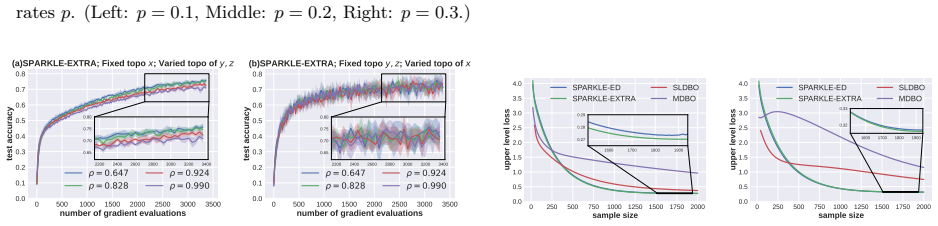
- [§3.3, Corollaries 2–3, Remark 3; §4, Figure 3] The claim that SPARKLE-EXTRA and SPARKLE-ED provably outperform SPARKLE-GT in transient iteration complexity is only strict in a narrow regime. Comparing n^3/(1-ρ)^2 with max{n^3/(1-ρ)^2, n/(1-ρ)^{8/3}}, the first term dominates exactly when 1-ρ ≥ n^{-3}, in which case the two upper bounds coincide up to constants. For the experiments in Section 4 with n=10 and ρ ∈ {0.647, 0.828, 0.924, 0.990}, we have 1-ρ ≥ 0.010 ≫ 10^{-3}, so the advertised theoretical ranking is not realized in any tested topology. The observed gains of ED/EXTRA over GT in Figures 2–3 must therefore come from unquantified constant factors, not from the transient-complexity comparison stated in Corollaries 2–3. I recommend that the authors state the regime 1-ρ < n^{-3} explicitly, soften the abstract and Remark 3, and add an experiment (e.g., a ring with n large or a lazily updated mixing matrix) where the comparison actually bites.
- [Appendix C.2.2, Table 4] The explicit values of δ_x, δ_y, δ_z and hat-δ_x, hat-δ_y, hat-δ_z used in Corollaries 2–3 are not derived in this paper. Lemma 3 only establishes the existence of matrices O and Γ with ∥Γ∥ < 1; the quantitative bounds such as ∥O∥, ∥O^{-1}∥, ∥Λ_b^{-1}∥, and ∥Γ∥ in Table 4 are taken from [2, Appendix B.2]. Because these constants are load-bearing for the central comparison between SPARKLE variants, the manuscript should either provide a self-contained construction of O and Γ for ED, EXTRA, and GT, or state precisely which results from [2] are being invoked and reproduce the needed arguments in the appendix.
- [§4, Figures 2–3 and Remark 3] The experiments in Section 4 measure test accuracy or upper-level loss, not the stationarity measure ∥∇Φ(·)∥^2 used in Theorem 1. Consequently, the empirical ordering of SPARKLE-ED/EXTRA versus SPARKLE-GT does not by itself confirm the transient-complexity ranking in Corollaries 2–3; it is consistent with a constant-factor difference. Since the paper makes a strong theoretical claim about transient complexity, I suggest reporting, at least for a simple synthetic problem as in Appendix D.1, the empirical stationarity gap versus iterations together with the spectral gaps of the mixing matrices, so the regime in which the theoretical ranking is strict is actually tested.
minor comments (5)
- [§3.3, after Theorem 1] The sentence 'This recovers the rate in [15]' cites [15] (Eflops: Algorithm and system co-design for a high performance distributed training platform), which appears unrelated to deterministic decentralized bilevel optimization; please verify and replace the citation.
- [Figures 2–3, 5–9] The legend labels contain visible 'uni00AD' artifacts (e.g., 'SPARKLE/uni00ADGT'); these should be cleaned in the figure files.
- [Footnote on page 1] There is a typo in the affiliation footnote: 'National Engineering Labratory' should be 'Laboratory'.
- [Table 1] The table header uses several unexplained symbols (▷, ♢, †, ‡, ◁) and the entry 'ap+qnε2♯' is hard to parse; please define all symbols in the caption or in a separate legend.
- [Assumption 2 and Appendix C.2.2] For ED and EXTRA the analysis additionally requires the mixing matrix W to be positive definite, with a lazy-replacement W ← tI + (1-t)W suggested in Appendix C.2.2; this restriction should be stated explicitly in Assumption 2 or in a remark in the main text, since Assumption 2 as written only requires the second eigenvalue to be strictly less than one in magnitude.
Circularity Check
No significant circularity: the central convergence theorem and transient-complexity corollaries are derived from explicit assumptions, and self-citations serve only as technical building blocks or comparison baselines.
full rationale
The paper's derivation chain is self-contained at the level that matters for circularity. Theorem 1 is proved from Assumptions 1-4 through a long sequence of explicit lemmas (Lemmas 4-17), with step-size choices given in (88)-(89); no parameter is fitted to data and then renamed as a prediction. The transient-iteration-complexity claims in Corollaries 1-4 are obtained by substituting the matrix-norm bounds of Table 4 into the closed-form expression of Lemma 18, and the ED/EXTRA-versus-GT comparison is arithmetic on the resulting max expressions, not a restatement of an input. Section 3.6's claim that bilevel optimization subsumes single-level optimization is explicitly a special-case construction (Gi(x,y)=|y|^2/2, Fi independent of y) that reduces SPARKLE to the single-level framework (6); this is a consistency check, and it is not used to prove the main rates. The references to the authors' prior work are not load-bearing in a circular way: [2] supplies the unified single-level formulation and matrix-norm estimates, but Lemma 3's key similarity transformation is proved in the paper itself, and the rate comparison with D-SOBA [29] treats that work as an external baseline rather than as the source of the main result. The narrowness of the ED/EXTRA superiority claim (requiring 1-rho < n^{-3}, a regime not realized in the paper's own experiments) is a legitimate scope-of-claim or overgeneralization concern, but it is not a circularity: the comparison follows from the derived bounds rather than being assumed into them. No step reduces, by construction or by self-citation, to its own inputs.
Assumptions & free parameters
assumptions (6)
- standard math The hypergradient formula (Eq. 3) expresses ∇Φ(x) using the lower-level solution y*(x) and inverse Hessian; this is taken from [22] and not derived.
- domain assumption Assumption 1: functions and derivatives are Lipschitz, and gi is μg-strongly convex in y.
- domain assumption Assumption 2: mixing matrices are symmetric, doubly stochastic, strongly connected.
- ad hoc to paper Assumption 3: As, Bs, Cs are polynomials of Ws and the augmented matrix Ls has spectral radius less than one.
- domain assumption Assumption 4: unbiased stochastic gradients, Jacobians, and Hessians with bounded variances.
- standard math Lemma 3 (existence of O and Γ with norm less than one) is used to bound consensus errors; the explicit construction is deferred to [2].
Cite this review
Pith. "Pith review of SPARKLE: A Unified Single-Loop Primal-Dual Framework for Decentralized Bilevel Optimization." pith.science (2026). https://pith.science/paper/VPB6DQEK
@misc{pith2026241114166,
  author       = {Pith},
  title        = {Pith review of: SPARKLE: A Unified Single-Loop Primal-Dual Framework for Decentralized Bilevel Optimization},
  year         = {2026},
  howpublished = {\url{https://pith.science/paper/VPB6DQEK}},
  note         = {Machine review of arXiv:2411.14166}
}
read the original abstract
This paper studies decentralized bilevel optimization, in which multiple agents collaborate to solve problems involving nested optimization structures with neighborhood communications. Most existing literature primarily utilizes gradient tracking to mitigate the influence of data heterogeneity, without exploring other well-known heterogeneity-correction techniques such as EXTRA or Exact Diffusion. Additionally, these studies often employ identical decentralized strategies for both upper- and lower-level problems, neglecting to leverage distinct mechanisms across different levels. To address these limitations, this paper proposes SPARKLE, a unified Single-loop Primal-dual AlgoRithm frameworK for decentraLized bilEvel optimization. SPARKLE offers the flexibility to incorporate various heterogeneitycorrection strategies into the algorithm. Moreover, SPARKLE allows for different strategies to solve upper- and lower-level problems. We present a unified convergence analysis for SPARKLE, applicable to all its variants, with state-of-the-art convergence rates compared to existing decentralized bilevel algorithms. Our results further reveal that EXTRA and Exact Diffusion are more suitable for decentralized bilevel optimization, and using mixed strategies in bilevel algorithms brings more benefits than relying solely on gradient tracking.
Figures


Figures from the paper (5 more)


Reference graph
Works this paper leans on
-
[2]
S. A. Alghunaim and K. Yuan. A unified and refined convergence analysis for non-convex decentralized learning. IEEE Transactions on Signal Processing, 2022
work page 2022
-
[1]
S. A. Alghunaim, E. K. Ryu, K. Yuan, and A. H. Sayed. Decentralized proximal gradient algorithms with linear convergence rates.IEEE Transactions on Automatic Control, 66(6):2787–2794, 2020
work page 2020
- [3]
-
[4]
L. Bertinetto, J. Henriques, P. Torr, and A. Vedaldi. Meta-learning with differentiable closed-form solvers. In International Conference on Learning Representations (ICLR), 2019. International Conference on Learning Representations, 2019
work page 2019
- [5]
-
[6]
J. Chen and A. H. Sayed. Diffusion adaptation strategies for distributed optimization and learning over networks. IEEE Transactions on Signal Processing, 60(8):4289–4305, 2012
work page 2012
-
[7]
T. Chen, Y. Sun, Q. Xiao, and W. Yin. A single-timescale method for stochastic bilevel optimization. In International Conference on Artificial Intelligence and Statistics, pages 2466–2488. PMLR, 2022
work page 2022
-
[8]
T. Chen, Y. Sun, and W. Yin. Closing the gap: Tighter analysis of alternating stochastic gradient methods for bilevel problems. Advances in Neural Information Processing Systems, 34:25294–25307, 2021
work page 2021
Show all 59 references
-
[9]
X. Chen, M. Huang, and S. Ma. Decentralized bilevel optimization.arXiv preprint arXiv:2206.05670, 2022
2022 arXiv
-
[10]
X. Chen, M. Huang, S. Ma, and K. Balasubramanian. Decentralized stochastic bilevel optimization with improved per-iteration complexity. InInternational Conference on Machine Learning, pages 4641–4671. PMLR, 2023
2023
-
[11]
X. Chen, T. Xiao, and K. Balasubramanian. Optimal algorithms for stochastic bilevel optimization under relaxed smoothness conditions. arXiv preprint arXiv:2306.12067, 2023
2023 arXiv
-
[12]
Dagréou, P
M. Dagréou, P. Ablin, S. Vaiter, and T. Moreau. A framework for bilevel optimization that enables stochastic and global variance reduction algorithms.Advances in Neural Information Processing Systems, 35:26698–26710, 2022
2022
-
[13]
Di Lorenzo and G
P. Di Lorenzo and G. Scutari. Next: In-network nonconvex optimization.IEEE Transactions on Signal and Information Processing over Networks, 2(2):120–136, 2016
2016
-
[14]
J. Domke. Generic methods for optimization-based modeling. InArtificial Intelligence and Statistics, pages 318–326. PMLR, 2012
2012
-
[15]
J. Dong, Z. Cao, T. Zhang, J. Ye, S. Wang, F. Feng, L. Zhao, et al. Eflops: Algorithm and system co-design for a high performance distributed training platform. In2020 IEEE International Symposium on High Performance Computer Architecture (HPCA), pages 610–622, 2020
2020
-
[16]
Y. Dong, S. Ma, J. Yang, and C. Yin. A single-loop algorithm for decentralized bilevel optimization.arXiv preprint arXiv:2311.08945, 2023
2023 arXiv
-
[17]
J. C. Duchi, A. Agarwal, and M. J. Wainwright. Dual averaging for distributed optimization: Convergence analysis and network scaling.IEEE Transactions on Automatic control, 57(3):592–606, 2011
2011
-
[18]
C. Finn, P. Abbeel, and S. Levine. Model-agnostic meta-learning for fast adaptation of deep networks.International Conference on Machine Learning, pages 1126–1135, 2017. 13
2017
-
[19]
Franceschi, P
L. Franceschi, P. Frasconi, S. Salzo, R. Grazzi, and M. Pontil. Bilevel programming for hyperparameter optimization and meta-learning. InInternational Conference on Machine Learning, pages 1568–1577. PMLR, 2018
2018
-
[20]
B. Gao, Y. Yang, and Y. xiang Yuan. Lancbio: dynamic lanczos-aided bilevel optimization via krylov subspace. arXiv preprint arXiv:2404.03331, 2024
2024 arXiv
-
[21]
H. Gao, B. Gu, and M. T. Thai. On the convergence of distributed stochastic bilevel optimization algorithms over a network. InInternational Conference on Artificial Intelligence and Statistics, pages 9238–9281. PMLR, 2023
2023
-
[22]
Ghadimi and M
S. Ghadimi and M. Wang. Approximation methods for bilevel programming.arXiv preprint arXiv:1802.02246, 2018
2018 arXiv
-
[23]
Grazzi, L
R. Grazzi, L. Franceschi, M. Pontil, and S. Salzo. On the iteration complexity of hypergradient computation. In International Conference on Machine Learning, pages 3748–3758. PMLR, 2020
2020
-
[24]
Z. Guo, Q. Hu, L. Zhang, and T. Yang. Randomized stochastic variance-reduced methods for multi-task stochastic bilevel optimization. arXiv preprint arXiv:2105.02266, 2021
2021 arXiv
-
[25]
Hong, H.-T
M. Hong, H.-T. Wai, Z. Wang, and Z. Yang. A two-timescale stochastic algorithm framework for bilevel optimization: Complexity analysis and application to actor-critic.SIAM Journal on Optimization, 33(1):147–180, 2023
2023
-
[26]
Jakovetić
D. Jakovetić. A unification and generalization of exact distributed first-order methods.IEEE Transactions on Signal and Information Processing over Networks, 5(1):31–46, 2018
2018
-
[27]
K. Ji, J. Yang, and Y. Liang. Bilevel optimization: Convergence analysis and enhanced design. InInternational Conference on Machine Learning, pages 4882–4892. PMLR, 2021
2021
-
[28]
Koloskova, T
A. Koloskova, T. Lin, and S. U. Stich. An improved analysis of gradient tracking for decentralized machine learning. Advances in Neural Information Processing Systems, 34:11422–11435, 2021
2021
-
[29]
B. Kong, S. Zhu, S. Lu, X. Huang, and K. Yuan. Decentralized bilevel optimization over graphs: Loopless algorithmic update and transient iteration complexity.arXiv preprint arXiv:2402.03167, 2024
2024
-
[30]
Z. Li, W. Shi, and M. Yan. A decentralized proximal-gradient method with network independent step-sizes and separated convergence rates.IEEE Transactions on Signal Processing, July 2019. early acces. Also available on arXiv:1704.07807
2019 arXiv
-
[31]
X. Lian, C. Zhang, H. Zhang, C.-J. Hsieh, W. Zhang, and J. Liu. Can decentralized algorithms outperform centralized algorithms? A case study for decentralized parallel stochastic gradient descent. InAdvances in Neural Information Processing Systems, pages 5330–5340, 2017
2017
-
[32]
T. Lin, S. P. Karimireddy, S. U. Stich, and M. Jaggi. Quasi-global momentum: Accelerating decentralized deep learning on heterogeneous data. InInternational Conference on Machine Learning, 2021
2021
-
[33]
S. Lu, S. Zeng, X. Cui, M. Squillante, L. Horesh, B. Kingsbury, J. Liu, and M. Hong. A stochastic linearized augmented lagrangian method for decentralized bilevel optimization.Advances in Neural Information Processing Systems, 35:30638–30650, 2022
2022
-
[34]
Lu and C
Y. Lu and C. De Sa. Optimal complexity in decentralized training. InInternational Conference on Machine Learning, pages 7111–7123. PMLR, 2021
2021
-
[35]
Maclaurin, D
D. Maclaurin, D. Duvenaud, and R. Adams. Gradient-based hyperparameter optimization through reversible learning. In International Conference on Machine Learning, pages 2113–2122. PMLR, 2015
2015
-
[36]
Madry, A
A. Madry, A. Makelov, L. Schmidt, D. Tsipras, and A. Vladu. Towards deep learning models resistant to adversarial attacks. InInternational Conference on Learning Representations, 2018
2018
-
[37]
Nedić, A
A. Nedić, A. Olshevsky, and M. G. Rabbat. Network topology and communication-computation tradeoffs in decentralized optimization. Proceedings of the IEEE, 106(5):953–976, 2018
2018
-
[38]
Nedic, A
A. Nedic, A. Olshevsky, and W. Shi. Achieving geometric convergence for distributed optimization over time- varying graphs.SIAM Journal on Optimization, 27(4):2597–2633, 2017. 14
2017
-
[39]
Nedic and A
A. Nedic and A. Ozdaglar. Distributed subgradient methods for multi-agent optimization.IEEE Transactions on Automatic Control, 54(1):48–61, 2009
2009
-
[40]
Y. Niu, J. Xu, Y. Sun, Y. Huang, and L. Chai. Distributed stochastic bilevel optimization: Improved complexity and heterogeneity analysis.arXiv preprint arXiv:2312.14690, 2023
2023 arXiv
-
[41]
Qu and N
G. Qu and N. Li. Harnessing smoothness to accelerate distributed optimization.IEEE Transactions on Control of Network Systems, 5(3):1245–1260, 2018
2018
-
[42]
Russakovsky, J
O. Russakovsky, J. Deng, H. Su, J. Krause, S. Satheesh, S. Ma, Z. Huang, A. Karpathy, A. Khosla, M. Bernstein, et al. Imagenet large scale visual recognition challenge.International Journal of Computer Vision, 115:211–252, 2015
2015
-
[43]
A. H. Sayed. Adaptive networks.Proceedings of the IEEE, 102(4):460–497, 2014
2014
-
[44]
Shaban, C.-A
A. Shaban, C.-A. Cheng, N. Hatch, and B. Boots. Truncated back-propagation for bilevel optimization. InThe 22nd International Conference on Artificial Intelligence and Statistics, pages 1723–1732. PMLR, 2019
2019
-
[45]
W. Shi, Q. Ling, G. Wu, and W. Yin. EXTRA: An exact first-order algorithm for decentralized consensus optimization. SIAM Journal on Optimization, 25(2):944–966, 2015
2015
-
[46]
H. Tang, X. Lian, M. Yan, C. Zhang, and J. Liu. D2: Decentralized training over decentralized data. In International Conference on Machine Learning, pages 4848–4856, 2018
2018
-
[47]
Vinyals, C
O. Vinyals, C. Blundell, T. Lillicrap, D. Wierstra, et al. Matching networks for one shot learning.Advances in Neural Information Processing Systems, 29, 2016
2016
-
[48]
H. Xiao, K. Rasul, and R. Vollgraf. Fashion-mnist: a novel image dataset for benchmarking machine learning algorithms. arXiv preprint arXiv:1708.07747, 2017
2017 arXiv
-
[49]
J. Xu, Y. Tian, Y. Sun, and G. Scutari. Distributed algorithms for composite optimization: Unified framework and convergence analysis.IEEE Transactions on Signal Processing, 69:3555–3570, 2021
2021
-
[50]
J. Xu, S. Zhu, Y. C. Soh, and L. Xie. Augmented distributed gradient methods for multi-agent optimization under uncoordinated constant stepsizes. InIEEE Conference on Decision and Control (CDC), pages 2055–2060, Osaka, Japan, 2015
2015
-
[51]
J. Yang, K. Ji, and Y. Liang. Provably faster algorithms for bilevel optimization.Advances in Neural Information Processing Systems, 34:13670–13682, 2021
2021
-
[52]
S. Yang, X. Zhang, and M. Wang. Decentralized gossip-based stochastic bilevel optimization over communication networks. Advances in Neural Information Processing Systems, 35:238–252, 2022
2022
-
[53]
K. Yuan, S. A. Alghunaim, and X. Huang. Removing data heterogeneity influence enhances network topology dependence of decentralized SGD.Journal of Machine Learning Research, 24(280):1–53, 2023
2023
-
[54]
K. Yuan, S. A. Alghunaim, B. Ying, and A. H. Sayed. On the influence of bias-correction on distributed stochastic optimization. IEEE Transactions on Signal Processing, 2020
2020
-
[55]
K. Yuan, Q. Ling, and W. Yin. On the convergence of decentralized gradient descent.SIAM Journal on Optimization, 26(3):1835–1854, 2016
2016
-
[56]
K. Yuan, B. Ying, X. Zhao, and A. H. Sayed. Exact dffusion for distributed optimization and learning – Part I: Algorithm development.IEEE Transactions on Signal Processing, 67(3):708 – 723, 2018
2018
-
[57]
SPARKLE: A Unified Single-Loop Primal-Dual Framework for Decentralized Bilevel Optimization
Y. Zhang, M. T. Thai, J. Wu, and H. Gao. On the communication complexity of decentralized bilevel optimization. arXiv preprint arXiv:2311.11342, 2023. 15 Appendix for “SPARKLE: A Unified Single-Loop Primal-Dual Framework for Decentralized Bilevel Optimization” Contents A More ...
2023 arXiv
-
[58]
Subtracting 2 K−1X k=0 (1 − θ)2 θ L2 ∇Φα2 · 2E∥Ek[¯rk+1] − ∇Φ(¯xk)∥2 31 from both sides of (50), we have: KX k=0 θE∥Ek ¯rk+1 − ∇Φ(¯xk)∥2 ≤4 KX k=0 θE∥Ek ¯uk − ∇Φ(¯xk)∥2 + 8 K−1X k=0 (1 − θ)θ2E∥¯uk − Ek ¯uk∥2 + 4(1 − θ)2∥∇Φ(¯x0)∥2 + θ 4 K−1X k=0 E∥∇Φ(¯xk)∥2. (51) Substituting (...
-
[59]
κ2∥Oy∥2∥ˆek+1 y ∥2 n # + 6(K + 1)γ µgn 3σ2 g,2 L2 f,0 µ2g + σ2 f,1 ! + 73κ4
Taking the summation and expectation on the both sides, we get: KX k=0 βµg 2 E[∥¯yk − y⋆(¯xk−1)∥2] + E[∥¯yk+1 − y⋆(¯xk)∥2] ≤E∥¯y0 − y⋆(¯x0)∥2 + KX k=0 E " 3α2 βµg L2 y⋆ ∥¯rk∥2 + 3β µg L2 g,1 ∥xk − ¯xk∥2 n + ∥yk − ¯yk∥2 n + β2 σ2 g,1 n # . Using (36) and the fact thatx0, y0 is ...
Reviewed August 12, 2026 · model on record in the stance chip above.
Discussion (0). Continue with ORCID to comment.