REVIEW 4 major objections 6 minor 1 cited by
Anomalous Temperature Induced Transition and Convergence of Thermal Conductivity in Germanene Monolayer
T0 review · 4 major / 6 minor · reviewed 2026-08-12 · deepseek-v4-flash
Pith's one-line read Molecular dynamics simulations show that germanene's thermal conductivity abruptly changes temperature behavior at 350 K.
desk verdict Competent MD study with a potentially interesting kappa(T) crossover in germanene, but the transition is not yet distinguished from a potential or classical-statistics artifact. read the letter →
The pith
A machine-rendered reading of the paper's core claim, the machinery that carries it, and where it could break.
The reading
What carries the argument
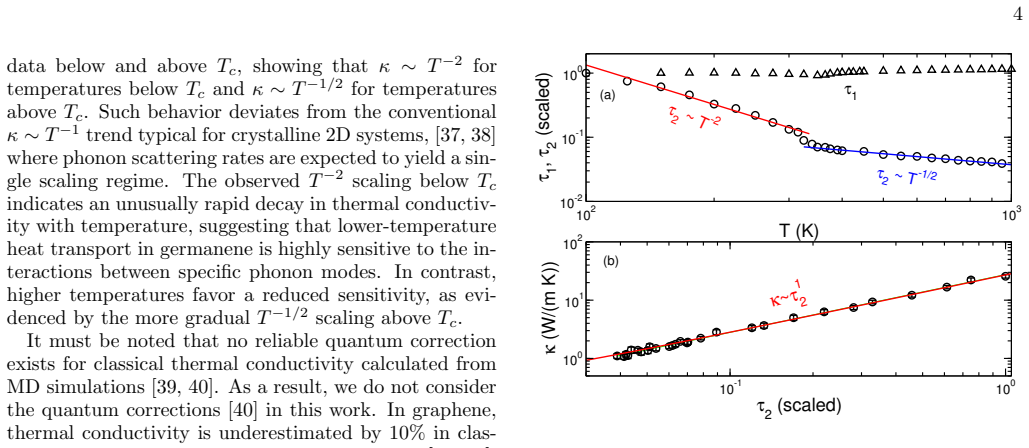
The load-bearing object is the acoustic-optical (AO) phonon gap, the frequency separation between the top of the acoustic branches and the bottom of the optical branches. Normal-mode decomposition of the molecular dynamics trajectories tracks how this gap shrinks with temperature: the ZO mode at the $\Gamma$ point redshifts significantly, and around 350 K the acoustic and optical branches overlap. This overlap strengthens the AAO scattering channel (two acoustic phonons combining into an optical phonon, and its reverse), which the paper identifies as the cause of the anomalous scaling. A second piece of machinery is the two-exponential fit of the heat current autocorrelation function, whose long time constant $\tau_2$ is found to obey the same power laws as $\kappa$, giving $\kappa \propto \tau_2$.
What would settle it
A finite-temperature first-principles phonon calculation that shows no acoustic-optical overlap near 350 K would refute the mechanism, as would an inelastic light scattering measurement of the ZO branch without the predicted redshift kink; likewise, an ab initio anharmonic calculation of $\kappa(T)$ without the $T^{-2}$ to $T^{-1/2}$ transition would challenge the reality of the crossover.
Extended reading notes
Core claim
The central discovery is an anomalous temperature-induced transition in the thermal conductivity of a germanene monolayer at $T_c \approx 350$ K. Below $T_c$, $\kappa \sim T^{-2}$; above, $\kappa \sim T^{-1/2}$. This behavior correlates with the long-time relaxation scale $\tau_2$ of the heat current autocorrelation function, and normal-mode decomposition attributes it to a redshift of the ZO branch that shrinks the acoustic-optical gap until the acoustic and optical branches overlap near $T_c$, intensifying scattering. A separate nonequilibrium calculation shows that $\kappa$ saturates at sample lengths near 1 $\mu$m, consistent with mode-coupling theory and with the reduced flexural contribution caused by buckling.
Load-bearing premise
Everything rests on the modified three-body interatomic potential faithfully reproducing germanene's temperature-dependent structure and phonon shifts; if that potential misjudges the lattice contraction or the ZO redshift, the 350 K transition could be an artifact of the model rather than a property of germanene.
Editorial extensions
If this is right
- Thermal management of germanene-based devices must allow for two regimes: heat conduction falls steeply below roughly 350 K and slowly above it.
- The linear relation between $\kappa$ and the long heat-current autocorrelation time constant $\tau_2$ means that models of the long-time tail can directly predict the temperature dependence of $\kappa$.
- Because $\kappa$ converges by about 1 $\mu$m, experimental samples longer than that should show intrinsic, length-independent thermal conductivity.
- The closing of the acoustic-optical gap provides a mechanism by which the same material can display markedly different scattering physics above and below a transition temperature.
- The paper concludes that buckling, long seen as a source of low thermal conductivity, is also the reason thermal conductivity converges with system size rather than diverging.
Reading between the lines
- One testable extension is to look for the same two-power-law crossover in other buckled group-IV monolayers such as silicene or stanene; the paper does not make this claim.
- Because the simulations are classical, the true low-temperature exponent could differ once quantum statistics are included; the paper argues the crossover would survive, but that remains an assessment rather than a computed result.
- A spectroscopic probe that tracks the ZO phonon frequency with temperature could corroborate the mechanism: an accelerated redshift or a kink near 350 K would support the proposed gap closure.
Editorial analysis
A structured set of objections, weighed in public.
Referee Report
Summary. The manuscript reports equilibrium and nonequilibrium molecular dynamics simulations of thermal transport in a buckled germanene monolayer modeled with the modified Stillinger-Weber potential of Jiang et al. The central claim is a crossover at Tc ≈ 350 K from κ ∼ T^-2 below Tc to κ ∼ T^-1/2 above Tc, which the authors attribute to a temperature-driven redshift of the ZO phonon branch that closes the acoustic-optical gap and enhances phonon-phonon scattering. The paper also reports saturation of the length-dependent thermal conductivity near 1 μm and connects the temperature dependence of κ to the long timescale τ2 extracted from a double-exponential fit of the heat current autocorrelation function and to mode-resolved phonon linewidths.
Significance. If the claimed 350 K crossover is real, the result would be a notable addition to the thermal-transport literature on two-dimensional group-IV materials, with potential implications for phonon engineering in germanene-based devices. The manuscript has clear strengths: the room-temperature κ value of 3.6 ± 0.4 W/mK is comparable with earlier DFT/BTE estimates, the EMD/NEMD protocols are standard and documented, the simulations include 30-trajectory averaging, and the length-convergence claim is supported by a t^-1.6 HCACF tail and by a comparison with prior germanene nanoribbon results. However, the central two-regime transition currently rests on a single empirical potential, on classical statistics in a temperature range that extends below the Debye temperature, and on a τ2 correlation that is partly built into the Green-Kubo integral. The paper therefore requires substantial additional validation before the anomaly can be considered established.
major comments (4)
- [Sec. III B, Fig. 2; Sec. II] The two power-law regimes are asserted from fits whose procedure, number of points, and uncertainties are not reported. This matters because Tc ≈ 350 K coincides almost exactly with the Debye temperature of 352 K quoted by the authors, so the steep T^-2 branch below Tc could be a classical-statistics artifact: at T < Θ_D, classical MD overpopulates high-frequency optical modes, and the resulting temperature dependence of κ is not directly comparable to a quantum transport calculation. The caveat that a quantum correction might increase the low-temperature exponent does not remove the need to demonstrate the transition with a quantum treatment, such as the Boltzmann transport equation with temperature-dependent force constants, or at least with classical simulations from an independent interatomic potential. Please report the fitting procedure, confidence intervals for the exponents and Tc, and a sensitivity test of the crossover to the potential and to the thermostat/ensemble choices.
- [Sec. III C, Eq. (9); Fig. 3(b)] The reported proportionality κ ∝ τ2 is largely a consequence of the Green-Kubo definition rather than an independent validation. Since Eq. (1) defines κ as the time integral of the unnormalized HCACF, a double-exponential representation with a dominant τ2 term gives κ ≈ [⟨S²⟩/(V k_B T²)] [α0 τ1 + (1 - α0) τ2] by construction. The linear κ versus τ2 plot in Fig. 3(b) is therefore a consistency check, not evidence that τ2 'governs' the thermal conductivity. To substantiate the mechanistic claim, the paper should supplement or replace this argument with a mode-resolved decomposition, for example spectral heat-current analysis or mode-dependent relaxation times that are not defined through the total κ integral.
- [Sec. II; Sec. III C] The proposed mechanism is entirely internal to the modified Stillinger-Weber potential, which is validated only by the room-temperature κ value (within about 13-50% of earlier DFT-based results) and by the absence of negative phonon frequencies. The temperature-dependent lattice contraction, buckling reduction, and ZO redshift are the load-bearing ingredients for the claimed transition, but none of these finite-temperature quantities is compared with first-principles calculations or with another interatomic model. Please provide an independent check of the temperature-dependent geometry and phonon shifts, or a second potential or ab initio reference, and show that the 350 K crossover persists under that check.
- [Sec. III C, Figs. 4-5] The acoustic-optical gap narrowing and the increase in phonon linewidths near 350 K are correlational observations. They show that the gap shrinks and scattering broadens, but they do not demonstrate that the AAO channel becomes the dominant scattering process at Tc or that this quantitatively explains the observed exponents. No phonon-phonon scattering phase-space calculation, no mode-projected contribution to κ, and no comparison between the measured linewidths and the predicted T^-2 or T^-1/2 scaling is provided. A quantitative test, such as a three-phonon scattering-rate calculation using the same force field as a function of temperature, would be needed to make the mechanism load-bearing.
minor comments (6)
- [Sec. II, after Eq. (2)] There is a typo: 'potentail' should be 'potential', and 'heatflux' should be 'heat flux'.
- [Sec. III C, Fig. 3(a)] The text refers to τ1 as the 'slow decay characteristic timescale', but in Eq. (9) τ1 is the short-range (fast) timescale and τ2 is the long-range (slow) timescale; please correct this labeling to avoid confusion.
- [Sec. III B; Sec. III C] The phrase 'critical temperature' and 'transition' suggest a true phase transition; since no order parameter or thermodynamic singularity is identified, the more neutral terms 'crossover temperature' and 'regime change' would better match the evidence presented.
- [Sec. III B] The statement that 3.6 ± 0.4 W/mK is in 'close agreement' with prior values of 2.4 and 3.1 W/mK should be quantified; the difference from 2.4 W/mK is about 50%, which is not obviously 'close agreement'.
- [Sec. III C, Eq. (8)] The Lorentzian fitting procedure for the phonon power spectrum is not described in enough detail; please specify the fitting range, the number of q-points sampled, and how the linewidth uncertainty is estimated, since these linewidths are central to the proposed mechanism.
- [Sec. II, quantum corrections paragraph] The statement that 'no reliable quantum correction exists' is too strong; approximate mode-by-mode quantum corrections have been discussed in the cited literature and should be described more carefully rather than dismissed in a single sentence.
Circularity Check
One circular step: the κ ∝ τ2 'confirmation' restates the Green-Kubo integral of the very HCACF that was used to fit τ2; the central κ(T) transition is not circular, but this mechanistic evidence partially reduces to construction.
-
fitted input called prediction
[Sec. III C, Fig. 3; Sec. IV Conclusions; Eqs. (1) and (9)]
"This anomalous scaling is closely mirrored in the slow relaxation timescale τ2 of the HCACF, with τ2 ∼ T −2 below Tc and τ2 ∼ T −1/2 above, confirming the direct relationship κ ∼ τ2."
By Eq. (1), κ is the time integral of the heat current autocorrelation function. By Eq. (9), that same HCACF is fitted as α0 exp(−t/τ1) + (1−α0) exp(−t/τ2), so its integral is α0τ1 + (1−α0)τ2 (times normalization). The temperature dependence of κ is therefore not independent of τ2: if the long-time component dominates the integral, the fitted τ2 must track κ's scaling. Asserting that τ2 mirrors κ and confirms the direct relationship κ ∼ τ2 is a restatement of the fit, not an independent mechanistic validation. The τ2 exponents are extracted from the same trajectory data that enter κ, so the confirmation is forced by construction.
full rationale
The core observation—a change in the T-scaling of κ near 350 K (Fig. 2, Sec. III B)—is a legitimate simulation result and is not circular. The circularity is confined to the supporting claim that the long-time constant τ2 from a double-exponential HCACF fit confirms κ ∼ τ2: since κ is the integral of the HCACF and τ2 is a parameter of a fit to that same HCACF, the proportionality is built in rather than independently established. Other candidate circularities were considered and rejected: the choice of the modified Stillinger-Weber potential relies on the external Jiang et al. parameters (Ref. 24), and the dismissals of Tersoff (Ref. 23) are technical self-citations that are not load-bearing for the central claim. The AO-gap narrowing and linewidth behavior (Sec. III C) are correlated with the transition but are not definitionally equivalent to it. The paper does flag its main limitation, stating that no reliable quantum correction exists for classical thermal conductivity calculated from MD simulations (Sec. III B), and the closeness of Tc ≈ 350 K to the quoted Debye temperature (352 K) raises a classical-statistics artifact concern; however that is a correctness and validation risk, not a circularity. Overall: one fitted-input-as-prediction step, partial circularity, score 6.
Assumptions & free parameters
free parameters (5)
- Low-temperature power-law exponent α1 =
-2.0
- High-temperature power-law exponent α2 =
-0.5
- Critical temperature Tc =
350 K
- HCACF double-exponential parameters (τ1, τ2, α0) =
Temperature-dependent values
- NEMD length-convergence saturation length =
~1 µm
assumptions (5)
- domain assumption The modified Stillinger-Weber potential with Jiang et al. parameters accurately describes germanene's anharmonic phonon physics.
- domain assumption Classical MD without quantum corrections is adequate for κ(T) down to 100 K.
- domain assumption Harmonic phonon eigenvectors from normal mode decomposition remain valid at high temperatures.
- domain assumption A 32x32x1 supercell and 2 ns trajectories give converged Green-Kubo results.
- domain assumption The heat current expression in Eq. 2 correctly captures many-body contributions.
Cite this review
Pith. "Pith review of Anomalous Temperature Induced Transition and Convergence of Thermal Conductivity in Germanene Monolayer." pith.science (2026). https://pith.science/paper/I42PM3LO
@misc{pith2026241114197,
  author       = {Pith},
  title        = {Pith review of: Anomalous Temperature Induced Transition and Convergence of Thermal Conductivity in Germanene Monolayer},
  year         = {2026},
  howpublished = {\url{https://pith.science/paper/I42PM3LO}},
  note         = {Machine review of arXiv:2411.14197}
}
abstract
We report an anomalous temperature-induced transition in thermal conductivity in germanene monolayer around a critical temperature $T_c = 350 \, \text{K}$. Equilibrium molecular dynamics simulations reveal a transition from $\kappa \sim T^{-2}$ scaling below $T_c$ to $\kappa \sim T^{-1/2}$ above, contrasting with conventional $\kappa \sim T^{-1}$ behavior. This anomalous scaling correlates with the long-scale characteristic timescale $\tau_2$ obtained from double exponential fitting of the heat current autocorrelation function. Phonon mode analysis using normal mode decomposition indicates that a redshift in ZO phonons reduces the acoustic-optical phonon gap, causing an overlap, enhances the phonon-phonon scattering, driving the anomalous scaling behavior. Moreover, nonequilibrium simulations find a convergent thermal conductivity of germanene with sample size, in agreement with mode coupling theory, owing to the high scattering of ZA phonons due to the inherent buckling of germanene.
Figures


Figures from the paper (2 more)


Forward citations
Cited by 1 Pith paper
-
Tunable Interfacial Thermal Conductance in Graphene/Germanene van der Waals Heterostructure using an Optimized Interlayer Potential
A newly fitted interlayer potential for graphene/germanene predicts interfacial heat conductance rises under compressive strain to 136% and falls under tensile strain to 70%, with higher temperature and stronger inter...
Reference graph
Works this paper leans on
-
[1]
is a fitting parameter. The short-range character- istic timescale ( τ1) is typically attributed to the high- frequency (optical) phonons [42]. The initial rapid decay in the HCACF is thus linked to the loss of correlation among these optical phonons. The long-range charac- teristic timescale ( τ2) is associated with low-frequency 10 2 10 3 T (K) 10 -2 10...
-
[2]
J. Yuhara and G. L. Lay, Beyond silicene: synthesis of germanene, stanene and plumbene, Japanese Journal of Applied Physics 59, SN0801 (2020)
work page 2020
-
[3]
A. Acun, L. Zhang, P. Bampoulis, M. Farmanbar, A. van Houselt, A. N. Rudenko, M. Lingenfelder, G. Brocks, B. Poelsema, M. I. Katsnelson, and H. J. W. Zandvliet, Germanene: the germanium analogue of graphene, Jour- nal of Physics: Condensed Matter 27, 443002 (2015)
work page 2015
-
[4]
N. J. Roome and J. D. Carey, Beyond graphene: Sta- ble elemental monolayers of silicene and germanene, ACS Applied Materials & Interfaces 6, 7743 (2014), pMID: 24724967, https://doi.org/10.1021/am501022x
-
[5]
S. Cahangirov, M. Topsakal, E. Akt¨ urk, H. S ¸ahin, and S. Ciraci, Two- and one-dimensional honeycomb struc- tures of silicon and germanium, Phys. Rev. Lett. 102, 236804 (2009)
work page 2009
-
[6]
T. Arjmand, M. B. Tagani, and H. R. Soleimani, Buckling-dependent switching behaviours in shifted bi- layer germanene nanoribbons: A computational study, Superlattices and Microstructures 113, 657 (2018)
work page 2018
-
[7]
X. Li, S. Wu, S. Zhou, and Z. Zhu, Structural and elec- tronic properties of germanene/mos2 monolayer and sil- icene/mos2 monolayer superlattices, Nanoscale Research Letters 9, 110 (2014)
work page 2014
-
[8]
R. Chegel and S. Behzad, Tunable electronic, optical, and thermal properties of two- dimensional germanene via an external electric field, Scientific Reports 10, 704 (2020)
work page 2020
Show all 53 references
-
[9]
M. Ye, R. Quhe, J. Zheng, Z. Ni, Y. Wang, Y. Yuan, G. Tse, J. Shi, Z. Gao, and J. Lu, Tunable band gap in germanene by surface adsorption, Physica E: Low- dimensional Systems and Nanostructures 59, 60 (2014)
2014
-
[10]
Mortazavi, A
B. Mortazavi, A. Dianat, G. Cuniberti, and T. Rabczuk, Application of silicene, germanene and stanene for na or li ion storage: A theoretical investigation, Electrochimica Acta 213, 865 (2016)
2016
-
[11]
J. E. Padilha and R. B. Pontes, Electronic and transport properties of structural defects in monolayer germanene: An ab initio investigation, Solid State Communications 225, 38 (2016)
2016
-
[12]
C. Si, J. Liu, Y. Xu, J. Wu, B.-L. Gu, and W. Duan, Functionalized germanene as a prototype of large-gap two-dimensional topological insulators, Phys. Rev. B 89, 115429 (2014)
2014
-
[13]
B. Peng, H. Zhang, H. Shao, Y. Xu, G. Ni, R. Zhang, and H. Zhu, Phonon transport properties of two-dimensional group-iv materials from ab initio calculations, Phys. Rev. B 94, 245420 (2016)
2016
-
[14]
G. P. Das, P. R. Raghuvanshi, and A. Bhattacharya, Phonons and lattice thermal conductivities of graphene family, Procedia Structural Integrity 23, 334 (2019), 9th International Conference Materials Structure & Mi- cromechanics of Fracture (MSMF9)
2019
-
[15]
Y. Tang, J. Che, and G. Qin, On the microscopic view of the low thermal conductivity of buckling two-dimensional materials from molecular dynamics, Chemical Physics Letters 780, 138954 (2021)
2021
-
[16]
Y. D. Kuang, L. Lindsay, S. Q. Shi, and G. P. Zheng, Tensile strains give rise to strong size effects for ther- mal conductivities of silicene, germanene and stanene, Nanoscale 8, 3760 (2016)
2016
-
[17]
X. Wang, Y. Hong, P. K. L. Chan, and J. Zhang, Phonon thermal transport in silicene-germanene superlattice: a molecular dynamics study, Nanotechnology 28, 255403 (2017)
2017
-
[18]
Jomehpour Zaveh, M
S. Jomehpour Zaveh, M. Roknabadi, T. Morshedloo, and M. Modarresi, Electronic and thermal properties of ger- manene and stanene by first-principles calculations, Su- perlattices and Microstructures 91, 383 (2016)
2016
-
[19]
D. L. Nika and A. A. Balandin, Phonons and thermal transport in graphene and graphene-based materials, Re- ports on Progress in Physics 80, 036502 (2017)
2017
-
[20]
A. A. Balandin, S. Ghosh, W. Bao, I. Calizo, D. Teweldebrhan, F. Miao, and C. N. Lau, Supe- rior thermal conductivity of single-layer graphene, Nano Letters 8, 902 (2008), pMID: 18284217, https://doi.org/10.1021/nl0731872
2008 doi
-
[21]
Lindsay, W
L. Lindsay, W. Li, J. Carrete, N. Mingo, D. Broido, and T. Reinecke, Phonon thermal transport in strained and unstrained graphene from first principles, Physical Re- view B 89, 155426 (2014)
2014
-
[22]
A. P. Thompson, H. M. Aktulga, R. Berger, D. S. Bolin- tineanu, W. M. Brown, P. S. Crozier, P. J. in ’t Veld, A. Kohlmeyer, S. G. Moore, T. D. Nguyen, R. Shan, M. J. Stevens, J. Tranchida, C. Trott, and S. J. Plimpton, LAMMPS - a flexible simulation tool for particle-based mat...
2022
-
[23]
M. Ma´ zdziarz, Transferability of interatomic potentials for germanene (2d germanium), Journal of Applied Physics 134, 184303 (2023), https://pubs.aip.org/aip/jap/article- pdf/doi/10.1063/5.0173745/18208226/184303 1 5.0173745.pdf
2023 doi
-
[24]
Thapliyal, S
S. Thapliyal, S. S. Paul Chowdhury, and S. Moguram- pelly, Modeling germanene monolayer: Interaction po- tentials and insights into the phonon thermal conductiv- ity, in Energy Materials and Devices, edited by A. Dixit, V. K. Singh, and S. Ahmad (Springer Nature Singapore, Sin...
2024
-
[25]
Jiang and Y.-P
J.-W. Jiang and Y.-P. Zhou, Handbook of Stillinger-Weber Potential Parameters for Two Dimensional Atomic Crystals (IntechOpen, Rijeka, 2017)
2017
-
[26]
Z. Wang, T. Feng, and X. Ruan, Thermal conductivity and spectral phonon properties of freestanding and sup- ported silicene, Journal of Applied Physics 117, 084317 (2015), https://doi.org/10.1063/1.4913600
2015 doi
-
[27]
Pei, Y.-W
Q.-X. Pei, Y.-W. Zhang, Z.-D. Sha, and V. B. Shenoy, Tuning the thermal conductivity of silicene with tensile strain and isotopic doping: A molecular dynamics study, 8 Journal of Applied Physics 114, 10.1063/1.4815960 (2013), 033526
2013 doi
-
[28]
Mantina, A
M. Mantina, A. C. Chamberlin, R. Valero, C. J. Cramer, and D. G. Truhlar, Consistent van der waals radii for the whole main group, The Journal of Phys- ical Chemistry A 113, 5806 (2009), pMID: 19382751, https://doi.org/10.1021/jp8111556
2009 doi
-
[29]
Surblys, H
D. Surblys, H. Matsubara, G. Kikugawa, and T. Ohara, Application of atomic stress to compute heat flux via molecular dynamics for systems with many-body inter- actions, Phys. Rev. E 99, 051301 (2019)
2019
-
[30]
Surblys, H
D. Surblys, H. Matsubara, G. Kikugawa, and T. Ohara, Methodology and meaning of computing heat flux via atomic stress in systems with con- straint dynamics, Journal of Applied Physics 130, 215104 (2021), https://pubs.aip.org/aip/jap/article- pdf/doi/10.1063/5.0070930/15273091/...
2021 doi
-
[31]
Chakraborty, S
H. Chakraborty, S. Mogurampelly, V. K. Yadav, U. V. Waghmare, and M. L. Klein, Phonons and thermal con- ducting properties of borocarbonitride (bcn) nanosheets, Nanoscale 10, 22148 (2018)
2018
-
[32]
S. S. Paul Chowdhury, A. Samudrala, and S. Moguram- pelly, Modeling interlayer interactions and phonon ther- mal transport in silicene bilayers, Phys. Rev. B 108, 155436 (2023)
2023
-
[33]
Carreras, A
A. Carreras, A. Togo, and I. Tanaka, Dynaphopy: A code for extracting phonon quasiparticles from molecular dy- namics simulations, Computer Physics Communications 221, 221 (2017)
2017
-
[34]
Yuhara, D
J. Yuhara, D. Matsuba, M. Ono, A. Ohta, S. Miyazaki, M. Araidai, S. ichi Takakura, M. Nakatake, and G. Le Lay, Formation of germanene with free-standing lattice constant, Surface Science 738, 122382 (2023)
2023
-
[35]
Yuhara, H
J. Yuhara, H. Shimazu, K. Ito, A. Ohta, M. Araidai, M. Kurosawa, M. Nakatake, and G. Le Lay, Ger- manene epitaxial growth by segregation through ag(111) thin films on ge(111), ACS Nano 12, 11632 (2018), https://doi.org/10.1021/acsnano.8b07006
2018 doi
-
[36]
peng Li and R
H. peng Li and R. qin Zhang, Vacancy-defect–induced diminution of thermal conductivity in silicene, Euro- physics Letters 99, 36001 (2012)
2012
-
[37]
Mohammadi, B
R. Mohammadi, B. Karimi, J. Kieffer, and D. Hashemi, A molecular dynamics simulation study of thermal conduc- tivity of plumbene, Phys. Chem. Chem. Phys. 26, 28133 (2024)
2024
-
[38]
G. Qin, Z. Qin, H. Wang, and M. Hu, Anomalously temperature-dependent thermal conductivity of mono- layer gan with large deviations from the traditional 1 /t law, Phys. Rev. B 95, 195416 (2017)
2017
-
[39]
Carruthers, Theory of thermal conductivity of solids at low temperatures, Rev
P. Carruthers, Theory of thermal conductivity of solids at low temperatures, Rev. Mod. Phys. 33, 92 (1961)
1961
-
[40]
Z. Fan, L. F. C. Pereira, P. Hirvonen, M. M. Ervasti, K. R. Elder, D. Donadio, T. Ala-Nissila, and A. Harju, Thermal conductivity decomposition in two-dimensional materials: Application to graphene, Phys. Rev. B 95, 144309 (2017)
2017
-
[41]
J. E. Turney, A. J. H. McGaughey, and C. H. Amon, As- sessing the applicability of quantum corrections to clas- sical thermal conductivity predictions, Phys. Rev. B 79, 224305 (2009)
2009
-
[42]
Singh, J
D. Singh, J. Y. Murthy, and T. S. Fisher, On the accuracy of classical and long wave- length approximations for phonon transport in graphene, Journal of Applied Physics 110, 113510 (2011), https://pubs.aip.org/aip/jap/article- pdf/doi/10.1063/1.3665226/13423393/113510 1 online.pdf
2011 doi
-
[43]
Grujicic, G
M. Grujicic, G. Cao, and W. N. Roy, Computational analysis of the lattice contribution to thermal conduc- tivity of single-walled carbon nanotubes, Journal of Ma- terials Science 40, 1943 (2005)
2005
-
[44]
K. V. Tretiakov and S. Scandolo, Thermal con- ductivity of solid argon from molecular dynam- ics simulations, The Journal of Chemical Physics 120, 3765 (2004), https://pubs.aip.org/aip/jcp/article- pdf/120/8/3765/19039141/3765 1 online.pdf
2004
-
[45]
J. Chen, G. Zhang, and B. Li, How to improve the accu- racy of equilibrium molecular dynamics for computation of thermal conductivity?, Physics Letters A 374, 2392 (2010)
2010
-
[46]
S. S. Paul Chowdhury and S. Mogurampelly, Unusual phonon thermal transport mechanisms in monolayer beryllene (2024), arXiv:2409.05766 [cond-mat.mtrl-sci]
2024 arXiv
-
[47]
Gu and R
X. Gu and R. Yang, First-principles prediction of phononic thermal conductivity of silicene: A compar- ison with graphene, Journal of Applied Physics 117, 025102 (2015), https://pubs.aip.org/aip/jap/article- pdf/doi/10.1063/1.4905540/15157174/025102 1 online.pdf
2015 doi
-
[48]
Lindsay, D
L. Lindsay, D. A. Broido, and T. L. Reinecke, First- principles determination of ultrahigh thermal conductiv- ity of boron arsenide: A competitor for diamond?, Phys. Rev. Lett. 111, 025901 (2013)
2013
-
[49]
Lindsay, D
L. Lindsay, D. A. Broido, J. Carrete, N. Mingo, and T. L. Reinecke, Anomalous pressure dependence of ther- mal conductivities of large mass ratio compounds, Phys. Rev. B 91, 121202 (2015)
2015
-
[50]
Gu and R
X. Gu and R. Yang, Phonon transport in single- layer transition metal dichalcogenides: A first- principles study, Applied Physics Letters 105, 131903 (2014), https://pubs.aip.org/aip/apl/article- pdf/doi/10.1063/1.4896685/8608036/131903 1 online.pdf
2014 doi
-
[51]
S. P. Keshri and A. Medhi, Enhanced thermoelectric ef- ficiency of monolayer inp3 under strain: a first-principles study, Journal of Physics: Condensed Matter 33, 225701 (2021)
2021
-
[52]
X. Gu, Y. Wei, X. Yin, B. Li, and R. Yang, Colloquium: Phononic thermal properties of two-dimensional materi- als, Rev. Mod. Phys. 90, 041002 (2018)
2018
-
[53]
Lepri, R
S. Lepri, R. Livi, and A. Politi, Thermal conduction in classical low-dimensional lattices, Physics Reports 377, 1 (2003)
2003
Reviewed August 12, 2026 · model on record in the stance chip above.
Discussion (0). Continue with ORCID to comment.