REVIEW 3 major objections 3 minor 35 references
Indiscriminate Disruption of Conditional Inference on Multivariate Gaussians
T0 review · 3 major / 3 minor · reviewed 2026-08-12 · deepseek-v4-flash
Pith's one-line read The paper shows that an attacker who wants to disrupt conditional inference on a multivariate Gaussian while staying plausible solves a single quadratic program in the white-box case and a stochastic quadratic program in the grey-box…
desk verdict The QP reduction is real, but the convexity conditions in Properties 4 and 5 use the wrong eigenvalues; the weight-regime classification needs re-derivation before the paper can be trusted. read the letter →
The pith
A machine-rendered reading of the paper's core claim, the machinery that carries it, and where it could break.
The reading
What carries the argument
The workhorse is the quadratic-form identity for conditional KL divergence: $D_{\mathrm{KL}}(P_{Y|z'} \Vert P_{Y|z}) = \frac{1}{2}(z^T Q z + v^T z + c)$, where $Q = \Lambda^T_{[YZ]} \Lambda^{-1}_{[YY]} \Lambda_{[YZ]}$ is the precision-weighted cross-information matrix, a positive semidefinite matrix built from the canonical (precision) form of the Gaussian. Its role is to convert distributional disruption into a vector-space objective. Combined with the plausibility term $\phi_2(z) = -z^T \Sigma^{-1}_{[ZZ]} z + 2 z^T \Sigma^{-1}_{[ZZ]} \mu_{[Z]}$, the attacker's task becomes the quadratic program in Problem WB; the Hessian $w_1 Q - w_2 \Sigma^{-1}_{[ZZ]}$ is what Properties 4 and 5 analyze through Weyl's eigenvalue inequalities. In the grey-box setting, the same machinery carries over with $\mathbb{E}[Q]$ and $\mathbb{E}[\Sigma^{-1}_{[ZZ]}]$, which under a normal-inverse-Wishart prior have closed forms via Schur complements of the Wishart distribution.
What would settle it
Take a small multivariate Gaussian with one unobserved variable and two observed variables, fix the true evidence $z'$, the covariance, and a box-shaped feasible region; enumerate all feasible $z$ on a fine grid, compute the true KL divergence and the log-ratio plausibility penalty directly, and compare the grid optimum with the solution of the white-box quadratic program (Problem WB). If the quadratic-program solution or the concavity/convexity predicted by Properties 4 and 5 does not match the grid results, the reduction or its structural characterization fails.
Extended reading notes
Core claim
For a multivariate Gaussian $P_{YZ}$ with $Y$ unobserved and $Z$ observed, corrupting $z'$ to $z$ changes the posterior $Y|z$; the paper's central discovery is that the KL divergence $D_{\mathrm{KL}}(P_{Y|z'} \Vert P_{Y|z})$ collapses to $\frac{1}{2}(z^T Q z + v^T z + c)$, where $Q = \Lambda^T_{[YZ]} \Lambda^{-1}_{[YY]} \Lambda_{[YZ]}$ and $v = 2(\Lambda^T_{[YZ]}\mu_{Y|z'} - \Lambda^T_{[YZ]}\Lambda^{-1}_{[YY]}\eta_{[Y]})$, so disruption is a quadratic function of $z$. Adding the plausibility penalty (the log-ratio of the marginal density of $Z$ at $z$ versus at its mode) yields the white-box attack $\max_{z\in\mathcal{Z}} z^T(w_1 Q - w_2 \Sigma^{-1}_{[ZZ]}) z + z^T(w_1 v + 2 w_2 \Sigma^{-1}_{[ZZ]}\mu_{[Z]})$, and the grey-box attack is the same quadratic under an expectation over the prior. The authors prove $Q$ is positive semidefinite and $\Sigma^{-1}_{[ZZ]}$ is positive definite, so the combined Hessian $w_1 Q - w_2 \Sigma^{-1}_{[ZZ]}$ determines difficulty; Properties 4 and 5 give sufficient eigenvalue conditions, via Weyl's inequalities, for concavity and convexity. In the three applications, the attacks materially alter the decisionmaker's modal estimates — e.g., the Arizona ZHVI attack changes the four-county modal estimate from $(0.98, 0.45, 1.09, 0.41)$ to $(0.88, 0.75, 0.77, 0.48)$ under the white-box attack — while keeping corrupted values inside the declared feasible region, and they outperform the random-noise baseline on the objective.
Load-bearing premise
The load-bearing premise is that an attack is considered undetectable exactly when the corrupted evidence is probable under the marginal distribution of the observed variables, measured by the log-ratio of its density to the marginal mode; if a decisionmaker instead uses a joint anomaly detector, robust estimators, or human review, the plausibility guarantee may fail.
Editorial extensions
If this is right
- The attacker's optimal corruption is found by one quadratic program in the white-box setting, so the search is over vectors in the feasible region $\mathcal{Z}$ rather than over distributions; the objective function is fully specified by $Q$, $v$, $w_1$, $w_2$, and $\Sigma^{-1}_{[ZZ]}$.
- The eigenvalue conditions of Properties 4 and 5 give a spectral test: if all shifted eigenvalues of $w_1 Q - w_2 \Sigma^{-1}_{[ZZ]}$ are non-positive the problem is concave and easy; if all are non-negative it is convex and generally NP-hard; otherwise it is neither.
- In the grey-box setting with a normal-inverse-Wishart prior, $\mathbb{E}[Q]$ and $\mathbb{E}[\Sigma^{-1}_{[ZZ]}]$ have closed forms, so the same spectral analysis and the same solution methods apply to the expected objective.
- Sample average approximation converges to the true grey-box optimum as the number of samples $J$ grows, and stochastic gradient variants approach the same solution with more tuning, so the grey-box problem is tractable in practice.
- In the three applications, the attacks shift modal posterior estimates and achieve large KL divergences relative to the random-noise baseline, showing that Gaussian conditional inference is concretely vulnerable to this kind of corruption.
Reading between the lines
- Editorial inference: the same quadratic reduction applies to any feasible set $\mathcal{Z}$ that is a polytope or convex body, so the framework extends to $\ell_p$-ball attacks (the epsilon-neighborhood idea mentioned in the conclusion) as a limiting case of the plausibility penalty.
- Editorial inference: if a decisionmaker uses a detection statistic that is not a function of the marginal density of $Z$ alone, such as a joint anomaly detector, robust scatter, or human review, the plausibility guarantee may fail; the paper's own choice of the marginal log-ratio as the detection proxy is the load-bearing simplification.
- Editorial inference: the concavity/convexity eigenvalue conditions suggest an implicit defensive lever: by choosing model parameterizations that push the eigenvalues of $Q$ relative to $\Sigma^{-1}_{[ZZ]}$ into the neither-convex-nor-concave regime, a decisionmaker can make the attacker's optimization problem harder; the paper does not propose this defense.
- Editorial inference: the qualitative difference between the white- and grey-box attacks in the state-space example, despite the attacker's prior being centered on the true parameters, indicates that hiding model parameters can be an effective defense even against a well-informed adversary, because $\mathbb{E}[Q] \neq Q$.
Editorial analysis
A structured set of objections, weighed in public.
Referee Report
Summary. The paper formalizes an attacker's problem of corrupting evidence variables to disrupt a decisionmaker's conditional inference in a multivariate Gaussian model, while keeping the corrupted evidence plausible under the marginal density of the observed variables. The attacker's objective is a weighted combination of the KL divergence between the true and corrupted conditional distributions and a log-ratio plausibility penalty; the paper shows in Property 1 that this objective reduces to a quadratic function, yielding a quadratic program (WB) in the white-box setting and a stochastic quadratic program (GB) in the grey-box setting. Structural properties are developed to characterize when the quadratic objective is convex or concave (Properties 4 and 5), closed-form expectations are derived for a normal-inverse-Wishart prior (Property 6), and solution methods based on CPLEX, sample average approximation, and stochastic gradient ascent variants are proposed. The framework is demonstrated on three applications: a real-estate ZHVI example, a Lending Club loan-interest regression, and a linear Gaussian state-space model for object tracking.
Significance. The paper addresses an under-studied and practically important problem: adversarial corruption of conditional Gaussian inference. The reduction of the two-objective attack to a quadratic program is elegant and correctly derived, and the Wishart-based expectation formulas for the grey-box setting are valuable and correct. The three applications, with publicly available code, demonstrate broad applicability and provide useful benchmarks. However, the paper's central structural characterization of the objective's convexity (Properties 4 and 5) contains a mathematical error that changes which weight regimes are classified as convex, concave, or indefinite; this error also affects Equations (2) and (3) and the empirical overcoverage analysis in Figure 1. Because these properties are load-bearing for the paper's guidance on solution methods and its narrative of problem difficulty, the manuscript requires a substantial correction and re-verification of the affected results before it can be accepted.
major comments (3)
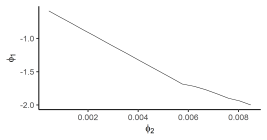
- [Section 3.1, Properties 4 and 5] The proofs of Properties 4 and 5 incorrectly identify the eigenvalues of −w2Σ^{-1}[ZZ] as {−w2ζ_m}, where {ζ_m} are defined as the eigenvalues of Σ[ZZ]. Since the eigenvalues of the inverse are the reciprocals of the eigenvalues of the original matrix, the eigenvalues of −w2Σ^{-1}[ZZ] are {−w2/ζ_m}. Consequently, Weyl's inequalities in Properties 4 and 5 should involve w1ρ_m − w2/ζ_n rather than w1ρ_m − w2ζ_n, and Equations (2) and (3) should replace ζ_n with 1/ζ_n in the appropriate places. The error is not cosmetic: for a one-dimensional example with Q = 1, Σ[ZZ] = 4, u1 = u2 = 0.5, and |φ*1| = |φ*2| = 1, the true quadratic matrix is w1Q − w2Σ^{-1}[ZZ] = 0.5 − 0.5/4 = 0.375 > 0, so the objective is strictly convex, yet Property 4's criterion computes w1ρ_1 − w2ζ_1 = 0.5 − 2 = −1.5 ≤ 0 and incorrectly declares the objective concave. The bounds in Equations (2) and (3) and the overcoverage computation in Figure 1 inherit this error and must be recomputed with the reciprocal eigenvalues.
- [Section 4.1, Property 6 proof] The proof of Property 6 contains a displayed formula with an apparent typographical error: the Schur complement is written as "Λ[ZZ] − Λ^T[YZ]Λ^{-1}[YY]Λ[YY]", which does not have matching dimensions and is not the Schur complement of Λ[YY] in Λ. It should read Λ[ZZ] − Λ[ZY]Λ^{-1}[YY]Λ[YZ] (or equivalently Λ[ZZ] − Λ^T[YZ]Λ^{-1}[YY]Λ[YZ]). The final expectation formula for E[Q] is correct, but the proof's displayed equation should be corrected for mathematical rigor.
- [Section 4.2.2, SGA gradient formula] The stochastic gradient r_j is defined as "2(w1Q_j − w2Σ^{-1}[ZZ])z + w1v + 2w2Σ^{-1}[ZZ]µ[Z]µ[Z]", where µ[Z] appears twice. The correct gradient of w1ϕ1,j(z) + w2ϕ2,j(z) requires only one factor of µ[Z], i.e., the last term should be 2w2Σ^{-1}[ZZ]µ[Z]. As written, the formula would initialize an extra outer product or duplicated vector, potentially misleading any implementation of the SGA methods.
minor comments (3)
- [Section 5.3.1, initial distributions] The initial distributions are introduced as Y1,0, Y2,0, ˙Y1,0, ˙Y2,0, but the second distribution is printed as "˙Y1,0∼N(1, 0.0625)", which should be "˙Y2,0∼N(1, 0.0625)".
- [References] The OpenIntro reference contains a typo: "Retreived" should be "Retrieved".
- [Section 3.1, statement after Eq. (3)] The sentence "However, if u−1 < u1 < u+1, determining convexity of the objective function requires further analysis" is correct only after the reciprocal-eigenvalue correction; as printed it refers to the incorrect bounds.
Circularity Check
No significant circularity: the attack-to-QP derivation is self-contained and independently checkable.
full rationale
The paper's central derivation is not circular. The attacker's objective is assembled from two independently defined components: KL divergence between conditional Gaussians (quantified in Property 1 from standard canonical-form algebra) and the log-ratio of marginal densities of Z relative to its mode (derived directly in Section 2.3). Problem WB is then formed by combining these with user-chosen normalized weights, and the grey-box version is the same objective under an expectation over a stated prior. No parameter in the theoretical derivation is fitted to the quantities being predicted; the weights, prior hyperparameters, and feasible regions are explicit modeling choices. The empirical sections fit model parameters to real-world data, but these fits serve only as illustrative inputs and do not appear as hidden constraints in the theorem chain. The reference list contains no load-bearing self-citations by the present authors; the cited distributional facts (e.g., Schur complements of Wishart matrices) are external and checkable. The one substantive concern visible in the manuscript, namely that Properties 4 and 5 appear to use eigenvalues of Sigma_[ZZ] where the objective contains Sigma^{-1}_[ZZ], is a mathematical-correctness issue rather than a circularity issue, because it does not make the claimed result equivalent to its own inputs by construction.
Assumptions & free parameters
free parameters (3)
- Objective weights u1, u2 = 1 - u1 =
u1 = 0.5 in base cases; swept over [0.01, 0.99] in Pareto analyses
- Feasible-region and attack-budget parameters (max perturbation, q) =
0.15 for ZHVI; 10% of true value for loan; q in {0.1, 0.25, 0.5} for LG-SSM
- Grey-box prior hyperparameters (mu0, kappa, Psi, nu) =
mu0 = mu_hat, kappa = 5, Psi = Sigma_hat, nu = 17 (ZHVI); analogous choices for loan and LG-SSM
assumptions (6)
- domain assumption The joint (Y, Z) follows a multivariate Gaussian with positive definite covariance Sigma.
- domain assumption The attacker can intercept the realized evidence z_prime and replace it with any z in a bounded feasible region Z with non-empty interior.
- domain assumption Detection risk is measured by the log-ratio of the marginal density of Z at z relative to its mode.
- standard math Weyl's eigenvalue inequalities apply to Hermitian matrix sums.
- standard math Schur complements of Wishart matrices are Wishart, and inverse-Wishart block marginals are inverse-Wishart.
- domain assumption In the grey-box setting, uncertainty about PYZ is represented by a prior and the attacker optimizes the expected objective.
Cite this review
Pith. "Pith review of Indiscriminate Disruption of Conditional Inference on Multivariate Gaussians." pith.science (2026). https://pith.science/paper/HQZXS53G
@misc{pith2026241114351,
  author       = {Pith},
  title        = {Pith review of: Indiscriminate Disruption of Conditional Inference on Multivariate Gaussians},
  year         = {2026},
  howpublished = {\url{https://pith.science/paper/HQZXS53G}},
  note         = {Machine review of arXiv:2411.14351}
}
read the original abstract
The multivariate Gaussian distribution underpins myriad operations-research, decision-analytic, and machine-learning models (e.g., Bayesian optimization, Gaussian influence diagrams, and variational autoencoders). However, despite recent advances in adversarial machine learning (AML), inference for Gaussian models in the presence of an adversary is notably understudied. Therefore, we consider a self-interested attacker who wishes to disrupt a decisionmaker's conditional inference and subsequent actions by corrupting a set of evidentiary variables. To avoid detection, the attacker also desires the attack to appear plausible wherein plausibility is determined by the density of the corrupted evidence. We consider white- and grey-box settings such that the attacker has complete and incomplete knowledge about the decisionmaker's underlying multivariate Gaussian distribution, respectively. Select instances are shown to reduce to quadratic and stochastic quadratic programs, and structural properties are derived to inform solution methods. We assess the impact and efficacy of these attacks in three examples, including, real estate evaluation, interest rate estimation and signals processing. Each example leverages an alternative underlying model, thereby highlighting the attacks' broad applicability. Through these applications, we also juxtapose the behavior of the white- and grey-box attacks to understand how uncertainty and structure affect attacker behavior.
Figures


Figures from the paper (3 more)


Reference graph
Works this paper leans on
-
[1]
author Aktekin, T. , author Soyer, R. , & author Xu, F. ( year 2013 ). title Assessment of mortgage default risk via bayesian state space models . journal The Annals of Applied Statistics \/ , (pp. pages 1450--1473 )
work page 2013
-
[2]
author Bao, X. , author Khajavirad, A. , author Sahinidis, N. V. , & author Tawarmalani, M. ( year 2015 ). title Global optimization of nonconvex problems with multilinear intermediates . journal Mathematical Programming Computation \/ , volume 7 \/ , pages 1--37
work page 2015
-
[3]
author Bazaraa, M. S. , author Sherali, H. D. , & author Shetty, C. M. ( year 2013 ). title Nonlinear programming: theory and algorithms \/ . publisher John Wiley & Sons
work page 2013
-
[4]
author Biggio, B. , & author Roli, F. ( year 2018 ). title Wild patterns: Ten years after the rise of adversarial machine learning . journal Pattern Recognition \/ , volume 84 \/ , pages 317--331 . https://www.sciencedirect.com/science/article/pii/S0031320318302565. :https://doi.org/10.1016/j.patcog.2018.07.023
-
[5]
author Bishop, C. M. , & author Nasrabadi, N. M. ( year 2006 ). title Pattern recognition and machine learning \/ volume volume 4 . publisher Springer
work page 2006
-
[6]
author Boyd, S. , author Boyd, S. P. , & author Vandenberghe, L. ( year 2004 ). title Convex optimization \/ . publisher Cambridge university press
work page 2004
-
[7]
author Burer, S. , & author Vandenbussche, D. ( year 2008 ). title A finite branch-and-bound algorithm for nonconvex quadratic programming via semidefinite relaxations . journal Mathematical Programming \/ , volume 113 \/ , pages 259--282
work page 2008
-
[8]
author Das, A. , & author Geisler, W. S. ( year 2021 ). title A method to integrate and classify normal distributions . journal Journal of Vision \/ , volume 21 \/ , pages 1--1
work page 2021
Show all 35 references
-
[9]
, author Hazan, E
author Duchi, J. , author Hazan, E. , & author Singer, Y. ( year 2011 ). title Adaptive subgradient methods for online learning and stochastic optimization. journal Journal of machine learning research \/ , volume 12 \/
2011
-
[10]
author Goodfellow, I. J. , author Shlens, J. , & author Szegedy, C. ( year 2014 ). title Explaining and harnessing adversarial examples . journal arXiv preprint arXiv:1412.6572 \/ ,
2014 arXiv
-
[11]
, author Serra, G
author Grana, C. , author Serra, G. , author Manfredi, M. , & author Cucchiara, R. ( year 2013 ). title Image classification with multivariate gaussian descriptors . In booktitle Image Analysis and Processing--ICIAP 2013: 17th International Conference, Naples, Italy, September...
2013
-
[12]
, author Dolan-Gavitt, B
author Gu, T. , author Dolan-Gavitt, B. , & author Garg, S. ( year 2017 ). title Badnets: Identifying vulnerabilities in the machine learning model supply chain . journal arXiv preprint arXiv:1708.06733 \/ ,
2017 arXiv
-
[13]
, & author Tibshirani, R
author Hastie, T. , & author Tibshirani, R. ( year 1996 ). title Discriminant analysis by gaussian mixtures . journal Journal of the Royal Statistical Society: Series B (Methodological) \/ , volume 58 \/ , pages 155--176
1996
-
[14]
author Kingma, D. P. , & author Ba, J. ( year 2014 ). title Adam: A method for stochastic optimization . journal arXiv preprint arXiv:1412.6980 \/ ,
2014 arXiv
-
[15]
, & author Friedman, N
author Koller, D. , & author Friedman, N. ( year 2009 ). title Probabilistic Graphical Models: Principles and Techniques \/ . Adaptive computation and machine learning. publisher MIT Press . https://books.google.co.in/books?id=7dzpHCHzNQ4C
2009
-
[16]
, author Goodfellow, I
author Kurakin, A. , author Goodfellow, I. , & author Bengio, S. ( year 2016 ). title Adversarial machine learning at scale . journal arXiv preprint arXiv:1611.01236 \/ ,
2016 arXiv
-
[17]
, author Goodfellow, I
author Kurakin, A. , author Goodfellow, I. J. , & author Bengio, S. ( year 2018 ). title Adversarial examples in the physical world . In booktitle Artificial intelligence safety and security \/ (pp. pages 99--112 ). publisher Chapman and Hall/CRC
2018
-
[18]
, author Xing, J
author Luo, W. , author Xing, J. , author Milan, A. , author Zhang, X. , author Liu, W. , & author Kim, T.-K. ( year 2021 ). title Multiple object tracking: A literature review . journal Artificial intelligence \/ , volume 293 \/ , pages 103448
2021
-
[19]
author McDonald, D. J. , author McBride, M. , author Gu, Y. , & author Raphael, C. ( year 2021 ). title Markov-switching state space models for uncovering musical interpretation . journal The Annals of Applied Statistics \/ , volume 15 \/ , pages 1147--1170
2021
-
[20]
title Loan Data from Lending Club
author OpenIntro ( year 2023 ). title Loan Data from Lending Club . howpublished https://www.openintro.org/data/index.php?data=loan50 . note Retreived on 10 Apr 2023
2023
-
[21]
author Ouellette, D. V. ( year 1981 ). title Schur complements and statistics . journal Linear Algebra and its Applications \/ , volume 36 \/ , pages 187--295
1981
-
[22]
author Pardalos, P. M. ( year 1991 ). title Global optimization algorithms for linearly constrained indefinite quadratic problems . journal Computers & Mathematics with Applications \/ , volume 21 \/ , pages 87--97
1991
-
[23]
author Pardalos, P. M. , & author Rosen, J. B. ( year 1986 ). title Methods for global concave minimization: A bibliographic survey . journal Siam Review \/ , volume 28 \/ , pages 367--379
1986
-
[24]
author Powell, W. B. ( year 2019 ). title A unified framework for stochastic optimization . journal European Journal of Operational Research \/ , volume 275 \/ , pages 795--821
2019
-
[25]
, author Naveiro, R
author Rios Insua, D. , author Naveiro, R. , author Gallego, V. , & author Poulos, J. ( year 2023 ). title Adversarial machine learning: Bayesian perspectives . journal Journal of the American Statistical Association \/ , (pp. pages 1--12 )
2023
-
[26]
( year 2024 )
author Roblin, S. ( year 2024 ). title Future force: Impact of autonomous systems on the defense sector . journal Inside Unmanned Systems \/ ,
2024
-
[27]
, & author Ghahramani, Z
author Roweis, S. , & author Ghahramani, Z. ( year 1999 ). title A unifying review of linear gaussian models . journal Neural computation \/ , volume 11 \/ , pages 305--345
1999
-
[28]
author Sahinidis, N. V. ( year 1996 ). title Baron: A general purpose global optimization software package . journal Journal of global optimization \/ , volume 8 \/ , pages 201--205
1996
-
[29]
author Sherali, H. D. , & author Tuncbilek, C. H. ( year 1995 ). title A reformulation-convexification approach for solving nonconvex quadratic programming problems . journal Journal of Global Optimization \/ , volume 7 \/ , pages 1--31
1995
-
[30]
author Soken, H. E. , author Hajiyev, C. , & author Sakai, S.-i. ( year 2014 ). title Robust kalman filtering for small satellite attitude estimation in the presence of measurement faults . journal European Journal of Control \/ , volume 20 \/ , pages 64--72
2014
-
[31]
, author Zaremba, W
author Szegedy, C. , author Zaremba, W. , author Sutskever, I. , author Bruna, J. , author Erhan, D. , author Goodfellow, I. , & author Fergus, R. ( year 2013 ). title Intriguing properties of neural networks . journal arXiv preprint arXiv:1312.6199 \/ ,
2013 arXiv
-
[32]
, author Hinton, G
author Tieleman, T. , author Hinton, G. et al. ( year 2012 ). title Lecture 6.5-rmsprop: Divide the gradient by a running average of its recent magnitude . journal Coursera: Neural networks for machine learning \/ , volume 4 \/ , pages 26--31
2012
-
[33]
, author Ippoliti, L
author Valentini, P. , author Ippoliti, L. , & author Fontanella, L. ( year 2013 ). title Modeling us housing prices by spatial dynamic structural equation models . journal The Annals of Applied Statistics \/ , (pp. pages 763--798 )
2013
-
[34]
title Housing Data
author Zillow ( year 2023 ). title Housing Data . howpublished https://www.zillow.com/research/data/ . note Retrieved on 22 Mar 2022
2023
-
[35]
write newline
" write newline "" before.all 'output.state := FUNCTION n.dashify 't := "" t empty not t #1 #1 substring "-" = t #1 #2 substring "--" = not "--" * t #2 global.max substring 't := t #1 #1 substring "-" = "-" * t #2 global.max substring 't := while if t #1 #1 substring * t #2 gl...
Reviewed August 12, 2026 · model on record in the stance chip above.
Discussion (0). Continue with ORCID to comment.