REVIEW 4 major objections 5 minor 69 references
Towards a Middleware for Large Language Models
T0 review · 4 major / 5 minor · reviewed 2026-08-12 · deepseek-v4-flash
Pith's one-line read A middleware architecture for self-hosted LLMs that turns the LLM into an enterprise service gateway, with a calculator proof showing the pattern works.
desk verdict A well-scoped vision paper for LLM middleware whose gateway claim is plausible but rests on a calculator demo and deferred scaling; the authors are honest about the gap. read the letter →
The pith
A machine-rendered reading of the paper's core claim, the machinery that carries it, and where it could break.
The reading
What carries the argument
The load-bearing object is the two-step prompt-binding pattern, used twice: once to turn service discovery into a registry-ranking task, and once to turn parameter binding into a JSON-extraction task. A Service Identifier backed by a vector database retrieves candidate service descriptions filtered by user permissions, and an Execution Graph, modeled after a dataflow graph, chains the selected services, stopping for user input when information is missing and validating each intermediate call with a parser. The calculator experiment is the minimal demonstration that this pattern converts an unreliable arithmetic LLM into a reliable calculator-facing oracle.
What would settle it
Run the paper's two prompt templates over a service registry with dozens to hundreds of services of varied descriptions, measuring end-to-end task accuracy and latency; if accuracy falls below a usable threshold before reaching realistic enterprise registry sizes, the central claim that an LLM can serve as service discovery and binding middleware fails.
Extended reading notes
Core claim
The paper's central claim is that a middleware layer can make self-hosted LLMs practical in enterprises, and that in the most integrated form the LLM becomes the gateway to the application ecosystem: it selects the right service from a registry, turns a natural-language prompt into a concrete operation call with parameters, and translates the result back into language, thereby absorbing service discovery, binding, and protocol adaptation that normally live in middleware. This is supported by a two-step prompting procedure: first the model is shown the registry's application descriptions and asked which app fits the prompt; then it is shown the allowed operations and asked to return a JSON list pairing operations with numbers. In the evaluation, that pattern kept accuracy at 93-100 percent as argument counts grew to 5-20, where the unaided model scored 0-1 percent. The surrounding middleware, consisting of Service Registry, Scheduler, Service Identifier, and Execution Graph, is what the paper claims can provide the guarantees of correctness, permissions, and caching that the model alone lacks.
Load-bearing premise
The architecture depends on the assumption that an LLM given registry metadata keeps identifying services and extracting parameters correctly as the number of services and the complexity of enterprise intents grow; the only demonstration is a calculator with a handful of operations, and the paper defers Execution Graph scaling to future work.
Editorial extensions
If this is right
- Self-hosted LLMs can be deployed with middleware-level features such as sticky GPU scheduling, semantic caching, and permission-aware service lookup, so enterprises can avoid cloud dependence for privacy and cost reasons.
- Service discovery and binding can be implemented as ranking and extraction over a service registry, using established search-ranking techniques in the small-registry regime and two-tower pre-embedding when the registry grows.
- Routing arithmetic-style prompts through an external service turns a model that fails at five arguments into one that stays at 93-100 percent accuracy at five to twenty arguments.
- An LLM gateway can chain multiple services in an Execution Graph, pausing mid-chain to request missing information from the user and resuming once it arrives.
- Deterministic guarantees for LLM responses come from collaboration with external services rather than from the model alone, which is why the middleware layer matters.
Reading between the lines
- A natural test the paper leaves implicit: measure the gateway's accuracy as the service registry grows from one to hundreds of entries; the size at which accuracy drops is the economic boundary between cross-attention routing and two-tower pre-routing.
- The same two-step binding pattern could generalize to LLM-to-LLM communication by treating another model's output as a service response, which is the multi-LLM scenario the paper names but does not implement.
- The vector database used for the Service Identifier could double as the semantic cache for response caching, so the middleware might need only one embedding index rather than two separate stores.
- The gateway pattern redraws the middleware map: if protocol adaptation lives in the model, then service interface evolution may become a prompt-engineering concern rather than an IDL or API migration concern.
Editorial analysis
A structured set of objections, weighed in public.
Referee Report
Summary. The paper argues that deploying large language models in enterprises requires a dedicated middleware layer that addresses session state, scheduling, caching, observability, explainability, and integration with existing microservices. It distinguishes a baseline ``LLM as a Service'' architecture from a more ambitious ``LLM as a Gateway'' architecture in which the LLM performs service discovery, parameter binding, and protocol adaptation, potentially absorbing parts of the traditional middleware stack. The paper outlines these components, proposes prompt-based mechanisms for service identification and binding, and evaluates a prototype that connects a Llama 3 model to a calculator service. The evaluation shows that the LLM-plus-calculator combination outperforms the bare LLM on arithmetic prompts, but the scaling of the Execution Graph and Service Identifier to realistic service registries is explicitly left to future work.
Significance. If the vision were validated, the paper would contribute a useful systems-level research agenda for self-hosted LLMs, a clear architecture separating baseline and gateway use cases, and a concrete initial prototype. The paper is strongest in its taxonomy of deployment challenges (Section 3), its separation of ``LLM as a Service'' from ``LLM as a Gateway'' (Sections 4 and 5), and its candid enumeration of open questions in Section 7.2. It does not claim more than an existence proof in the evaluation, and it explicitly identifies the scaling questions that must be answered before the gateway vision is credible. The calculator experiment is not circular because it compares against external ground truth, and the paper does not fit parameters to its own claims. However, the contribution at this stage is a research agenda plus a small proof-of-concept, not a validated middleware system.
major comments (4)
- [Section 7.1, Table 1] The only quantitative evidence for the gateway claims is a calculator-arithmetic experiment. Each row of Table 1 reports 100 prompts, but there are no repetitions, no variance measures, no confidence intervals, and the specific Llama 3 variant and inference setup are not stated; at 5 arguments the LLM+Calculator accuracy drops to 93/100, and the error analysis does not separate service-identification failures from parameter-extraction failures. This evidence does not by itself demonstrate that an LLM can route and bind services with the reliability a middleware gateway would require.
- [Section 5.2] The service identification and binding mechanism relies on injecting the full registry metadata and allowed operations into the system prompt. The manuscript states in Section 5.2 that this approach provides "significantly fewer guarantees compared to traditional middleware." This is a serious caveat that directly limits the abstract's claim that an LLM can "absorb functionality traditionally attributed to the middleware"; the paper should either present evidence that the reliability gap can be closed (for example, through the validation layer in the Execution Graph) or substantially temper the central claim.
- [Section 7.2] Section 7.2 explicitly defers to future work the scaling of the Execution Graph Generator, including the number of services in the registry, the amount of service metadata appended to prompts, and the use of a vector database. Because the Service Identifier and Execution Graph are the components that would turn a single-tool demo into an enterprise gateway, deferring their evaluation leaves the central architectural claim unvalidated; a proof of concept with one calculator service is not sufficient support.
- [Section 5.1.2] The proposed scaling path of a two-tower pre-router is incomplete in a load-bearing way: the authors state that "the extension of this method to parameter extraction is less obvious," and parameter extraction is required to bind a discovered service to operations and arguments. Without a concrete mechanism or experimental evidence for the extraction step at scale, the paper does not establish a path from the prototype to a scalable gateway.
minor comments (5)
- [Table 1 caption / Section 7.1] The model is referred to as "LLama3" in Table 1 and "LLama3 [40]" in the text; please use the correct name and specify the exact variant (for example, 8B or 70B, bf16, etc.) and the serving stack used for the measurements.
- [Section 7.1] The reported response times (for example, 1.031 s for two arguments) are given to three decimal places, but no GPU model, batch size, number of repetitions, or standard deviation is provided; please add these details so the reader can interpret the resource-contention claims.
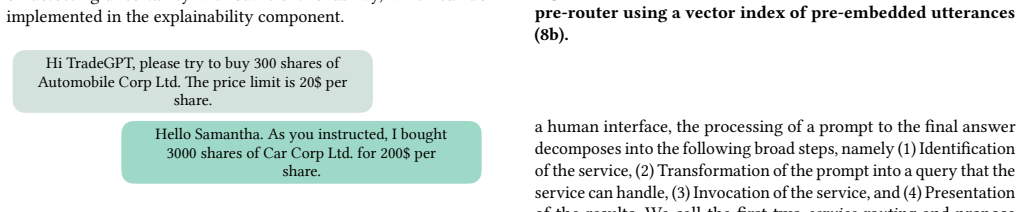
- [Figures 6 and 7] Figures 6 and 7 appear to show the same schematic in the submitted text; if they are meant to illustrate different conversations (an idealized one and a precision-critical one), the figures should be distinct and their captions clarified.
- [Section 4.2] The term "sticky-routing policy" is introduced without a definition or citation; please clarify what property is pinned to which session or user.
- [Section 6.4 versus Section 7.2] The text refers to both the "Execution Graph" and the "Execution Graph Generator"; please use consistent naming so it is clear whether Section 7.2 is evaluating the generator alone or the whole execution component.
Circularity Check
No significant circularity: the paper's claims are architectural vision plus an externally validated calculator prototype; no fitted input is relabeled as a prediction and no load-bearing self-citation chain is present.
full rationale
The paper does not derive predictions from fitted parameters. Its central contribution is a proposed middleware architecture and a proof-of-concept evaluation. The Section 7.1 calculator experiment prompts an LLM to route arithmetic prompts to a calculator and measures accuracy against ground-truth expected results; this is an external benchmark, not a quantity reconstructed from the model's own assumptions. The latency and GPU figures in Sections 3.5 and 3.6 are borrowed from cited external sources, which is normal use of prior evidence rather than circularity. The authors self-identify limitations: Section 5.2 states that the LLM-based service binding approach 'provides significantly fewer guarantees compared to traditional middleware,' and Section 7.2 explicitly defers scaling of the Execution Graph Generator, including registry size and metadata volume, to future work. These caveats weaken the strength of the gateway vision but do not constitute circular reasoning. No equations are reused as results, no fitted parameter is renamed as a prediction, and no self-citation is load-bearing. The honest finding is therefore no significant circularity (score 0).
Assumptions & free parameters
assumptions (3)
- domain assumption LLM prompts containing service registry metadata will identify the correct service and extract parameters with sufficient reliability.
- domain assumption Enterprise services can be described by a set of procedures, parameters, and example utterances, following the Amazon Alexa skill model.
- domain assumption Natural language is an acceptable interface for service discovery in enterprise environments despite its imprecision.
invented entities (3)
-
LLM-as-Gateway architectural pattern
-
Execution Graph component
-
Service Identifier component
Cite this review
Pith. "Pith review of Towards a Middleware for Large Language Models." pith.science (2026). https://pith.science/paper/634RX6TH
@misc{pith2026241114513,
  author       = {Pith},
  title        = {Pith review of: Towards a Middleware for Large Language Models},
  year         = {2026},
  howpublished = {\url{https://pith.science/paper/634RX6TH}},
  note         = {Machine review of arXiv:2411.14513}
}
read the original abstract
Large language models have gained widespread popularity for their ability to process natural language inputs and generate insights derived from their training data, nearing the qualities of true artificial intelligence. This advancement has prompted enterprises worldwide to integrate LLMs into their services. So far, this effort is dominated by commercial cloud-based solutions like OpenAI's ChatGPT and Microsoft Azure. As the technology matures, however, there is a strong incentive for independence from major cloud providers through self-hosting "LLM as a Service", driven by privacy, cost, and customization needs. In practice, hosting LLMs independently presents significant challenges due to their complexity and integration issues with existing systems. In this paper, we discuss our vision for a forward-looking middleware system architecture that facilitates the deployment and adoption of LLMs in enterprises, even for advanced use cases in which we foresee LLMs to serve as gateways to a complete application ecosystem and, to some degree, absorb functionality traditionally attributed to the middleware.
Figures


Figures from the paper (9 more)




Reference graph
Works this paper leans on
-
[1]
Martín Abadi, Paul Barham, Jianmin Chen, Zhifeng Chen, Andy Davis, Jeffrey Dean, Matthieu Devin, Sanjay Ghemawat, Geoffrey Irving, Michael Isard, Man- junath Kudlur, Josh Levenberg, Rajat Monga, Sherry Moore, Derek G. Murray, Benoit Steiner, Paul Tucker, Vijay Vasudevan, Pete Warden, Martin Wicke, Yuan Yu, and Xiaoqiang Zheng. TensorFlow: A system for Lar...
work page 2016
-
[2]
Josh Achiam, Steven Adler, Sandhini Agarwal, Lama Ahmad, Ilge Akkaya, Floren- cia Leoni Aleman, Diogo Almeida, Janko Altenschmidt, Sam Altman, Shyamal Anadkat, et al. Gpt-4 technical report, 2024
work page 2024
-
[3]
Gqa: Training generalized multi-query transformer models from multi-head checkpoints, 2023
Joshua Ainslie, James Lee-Thorp, Michiel de Jong, Yury Zemlyanskiy, Federico Lebrón, and Sumit Sanghai. Gqa: Training generalized multi-query transformer models from multi-head checkpoints, 2023
2023
-
[4]
Define the dialog to collect and confirm required informa- tion
Amazon Alexa. Define the dialog to collect and confirm required informa- tion. https://developer.amazon.com/en-US/docs/alexa/custom-skills/define-the- dialog-to-collect-and-confirm-required-information.html, 2024. Accessed: 2024- 05-30
work page 2024
-
[5]
Dialog management with alexa conversations
Amazon Alexa. Dialog management with alexa conversations. https://developer. amazon.com/en-US/alexa/alexa-skills-kit/dialog-management, 2024. Accessed: 2024-05-30
work page 2024
-
[6]
Amazon. Agents for amazon bedrock. https://docs.aws.amazon.com/bedrock/ latest/userguide/agents.html, 2024. Accessed: 2024-04-16
work page 2024
-
[7]
Anthropic. Meet claude. https://www.anthropic.com/claude, 2024. Accessed: 2024-04-16
work page 2024
-
[8]
Fu Bang. GPTCache: An open-source semantic cache for LLM applications enabling faster answers and cost savings. In Liling Tan, Dmitrijs Milajevs, Geeticka Chauhan, Jeremy Gwinnup, and Elijah Rippeth, editors, Proceedings of the 3rd Workshop for Natural Language Processing Open Source Software (NLP-OSS 2023), pages 212–218, Singapore, December 2023. Associ...
work page 2023
Show all 69 references
-
[9]
Yu, Yin-Wen Chang, Yiming Yang, and Sanjiv Kumar
Wei-Cheng Chang, Felix X. Yu, Yin-Wen Chang, Yiming Yang, and Sanjiv Kumar. Pre-training tasks for embedding-based large-scale retrieval. CoRR, abs/2002.03932, 2020
2002 arXiv
-
[10]
Punica: Multi-tenant lora serving, 2023
Lequn Chen, Zihao Ye, Yongji Wu, Danyang Zhuo, Luis Ceze, and Arvind Krish- namurthy. Punica: Multi-tenant lora serving, 2023
2023
-
[11]
Frugalgpt: How to use large language models while reducing cost and improving performance, 2023
Lingjiao Chen, Matei Zaharia, and James Zou. Frugalgpt: How to use large language models while reducing cost and improving performance, 2023
2023
-
[12]
K. R. Chowdhary. Natural Language Processing, pages 603–649. Springer India, New Delhi, 2020
2020
-
[13]
Aakanksha Chowdhery, Sharan Narang, Jacob Devlin, Maarten Bosma, Gaurav Mishra, Adam Roberts, Paul Barham, Hyung Won Chung, Charles Sutton, Sebas- tian Gehrmann, Parker Schuh, Kensen Shi, Sasha Tsvyashchenko, Joshua Maynez, Abhishek Rao, Parker Barnes, Yi Tay, Noam Shazeer, Vi...
2023
-
[14]
Llm inference performance engineering: Best practices
Databricks. Llm inference performance engineering: Best practices. https://www.databricks.com/blog/llm-inference-performance-engineering- best-practices, 2024. Accessed: 2024-05-30
2024
-
[15]
Challenges in service discovery for microservices deployed in a kubernetes cluster–a case study
Baasanjargal Erdenebat, Bayarjargal Bud, and Tamás Kozsik. Challenges in service discovery for microservices deployed in a kubernetes cluster–a case study. Infocommunications Journal, 15(SI):69–75, 2023
2023
-
[16]
Direct access, High-Performance memory disaggregation with DirectCXL
Donghyun Gouk, Sangwon Lee, Miryeong Kwon, and Myoungsoo Jung. Direct access, High-Performance memory disaggregation with DirectCXL. In 2022 USENIX Annual Technical Conference (USENIX ATC 22) , pages 287–294, Carlsbad, CA, July 2022. USENIX Association
2022
-
[17]
Service location protocol: Automatic discovery of ip network services
Erik Guttman. Service location protocol: Automatic discovery of ip network services. IEEE Internet computing, 3(4):71–80, 1999
1999
-
[18]
Learning multiple layers of representation.Trends in cognitive sciences, 11(10):428–434, 2007
Geoffrey E Hinton. Learning multiple layers of representation.Trends in cognitive sciences, 11(10):428–434, 2007
2007
-
[19]
Llm-adapters: An adapter family for parameter-efficient fine-tuning of large language models
Zhiqiang Hu, Lei Wang, Yihuai Lan, Wanyu Xu, Ee-Peng Lim, Lidong Bing, Xing Xu, Soujanya Poria, and Roy Ka-Wei Lee. Llm-adapters: An adapter family for parameter-efficient fine-tuning of large language models. In The 2023 Conference on Empirical Methods in Natural Language Pro...
2023
-
[20]
A survey on hallucination in large language models: Principles, taxonomy, challenges, and open questions, 2023
Lei Huang, Weijiang Yu, Weitao Ma, Weihong Zhong, Zhangyin Feng, Haotian Wang, Qianglong Chen, Weihua Peng, Xiaocheng Feng, Bing Qin, and Ting Liu. A survey on hallucination in large language models: Principles, taxonomy, challenges, and open questions, 2023
2023
-
[21]
Continuous delivery: reliable software releases through build, test, and deployment automation
Jez Humble and David Farley. Continuous delivery: reliable software releases through build, test, and deployment automation . Pearson Education, 2010
2010
-
[22]
do you follow me?
Léo Jacqmin, Lina M. Rojas-Barahona, and Benoit Favre. "do you follow me?": A survey of recent approaches in dialogue state tracking, 2022
2022
-
[23]
Towards mitigating llm hallucination via self reflection
Ziwei Ji, Tiezheng Yu, Yan Xu, Nayeon Lee, Etsuko Ishii, and Pascale Fung. Towards mitigating llm hallucination via self reflection. In Findings of the Asso- ciation for Computational Linguistics: EMNLP 2023 , pages 1827–1843, 2023
2023
-
[24]
Colbert: Efficient and effective passage search via contextualized late interaction over bert
Omar Khattab and Matei Zaharia. Colbert: Efficient and effective passage search via contextualized late interaction over bert. In Proceedings of the 43rd Inter- national ACM SIGIR Conference on Research and Development in Information Retrieval, SIGIR ’20, pages 39–48, New York...
2020
-
[25]
Imagenet classification with deep convolutional neural networks
Alex Krizhevsky, Ilya Sutskever, and Geoffrey E Hinton. Imagenet classification with deep convolutional neural networks. In F. Pereira, C.J. Burges, L. Bottou, and K.Q. Weinberger, editors,Advances in Neural Information Processing Systems , volume 25. Curran Associates, Inc., 2012
2012
-
[26]
A survey on out-of-distribution detection in nlp, 2023
Hao Lang, Yinhe Zheng, Yixuan Li, Jian Sun, Fei Huang, and Yongbin Li. A survey on out-of-distribution detection in nlp, 2023
2023
-
[27]
Conceptual guide
LangChain. Conceptual guide. https://python.langchain.com/v0.2/docs/ concepts/, 2024. Accessed: 2024-05-30
2024
-
[28]
Langsmith tracing
LangChain. Langsmith tracing. https://docs.smith.langchain.com/concepts/ tracing, 2024. Accessed: 2024-05-28
2024
-
[29]
Machine learning in bioinformatics
Pedro Larranaga, Borja Calvo, Roberto Santana, Concha Bielza, Josu Galdiano, Inaki Inza, José A Lozano, Rubén Armananzas, Guzmán Santafé, Aritz Pérez, et al. Machine learning in bioinformatics. Briefings in bioinformatics, 7(1):86–112, 2006
2006
-
[30]
Dialogue state tracking with a language model using schema-driven prompting
Chia-Hsuan Lee, Hao Cheng, and Mari Ostendorf. Dialogue state tracking with a language model using schema-driven prompting. In Marie-Francine Moens, Xuanjing Huang, Lucia Specia, and Scott Wen-tau Yih, editors, Proceedings of the 2021 Conference on Empirical Methods in Natural...
2021
-
[31]
Retrieval-augmented generation for knowledge-intensive nlp tasks
Patrick Lewis, Ethan Perez, Aleksandra Piktus, Fabio Petroni, Vladimir Karpukhin, Naman Goyal, Heinrich Küttler, Mike Lewis, Wen-tau Yih, Tim Rock- täschel, Sebastian Riedel, and Douwe Kiela. Retrieval-augmented generation for knowledge-intensive nlp tasks. In H. Larochelle, M...
2020
-
[32]
Can llm already serve as a database interface? a big bench for large-scale database grounded text-to-sqls
Jinyang Li, Binyuan Hui, Ge Qu, Jiaxi Yang, Binhua Li, Bowen Li, Bailin Wang, Bowen Qin, Ruiying Geng, Nan Huo, et al. Can llm already serve as a database interface? a big bench for large-scale database grounded text-to-sqls. Advances in Neural Inf. Proc. Systems , 36, 2024
2024
-
[33]
Proactive conversational agents in the post-chatgpt world
Lizi Liao, Grace Hui Yang, and Chirag Shah. Proactive conversational agents in the post-chatgpt world. In Proceedings of the 46th International ACM SIGIR Conference on Research and Development in Information Retrieval , pages 3452– 3455, 2023
2023
-
[34]
A high performance, scalable dns service for very large scale container cloud platforms
Haifeng Liu, Shugang Chen, Yongcheng Bao, Wanli Yang, Yuan Chen, Wei Ding, and Huasong Shan. A high performance, scalable dns service for very large scale container cloud platforms. In Proceedings of the 19th International Middleware Conference Industry, pages 39–45, 2018
2018
-
[35]
Gonzalez, Ion Stoica, and Matei Zaharia
Shu Liu, Asim Biswal, Audrey Cheng, Xiangxi Mo, Shiyi Cao, Joseph E. Gonzalez, Ion Stoica, and Matei Zaharia. Optimizing llm queries in relational workloads, 2024
2024
-
[36]
Learn- ing under concept drift: A review
Jie Lu, Anjin Liu, Fan Dong, Feng Gu, João Gama, and Guangquan Zhang. Learn- ing under concept drift: A review. IEEE Transactions on Knowledge and Data Engineering, 31(12):2346–2363, 2019
2019
-
[37]
PrivateGPT
Iván Martínez Toro, Daniel Gallego Vico, and Pablo Orgaz. PrivateGPT. https: //github.com/imartinez/privateGPT, May 2023
2023
-
[38]
In defense of dual-encoders for neural ranking
Aditya Menon, Sadeep Jayasumana, Ankit Singh Rawat, Seungyeon Kim, Sashank Reddi, and Sanjiv Kumar. In defense of dual-encoders for neural ranking. In Kamalika Chaudhuri, Stefanie Jegelka, Le Song, Csaba Szepesvari, Gang Niu, and Sivan Sabato, editors, Proceedings of the 39th ...
2022
-
[39]
A qualitative study of application-level caching
Jhonny Mertz and Ingrid Nunes. A qualitative study of application-level caching. IEEE Transactions on Software Engineering , 43(9):798–816, 2017. Towards a Middleware for Large Language Models
2017
-
[40]
Introducing meta llama 3: The most capable openly available llm to date
Meta. Introducing meta llama 3: The most capable openly available llm to date. https://ai.meta.com/blog/meta-llama-3/, 2024. Accessed: 2024-05-20
2024
-
[41]
Large language models: A survey, 2024
Shervin Minaee, Tomas Mikolov, Narjes Nikzad, Meysam Chenaghlu, Richard Socher, Xavier Amatriain, and Jianfeng Gao. Large language models: A survey, 2024
2024
-
[42]
Agile cold starts for scalable serverless
Anup Mohan, Harshad Sane, Kshitij Doshi, Saikrishna Edupuganti, Naren Nayak, and Vadim Sukhomlinov. Agile cold starts for scalable serverless. In11th USENIX Workshop on Hot Topics in Cloud Computing (HotCloud 19) , Renton, WA, July
-
[43]
Effi- cient large-scale language model training on gpu clusters using megatron-lm
Deepak Narayanan, Mohammad Shoeybi, Jared Casper, Patrick LeGresley, Mostofa Patwary, Vijay Korthikanti, Dmitri Vainbrand, Prethvi Kashinkunti, Julie Bernauer, Bryan Catanzaro, Amar Phanishayee, and Matei Zaharia. Effi- cient large-scale language model training on gpu clusters...
2021
-
[44]
Applications of large language models (llms) in business analytics–exemplary use cases in data preparation tasks
Mehran Nasseri, Patrick Brandtner, Robert Zimmermann, Taha Falatouri, Farzaneh Darbanian, and Tobechi Obinwanne. Applications of large language models (llms) in business analytics–exemplary use cases in data preparation tasks. In International Conference on Human-Computer Inte...
2023
-
[45]
Aladdin: Joint placement and scaling for slo-aware llm serving, 2024
Chengyi Nie, Rodrigo Fonseca, and Zhenhua Liu. Aladdin: Joint placement and scaling for slo-aware llm serving, 2024
2024
-
[46]
Overview of seldon core components ⁄pilcrow
NVidia. Overview of seldon core components ⁄pilcrow. https://www.nvidia.com/de- de/ai-data-science/products/triton-inference-server, 2024. Accessed: 2024-05-29
2024
-
[47]
Semantics-based automated service discovery
Aabhas V Paliwal, Basit Shafiq, Jaideep Vaidya, Hui Xiong, and Nabil Adam. Semantics-based automated service discovery. IEEE Transactions on Services Computing, 5(2):260–275, 2011
2011
-
[48]
Efficiently scaling transformer inference
Reiner Pope, Sholto Douglas, Aakanksha Chowdhery, Jacob Devlin, James Brad- bury, Jonathan Heek, Kefan Xiao, Shivani Agrawal, and Jeff Dean. Efficiently scaling transformer inference. In D. Sond, M. Carbin, and T. Chen, editors, Proceedings of Machine Learning and Systems 5 pr...
2023
-
[49]
Pratheek, Neha Jawalkar, and Arkaprava Basu
B. Pratheek, Neha Jawalkar, and Arkaprava Basu. Improving gpu multi-tenancy with page walk stealing. In 2021 IEEE International Symposium on High- Performance Computer Architecture (HPCA), pages 626–639, 2021
2021
-
[50]
Overview of seldon core components ⁄pilcrow
Seldon. Overview of seldon core components ⁄pilcrow. https://docs.seldon.io/projects/ seldon-core/en/latest/workflow/overview.html, 2024. Accessed: 2024-05-29
2024
-
[51]
Continuous integration, delivery and deployment: a systematic review on approaches, tools, challenges and practices
Mojtaba Shahin, Muhammad Ali Babar, and Liming Zhu. Continuous integration, delivery and deployment: a systematic review on approaches, tools, challenges and practices. IEEE access, 5:3909–3943, 2017
2017
-
[52]
Fast transformer decoding: One write-head is all you need, 2019
Noam Shazeer. Fast transformer decoding: One write-head is all you need, 2019
2019
-
[53]
Megatron-lm: Training multi-billion parameter language models using model parallelism, 2020
Mohammad Shoeybi, Mostofa Patwary, Raul Puri, Patrick LeGresley, Jared Casper, and Bryan Catanzaro. Megatron-lm: Training multi-billion parameter language models using model parallelism, 2020
2020
-
[54]
Computer vision
George Stockman and Linda G Shapiro. Computer vision. Prentice Hall PTR, 2001
2001
-
[55]
Gptcache : A library for creating semantic cache for llm queries
Zilliz Tech. Gptcache : A library for creating semantic cache for llm queries. https://github.com/zilliztech/GPTCache, 2024. Accessed: 2024-05-30
2024
-
[56]
Creating large language model applications utilizing langchain: A primer on developing llm apps fast
Oguzhan Topsakal and Tahir Cetin Akinci. Creating large language model applications utilizing langchain: A primer on developing llm apps fast. In In- ternational Conference on Applied Engineering and Natural Sciences , volume 1, pages 1050–1056, 2023
2023
-
[57]
Deloitte UK. Open vs. closed-source generative ai. https://www2.deloitte.com/ uk/en/blog/ai-institute/2023/open-vs-closed-source-generative-ai.html, 2024. Accessed: 2024-05-28
2023
-
[58]
Gomez, Lukasz Kaiser, and Illia Polosukhin
Ashish Vaswani, Noam Shazeer, Niki Parmar, Jakob Uszkoreit, Llion Jones, Aidan N. Gomez, Lukasz Kaiser, and Illia Polosukhin. Attention is all you need. CoRR, abs/1706.03762, 2017
2017 arXiv
-
[59]
Chain-of-thought prompting elicits reasoning in large language models, 2023
Jason Wei, Xuezhi Wang, Dale Schuurmans, Maarten Bosma, Brian Ichter, Fei Xia, Ed Chi, Quoc Le, and Denny Zhou. Chain-of-thought prompting elicits reasoning in large language models, 2023
2023
-
[60]
Raise a child in large language model: Towards effective and generalizable fine-tuning
Runxin Xu, Fuli Luo, Zhiyuan Zhang, Chuanqi Tan, Baobao Chang, Songfang Huang, and Fei Huang. Raise a child in large language model: Towards effective and generalizable fine-tuning. In Proceedings of the 2021 Conference on Empirical Methods in Natural Language Processing , pag...
2021
-
[61]
Hallucination is inevitable: An innate limitation of large language models
Ziwei Xu, Sanjay Jain, and Mohan Kankanhalli. Hallucination is inevitable: An innate limitation of large language models. arXiv preprint arXiv:2401.11817, 2024
2024 arXiv
-
[62]
React: Synergizing reasoning and acting in language models, 2023
Shunyu Yao, Jeffrey Zhao, Dian Yu, Nan Du, Izhak Shafran, Karthik Narasimhan, and Yuan Cao. React: Synergizing reasoning and acting in language models, 2023
2023
-
[63]
Deltazip: Multi-tenant language model serving via delta compression, 2023
Xiaozhe Yao and Ana Klimovic. Deltazip: Multi-tenant language model serving via delta compression, 2023
2023
-
[64]
A survey on large language model (llm) security and privacy: The good, the bad, and the ugly
Yifan Yao, Jinhao Duan, Kaidi Xu, Yuanfang Cai, Zhibo Sun, and Yue Zhang. A survey on large language model (llm) security and privacy: The good, the bad, and the ugly. High-Confidence Computing, page 100211, 2024
2024
-
[65]
Nomad-attention: Efficient llm inference on cpus through multiply- add-free attention, 2024
Tianyi Zhang, Jonah Wonkyu Yi, Bowen Yao, Zhaozhuo Xu, and Anshumali Shrivastava. Nomad-attention: Efficient llm inference on cpus through multiply- add-free attention, 2024
2024
-
[66]
Explainability for large language models: A survey, 2023
Haiyan Zhao, Hanjie Chen, Fan Yang, Ninghao Liu, Huiqi Deng, Hengyi Cai, Shuaiqiang Wang, Dawei Yin, and Mengnan Du. Explainability for large language models: A survey, 2023
2023
-
[67]
Service discovery in pervasive computing environments
Feng Zhu, Matt W Mutka, and Lionel M Ni. Service discovery in pervasive computing environments. IEEE Pervasive computing, 4(4):81–90, 2005
2005
-
[68]
Large language models for information retrieval: A survey
Yutao Zhu, Huaying Yuan, Shuting Wang, Jiongnan Liu, Wenhan Liu, Chenlong Deng, Zhicheng Dou, and Ji-Rong Wen. Large language models for information retrieval: A survey. arXiv preprint arXiv:2308.07107, 2023
2023
-
[69]
Large language models are built-in autoregressive search engines
Noah Ziems, Wenhao Yu, Zhihan Zhang, and Meng Jiang. Large language models are built-in autoregressive search engines. arXiv preprint arXiv:2305.09612, 2023
2023 arXiv
Reviewed August 12, 2026 · model on record in the stance chip above.
Discussion (0). Continue with ORCID to comment.