REVIEW 3 major objections 5 minor 36 references
Superconductivity in Ternary Germanite TaAl$_{x}$Ge$_{2-x}$ with a C40 chiral structure
T0 review · 3 major / 5 minor · reviewed 2026-08-12 · deepseek-v4-flash
Pith's one-line read This paper claims that substituting aluminum into the chiral C40 compound TaGe2 produces a type-II superconductor, TaAl_xGe_{2−x}, with Tc between 2.0 and 2.2 K for x in 0.2–0.4.
desk verdict A new C40 chiral-structure superconductor with solid basic evidence, but the nominal Al content is unverified and the x-window claim is partly limited by the 1.8 K floor. read the letter →
The pith
A machine-rendered reading of the paper's core claim, the machinery that carries it, and where it could break.
The reading
What carries the argument
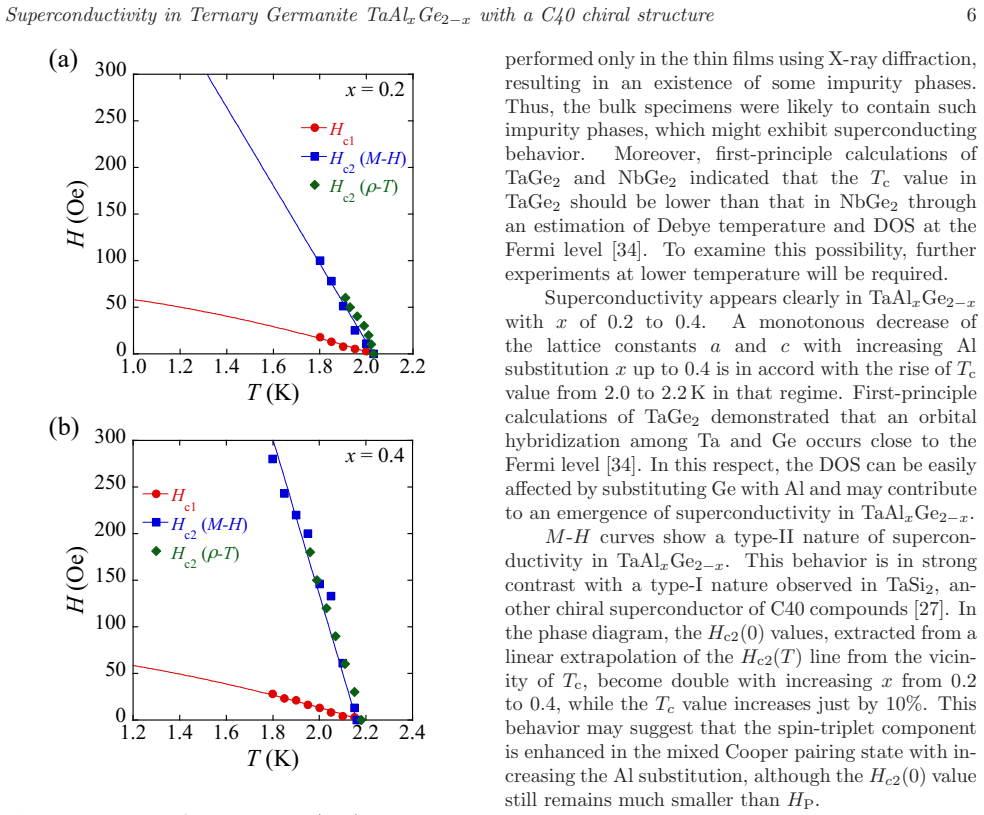
The C40 chiral hexagonal structure (space groups P6_222 or P6_422) with its helical arrangement of Ta and Ge atoms is the host lattice; aluminum substitutes for germanium and acts as the tuning parameter. The paper tracks the evolution of lattice constants with x and uses Ginzburg-Landau analysis of lower and upper critical fields (Hc1 and Hc2) to extract penetration depth, coherence length, and Ginzburg-Landau parameter κ ≈ 3.4–4.5, which establishes the type-II nature.
What would settle it
Measure the aluminum content in the superconducting grains (e.g., by energy-dispersive X-ray spectroscopy) and confirm that a sample with x = 0.2, after removing the Ta5Ge3 impurity, still shows a superconducting transition near 2.0 K with a diamagnetic volume fraction approaching 100%; if the transition disappears or the measured aluminum content falls outside 0.2–0.4, the intrinsic-composition claim fails.
Extended reading notes
Core claim
The central discovery is that aluminum substitution in the chiral C40 compound TaGe2 induces bulk type-II superconductivity in the narrow composition window x = 0.2–0.4, with Tc = 2.0–2.2 K, as established by sharp diamagnetic drops in zero-field-cooled and field-cooled susceptibility, zero resistance in resistivity, and hysteretic magnetization loops. The authors further find that the superconducting window coincides with a monotonic shrinkage of both lattice constants a and c, while superconductivity disappears when c sharply expands for x > 0.4, suggesting a structural origin for the emergence of superconductivity.
Load-bearing premise
The superconductivity is an intrinsic property of the C40 TaAl_xGe_{2−x} phase with the nominal aluminum content, not a product of the few percent Ta5Ge3 impurity present in the x = 0.2 sample or of a composition that differs from the intended one.
Editorial extensions
If this is right
- The C40 TX2 family (T = Nb, Ta; X = Si, Ge) is now a candidate family for chiral superconductors with a hexagonal, not cubic, structure.
- The near-doubling of Hc2(0) from x = 0.2 to 0.4 with only a 10% rise in Tc may indicate that aluminum substitution strengthens the spin-triplet component in the mixed pairing state, a speculation the authors offer.
- If the c-axis expansion suppresses superconductivity for x > 0.4, applying uniaxial pressure along the c-axis to such samples might restore superconductivity, as the paper suggests.
- The combination of chirality control and chirality-induced spin selectivity in these compounds might enable current-driven enhancement of superconducting properties, a route the authors propose for future exploration.
Reading between the lines
- The paper's x values are nominal; a direct measurement of the aluminum content in the superconducting C40 grains would test whether the intrinsic superconducting phase truly lies in the 0.2–0.4 range, or whether the real composition window is shifted.
- The absence of superconductivity in pure TaGe2 above 1.8 K contradicts an earlier report; extending measurements below 1.8 K would determine whether aluminum substitution is creating superconductivity or merely moving an already-existing transition upward.
- The sharp compositional boundary near x = 0.4, together with the sudden c expansion, hints at a possible ordered Al superstructure; synchrotron diffraction could look for such superlattice reflections, as the authors themselves note.
- The lattice-constant–Tc correlation implies a pressure response: hydrostatic pressure should raise Tc for samples near the low-x edge if the mechanism is volume-driven, a testable prediction beyond the paper's explicit claims.
Editorial analysis
A structured set of objections, weighed in public.
Referee Report
Summary. The manuscript reports the synthesis and characterization of ternary intermetallic compounds TaAl_xGe_{2-x} with the C40 chiral crystal structure for nominal Al contents x from 0 to 0.8. The authors find that samples with x = 0.2 and x = 0.4 become superconducting with Tc = 2.03 K and 2.16 K, respectively, as evidenced by diamagnetic shielding with large superconducting volume fractions (71% and 53% in FC), zero electrical resistance, and type-II M-H hysteresis loops. They also report that stoichiometric TaGe2 does not superconduct down to 1.8 K in their samples, in contrast to an earlier report, and that superconductivity is suppressed for x > 0.4. The paper discusses the lattice-constant evolution with Al substitution and suggests that the appearance of superconductivity correlates with a decrease of both a and c lattice parameters, while the suppression beyond x = 0.4 accompanies a sudden rise of the c parameter.
Significance. If the central claim is correct, the paper introduces a new family of chiral-structure superconductors in the C40 class, extending the sparse list of non-cubic chiral superconductors. The evidence is internally consistent: the diamagnetic response with large volume fractions, zero resistance at the same temperatures, and type-II hysteresis are concordant bulk signatures. The manuscript also provides a plausible materials-design rationale (Al substitution to raise the DOS) and explicit discussion of the observed lattice-constant trends. The main weakness is that the Al content is purely nominal and the superconducting phase is not directly compositionally verified, so the claimed x-window and the Tc(x) trend rest on an unverified assumption. This is a load-bearing point that can be addressed with additional experiments.
major comments (3)
- [Sec. 1; Sec. 3 (Fig. 2, Fig. 3)] The Al content x is only nominal; no elemental composition analysis (e.g., EDX or WDS) is reported for the synthesized C40 grains. The lattice-parameter trends in Fig. 3 are used to infer successful substitution, but because Al and Ge have similar metallic radii, the observed monotonic decrease of a and c is not by itself a quantitative verification of the Al concentration. The large superconducting volume fractions and zero resistance are strong evidence for bulk superconductivity, but they do not establish that the superconducting phase has the claimed stoichiometry. Please provide elemental analysis on the actual grains that superconduct, or at least an independent composition check, and discuss the possibility that the effective Al content in the superconducting portion differs from the nominal x.
- [Sec. 3 (Fig. 2)] The x = 0.2 sample contains a few percent of Ta5Ge3 impurity phases. Although a shielding fraction of 71% makes an impurity-dominant origin unlikely, the paper does not directly exclude superconductivity from a minor phase—such as a thin intergranular phase or Al-enriched regions—that could produce similar bulk signatures. Please strengthen the phase-specific attribution, for example by measuring the superconducting properties of a phase-pure Ta5Ge3 reference sample, or by spatially resolved measurements on individual grains of the C40 phase.
- [Abstract; Sec. 3 (Fig. 4)] The claim that superconductivity 'disappeared or was largely suppressed' for x < 0.2 rests on measurements that stop at 1.8 K. Given the previous report of Tc = 1.9 K in bulk TaGe2 [28], the absence of a transition above 1.8 K is consistent with either suppression or with a transition at slightly lower temperatures. Please either extend measurements below 1.8 K for x = 0 and x = 0.1, or state this limitation explicitly in the abstract and concluding remarks and soften the phase-window claim accordingly.
minor comments (5)
- [Sec. 5] In the last paragraph, 'mixed Copper pairing state' should be 'mixed Cooper pairing state'.
- [Sec. 3; Fig. 5; Fig. 7] The terms 'deducted' in the text and figure captions should be 'deduced' or 'determined' (e.g., 'Hc1(T) and Hc2(T) are deduced from the M-H curves').
- [Title] The word 'Germanite' in the title is a mineral name; for a compound of germanium the standard term is 'Germanide' (TaAlxGe2-x is a germanide).
- [Fig. 4(b)] The caption says 'Al-content x evolution of Tc and volume fraction (VF)', but the markers for VF are not explicitly identified in the caption. Please clarify what the open and closed symbols represent.
- [Sec. 4] The discussion of a possible ordered Al superstructure for x > 0.4 is explicitly speculative and is not supported by observed superlattice reflections; this is acceptable as a conjecture, but it should be more clearly separated from the data-based conclusions.
Circularity Check
No circularity: the central claims are direct experimental observations, and the fitted parameters are standard post-hoc characterizations, not predictions derived from the claimed result.
full rationale
The paper's central claim is an experimental discovery: sharp ZFC/FC susceptibility drops with large volume fractions (71% and 53%) and zero electrical resistance at Tc = 2.0–2.2 K in TaAl0.2Ge1.8 and TaAl0.4Ge1.6, as shown in Figs. 4 and 6. The only fitted quantities are Hc1(0), Hc2(0), lambda_GL, xi_GL, and kappa_GL, obtained by standard Ginzburg–Landau fitting Hc1(T) = Hc1(0)[1 − (T/Tc)^2] and by linear extrapolation of Hc2(T); these are post-hoc characterizations of measured magnetic and resistive data, not inputs that define the superconducting transition, the Tc window, or the composition trend. The lattice-constant discussion in Section 4 is a qualitative interpretation of measured XRD data, not a fitted prediction asserted as derivation. Self-citations (refs. 16–19) concern chirality-controlled crystal growth and CISS, and are contextual, not load-bearing for the existence of superconductivity. The unverified nominal Al content and lack of elemental analysis are experimental-evidence weaknesses, not circularity. No equation or parameter used in the paper is equivalent by construction to the claimed result.
Assumptions & free parameters
free parameters (2)
- Hc1(0) =
74.2 Oe for x=0.2, 89.3 Oe for x=0.4
- Hc2(0) =
850 Oe for x=0.2, 1810 Oe for x=0.4
assumptions (3)
- domain assumption Samples with x<=0.4 are single-phase C40 with Al substituting on Ge sites
- domain assumption Observed superconductivity is intrinsic to the C40 phase, not to Ta5Ge3 impurities or other minority phases
- standard math Ginzburg-Landau formula Hc1(T)=Hc1(0)[1-(T/Tc)^2] and relation mu0 Hc1 ~ Phi0/pi/lambda^2 apply
invented entities (1)
-
Possible ordered Al substitution superlattice (superstructure) for x>0.4
Cite this review
Pith. "Pith review of Superconductivity in Ternary Germanite TaAl$_{x}$Ge$_{2-x}$ with a C40 chiral structure." pith.science (2026). https://pith.science/paper/WTDTAVXG
@misc{pith2026241114549,
  author       = {Pith},
  title        = {Pith review of: Superconductivity in Ternary Germanite TaAl$_x$Ge$_2-x$ with a C40 chiral structure},
  year         = {2026},
  howpublished = {\url{https://pith.science/paper/WTDTAVXG}},
  note         = {Machine review of arXiv:2411.14549}
}
abstract
We report a new family of chiral intermetallic superconductors TaAl$_{x}$Ge$_{2-x}$. The mother compound TaGe$_2$ has a C40-type chiral hexagonal crystal structure with a pair of enantiomorphic space groups of $P6{_2}22$ and $P6{_4}22$. By substituting Ge with Al, TaAl$_{x}$Ge$_{2-x}$ polycrystals with the C40 structure were synthesized with Al substitution $x$ from 0 to 0.8. Magnetic susceptibility, magnetization curves and electrical resistivity revealed that TaAl$_{x}$Ge$_{2-x}$ with $x$ of 0.2 to 0.4 was a type-II superconductor with a superconducting transition temperature $T_{\rm c}$ of 2.0 to 2.2 K. The superconductivity disappeared or was largely suppressed at $x$ less than 0.2 and more than 0.4, although all the measurements were performed at temperatures above 1.8 K. An emergence of superconductivity is discussed in terms of the lattice constants changes with the Al substitution.
Figures


Figures from the paper (3 more)


Reference graph
Works this paper leans on
-
[28]
C. M. Knoedler and D. H. Douglass, J. Low Temp. Phys. 37, 189 (1979)
work page 1979
- [1]
- [2]
- [3]
- [4]
-
[5]
H. Q. Yuan, D. F. Agterberg, N. Hayashi, P. Badica, D. Vandervelde, K. Togano, M. Sigrist, and M. B. Salamon, Phys. Rev. Lett. 97, 017006 (2006)
work page 2006
-
[6]
G. L. J. A. Rikken and E. Raupach, Nature 390, 493 (1997)
work page 1997
-
[7]
S. Kibayashi, Y. Takahashi, S. Seki, and Y. Tokura, Nat. Commun. 5, 4583 (2014)
work page 2014
Show all 36 references
-
[8]
Okamura, F
Y. Okamura, F. Kagawa, S. Seki, M. Kubota, M. Kawasaki, and Y. Tokura, Phys. Rev. Lett. 114, 197202 (2015)
2015
-
[9]
Nakagawa, N
N. Nakagawa, N. Abe, S. Toyoda, S. Kimura, J. Zaccaro, I. Gautier-Luneau, D. Luneau, Y. Kousaka, A. Sera, M. Sera, K. Inoue, J. Akimitsu, Y. Tokunaga, and T. Arima, Phys. Rev. B 96, 121102 (2017)
2017
-
[10]
G. L. J. A. Rikken, J. F¨ olling, and P. Wyder, Phys. Rev. Lett. 87, 236602 (2001)
2001
-
[11]
Yokouchi, N
T. Yokouchi, N. Kanazawa, A. Kikkawa, D. Morikawa, K. Shibata, T. Arima, Y. Taguchi, F. Kagawa, and Y. Tokura, Nat. Commun. 8, 866 (2017)
2017
-
[12]
R. Aoki, Y. Kousaka, and Y. Togawa, Phys. Rev. Lett. 122, 057206 (2019)
2019
-
[13]
G¨ ohler, V
B. G¨ ohler, V. Hamelbeck, T. Z. Markus, M. Kettner, G. F. Hanne, Z. Vager, R. Naaman, and H. Zacharias, Science 331, 894 (2011)
2011
-
[14]
Z. Xie, T. Z. Markus, S. R. Cohen, Z. Vager, R. Gutierrez, and R. Naaman, Nano Lett. 11, 4652 (2011)
2011
-
[15]
A. Inui, R. Aoki, Y. Nishiue, K. Shiota, Y. Kousaka, H. Shishido, D. Hirobe, M. Suda, J. Ohe, J. Kishine, H. M. Yamamoto, and Y. Togawa, Phys. Rev. Lett. 124, 166602 (2020)
2020
-
[16]
Kousaka, T
Y. Kousaka, T. Sayo, S. Iwasaki, R. Saki, C. Shimada, H. Shishido, and Y. Togawa, Jpn. J. Appl. Phys. 62, 015506 (2023)
2023
-
[17]
Shiota, A
K. Shiota, A. Inui, Y. Hosaka, R. Amano, Y. ¯Onuki, M. Hedo, T. Nakama, D. Hirobe, J. Ohe, J. Kishine, H. M. Yamamoto, H. Shishido, and Y. Togawa, Phys. Rev. Lett. 127, 126602 (2021)
2021
-
[18]
Shishido, R
H. Shishido, R. Sakai, Y. Hosaka, and Y. Togawa, Appl. Phys. Lett. 119, 182403 (2021)
2021
-
[19]
Shishido, Y
H. Shishido, Y. Hosaka, K. Monden, A. Inui, T. Sayo, Y. Kousaka, and Y. Togawa, J. Chem. Phys. 159, 064502 (2023)
2023
-
[20]
K. Ohe, H. Shishido, M. Kato, S. Utsumi, H. Matsuura, and Y. Togawa, Phys. Rev. Lett. 132, 056302 (2024)
2024
-
[21]
Togawa, A
Y. Togawa, A. S. Ovchinnikov, and J. Kishine, J. Phys. So c. Jpn. 92, 081006 (2023)
2023
-
[22]
Nakajima, D
R. Nakajima, D. Hirobe, G. Kawaguchi, Y. Nabei, T. Sato, T. Narushima, H. Okamoto, and H. M. Yamamoto, Nature 613, 479 (2023)
2023
-
[23]
Akazawa, H
T. Akazawa, H. Hidaka, H. Kotegawa, T. C. Kobayashi, T. Fujiwara, E. Yamamoto, Y. Haga, R. Settai, and Y. ¯Onuki, J. Phys. Soc. Jpn. 73, 3129 (2004)
2004
-
[24]
Joshi, A
B. Joshi, A. Thamizhavel, and S. Ramakrishnan, Phys. Re v. B 84, 064518 (2011)
2011
-
[25]
E. M. Carnicom, W. Xie, T. Klimczuk, J. Lin, K. G´ ornicka , Z. Sobczak, N. P. Ong, and R. J. Cava, Sci. Adv. 4, eaar7969 (2018)
2018
-
[26]
J. P. Remeika, A. S. Cooper, Z. Fisk, and D. C. Johnston, J. Less Common Met. 62, 211 (1978)
1978
-
[27]
Gottlieb, J
U. Gottlieb, J. C. Lasjaunias, J. L. Tholence, O. Labord e, O. Thomas, and R. Madar, Phys. Rev. B 45, 4803 (1992)
1992
-
[29]
Sakamoto, A
H. Sakamoto, A. Fujii, K. Tanaka, and H. Inui, Acta Mater . 53, 41 (2005)
2005
-
[30]
¯Onuki, A
Y. ¯Onuki, A. Nakamura, T. Uejo, A. Teruya, M. Hedo, T. Nakama, F. Honda, and H. Harima, J. Phys. Soc. Jpn. 83, 061018 (2014)
2014
-
[31]
B. Lv, M. Li, J. Chen, Y. Yang, S. W u, L. Qiao, F. Guan, H. Xing, Q. Tao, G.-H. Cao, and Z.-A. Xu, Phys. Rev. B 102, 064507 (2020)
2020
-
[32]
B. S. Chandrasekhar, Appl. Phys. Lett. 1, 7 (1962)
1962
-
[33]
A. M. Clogston, Phys. Rev. Lett. 9, 266 (1962)
1962
-
[34]
M. H. Kabir, M. M. Hossain, M. A. Ali, M. M. Uddin, M. L. Ali, M. Z. Hasan, A. K. M. A. Islam, and S. H. Naqib, Results Phys. 51, 106701 (2023)
2023
-
[35]
Sagayama, Y
H. Sagayama, Y. W akabayashi, H. Sawa, T. Kamiyama, A. Hoshikawa, S. Harjo, K. Uozato, A. K. Ghosh, M. Tokunaga, and T. Tamegai, J. Phys. Soc. Jpn. 75, 043713 (2006)
2006
-
[36]
Kuroiwa, H
S. Kuroiwa, H. Sagayama, T. Kakiuchi, H. Sawa, Y. Noda, and J. Akimitsu, Phys. Rev. B 74, 014517 (2006)
2006
Reviewed August 12, 2026 · model on record in the stance chip above.
Discussion (0). Continue with ORCID to comment.