REVIEW 5 major objections 7 minor 37 references
Population dynamics of multiple ecDNA types
T0 review · 5 major / 7 minor · reviewed 2026-08-12 · deepseek-v4-flash
Pith's one-line read Under equal fitness, switching among ecDNA types does not change total copy-number dynamics.
desk verdict Rigorous two-type ecDNA result with an unexamined mix-fitness assumption that deserves referee time. read the letter →
The pith
A machine-rendered reading of the paper's core claim, the machinery that carries it, and where it could break.
The reading
What carries the argument
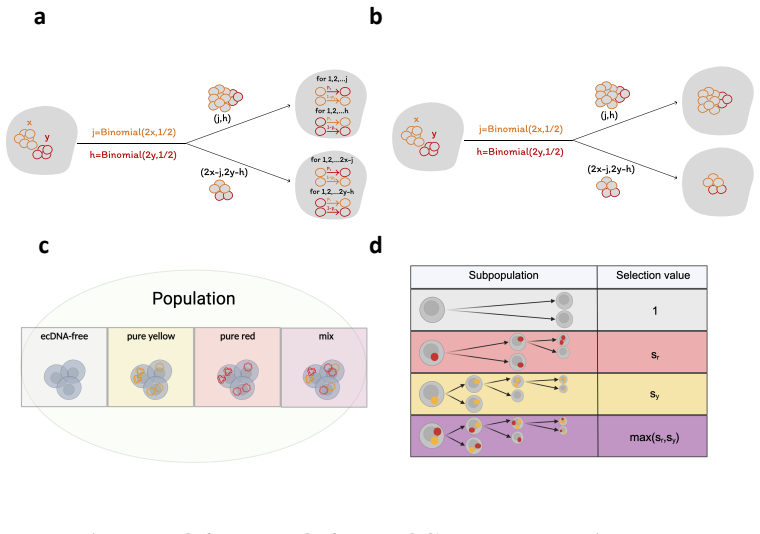
The central object is a master equation counting cells by copy numbers of two ecDNA colors, $C_{i,k}(t)$. The load-bearing identity is that the sum over all switching outcomes of a binomial distribution, or of a convolution of two binomials, equals one, because switching only relabels copies without changing how many copies are inherited. Summing the two-color equations over color partitions collapses the process to the single-type branching process of Eq. (9). The approximate moment equations then track weighted first and second moments of pure and mixed subpopulations, with an infinite geometric-like sum truncated to its first four terms.
What would settle it
Simulate Eq. (8) with mix-cell fitness set to $\max(s_y,s_r)-\varepsilon$ for a range of positive $\varepsilon$ and compare the mixed-cell fraction over time; if even a small fitness cost removes the predicted persistence and dominance, the core persistence claim fails.
Extended reading notes
Core claim
The discovery is a reduction: by summing the master equation over all color configurations, all switching terms cancel via complete binomial probability sums, leaving $\frac{dN_k}{dt} = -sN_k + 2s \sum_{i \ge \lceil k/2 \rceil} N_i \binom{2i}{k} 2^{-2i}$, which is exactly the single-type ecDNA equation. Therefore, for $s_y = s_r = s \ge 1$, the distribution of total ecDNA copies and the fraction of ecDNA-free cells are independent of $p_y$ and $p_r$ at all times. With $s_y \neq s_r$ the cancellation fails and switching shapes total copy dynamics. For ecDNA species without switching, mixed-type cells are transient; with two-way switching, mixed-type cells can persist and dominate the ecDNA-positive population.
Load-bearing premise
The conclusion that mixed cells can persist under switching rests on treating a cell that carries both ecDNA types as no fitter and no sicker than a cell carrying only the fitter type, an assumption the paper adopts without testing alternatives.
Editorial extensions
If this is right
- For cells carrying two ecDNA types with equal fitness, the total ecDNA copy distribution and the fraction of ecDNA-free cells can be predicted from the single-type model without measuring switching rates.
- When selection is identical, switching affects only the composition of cells among pure-yellow, pure-red, and mixed subpopulations, not the overall ecDNA burden.
- Under two-way switching, mixed cells can persist and even dominate the ecDNA-positive population despite receiving no extra fitness benefit, with intermediate switching rates most effective.
- If the two ecDNA types have different fitness, switching changes the total ecDNA dynamics, so type identity cannot be ignored.
- The framework generalizes to more than two ecDNA types, allowing the same switching parameter to model species, genotypes, or phenotypes.
Reading between the lines
- Extension: if mix cells pay any fitness cost, the persistence and dominance of mixed cells under switching is fragile; rerunning Eq. (8) with mix fitness set to $\max(s_y,s_r)-\varepsilon$ would show how quickly the effect disappears.
- Unstated consequence: for equal fitness, therapies aimed at lowering total ecDNA copy number cannot be tuned by knowing switching rates; only the sum of copies matters, while type composition remains relevant for heterogeneity and resistance.
- Testable extension: the four-term truncation of the moment sums can be stress-tested by comparing the approximate moment equations against the untruncated master equation for larger $p$ or higher moments, to see whether the predicted mix-cell dominance is quantitatively robust.
Editorial analysis
A structured set of objections, weighed in public.
Referee Report
Summary. This paper develops a master-equation framework for cell populations carrying two types of extrachromosomal DNA (ecDNA), with independent binomial segregation, possible switching between types at cell division, and selection. The model covers two ecDNA 'species' (no switching), two genotypes/phenotypes (one-way or two-way switching), and the resulting subpopulations of pure yellow, pure red, mix, and ecDNA-free cells. The central exact result is that when the two ecDNA types have identical fitness, the total number N_k of cells with k ecDNA copies satisfies the single-type equation -sN_k + 2s Σ_{i≥⌈k/2⌉} N_i (2i choose k)/2^{2i}, independent of the switching rates (Eq. 9); consequently the total ecDNA-positive distribution and the fraction of ecDNA-free cells are claimed to be switching-independent. For the subpopulations, the authors derive approximate first- and second-moment ODEs using a four-term truncation of infinite sums and small-p Taylor expansions, and compare them with Gillespie simulations. They conclude that without switching, mix cells cannot be maintained, while with switching they can persist and even dominate the ecDNA-positive population. The model assumes that mix cells have the fitness of the fitter pure type, i.e., no extra fitness cost for carrying both ecDNA types.
Significance. If Eq. (9) and the supporting analyses are correct, the paper provides a useful reduction result: selectively equivalent ecDNA types do not affect the total ecDNA load regardless of switching, while switching can maintain multiple ecDNA types in a way that non-switching species cannot. The combinatorial proof of Eq. (9) is a genuine strength, as is the systematic comparison with Gillespie simulations in Figures 3-6 and the clear separation of exact from approximate results. The main caveats are that the closed form in Eq. (18) relies on an undefined quantity, the moment approximations use an uncontrolled truncation, and the persistence/dominance conclusions depend on an untested no-cost assumption for mix cells. With these points resolved, the framework would be a valuable contribution to the quantitative cancer-evolution literature.
major comments (5)
- [Under neutral and identical positive selection, Eq. (18)] The function δ(s) is listed in Table 1 as a 'zeroing function' but is never defined or derived, so the claimed closed form ρ0,0(t)=t/(2+t e^{δ(s)t}) for sy=sr>1 cannot be verified. In particular, the statement that ρ0,0 shrinks to zero requires a sign and magnitude condition on δ(s) that is not given. Please provide the definition and derivation, or label Eq. (18) as an ansatz and support it with simulations.
- [Methods, Eq. (8), last line] The equation for C0,0 as printed includes the term 2sr Σ_{h=0}∞ C0,h (2h choose 0)/2^{2h}; with h=0 this contributes 2sr C0,0 on top of the -C0,0+2C0,0 division term already present. For sr=1 the free-cell compartment would grow at three times its correct rate. The lower index should be h≥1, and the first sum in that line should be clarified, since as printed 'j+h=1' is ambiguous. Please correct the complete system.
- [Moment analysis for multiple ecDNA species when switching is off, Eq. (24) and Tables 2-5] The infinite sums E∞_j and V∞_j are truncated to their first four terms with only the heuristic statement that the terms decay geometrically in h. No bound on the remainder is given, and these truncated moment equations are part of the evidence for the persistence/dominance of mix cells under switching. Please add a quantitative truncation-error estimate or a convergence check by increasing the truncation order, or explicitly state that the persistence claim rests on the Gillespie simulations rather than on the truncated moment equations.
- [Under identical fitness and one-way switching, Table 4] The Total row gives dM^(1)/dt=0 for sy=sr>1, which contradicts Eq. (27) and Table 2, where dM^(1)/dt=(s-1)ρ0,0M^(1). Since Figure 5 compares subpopulation moments against this system, the contradiction should be resolved and the normalization of the plotted moments clarified.
- [Methods, 'A general framework of two ecDNA types' and Figure 1d] The assumption that mix cells have reproduction rate max(sy,sr), i.e., no extra fitness cost or benefit from carrying both types, is load-bearing for the exact reduction in Eq. (9) when sy=sr and for the conclusion that mix cells can persist and dominate under switching. The text notes this assumption 'can be easily released' but does not explore the consequences, and ref. [28] is an unpublished preprint. Please provide a sensitivity analysis with a mix-cell fitness cost (e.g., max(sy,sr)-c in Eqs. (5)-(8)) and state whether the switching-independence and persistence results survive, or explicitly limit the conclusions to the no-cost regime.
minor comments (7)
- [Methods, Eq. (2)] The rates γ(t), g1, g2, h1, h2, k1, k2 in Eq. (2) are listed in Table 1 but never defined; please define them or remove Eq. (2) if it is superseded by Eqs. (8).
- [Eq. (36) versus Eq. (37) and Table 4] Eq. (36) has '+ (s-1)ρ0,0(t)ρi,0(t)' but Eq. (37) and Table 4 use the opposite sign in the corresponding moment equation; please align the signs.
- [Eq. (17)] The notation ρ0(τ) in Eq. (17) should presumably be ρ0,0(τ), the frequency of ecDNA-free cells; please use one consistent notation.
- [Discussion, paragraph beginning 'Moreover, if the switching is identical and two-way'] The sentence refers to Figure 2b&d for intermediate switching values, but those panels show the non-identical fitness scenario; please rephrase to distinguish identical switching rates (py=pr) from identical selection (sy=sr).
- [References] References [30] and [31] are duplicates, and reference [10] cites the current manuscript as 'in preparation'; please remove the self-citation or replace it with an appropriate published reference.
- [Figures 3-5] The x-axis labels are inconsistent across panels (number of cells vs. time in generations); please unify the axis convention and state clearly how the number of cells relates to generation time.
- [Eqs. (13)-(14)] The statement that the term in Eq. (13) '= 1' should be stated more carefully: the sum over k of the convolution is 1 for each v, and the additional summation over v yields the binomial identity in Eq. (14).
Circularity Check
No significant circularity: the switching-independence of total ecDNA copy distribution is derived algebraically from the stated model, and the subpopulation moment results are self-consistent with simulations rather than fitted predictions.
full rationale
The central derivation (Eq. 9) is obtained by explicitly summing the master equations (Eqs. 8) and applying binomial identities; switch terms cancel because switching is defined as a recoloring event that conserves the total number of ecDNA copies per cell. This is a mathematical consequence of the stated model, not a circular definition of the predicted quantity. The moment equations (Tables 2-6) are derived from the same master equations with stated approximations (e.g., first-four-term truncation, Eq. 24) and are compared with Gillespie simulations of the same stochastic process; no parameter is fitted to the quantity being predicted. Self-citations to refs. [21], [22], and [28] provide background or motivate modeling assumptions, such as the mix-cell fitness equal to max(sy, sr) stated in Methods; the main derivations do not rely on these citations as evidence for their conclusions. The mix-fitness assumption is an unvalidated modeling input and a legitimate robustness concern for the persistence/dominance interpretation, but it is not a circular step: the paper's derivations are conditional on that assumption and do not assume the conclusion. The uncontrolled truncation of infinite sums in Eq. 24 is an approximation, not a circular reduction. The paper is therefore not circular in the sense of a prediction reducing to its inputs.
Assumptions & free parameters
free parameters (1)
- Truncation order of infinite moment sums (E4) =
4
assumptions (4)
- domain assumption Independent binomial segregation of the two ecDNA types at each cell division
- domain assumption Mix cell reproductive rate equals max(sy, sr)
- domain assumption ecDNA-free cells cannot regain ecDNA (no reacquisition)
- standard math Small-switching Taylor approximations (1-p)^i ≈ 1-p and p^i ≈ p
Cite this review
Pith. "Pith review of Population dynamics of multiple ecDNA types." pith.science (2026). https://pith.science/paper/I47DDWJX
@misc{pith2026241114588,
  author       = {Pith},
  title        = {Pith review of: Population dynamics of multiple ecDNA types},
  year         = {2026},
  howpublished = {\url{https://pith.science/paper/I47DDWJX}},
  note         = {Machine review of arXiv:2411.14588}
}
read the original abstract
Extrachromosomal DNA (ecDNA) can drive oncogene amplification, gene expression and intratumor heterogeneity, representing a major force in cancer initiation and progression. The phenomenon becomes even more intricate as distinct types of ecDNA present within a single cancer cell. While exciting as a new and significant observation across various cancer types, there is a lack of a general framework capturing the dynamics of multiple ecDNA types theoretically. Here, we present novel mathematical models investigating the proliferation and expansion of multiple ecDNA types in a growing cell population. By switching on and off a single parameter, we model different scenarios including ecDNA species with different oncogenes, genotypes with same oncogenes but different point mutations and phenotypes with identical genetic compositions but different functions. We analyse the fraction of ecDNA-positive and free cells as well as how the mean and variance of the copy number of cells carrying one or more ecDNA types change over time. Our results showed that switching does not play a role in the fraction and copy number distribution of total ecDNA-positive cells, if selection is identical among different ecDNA types. In addition, while cells with multiple ecDNA cannot be maintained in the scenario of ecDNA species without extra fitness advantages, they can persist and even dominate the ecDNA-positive population if switching is possible.
Figures


Figures from the paper (2 more)


Reference graph
Works this paper leans on
-
[28]
Coordinated inheritance of extrachromosomal DNA species in human cancer cells.bioRxiv, 2023
Hung KL, Jones MG, Wong IT, Lange JT, Luebeck J, Scanu E, He BJ, Brückner L, Li R, González RC, Schmargon R, Dörr JR, Belk JA, Bafna V, Werner B, Huang W, Henssen AG, Mischel PS, and Chang HY. Coordinated inheritance of extrachromosomal DNA species in human cancer cells.bioRxiv, 2023
work page 2023
-
[1]
L’Abbate A, Macchia G, D’Addabbo P, Lonoce A, Tolomeo D, Trombetta D, Kok K, Bartenhagen C, Whelan CW, Palumbo O, Severgnini M, Cifola I, Dugas M, Carella M, De Bellis G, Rocchi M, Carbone L, and Storlazzi CT. Ge- nomic organization and evolution of double minutes/homogeneously staining regions with MYC amplification in human cancer. Nucleic Acids Researc...
work page 2014
-
[2]
Bailey C, Shoura MJ, Mischel PS, and Swanton C. Extrachromosomal DNA- relieving heredity constraints, accelerating tumour evolution.Annals of Oncol- ogy, 31:884–893, 2020
work page 2020
-
[3]
Extrachromosomal DNA—relieving heredity constraints, accelerating tumour evolution
Bailey C, Shoura MJ, Mischel PS, and Swanton C. Extrachromosomal DNA—relieving heredity constraints, accelerating tumour evolution. Annals of Oncology, 31(7):884–893, 2020
work page 2020
-
[4]
Life history trade-offs in cancer evolution.Nature Reviews Cancer, 13:883–892, 2013
Aktipis CA, Boddy AM, Gatenby RA, Brown JS, and Maley CC. Life history trade-offs in cancer evolution.Nature Reviews Cancer, 13:883–892, 2013
work page 2013
-
[5]
DNA mismatch repair promotes APOBEC3- mediateddiffusehypermutationinhumancancers
Mas-Ponte D and Supek F. DNA mismatch repair promotes APOBEC3- mediateddiffusehypermutationinhumancancers. Nature Genetics, 52:958–968, 2020
work page 2020
-
[6]
Nathanson DA, Gini B, Mottahedeh J, Visnyei K, Koga T, Gomez G, Eskin A, Hwang K, Wang J, Masui K, Paucar A, Yang H, Ohashi M, Zhu S, Wykosky J, ReedR,NelsonSF,CloughesyTF,JamesCD,RaoPN,KornblumHI,HeathJR, Cavenee WK, Furnari FB, and Mischel PS. Targeted therapy resistance medi- ated by dynamic regulation of extrachromosomal mutant EGFR DNA.Science, 343:7...
work page 2014
-
[7]
Gillespie DT. A general method for numerically simulating the stochastic time evolution of coupled chemical reactions. Journal of Computational Physics , 22(4):403–434, 1976
work page 1976
Show all 37 references
-
[8]
Exact stochastic simulation of coupled chemical reactions.The Journal of Physical Chemistry , 81(25):2340–2361, 1977
Gillespie DT. Exact stochastic simulation of coupled chemical reactions.The Journal of Physical Chemistry , 81(25):2340–2361, 1977
1977
-
[9]
Stochastic simulation of chemical kinetics
Gillespie DT. Stochastic simulation of chemical kinetics. Annual Review of Physical Chemistry, 58:35–55, 2007
2007
-
[10]
Population dynamics of multiple ecDNA types
Scanu E, Werner B, and Huang W. Population dynamics of multiple ecDNA types. in preparation, 2024
2024
-
[11]
Live- cell imaging shows uneven segregation of extrachromosomal DNA elements and transcriptionally active extrachromosomal DNA hubs in cancer.Cancer Discov- ery, 12:468–483, 2022
Yi E, Gujar AD, Guthrie M, Kim H, Zhao D, Johnson KC, Amin SB, Costa ML, Yu Q, Das S, Jillette N, Clow PA, Cheng AW, and Verhaak RGW. Live- cell imaging shows uneven segregation of extrachromosomal DNA elements and transcriptionally active extrachromosomal DNA hubs in cancer.C...
2022
-
[12]
Extrachromoso- mal DNA amplifications in cancer.Nature Reviews Genetics, 23:760–771, 2022
Yi E, Chamorro González R, Henssen AG, and Verhaak RGW. Extrachromoso- mal DNA amplifications in cancer.Nature Reviews Genetics, 23:760–771, 2022
2022
-
[13]
Mapping clustered mutations in cancer reveals APOBEC3 mutagenesis of ecDNA
Bergstrom EN, Luebeck J, Petljak M, Khandekar A, Barnes M, Zhang T, Steele CD, Pillay N, Landi MT, Bafna V, Mischel PS, Harris RS, and Alexandrov LB. Mapping clustered mutations in cancer reveals APOBEC3 mutagenesis of ecDNA. Nature, 602:510–517, 2022
2022
-
[14]
Errorbarsinexperimentalbiology
CummingG,FidlerF,andVauxDL. Errorbarsinexperimentalbiology. Journal of Cell Biology , 177(1):7–11, 2007
2007
-
[15]
Recent progress in un- derstanding mechanisms of mammalian DNA amplification.Cell, 57:901–908, 1989
Stark GR, Debatisse M, Giulotto E, and Wahl GM. Recent progress in un- derstanding mechanisms of mammalian DNA amplification.Cell, 57:901–908, 1989
1989
-
[16]
Extra- chromosomal DNA is associated with oncogene amplification and poor outcome across multiple cancers.Nature Genetics, 52:891–897, 2020
Kim H, Nguyen NP, Turner K, Wu S, Gujar AD, Luebeck J, Liu J, Deshpande V, Rajkumar U, Namburi S, Amin SB, Yi E, Menghi F, Schulte JH, Henssen AG, Chang HY, Beck CR, Mischel PS, Bafna V, and Verhaak RGW. Extra- chromosomal DNA is associated with oncogene amplification and poor...
2020
-
[17]
Somatic mutation in cancer and normal cells
Martincorena I and Peter JC. Somatic mutation in cancer and normal cells. Science, 349.625:1483–1489, 2015
2015
-
[18]
Stochastic modelling, bayesian inference, and new in vivo mea- surements elucidate the debated mtDNA bottleneck mechanism.Elife, 4:e07464, 2015
Johnston IG, Burgstaller JP, Havlicek V, Kolbe T, Rülicke T, Brem G, Poulton J, and Jones NS. Stochastic modelling, bayesian inference, and new in vivo mea- surements elucidate the debated mtDNA bottleneck mechanism.Elife, 4:e07464, 2015. 31
2015
-
[19]
Johnston IG and Jones NS. Closed-form stochastic solutions for non-equilibrium dynamics and inheritance of cellular components over many cell divisions.Pro- ceedings of the Royal Society A: Mathematical, Physical and Engineering Sci- ences, 471(2180):20150050, 2015
2015
-
[20]
Disparate pathways for extrachromosomal DNA biogenesis and genomic DNA repair.bioRxiv, 2023
Rose JC, Wong ITL, Daniel B, Jones MG, Yost KE, Hung KL, Curtis EJ, Mischel PS, and Chang HY. Disparate pathways for extrachromosomal DNA biogenesis and genomic DNA repair.bioRxiv, 2023
2023
-
[21]
Principles of ecDNA random in- heritance drive rapid genome change and therapy resistance in human cancers
Lange JT, Chen CY, Pichugin Y, Xie, Tang J, Hung KL, Yost KE, Shi Q, Erb ML, Rajkumar U, Wu S, Swanton C, Liu Z, Huang W, Chang HY, Bafna V, Henssen AG, Werner B, and Mischel PS. Principles of ecDNA random in- heritance drive rapid genome change and therapy resistance in human...
2021
-
[22]
The evolutionary dynamics of extrachromosomal DNA in human cancers
Lange JT, Rose JC, Chen CY, Pichugin Y, Xie L, Tang J, Hung KL, Yost KE, Shi Q, Erb ML, Rajkumar U, Wu S, Taschner-Mandl S, Bernkopf M, Swanton C, Liu Z, Huang W, Chang HY, Bafna V, Henssen AG, Werner B, and Mischel PS. The evolutionary dynamics of extrachromosomal DNA in huma...
2022
-
[23]
Double minute chromosomes in glioblas- toma multiforme are revealed by precise reconstruction of oncogenic amplicons
Sanborn JZ, Salama SR, Grifford M, Brennan CW, Mikkelsen T, Jhanwar S, Katzman S, Chin L, and Haussler D. Double minute chromosomes in glioblas- toma multiforme are revealed by precise reconstruction of oncogenic amplicons. Cancer Research, 73:6036–6045, 2013
2013
-
[24]
Plasticity of extrachromosomal and intrachromosomal BRAF amplifications in overcoming targeted therapy dosage challenges
Song K, Minami JK, Huang A, Dehkordi SR, Lomeli SH, Luebeck J, Good- man MH, Moriceau G, Krijgsman O, Dharanipragada P, Ridgley T, Crosson WP, Salazar J, Pazol E, Karin G, Jayaraman R, Balanis NG, Alhani S, Sheu K, Ten Hoeve J, Palermo A, Motika SE, Senaratne TN, Paraiso KH, H...
2022
-
[25]
Single-cell multimodal glioma analyses identify epigenetic regulators of cellular plasticity and environmental stress response
Johnson KC, Anderson KJ, Courtois ET, Gujar AD, Barthel FP, Varn FS, Luo D, Seignon M, Yi E, Kim H, Estecio MRH, Zhao D, Tang M, Navin NE, Maurya R, Ngan CY, Verburg N, De Witt Hamer PC, Bulsara K, Samuels ML, Das S, Robson P, and Verhaak RGW. Single-cell multimodal glioma ana...
2021
-
[26]
Tar- geted profiling of human extrachromosomal DNA by CRISPR-CATCH.Nature Genetics, 54:1746–1754, 2022
Hung KL, Luebeck J, Dehkordi SR, Colón CI, Li R, Wong IT, Coruh C, Dhara- nipragada P, Lomeli SH, Weiser NE, Moriceau G, Zhang X, Bailey C, Houlahan KE, Yang W, González RC, Swanton C, Curtis C, Jamal-Hanjani M, Henssen 32 AG, Law JA, Greenleaf WJ, Lo RS, Mischel PS, Bafna V, ...
2022
-
[27]
ecDNA hubs drive cooperative intermolecular oncogene expression.Nature, 600:731–736, 2021
Hung KL, Yost KE, Xie L, Shi Q, Helmsauer K, Luebeck J, Schöpflin R, Lange JT, Chamorro González R, Weiser NE, Chen C, Valieva ME, Wong IT, Wu S, Dehkordi SR, Duffy CV, Kraft K, Tang J, Belk JA, Rose JC, Corces MR, Granja JM, Li R, Rajkumar U, Friedlein J, Bagchi A, Satpathy A...
2021
-
[29]
Gene regulation on extrachromosomal DNA
Hung KL, Mischel PS, and Chang HY. Gene regulation on extrachromosomal DNA. Nature Structural and Molecular Biology , 29:736–744, 2022
2022
-
[31]
Extrachromosomal oncogene amplification drives tumour evo- lution and genetic heterogeneity.Nature, 543:122–125, 2017
Turner KM, Deshpande V, Beyter D, Koga T, Rusert J, Lee C, Li B, Arden K, Ren B, Nathanson DA, Kornblum HI, Taylor MD, Kaushal S, Cavenee WK, Wechsler-Reya R, Furnari FB, Vandenberg SR, Rao PN, Wahl GM, Bafna V, and Mischel PS. Extrachromosomal oncogene amplification drives tu...
2017
-
[32]
Extrachromosomal DNA (ecDNA): an origin of tumor heterogeneity, genomic remodeling, and drug resistance
Pecorino LT, Verhaak RGW, Henssen A, and Mischel PS. Extrachromosomal DNA (ecDNA): an origin of tumor heterogeneity, genomic remodeling, and drug resistance. Biochemical Society Transactions, 50(6):1911–1920, 2022
1911
-
[33]
Clonal heterogeneity and tumor evolution: Past, present, and the future.Cell, 168(4):613–628, 2017
McGranahan N and Swanton C. Clonal heterogeneity and tumor evolution: Past, present, and the future.Cell, 168(4):613–628, 2017
2017
-
[34]
Extrachromosomal oncogene amplifica- tion in tumour pathogenesis and evolution.Nature Reviews Cancer, 19:283–288, 2019
Verhaak RG, Bafna V, and Mischel PS. Extrachromosomal oncogene amplifica- tion in tumour pathogenesis and evolution.Nature Reviews Cancer, 19:283–288, 2019
2019
-
[35]
Stochastic simulation of structured skin cell popula- tion dynamics
Nakaoka S and Aihara K. Stochastic simulation of structured skin cell popula- tion dynamics. Journal of Mathematical Biology , 66:807–835, 2013. 33
2013
-
[36]
Circular ecDNA promotes accessible chromatin and high oncogene expression
Wu S, Turner KM, Nguyen N, Raviram R, Erb M, Santini J, Luebeck J, Ra- jkumar U, Diao Y, Li B, Zhang W, Jameson N, Corces MR, Granja JM, Chen X, Coruh C, Abnousi A, Houston J, Ye Z, Hu R, Yu M, Kim H, Law JA, Ver- haak RGW, Hu M, Furnari FB, Chang HY, Ren B, Bafna V, and Misch...
2019
-
[37]
Extrachromosomal DNA (ecDNA) in cancer pathogenesis
Wu S, Bafna V, and Mischel PS. Extrachromosomal DNA (ecDNA) in cancer pathogenesis. Current Opinion in Genetics and Development , 66:78–82, 2021
2021
-
[38]
Classificationofextrachromosomal circular DNA with a focus on the role of extrachromosomal DNA (ecDNA) in tumor heterogeneity and progression
LiaoZ,JiangW,YeL,LiT,YuX,andLiuL. Classificationofextrachromosomal circular DNA with a focus on the role of extrachromosomal DNA (ecDNA) in tumor heterogeneity and progression. Biochimica et Biophysica Acta Reviews on Cancer, 1874(1), 2020. 34 Supplementary Figures c. PURE YEL...
2020
Reviewed August 12, 2026 · model on record in the stance chip above.
Discussion (0). Continue with ORCID to comment.