REVIEW 6 major objections 5 minor 24 references
FairAdapter: Detecting AI-generated Images with Improved Fairness
T0 review · 6 major / 5 minor · reviewed 2026-08-12 · deepseek-v4-flash
Pith's one-line read A CLIP-based adapter claims to reduce content-category bias in AI-generated image detection while keeping accuracy.
desk verdict The fairness claim is not established: FFPR has no stated threshold, FAUC is flat or worse on two GAN benchmarks, and no code or seeds are provided, though the underlying problem is real and the method is plausible. read the letter →
The pith
A machine-rendered reading of the paper's core claim, the machinery that carries it, and where it could break.
The reading
What carries the argument
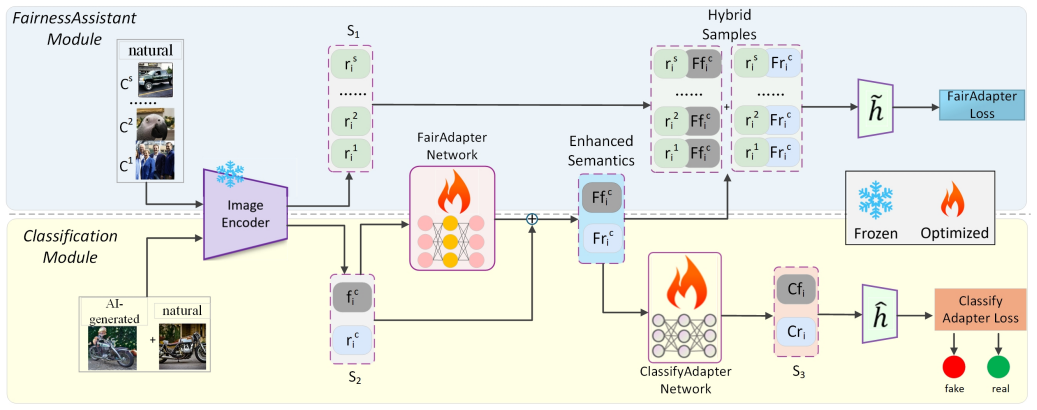
The load-bearing mechanism is hybrid-sample mixing combined with dynamic per-category loss reweighting. The FairAdapter network takes CLIP-extracted semantics $f_i^c$ and $r_i^c$ for a fake and a real image of one category, adds them as residual enhanced features, and concatenates the enhanced fake/natural pair with natural semantics $r_i^s$ from another category to build hybrid samples $f_{\mathrm{mix}}^i$. The FairAdapter loss then computes a cross-entropy term per category and multiplies each category's term by a weight $\lambda_j$ that goes up when a category's current loss grows relative to its previous value and goes down when the loss shrinks, so categories falling behind are penalized more strongly. This directly targets category-level disparity during training. A separate ClassifyAdapter network produces the final fake/natural classification from the enhanced semantics.
What would settle it
Train the same FairAdapter on a category partition that is imbalanced or different from the 20 balanced ProGAN classes and measure FAUC and FFPR on a held-out test set with independent category labels; if the disparity reduction relative to CLIP+Adapter disappears or reverses, the fairness improvement depends on the specific balanced category partition rather than on the mixing and reweighting mechanism itself.
Extended reading notes
Core claim
The central claim is that fairness across image contents can be improved without sacrificing detection accuracy. Concretely, the paper reports that the proposed CLIP-based model achieves lower FAUC (the maximum accuracy gap between content categories) and lower FFPR (the maximum false-positive-rate gap relative to the overall rate) than state-of-the-art detectors on ProGAN, CycleGAN, StyleGAN, and StyleGAN2, while attaining AUC at or above most baselines. The authors attribute this to training the detector to ignore category-specific semantics: the FairAdapter network mixes the CLIP features of a fake/natural image pair with natural-image features from a different category, and the category-weighted loss in Eq. (7) reweights each category's cross-entropy by a dynamic weight $\lambda_j$ derived from the ratio of that category's current loss to its previous value. The measured fairness gains transfer to unseen GAN families, and on diffusion datasets the method reports lower false-positive rates even though it was trained only on ProGAN.
Load-bearing premise
The fairness claim assumes that every training image has a known content category and that the 20 balanced ProGAN categories chosen in Section IV-A fairly represent the range of image contents a detector will face in practice.
Editorial extensions
If this is right
- Detectors trained with FairAdapter should show less accuracy variation across image contents, so a single model can serve a wider range of content without per-category retuning.
- The fairness gains on CycleGAN, StyleGAN, and StyleGAN2 reported in Table II indicate the mechanism transfers to unseen generators, not just to the generator seen in training.
- Because the method relies only on CLIP features and two small adapter networks, it can be added to existing CLIP-based detectors with minimal architectural change.
- The reported low false-positive rates on diffusion datasets suggest that, even where category labels are unavailable, the training strategy still reduces false alarms relative to baselines.
Reading between the lines
- Inference: the same hybrid-mixing and dynamic-reweighting recipe could be applied to demographic fairness in face-based deepfake detection, where the categories would be demographic groups rather than image contents; the paper does not test this.
- Inference: because FAUC measures the maximum gap between the best and worst category, the headline fairness numbers depend on the 20 balanced ProGAN categories; a deployment with long-tailed category distributions could show smaller or larger gains.
- Inference: since the dynamic weights depend only on category loss history, a natural testable extension is to apply the same loss to any pretrained forensic backbone, not just CLIP, and compare FAUC and FFPR.
- Inference: the conclusion's stated limitation that diffusion-model accuracy drops after ProGAN training suggests the fairness improvement and cross-generator detection remain partly separate; a future version could combine FairAdapter with diffusion-specific training to close that gap.
Editorial analysis
A structured set of objections, weighed in public.
Referee Report
Summary. The paper proposes FairAdapter, a framework for detecting AI-generated non-facial images with improved fairness. It uses a frozen CLIP image encoder together with two trainable adapter networks (FairAdapter and ClassifyAdapter) and a category-wise loss that dynamically reweights per-category cross-entropy terms. The authors train on the ProGAN dataset and evaluate intra-domain on ProGAN and cross-domain on CycleGAN, StyleGAN, StyleGAN2, and diffusion-generated datasets, reporting AUC, FAUC, and FFPR. The central claim is that FairAdapter achieves improved fairness over existing detectors while maintaining competitive detection accuracy.
Significance. Fairness in AI-generated image detection is an important and underexplored problem, and the proposed design—mixing natural semantics and dynamically reweighting per-category losses—is a reasonable starting point. The cross-domain evaluation strategy is valuable, and the paper includes ablation studies and a public code link. However, the evidence as presented does not establish the headline fairness claim: the fairness metrics are not consistently defined or thresholded, the threshold-free metric often moves against the claim, and the training protocol is not matched across methods. The intra-domain fairness gain should also be interpreted cautiously because the training loss directly targets per-category cross-entropy disparities and the fairness metrics are computed over the same categories; the cross-domain results provide the more independent evidence.
major comments (6)
- [Section IV-A, Eqs. (9)-(10)] The definitions of FFPR and FAUC use binarized predictions I[Yhat_j=1] and I[Yhat_j=Y_j], but no decision threshold or binarization procedure is specified anywhere in the experimental setup. Because Tables I, II, and IV report large FFPR/FPR advantages (e.g., ProGAN FFPR 1.0 vs 3.0/5.0), these results can be artifacts of threshold choice. Moreover, the displayed FAUC formula computes a gap in per-group accuracy, not an area under an ROC curve, so calling it threshold-free is incorrect. Please disclose the threshold (e.g., 0.5 or tuned per method) and verify that the fairness ordering holds at a common threshold, or restrict the fairness claims to metrics that are properly defined.
- [Tables I-II] Tables I and II show that FairAdapter's FAUC is worse than CLIP+Linear Probing on ProGAN (0.53 vs 0.25) and worse than CLIP+Adapter on CycleGAN (1.85 vs 1.16), while its FFPR is better. Since FFPR is threshold-dependent and FAUC is the only purported threshold-free fairness metric, the current tables contradict a uniform "improved fairness" claim. The paper should either report a common-threshold FFPR/FAUC comparison that supports the claim, or qualify the conclusion to datasets and metrics where the evidence is consistent.
- [Section III-B3a, Eq. (7)] The dynamic weight formula is not a well-defined optimization objective. If Lpre_j = Lj, the second branch gives λj = 0, so a category whose loss is unchanged receives no gradient; if Lpre_j = 0 with Lj > 0, or Lj = 0 with Lpre_j ≥ Lj, the formula divides by zero. The text also does not specify how Lpre_j is initialized or updated across epochs and batches, and Eq. (6)-(7) mix indices j and i without defining how samples map to categories. Please correct the formula, define the update schedule, and state the exact objective being optimized.
- [Section IV-A (Experimental details)] The experimental details state that the baseline batch size is 32 while the proposed method uses batch size 1, with all other hyperparameters fixed. Batch size affects optimization dynamics and can change both AUC and per-category accuracy disparities, so the comparison is confounded. Please retrain or re-evaluate baselines under the same batch size, or justify why the difference is immaterial, and correct the optimizer name ("ADM" is presumably Adam).
- [Section IV-B, Table IV] Table IV replaces FFPR/FAUC with plain FPR and states that the diffusion datasets do not contain multiple categories. Plain FPR is not a disparity metric, so Table IV cannot support the conclusion in Section IV-B that the method shows "superior fairness" on diffusion models. Furthermore, FPR still requires a decision threshold, which is not disclosed. Either report a per-category disparity metric defined on the available labels or remove the fairness claim for diffusion datasets.
- [Tables I-IV] All reported metrics are single point estimates without error bars, confidence intervals, or significance tests. Some comparisons are very close (e.g., FFPR 1.05 vs 1.05 on StyleGAN in Table II), so the central fairness claim is not statistically supported. Please report multiple runs or otherwise quantify the variability of the fairness metrics.
minor comments (5)
- [Section III-B, Eq. (1)] In Eq. (1), E is described as an image encoder but is applied to a pair (X_c_i, X_c'_i); please clarify whether the encoder is applied jointly or separately to the two images.
- [Section III-B1, Eq. (4)] Eq. (4) uses F_fc_i / F_rc_i without defining the division; if it is element-wise, please state so, and align the notation with Eq. (3), where F_fc_i and F_rc_i are separated by a comma.
- [Section IV-B, Table III] The ablation table is hard to read because the check marks are not aligned with column headers; for example, VariantC appears to have two check marks without indicating which components are active. Please use explicit symbols for each of the three components.
- [Section IV-A] The term "ADM optimizer" appears to be a typo for "Adam optimizer"; please correct it.
- [Abstract and Conclusion] The abstract and conclusion claim "improved fairness" without qualification; consider specifying the metric and dataset scope in these statements to match the evidence presented in the tables.
Circularity Check
No significant circularity: the fairness metric is not the training loss, and the central claim is supported by held-out and cross-domain evaluations; a self-cited metric definition is restated in the paper and is not load-bearing.
full rationale
The paper's central claim is that FairAdapter improves fairness (FAUC/FFPR) over state-of-the-art methods on ProGAN and cross-domain GAN benchmarks. I checked whether this claim reduces to the training objective by construction. The FairAdapter loss (Eqs. 6-7) is a dynamically reweighted sum of per-category cross-entropy terms, with dynamic weights lambda_j computed from previous per-category loss values. The evaluation metrics FAUC and FFPR (Section IV-A) measure disparity of per-category AUC and thresholded false-positive rate. These are not identical functionals: cross-entropy and AUC/FPR differ, and the metrics are evaluated on a held-out ProGAN test set as well as on CycleGAN, StyleGAN, StyleGAN2, and diffusion datasets not used for training. The reported fairness improvement is therefore the intended effect of the optimization rather than a metric inserted directly into the loss; it is an empirical result that could have failed, and indeed Table II shows FairAdapter FAUC is worse than CLIP+Linear Probing on CycleGAN. The citation of FAUC/FFPR to Ref. [13] is a self-citation with overlapping authors (Xinan He, Feng Ding), but the metrics are fully redefined in the present paper and are conventional disparity measures, so the argument does not depend on unverified content of [13]. Other self-citations appear in related-work and limitation contexts and are not load-bearing. I found no equation-level reduction, no fitted parameter renamed as a prediction, and no uniqueness theorem imported from the authors' prior work. The unstated decision threshold for FFPR and the metric switch to FPR in Table IV are experimental-reporting concerns, not circularity.
Assumptions & free parameters
free parameters (2)
- Dynamic category loss weight update rule =
lambda_j = 1 + L_j/Lpre_j when loss increases, else 1 - Lpre_j/L_j
- Training hyperparameters =
lr=0.0002, epochs=40, batch size=1 for FairAdapter, 32 for baselines
assumptions (4)
- domain assumption CLIP image encoder features are semantic enough that concatenating enhanced features with natural features from other categories removes content-specific bias while preserving generation traces.
- domain assumption The 20 ProGAN categories used for training and evaluation adequately represent the content distribution over which fairness should be measured.
- domain assumption Category annotations are available for every training image and are balanced, with 300 real and 300 fake images per category.
- ad hoc to paper The dynamic weight formula provides a valid optimization objective.
Cite this review
Pith. "Pith review of FairAdapter: Detecting AI-generated Images with Improved Fairness." pith.science (2026). https://pith.science/paper/NPJO6ZGY
@misc{pith2026241114755,
  author       = {Pith},
  title        = {Pith review of: FairAdapter: Detecting AI-generated Images with Improved Fairness},
  year         = {2026},
  howpublished = {\url{https://pith.science/paper/NPJO6ZGY}},
  note         = {Machine review of arXiv:2411.14755}
}
read the original abstract
The high-quality, realistic images generated by generative models pose significant challenges for exposing them.So far, data-driven deep neural networks have been justified as the most efficient forensics tools for the challenges. However, they may be over-fitted to certain semantics, resulting in considerable inconsistency in detection performance across different contents of generated samples. It could be regarded as an issue of detection fairness. In this paper, we propose a novel framework named Fairadapter to tackle the issue. In comparison with existing state-of-the-art methods, our model achieves improved fairness performance. Our project: https://github.com/AppleDogDog/FairnessDetection
Figures
Reference graph
Works this paper leans on
-
[13]
Preserv- ing fairness generalization in deepfake detection,
Li Lin, Xinan He, Yan Ju, Xin Wang, Feng Ding, and Shu Hu, “Preserv- ing fairness generalization in deepfake detection,” in Proceedings of the IEEE/CVF Conference on Computer Vision and Pattern Recognition, 2024, pp. 16815–16825
work page 2024
-
[14]
Improving fairness in deepfake detection,
Yan Ju, Shu Hu, Shan Jia, George H Chen, and Siwei Lyu, “Improving fairness in deepfake detection,” in Proceedings of the IEEE/CVF Winter Conference on Applications of Computer Vision, 2024, pp. 4655–4665
work page 2024
-
[1]
Denoising diffusion prob- abilistic models,
Jonathan Ho, Ajay Jain, and Pieter Abbeel, “Denoising diffusion prob- abilistic models,” Advances in neural information processing systems, vol. 33, pp. 6840–6851, 2020
work page 2020
-
[2]
Disrupting anti-spoofing systems by images of consistent identity,
Feng Ding, Zihan Jiang, Yue Zhou, Jianfeng Xu, and Guopu Zhu, “Disrupting anti-spoofing systems by images of consistent identity,” IEEE Signal Processing Letters, 2024
work page 2024
-
[3]
Cnn-generated images are surprisingly easy to spot... for now,
Sheng-Yu Wang, Oliver Wang, Richard Zhang, Andrew Owens, and Alexei A Efros, “Cnn-generated images are surprisingly easy to spot... for now,” in Proceedings of the IEEE/CVF conference on computer vision and pattern recognition, 2020, pp. 8695–8704
work page 2020
-
[4]
On the detection of synthetic images generated by diffusion models,
Riccardo Corvi, Davide Cozzolino, Giada Zingarini, Giovanni Poggi, Koki Nagano, and Luisa Verdoliva, “On the detection of synthetic images generated by diffusion models,” in ICASSP 2023-2023 IEEE International Conference on Acoustics, Speech and Signal Processing (ICASSP). IEEE, 2023, pp. 1–5
work page 2023
-
[5]
Decoupling forgery semantics for generalizable deepfake detection,
Wei Ye, Xinan He, and Feng Ding, “Decoupling forgery semantics for generalizable deepfake detection,” arXiv preprint arXiv:2406.09739, 2024
arXiv 2024
-
[6]
Detecting multimedia generated by large ai models: A survey,
Li Lin, Neeraj Gupta, Yue Zhang, Hainan Ren, Chun-Hao Liu, Feng Ding, Xin Wang, Xin Li, Luisa Verdoliva, and Shu Hu, “Detecting multimedia generated by large ai models: A survey,” arXiv preprint arXiv:2402.00045, 2024
arXiv 2024
Show all 24 references
-
[7]
Towards universal fake image detectors that generalize across generative models,
Utkarsh Ojha, Yuheng Li, and Yong Jae Lee, “Towards universal fake image detectors that generalize across generative models,” in Proceed- ings of the IEEE/CVF Conference on Computer Vision and Pattern Recognition, 2023, pp. 24480–24489
2023
-
[8]
Synthesizing black-box anti- forensics deepfakes with high visual quality,
Bing Fan, Shu Hu, and Feng Ding, “Synthesizing black-box anti- forensics deepfakes with high visual quality,” in ICASSP 2024-2024 IEEE International Conference on Acoustics, Speech and Signal Pro- cessing (ICASSP). IEEE, 2024, pp. 4545–4549
2024
-
[9]
Anti-forensics for face swapping videos via adversarial training,
Feng Ding, Guopu Zhu, Yingcan Li, Xinpeng Zhang, Pradeep K Atrey, and Siwei Lyu, “Anti-forensics for face swapping videos via adversarial training,” IEEE Transactions on Multimedia, vol.24, pp. 3429–3441, 2021
2021
-
[10]
High-resolution image synthesis with latent diffu- sion models,
Robin Rombach, Andreas Blattmann, Dominik Lorenz, Patrick Esser, and Bj¨orn Ommer, “High-resolution image synthesis with latent diffu- sion models,” in Proceedings of the IEEE/CVF conference on computer vision and pattern recognition, 2022, pp. 10684–10695
2022
-
[11]
Detecting and simu- lating artifacts in gan fake images,
Xu Zhang, Svebor Karaman, and Shih-Fu Chang, “Detecting and simu- lating artifacts in gan fake images,” in 2019 IEEE international workshop on information forensics and security (WIFS). IEEE, 2019, pp. 1–6
2019
-
[12]
Clipping the decep- tion: Adapting vision-language models for universal deepfake detection,
Sohail Ahmed Khan and Duc-Tien Dang-Nguyen, “Clipping the decep- tion: Adapting vision-language models for universal deepfake detection,” in Proceedings of the 2024 International Conference on Multimedia Retrieval, 2024, pp. 1006–1015
2024
-
[15]
Learning trans- ferable visual models from natural language supervision,
Alec Radford, Jong Wook Kim, Chris Hallacy, Aditya Ramesh, Gabriel Goh, Sandhini Agarwal, Girish Sastry, Amanda Askell, Pamela Mishkin, Jack Clark, et al., “Learning trans- ferable visual models from natural language supervision,” in International conference on machine learnin...
2021
-
[16]
Progres- sive growing of gans for improved quality, stability, and variation,
Tero Karras, Timo Aila, Samuli Laine, and Jaakko Lehtinen, “Progres- sive growing of gans for improved quality, stability, and variation,” arXiv preprint arXiv:1710.10196, 2017
2017 arXiv
-
[17]
Unpaired image-to-image translation using cycle-consistent adversarial networks,
Jun-Yan Zhu, Taesung Park, Phillip Isola, and Alexei A Efros, “Unpaired image-to-image translation using cycle-consistent adversarial networks,” in Proceedings of the IEEE international conference on computer vision, 2017, pp. 2223–2232
2017
-
[18]
A style-based generator architecture for generative adversarial networks,
Tero Karras, Samuli Laine, and Timo Aila, “A style-based generator architecture for generative adversarial networks,” in Proceedings of the IEEE/CVF conference on computer vision and pattern recognition, 2019, pp. 4401–4410
2019
-
[19]
Analyzing and improving the image quality of stylegan,
Tero Karras, Samuli Laine, Miika Aittala, Janne Hellsten, Jaakko Lehtinen, and Timo Aila, “Analyzing and improving the image quality of stylegan,” in Proceedings of the IEEE/CVF conference on computer vision and pattern recognition, 2020, pp. 8110–8119
2020
-
[20]
Glide: Towards photorealistic image generation and editing with text-guided diffusion models,
Alex Nichol, Prafulla Dhariwal, Aditya Ramesh, Pranav Shyam, Pamela Mishkin, Bob McGrew, Ilya Sutskever, and Mark Chen, “Glide: Towards photorealistic image generation and editing with text-guided diffusion models,” arXiv preprint arXiv:2112.10741, 2021
2021 arXiv
-
[21]
Leveraging frequency analysis for deep fake image recognition,
Joel Frank, Thorsten Eisenhofer, Lea Sch ¨onherr, Asja Fischer, Dorothea Kolossa, and Thorsten Holz, “Leveraging frequency analysis for deep fake image recognition,” in International conference on machine learn- ing. PMLR, 2020, pp. 3247–3258
2020
-
[22]
Fusing global and local features for generalized ai-synthesized image detection,
Yan Ju, Shan Jia, Lipeng Ke, Hongfei Xue, Koki Nagano, and Siwei Lyu, “Fusing global and local features for generalized ai-synthesized image detection,” in 2022 IEEE International Conference on Image Processing (ICIP). IEEE, 2022, pp. 3465–3469
2022
-
[23]
Learning on gradients: Generalized artifacts representation for gan-generated images detection,
Chuangchuang Tan, Yao Zhao, Shikui Wei, Guanghua Gu, and Yunchao Wei, “Learning on gradients: Generalized artifacts representation for gan-generated images detection,” in Proceedings of the IEEE/CVF Conference on Computer Vision and Pattern Recognition, 2023, pp. 12105–12114
2023
-
[24]
Clip-adapter: Better vision-language models with feature adapters,
Peng Gao, Shijie Geng, Renrui Zhang, Teli Ma, Rongyao Fang, Yongfeng Zhang, Hongsheng Li, and Yu Qiao, “Clip-adapter: Better vision-language models with feature adapters,” International Journal of Computer Vision, vol. 132, no. 2, pp. 581–595, 2024
2024
Reviewed August 12, 2026 · model on record in the stance chip above.
Discussion (0). Continue with ORCID to comment.