REVIEW 3 major objections 6 minor 91 references
Efficient Generation of Spin Currents in Altermagnets via Magnon Drag
T0 review · 3 major / 6 minor · reviewed 2026-08-12 · deepseek-v4-flash
Pith's one-line read A charge current can drag magnons into a transverse spin current in altermagnets, no spin-orbit coupling needed.
desk verdict A plausible and clearly worked-out prediction of a magnonic spin splitter effect in altermagnets, but the unproven cancellation of the equilibrium magnon self-energy is a load-bearing gap that needs fixing before I'd trust the numbers. read the letter →
The pith
A machine-rendered reading of the paper's core claim, the machinery that carries it, and where it could break.
The reading
What carries the argument
The central object is the electron-magnon interaction Hamiltonian in a d-wave altermagnet, obtained from a Holstein-Primakoff transformation of a two-sublattice Heisenberg antiferromagnet with an easy-axis anisotropy. The interaction couples each electron spin-flip process to a superposition of the two magnon chiralities through the matrix elements $W^\nu_q$ of the magnon diagonalization matrix. The key identity is that the equilibrium magnon self-energy $\Pi^\nu_q$ vanishes exactly when summed over the electron Brillouin zone, so the magnon spectrum stays degenerate; out of equilibrium, the electric-field-induced Fermi-surface imbalance makes the scattering rates chiral-dependent, and the Boltzmann equation then yields the nonequilibrium magnon distributions $g^\nu_q$ from which the magnon spin currents are constructed.
What would settle it
Measure the transverse magnon spin conductivity in a clean altermagnet film as a function of temperature: if the signal does not vanish below the magnon gap and then grow with temperature, or if its sign reversal cannot be observed, the predicted magnon drag mechanism is not the dominant source.
Extended reading notes
Core claim
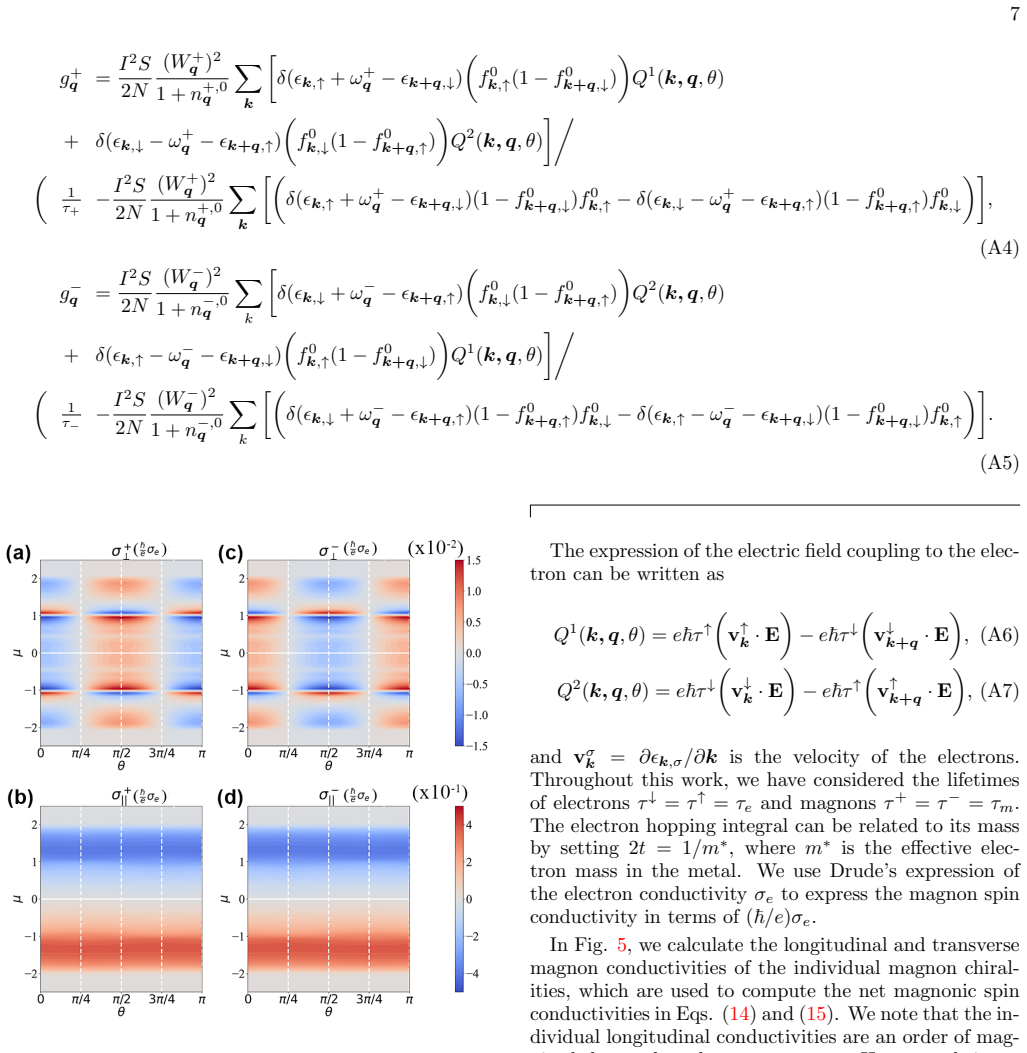
The central claim is that a charge current flowing in an altermagnetic metal induces a transverse magnon spin current whose angular symmetry matches that of the electronic magnetic spin Hall effect (MSHE). Concretely, the authors compute a magnon spin conductivity $\sigma^s_\perp$ from a coupled electron-magnon Boltzmann treatment and find it is nonzero with the same fourfold angular dependence as the electronic MSHE, while the total magnon charge-like current $\sigma^m_\perp$ vanishes because the two chiralities cancel. The magnon spin current inherits a strong dependence on chemical potential, changing sign near electron-magnon resonances ($\epsilon_{k,\uparrow} \approx \epsilon_{k+q,\downarrow}$), where its magnitude can reach roughly 10% of the electronic spin conductivity. The paper states this as the efficient generation of spin currents via magnons, without reliance on the material's spin-orbit coupling.
Load-bearing premise
The derivation assumes that the equilibrium electron-magnon self-energy cancels exactly when summed over the electron Brillouin zone, so the magnon spectrum remains degenerate and only the electric-field-driven imbalance matters.
Editorial extensions
If this is right
- Altermagnetic metals can produce magnon-mediated spin currents without spin-orbit coupling, offering a new route for spin generation in spintronic devices.
- The magnon spin current's strong temperature dependence—vanishing below the magnon gap and switching sign as temperature rises—provides an experimental fingerprint to separate it from the electronic MSHE.
- Because the magnon spin conductivity can reach about 10% of the electronic one near resonances, the effect should be detectable in nonlocal transport or magnetoresistance measurements on altermagnet/ferromagnet bilayers.
- The effect gives a chemical-potential knob: tuning the Fermi level can reverse the sign of the transverse magnon spin current, enabling electrically controlled spin-current polarity.
- The longitudinal magnon spin current, which flows along the charge current with a strength independent of current direction, accompanies the transverse one and may be measurable as an additional signal.
Reading between the lines
- If the equilibrium cancellation of the electron-magnon self-energy is only approximate in real materials, the residual renormalization could split the magnon bands and either suppress or enhance the predicted drag current; the paper acknowledges this but does not quantify it.
- Because the derivation assumes equal relaxation times for the two magnon chiralities, any chiral-dependent scattering (e.g., from impurities or phonons) would break the exact cancellation of $\sigma^m_\perp$ and could produce a net magnon flow even without electron splitting.
- The 10% ratio estimate is tied to the simple square-lattice models; in realistic altermagnets with multiple orbitals and complex Fermi surfaces, the electron-magnon resonances may shift, so a first-principles band-structure calculation would be needed to predict the magnitude and sign of the effect in a specific compound such as RuO$_2$.
- The temperature-dependent sign reversal of the transverse magnon spin conductivity suggests a way to directly probe the electron-magnon resonance energy scale, potentially mapping the spin-split Fermi surface via transport rather than spectroscopy.
Editorial analysis
A structured set of objections, weighed in public.
Referee Report
Summary. The paper studies electron-magnon coupling in a minimal two-band d-wave altermagnet model coupled to degenerate antiferromagnetic magnons. It claims that the equilibrium electron-magnon self-energy cancels over the Brillouin zone, leaving magnons degenerate, while an applied electric field imprints the altermagnetic spin texture onto magnons through drag. Using a Boltzmann transport approach in the relaxation-time approximation, the authors derive nonequilibrium magnon distributions and compute transverse and longitudinal magnon spin conductivities. The central result is a magnonic spin-splitter effect: a charge current induces a transverse magnon spin current with the same angular symmetry as the electronic spin-splitter effect, reaching about 10% of the electronic spin conductivity near electron-magnon resonances, with a distinctive temperature dependence. The paper also discusses experimental detection schemes and acknowledges several material-specific limitations.
Significance. If the central claim survives scrutiny, this is a valuable prediction: it identifies a mechanism for generating magnon spin currents without spin-orbit coupling, directly extending the altermagnetic spin-splitter effect to the magnon sector. The derivation is explicit and internally coherent, follows a well-established linear-response/Boltzmann framework (Ref. 52), and yields falsifiable numerical predictions for a stated model. The authors are also commendably transparent about acknowledged limitations: chiral magnon splitting in real materials, the need for realistic band structures, and the absence of experimental estimates for magnon relaxation lengths. The principal weakness is that the equilibrium self-energy cancellation is asserted rather than proven, and several quantitative inputs are chosen without sensitivity analysis. These issues affect the reliability of the central numerical claim, but they are addressable within the manuscript's scope.
major comments (3)
- [Sec. II.B, after Eq. (5)] The claim that Π±q = 0 after summation over the electron Brillouin zone is load-bearing for the entire calculation, but it is asserted rather than demonstrated and is not established by the plotted data. Figure 2 shows the real part of the self-energy integrand at four magnon momenta, not the momentum-summed result, and no symmetry proof is supplied. The cancellation is transparent at μ = 0 and q = 0, yet the main results in Figs. 3 and 4 use μ = ±0.05 and scan μ up to ±1, where the spin-up and spin-down Fermi surfaces are shifted relative to each other even though their areas remain equal. If Re Π±q is nonzero at these parameters, the magnon modes are renormalized and split, so the γ± basis used in Eq. (4), the g±q expressions (A4)-(A5), and the spin conductivity σs (Eqs. 12-13) are all evaluated in the wrong eigenbasis, and the resonance positions producing the ~10% ratio shift. Please provide a proof valid for the finite-μ parameters of the main figures, or a numerical Brillouin-zone sum of Re Π±q for those parameters, and quantify how σs changes if the cancellation is approximate rather than exact.
- [Sec. II.A; Sec. V] The restriction to exactly degenerate magnon modes is acknowledged to be unrealistic for candidate materials (the next-nearest-neighbor exchange exceeds 1.5 meV in RuO2, Ref. 76), but the paper does not quantify the impact on the central prediction. Since σs is defined as the difference of the two chiral conductivities σ+ − σ− in Eqs. (12)-(13), an intrinsic chiral splitting modifies equilibrium occupations, group velocities, and the on-shell conditions in Eqs. (A4)-(A5) in a way that cannot be assumed to be a small correction at the temperatures and chemical potentials considered. The closing statement that accounting for chiral splitting "is likely to enhance the overall signal" is not supported by a calculation. I ask for an estimate of the effect of a 1.5 meV splitting on the transverse magnon spin conductivity, or, failing that, a clear statement that the quantitative prediction applies only to the degenerate model.
- [Appendix A] The relaxation-time assignments τ↑ = τ↓ = τe and τ+ = τ− = τm are introduced without justification and are used to obtain the numerical ratios, including the ~10% comparison with the electronic spin conductivity. The spin dependence of electron-magnon and electron-impurity scattering is generally not identical, and unequal τ+ and τ− would alter the balance between the two chiral magnon populations. Please either justify these equalities from a scattering calculation or show that the reported sign changes and magnitudes are robust over a plausible range of τ↑/τ↓ and τ+/τ−.
minor comments (6)
- [Sec. II.C] The phrase "By solving the problems, see Appendix A" should read "By solving the coupled Boltzmann equations, see Appendix A".
- [Appendix A] The functions Q1 and Q2 are used in Eqs. (A4)-(A5) before they are defined in Eqs. (A6)-(A7); please define them at first use or reorder the presentation.
- [Figs. 3 and 4] No numerical details are given for the Brillouin-zone integrations or the δ-function broadening in Eqs. (5), (9), and (A4)-(A5). Without this information the 10% ratio and the resonance features cannot be reproduced; please add the relevant numerical parameters.
- [Sec. IV] The sentence "measurement the (possibly unidirectional) magnetoresistance response" is missing a word and should read "measuring the (possibly unidirectional) magnetoresistance response".
- [Fig. 4] The text refers to "Fig. 4(b)" for the temperature dependence, but the temperature curves appear in panel (c); please correct the cross-reference.
- [References] Ref. 80 is an arXiv preprint; if a peer-reviewed version is available by publication, it should be updated.
Circularity Check
No significant circularity: the magnonic spin current is solved from a microscopic scattering integral rather than imposed by definition, and the cited prior work is independent of the authors.
full rationale
The central result is not an input in disguise. Starting from the electron-magnon Hamiltonian in Eqs. (1)-(4), the paper derives the magnon scattering integral by Fermi's golden rule (Eq. (9)) and solves for the nonequilibrium magnon distributions g^nu_q in Appendix A (Eqs. (A4)-(A7)); the magnon spin conductivity is then evaluated from the standard current expression Eq. (10) and compared with, not set equal to, the electronic spin conductivity Eq. (11). The parameters (t, I, J, K, tau_e, tau_m) are declared model inputs, and the claimed ~10% ratio emerges at electron-magnon resonances rather than being fitted. The many citations include some self-citations, but the load-bearing formalism (magnon drag [52], altermagnetic spin splitter [41], magnon diagonalization [82]) is external. The main caveat is Sec. II.B's assertion that Pi^pm_q = 0 after BZ summation, so the equilibrium magnon spectrum remains degenerate; this is stated without a displayed symmetry proof and would be a correctness risk if violated at finite mu, because the chiral basis and the g^nu_q formulas would be renormalized. The paper itself acknowledges related limitations in Sec. V (realistic band structures and chiral magnon splitting). Those are robustness concerns, not circularity: the self-energy is not defined to vanish, and the drag conductivity is computed independently of that equilibrium claim.
Assumptions & free parameters
free parameters (7)
- electron hopping t =
1 eV (set)
- exchange coupling I =
0.5t
- spin S =
1
- Heisenberg exchange J =
t/100
- easy-axis anisotropy K =
J/10
- electron relaxation time τ_e =
used via Drude conductivity
- magnon relaxation time τ_m =
τ_m = 100 τ_e in plots
assumptions (6)
- domain assumption The equilibrium electron-magnon self-energy summed over the Brillouin zone vanishes (Π^ν_q = 0), leaving magnon modes degenerate.
- standard math Holstein-Primakoff transformation truncated to first order in 1/S.
- domain assumption Relaxation time approximation for both electrons and magnons with constant τ_e, τ_m and negligible chirality mixing.
- standard math Fermi's golden rule applies to electron-magnon scattering rates.
- domain assumption Degenerate magnon spectrum; next-nearest-neighbor exchange (chiral splitting) is neglected.
- domain assumption The d-wave square-lattice model captures the essential altermagnetic symmetry.
Cite this review
Pith. "Pith review of Efficient Generation of Spin Currents in Altermagnets via Magnon Drag." pith.science (2026). https://pith.science/paper/RBJ2CFWY
@misc{pith2026241114803,
  author       = {Pith},
  title        = {Pith review of: Efficient Generation of Spin Currents in Altermagnets via Magnon Drag},
  year         = {2026},
  howpublished = {\url{https://pith.science/paper/RBJ2CFWY}},
  note         = {Machine review of arXiv:2411.14803}
}
read the original abstract
Altermagnets, a recently identified class of magnetic materials, possess a spin-split Fermi surface that results in the so-called spin splitter effect, enabling the generation of a spin current transverse to the injection direction and whose polarization lies along the N\'eel vector. In this study, we investigate how magnons interact with electrons in an altermagnetic metal. We find that while the electron-magnon interaction does not perturb the magnon dispersion, a charge current flowing in the material can induce a transverse magnon spin current, analogous to the electronic spin splitter effect. This spin current possesses both electronic and magnonic characteristics, i.e., a chemical potential dependence and a strong temperature dependence. This effect realizes the efficient generation of spin currents via magnons without depending on the material's spin-orbit coupling.
Figures


Figures from the paper (2 more)

Reference graph
Works this paper leans on
-
[1]
Tombros, C
N. Tombros, C. Jozsa, M. Popinciuc, H. T. Jonkman, and B. J. van Wees, Electronic spin transport and spin precession in single graphene layers at room temperature, Nature 448, 571 (2007)
2007
-
[2]
Ralph and M
D. Ralph and M. Stiles, Spin transfer torques, Journal of Magnetism and Magnetic Materials 320, 1190 (2008)
2008
-
[3]
Manchon, J
A. Manchon, J. ˇZelezn´ y, I. M. Miron, T. Jungwirth, J. Sinova, A. Thiaville, K. Garello, and P. Gambardella, Current-induced spin-orbit torques in ferromagnetic and antiferromagnetic systems, Rev. Mod. Phys. 91, 035004 (2019)
2019
-
[4]
Sinova, S
J. Sinova, S. O. Valenzuela, J. Wunderlich, C. H. Back, and T. Jungwirth, Spin hall effects, Rev. Mod. Phys. 87, 1213 (2015)
2015
-
[5]
Bihlmayer, P
G. Bihlmayer, P. No¨ el, D. V. Vyalikh, E. V. Chulkov, and A. Manchon, Rashba-like physics in condensed matter, Nature Reviews Physics 4, 642 (2022)
2022
-
[6]
W. Y. Choi, H.-j. Kim, J. Chang, S. H. Han, A. Abbout, 8 H. B. M. Saidaoui, A. Manchon, K.-J. Lee, and H. C. Koo, Ferromagnet-free all-electric spin hall transistors, Nano Letters 18, 7998 (2018)
2018
-
[7]
Manipatruni, D
S. Manipatruni, D. E. Nikonov, C.-C. Lin, T. A. Gosavi, H. Liu, B. Prasad, Y.-L. Huang, E. Bonturim, R. Ramesh, and I. A. Young, Scalable energy-efficient magnetoelectric spin–orbit logic, Nature 565, 35 (2019)
2019
-
[8]
No¨ el, F
P. No¨ el, F. Trier, L. M. Vicente Arche, J. Br´ ehin, D. C. Vaz, V. Garcia, S. Fusil, A. Barth´ el´ emy, L. Vila, M. Bibes, and J.-P. Attan´ e, Non-volatile electric control of spin–charge conversion in a SrTiO3 rashba system, Nature 580, 483 (2020)
2020
Show all 91 references
-
[9]
A. A. Serga, A. V. Chumak, and B. Hillebrands, Yig magnonics, Journal of Physics D: Applied Physics 43, 264002 (2010)
2010
-
[10]
A. V. Chumak, V. I. Vasyuchka, A. A. Serga, and B. Hillebrands, Magnon spintronics, Nature Physics 11, 453 (2015)
2015
-
[11]
L. J. Cornelissen, J. Liu, R. A. Duine, J. B. Youssef, and B. J. van Wees, Long-distance transport of magnon spin information in a magnetic insulator at room temperature, Nature Physics 11, 1022 (2015)
2015
-
[12]
H. Wu, L. Huang, C. Fang, B. S. Yang, C. H. Wan, G. Q. Yu, J. F. Feng, H. X. Wei, and X. F. Han, Magnon valve effect between two magnetic insulators, Phys. Rev. Lett. 120, 097205 (2018)
2018
-
[13]
G. Chen, S. Qi, J. Liu, D. Chen, J. Wang, S. Yan, Y. Zhang, S. Cao, M. Lu, S. Tian, K. Chen, P. Yu, Z. Liu, X. C. Xie, J. Xiao, R. Shindou, and J.-H. Chen, Electri- cally switchable van der waals magnon valves, Nature Communications 12, 6279 (2021)
2021
-
[14]
Y. Li, Z. Zhang, C. Liu, D. Zheng, B. Fang, C. Zhang, A. Chen, Y. Ma, C. Wang, H. Liu, K. Shen, A. Manchon, J. Q. Xiao, Z. Qiu, C.-M. Hu, and X. Zhang, Recon- figurable spin current transmission and magnon–magnon coupling in hybrid ferrimagnetic insulators, Nature Com- municat...
2024
-
[15]
Y. Wang, D. Zhu, Y. Yang, K. Lee, R. Mishra, G. Go, S.- H. Oh, D.-H. Kim, K. Cai, E. Liu, S. D. Pollard, S. Shi, J. Lee, K. L. Teo, Y. Wu, K.-J. Lee, and H. Yang, Mag- netization switching by magnon-mediated spin torque through an antiferromagnetic insulator, Science 366, 1125 (2019)
2019
-
[16]
Zheng, J
D. Zheng, J. Lan, B. Fang, Y. Li, C. Liu, J. O. Ledesma-Martin, Y. Wen, P. Li, C. Zhang, Y. Ma, Z. Qiu, K. Liu, A. Manchon, and X. Zhang, High- efficiency magnon-mediated magnetization switching in all-oxide heterostructures with perpendicular magnetic anisotropy, Advanced Mat...
2022
-
[17]
Manchon, P
A. Manchon, P. B. Ndiaye, J.-H. Moon, H.-W. Lee, and K.-J. Lee, Magnon-mediated Dzyaloshinskii-Moriya torque in homogeneous ferromagnets, Phys. Rev. B 90, 224403 (2014)
2014
-
[18]
A. A. Kovalev and V. Zyuzin, Spin torque and nernst ef- fects in Dzyaloshinskii-Moriya ferromagnets, Phys. Rev. B 93, 161106 (2016)
2016
-
[19]
Kim, S.-W
K.-W. Kim, S.-W. Lee, J.-H. Moon, G. Go, A. Man- chon, H.-W. Lee, K. Everschor-Sitte, and K.-J. Lee, Uni- directional magnon-driven domain wall motion due to the interfacial dzyaloshinskii-moriya interaction, Phys. Rev. Lett. 122, 147202 (2019)
2019
-
[20]
F. J. Blatt, D. J. Flood, V. Rowe, P. A. Schroeder, and J. E. Cox, Magnon-drag thermopower in iron, Phys. Rev. Lett. 18, 395 (1967)
1967
-
[21]
M. V. Costache, G. Bridoux, I. Neumann, and S. O. Valenzuela, Magnon-drag thermopile, Nature Materials 11, 199 (2012)
2012
-
[22]
S. J. Watzman, R. A. Duine, Y. Tserkovnyak, S. R. Boona, H. Jin, A. Prakash, Y. Zheng, and J. P. Here- mans, Magnon-drag thermopower and nernst coefficient in fe, co, and ni, Phys. Rev. B 94, 144407 (2016)
2016
-
[23]
S. S.-L. Zhang and S. Zhang, Magnon mediated electric current drag across a ferromagnetic insulator layer, Phys. Rev. Lett. 109, 096603 (2012)
2012
-
[24]
J. Li, Y. Xu, M. Aldosary, C. Tang, Z. Lin, S. Zhang, R. Lake, and J. Shi, Observation of magnon-mediated current drag in pt/yttrium iron garnet/pt(ta) trilayers, Nature Communications 7, 10858 (2016)
2016
-
[25]
H. Wu, C. H. Wan, X. Zhang, Z. H. Yuan, Q. T. Zhang, J. Y. Qin, H. X. Wei, X. F. Han, and S. Zhang, Obser- vation of magnon-mediated electric current drag at room temperature, Phys. Rev. B 93, 060403 (2016)
2016
-
[26]
Cheng, K
Y. Cheng, K. Chen, and S. Zhang, Interplay of magnon and electron currents in magnetic heterostructure, Phys. Rev. B 96, 024449 (2017)
2017
-
[27]
Jungwirth, X
T. Jungwirth, X. Marti, P. Wadley, and J. Wunderlich, Antiferromagnetic spintronics, Nature Nanotechnology 11, 231 (2016)
2016
-
[28]
Baltz, A
V. Baltz, A. Manchon, M. Tsoi, T. Moriyama, T. Ono, and Y. Tserkovnyak, Antiferromagnetic spintronics, Rev. Mod. Phys. 90, 015005 (2018)
2018
-
[29]
ˇZelezn´ y, H
J. ˇZelezn´ y, H. Gao, K. V´ yborn´ y, J. Zemen, J. Maˇ sek, A. Manchon, J. Wunderlich, J. Sinova, and T. Jungwirth, Relativistic n´ eel-order fields induced by electrical current in antiferromagnets, Phys. Rev. Lett.113, 157201 (2014)
2014
-
[30]
Wadley, V
P. Wadley, V. Hills, M. R. Shahedkhah, K. W. Edmonds, R. P. Campion, V. Nov´ ak, B. Ouladdiaf, D. Khalyavin, S. Langridge, V. Saidl, P. Nemec, A. W. Rushforth, B. L. Gallagher, S. S. Dhesi, F. Maccherozzi, J. ˇZelezn´ y, and T. Jungwirth, Antiferromagnetic structure in tetrago...
2015
-
[31]
H. Tsai, T. Higo, K. Kondou, T. Nomoto, A. Sakai, A. Kobayashi, T. Nakano, K. Yakushiji, R. Arita, S. Miwa, Y. Otani, and S. Nakatsuji, Electrical manip- ulation of a topological antiferromagnetic state, Nature 580, 608 (2020)
2020
-
[32]
Vaidya, S
P. Vaidya, S. A. Morley, J. van Tol, Y. Liu, R. Cheng, A. Brataas, D. Lederman, and E. del Barco, Subtera- hertz spin pumping from an insulating antiferromagnet, Science 368, 160 (2020)
2020
-
[33]
J. Li, C. B. Wilson, R. Cheng, M. Lohmann, M. Ka- vand, W. Yuan, M. Aldosary, N. Agladze, P. Wei, M. S. Sherwin, and J. Shi, Spin current from sub-terahertz- generated antiferromagnetic magnons, Nature 578, 70 (2020)
2020
-
[34]
Bonbien, F
V. Bonbien, F. Zhuo, A. Salimath, O. Ly, A. Abbout, and A. Manchon, Topological aspects of antiferromag- nets, Journal of Physics D: Applied Physics 55, 103002 (2021)
2021
-
[35]
Zhang, M
W. Zhang, M. B. Jungfleisch, W. Jiang, J. E. Pear- son, A. Hoffmann, F. Freimuth, and Y. Mokrousov, Spin hall effects in metallic antiferromagnets, Phys. Rev. Lett. 113, 196602 (2014)
2014
-
[36]
Zhang, J
Y. Zhang, J. ˇZelezn´ y, Y. Sun, J. van den Brink, and B. Yan, Spin hall effect emerging from a noncollinear magnetic lattice without spin–orbit coupling, New Jour- nal of Physics 20, 073028 (2018)
2018
-
[37]
Gonz´ alez-Hern´ andez, P
R. Gonz´ alez-Hern´ andez, P. Ritzinger, K. V´ yborn´ y, 9 J. ˇZelezn´ y, and A. Manchon, Non-relativistic torque and edelstein effect in non-collinear magnets, Nature Com- munications 15, 7663 (2024)
2024
-
[38]
ˇZelezn´ y, Y
J. ˇZelezn´ y, Y. Zhang, C. Felser, and B. Yan, Spin- polarized current in noncollinear antiferromagnets, Phys. Rev. Lett. 119, 187204 (2017)
2017
-
[39]
Kimata, H
M. Kimata, H. Chen, K. Kondou, S. Sugimoto, P. K. Muduli, M. Ikhlas, Y. Omori, T. Tomita, A. H. Macdon- ald, S. Nakatsuji, and Y. Otani, Magnetic and magnetic inverse spin hall effects in a non-collinear antiferromag- net, Nature 565, 627 (2019)
2019
-
[40]
Recent reports have shown that the MSHE-driven spin currents can be used to generate spin torque in neighboring magnets [42–45]
and ”spin-splitter effect” [41], respectively, they are fundamentally the same effect as the MSHE, although in a different magnetic landscape. Recent reports have shown that the MSHE-driven spin currents can be used to generate spin torque in neighboring magnets [42–45]. The t...
2025 arXiv
-
[41]
X. Chen, S. Shi, G. Shi, X. Fan, C. Song, X. Zhou, H. Bai, L. Liao, Y. Zhou, H. Zhang, A. Li, Y. Chen, X. Han, S. Jiang, Z. Zhu, H. Wu, X. Wang, D. Xue, H. Yang, and F. Pan, Observation of the antiferromagnetic spin hall effect, Nature Materials 20, 800 (2021)
2021
-
[42]
Gonz´ alez-Hern´ andez, L.ˇSmejkal, K
R. Gonz´ alez-Hern´ andez, L.ˇSmejkal, K. V´ yborn´ y, Y. Ya- hagi, J. Sinova, T. c. v. Jungwirth, and J. ˇZelezn´ y, Efficient electrical spin splitter based on nonrelativis- tic collinear antiferromagnetism, Phys. Rev. Lett. 126, 127701 (2021)
2021
-
[43]
T. Nan, C. X. Quintela, J. Irwin, G. Gurung, D. F. Shao, J. Gibbons, N. Campbell, K. Song, S.-Y. Choi, L. Guo, R. D. Johnson, P. Manuel, R. V. Chopdekar, I. Hall- steinsen, T. Tybell, P. J. Ryan, J.-W. Kim, Y. Choi, P. G. Radaelli, D. C. Ralph, E. Y. Tsymbal, M. S. Rz- chowski...
2020
-
[44]
A. Bose, N. J. Schreiber, R. Jain, D.-F. Shao, H. P. Nair, J. Sun, X. S. Zhang, D. A. Muller, E. Y. Tsymbal, D. G. Schlom, and D. C. Ralph, Tilted spin current generated by the collinear antiferromagnet ruthenium dioxide, Na- ture Electronics 5, 267 (2022)
2022
-
[45]
H. Bai, L. Han, X. Y. Feng, Y. J. Zhou, R. X. Su, Q. Wang, L. Y. Liao, W. X. Zhu, X. Z. Chen, F. Pan, X. L. Fan, and C. Song, Observation of spin splitting torque in a collinear antiferromagnet RuO 2, Phys. Rev. Lett. 128, 197202 (2022)
2022
-
[46]
Karube, T
S. Karube, T. Tanaka, D. Sugawara, N. Kadoguchi, M. Kohda, and J. Nitta, Observation of spin-splitter torque in collinear antiferromagnetic RuO 2, Phys. Rev. Lett. 129, 137201 (2022)
2022
-
[47]
Lebrun, A
R. Lebrun, A. Ross, S. A. Bender, A. Qaiumzadeh, L. Baldrati, J. Cramer, A. Brataas, R. A. Duine, and M. Kl¨ aui, Tunable long-distance spin transport in a crys- talline antiferromagnetic iron oxide, Nature 561, 222 (2018)
2018
-
[48]
W. Xing, L. Qiu, X. Wang, Y. Yao, Y. Ma, R. Cai, S. Jia, X. C. Xie, and W. Han, Magnon transport in quasi-two- dimensional van der waals antiferromagnets, Phys. Rev. X 9, 011026 (2019)
2019
-
[49]
V. A. Zyuzin and A. A. Kovalev, Magnon spin nernst effect in antiferromagnets, Phys. Rev. Lett. 117, 217203 (2016)
2016
-
[50]
Cheng, S
R. Cheng, S. Okamoto, and D. Xiao, Spin nernst effect of magnons in collinear antiferromagnets, Phys. Rev. Lett. 117, 217202 (2016)
2016
-
[51]
B. Li, A. Mook, A. Raeliarijaona, and A. A. Kovalev, Magnonic analog of the edelstein effect in antiferromag- netic insulators, Phys. Rev. B 101, 024427 (2020)
2020
-
[52]
Y. Wen, F. Zhuo, Y. Zhao, P. Li, Q. Zhang, A. Man- chon, and X.-x. Zhang, Competition between electronic and magnonic spin currents in metallic antiferromagnets, Phys. Rev. Appl. 12, 054030 (2019)
2019
-
[53]
Cheng and S
Y. Cheng and S. Zhang, Spin transport in noncollinear antiferromagnetic metals, Phys. Rev. B 102, 134403 (2020)
2020
-
[54]
Erlandsen and A
E. Erlandsen and A. Sudbø, Magnon drag in a metal– insulating antiferromagnet bilayer, Phys. Rev. B 105, 184434 (2022)
2022
-
[55]
M. M. S. Barbeau, M. Titov, M. I. Katsnelson, and A. Qaiumzadeh, Nonequilibrium magnons from hot elec- trons in antiferromagnetic systems, Phys. Rev. Res. 5, L022065 (2023)
2023
-
[56]
ˇSmejkal, J
L. ˇSmejkal, J. Sinova, and T. Jungwirth, Beyond conven- tional ferromagnetism and antiferromagnetism: A phase with nonrelativistic spin and crystal rotation symmetry, Phys. Rev. X 12, 031042 (2022)
2022
-
[57]
L´ opez-Moreno, A
S. L´ opez-Moreno, A. H. Romero, J. Mej ´ ıa-L´ opez, A. Mu˜ noz, and I. V. Roshchin, First-principles study of electronic, vibrational, elastic, and magnetic properties of fef2 as a function of pressure, Phys. Rev. B 85, 134110 (2012)
2012
-
[58]
Y. Noda, K. Ohno, and S. Nakamura, Momentum- dependent band spin splitting in semiconducting mno2: a density functional calculation, Phys. Chem. Chem. Phys. 18, 13294 (2016)
2016
-
[59]
Okugawa, K
T. Okugawa, K. Ohno, Y. Noda, and S. Nakamura, Weakly spin-dependent band structures of antiferromag- netic perovskite LaMO 3 (M = Cr, Mn, Fe), Journal of Physics: Condensed Matter 30, 075502 (2018)
2018
-
[60]
ˇSmejkal, R
L. ˇSmejkal, R. Gonz´ alez-Hern´ andez, T. Jungwirth, and J. Sinova, Crystal time-reversal symmetry breaking and spontaneous hall effect in collinear antiferromagnets, Sci- ence Advances 6, eaaz8809 (2020)
2020
-
[61]
M. Naka, S. Hayami, H. Kusunose, Y. Yanagi, Y. Mo- tome, and H. Seo, Spin current generation in organic an- tiferromagnets, Nature Communications 10, 4305 (2019)
2019
-
[62]
Hayami, Y
S. Hayami, Y. Yanagi, and H. Kusunose, Momentum- dependent spin splitting by collinear antiferromagnetic ordering, Journal of the Physical Society of Japan 88, 123702 (2019)
2019
-
[63]
K.-H. Ahn, A. Hariki, K.-W. Lee, and J. Kuneˇ s, Antifer- romagnetism in RuO2 as d-wave pomeranchuk instability, Phys. Rev. B 99, 184432 (2019)
2019
-
[64]
L.-D. Yuan, Z. Wang, J.-W. Luo, E. I. Rashba, and A. Zunger, Giant momentum-dependent spin splitting in centrosymmetric low- z antiferromagnets, Phys. Rev. B 102, 014422 (2020)
2020
-
[65]
L.-D. Yuan, Z. Wang, J.-W. Luo, and A. Zunger, Predic- tion of low-z collinear and noncollinear antiferromagnetic compounds having momentum-dependent spin splitting even without spin-orbit coupling, Phys. Rev. Mater. 5, 014409 (2021)
2021
-
[66]
ˇSmejkal, J
L. ˇSmejkal, J. Sinova, and T. Jungwirth, Emerging re- search landscape of altermagnetism, Phys. Rev. X 12, 040501 (2022)
2022
-
[67]
S. A. Egorov, D. B. Litvin, and R. A. Evarestov, Antiferromagnetism-induced spin splitting in systems de- scribed by magnetic layer groups, The Journal of Physical Chemistry C 125, 16147 (2021)
2021
-
[68]
Y. Guo, H. Liu, O. Janson, I. C. Fulga, J. van den Brink, and J. I. Facio, Spin-split collinear antiferromagnets: A large-scale ab-initio study, Materials Today Physics 32, 100991 (2023)
2023
-
[69]
I. I. Mazin, K. Koepernik, M. D. Johannes, R. Gonz´ alez- Hern´ andez, and L.ˇSmejkal, Prediction of unconventional 10 magnetism in doped FeSb 2, Proceedings of the National Academy of Sciences 118, e2108924118 (2021)
2021
-
[70]
Z. Feng, X. Zhou, L. ˇSmejkal, L. Wu, Z. Zhu, H. Guo, R. Gonz´ alez-Hern´ andez, X. Wang, H. Yan, P. Qin, X. Zhang, H. Wu, H. Chen, Z. Meng, L. Liu, Z. Xia, J. Sinova, T. Jungwirth, and Z. Liu, An anomalous hall effect in altermagnetic ruthenium dioxide, Nature Elec- tronics 5...
2022
-
[71]
R. D. Gonzalez Betancourt, J. Zub´ aˇ c, R. Gonzalez- Hernandez, K. Geishendorf, Z. ˇSob´ aˇ n, G. Springholz, K. Olejn ´ ık, L.ˇSmejkal, J. Sinova, T. Jungwirth, S. T. B. Goennenwein, A. Thomas, H. Reichlov´ a, J.ˇZelezn´ y, and D. Kriegner, Spontaneous anomalous hall effect ...
2023
-
[72]
Reichlova, R
H. Reichlova, R. Lopes Seeger, R. Gonz´ alez-Hern´ andez, I. Kounta, R. Schlitz, D. Kriegner, P. Ritzinger, M. Lammel, M. Leivisk¨ a, A. Birk Hellenes, K. Olejn ´ ık, V. Petˇ riˇ cek, P. Doleˇ zal, L. Horak, E. Schmoranzerova, A. Badura, S. Bertaina, A. Thomas, V. Baltz, L. Mi...
2024
-
[73]
Smolyanyuk, I
A. Smolyanyuk, I. I. Mazin, L. Garcia-Gassull, and R. Valent ´ ı, Fragility of the magnetic order in the pro- totypical altermagnet RuO 2, Phys. Rev. B 109, 134424 (2024)
2024
-
[74]
Berlijn, P
T. Berlijn, P. C. Snijders, O. Delaire, H.-D. Zhou, T. A. Maier, H.-B. Cao, S.-X. Chi, M. Matsuda, Y. Wang, M. R. Koehler, P. R. C. Kent, and H. H. Weitering, Itin- erant antiferromagnetism in RuO2, Phys. Rev. Lett. 118, 077201 (2017)
2017
-
[75]
Z. H. Zhu, J. Strempfer, R. R. Rao, C. A. Occhialini, J. Pelliciari, Y. Choi, T. Kawaguchi, H. You, J. F. Mitchell, Y. Shao-Horn, and R. Comin, Anomalous anti- ferromagnetism in metallic RuO2 determined by resonant x-ray scattering, Phys. Rev. Lett. 122, 017202 (2019)
2019
-
[76]
S. W. Lovesey, D. D. Khalyavin, and G. van der Laan, Magnetic structure of RuO 2 in view of altermagnetism, Phys. Rev. B 108, L121103 (2023)
2023
-
[77]
ˇSmejkal, A
L. ˇSmejkal, A. Marmodoro, K.-H. Ahn, R. Gonz´ alez- Hern´ andez, I. Turek, S. Mankovsky, H. Ebert, S. W. D’Souza, O. c. v. ˇSipr, J. Sinova, and T. c. v. Jungwirth, Chiral magnons in altermagnetic RuO2, Phys. Rev. Lett. 131, 256703 (2023)
2023
-
[78]
Q. Cui, B. Zeng, P. Cui, T. Yu, and H. Yang, Efficient spin seebeck and spin nernst effects of magnons in alter- magnets, Phys. Rev. B 108, L180401 (2023)
2023
-
[79]
Brekke, A
B. Brekke, A. Brataas, and A. Sudbø, Two-dimensional altermagnets: Superconductivity in a minimal micro- scopic model, Phys. Rev. B 108, 224421 (2023)
2023
-
[80]
Z. Liu, M. Ozeki, S. Asai, S. Itoh, and T. Masuda, Chiral- split magnon in altermagnetic MnTe, Physical Review Letters 133, 156702 (2024)
2024
-
[81]
D. Jost, R. B. Regmi, S. Sahel-Schackis, M. Scheufele, M. Neuhaus, R. Nickel, F. Yakhou, K. Kummer, N. Brookes, L. Shen, G. L. Dakovski, N. J. Ghimire, S. Gepr¨ ags, and M. F. Kling, Chiral altermagnon in MnTe, https://arxiv.org/pdf/2501.17380 (2025)
2025
-
[82]
Keßler, L
P. Keßler, L. Garcia-Gassull, A. Suter, T. Prokscha, Z. Salman, D. Khalyavin, P. Manuel, F. Orlandi, I. I. Mazin, R. Valent ´ ı, and S. Moser, Absence of magnetic order in ruo 2: insights from µsr spectroscopy and neu- tron diffraction, npj Spintronics 2, 50 (2024)
2024
-
[83]
S. M. Rezende, A. Azevedo, and R. L. Rodr ´ ıguez-Su´ arez, Introduction to antiferromagnetic magnons, Journal of Applied Physics 126, 151101 (2019)
2019
-
[84]
R. B. Woolsey and R. M. White, Electron-magnon inter- action in ferromagnetic semiconductors, Phys. Rev. B 1, 4474 (1970)
1970
-
[85]
G. D. Mahan, Many-particle physics (Springer Science & Business Media, 2013)
2013
-
[86]
Y. Guo, J. Zhang, Z. Zhu, Y.-y. Jiang, L. Jiang, C. Wu, J. Dong, X. Xu, W. He, B. He, Z. Huang, L. Du, G. Zhang, K. Wu, X. Han, D.-f. Shao, G. Yu, and H. Wu, Direct and inverse spin splitting effects in altermagnetic RuO2, Advanced Science 11, 2400967 (2024)
2024
-
[87]
H. Bai, Y. C. Zhang, Y. J. Zhou, P. Chen, C. H. Wan, L. Han, W. X. Zhu, S. X. Liang, Y. C. Su, X. F. Han, F. Pan, and C. Song, Efficient spin-to-charge conversion via altermagnetic spin splitting effect in antiferromagnet RuO2, Phys. Rev. Lett. 130, 216701 (2023)
2023
-
[88]
Liao, Y.-C
C.-T. Liao, Y.-C. Wang, Y.-C. Tien, S.-Y. Huang, and D. Qu, Separation of inverse altermagnetic spin-splitting effect from inverse spin hall effect in RuO 2, Phys. Rev. Lett. 133, 056701 (2024)
2024
-
[89]
Z. Q. Wang, Z. Q. Li, L. Sun, Z. Y. Zhang, K. He, H. Niu, J. Cheng, M. Yang, X. Yang, G. Chen, Z. Yuan, H. F. Ding, and B. F. Miao, Inverse spin hall effect dominated spin-charge conversion in (101) and (110)-oriented RuO2 films, Phys. Rev. Lett. 133, 046701 (2024)
2024
-
[90]
Nakayama, M
H. Nakayama, M. Althammer, Y.-T. Chen, K. Uchida, Y. Kajiwara, D. Kikuchi, T. Ohtani, S. Gepr¨ ags, M. Opel, S. Takahashi, R. Gross, G. E. W. Bauer, S. T. B. Goennenwein, and E. Saitoh, Spin hall magnetoresistance induced by a nonequilibrium proximity effect, Physical Review L...
2013
-
[91]
C. O. Avci, K. Garello, A. Ghosh, M. Gabureac, S. F. Alvarado, and P. Gambardella, Unidirectional spin hall magnetoresistance in ferromagnet/normal metal bilayers, Nature Physics 11, 570 (2015)
2015
Reviewed August 12, 2026 · model on record in the stance chip above.
Discussion (0). Continue with ORCID to comment.