REVIEW 2 major objections 4 minor 99 references
The non-equilibrium Marshak wave problem in non-homogeneous media
T0 review · 2 major / 4 minor · reviewed 2026-08-12 · deepseek-v4-flash
Pith's one-line read This paper derives self-similar solutions of the non-equilibrium supersonic Marshak wave problem in a planar medium with a power-law density profile, showing that such solutions exist exactly when the surface-temperature exponent and the…
desk verdict A solid benchmark paper with a genuinely new generalization; the mu=1 special-case formulas in Eqs. (38)-(39) contain an algebra error that needs fixing. read the letter →
The pith
A machine-rendered reading of the paper's core claim, the machinery that carries it, and where it could break.
The reading
What carries the argument
The engine of the argument is the self-similar ansatz of Eqs. (21)-(23), combined with Buckingham-Pi dimensional analysis. The ansatz collapses $E$ and $U$ into dimensionless profiles $f(\xi)$ and $g(\xi)$ with similarity coordinate $\xi = x / [t^{\delta}(K E_0^{\alpha/4})^{1/(2-\omega(1+\lambda))}]$. Imposing that the two dimensionless constants $A$ and $B$ (Eqs. (19)-(20)) are independent of space and time yields the consistency conditions (17)-(18) that determine $\tau$ and $\omega$. Once those hold, the problem reduces to the ODE system (27)-(28), whose front coordinate $\xi_0$ is fixed by shooting until $f(0)=1$. The same machinery yields the Marshak boundary condition, with a bath temperature involving the dimensionless surface flux $S(0)$, and the front law $x_F(t)\propto t^{\delta}$.
What would settle it
One concrete test: rerun any of the six benchmarks with the same total and absorption opacities but with the scattering opacity replaced by a different positive function that still sums to the same total opacity; if the transport results no longer match the self-similar profiles, the agreement is an artifact of the $k_s = k_t - k_a$ construction. Another: for a material with $\beta \neq 4$, set $\omega = 0$ and attempt the shooting solution of Eqs. (27)-(28); the paper predicts no self-similar solution, so a successful find would refute the claimed if-and-only-if condition.
Extended reading notes
Core claim
The central claim is that the two-temperature gray-diffusion equations (12)-(13), with total and absorption opacities $k_t \propto T^{-\alpha}\rho^{1+\lambda}$, $k_a \propto T^{-\alpha'}\rho^{1+\lambda'}$, material energy $u \propto T^{\beta}\rho^{1-\mu}$, density $\rho=\rho_0 x^{-\omega}$ and surface drive $T_r(0,t)=T_0 t^{\tau}$, admit self-similar solutions $E=E_0 t^{4\tau} f(\xi)$, $U=E_0 t^{4\tau} g(\xi)$ if and only if $\tau$ and $\omega$ take the values prescribed by Eqs. (17)-(18). When these hold, all dimensional factors cancel and the PDE system reduces to the two ordinary differential equations (27)-(28) for the similarity profiles, with $f(0)=1$ and a finite heat front at $\xi=\xi_0$. Self-similarity for $\beta\neq 4$ is possible only because $\omega\neq 0$: a homogeneous medium forces $\beta=4$. The paper also derives the equivalent Marshak boundary condition, giving a time-dependent bath temperature $T_{bath}(t)$, and shows that the resulting profiles, integrated numerically and optionally fitted to closed-form approximations, are reproduced by gray-diffusion simulations and by stochastic and deterministic transport codes in the optically thick limit.
Load-bearing premise
The load-bearing premise is that the transport verification is a genuine independent check, even though its scattering opacity is defined as the difference between the model's total and absorption opacities, a quantity that need not be a physical non-negative opacity, and its boundary drive is computed from the very diffusion solution being tested.
Editorial extensions
If this is right
- Wherever the material exponents satisfy the validity conditions, the heat front advances as a power law $x_F(t) = \xi_0 (K E_0^{\alpha/4})^{1/(2-\omega(1+\lambda))} t^{\delta}$, with $\delta$ from Eq. (24), so the wave accelerates, decelerates, or travels at constant speed depending on the material.
- The solution family exhibits three distinct near-origin behaviors: material temperature locked to zero when $\omega<0$, finite but below the radiation temperature when $\omega=0$, and equal to the radiation temperature when $\omega>0$; these are directly testable signatures in simulations.
- The six benchmarks, with tabulated profiles and fitted analytic forms accurate to about 0.5%, give code developers a non-trivial target for verifying non-equilibrium radiation diffusion and transport codes in the optically thick limit.
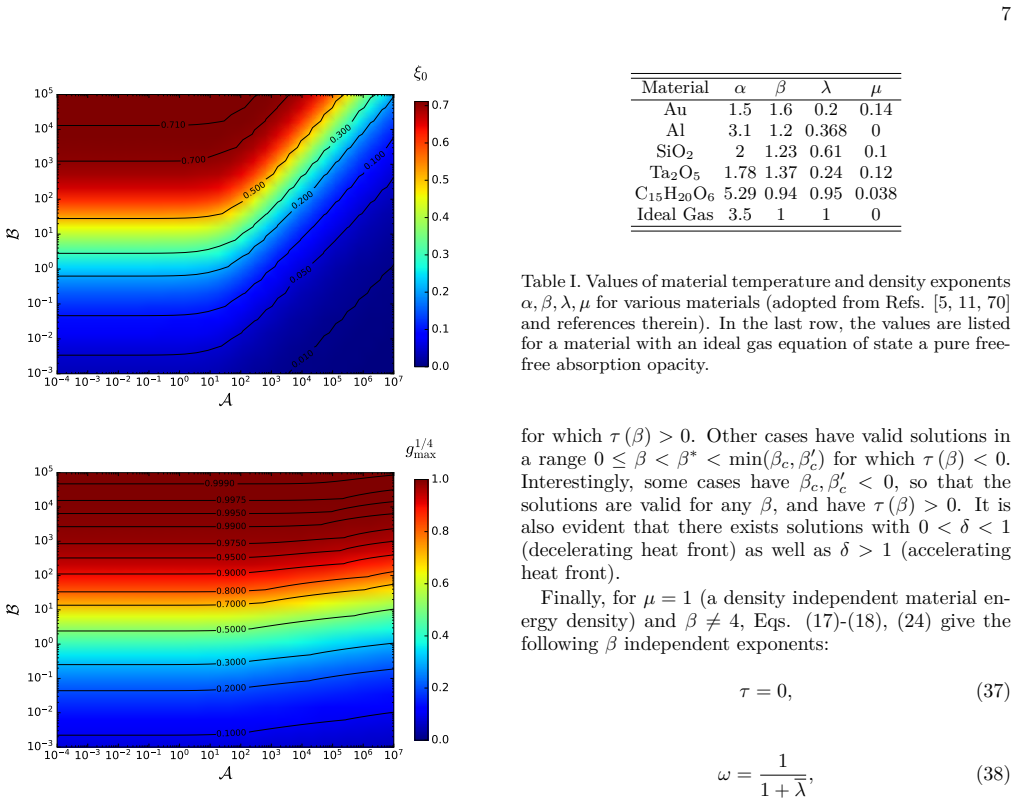
- In the large-$B$ (strong coupling) limit the radiation and material temperatures approach equality, $g\approx f$, so the family contains its own equilibrium-limit consistency check, while test 6 shows equilibrium can fail in a low-density inner region even when $B$ is large.
Reading between the lines
- We infer that the derived bath temperature $T_{bath}(t)$ is not a pure power law whenever $\delta\neq 1$ (Eq. (48)), so driving a Marshak wave with a heat bath instead of a surface temperature requires a non-power-law temporal modulation to stay self-similar; this could be tested in a simulation that prescribes $T_{bath}$ rather than $T_s$.
- We infer that because the transport agreement uses the constructed scattering opacity $k_t-k_a$, extending the benchmarks to physical, positive scattering opacities, or to multi-group transport where the gray-limit equivalence breaks, would test whether the similarity solutions survive outside the exact gray-diffusion setting.
- We infer that for real materials with $\beta<4$, the self-similarity condition $\omega\neq 0$ suggests a design rule for experiments: choose a density profile with the $\omega$ that satisfies Eq. (18) to realize a self-similar non-equilibrium wave in the laboratory, rather than a homogeneous target.
- We infer that the family may also serve as a test bed for inverse problems: because $A$, $B$, the front position, and the profile shape all depend on material exponents, matching a measured $x_F(t)$ to the self-similar form could in principle constrain an unknown power-law opacity model—an inversion the paper does not take up.
Editorial analysis
A structured set of objections, weighed in public.
Referee Report
Summary. The paper derives a family of self-similar solutions for the non-equilibrium, supersonic Marshak wave problem in the gray diffusion limit, for a planar non-homogeneous medium with density profile ρ(x)=ρ0 x^{-ω}, surface temperature drive T_s(t)=T0 t^τ, and power-law material opacities and specific energy. Using dimensional analysis (Appendix A), the authors show that self-similarity fixes τ and ω through the material exponents, reducing the partial differential equations (12)-(13) to the ODE system (27)-(28). They classify solutions by their near-origin behavior, derive the equivalent Marshak bath-temperature boundary condition (48), and construct six benchmark problems. Numerical solutions of the similarity ODEs are tabulated, and gray diffusion, implicit Monte-Carlo, and discrete-ordinates transport simulations are compared with the profiles in optically thick cases.
Significance. If correct, this is a valuable extension of the homogeneous-medium nonlinear non-equilibrium Marshak solutions, allowing self-similar benchmarks for materials with β≠4 through the inhomogeneous density profile. The construction is first-principles dimensional analysis with no fitted parameters in the similarity profiles, and the tabulated numerical profiles plus approximate analytic fits are a practical resource for code verification. The transport benchmarks are less independent than a fully external test, because the bath drive is taken from the diffusion solution (Eq. 48) and the scattering opacity k_s=k_t-k_a is an effective, nonphysical material law; however, these points are acknowledged in the text and do not affect the mathematical derivation of the diffusion-limit solutions.
major comments (2)
- [Sec. III A, Eqs. (38)-(39)] The μ=1 special-case exponents are algebraically inconsistent with the general formulas. Setting μ=1 and β≠4 in Eqs. (17)-(18) and (24) gives τ=0, ω=2/(2+λ+λ′), and δ=(2+λ+λ′)/(2(1+λ′)); the printed values ω=1/(1+λ) and δ=(1+λ)/(1+λ′) are recovered only under the additional assumption λ=λ′. Because the text presents these as the general β-independent exponents for a density-independent material energy density, the formulas should be corrected or the λ=λ′ restriction should be stated explicitly. Without this fix, a user constructing a benchmark for μ=1 would use incorrect density-profile and front-propagation exponents.
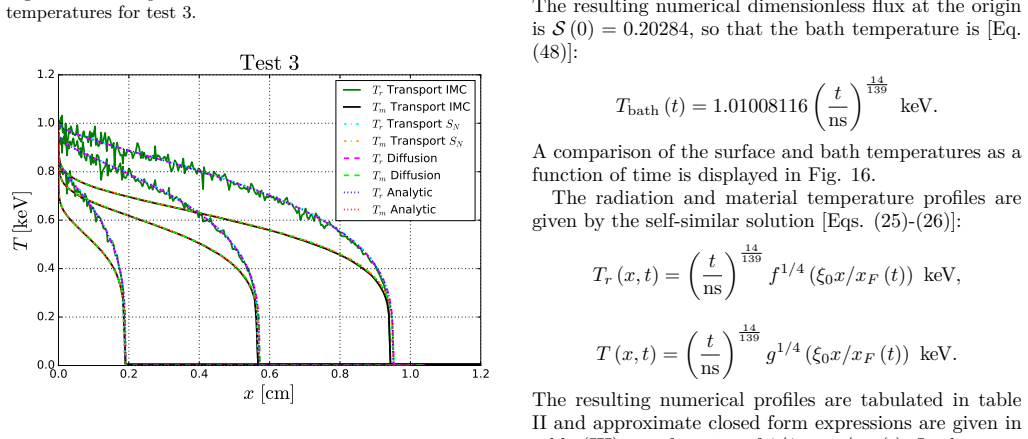
- [Sec. IV B, Figs. 13-24 and Sec. V] The verification claim rests on visual agreement: the comparisons with gray diffusion, IMC, and SN transport simulations are shown only as overlaid curves and described as "great agreement," without numerical error measures. For a paper whose central deliverable is a set of code-verification benchmarks, quantitative agreement should be reported, for example the maximum and mean relative deviation of T_r and T from the analytic profiles for each test and time. This would also make the benchmarks reproducible and would allow other codes to be checked against the same tolerances.
minor comments (4)
- [Fig. 8 caption] The caption quotes the material exponents as α=3.9 and α′=1.9, while Figs. 4 and 7, which are cited as the same case, use α=3.5 and α′=1.9; one of these is a typo.
- [Sec. IV B, Test 2] The stated value β′_c=2.69565 does not follow from α=3, λ=0.2, μ=0.4; Eq. (35) gives β′_c=2.5. The mistake does not affect the computed solution but should be corrected.
- [Sec. III A] The sentence "there is no solution with τ=0" is stated under the preceding assumption μ<1, but the transition to the μ=1 case in Eqs. (37)-(39) is abrupt; the domain of each statement should be made explicit to avoid confusion.
- [Sec. IV A, Eq. (54)] The effective scattering opacity k_s=k_t-k_a is nonphysical and can become negative; although the paper acknowledges this, the benchmark section should state more prominently that the transport tests are consistency checks of the transport solver against the diffusion-derived boundary condition for a synthetic material, not independent physics validation.
Circularity Check
The central self-similar derivation is independent and non-circular, but the transport 'validation' is partly self-referential: the bath drive and scattering opacity are constructed from the diffusion solution, so the reported agreement is by construction in the optically thick limit.
-
other
[Sec. IVA, Eqs. (48) and (54); Sec. IIID]
"The time dependent bath temperature drive is taken from the Marshak (Milne) boundary condition using the radiation temperature and flux which are taken from the gray diffusion solution [Eq. (48)], as detailed in Sec. IIID. ... a transport setup of the diffusion problem defined in Sec. II should have the following effective elastic scattering opacity: ks (T,ρ ) =kt (T,ρ )−ka (T,ρ )."
The transport benchmark is constructed to be mathematically equivalent to the gray diffusion problem: Eq. (54) forces the total transport opacity kt=ks+ka to equal the diffusion total opacity, and Eq. (48) sets the black-body bath temperature from the diffusion solution's own surface flux S(0). Therefore, agreement between IMC/SN transport and the analytic profiles in the optically thick limit is an internal consistency check of the diffusion-limit equivalence and of the numerical ODE solution, not an independent confirmation of the similarity solution. The dimensional-analysis derivation of Eqs. (17)-(18) is unaffected by this self-reference.
full rationale
The core claim—existence of self-similar solutions for the power-law gray-diffusion model—is derived in Appendix A by dimensional analysis: the self-similar ansatz is substituted into Eqs. (12)-(13), and the conditions (A3) and (A5) are solved for tau and omega (Eqs. (17)-(18)). No fitted parameter enters the similarity exponents or the ODE system (27)-(28); the profiles are obtained by numerical ODE integration. The extension from the authors' prior homogeneous solution (Ref. [27]) is a genuine generalization, and although self-citations are frequent, none carries a load-bearing 'uniqueness' argument or replaces a proof. The only self-referential element is the verification section: the transport boundary condition (Eq. (48)) is computed from the diffusion solution, and the scattering opacity (Eq. (54)) is chosen to reproduce the diffusion total opacity, so the transport agreement is a consistency check of the diffusion limit rather than an independent prediction. Separately, the mu=1 special-case exponents (Eqs. (38)-(39)) are algebraically inconsistent with the general formulas (17), (18), and (24); this is a correctness issue, not circularity. Overall, the central derivation is sound and non-circular; the partial self-reference in the benchmark setup justifies a modest score.
Assumptions & free parameters
assumptions (5)
- domain assumption The two-temperature gray diffusion system (Eqs. 1-3) with Fick's law and diffusion coefficient D=c/(3kt) is an accurate model for supersonic non-equilibrium radiative transfer in optically thick media.
- domain assumption Material properties follow power laws: kt=(1/G)T^{-alpha}rho^{1+lambda}, ka=(1/G')T^{-alpha'}rho^{1+lambda'}, u=F T^beta rho^{1-mu} with stated exponents.
- domain assumption The density profile and surface drive are power laws, rho=rho0 x^{-omega}, Ts=T0 t^tau, with zero initial radiation and material energy.
- domain assumption Hydrodynamic motion is negligible (supersonic regime), so density is time-independent.
- domain assumption The solution is assumed to be self-similar of the first kind: E=E0 t^{4tau} f(xi), U=E0 t^{4tau} g(xi) with xi = x t^{-delta} C.
invented entities (1)
-
Effective elastic scattering opacity ks = kt - ka (Eq. 54)
Cite this review
Pith. "Pith review of The non-equilibrium Marshak wave problem in non-homogeneous media." pith.science (2026). https://pith.science/paper/7UOXOHU6
@misc{pith2026241114891,
  author       = {Pith},
  title        = {Pith review of: The non-equilibrium Marshak wave problem in non-homogeneous media},
  year         = {2026},
  howpublished = {\url{https://pith.science/paper/7UOXOHU6}},
  note         = {Machine review of arXiv:2411.14891}
}
read the original abstract
We derive a family of similarity solutions to the nonlinear non-equilibrium Marshak wave problem for an inhomogeneous planar medium which is coupled to a time dependent radiation driving source. We employ the non-equilibrium gray diffusion approximation in the supersonic regime. The solutions constitute a generalization of the non-equilibrium nonlinear solutions that were developed recently for homogeneous media. Self-similar solutions are constructed for a power law time dependent surface temperature, a spatial power law density profile and a material model with power law temperature and density dependent opacities and specific energy density. The extension of the problem to non-homogeneous media enables the existence of similarity solutions for a general power law specific material energy. It is shown that the solutions exist for specific values of the temporal temperature drive and spatial density exponents, which depend on the material exponents. We also illustrate how the similarity solutions take various qualitatively different forms which are analyzed with respect to various parameters. Based on the solutions, we define a set of non-trivial benchmarks for supersonic non-equilibrium radiative heat transfer. The similarity solutions are compared to gray diffusion simulations as well as to detailed implicit Monte-Carlo and discrete-ordinate transport simulations in the optically-thick regime, showing a great agreement, which highlights the benefit of these solutions as a code verification test problem.
Figures

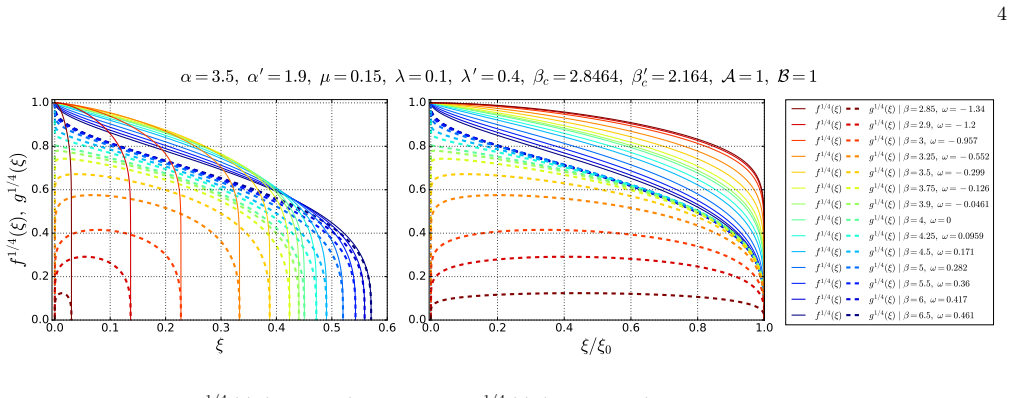

Figures from the paper (19 more)






Reference graph
Works this paper leans on
-
[1]
Lindl, J. D. et al. The physics basis for ignition us- ing indirect-drive targets on the national ignition facility. Physics of plasmas11, 339–491 (2004)
2004
-
[2]
& Bouquet, S
Falize, E., Michaut, C. & Bouquet, S. Similarity proper- ties and scaling laws of radiation hydrodynamic flows in laboratory astrophysics.The Astrophysical Journal730, 96 (2011)
2011
-
[3]
F.et al.An experimental testbed for the study of hydrodynamic issues in supernovae.Physics of Plas- mas 8, 2446–2453 (2001)
Robey, H. F.et al.An experimental testbed for the study of hydrodynamic issues in supernovae.Physics of Plas- mas 8, 2446–2453 (2001)
2001
-
[4]
Fuel gain exceeding unity in an in- ertially confined fusion implosion.Nature 506, 343–348 (2014)
Hurricane, O.et al. Fuel gain exceeding unity in an in- ertially confined fusion implosion.Nature 506, 343–348 (2014)
2014
-
[5]
P., Malamud, G
Cohen, A. P., Malamud, G. & Heizler, S. I. Key to under- standing supersonic radiative marshak waves using sim- 20 ple models and advanced simulations. Physical Review Research 2, 023007 (2020)
2020
-
[6]
& Balberg, S
Brutman, Y., Steinberg, E. & Balberg, S. The primary flare following a stellar collision in a galactic nucleus.The Astrophysical Journal Letters974, L22 (2024)
2024
-
[7]
& Stone, N
Steinberg, E. & Stone, N. C. Stream–disk shocks as the origins of peak light in tidal disruption events.Nature 625, 463–467 (2024)
2024
-
[8]
& Tsakiris, G
Sigel, R., Pakula, R., Sakabe, S. & Tsakiris, G. X-ray generation in a cavity heated by 1.3-or 0.44-µm laser light. iii. comparison of the experimental results with theoretical predictions for x-ray confinement. Physical Review A 38, 5779 (1988)
1988
Show all 99 references
-
[9]
Development of the indirect-drive approach to inertial confinement fusion and the target physics basis for ignition and gain
Lindl, J. Development of the indirect-drive approach to inertial confinement fusion and the target physics basis for ignition and gain. Physics of plasmas 2, 3933–4024 (1995)
1995
-
[10]
Cohen, A. P. & Heizler, S. I. Modeling of supersonic ra- diative marshak waves using simple models and advanced simulations. Journal of Computational and Theoretical Transport 47, 378–399 (2018)
2018
-
[11]
I., Shussman, T
Heizler, S. I., Shussman, T. & Fraenkel, M. Radia- tion drive temperature measurements in aluminum via radiation-driven shock waves: Modeling using self-similar solutions. Physics of Plasmas28, 032105 (2021)
2021
-
[12]
& Heizler, S
Malka, E. & Heizler, S. I. Supersonic–subsonic transition region in radiative heat flow via self-similar solutions. Physics of Fluids34 (2022)
2022
-
[13]
Characterization of similar marshak waves observed at the lmj.Physics of Plasmas31 (2024)
Courtois, C.et al. Characterization of similar marshak waves observed at the lmj.Physics of Plasmas31 (2024)
2024
-
[14]
& Kang, W
Liao, L., Shen, J., Sun, L., Mo, C. & Kang, W. Inverse design of the radiation temperature for indirect laser- driven equation-of-state measurement.Physics of Fluids 36 (2024)
2024
-
[15]
C.et al.On validating an astrophysical simu- lationcode
Calder, A. C.et al.On validating an astrophysical simu- lationcode. The Astrophysical Journal Supplement Series 143, 201 (2002)
2002
-
[16]
& Meyer-ter Vehn, J
Reinicke, P. & Meyer-ter Vehn, J. The point explosion with heat conduction. Physics of Fluids A: Fluid Dy- namics 3, 1807–1818 (1991)
1991
-
[17]
Lowrie, R. B. & Edwards, J. D. Radiative shock solutions with grey nonequilibrium diffusion.Shock waves18, 129– 143 (2008)
2008
-
[18]
McClarren, R. G. & Holladay, D. Benchmarks for verifi- cation of hedp/ife codes.Fusion Science and Technology 60, 600–604 (2011)
2011
-
[19]
McClarren, R. G. Two-group radiative transfer bench- marks for the non-equilibrium diffusion model.Journal of Computational and Theoretical Transport50, 583–597 (2021)
2021
-
[20]
McClarren, R. G. & Wöhlbier, J. G. Solutions for ion– electron–radiation coupling with radiation and electron diffusion. Journal of Quantitative Spectroscopy and Ra- diative Transfer 112, 119–130 (2011)
2011
-
[21]
G., Holloway, J
McClarren, R. G., Holloway, J. P. & Brunner, T. A. An- alytic p1 solutions for time-dependent, thermal radia- tive transfer in several geometries. Journal of Quanti- tative Spectroscopy and Radiative Transfer109, 389–403 (2008)
2008
-
[22]
& McClarren, R
Bennett, W. & McClarren, R. G. Self-similar solutions for high-energy density radiative transfer with separate ion and electron temperatures.Proceedings of the Royal Society A 477, 20210119 (2021)
2021
-
[23]
Analytic solutions of the nonlinear radiation diffusion equation with an instantaneous point source in non-homogeneous media
Krief, M. Analytic solutions of the nonlinear radiation diffusion equation with an instantaneous point source in non-homogeneous media. Physics of Fluids 33, 057105 (2021)
2021
-
[24]
& Krief, M
Giron, I., Balberg, S. & Krief, M. Solutions of the im- ploding shock problem in a medium with varying density. Physics of Fluids33 (2021)
2021
-
[25]
& Krief, M
Giron, I., Balberg, S. & Krief, M. Solutions of the con- verging and diverging shock problem in a medium with varying density.Physics of Fluids35 (2023)
2023
-
[26]
Piston driven shock waves in non-homogeneous planar media
Krief, M. Piston driven shock waves in non-homogeneous planar media. Physics of Fluids35 (2023)
2023
-
[27]
& McClarren, R
Krief, M. & McClarren, R. G. Self-similar solutions for the non-equilibrium nonlinear supersonic marshak wave problem. Physics of Fluids36 (2024)
2024
-
[28]
& McClarren, R
Krief, M. & McClarren, R. G. A unified theory of the self-similar supersonic marshak wave problem. Physics of Fluids 36 (2024)
2024
-
[29]
I., Krief, M
Heizler, S. I., Krief, M. & Assaf, M. Accurate reaction- diffusion limit to the spherical-symmetric boltzmann equation. Physical Review Research6, L012023 (2024)
2024
-
[30]
Effect of radiation on shock wave behavior
Marshak, R. Effect of radiation on shock wave behavior. The Physics of Fluids1, 24–29 (1958)
1958
-
[31]
G., Williamson, R
Petschek, A. G., Williamson, R. E. & Wooten Jr, J. K. The penetration of radiation with constant driving tem- perature. Tech. Rep., Los Alamos National Lab.(LANL), Los Alamos, NM (United States) (1960)
1960
-
[32]
B., Raizer, Y
Zeldovich, Y. B., Raizer, Y. P., Hayes, W. & Probstein, R. Physics of shock waves and high-temperature hydro- dynamic phenomena. Vol. 2(Academic Press New York, 1967)
1967
-
[33]
Propagation of self-similar radiation waves
Chow, C.-Y. Propagation of self-similar radiation waves. AIAA Journal 5, 2281–2283 (1967)
1967
-
[34]
A class of similar solutions of the non-linear diffusion equation
Pert, G. A class of similar solutions of the non-linear diffusion equation. Journal of Physics A: Mathematical and General 10, 583 (1977)
1977
-
[35]
& Sigel, R
Pakula, R. & Sigel, R. Self-similar expansion of dense matter due to heat transfer by nonlinear conduction.The Physics of fluids28, 232–244 (1985)
1985
-
[36]
& Sigel, R
Kaiser, N., Meyer-ter Vehn, J. & Sigel, R. The x-ray- drivenheatingwave. Physics of Fluids B: Plasma Physics 1, 1747–1752 (1989)
1989
-
[37]
Time-dependent simulations of point ex- plosions with heat conduction
Shestakov, A. Time-dependent simulations of point ex- plosions with heat conduction. Physics of Fluids 11, 1091–1095 (1999)
1999
-
[38]
Hammer, J. H. & Rosen, M. D. A consistent approach to solving the radiation diffusion equation. Physics of Plasmas 10, 1829–1845 (2003)
2003
-
[39]
& Cherfils-Clérouin, C
Garnier, J., Malinié, G., Saillard, Y. & Cherfils-Clérouin, C. Self-similar solutions for a nonlinear radiation diffu- sion equation. Physics of plasmas13, 092703 (2006)
2006
-
[40]
Principlesofthera- diativeablationmodeling
Saillard, Y., Arnault, P.&Silvert, V. Principlesofthera- diativeablationmodeling. Physics of Plasmas17, 123302 (2010)
2010
-
[41]
Lane, T. K. & McClarren, R. G. New self-similar radiation-hydrodynamics solutions in the high-energy density, equilibrium diffusion limit. New Journal of Physics 15, 095013 (2013)
2013
-
[42]
& Heizler, S
Shussman, T. & Heizler, S. I. Full self-similar solutions of thesubsonicradiativeheatequations. Physics of Plasmas 22, 082109 (2015)
2015
-
[43]
I., Shussman, T
Heizler, S. I., Shussman, T. & Malka, E. Self-similar solution of the subsonic radiative heat equations using a binary equation of state.Journal of Computational and 21 Theoretical Transport45, 256–267 (2016)
2016
-
[44]
Solutions of the radiation diffusion equation
Smith, C. Solutions of the radiation diffusion equation. High Energy Density Physics6, 48–56 (2010)
2010
-
[45]
Integral solutions to transient nonlinear heat (mass) diffusion with a power-law diffusivity: a semi- infinite medium with fixed boundary conditions
Hristov, J. Integral solutions to transient nonlinear heat (mass) diffusion with a power-law diffusivity: a semi- infinite medium with fixed boundary conditions. Heat and Mass Transfer52, 635–655 (2016)
2016
-
[46]
The heat radiation diffusion equation: Ex- plicit analytical solutions by improved integral-balance method
Hristov, J. The heat radiation diffusion equation: Ex- plicit analytical solutions by improved integral-balance method. Thermal science 22, 777–788 (2018)
2018
-
[47]
The non-equilibrium marshak wave prob- lem
Pomraning, G. The non-equilibrium marshak wave prob- lem. Journal of Quantitative Spectroscopy and Radiative Transfer 21, 249–261 (1979)
1979
-
[48]
& Olson, G
Bingjing, S. & Olson, G. L. Benchmark results for the non-equilibrium marshak diffusion problem. Jour- nal of Quantitative Spectroscopy and Radiative Transfer 56, 337–351 (1996)
1996
-
[49]
Timmes, G
Francis X. Timmes, G. M. H., Galen Gisler. Automated analyses of the tri-lab verification test suite on uniform and adaptive grids for code project a (2005)
2005
-
[50]
Hayes, J. C.et al. Simulating radiating and magnetized flows in multiple dimensions with zeus-mp.The Astro- physical Journal Supplement Series165, 188 (2006)
2006
-
[51]
R., Klein, R
Krumholz, M. R., Klein, R. I., McKee, C. F. & Bol- stad, J. Equations and algorithms for mixed-frame flux- limited diffusion radiation hydrodynamics. The Astro- physical Journal 667, 626 (2007)
2007
-
[52]
Gittings, M. et al. The rage radiation-hydrodynamic code. Computational Science & Discovery 1, 015005 (2008)
2008
-
[53]
Kamm, J. R.et al. Enhanced verification test suite for physics simulation codes. Tech. Rep., Lawrence Liv- ermore National Lab.(LLNL), Livermore, CA (United States) (2008)
2008
-
[54]
Zhang, W.et al.Castro: a new compressible astrophysi- cal solver. iii. multigroup radiation hydrodynamics.The Astrophysical Journal Supplement Series204, 7 (2012)
2012
-
[55]
Atwo-momentradiation hydrodynamics module in athena using a time-explicit godunov method.The Astrophysical Journal Supplement Series 206, 21 (2013)
Skinner, M.A.&Ostriker, E.C. Atwo-momentradiation hydrodynamics module in athena using a time-explicit godunov method.The Astrophysical Journal Supplement Series 206, 21 (2013)
2013
-
[56]
Rider, W., Witkowski, W., Kamm, J. R. & Wildey, T. Robust verification analysis. Journal of Computational Physics 307, 146–163 (2016)
2016
-
[57]
& Dullemond, C
Ramsey, J. & Dullemond, C. Radiation hydrodynamics including irradiation and adaptive mesh refinement with azeus-i. methods. Astronomy & Astrophysics574, A81 (2015)
2015
-
[58]
Menon, S. H.et al. Vettam: a scheme for radiation hy- drodynamics with adaptive mesh refinement using the variable eddington tensor method. Monthly Notices of the Royal Astronomical Society512, 401–423 (2022)
2022
-
[59]
Ganapol, B. D. & Pomraning, G. The non-equilibrium marshak wave problem: a transport theory solution. Journal of Quantitative Spectroscopy and Radiative Transfer 29, 311–320 (1983)
1983
-
[60]
Ganapol, B. D. Two-temperature nonequilibrium radia- tive transfer in an infinite medium.In Transactions of the American Nuclear Society, 87, 170–174 (2002)
2002
-
[61]
Brunner, T. A. Development of a grey nonlinear ther- mal radiation diffusion verification problem. Tech. Rep., Sandia Report SAND2006-4030C, Sandia National Lab- oratory (2006)
2006
-
[62]
Someverificationproblemswithpossibletrans- port applications
Miller, D. Someverificationproblemswithpossibletrans- port applications. In Computational Methods in Trans- port: Verification and Validation , 169–175 (Springer, 2008)
2008
-
[63]
Analytical benchmark for non-equilibrium ra- diation diffusion in finite size systems.Annals of Nuclear Energy 63, 59–68 (2014)
Ghosh, K. Analytical benchmark for non-equilibrium ra- diation diffusion in finite size systems.Annals of Nuclear Energy 63, 59–68 (2014)
2014
-
[64]
Pomraning, G. C. Radiation hydrodynamics. Tech. Rep., Los Alamos National Lab.(LANL), Los Alamos, NM (United States) (1982)
1982
-
[65]
Pomraning, G. C. The equations of radiation hydrody- namics (Courier Corporation, 2005)
2005
-
[66]
& Weibel-Mihalas, B.Foundations of radia- tion hydrodynamics(Courier Corporation, 1999)
Mihalas, D. & Weibel-Mihalas, B.Foundations of radia- tion hydrodynamics(Courier Corporation, 1999)
1999
-
[67]
Brunner, T. A. Forms of approximate radiation trans- port. Tech.Rep., SandiaReportSAND2002-1778, Sandia National Laboratory (2002)
2002
-
[68]
Heizler, S. I. The asymptotic telegraphers equation (p1) approximation for time-dependent, thermal radia- tive transfer. Transport Theory and Statistical Physics 41, 175–199 (2012)
2012
-
[69]
Fundamen- tals of ICF Hohlraums
Rosen, M. D. Fundamentals of icf hohlraums. Tech. Rep., Lawrence Livermore National Lab.(LLNL), Liver- more, CA (United States). Also appears as: "Fundamen- tals of ICF Hohlraums", Mordecai D. Rosen, "Lectures in the Scottish Universities Summer School in Physics, 2005, on Hig...
2009
-
[70]
& McClarren, R
Farmer, J., Smith, E., Bennett, W. & McClarren, R. High energy density radiative transfer in the diffusion regime with fourier neural operators.Journal of Fusion Energy 43, 74 (2024)
2024
-
[71]
On physically similar systems; illustra- tions of the use of dimensional equations.Physical review 4, 345 (1914)
Buckingham, E. On physically similar systems; illustra- tions of the use of dimensional equations.Physical review 4, 345 (1914)
1914
-
[72]
I.Scaling, self-similarity, and intermedi- ate asymptotics: dimensional analysis and intermediate asymptotics
Barenblatt, G. I.Scaling, self-similarity, and intermedi- ate asymptotics: dimensional analysis and intermediate asymptotics. 14 (Cambridge University Press, 1996)
1996
-
[73]
I.Radiation hydrodynamics(2004)
Castor, J. I.Radiation hydrodynamics(2004)
2004
-
[74]
Nelson, E. M. & Reynolds, J. Semi-analytic solution for a marshak wave via numerical integration in mathemat- ica. Tech. Rep. LA-UR-09-04551, Los Alamos National Laboratory (2009)
2009
-
[75]
Fleck Jr, J. A. & Cummings Jr, J. An implicit monte carlo scheme for calculating time and frequency depen- dent nonlinear radiation transport.Journal of Computa- tional Physics 8, 313–342 (1971)
1971
-
[76]
A grey transport acceleration method far time-dependent radiative transfer problems
Larsen, E. A grey transport acceleration method far time-dependent radiative transfer problems. Journal of Computational Physics 78, 459–480 (1988)
1988
-
[77]
L., Auer, L
Olson, G. L., Auer, L. H. & Hall, M. L. Diffusion, p1, and other approximate forms of radiation transport.Journal of Quantitative Spectroscopy and Radiative Transfer64, 619–634 (2000)
2000
-
[78]
A deterministic photon free method to solve radiation transfer equations
Chang, B. A deterministic photon free method to solve radiation transfer equations. Journal of Computational Physics 222, 71–85 (2007)
2007
-
[79]
E., Yang, T.-Y
Morel, J. E., Yang, T.-Y. B. & Warsa, J. S. Lin- ear multifrequency-grey acceleration recast for precon- ditioned krylov iterations. Journal of Computational Physics 227, 244–263 (2007)
2007
-
[80]
D., Thompson, K
Densmore, J. D., Thompson, K. G. & Urbatsch, T. J. A hybrid transport-diffusion monte carlo method 22 for frequency-dependent radiative-transfer simulations. Journal of Computational Physics 231, 6924–6934 (2012)
2012
-
[81]
& Heizler, S
Steinberg, E. & Heizler, S. I. Multi-frequency implicit semi-analog monte-carlo (ismc) radiative transfer solver in two-dimensions (without teleportation). Journal of Computational Physics 450, 110806 (2022)
2022
-
[82]
& Heizler, S
Steinberg, E. & Heizler, S. I. Frequency-dependent dis- crete implicit monte carlo scheme for the radiative trans- fer equation. Nuclear Science and Engineering 1–13 (2023)
2023
-
[83]
& Rose, S
McLean, K. & Rose, S. Multi-group radiation diffusion convergence in low-density foam experiments.Journal of Quantitative Spectroscopy and Radiative Transfer280, 108070 (2022)
2022
-
[84]
Asta- ble 1d multigroup high-order low-order method.Journal of Computational and Theoretical Transport46, 46–76 (2017)
Yee, B.C., Wollaber, A.B., Haut, T.S.&Park, H. Asta- ble 1d multigroup high-order low-order method.Journal of Computational and Theoretical Transport46, 46–76 (2017)
2017
-
[85]
Afamilyofmulti-dimensionalthermalradia- tive transfer test problems
Brunner, T. Afamilyofmulti-dimensionalthermalradia- tive transfer test problems. Tech. Rep., Technical Report LLNL-TR-858450, Lawrence Livermore National Labo- ratory (2023)
2023
-
[86]
& Tang, M
Zhang, X., Song, P., Shi, Y. & Tang, M. A fully asymp- totic preserving decomposed multi-group method for the frequency-dependent radiative transfer equations.Jour- nal of Computational Physics491, 112368 (2023)
2023
-
[87]
Liu, C., Li, W., Wang, Y., Song, P. & Xu, K. An im- plicit unified gas-kinetic wave–particle method for radia- tive transport process.Physics of Fluids35 (2023)
2023
-
[88]
& Song, P
Li, W., Liu, C. & Song, P. Unified gas-kinetic parti- cle method for frequency-dependent radiation transport. Journal of Computational Physics498, 112663 (2024)
2024
-
[89]
& Olson, G
Su, B. & Olson, G. L. An analytical benchmark for non- equilibrium radiative transfer in an isotropically scatter- ing medium. Annals of Nuclear Energy 24, 1035–1055 (1997)
1997
-
[90]
& Gazit, D
Krief, M., Feigel, A. & Gazit, D. A new implementation of the STA method for the calculation of opacities of local thermodynamic equilibrium plasmas.Atoms 6, 35 (2018)
2018
-
[91]
& Gazit, D
Krief, M. & Gazit, D. Star: A new sta code for the cal- culation of solar opacities. InWorkshop on Astrophysical Opacities, vol. 515, 63 (2018)
2018
-
[92]
McClarren, R. G. & Urbatsch, T. J. A modified implicit monte carlo method for time-dependent radiative trans- fer with adaptive material coupling.Journal of Compu- tational Physics 228, 5669–5686 (2009)
2009
-
[93]
A., Urbatsch, T
Brunner, T. A., Urbatsch, T. J., Evans, T. M. & Gentile, N. A. Comparison of four parallel algorithms for domain decomposed implicit monte carlo.Journal of Computa- tional Physics 212, 527–539 (2006)
2006
-
[94]
Cleveland, M. A. & Gentile, N. Mitigating teleporta- tion error in frequency-dependent hybrid implicit monte carlo diffusion methods. Journal of Computational and Theoretical Transport43, 6–37 (2014)
2014
-
[95]
A., Kromer, M., Röpke, F
Noebauer, U., Sim, S. A., Kromer, M., Röpke, F. & Hille- brandt, W. Monte carlo radiation hydrodynamics: meth- ods, tests and application to type ia supernova ejecta. Monthly Notices of the Royal Astronomical Society425, 1430–1444 (2012)
2012
-
[96]
Wollaber, A. B. Four decades of implicit monte carlo. Journal of Computational and Theoretical Transport45, 1–70 (2016)
2016
-
[97]
Noebauer, U. M. & Sim, S. A. Monte carlo radiative transfer. Living Reviews in Computational Astrophysics 5, 1–103 (2019)
2019
-
[98]
McClarren, R. G. & Haut, T. S. Data-driven accelera- tion of thermal radiation transfer calculations with the dynamic mode decomposition and a sequential singular value decomposition. Journal of Computational Physics 448, 110756 (2022)
2022
-
[99]
& Heizler, S
Steinberg, E. & Heizler, S. I. A new discrete implicit monte carlo scheme for simulating radiative transfer problems. The Astrophysical Journal Supplement Series 258, 14 (2022). 23 Appendix A: Dimensional analysis In this appendix, we use the method of dimensional analysis to ...
2022
Reviewed August 12, 2026 · model on record in the stance chip above.
Discussion (0). Continue with ORCID to comment.