REVIEW 3 major objections 5 minor 37 references
Learning to Stabilize Faces
T0 review · 3 major / 5 minor · reviewed 2026-08-12 · deepseek-v4-flash
Pith's one-line read A network trained only on synthetic 3DMM faces predicts the skull-aligning transform between two real registered face meshes, outperforming prior automatic stabilizers.
desk verdict The regression idea is new and the manual-teeth benchmark is a real strength, but the same-database 3DMM training leaves the synthetic-to-real generalization claim unproven. read the letter →
The pith
A machine-rendered reading of the paper's core claim, the machinery that carries it, and where it could break.
The reading
What carries the argument
The key object is a 3D Morphable Model with a stable skull: by construction, changes in the expression parameters $\varphi$ move the exterior vertex positions $V$ but leave the hypothetical underlying skull $W$ unchanged, so for any synthetic pair the rigid transform that aligns the skulls equals the transform applied to the target mesh. This turns the unobservable skull-alignment energy $\|SW_s - W_t\|_F$ into a computable regression target and lets the authors generate unlimited training pairs by sampling identities, expressions, and random rigid perturbations (Algorithm 1). The network itself is a two-stage MLP: a shared feature extractor $F$ maps each mesh to a latent code, and a regressor $R$ turns the concatenated codes into a 6D rotation representation and a translation vector, trained with rotation-plus-translation loss.
What would settle it
Retrain the 3DMM identity PCA on a split that provably excludes the 15 test subjects, regenerate the synthetic training pairs from that held-out PCA, and re-measure the face-region mean vertex error on the same test set; if the error rises well above the reported 1.08 mm, the claimed cross-subject generalization is partly an artifact of identity leakage inside the 3DMM rather than genuine transfer.
Extended reading notes
Core claim
The paper's central claim is that stabilization of registered face meshes can be cast as direct regression: a network consumes two meshes of the same subject in arbitrary expressions and outputs the rotation and translation that bring the underlying skulls into alignment. All training supervision comes from synthetic pairs sampled from a 3D Morphable Model with a stable skull by design—changing expression parameters deforms the exterior vertices but leaves the skull unchanged, so the alignment transform is known exactly. On a manually stabilized test set from the same capture pipeline, the network reports a face-region mean vertex error of $1.08 \pm 0.64$ mm, compared with $1.20 \pm 0.86$ mm for the strongest baseline, and a higher area under the PCK curve (78.03% versus 75.71%). The authors present this as evidence that the synthetic-data domain gap is manageable and that fully automatic, pair-based stabilization is achievable without manual skull initialization or temporal ordering.
Load-bearing premise
The load-bearing premise is that a network trained only on synthetic face pairs sampled from a 3D Morphable Model will transfer to real registered face meshes, with the upper teeth serving as a valid rigid stand-in for the skull.
Editorial extensions
If this is right
- Stabilization no longer needs temporally ordered input: any two meshes of the same subject, even from different sessions or from a discrete set of expressions, can be aligned in one forward pass.
- Because pairs are processed independently, large capture databases can be stabilized in parallel; the paper reports stabilizing a 1000-frame performance in roughly 6 seconds on an A100 GPU.
- The synthetic-data training procedure removes the need for manual ground-truth stabilization when building the predictor, so scaling to new identities and expressions only requires sampling the 3DMM.
- The method is scoped to registered meshes with a common topology in studio capture pipelines; raw in-the-wild scans are explicitly outside its intended use.
Reading between the lines
- If the transfer result holds across capture pipelines, the same recipe—a parametric model with a stable internal skeleton generating known ground-truth rigid transforms—could be applied to other stabilization problems, such as body scans with a fixed bone structure or animal faces.
- Because the method is agnostic to pair order, a single forward pass could also serve as a fast initialization for existing optimization-based stabilization or jaw-tracking methods, potentially improving their convergence.
- A natural robustness check the paper does not explicitly run is retraining with the test identities excluded from the identity PCA; that would separate genuine synthetic-to-real transfer from hidden overlap between the synthetic distribution and the test subjects.
Editorial analysis
A structured set of objections, weighed in public.
Referee Report
Summary. The paper proposes a fully automatic, learning-based method for rigidly stabilizing registered face meshes. The central idea is to train a network to predict the rigid transform between two meshes of the same subject that aligns the underlying skulls. Training pairs are synthesized with a 3DMM whose expression parameters leave the skull stable, and the network is evaluated on real meshes using manually annotated upper teeth as a rigid proxy for the skull. The method is compared against Procrustes variants, 3DMM unposing, and a reimplemented confidence-map baseline, reporting the lowest mean vertex error (1.08 mm on the face region).
Significance. If the synthetic-to-real generalization claim holds, the paper makes a useful practical contribution: it removes the need for manual stabilization, works on arbitrary expression pairs without temporal ordering, and can be parallelized for large datasets. The evaluation is more trustworthy than many papers in this area because the ground truth comes from an independent manual-teeth benchmark rather than synthetic metrics, and because the training-data synthesis scheme is described in enough detail to be reproduced. The main caveat is that the evaluation subjects are drawn from the same proprietary capture database used to build the 3DMM, and the paper does not state whether those subjects were excluded from the identity PCA; this is a load-bearing issue for the generalization claim.
major comments (3)
- [§3.2, §4.1] Section 3.2 states that the vertex identity basis I is computed by PCA on a dataset of 38,360 frames of 2,519 subjects, and Section 4.1 evaluates on 15 subjects selected from this same dataset. Section 4.1 only removes 'all the expressions of the 15 subjects' from the training data; it does not state that these subjects' identities were excluded from the PCA or from the identity distribution N(βμ,Diag(βσ)) used in Section 3.3. If the test identities participate in the PCA, the synthetic training distribution includes identity directions that are close to the test subjects, so the reported face-region error of 1.08±0.64 mm in Table 1 may partly reflect identity-specific skin-to-skull geometry seen during training rather than generalization to unseen identities. Please state explicitly whether the 15 evaluation subjects were excluded from the identity PCA and from the identity statistics; if not, retrain the 3DMM and the network leaving out all data of those subjects and rerun the full comparison in Table 1. This is necessary to support the synthetic-to-real generalization claim made in §3.3 and §4.4.
- [Table 1, §4.4] Table 1 reports a mean vertex distance of 1.08±0.64 mm for the proposed method versus 1.20±0.86 mm for CMAP on the face region, with only 20 test expression pairs. No per-subject or per-pair error distributions, confidence intervals, or significance tests are reported, and the mx and mAUC columns are point estimates without error bars. Given the overlapping standard deviations and the small test set, the headline '10% improvement' over CMAP is not shown to be statistically reliable. Please report paired significance tests (e.g., Wilcoxon signed-rank or bootstrapped confidence intervals) on all three metrics, and clarify the number of subjects and expression pairs behind each aggregate number.
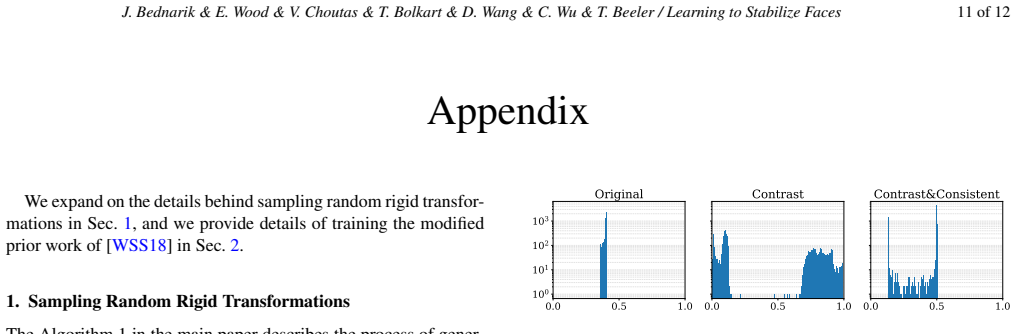
- [§4.3, Appendix §2] The CMAP baseline is not the published method of [WSS18]. Section 4.3 states that the original formulation produced unsatisfactory results 'on par with the basic PROChead', and the appendix describes a reimplementation with two additional energy terms (contrast and spatial consistency) whose hyperparameters are tuned on the validation set. The variant labeled CMAP in Table 1 and Fig. 7 is therefore a substantially strengthened reimplementation, so the claim of outperforming prior work is not a comparison with the actual state of the art. Please compare with the original formulation as published (or with the authors' code, if available), or clearly label the baseline as a modified reimplementation and adjust the claim accordingly.
minor comments (5)
- [Eq. (2)] The domain notation R^{2×4×NV} is imprecise: S takes a pair of matrices, each in R^{4×NV}. Please rewrite the function signature as S : R^{4×NV} × R^{4×NV} → R^{4×4}.
- [References] The reference [Gow75] appears to be a copy-paste error: the 1975 Psychometrika paper is 'Generalized Procrustes analysis', not 'Face transfer with multilinear models', which is properly the title of [VBPP05].
- [§4.1] The description of the evaluation data is confusing: the text mentions 45 expressions, one annotated expression per subject, 30 source frames, and then a split into 10 validation and 20 test expressions. Please clarify the exact pairing and splitting procedure (e.g., 15 subjects × 3 expressions, with 2 target expressions per annotated source).
- [Table 1, §4.3] Method names are inconsistent between the text and the table: 'PROC head' versus 'PROChead' and 'UNPOSE id' versus 'UNPOSEid' should be made uniform.
- [§3.3, §3.4] The free hyperparameters αT, εR, εT, and εφ are set empirically without a sensitivity analysis. A short study or at least a statement of their typical effect on the validation error would increase confidence in the robustness of the reported results.
Circularity Check
No circularity: synthetic training labels are generated from the 3DMM's stable-skull construction, while test labels are independent manual teeth annotations; no prediction reduces to a fitted input or self-citation.
full rationale
The derivation chain is self-contained. The network is trained with labels S generated in Algorithm 1 from the 3DMM's stable-skull property: for fixed identity beta, changing expression phi leaves the implied skull fixed, so the applied rigid transform is the minimizer of Eq. (1) by Eq. (3). This is a definitional construction of training data, not a circular prediction. At test time, ground truth comes from an external protocol: manual 2D keypoints on the upper teeth triangulated to a 3D polyline (Sec. 4.1), a rigid proxy for the skull that does not depend on the network or the 3DMM's identity basis. The comparison baselines are either standard Procrustes variants or a reimplemented WSS18 module tuned on the validation set; no baseline is defined in terms of the paper's fitted parameters. The only self-citations (BB14 for evaluation protocol, WBH21 for the 3DMM formulation) are used as ordinary prior work, not as load-bearing uniqueness theorems, and the 3DMM's construction is described in the paper. The reviewer-flagged concern that the 15 evaluation subjects may not have been excluded from the identity PCA is a data-leakage/generalization risk, not a circularity: the predicted rigid transform is not defined as, or statistically forced to be, a function of the identity basis, and the test errors are measured against manual teeth annotations. Correctness risk should be assessed separately; it does not change the circularity score.
Assumptions & free parameters
free parameters (4)
- translation loss weight alpha_T =
1
- pose noise scale epsilon_R =
not reported
- pose noise scale epsilon_T =
not reported
- expression noise scale epsilon_phi =
not reported
assumptions (4)
- domain assumption The 3DMM has a stable skull: changing expression parameters phi does not move the underlying skull.
- domain assumption Upper teeth are rigidly attached to the skull and can serve as a ground-truth proxy for skull alignment.
- domain assumption Registered meshes are in dense correspondence with a common template topology.
- ad hoc to paper The synthetic sampling distribution, Gaussian identities plus random sampled expressions and small pose noise, approximates the real distribution of registered face pairs.
Cite this review
Pith. "Pith review of Learning to Stabilize Faces." pith.science (2026). https://pith.science/paper/QI4MJZKC
@misc{pith2026241115074,
  author       = {Pith},
  title        = {Pith review of: Learning to Stabilize Faces},
  year         = {2026},
  howpublished = {\url{https://pith.science/paper/QI4MJZKC}},
  note         = {Machine review of arXiv:2411.15074}
}
read the original abstract
Nowadays, it is possible to scan faces and automatically register them with high quality. However, the resulting face meshes often need further processing: we need to stabilize them to remove unwanted head movement. Stabilization is important for tasks like game development or movie making which require facial expressions to be cleanly separated from rigid head motion. Since manual stabilization is labor-intensive, there have been attempts to automate it. However, previous methods remain impractical: they either still require some manual input, produce imprecise alignments, rely on dubious heuristics and slow optimization, or assume a temporally ordered input. Instead, we present a new learning-based approach that is simple and fully automatic. We treat stabilization as a regression problem: given two face meshes, our network directly predicts the rigid transform between them that brings their skulls into alignment. We generate synthetic training data using a 3D Morphable Model (3DMM), exploiting the fact that 3DMM parameters separate skull motion from facial skin motion. Through extensive experiments we show that our approach outperforms the state-of-the-art both quantitatively and qualitatively on the tasks of stabilizing discrete sets of facial expressions as well as dynamic facial performances. Furthermore, we provide an ablation study detailing the design choices and best practices to help others adopt our approach for their own uses. Supplementary videos can be found on the project webpage syntec-research.github.io/FaceStab.
Figures


Figures from the paper (8 more)



Reference graph
Works this paper leans on
-
[1]
write newline
" write newline "" before.all 'output.state := FUNCTION fin.entry add.period write newline FUNCTION new.block output.state before.all = 'skip after.block 'output.state := if FUNCTION new.sentence output.state after.block = 'skip output.state before.all = 'skip after.sentence 'output.state := if if FUNCTION not #0 #1 if FUNCTION and 'skip pop #0 if FUNCTIO...
-
[2]
write newline
" write newline "" before.all 'output.state := FUNCTION fin.entry.original add.period write newline FUNCTION new.block output.state before.all = 'skip after.block 'output.state := if FUNCTION new.sentence output.state after.block = 'skip output.state before.all = 'skip after.sentence 'output.state := if if FUNCTION not #0 #1 if FUNCTION and 'skip pop #0 i...
-
[3]
Arun K. S., Huang T. S., Blostein S. D. : Least-squares fitting of two 3-d point sets. IEEE Transactions on pattern analysis and machine intelligence, 5 (1987), 698--700
work page 1987
-
[4]
Alexander O., Rogers M., Lambeth W., Chiang M. J., Debevec P. E. : The digital Emily project: photoreal facial modeling and animation. In SIGGRAPH Courses (2009), pp. 12:1--12:15
work page 2009
-
[5]
: Rigid stabilization of facial expressions
Beeler T., Bradley D. : Rigid stabilization of facial expressions. SIGGRAPH (2014)
work page 2014
-
[6]
Bogo F., Kanazawa A., Lassner C., Gehler P., Romero J., Black M. J. : Keep it SMPL : Automatic estimation of 3D human pose and shape from a single image. In European Conference on Computer Vision (2016)
work page 2016
-
[7]
Bolkart T., Li T., Black M. J. : Instant multi-view head capture through learnable registration. In Proceedings of the IEEE/CVF Conference on Computer Vision and Pattern Recognition (CVPR) (2023)
work page 2023
-
[8]
: Online modeling for realtime facial animation
Bouaziz S., Wang Y., Pauly M. : Online modeling for realtime facial animation. ACM Transactions on Graphics (2013)
work page 2013
Show all 37 references
-
[9]
: Local anatomically-constrained facial performance retargeting
Chandran P., Ciccone L., Gross M., Bradley D. : Local anatomically-constrained facial performance retargeting. ACM Transactions on Graphics (2022)
2022
-
[10]
: Stabilized real-time face tracking via a learned dynamic rigidity prior
Cao C., Chai M., Woodford O., Luo L. : Stabilized real-time face tracking via a learned dynamic rigidity prior. ACM Transactions on Graphics (Proc. SIGGRAPH Asia (2018)
2018
-
[11]
: 2D human pose estimation: a survey
Chen H., Feng R., Wu S., Xu H., Zhou F., Liu Z. : 2D human pose estimation: a survey. Multimedia Systems (2022)
2022
-
[12]
: Adversarial parametric pose prior
Davydov A., Remizova A., Constantin V., Honari S., Salzmann M., Fua P. : Adversarial parametric pose prior. In Proceedings of the IEEE/CVF Conference on Computer Vision and Pattern Recognition (CVPR) (2022)
2022
-
[13]
: Facial Action Coding System A Technique for the Measurement of Facial Movement
Ekman P., Friesen W. : Facial Action Coding System A Technique for the Measurement of Facial Movement. Consulting Psychologists Press, 1978
1978
-
[14]
Egger B., Smith W. A. P., Tewari A., Wuhrer S., Zollhoefer M., Beeler T., Bernard F., Bolkart T., Kortylewski A., Romdhani S., Theobalt C., Blanz V., Vetter T. : 3D morphable face models—past, present, and future. ACM Transactions on Graphics (2020)
2020
-
[15]
: Multi-view stereo on consistent face topology
Fyffe G., Nagano K., Huynh L., Saito S., Busch J., Jones A., Li H., Debevec P. : Multi-view stereo on consistent face topology. Computer Graphics Forum (2017)
2017
-
[16]
J., Hoppe H
Gu X., Gortler S. J., Hoppe H. : Geometry images. ACM Transactions on Graphics (2002)
2002
-
[17]
Gower J. C. : Face transfer with multilinear models. Psychometrika (1975)
1975
-
[18]
Kocabas M., Athanasiou N., Black M. J. : VIBE : V ideo inference for human body pose and shape estimation. In Proceedings of the IEEE/CVF Conference on Computer Vision and Pattern Recognition (CVPR) (2020)
2020
-
[19]
J., Li H., Romero J
Li T., Bolkart T., Black M. J., Li H., Romero J. : Learning a model of facial shape and expression from 4D scans. ACM Transactions on Graphics (Proc. SIGGRAPH Asia (2017)
2017
-
[20]
: Rapid face asset acquisition with recurrent feature alignment
Liu S., Cai Y., Chen H., Zhou Y., Zhao Y. : Rapid face asset acquisition with recurrent feature alignment. ACM Transactions on Graphics (Proc. SIGGRAPH Asia 41, 6 (2022), 214:1--214:17
2022
-
[21]
: Topologically consistent multi-view face inference using volumetric sampling
Li T., Liu S., Bolkart T., Liu J., Li H., Zhao Y. : Topologically consistent multi-view face inference using volumetric sampling. In International Conference on Computer Vision (2021), pp. 3824--3834
2021
-
[22]
: Face stabilization by mode pursuit for avatar construction
Lamarre M., Lewis J., Danvoye E. : Face stabilization by mode pursuit for avatar construction. In 2018 International Conference on Image and Vision Computing New Zealand (IVCNZ) (2018)
2018
-
[23]
: Realtime facial animation with on-the-fly correctives
Li H., Yu J., Ye Y., Bregler C. : Realtime facial animation with on-the-fly correctives. ACM Transactions on Graphics (2013)
2013
-
[24]
Pavlakos G., Choutas V., Ghorbani N., Bolkart T., Osman A. A. A., Tzionas D., Black M. J. : Expressive body capture: 3D hands, face, and body from a single image. In Proceedings of the IEEE/CVF Conference on Computer Vision and Pattern Recognition (CVPR) (2019)
2019
-
[25]
: A 3D face model for pose and illumination invariant face recognition
Paysan P., Knothe R., Amberg B., Romdhani S., Vetter T. : A 3D face model for pose and illumination invariant face recognition. In Proceedings of the 6th IEEE International Conference on Advanced Video and Signal based Surveillance (AVSS) for Security, Safety and Monitoring in...
2009
-
[26]
https://polywink.com/en/9-automatic-expressions-blendshapes-on-demand.html
Polywink : Polywink blendshapes. https://polywink.com/en/9-automatic-expressions-blendshapes-on-demand.html. Accessed: 2024-01-25
2024
-
[27]
: Meet Mike : E pic avatars
Seymour M., Evans C., Libreri K. : Meet Mike : E pic avatars. In SIGGRAPH (2017)
2017
-
[28]
E., Sarafianos N., Tung T., Pons-Moll G
Tiwari G., Antic D., Lenssen J. E., Sarafianos N., Tung T., Pons-Moll G. : Pose-NDF : M odeling human pose manifolds with neural distance fields. In European Conference on Computer Vision (2022)
2022
-
[29]
: Face transfer with multilinear models
Vlasic D., Brand M., Pfister H., Popovi\' c J. : Face transfer with multilinear models. ACM Transactions on Graphics (2005)
2005
-
[30]
: An anatomically-constrained local deformation model for monocular face capture
Wu C., Bradley D., Gross M., Beeler T. : An anatomically-constrained local deformation model for monocular face capture. ACM Transactions on Graphics (2016)
2016
-
[31]
J., Shotton J
Wood E., Baltru s aitis T., Hewitt C., Dziadzio S., Johnson M., Estellers V., Cashman T. J., Shotton J. : Fake it till you make it: F ace analysis in the wild using synthetic data alone. In International Conference on Computer Vision (2021)
2021
-
[32]
: Realtime performance-based facial animation
Weise T., Bouaziz S., Li H., Pauly M. : Realtime performance-based facial animation. ACM Transactions on Graphics (2011)
2011
-
[33]
: Deep incremental learning for efficient high-fidelity face tracking
Wu C., Shiratori T., Sheikh Y. : Deep incremental learning for efficient high-fidelity face tracking. ACM Transactions on Graphics (2018)
2018
-
[34]
: Accurate markerless jaw tracking for facial performance capture
Zoss G., Beeler T., Gross M., Bradley D. : Accurate markerless jaw tracking for facial performance capture. ACM Transactions on Graphics (2019)
2019
-
[35]
: On the continuity of rotation representations in neural networks
Zhou Y., Barnes C., Jingwan L., Jimei Y., Hao L. : On the continuity of rotation representations in neural networks. In Proceedings of the IEEE/CVF Conference on Computer Vision and Pattern Recognition (CVPR) (2019)
2019
-
[36]
G., Xu H., Freeman B., Sukthankar R., Sminchisescu C
Zanfir A., Bazavan E. G., Xu H., Freeman B., Sukthankar R., Sminchisescu C. : Weakly supervised 3D human pose and shape reconstruction with normalizing flows. In European Conference on Computer Vision (2020)
2020
-
[37]
: Deep learning-based human pose estimation: A survey
Zheng C., Wu W., Chen C., Yang T., Zhu S., Shen J., Kehtarnavaz N., Shah M. : Deep learning-based human pose estimation: A survey. ACM Computing Surveys (2023)
2023
Reviewed August 12, 2026 · model on record in the stance chip above.
Discussion (0). Continue with ORCID to comment.