REVIEW 3 major objections 4 minor 13 references
Towards Speaker Identification with Minimal Dataset and Constrained Resources using 1D-Convolution Neural Network
T0 review · 3 major / 4 minor · reviewed 2026-08-12 · deepseek-v4-flash
Pith's one-line read A lightweight 1D convolutional network trained on about one minute of audio per speaker identifies speakers with 97.87 percent validation accuracy on a small dataset.
desk verdict A transparent small-scale 1D-CNN speaker-ID write-up whose headline number is a same-session validation statistic, not a measured generalization result. read the letter →
The pith
A machine-rendered reading of the paper's core claim, the machinery that carries it, and where it could break.
The reading
What carries the argument
The central machinery is the 1D convolutional residual block. Each block sends the input through two convolution layers with a ReLU activation in between and adds a shortcut convolution element-wise before a final activation and max pooling. Four such blocks feed an average-pooling layer, then three dense layers with 20 percent dropout, and a softmax output whose size is set by the number of speakers. The network's inputs are FFT coefficients of one-second audio clips resampled at 16 kHz, and background noise is mixed into both training and validation clips during preprocessing. The residual shortcut is what allows gradients to flow during training and is described as letting the network focus on speaker-specific spectral patterns rather than noise or wording.
What would settle it
Take the trained model and test it on clips recorded on a different day, in a different room, or with a different phrase from the same speakers. If accuracy drops substantially below 97.87 percent, the high validation number came from recording-condition cues rather than speaker identity.
Extended reading notes
Core claim
On its own terms, the paper's discovery is that a 1D convolutional network with residual blocks, trained on FFT coefficients of one-second clips, can separate a small set of speakers with high accuracy even when random background noise is added. The network reaches 97.87 percent validation accuracy on the authors' custom dataset, where each speaker contributed about one minute of speech. The authors additionally claim that the model can recognize speakers on phrases not seen in training and can decline to identify speakers it has not seen, although no experiment directly measuring those two behaviors is reported.
Load-bearing premise
The evaluation assumes that a random split of one-second clips, all cut from the same short recordings of the same phrase made in the same session, measures the model's ability to identify speakers.
Editorial extensions
If this is right
- A speaker identification model can be trained from roughly one minute of speech per speaker in about one minute on ordinary consumer hardware, making voice authentication feasible in low-resource settings.
- Adding random background noise during training preserves accuracy: the reported 97.87 percent validation figure includes added noise, so the model is not relying on clean recording conditions alone.
- Because the output layer size is set dynamically by the number of speakers, the same architecture can be extended to more speakers by retraining with a new final layer.
- For live use, one-second clips are scored individually and the speaker with the most clip-level votes is returned, so the system works with short utterances.
- When no speaker's probability is high enough, the system can decline to identify and ask for verification, which is the paper's route to rejecting unseen speakers.
Reading between the lines
- The reported 97.87 percent is likely optimistic because training and validation clips come from the same continuous recording; the model could score high by recognizing session and channel artifacts rather than voice identity.
- A stronger test would record each speaker across multiple sessions, microphones, or phrases; the paper's own claims about unknown phrases and unseen speakers would then become directly measurable.
- The same lightweight architecture could be compared against a simple spectrogram-based baseline on a public benchmark; if the baseline matches the accuracy, the gain may not come from the architecture itself.
- The rejection behavior for unknown speakers could be evaluated as a separate experiment by holding out entire speakers from training and checking whether the model's confidence threshold actually refuses them.
Editorial analysis
A structured set of objections, weighed in public.
Referee Report
Summary. The manuscript proposes a lightweight 1D-convolutional neural network for speaker identification on a very small custom dataset. Audio from each of a small number of speakers (four classes appear in Section 5.3) was recorded for about one minute saying the fixed phrase "Hello DSP 12345", resampled to 16 kHz, split into 1-second clips, and augmented with six background-noise samples. The model uses FFT coefficients as input, a residual-block 1D-CNN backbone, three dense layers with dropout, a learning-rate scheduler, and early stopping. The authors report a validation accuracy of 97.87% (Sections 3.3 and 6) and claim the model also recognizes unknown phrases and rejects unseen speakers (Sections 3.3 and 3.5). Code, the custom dataset, and trained models are provided on GitHub.
Significance. If the reported accuracy reflected genuine speaker-identity generalization, the paper would be a useful demonstration of a lightweight, fast-to-train speaker identification system for resource-constrained settings: training is reported to take about one minute on a consumer GPU, the architecture is relatively simple, and the authors make code, data, and trained models publicly available, which is a strong reproducibility asset. However, the central evaluation does not currently separate speaker identity from recording session, microphone, and phrase, and the claims about unknown phrases and unseen speakers are not experimentally supported. The contribution is therefore significant only conditionally on a corrected evaluation protocol; in its present form the headline number is not an unbiased estimate of speaker-identification performance.
major comments (3)
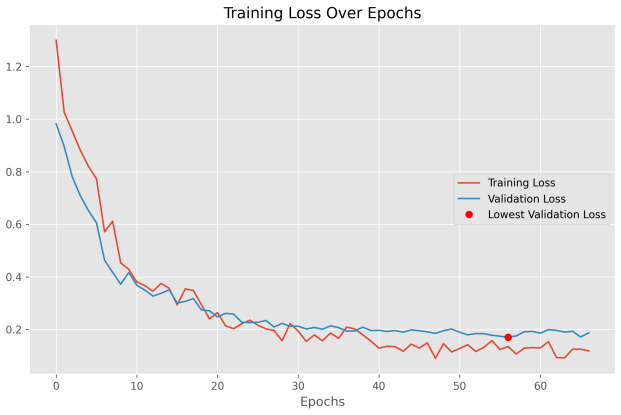
- [Sections 3.3, 6] The headline 97.87% validation accuracy is computed on a random 80/20 split of 1-second clips, where all clips of a given speaker come from the same roughly one-minute recording of the same phrase, recorded in one session with one microphone. Because the validation set is not speaker-disjoint, a model can achieve high accuracy by memorizing the recording's noise floor, room impulse response, microphone transfer function, or phrase-specific prosody rather than the speaker's voice identity. The paper's central claim in Section 6 ('Our model was successful in identifying speakers in our dataset with a validation accuracy 97.87%') requires either a speaker-disjoint evaluation (e.g., enrollment on one recording and test on a different recording of the same speaker) or, at minimum, per-speaker results and repeated random splits with mean and standard deviation to establish that the number is not an artifact of a single favorable split.
- [Sections 3.3, 3.5] The assertions that the model 'works remarkably well even for unknown phrases' and that it rejects unseen speakers by outputting a very low confidence are not backed by any reported experiment. No test utterance from a phrase different from 'Hello DSP 12345' is fed to the model, and no impostor speaker not present in training is evaluated. These claims should either be removed or supported by explicit experiments: for unknown phrases, record the same speakers speaking a different sentence and report accuracy; for unseen speakers, include impostor clips and report the false-accept/rejection trade-off rather than only top-1 classification accuracy.
- [Sections 4.3, 4.4, 5.1] The validation split is used both for the reported accuracy and for model selection. The authors state that architecture, number of neurons, dropout, learning rate, decay, batch size, and early-stopping patience were tuned on evaluation metrics from this same validation set (Sections 3.4, 4.2, 4.3, 4.4, and 5.1). Early stopping in particular selects the epoch with the best validation accuracy, so the reported 97.87% is a fitted selection statistic, not an unbiased estimate of performance on unseen data. The paper should report a protocol that separates tuning from evaluation, such as a held-out test set used once after all tuning, or nested cross-validation.
minor comments (4)
- [Section 3.1] The number of speakers is never explicitly stated; it appears only indirectly as 'by default 4 classes' in Section 5.3. Please state the dataset size, number of speakers, and number of clips per speaker explicitly.
- [Section 6] The claim that the model can identify a speaker from a voice clip 'as small as 8 seconds' is not connected to any experiment; the reported evaluation uses 1-second clips. Either add an experiment varying clip duration or remove this claim.
- [References] Several references are incomplete or inconsistent: [2] appears as 'B. et al' without a full author list, and [7] and [8] are duplicates of the HuBERT citation with different titles. Please correct these entries.
- [Throughout] The manuscript contains numerous typos and formatting issues that should be cleaned up before publication, including inconsistent spelling of 'preprocessing', '1d-ConvNet' versus '1D-CNN', and missing spaces in phrases like 'knows as the training set'.
Circularity Check
No significant circularity: the paper reports an empirical validation accuracy and makes unsupported generalization claims, but no claim is derived from its own inputs.
full rationale
The paper contains no derivation chain, fitted physical constant, or formal equation whose output is equivalent to its input. The central result, the 97.87% validation accuracy in Section 6, is an empirically measured metric obtained after an 80/20 clip-level split and hyperparameter tuning on the same validation partition (Sections 3.3 and 3.4). That protocol may make the reported number optimistically biased, but it does not make the accuracy equal by construction to any fitted parameter or input quantity; the accuracy is measured, not derived. The assertions that the model recognizes unknown phrases and rejects unseen speakers (Sections 3.3 and 3.5) are not backed by any reported experiment, which is a missing-evidence or evaluation-validity concern, not a circularity concern. There are no self-citations, no imported uniqueness theorems, and no ansatz smuggled in via citation. Accordingly, no circular step can be identified, and the circularity score is 0.
Assumptions & free parameters
free parameters (6)
- Initial learning rate =
0.0001
- Learning-rate decay factor =
0.7 every 250 training steps
- Dropout rate =
0.2
- Early-stopping patience =
10 epochs
- Dense layer neuron counts and 1D-CNN filter counts =
not specified in text
- Train/validation split ratio =
80/20
assumptions (5)
- domain assumption FFT coefficients of 1-second clips contain enough speaker-discriminative information.
- domain assumption Random 80/20 clip-level split from the same recordings approximates generalization to new speech.
- domain assumption Keras Speaker Recognition Example is a valid architectural starting point.
- ad hoc to paper The fixed phrase 'Hello DSP 12345' plus noise augmentation generalizes to other phrases.
- standard math Standard deep learning assumptions: ReLU, residual connections mitigate vanishing gradients, and softmax cross-entropy training converges.
Cite this review
Pith. "Pith review of Towards Speaker Identification with Minimal Dataset and Constrained Resources using 1D-Convolution Neural Network." pith.science (2026). https://pith.science/paper/ZTDPYW4Z
@misc{pith2026241115082,
  author       = {Pith},
  title        = {Pith review of: Towards Speaker Identification with Minimal Dataset and Constrained Resources using 1D-Convolution Neural Network},
  year         = {2026},
  howpublished = {\url{https://pith.science/paper/ZTDPYW4Z}},
  note         = {Machine review of arXiv:2411.15082}
}
read the original abstract
Voice recognition and speaker identification are vital for applications in security and personal assistants. This paper presents a lightweight 1D-Convolutional Neural Network (1D-CNN) designed to perform speaker identification on minimal datasets. Our approach achieves a validation accuracy of 97.87%, leveraging data augmentation techniques to handle background noise and limited training samples. Future improvements include testing on larger datasets and integrating transfer learning methods to enhance generalizability. We provide all code, the custom dataset, and the trained models to facilitate reproducibility. These resources are available on our GitHub repository: https://github.com/IrfanNafiz/RecMe.
Figures


Figures from the paper (9 more)



Reference graph
Works this paper leans on
-
[1]
A deep neural network model for speaker identification,
F. Ye and J. Yang, “A deep neural network model for speaker identification,” Appl. Sci.11, 3603 (2021)
work page 2021
-
[2]
Aishell-1isacorpusforspeechrecognitionresearchandbuildingspeechrecognitionsystemsformandarin
B.etal, “Aishell-1isacorpusforspeechrecognitionresearchandbuildingspeechrecognitionsystemsformandarin.” (2017)
work page 2017
-
[4]
wav2vec: Unsupervised pre-training for speech recognition,
S. Schneider, A. Baevski, R. Collobert, and M. Auli, “wav2vec: Unsupervised pre-training for speech recognition,” arXiv preprint arXiv:1904.05862 (2019)
arXiv 2019
-
[5]
Text-independent speaker verification using lstm-rnn with attention mechanism,
X. Zhang and Z. Zhang, “Text-independent speaker verification using lstm-rnn with attention mechanism,” in2019 IEEE International Conference on Acoustics, Speech and Signal Processing (ICASSP), (IEEE, 2019), pp. 6226–6230
work page 2019
-
[6]
Voxceleb: alarge-scalespeakeridentificationdataset,
A.Nagrani,J.S.Chung,andA.Zisserman,“Voxceleb: alarge-scalespeakeridentificationdataset,”in INTERSPEECH, (2017)
work page 2017
-
[7]
Hubert: Self-supervised speech representation learning by masked reconstruction,
W.-N. Chung, C.-F. Hsu, Y.-A. Tang, and H.-y. Chen, “Hubert: Self-supervised speech representation learning by masked reconstruction,” arXiv preprint arXiv:2106.07447 (2021)
arXiv 2021
-
[8]
Hubert: Self-supervised speech representation learning by masked prediction of hidden units,
W.-N. Hsu, B. Bolte, Y.-H. H. Tsai, K. Lakhotia, R. Salakhutdinov, and A. Mohamed, “Hubert: Self-supervised speech representation learning by masked prediction of hidden units,” IEEE/ACM Trans. on Audio, Speech, Lang. Process. 29, 3451–3460 (2021)
work page 2021
-
[9]
Improving training datasets for resource-constrained speaker recognition neural networks,
P.-M. Bousquet and M. Rouvier, “Improving training datasets for resource-constrained speaker recognition neural networks,” (2023), pp. 3167–3171
work page 2023
Show all 13 references
-
[10]
Speaker recognition dataset,
E. Kiplagat, “Speaker recognition dataset,” (2020)
2020
-
[11]
Keras documentation: Speaker recognition,
K. Team, “Keras documentation: Speaker recognition,”
-
[12]
Tensorboard: Tensorflow’s visualization toolkit,
TensorFlow, “Tensorboard: Tensorflow’s visualization toolkit,”
-
[13]
Using tensorboard - understanding histograms,
B. E. Nishimoto, “Using tensorboard - understanding histograms,”
-
[14]
Why is validation loss lower than training loss,
A. Rosebrock, “Why is validation loss lower than training loss,”
Reviewed August 12, 2026 · model on record in the stance chip above.
Discussion (0). Continue with ORCID to comment.