REVIEW 2 major objections 5 minor 72 references
Finding One's Bearings in the Hyperparameter Landscape of a Wide-Kernel Convolutional Fault Detector
T0 review · 2 major / 5 minor · reviewed 2026-08-12 · deepseek-v4-flash
Pith's one-line read Contrary to earlier speculation, high-frequency noise is not why a wide convolutional kernel beats a narrow one in bearing-fault detection.
desk verdict The filtering experiments are a clean negative result that should survive review; the resampling experiment is confounded and should not be used to support claims about sampling rate. read the letter →
The pith
A machine-rendered reading of the paper's core claim, the machinery that carries it, and where it could break.
The reading
What carries the argument
The central object is the first-layer kernel of a 1D wide-kernel CNN: a convolutional filter whose length in samples (16, 32, 64, 128 or 256) is the hyperparameter whose optimal value shifts most across datasets. The argument is carried by manipulated copies of the CWRU vibration dataset. Resampling condenses the signal while keeping kernel sizes fixed in sample count, and low-pass filtering removes high frequencies while keeping sample rate and window length identical; grid searches over the three most important hyperparameters on each version produce the box plots and correlation matrices that distinguish sampling-rate effects from spectral-content effects. A separate exhaustive search over the completed seven-dataset grid produces a ranked 'multiple defaults' list, a small set of hyperparameter combinations to try in sequence on new data.
What would settle it
Run the same grid search on CWRU at 48, 24, 12, 6 and 3 kHz with first-layer kernel sizes scaled so that each kernel covers the same physical duration in milliseconds (for example, 256 samples at 48 kHz would be matched by 128 samples at 24 kHz and 64 samples at 12 kHz). If, under constant-duration kernels, wide kernels stop beating narrow kernels or the optimal kernel size tracks the sampling rate, the paper's conclusion that sampling rate is not responsible would be overturned.
Extended reading notes
Core claim
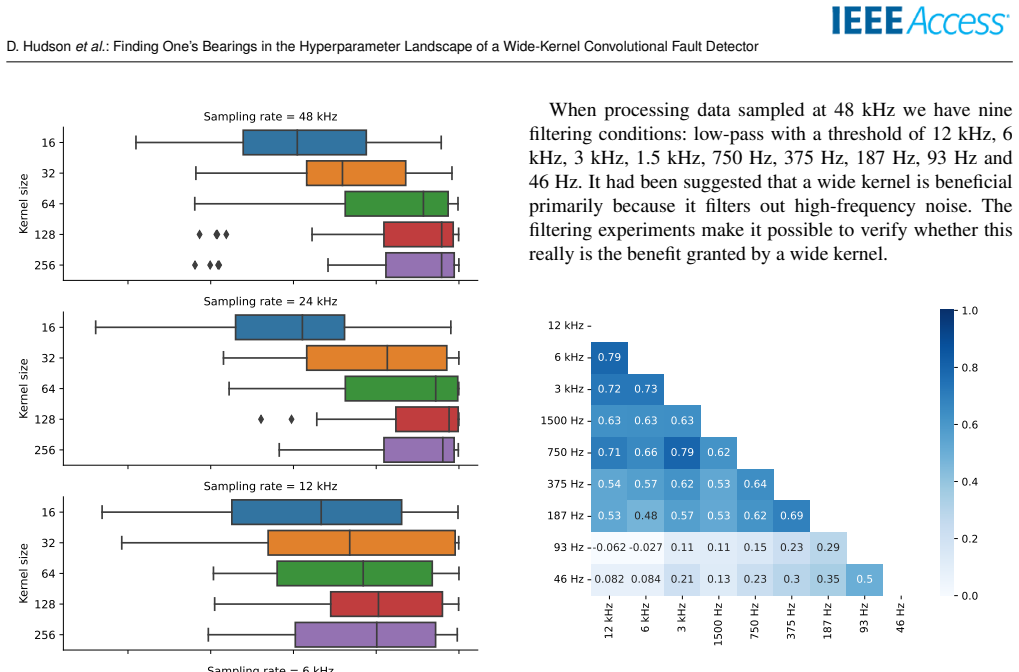
On the paper's own terms, the discovery is that the standard explanation for wide-kernel convolutional networks in bearing fault detection—that a long filter averages over high-frequency noise—is not supported. In experiments on the CWRU benchmark, copies of the data were low-pass filtered at cutoffs from 12 kHz down to 46 Hz and resampled from 48 kHz to 3 kHz; in all but the most destructive filtering conditions, first-layer kernels of 128 or 256 samples continued to outperform short kernels. Because the wide-kernel advantage survives the removal of high frequencies, the authors conclude that high-frequency noise is not the main reason wide kernels are preferable. They are left speculating that the advantage may be a generic architectural property such as regularization that helps training, while noting that this does not explain why the advantage reverses on the SEU dataset. The same experiments support a practical claim: resampling to 24 kHz caused no visible drop in accuracy, so the highest recording rates may be wasteful.
Load-bearing premise
The weakest load-bearing premise is that a first-layer kernel with a fixed number of samples is the same object after resampling: the experiment keeps kernel size in samples while changing the sampling rate, so the physical time span the kernel covers changes together with sampling rate, and the claim that sampling rate is not responsible for the wide-kernel preference depends on that comparison being meaningful.
Editorial extensions
If this is right
- Resampling a 48 kHz bearing signal to 24 kHz showed no accuracy loss, so recording at the highest rates may be unnecessary for this architecture.
- No single hyperparameter configuration dominates all seven benchmarks; users should expect to re-tune first-layer kernel size when moving to new data.
- The recommended tuning order for the wide-kernel CNN is first-layer kernel size, then first-layer filter count, then filter count in layers 3-5, because tuning kernel size later forces re-tuning of the others.
- The susceptibility to bad hyperparameters is not specific to wide-kernel CNNs: both LSTM and transformer fault detectors varied from poor to near-perfect accuracy depending on configuration.
- Multiple defaults, tried in sequence, reach the 92nd percentile of grid-search performance on held-out benchmarks, so a practitioner can find a strong configuration quickly.
Reading between the lines
- Not pursued in the paper: the resampling experiment conflates sample-count kernel size with physical kernel duration; a cleaner test would scale kernel length with the sampling period to see whether duration, not sampling rate, controls the wide-kernel advantage.
- If the wide-kernel advantage is not about frequencies, the mechanism may be a longer receptive field acting as implicit regularization; this could be tested by comparing wide and narrow kernels on synthetic signals whose fault signature and noise are generated with known spectra.
- The multiple-defaults procedure could be applied to the LSTM and transformer results to produce per-architecture default lists, since the same exhaustive-search principle only needs a completed performance table.
- The filtering sweep suggests a cheap diagnostic: if aggressive low-pass filtering does not hurt accuracy, the fault signature is concentrated at low frequencies and high-rate acquisition is unnecessary; this could be checked on the other six benchmarks, not just CWRU.
Editorial analysis
A structured set of objections, weighed in public.
Referee Report
Summary. The paper studies hyperparameter sensitivity of a wide-kernel CNN for bearing fault detection across seven benchmark datasets, two additional architectures (LSTM, transformer), and manipulated copies of the CWRU dataset. It proposes a sequence of 'multiple defaults' for efficiently tuning the architecture on new data, and it uses resampling and low-pass filtering to investigate whether sampling rate or high-frequency noise explains why wide first-layer kernels are often preferable to narrow ones. The central negative claim is that, contrary to earlier speculation, high-frequency noise is not the main reason wide kernels outperform narrow kernels; a secondary claim is that sampling rate is also not responsible. The filtering experiment is a clean falsifiable test and supports the noise-related claim; however, the resampling experiment is confounded because kernel sizes are kept fixed in sample count while the physical duration they cover changes with sampling rate.
Significance. If the negative result on high-frequency noise holds, it is a useful contribution: it refutes a commonly repeated explanation for wide-kernel CNNs and redirects attention to other mechanisms such as implicit regularization or training dynamics. The filtering experiment is well designed and gives a concrete, falsifiable test, and the multiple-defaults procedure with leave-one-out evaluation is a practical and reproducible way to give tuning guidance across datasets. The main weakness is that the sampling-rate half of the central claim currently rests on an experiment that conflates sample count with kernel duration, so the scope of the paper's headline conclusion is wider than the evidence supports.
major comments (2)
- [Section III-C5 / Figure 5] The resampling experiment does not support the conclusion that sampling rate is irrelevant to the wide-kernel preference. The grid search keeps kernel sizes fixed in sample count (16-256) across resampling levels, so each kernel covers a different physical duration at each rate: a 256-sample kernel covers 5.33 ms at 48 kHz but 85.3 ms at 3 kHz. The persistence of the large-kernel advantage under resampling is exactly what would be expected if the relevant quantity were kernel duration or the number of signal cycles spanned, rather than sample count. To test the sampling-rate hypothesis, the authors should either scale kernel sizes inversely with the resampling factor to keep duration constant, or re-analyze the existing grid by converting kernel sizes to physical durations and checking whether optimal duration is invariant across rates. Until then, the resampling half of the central claim remains ambiguous.
- [Abstract / Section IV-B5 / Section V] The filtering experiment is convincing for the noise hypothesis: removing high frequencies while holding sampling rate and window length fixed does not remove the wide-kernel advantage, so pre-filtering does not make narrow kernels viable. However, the Abstract and Conclusion state the joint claim that 'neither the sampling rate nor noise is responsible' for the wide-kernel preference. The noise part is supported, but the sampling-rate part currently rests on the confounded resampling experiment described above. The wording should be scoped to what is demonstrated, or the resampling experiment should be extended with a duration-matched control.
minor comments (5)
- [Table 4] The filtering thresholds '750 kHz', '375 kHz', '187 kHz', '93 kHz', and '46 kHz' should be labeled in Hz, not kHz; as written they exceed the Nyquist frequency of the 48 kHz signal.
- [Section III-C5] The phrase 'it will take fewer data points to record the same back-and-forth vibrations' accurately describes the confound: after resampling, each sample covers a larger physical time step. Consider making this explicit and discussing its consequences for comparing kernel sizes in samples.
- [Section IV-B4 / Figure 4] The correlation analysis uses Pearson correlations on accuracy scores that are heavily ceiling-affected. The caveat about ceiling effects is appreciated, but a rank-based correlation would be more robust for the claim that hyperparameter rankings are preserved across resampling conditions.
- [Appendix A / Appendix B] Minor typographical issues include 'University of Conneticut' and 'the data are collected with a sampling frequency' in Appendix A; these should be corrected.
- [General] No code or data availability statement is included. Given that the paper relies on a large grid search and a reproducible multiple-defaults procedure, adding a link to the code and processed data would strengthen the practical contribution.
Circularity Check
No significant circularity: the central negative result is tested with falsifiable data manipulations, and the multiple-defaults generalisation is evaluated by leave-one-out rather than by construction.
full rationale
The paper's central negative claim—that high-frequency noise is not the main reason wide kernels beat narrow ones—is tested by a falsifiable manipulation: low-pass filtering the CWRU signal at cutoffs from 12 kHz down to 187 Hz while keeping sampling rate and window length constant (Section III-C6, results in Figure 7). If the wide kernel's value were mainly low-pass filtering, pre-filtering should have made narrow kernels competitive; it did not. No parameter in this test is fitted to the claim, and the outcome is not entailed by the experimental construction. The resampling experiment (III-C5/IV-B4) does not scale kernel sizes to preserve physical duration when going from 48 kHz to 3 kHz, so its interpretation is confounded—as the paper's own caveat that 'each data point will represent a bigger jump forward in time' shows—but a confound is an experimental-validity limitation, not a circular reduction: the conclusion is not equal, by definition or by fitted value, to the experimental input. The multiple-defaults analysis (III-C4/IV-B3) is selected by exhaustive search on seven benchmarks, yet the reported generalization figure is obtained via leave-one-out on the benchmark not used for selection, so it is not a fitted-input-called-prediction. Self-citations to [1], [2], [35]–[37] supply the architecture and earlier grid-search data, which are prior published empirical results rather than an imported uniqueness theorem; moreover the paper explicitly argues against earlier speculation, so the self-citations do not force the conclusion. The limitations stated in Section V (small number of benchmarks, domain specificity, training-stopping rules) are honest scope restrictions and do not indicate that any derivation reduces to its inputs. Overall: no significant circularity.
Assumptions & free parameters
free parameters (3)
- Multiple defaults (10 hyperparameter combinations) =
See Table 8 (e.g., #1: KS1=256, S1=16, F1=256, KS2=3, F2=16, KS3+=3, F3+=64)
- Lowpass filter cutoff frequencies =
12 kHz, 6 kHz, 3 kHz, 1.5 kHz, 750 Hz, 375 Hz, 187 Hz, 93 Hz, 46 Hz
- Resampling factors =
2x, 4x, 8x, 16x (48 kHz to 24, 12, 6, 3 kHz)
assumptions (5)
- domain assumption The seven benchmark datasets are representative of real-world industrial vibration data.
- domain assumption The wide-kernel CNN from prior work is an appropriate representative state-of-the-art architecture.
- domain assumption Lowpass filtering removes high-frequency content without side effects that change the classification problem.
- ad hoc to paper Kernel size in samples can be compared across resampling levels.
- domain assumption Single training runs are sufficient to characterize configuration performance.
Cite this review
Pith. "Pith review of Finding One's Bearings in the Hyperparameter Landscape of a Wide-Kernel Convolutional Fault Detector." pith.science (2026). https://pith.science/paper/WWQE4NHB
@misc{pith2026241115191,
  author       = {Pith},
  title        = {Pith review of: Finding One's Bearings in the Hyperparameter Landscape of a Wide-Kernel Convolutional Fault Detector},
  year         = {2026},
  howpublished = {\url{https://pith.science/paper/WWQE4NHB}},
  note         = {Machine review of arXiv:2411.15191}
}
read the original abstract
State-of-the-art algorithms are reported to be almost perfect at distinguishing the vibrations arising from healthy and damaged machine bearings, according to benchmark datasets at least. However, what about their application to new data? In this paper, we confirm that neural networks for bearing fault detection can be crippled by incorrect hyperparameterisation, and also that the correct hyperparameter settings can change when transitioning to new data. The paper combines multiple methods to explain the behaviour of the hyperparameters of a wide-kernel convolutional neural network and how to set them. Since guidance already exists for generic hyperparameters like minibatch size, we focus on how to set architecture-specific hyperparameters such as the width of the convolutional kernels, a topic which might otherwise be obscure. We reflect different data properties by fusing information from seven different benchmark datasets, and our results show that the kernel size in the first layer in particular is sensitive to changes in the data. Looking deeper, we use manipulated copies of one dataset in an attempt to spot why the kernel size sometimes needs to change. The relevance of sampling rate is studied by using different levels of resampling, and spectral content is studied by increasingly filtering out high frequencies. We find that, contrary to speculation in earlier work, high-frequency noise is not the main reason why a wide kernel is preferable to a narrow kernel. Finally, we conclude by stating clear guidance on how to set the hyperparameters of our neural network architecture to work effectively on new data.
Figures


Figures from the paper (5 more)


Reference graph
Works this paper leans on
- [1]
-
[2]
J. van den Hoogen, D. Hudson, S. Bloemheuvel, M. Atzmueller, Hy- perparameter analysis of wide-kernel cnn architectures in industrial fault detection – an exploratory study, Int. J. Data Sci. Anal. (2023). doi: 10.1007/s41060-023-00440-6
- [3]
-
[4]
L. Eren, Bearing fault detection by one-dimensional convolutional neu- ral networks, Mathematical Problems in Engineering 2017 (1) (2017) 8617315
work page 2017
-
[5]
X. Guo, L. Chen, C. Shen, Hierarchical adaptive deep convolution neural network and its application to bearing fault diagnosis, Measurement 93 (2016) 490–502
work page 2016
-
[6]
T. Han, R. Ma, J. Zheng, Combination bidirectional long short-term memory and capsule network for rotating machinery fault diagnosis, Measurement 176 (2021) 109208
work page 2021
-
[7]
Data-driven Machinery Fault Diagnosis: A Comprehensive Review
D. Neupane, M. R. Bouadjenek, R. Dazeley, S. Aryal, Data-driven machinery fault detection: A comprehensive review, arXiv preprint arXiv:2405.18843 (2024)
work page Pith review arXiv 2024
-
[8]
F. Pfisterer, J. N. Van Rijn, P. Probst, A. C. Müller, B. Bischl, Learning multiple defaults for machine learning algorithms, in: Proceedings of the genetic and evolutionary computation conference companion, 2021, pp. 241–242
work page 2021
Show all 72 references
-
[9]
Wistuba, N
M. Wistuba, N. Schilling, L. Schmidt-Thieme, Hyperparameter search space pruning–a new component for sequential model-based hyperparam- eter optimization, in: Machine Learning and Knowledge Discovery in Databases: European Conference, ECML PKDD 2015, Porto, Portugal, September...
2015
-
[10]
D. W. Kim, E. S. Lee, W. K. Jang, B. H. Kim, Y . H. Seo, Effect of data preprocessing methods and hyperparameters on accuracy of ball bearing fault detection based on deep learning, Advances in Mechanical Engineering 14 (2) (2022) 16878132221078494
2022
-
[11]
Pandhare, J
V . Pandhare, J. Singh, J. Lee, Convolutional neural network based rolling- element bearing fault diagnosis for naturally occurring and progressing defects using time-frequency domain features, in: 2019 Prognostics and System Health Management Conference (PHM-Paris), 2019, pp....
2019
-
[12]
S. J. Lacey, An Overview of Bearing Vibration Analysis, Brochure (2008). URL https://www.schaeffler.com/remotemedien/media/_shared_media/ 08_media_library/01_publications/schaeffler_2/technicalpaper_1/ download_1/vibration_analysis_en_en.pdf
2008
-
[13]
S. Yin, X. Li, H. Gao, O. Kaynak, Data-based techniques focused on modern industry: An overview, IEEE Trans. Ind. Electron. 62 (1) (2014) 657–667
2014
-
[14]
R. Zhao, R. Yan, Z. Chen, K. Mao, P. Wang, R. X. Gao, Deep learning and its applications to machine health monitoring, Mechanical Systems and Signal Processing 115 (2019) 213–237
2019
-
[15]
Pandya, S
D. Pandya, S. Upadhyay, S. P. Harsha, Fault diagnosis of rolling element bearing with intrinsic mode function of acoustic emission data using apf- knn, Expert Systems with Applications 40 (10) (2013) 4137–4145
2013
-
[16]
Z. Zhou, C. Wen, C. Yang, Fault detection using random projections and k-nearest neighbor rule for semiconductor manufacturing processes, IEEE Transactions on Semiconductor Manufacturing 28 (1) (2015) 70–79. doi:10.1109/TSM.2014.2374339
2015
-
[17]
Z. Wang, Q. Zhang, J. Xiong, M. Xiao, G. Sun, J. He, Fault diagnosis of a rolling bearing using wavelet packet denoising and random forests, IEEE Sensors Journal 17 (17) (2017) 5581–5588
2017
-
[18]
Santos, L
P. Santos, L. F. Villa, A. Reñones, A. Bustillo, J. Maudes, An svm-based solution for fault detection in wind turbines, Sensors 15 (3) (2015) 5627– 5648
2015
-
[19]
D. You, X. Gao, S. Katayama, Wpd-pca-based laser welding process monitoring and defects diagnosis by using fnn and svm, IEEE Transactions on Industrial Electronics 62 (1) (2014) 628–636
2014
-
[20]
Huang, X
J. Huang, X. Hu, F. Yang, Support vector machine with genetic algorithm for machinery fault diagnosis of high voltage circuit breaker, Measurement 44 (6) (2011) 1018–1027
2011
-
[21]
Konar, P
P. Konar, P. Chattopadhyay, Bearing fault detection of induction motor us- ing wavelet and support vector machines (svms), Applied Soft Computing 11 (6) (2011) 4203–4211
2011
-
[22]
M. P. Naeini, H. Taremian, H. B. Hashemi, Stock market value prediction using neural networks, in: 2010 international conference on computer information systems and industrial management applications (CISIM), IEEE, 2010, pp. 132–136
2010
-
[23]
Abhishek, M
K. Abhishek, M. Singh, S. Ghosh, A. Anand, Weather forecasting model using artificial neural network, Procedia Technology 4 (2012) 311–318
2012
-
[24]
Hajnayeb, A
A. Hajnayeb, A. Ghasemloonia, S. Khadem, M. Moradi, Application and comparison of an ann-based feature selection method and the genetic algorithm in gearbox fault diagnosis, Expert systems with Applications 38 (8) (2011) 10205–10209
2011
-
[25]
Malhotra, A
P. Malhotra, A. Ramakrishnan, G. Anand, L. Vig, P. Agarwal, G. Shroff, Lstm-based encoder-decoder for multi-sensor anomaly detection, arXiv preprint arXiv:1607.00148 (2016)
2016 arXiv
-
[26]
Hannun, C
A. Hannun, C. Case, J. Casper, B. Catanzaro, G. Diamos, E. Elsen, R. Prenger, S. Satheesh, S. Sengupta, A. Coates, et al., Deep speech: Scaling up end-to-end speech recognition, arXiv preprint arXiv:1412.5567 (2014)
2014 arXiv
-
[27]
Zhang, G
W. Zhang, G. Peng, C. Li, Rolling element bearings fault intelligent diag- nosis based on convolutional neural networks using raw sensing signal, in: Advances in Intelligent Information Hiding and Multimedia Signal Processing, Springer, 2017, pp. 77–84
2017
-
[28]
Y . Liu, X. Yan, C.-a. Zhang, W. Liu, An ensemble convolutional neural networks for bearing fault diagnosis using multi-sensor data, Sensors VOLUME X, 2025 19 D. Hudson et al.: Finding One’s Bearings in the Hyperparameter Landscape of a Wide-Kernel Convolutional Fault Detector...
2019 doi
-
[29]
J. Yang, M. N. Nguyen, P. P. San, X. Li, S. Krishnaswamy, Deep convo- lutional neural networks on multichannel time series for human activity recognition., in: Ijcai, V ol. 15, Buenos Aires, Argentina, 2015, pp. 3995– 4001
2015
-
[30]
D. Zhao, T. Wang, F. Chu, Deep convolutional neural network based planet bearing fault classification, Computers in Industry 107 (2019) 59–66
2019
-
[31]
R. Chen, X. Huang, L. Yang, X. Xu, X. Zhang, Y . Zhang, Intelligent fault diagnosis method of planetary gearboxes based on convolution neural network and discrete wavelet transform, Computers in Industry 106 (2019) 48–59
2019
-
[32]
T. Ince, S. Kiranyaz, L. Eren, M. Askar, M. Gabbouj, Real-time motor fault detection by 1-d convolutional neural networks, IEEE Trans. Ind. Electron. 63 (11) (2016) 7067–7075
2016
-
[33]
Zheng, Q
Y . Zheng, Q. Liu, E. Chen, Y . Ge, J. L. Zhao, Time series classification using multi-channels deep convolutional neural networks, in: International Conference on Web-Age Information Management, Springer, 2014, pp. 298–310
2014
-
[34]
Zhang, S
A. Zhang, S. Li, Y . Cui, W. Yang, R. Dong, J. Hu, Limited data rolling bearing fault diagnosis with few-shot learning, IEEE Access 7 (2019) 110895–110904
2019
-
[35]
Zhang, G
W. Zhang, G. Peng, C. Li, Y . Chen, Z. Zhang, A new deep learning model for fault diagnosis with good anti-noise and domain adaptation ability on raw vibration signals, Sensors 17 (2) (2017) 425
2017
-
[37]
van den Hoogen, S
J. van den Hoogen, S. Bloemheuvel, M. Atzmueller, Classifying mul- tivariate signals in rolling bearing fault detection using adaptive wide- kernel cnns, Applied Sciences 11 (23) (2021). doi:10.3390/ app112311429. URL https://www.mdpi.com/2076-3417/11/23/11429
2021
-
[38]
Z. Zhao, Y . Jiao, X. Zhang, A fault diagnosis method of rotor system based on parallel convolutional neural network architecture with attention mechanism, Journal of Signal Processing Systems (2023) 1–13
2023
-
[39]
R. Li, J. Wu, Y . Li, Y . Cheng, Periodnet: Noise-robust fault diagnosis method under varying speed conditions, IEEE Transactions on Neural Networks and Learning Systems (2023) 1–15 doi:10.1109/TNNLS. 2023.3274290
2023
-
[40]
S. Chen, J. Yu, S. Wang, One-dimensional convolutional auto- encoder-based feature learning for fault diagnosis of multivariate processes, Journal of Process Control 87 (2020) 54–67. doi:https: //doi.org/10.1016/j.jprocont.2020.01.004. URL https://www.sciencedirect.com/science...
2020 doi
-
[41]
Goodfellow, Y
I. Goodfellow, Y . Bengio, A. Courville, Deep learning, MIT press, 2016
2016
-
[42]
Gulcehre, M
C. Gulcehre, M. Moczulski, M. Denil, Y . Bengio, Noisy activation func- tions, in: International conference on machine learning, PMLR, 2016, pp. 3059–3068
2016
-
[43]
Baratchi, C
M. Baratchi, C. Wang, S. Limmer, J. N. van Rijn, H. Hoos, T. Bäck, M. Ol- hofer, Automated machine learning: past, present and future, Artificial intelligence review 57 (5) (2024) 122
2024
-
[44]
Sharma, J
A. Sharma, J. N. van Rijn, F. Hutter, A. Müller, Hyperparameter impor- tance for image classification by residual neural networks, in: Discovery Science: 22nd International Conference, DS 2019, Split, Croatia, October 28–30, 2019, Proceedings 22, Springer, 2019, pp. 112–126
2019
-
[45]
Bergstra, Y
J. Bergstra, Y . Bengio, Random search for hyper-parameter optimization, The journal of machine learning research 13 (1) (2012) 281–305
2012
-
[46]
Hutter, H
F. Hutter, H. Hoos, K. Leyton-Brown, An efficient approach for assess- ing hyperparameter importance, in: International conference on machine learning, PMLR, 2014, pp. 754–762
2014
-
[47]
Theodorakopoulos, F
D. Theodorakopoulos, F. Stahl, M. Lindauer, Hyperparameter importance analysis for multi-objective automl, arXiv preprint arXiv:2405.07640 (2024)
2024 arXiv
-
[48]
Perrone, R
V . Perrone, R. Jenatton, M. W. Seeger, C. Archambeau, Scalable hyper- parameter transfer learning, Advances in neural information processing systems 31 (2018)
2018
-
[49]
Wistuba, N
M. Wistuba, N. Schilling, L. Schmidt-Thieme, Sequential model-free hyperparameter tuning, in: 2015 IEEE international conference on data mining, IEEE, 2015, pp. 1033–1038
2015
-
[50]
Martínez, F
F. Martínez, F. Martínez, E. Jacinto, Performance evaluation of the nas- net convolutional network in the automatic identification of covid-19, International Journal on Advanced Science, Engineering and Information Technology 10 (2) (2020) 662
2020
-
[51]
Rivolli, L
A. Rivolli, L. P. Garcia, C. Soares, J. Vanschoren, A. C. de Carvalho, Meta-features for meta-learning, Knowledge-Based Systems 240 (2022) 108101
2022
-
[52]
Petelin, G
G. Petelin, G. Cenikj, T. Eftimov, Towards understanding the importance of time-series features in automated algorithm performance prediction, Expert systems with applications 213 (2023) 119023
2023
-
[53]
Talkhi, N
N. Talkhi, N. Akhavan Fatemi, M. Jabbari Nooghabi, E. Soltani, A. Jab- bari Nooghabi, Using meta-learning to recommend an appropriate time- series forecasting model, BMC Public Health 24 (1) (2024) 148
2024
-
[54]
X. Chen, B. Zhang, D. Gao, Bearing fault diagnosis base on multi-scale cnn and lstm model, Journal of Intelligent Manufacturing 32 (4) (2021) 971–987
2021
-
[55]
Hochreiter, Long short-term memory, Neural Computation MIT-Press (1997)
S. Hochreiter, Long short-term memory, Neural Computation MIT-Press (1997)
1997
-
[56]
Vaswani, Attention is all you need, Advances in Neural Information Processing Systems (2017)
A. Vaswani, Attention is all you need, Advances in Neural Information Processing Systems (2017)
2017
-
[57]
Qiang, X
R. Qiang, X. Zhao, An intelligent diagnosis method for rolling bearings based on ghost module and adaptive weighting module, Research Square Preprint https://doi.org/10.21203/rs.3.rs-2627489/v1 (2023)
2023 doi
-
[58]
A. Zhou, A. B. Farimani, Faultformer: Pretraining transformers for adapt- able bearing fault classification, IEEE Access (2024)
2024
-
[59]
van den Hoogen, S
J. van den Hoogen, S. Bloemheuvel, M. Atzmueller, An improved wide- kernel cnn for classifying multivariate signals in fault diagnosis, in: 2020 International Conference on Data Mining Workshops (ICDMW), 2020, pp. 275–283. doi:10.1109/ICDMW51313.2020.00046
2020
-
[60]
Cwru dataset; case western reserve university bearing data center, avail- able: https://csegroups.case.edu/ bearingdatacenter/home
-
[61]
Neupane, J
D. Neupane, J. Seok, Bearing fault detection and diagnosis using case western reserve university dataset with deep learning approaches: A re- view, IEEE Access 8 (2020) 93155–93178
2020
-
[62]
X. Liu, H. Huang, J. Xiang, A personalized diagnosis method to detect faults in a bearing based on acceleration sensors and an fem simulation driving support vector machine, Sensors 20 (2) (2020) 420
2020
-
[63]
Piltan, J.-M
F. Piltan, J.-M. Kim, Svm-based hybrid robust pio fault diagnosis for bearing, in: International Conference on Intelligent and Fuzzy Systems, Springer, 2020, pp. 858–866
2020
-
[64]
Lessmeier, J
C. Lessmeier, J. K. Kimotho, D. Zimmer, W. Sextro, Condition monitoring of bearing damage in electromechanical drive systems by using motor current signals of electric motors: A benchmark data set for data-driven classification, Proc. PHM Society European Conference 3 (1) (2016)
2016
-
[65]
Malik, Y
H. Malik, Y . Pandya, A. Parashar, R. Sharma, Feature extraction using EMD and classifier through artificial neural networks for gearbox fault diagnosis, in: Applications of Artificial Intelligence Techniques in Engi- neering: SIGMA 2018, V olume 2, Springer, 2019, pp. 309–317
2018
-
[66]
Pandya, Gearbox fault diagnosis data (06 2018)
Y . Pandya, Gearbox fault diagnosis data (06 2018). URL https://data.openei.org/submissions/623
2018
-
[67]
Society For Machinery Failure Prevention Technology, Fault Data Sets, https://mfpt.org/fault-data-sets/, accessed: July 2023 (Online)
2023
-
[68]
B. Wang, Y . Lei, N. Li, N. Li, A hybrid prognostics approach for estimating remaining useful life of rolling element bearings, IEEE Transactions on Reliability (2018) 1–12doi:10.1109/TR.2018.2882682
2018
-
[69]
P. Cao, S. Zhang, J. Tang, Gear Fault Data (4 2018). doi:10.6084/ m9.figshare.6127874.v1. URL https://figshare.com/articles/dataset/Gear_Fault_Data/6127874
2018
-
[70]
P. Cao, S. Zhang, J. Tang, Preprocessing-free gear fault diagnosis using small datasets with deep convolutional neural network-based transfer learning, Ieee Access 6 (2018) 26241–26253
2018
-
[71]
S. U. (SEU), Gearbox mechanical datasets, https://github.com/cathysiyu/ Mechanical-datasets, accessed: July 2023 (Online)
2023
-
[72]
healthy”, “real damaged
D. P. Kingma, J. Ba, Adam: A method for stochastic optimization, arXiv preprint arXiv:1412.6980 (2014). . APPENDIX A ADDITIONAL DETAILS ON BENCHMARK DATASETS In this appendix we summarise the benchmark datasets. Note that we previously used and described the datasets in [1] an...
2014 arXiv
-
[73]
multi-scale
corresponding to the x, y, and z directions of the plan- etary gearbox, thus forming multivariate time series data. To increase the complexity within every fault condition, we merged the data from both rotational speeds and loads. The full recordings were employed, including t...
2025
Reviewed August 12, 2026 · model on record in the stance chip above.
Discussion (0). Continue with ORCID to comment.