REVIEW 1 major objections 6 minor 1 cited by
Derivative-Free Diffusion Manifold-Constrained Gradient for Unified XAI
T0 review · 1 major / 6 minor · reviewed 2026-08-12 · deepseek-v4-flash
Pith's one-line read This paper claims that the gradient of a black-box classifier can be approximated on the data manifold from output scores alone, and that the same estimate powers both feature attribution and counterfactual generation.
desk verdict A useful black-box XAI package built on known EnKF machinery, but the central manifold-gradient theorem is not supported under the paper's own operating conditions. read the letter →
The pith
A machine-rendered reading of the paper's core claim, the machinery that carries it, and where it could break.
The reading
What carries the argument
The load-bearing object is the FreeMCG estimator $g_{\mathrm{Free}} = \mathbb{E}\big[(x_{0|t}^{(k)}-\bar{x}_{0|t})(f(x_{0|t}^{(k)})-\bar{f})^\top\big](e_c-p)$, an ensemble Kalman-filter-style cross-covariance between Tweedie-denoised image particles and the classifier's logit outputs, multiplied by the softmax residual $e_c-p$. It carries the argument in three roles: Theorem 2 shows the cross-covariance equals $C_{xx}\nabla_x f(x)^\top$ plus a cubic error, so the formula is a genuine gradient surrogate; Theorem 1 shows the $C_{xx}$ preconditioner keeps the resulting direction tangent to the data manifold; and the diffusion denoiser provides the particles that satisfy the on-manifold premise in one step. This single object is what lets the paper treat feature attribution and counterfactual generation as two uses of the same black-box gradient.
What would settle it
Compute the exact preconditioned gradient $C_{xx}\nabla_x f(x)^\top$ by backpropagation for a set of ImageNet images and compare it with the FreeMCG estimate at increasing timesteps $t\in\{100,200,300,400,500,600,700\}$; if the relative error does not stay small as the particle spread $\delta$ grows, or if replacing the diffusion model with one trained on a different domain destroys the ROAD ranking, then the $O(\delta^3)$ approximation is not what carries the method.
Extended reading notes
Core claim
The central discovery is that the preconditioned gradient $C_{xx}\nabla_x \log p(y=c|x)$—the gradient of the classifier's class probability multiplied by the empirical covariance of nearby on-manifold particles—can be computed without the Jacobian $\partial f/\partial x$. Because $C_{xf} = \frac{1}{K}\sum_k (x^{(k)}-\bar{x})(f(x^{(k)})-\bar{f})^\top$ approximates $C_{xx}\nabla_x f(x)^\top$ up to $O(\delta^3)$ when the particles stay within distance $\delta$ of their mean, the paper defines $g_{\mathrm{Free}} = C_{xf}(e_c - p)$ as a derivative-free estimate of the manifold-constrained gradient. Diffusion models supply the particles: forward-diffuse the input, apply Tweedie's formula to denoise, and the resulting particles lie approximately on the manifold, so the covariance preconditioner expands tangent directions and contracts normal ones. The same $g_{\mathrm{Free}}$ is then used as the attribution map and as the ascent direction for counterfactuals, with only the target class vector $e_c-p$ changed.
Load-bearing premise
The entire estimate works only if the diffusion-denoised copies of the input stay within a tiny neighborhood of the input and on a locally flat part of the image manifold; the paper uses them at noise levels where this has not been checked, so if those copies drift off, the 'gradient' is no longer the model's gradient.
Editorial extensions
If this is right
- An image classifier that exposes only its softmax outputs can be explained with attribution maps competitive with white-box methods such as Integrated Gradients.
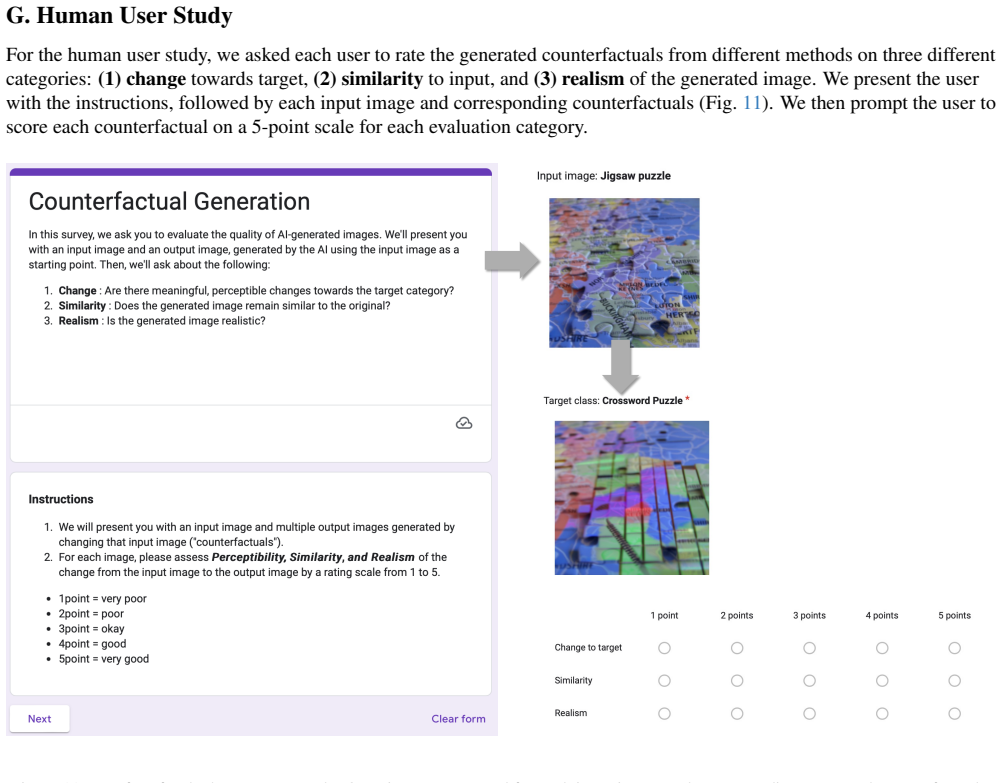
- Counterfactual explanation can be generated without access to classifier weights or adversarial robustness training, and the resulting images are perceived as more semantically changed and more realistic than gradient-based baselines.
- A single gradient estimate now serves both feature attribution and counterfactual generation, so the two XAI pipelines no longer need separate machinery.
- Because the estimated gradient lies on the image manifold, explanations should be more robust to the off-manifold adversarial perturbations that plague vanilla gradients.
- The method also works in the latent space of Stable Diffusion and on chest X-rays with a domain-trained diffusion model, indicating the framework transfers across image domains.
Reading between the lines
- The paper does not explore it, but the same covariance trick may extend beyond images: any black-box function evaluated on on-manifold perturbations could be locally explained in the same way, which would open XAI to API-only models in medicine, finance, or robotics.
- The heavy reliance on a pretrained diffusion model suggests a testable boundary condition: when the diffusion model is trained on a different distribution than the classifier, the 'manifold' it imposes may not be the classifier's decision manifold, so explanations could be systematically biased by the generative prior.
- One reading of the results is that FreeMCG counterfactuals target a human-aligned boundary on the data manifold rather than the classifier's true adversarial boundary, which would reframe what a counterfactual explanation should be optimizing.
- The method's success on a small six-class chest X-ray classifier with a custom diffusion model suggests a practical path for deploying black-box XAI in clinical settings, but this is an extrapolation from the paper's two datasets.
Editorial analysis
A structured set of objections, weighed in public.
Referee Report
Summary. The paper proposes FreeMCG, a black-box explainability method that approximates a classifier's input gradient preconditioned by the empirical covariance of diffusion-denoised image particles. The central derivation combines Tweedie's formula, an ensemble Kalman filter-style covariance estimate, and a Taylor expansion (Theorem 2) to replace the unavailable Jacobian-gradient product C_xx ∇f(x)^T with a derivative-free cross-covariance C_xf computed from classifier outputs only. The same gradient estimate is then applied to two downstream tasks: feature attribution (via a weighted average over denoised particles) and counterfactual explanation (via reverse-diffusion guided sampling). Experiments on ImageNet and MIMIC-CXR compare FreeMCG against DVCE and LDCE for counterfactuals and against gradient-based attributions plus SHAP under ROAD evaluation.
Significance. If the theoretical derivation were solid, FreeMCG would be a valuable unified, derivative-free XAI framework: it would offer a single gradient-like object for both feature attribution and counterfactual explanation without model-weight access, and the empirical results include human-subject evaluation and cross-architecture counterfactual demonstrations. The use of EnKF-style covariance from diffusion particles is a promising idea, and the derivative-free property is practically important. However, the paper's central claim that gFree is a manifold-constrained gradient at the input x is currently supported only by theorems whose assumptions are not met in the operating regime, so the significance is conditional on a substantial revision of either the theory or the experimental protocol.
major comments (1)
minor comments (6)
- [Abstract and title] The abstract contains the typo “Manifold-Contrained”; the title uses “Manifold-Constrained”.
- [Algorithm 3, lines 6–7] Algorithm 3 computes a per-particle probability p^(k) = softmax(f([x_k])) and passes it to FREE MCG, whereas the derivation in Eq. (10) uses a fixed p = p(x). This makes the implemented estimator different from the derived one; the pseudocode should be aligned with the derivation, or a per-particle variant should be derived explicitly.
- [Algorithm 3, line 6] The notation [x_k] is ambiguous; it should presumably be the Tweedie-denoised estimate [x_{0|t}^{(k)}] rather than the noisy particle [x_t^{(k)}].
- [Appendix A, Theorem 2 proof] The theorem statement writes ∇_x f(x), but the proof expands around x̄ and the final line conflates the two centers; this notation should be corrected to avoid ambiguity about which point the Jacobian is evaluated at.
- [Theorem 1] The proof of Theorem 1 is essentially a restatement of the construction: if all particles lie on the manifold, then C_xx b lies in the span of tangent vectors by definition. This should be presented as intuition or a direct consequence, not as a substantive theorem, and the claim that C_xx “contracts” normal components should be quantified for finite sample size.
- [Eq. (8) and Fig. 2] The notation gFree := C_xx ∇_x log p(c|x) is introduced before C_xx is defined; consider reordering or adding a one-line definition. Also, the equation in Fig. 2 appears to omit the argument of ∇f; it should read something like C_xx (∂f/∂x)^T(e_c − p).
Circularity Check
The derivative-free EnKF/Taylor approximation is genuinely independent, but the advertised 'on-manifold' property of FreeMCG is built into the estimator's definition and the on-manifold premise is imported from the authors' own prior work.
-
self definitional
[Section 3.1, Eq. (8) and Theorem 1 (proof in Appendix A)]
"gFree := Cxx∇x log p(c|x) = Cxx(∂f(x)/∂x)^⊤(ec − p(x)), (8) ... Theorem 1. Suppose that M is locally linear at x ... Suppose further, that the particles x(k) ∈ M. Then, gFree approximately lies within M. Precisely, Cxx acts as a linear transformation, expanding along TxM and contracting the vectors normal to TxM."
The proof of Theorem 1 in Appendix A shows Cxx·b = (1/K)Σ_k (x(k)−x̄)((x(k)−x̄)^⊤·b), so gFree is, by its definition in (8), an affine combination of the particle deviations x(k)−x̄. Once the premise 'x(k) ∈ M' is granted, 'gFree approximately lies in M' is a restatement of that premise plus the algebraic form of the estimator. The advertised manifold-constrained character is therefore an input (on-manifold particles) presented as an output theorem, not an independent first-principles result.
-
self citation load bearing
[Section 3.1, immediately after Eq. (11); operating points in Alg. 2 and Appendix E]
"Notice that under our assumption of local linearity, we can use Proposition 2 of [7], which states that Tweedie’s formula [14] is locally an orthogonal projection to the manifold M, satisfying the assumption of Thm. 1."
The premise that makes Theorem 1 applicable—that Tweedie-denoised particles x(k)_{0|t} lie on M—is not established here; it is imported from Proposition 2 of the authors' own prior work [7]. The paper supplies no proof or independent check of that proposition, and the practical operating regime (Alg. 2 draws t up to 700; Alg. 3 uses t′ = 400) is far outside the small-δ local-linearity regime stated in Theorem 2. Thus the central 'on-manifold gradient' claim rests on a load-bearing self-citation whose assumptions are not verified at the points where FreeMCG is actually run.
full rationale
The core derivative-free approximation Cxf ≈ Cxx∇xf(x)^⊤ (Theorem 2) is a genuine Taylor/EnKF result and the XAI benchmarks (ROAD, flip rate, human study) are external, so the paper is not wholly circular. However, the headline 'manifold-constrained' property is partially circular: gFree is defined as a covariance-weighted combination of particles, so its lying on M is a direct consequence of the on-manifold-particle premise, and that premise is supplied by a self-citation to Proposition 2 of [7] rather than by verification in the operating regime. These issues undermine the strength of the central claim but do not reduce the entire derivation to a fit, so a moderate score is appropriate.
Assumptions & free parameters
free parameters (5)
- Diffusion timestep range for feature attribution =
t in [100, 200, 300, 400, 500, 600, 700], or normalized [0.1, 0.7]
- Number of ensemble particles K =
100
- Counterfactual reverse diffusion timestep t' =
400 for ImageNet, 300 for MIMIC-CXR
- Gradient ascent step size alpha =
0.2
- Proximal regularization beta =
0.01 or 0.02, selected per example for the 'most informative' result
assumptions (4)
- domain assumption The data manifold M is locally linear at x and particles x(k) lie on M near x.
- domain assumption The classifier f has uniformly bounded Hessian and all particles are within delta of the mean, so the O(delta^3) Taylor error is small.
- domain assumption Tweedie denoising is locally an orthogonal projection onto the data manifold, as per Proposition 2 of [7].
- domain assumption The diffusion model D_theta accurately estimates E[x0|xt] well enough for particle generation.
Cite this review
Pith. "Pith review of Derivative-Free Diffusion Manifold-Constrained Gradient for Unified XAI." pith.science (2026). https://pith.science/paper/ZSW3VQ5S
@misc{pith2026241115265,
  author       = {Pith},
  title        = {Pith review of: Derivative-Free Diffusion Manifold-Constrained Gradient for Unified XAI},
  year         = {2026},
  howpublished = {\url{https://pith.science/paper/ZSW3VQ5S}},
  note         = {Machine review of arXiv:2411.15265}
}
read the original abstract
Gradient-based methods are a prototypical family of explainability techniques, especially for image-based models. Nonetheless, they have several shortcomings in that they (1) require white-box access to models, (2) are vulnerable to adversarial attacks, and (3) produce attributions that lie off the image manifold, leading to explanations that are not actually faithful to the model and do not align well with human perception. To overcome these challenges, we introduce Derivative-Free Diffusion Manifold-Constrainted Gradients (FreeMCG), a novel method that serves as an improved basis for explainability of a given neural network than the traditional gradient. Specifically, by leveraging ensemble Kalman filters and diffusion models, we derive a derivative-free approximation of the model's gradient projected onto the data manifold, requiring access only to the model's outputs. We demonstrate the effectiveness of FreeMCG by applying it to both counterfactual generation and feature attribution, which have traditionally been treated as distinct tasks. Through comprehensive evaluation on both tasks, counterfactual explanation and feature attribution, we show that our method yields state-of-the-art results while preserving the essential properties expected of XAI tools.
Figures


Figures from the paper (8 more)


Forward citations
Cited by 1 Pith paper
-
Blade: A Derivative-free Bayesian Inversion Method using Diffusion Priors
Blade produces well-calibrated derivative-free Bayesian posterior samples by combining split Gibbs sampling, ensemble statistical linearization, and diffusion priors.
Reference graph
Works this paper leans on
-
[55]
Hongkai Zheng, Wenda Chu, Austin Wang, Nikola Ko- vachki, Ricardo Baptista, and Yisong Yue. Ensemble kalman diffusion guidance: A derivative-free method for inverse problems. arXiv preprint arXiv:2409.20175, 2024. 4, 5, 8 10 Derivative-Free Diffusion Manifold-Constrained Gradient for Unified XAI Supplementary Material A. Proofs Theorem 1. Suppose that M i...
arXiv 2024
-
[1]
Sanity checks for saliency maps
Julius Adebayo, Justin Gilmer, Michael Muelly, Ian Good- fellow, Moritz Hardt, and Been Kim. Sanity checks for saliency maps. Advances in neural information processing systems, 31, 2018. 2
work page 2018
-
[2]
Concrete problems in ai safety
Dario Amodei, Chris Olah, Jacob Steinhardt, Paul Chris- tiano, John Schulman, and Dan Man ´e. Concrete problems in ai safety. arXiv preprint arXiv:1606.06565, 2016. 1
arXiv 2016
-
[3]
Towards better understanding of gradient-based attri- bution methods for deep neural networks, 2018
Marco Ancona, Enea Ceolini, Cengiz ¨Oztireli, and Markus Gross. Towards better understanding of gradient-based attri- bution methods for deep neural networks, 2018. 1
work page 2018
-
[4]
Diffusion visual counterfactual explana- tions, 2022
Maximilian Augustin, Valentyn Boreiko, Francesco Croce, and Matthias Hein. Diffusion visual counterfactual explana- tions, 2022. 1, 2, 3, 6, 7, 8, 5
work page 2022
-
[5]
Katarzyna Borys, Yasmin Alyssa Schmitt, Meike Nauta, Christin Seifert, Nicole Kr ¨amer, Christoph M Friedrich, and Felix Nensa. Explainable ai in medical imaging: An overview for clinical practitioners–beyond saliency-based xai approaches. European journal of radiology, 162:110786,
-
[6]
Haomin Chen, Catalina Gomez, Chien-Ming Huang, and Mathias Unberath. Explainable medical imaging ai needs human-centered design: guidelines and evidence from a sys- tematic review. NPJ digital medicine, 5(1):156, 2022. 1
work page 2022
-
[7]
Improving diffusion models for inverse prob- lems using manifold constraints
Hyungjin Chung, Byeongsu Sim, Dohoon Ryu, and Jong Chul Ye. Improving diffusion models for inverse prob- lems using manifold constraints. In Advances in Neural In- formation Processing Systems, 2022. 3, 5
work page 2022
Show all 55 references
-
[8]
Diffusion pos- terior sampling for general noisy inverse problems
Hyungjin Chung, Jeongsol Kim, Michael Thompson Mc- cann, Marc Louis Klasky, and Jong Chul Ye. Diffusion pos- terior sampling for general noisy inverse problems. In Inter- national Conference on Learning Representations, 2023. 3, 6
2023
-
[9]
De- composed diffusion sampler for accelerating large-scale in- verse problems
Hyungjin Chung, Suhyeon Lee, and Jong Chul Ye. De- composed diffusion sampler for accelerating large-scale in- verse problems. In The Twelfth International Conference on Learning Representations, 2024. 6
2024
-
[10]
Costa, Tiago Roxo, Hugo Proenc ¸a, and Pedro Ri- cardo Morais In ´acio
Joana C. Costa, Tiago Roxo, Hugo Proenc ¸a, and Pedro Ri- cardo Morais In ´acio. How deep learning sees the world: A survey on adversarial attacks; defenses. IEEE Access, 12: 61113–61136, 2024. 7
2024
-
[11]
Imagenet: A large-scale hierarchical image database
Jia Deng, Wei Dong, Richard Socher, Li-Jia Li, Kai Li, and Li Fei-Fei. Imagenet: A large-scale hierarchical image database. In 2009 IEEE conference on computer vision and pattern recognition, pages 248–255. Ieee, 2009. 6
2009
-
[12]
Diffusion models beat GANs on image synthesis
Prafulla Dhariwal and Alexander Quinn Nichol. Diffusion models beat GANs on image synthesis. In Advances in Neu- ral Information Processing Systems, 2021. 3, 6, 8
2021
-
[13]
Gerken, Klaus-Robert M¨uller, and Pan Kessel
Ann-Kathrin Dombrowski, Jan E. Gerken, Klaus-Robert M¨uller, and Pan Kessel. Diffeomorphic counterfactuals with generative models, 2022. 3
2022
-
[14]
Tweedie’s formula and selection bias
Bradley Efron. Tweedie’s formula and selection bias. Jour- nal of the American Statistical Association, 106(496):1602– 1614, 2011. 3, 5
2011
-
[15]
Latent diffusion counterfactual explanations
Karim Farid, Simon Schrodi, Max Argus, and Thomas Brox. Latent diffusion counterfactual explanations. arXiv preprint arXiv:2310.06668, 2023. 6, 7, 8, 5
2023 arXiv
-
[16]
Explaining and harnessing adversarial examples
Ian J Goodfellow, Jonathon Shlens, and Christian Szegedy. Explaining and harnessing adversarial examples. arXiv preprint arXiv:1412.6572, 2014. 3, 7
2014 arXiv
-
[17]
Deep residual learning for image recognition
Kaiming He, Xiangyu Zhang, Shaoqing Ren, and Jian Sun. Deep residual learning for image recognition. In Proceed- ings of the IEEE conference on computer vision and pattern recognition, pages 770–778, 2016. 6, 8
2016
-
[18]
Gans trained by a two time-scale update rule converge to a local nash equilib- rium
Martin Heusel, Hubert Ramsauer, Thomas Unterthiner, Bernhard Nessler, and Sepp Hochreiter. Gans trained by a two time-scale update rule converge to a local nash equilib- rium. Advances in neural information processing systems , 30, 2017. 7
2017
-
[19]
Denoising diffu- sion probabilistic models
Jonathan Ho, Ajay Jain, and Pieter Abbeel. Denoising diffu- sion probabilistic models. Advances in Neural Information Processing Systems, 33:6840–6851, 2020. 3
2020
-
[20]
Explain- ing explanations: Axiomatic feature interactions for deep networks
Joseph D Janizek, Pascal Sturmfels, and Su-In Lee. Explain- ing explanations: Axiomatic feature interactions for deep networks. Journal of Machine Learning Research, 22(104): 1–54, 2021. 3
2021
-
[21]
Diffu- sion models for counterfactual explanations
Guillaume Jeanneret, Lo ¨ıc Simon, and Fr´ed´eric Jurie. Diffu- sion models for counterfactual explanations. In Proceedings of the Asian Conference on Computer Vision , pages 858– 876, 2022. 6
2022
-
[22]
Ad- versarial counterfactual visual explanations, 2023
Guillaume Jeanneret, Lo ¨ıc Simon, and Fr ´ed´eric Jurie. Ad- versarial counterfactual visual explanations, 2023. 1, 3
2023
-
[23]
Mimic-cxr, a de- identified publicly available database of chest radiographs with free-text reports
Alistair EW Johnson, Tom J Pollard, Seth J Berkowitz, Nathaniel R Greenbaum, Matthew P Lungren, Chih-ying Deng, Roger G Mark, and Steven Horng. Mimic-cxr, a de- identified publicly available database of chest radiographs with free-text reports. Scientific data , 6(1):317, 2019. 6, 8
2019
-
[24]
Guided integrated gradients: An adaptive path method for remov- ing noise
Andrei Kapishnikov, Subhashini Venugopalan, Besim Avci, Ben Wedin, Michael Terry, and Tolga Bolukbasi. Guided integrated gradients: An adaptive path method for remov- ing noise. In Proceedings of the IEEE/CVF conference on computer vision and pattern recognition, pages 5050–5058,
-
[25]
Elucidating the design space of diffusion-based generative models
Tero Karras, Miika Aittala, Timo Aila, and Samuli Laine. Elucidating the design space of diffusion-based generative models. In Proc. NeurIPS, 2022. 3
2022
-
[26]
A primer on zeroth-order optimization in signal processing and machine learning: Principals, recent advances, and applications.IEEE Signal Processing Magazine, 37(5):43–54, 2020
Sijia Liu, Pin-Yu Chen, Bhavya Kailkhura, Gaoyuan Zhang, Alfred O Hero III, and Pramod K Varshney. A primer on zeroth-order optimization in signal processing and machine learning: Principals, recent advances, and applications.IEEE Signal Processing Magazine, 37(5):43–54, 2020. 3
2020
-
[27]
A unified approach to interpreting model predictions
Scott M Lundberg and Su-In Lee. A unified approach to interpreting model predictions. Advances in neural informa- tion processing systems, 30, 2017. 1, 7
2017
-
[28]
SDEdit: Image synthesis and editing with stochastic differential equations
Chenlin Meng, Yang Song, Jiaming Song, Jiajun Wu, Jun- Yan Zhu, and Stefano Ermon. SDEdit: Image synthesis and editing with stochastic differential equations. arXiv preprint arXiv:2108.01073, 2021. 5, 6
2021 arXiv
-
[29]
Investigating sat- uration effects in integrated gradients
Vivek Miglani, Narine Kokhlikyan, Bilal Alsallakh, Miguel Martin, and Orion Reblitz-Richardson. Investigating sat- uration effects in integrated gradients. arXiv preprint arXiv:2010.12697, 2020. 3
2010 arXiv
-
[30]
George A. Miller. WordNet: A lexical database for En- glish. In Human Language Technology: Proceedings of a 9 Workshop held at Plainsboro, New Jersey, March 8-11, 1994,
1994
-
[31]
Random gradient- free minimization of convex functions
Yurii Nesterov and Vladimir Spokoiny. Random gradient- free minimization of convex functions. Foundations of Com- putational Mathematics, 17(2):527–566, 2017. 4
2017
-
[32]
Barron, and Ben Milden- hall
Ben Poole, Ajay Jain, Jonathan T. Barron, and Ben Milden- hall. Dreamfusion: Text-to-3d using 2d diffusion. arXiv,
-
[33]
High-resolution image synthesis with latent diffusion models
Robin Rombach, Andreas Blattmann, Dominik Lorenz, Patrick Esser, and Bj ¨orn Ommer. High-resolution image synthesis with latent diffusion models. In Proceedings of the IEEE/CVF Conference on Computer Vision and Pattern Recognition, pages 10684–10695, 2022. 7
2022
-
[34]
A consistent and efficient evaluation strategy for attribution methods
Yao Rong, Tobias Leemann, Vadim Borisov, Gjergji Kas- neci, and Enkelejda Kasneci. A consistent and efficient evaluation strategy for attribution methods. arXiv preprint arXiv:2202.00449, 2022. 7, 8
2022 arXiv
-
[35]
Explainable artificial intelligence: Understand- ing, visualizing and interpreting deep learning models.arXiv preprint arXiv:1708.08296, 2017
W Samek. Explainable artificial intelligence: Understand- ing, visualizing and interpreting deep learning models.arXiv preprint arXiv:1708.08296, 2017. 1
2017 arXiv
-
[36]
Image synthesis with a single (robust) classifier
Shibani Santurkar, Andrew Ilyas, Dimitris Tsipras, Logan Engstrom, Brandon Tran, and Aleksander Madry. Image synthesis with a single (robust) classifier. Advances in Neu- ral Information Processing Systems, 32, 2019. 1, 2
2019
-
[37]
Analysis of the ensemble kalman filter for inverse problems
Claudia Schillings and Andrew M Stuart. Analysis of the ensemble kalman filter for inverse problems. SIAM Journal on Numerical Analysis, 55(3):1264–1290, 2017. 2, 4
2017
-
[38]
Selvaraju, Michael Cogswell, Abhishek Das, Ramakrishna Vedantam, Devi Parikh, and Dhruv Ba- tra
Ramprasaath R. Selvaraju, Michael Cogswell, Abhishek Das, Ramakrishna Vedantam, Devi Parikh, and Dhruv Ba- tra. Grad-cam: Visual explanations from deep networks via gradient-based localization. International Journal of Com- puter Vision, 128(2):336–359, 2019. 1
2019
-
[39]
Not just a black box: Learning important features through propagating activation differences
Avanti Shrikumar, Peyton Greenside, Anna Shcherbina, and Anshul Kundaje. Not just a black box: Learning important features through propagating activation differences. arXiv preprint arXiv:1605.01713, 2016. 2, 7
2016 arXiv
-
[40]
Learning important features through propagating activation differences, 2019
Avanti Shrikumar, Peyton Greenside, and Anshul Kundaje. Learning important features through propagating activation differences, 2019. 1
2019
-
[41]
Diffusion models as data mining tools
Ioannis Siglidis, Aleksander Holynski, Alexei A Efros, Mathieu Aubry, and Shiry Ginosar. Diffusion models as data mining tools. arXiv preprint arXiv:2408.02752, 2024. 5
2024 arXiv
-
[42]
Integrated directional gradients: Feature interaction attribu- tion for neural nlp models
Sandipan Sikdar, Parantapa Bhattacharya, and Kieran Heese. Integrated directional gradients: Feature interaction attribu- tion for neural nlp models. In Proceedings of the 59th An- nual Meeting of the Association for Computational Linguis- tics and the 11th International Joint...
2021
-
[43]
Deep inside convolutional networks: Visualising image classification models and saliency maps
Karen Simonyan, Andrea Vedaldi, and Andrew Zisserman. Deep inside convolutional networks: Visualising image classification models and saliency maps. arXiv preprint arXiv:1312.6034, 2013. 1, 3, 7
2013 arXiv
-
[44]
Denois- ing diffusion implicit models
Jiaming Song, Chenlin Meng, and Stefano Ermon. Denois- ing diffusion implicit models. In 9th International Confer- ence on Learning Representations, ICLR, 2021. 8
2021
-
[45]
Pseudoinverse-guided diffusion models for inverse problems
Jiaming Song, Arash Vahdat, Morteza Mardani, and Jan Kautz. Pseudoinverse-guided diffusion models for inverse problems. In International Conference on Learning Repre- sentations, 2023. 3, 6, 8
2023
-
[46]
Kingma, Ab- hishek Kumar, Stefano Ermon, and Ben Poole
Yang Song, Jascha Sohl-Dickstein, Diederik P. Kingma, Ab- hishek Kumar, Stefano Ermon, and Ben Poole. Score-based generative modeling through stochastic differential equa- tions. In 9th International Conference on Learning Repre- sentations, ICLR, 2021. 3
2021
-
[47]
Striving for simplicity: The all convolutional net, 2015
Jost Tobias Springenberg, Alexey Dosovitskiy, Thomas Brox, and Martin Riedmiller. Striving for simplicity: The all convolutional net, 2015. 1
2015
-
[48]
Visualiz- ing the impact of feature attribution baselines
Pascal Sturmfels, Scott Lundberg, and Su-In Lee. Visualiz- ing the impact of feature attribution baselines. Distill, 5(1): e22, 2020. 3
2020
-
[49]
Axiomatic attribution for deep networks
Mukund Sundararajan, Ankur Taly, and Qiqi Yan. Axiomatic attribution for deep networks. InInternational conference on machine learning, pages 3319–3328. PMLR, 2017. 1, 2, 3
2017
-
[50]
Intriguing properties of neural networks
C Szegedy. Intriguing properties of neural networks. arXiv preprint arXiv:1312.6199, 2013. 2
2013 arXiv
-
[51]
Counter- factual explanations for machine learning: A review
Sahil Verma, John Dickerson, and Keegan Hines. Counter- factual explanations for machine learning: A review. arXiv preprint arXiv:2010.10596, 2:1, 2020. 1
2010 arXiv
-
[52]
Gra- dient based feature attribution in explainable ai: A technical review, 2024
Yongjie Wang, Tong Zhang, Xu Guo, and Zhiqi Shen. Gra- dient based feature attribution in explainable ai: A technical review, 2024. 1
2024
-
[53]
Attribution in scale and space
Shawn Xu, Subhashini Venugopalan, and Mukund Sun- dararajan. Attribution in scale and space. In Proceedings of the IEEE/CVF Conference on Computer Vision and Pattern Recognition, pages 9680–9689, 2020. 3
2020
-
[54]
Visualizing and under- standing convolutional networks, 2013
Matthew D Zeiler and Rob Fergus. Visualizing and under- standing convolutional networks, 2013. 1
2013
Reviewed August 12, 2026 · model on record in the stance chip above.
Discussion (0). Continue with ORCID to comment.