REVIEW 3 major objections 4 minor 26 references
Suppression of hydrodynamic escape of an H2-rich early Earth atmosphere by radiative cooling of carbon oxides
T0 review · 3 major / 4 minor · reviewed 2026-08-12 · deepseek-v4-flash
Pith's one-line read Trace carbon oxides slow hydrogen escape from early Earth tenfold.
desk verdict Trace CO/CO2 suppress H2 escape on Earth-mass planets at surprisingly low mixing ratios, but the headline lifetime extension hinges on the LTE cooling assumption the authors themselves flag. read the letter →
The pith
A machine-rendered reading of the paper's core claim, the machinery that carries it, and where it could break.
The reading
What carries the argument
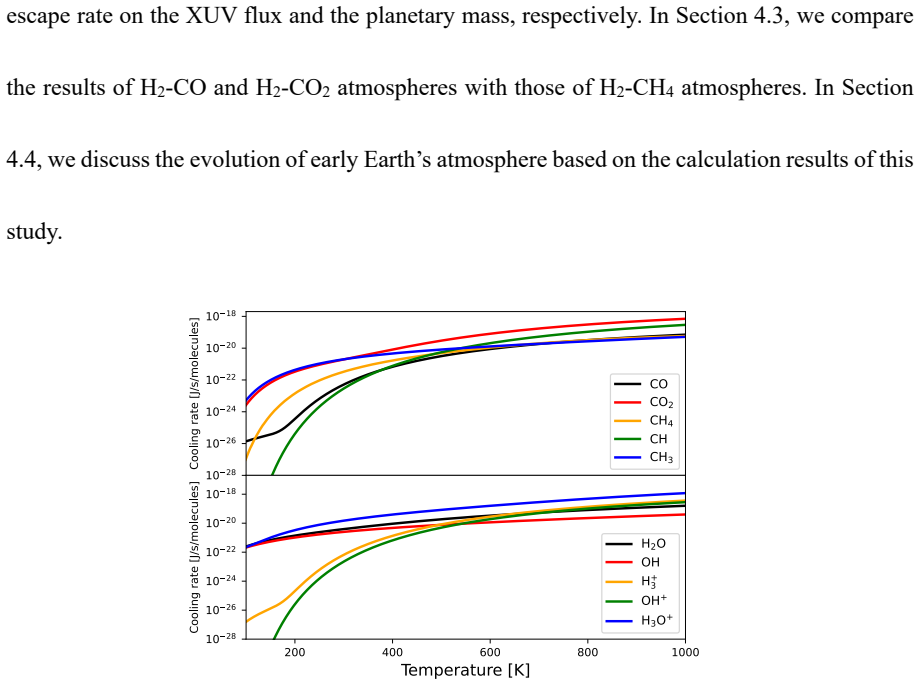
The load-bearing mechanism is a radiative-cooling thermostat in the escape outflow. The model couples 1D multi-fluid hydrodynamic equations to a 287-reaction chemical network for 30 H-C-O species and to line-by-line infrared cooling rates for CO, CO2, H2O, OH, CH4, CH, CH3, H3+, OH+, and H3O+, under a young-Sun XUV spectrum 100 times the present level. In the outflow, $\mathrm{CO_2}$ photolyzes to $\mathrm{CO} + \mathrm{O}$, $\mathrm{O}$ reacts with $\mathrm{H_2}$ to form $\mathrm{OH}$ and $\mathrm{H_2O}$, and these molecules radiate in the 4--15 micron region, while $\mathrm{H_3^+}$ dominates cooling high in the flow. This cooling lowers the heating efficiency $\eta$ (Equation 4) and pinches the H2 escape flux down to the Hunten critical flux (Equation 6), the diffusion-limited value at which H2 can barely drag heavier species out of the gravitational well.
What would settle it
Compute the same 1D escape flows with non-LTE level populations for CO, H2O, OH, and H3+ instead of the LTE cooling rates; if the non-LTE cooling rates in the low-density outer flow are weaker by more than the factor needed to double the escape flux, the predicted saturation at the critical flux and the order-of-magnitude lifetime extension would disappear. A simpler proxy observation is that an H2-rich atmosphere with known CO/H2 near 0.001 that keeps its escape rate rising linearly with stellar XUV flux would indicate the cooling suppression is not operating as modeled.
Extended reading notes
Core claim
The central discovery is a saturation law: once the basal $\mathrm{CO/H_2}$ or $\mathrm{CO_2/H_2}$ ratio exceeds about 0.001, adding more carbon no longer lowers the escape rate, because the H2 flux asymptotes to the Hunten critical flux — the minimum hydrogen flux that can drag a heavier species out of the planet's gravitational well. In the simulations, $\mathrm{CO_2}$ is photolyzed rapidly near the homopause into CO and atomic oxygen, and the oxygen reacts with H2 to form OH and H2O; these products, along with CO and H3+, radiate away most of the energy deposited by stellar X-ray and extreme-UV absorption, dropping the heating efficiency steeply as the carbon mixing ratio rises. The result is an H2 escape rate roughly an order of magnitude lower than in a pure hydrogen atmosphere and negligible escape of CO, CO2, heavier C/N species, and noble gases.
Load-bearing premise
The whole suppression rests on the assumption that the outflowing gas cools at local thermal equilibrium rates, so CO, H2O, OH, and H3+ radiate as efficiently in the low-density outer layers as in the denser thermosphere; if non-LTE effects weaken this cooling, escape speeds up and the lifetime gain shrinks.
Editorial extensions
If this is right
- At basal CO/H2 or CO2/H2 ratios below about 0.001, the H2 escape rate falls steeply as the carbon ratio rises; above about 0.001 it saturates near the critical flux and no further carbon is needed to cap escape.
- An H2-rich atmosphere on early Earth containing CO or CO2 lasts about ten times longer than a pure-H2 atmosphere, exceeding 100 Myr at an initial H2 amount of roughly 200 bar equivalent.
- Under the capped flux, heavier species such as CO, CO2, carbon- and nitrogen-bearing molecules, and noble gases are retained rather than dragged out, so the atmosphere's heavier inventory is largely preserved.
- Radiative cooling still suppresses escape when the young-Sun XUV flux is doubled; the escape flux again asymptotes to the critical flux rather than rising linearly.
Reading between the lines
- The paper models CO and CO2 separately from CH4; if real early atmospheres contained a mix, the escape capping would be controlled by whichever carbon carrier has the largest crossover mass and by the photochemical products it generates, so the lifetime estimate is a lower bound rather than a unique prediction.
- The same cooling mechanism should operate on hydrogen-rich sub-Neptune and mini-Neptune exoplanets with trace carbon oxides, implying that their envelope-loss timescales are set by the diffusion-limited flux rather than by XUV heating alone, which could flatten the expected mass-loss trend with stellar activity.
- Because the paper's cooling rates are LTE while the outer outflow is rarefied, the true early-Earth lifetime likely sits between the pure-H2 and LTE-suppressed estimates; a non-LTE version of these simulations would bracket the survival time.
Editorial analysis
A structured set of objections, weighed in public.
Referee Report
Summary. This paper presents 1D hydrodynamic escape simulations of H2-rich atmospheres containing CO or CO2 on an Earth-mass planet, with a photochemical network and radiative cooling from HITRAN/ExoMol line data. The authors find that CO, H2O, OH, and H3+ cool the outflow sufficiently to reduce the H2 escape rate, which asymptotes to the Hunten critical flux once the basal CO/H2 or CO2/H2 ratio reaches about 0.001. They use these escape rates in a time-evolution model to argue that the lifetime of an H2-rich proto-atmosphere on early Earth is extended by about one order of magnitude compared with a pure H2 atmosphere, with negligible escape of heavier carbon- and nitrogen-bearing species and noble gases.
Significance. If robust, this result is important for early Earth atmospheric evolution and for the evolution of H2-dominated atmospheres on terrestrial exoplanets, as it identifies a relatively low threshold of carbon-oxide contamination that can switch an atmosphere from rapid hydrodynamic escape to diffusion-limited escape. The forward modeling uses standard spectroscopic databases and an existing validated framework, and the numerical asymptotic approach to the Hunten critical flux provides a useful consistency check. The central quantitative lifetime claim is conditional on the LTE cooling assumption, so the paper would be strengthened considerably by a non-LTE sensitivity test; the qualitative suppression mechanism, however, is well supported by the simulations.
major comments (3)
- [Section 2 (radiative cooling; Equation (4))] Section 2 states that LTE is assumed for radiative cooling and that non-LTE effects can reduce cooling efficiency in low-pressure regions, but the paper does not quantify this. Because the energy equation directly uses these cooling rates and the heating efficiency (Equation (4)) is the key control on the escape rate, the order-of-magnitude lifetime extension in Section 4.4 depends on LTE cooling being roughly correct. In particular, H3+ is the main coolant in the upper outflow (Figure 3e,f), where densities are lowest and LTE is most suspect. A quantitative sensitivity test with reduced cooling efficiencies (e.g., a factor of 2 or 5 reduction in H3+ and CO cooling above a certain density) would be needed to show that the qualitative and quantitative conclusions are robust.
- [Section 5 (conclusions) and abstract] The abstract and conclusions claim 'negligible escape of heavier carbon- and nitrogen-bearing species and noble gases.' This goes beyond the simulations, which contain no nitrogen species in the chemical network (Section 2). The conclusion about nitrogen is an extrapolation from the crossover-mass behavior of CO and CO2. Please either remove the nitrogen claim or support it with an explicit crossover-mass argument or a simulation including N-bearing species.
- [Section 4.4 (evolutionary model)] In the evolutionary model, escape rates for basal CO/H2 or CO2/H2 above 0.5 are set to the critical flux for H2 and zero for carbon oxides. The authors state this has little effect when the initial H2 amount exceeds 10 bar, but the range of initial H2 amounts used in Figure 9 is not stated in the main text. Please specify this range and document the sensitivity of the lifetime estimate to the assumed behavior at ratios above 0.5, particularly for initial H2 amounts near or below 10 bar.
minor comments (4)
- [Throughout] Equation (7) is used twice: first for the crossover mass in Section 3 and later for the equivalent surface pressure in Section 4.4; please renumber to avoid ambiguity.
- [Figure 3(e)] The heating rate is described as a 'red dash-dotted line' in the main text and as a 'red solid line' in the figure legend at the end of the paper; please make these descriptions consistent.
- [Abstract and Section 3] The abstract says suppression occurs when the basal mixing fraction of CO and CO2 is 'lower than ~0.01', while Section 3 states the escape rate becomes almost constant above ~0.001; please reconcile these thresholds to avoid confusion.
- [Data availability] The data availability statement says 'no datasets were generated or analysed,' but Figures 2-9 are based on simulation outputs; consider making the model outputs available in a repository to support reproducibility.
Circularity Check
No significant circularity: the escape suppression emerges from a forward simulation with external line data and the Hunten critical-flux theory; self-citations are method reuse, not load-bearing.
full rationale
The paper's central claim, that trace CO/CO2 suppress H2 escape and prolong the H2-rich atmosphere lifetime by about an order of magnitude, is obtained by integrating a 1D hydrodynamic model with heating from an externally specified young-Sun spectrum, cooling rates from HITRAN and ExoMol line data, and a chemical network built from UMIST-based reactions plus the authors' earlier networks. The basal CO/H2 and CO2/H2 ratios are inputs; escape rates, heating efficiencies, and lifetimes are outputs. The asymptotic agreement with the Hunten critical flux is checked against an external analytical formula (Equation 6), not fitted. The lifetime comparison uses the simulated escape-rate curves in Figure 5, and the pure-H2 case is a separate simulation, so the order-of-magnitude extension is a computed difference rather than an identity. Self-citations to Yoshida and Kuramoto (2020, 2021) and Yoshida et al. (2022) establish the model lineage and line-list selection, but the new O-bearing chemistry and CO/CO2 cooling are implemented from external databases and the results are reported as profiles and rates, so those self-citations are method reuse rather than load-bearing justification. The LTE assumption is acknowledged by the authors as a possible source of overestimated cooling in low-pressure regions; that is a modeling uncertainty affecting the quantitative strength of the result, not a circular step. No fitted parameter is renamed as a prediction, and no uniqueness theorem or definitional equivalence forces the conclusion.
Assumptions & free parameters
free parameters (5)
- Basal CO/H2 mixing ratio =
varied from 1e-6 to 1 in simulation runs
- Basal CO2/H2 mixing ratio =
varied from 1e-6 to 1 in simulation runs
- Initial H2 amount in the evolution model =
parameter, from a few to over 200 bar equivalent
- Lower boundary H2 number density =
1e10 m^-3 (inferred from garbled text)
- Lower boundary temperature =
200 K
assumptions (6)
- domain assumption Local thermal equilibrium (LTE) for computing radiative cooling rates of neutral species
- domain assumption Optically thin emission for H3+, OH+, and H3O+
- domain assumption Neglect of molecules with more than one carbon
- domain assumption Solar flux spectrum at 100 Myr from Claire et al. (2012) as the XUV heating input
- standard math Hunten critical flux formula applies as the asymptotic escape limit
- ad hoc to paper In the evolution model, escape rates for basal ratio above 0.5 equal the critical flux
Cite this review
Pith. "Pith review of Suppression of hydrodynamic escape of an H2-rich early Earth atmosphere by radiative cooling of carbon oxides." pith.science (2026). https://pith.science/paper/VSSABPCI
@misc{pith2026241115456,
  author       = {Pith},
  title        = {Pith review of: Suppression of hydrodynamic escape of an H2-rich early Earth atmosphere by radiative cooling of carbon oxides},
  year         = {2026},
  howpublished = {\url{https://pith.science/paper/VSSABPCI}},
  note         = {Machine review of arXiv:2411.15456}
}
read the original abstract
Radiative cooling by molecules is a crucial process for hydrodynamic escape, as it can efficiently remove the thermal energy driving the outflow, acquired through X-ray and extreme UV absorption. Carbon oxides, such as CO and CO2, and their photochemical products are anticipated to serve as vital radiative cooling sources not only in atmospheres dominated by carbon oxides but also in H2-rich atmospheres. However, their specific effects on the hydrodynamic escape, especially in H2-rich atmospheres, have been inadequately investigated. In this study, we conduct 1-D hydrodynamic escape simulations for H2-rich atmospheres incorporating CO, CO2, and their chemical products on an Earth-mass planet. We consider detailed radiative cooling processes and chemical networks related to carbon oxides to elucidate their impacts on the hydrodynamic escape. In the escape outflow, CO2 undergoes rapid photolysis, producing CO and atomic oxygen, while CO exhibits photochemical stability compared to CO2. The H2 oxidation by atomic oxygen results in the production of OH and H2O. Consequently, the hydrodynamic escape is significantly suppressed by the radiative cooling effects of CO, H2O, OH, and H3+ even when the basal mixing fraction of CO and CO2 is lower than ~0.01. These mechanisms extend the lifetime of H2-rich atmospheres by about one order of magnitude compared to the case of pure hydrogen atmospheres on early Earth, which also results in negligible escape of heavier carbon- and nitrogen-bearing molecules and noble gases.
Figures


Figures from the paper (7 more)


Reference graph
Works this paper leans on
-
[1]
Suppression of Hydrodynamic Escape of an H2-rich Early Earth Atmosphere by Radiative Cooling of Carbon Oxides Tatsuya Yoshida1 Corresponding author Email: tatsuya@tohoku.ac.jp Naoki Terada1 Email: teradan@tohoku.ac.jp Kiyoshi Kuramoto2 Email: keikei@ep.sci.hokudai.ac.jp (Institutional addresses) 1 Graduate School of Science, Tohoku University, Sendai, Miy...
work page 2008
-
[4]
Here the heating efficiency, the fraction of absorbed radiative energy partitioned to net atmospheric heating, is given by 𝜂=∫(𝑞&'(−𝑞)*−𝑞+&,)4𝜋𝑟-𝑑𝑟.!."∫𝑞&'(4𝜋𝑟-𝑑𝑟.!." (4) where 𝑟/ and 𝑟0 are the radial distance of the lower boundary and the transonic point, respectively, and 𝑞&'(, 𝑞)*, and 𝑞+&, are the radiative heating rate by X-ray and UV absorption, th...
work page 1987
-
[5]
Radiative cooling rate per molecule under optically thin and LTE conditions as a function of temperature. The upper panel shows the cooling rates of C-bearing species, while the lower panel displays those of H- and O-bearing species, respectively. The net radiative cooling rate of each species is calculated by summing the cooling rate for each energy tran...
work page 2021
-
[6]
This indicates that carbon oxides tend to be retained while H2 escapes, especially when the H2 escape flux approaches the critical flux. The dashed lines in Figure 6 represent fractionation factors derived from the analytical formula expressed by the crossover mass (Hunten et al., 1987): 𝐹3/𝐹6#𝑛3(𝑟/)/𝑛6#(𝑟/)=𝑚8,3−𝑚3𝑚8,3−𝑚6#. (8) The numerical results alig...
work page 1987
-
[9]
Fractionation factor, defined as (𝐹3/𝐹6#)/(𝑛3(𝑟/)/𝑛6#(𝑟/)) (where 𝑖=CO, CO2), as a function of the basal CO/H2 or CO2/H2 ratio. Solid lines represent the numerical results, while dashed lines show the values derived from the analytical formula in Equation (8). The orange lines represent the fractionation factors between H2 and CO in H2-CO atmospheres, and...
work page 2020
-
[10]
The detailed investigation of the dependence on planetary mass is a focus of our future work
Thus, the outflow tends to be more significantly suppressed by radiative cooling on heavier planets as long as molecular coolants are present in the outflow. The detailed investigation of the dependence on planetary mass is a focus of our future work. 4.3 Comparison with H2-CH4 atmospheres This study focuses on the hydrodynamic escape of H2-CO and H2-CO2 ...
work page 2021
-
[11]
For convenience, the atmospheric mass of each species is expressed by the equivalent surface pressure given by 𝑃3=𝑀3𝑔4𝜋𝑅%- (7) where 𝑃3 and 𝑀3 are the equivalent surface pressure and atmospheric mass of species i, respectively. Here we define the lifetime for H2-rich atmosphere as the time for the amount of H2 to reach 0.1 bar equivalent. The lifetimes ob...
work page 2021
-
[13]
(a) Time until the H2 amount falls below 0.1 bar on the H2-CO atmospheres (orange), H2-CO2 atmospheres (red), and pure H2 atmosphere (dashed blue). The lifetime for the pure H2 atmosphere is obtained by dividing the initial H2 amount by the escape rate of pure hydrogen atmosphere. (b) Total loss amounts of CO from H2-CO atmospheres (orange) and CO2 from H...
work page 2022
Show all 26 references
-
[21]
Mumma, M
Astronomy & Astrophysics, 550, A36. Mumma, M. J., & Charnley, S. B. (2011). The chemical composition of comets—emerging taxonomies and natal heritage. Annual Review of Astronomy and Astrophysics, 49, 471-524. Muñoz, A. G. (2007). Formulation of molecular diffusion in planetary...
2011
-
[24]
Journal of Geophysical Research: Planets, 113(E5)
Response of the Earth's thermosphere to extreme solar EUV conditions and the significance of adiabatic cooling. Journal of Geophysical Research: Planets, 113(E5). Tian, F., Kasting, J. F., & Solomon, S. C. (2009). Thermal escape of carbon from the early Martian atmosphere. Geo...
2009
-
[36]
M., & Kockarts, G
31 Banks, P. M., & Kockarts, G. (1973). Aeronomy. Elsevier. Broadley, M. W., Byrne, D. J., Ardoin, L., Almayrac, M. G., Bekaert, D. V ., & Marty, B. (2022). High precision noble gas measurements of hydrothermal quartz reveal variable loss rate of Xe from the Archean atmosphere...
1973
-
[72]
Nakazawa, K., Mizuno, H., Sekiya, M., & Hayashi, C. (1985). Structure of the primordial atmosphere surrounding the early-Earth. Journal of geomagnetism and geoelectricity, 37(8), 781-799. 37 Odert, P., Lammer, H., Erkaev, N. V ., Nikolaou, A., Lichtenegger, H. I., Johnstone, C...
1985
-
[95]
B., Ghosh, D
Deng, J., Du, Z., Karki, B. B., Ghosh, D. B., & Lee, K. K. (2020). A magma ocean origin to divergent redox evolutions of rocky planetary bodies and early atmospheres. Nature communications, 11(1),
2020
-
[100]
The right vertical axis represents the mass flux normalized by the mass of the present-day Earth’s atmosphere: 1 bar = 5.3×10!9 kg. The dashed lines show the critical flux, which are the minimum fluxes of H2 that can drag other heavier species outside the planetary gravitation...
2015
-
[106]
N., Lammer, H., Lichtenegger, H
Kulikov, Y . N., Lammer, H., Lichtenegger, H. I., Penz, T., Breuer, D., Spohn, T., et al. (2007). A comparative study of the influence of the active young Sun on the early atmospheres of Earth, Venus, and Mars. Space Science Reviews, 129, 207-243. Kuramoto, K., & Matsui, T. (1...
2007
-
[137]
D., Shahar, A., & Schlichting, H
Young, E. D., Shahar, A., & Schlichting, H. E. (2023). Earth shaped by primordial H2 atmospheres. Nature, 616(7956), 306-311. Zahnle, K. J., Gacesa, M., & Catling, D. C. (2019). Strange messenger: A new history of hydrogen on Earth, as told by Xenon. Geochimica et Cosmochimica...
2023
-
[166]
Ikoma, M., & Genda, H. (2006). Constraints on the mass of a habitable planet with water of nebular origin. The Astrophysical Journal, 648(1),
2006
-
[169]
Yabe, T., & Aoki, T. (1991). A universal solver for hyperbolic equations by cubic-polynomial interpolation I. One-dimensional solver. Computer physics communications, 66(2-3), 219-232. Yokoyama, T., Nagashima, K., Nakai, I., Young, E. D., Abe, Y ., Aléon, J., ... & Yurimoto, H...
1991
-
[696]
P., Güdel, M., Lammer, H., & Kislyakova, K
33 Johnstone, C. P., Güdel, M., Lammer, H., & Kislyakova, K. G. (2018). Upper atmospheres of terrestrial planets: Carbon dioxide cooling and the Earth’s thermospheric evolution. Astronomy & Astrophysics, 617, A107. Johnstone, C. P., Lammer, H., Kislyakova, K. G., Scherf, M., &...
2018
-
[1049]
F., Liu, H
40 Tian, F., Kasting, J. F., Liu, H. L., & Roble, R. G. (2008). Hydrodynamic planetary thermosphere model:
2008
-
[1999]
Madhusudhan, N., Agúndez, M., Moses, J
Astronomy and Astrophysics Supplement Series, 146(1), 157-168. Madhusudhan, N., Agúndez, M., Moses, J. I., & Hu, Y . (2016). Exoplanetary atmospheres—chemistry, formation conditions, and habitability. Space science reviews, 205, 285-348. Marty, B. (2012). The origins and conce...
2016
-
[2007]
A., & Faure, A
Garcı́a Mun*oz, A., Ramos, A. A., & Faure, A. (2024). NLTE modelling of water-rich exoplanet atmospheres. Cooling and heating rates. Icarus, 415, 116080. 32 Genda, H., & Abe, Y . (2005). Enhanced atmospheric loss on protoplanets at the giant impact phase in the presence of oce...
2024
-
[2010]
and/or gravitational capture of solar nebular gas (e.g., Nakazawa et al., 1985; Ikoma and Genda, 2006). Earth may have lost abundant H2 through hydrodynamic escape induced by strong XUV irradiation from the young Sun to change the atmospheric composition enriched in heavier mo...
1985
-
[2012]
and/or hydrodynamic escape from low-mass proto-planets. Recent analysis of Xe isotopic compositions in Archean sedimentary rocks suggests that the Xe depletion and isotopic fractionation progressed over the first half of Earth’s history (e.g., Pujol et al., 2011; Avice et al.,...
2011
-
[2020]
The escape rate of H2 is a key factor controlling the lifetime and compositional evolution of an H2-rich atmosphere
and the occurrence of hydrodynamic escape has been indicated for gaseous exoplanets close to their parent stars 3 (e.g., Vidal-Madjar et al., 2003; Vidal-Madjar et al., 2004). The escape rate of H2 is a key factor controlling the lifetime and compositional evolution of an H2-r...
2020
-
[2022]
On planets like Earth heavier than Mars, photolysis of C-bearing species should proceed efficiently in their deeper gravitational well (Yoshida and Kuramoto, 2021)
and carbon oxide ices (Mumma and Charnley, 2011). On planets like Earth heavier than Mars, photolysis of C-bearing species should proceed efficiently in their deeper gravitational well (Yoshida and Kuramoto, 2021). In this case, radiatively active photochemical products like H...
2020
Reviewed August 12, 2026 · model on record in the stance chip above.
Discussion (0). Continue with ORCID to comment.