REVIEW 4 major objections 4 minor 93 references
How parameter constraining can influence the mass accretion process of a Black Hole in the Generalized Rastall Gravity Theory ?
T0 review · 4 major / 4 minor · reviewed 2026-08-12 · deepseek-v4-flash
Pith's one-line read This paper claims that in generalized Rastall gravity, a non-singular black hole accretes dark energy from both the CBDRM and CDMMA parameterizations in a way that increases its mass with cosmic time, and that the growth is consistent…
desk verdict The paper derives new accretion mass formulas for two dark energy equations of state in generalized Rastall gravity, but the headline mass-increase claim does not follow because the sign of the accretion rate is controlled by an unconstrained integration constant. read the letter →
The pith
A machine-rendered reading of the paper's core claim, the machinery that carries it, and where it could break.
The reading
What carries the argument
The load-bearing object is the modified energy-momentum conservation law $T^{{mu nu}}$;_{; mu} = ($\lambda$ R)^{, nu} with $\lambda$ = delta/R, which turns the generalized Rastall field equations into Einstein equations with a varying cosmological-constant-like term. From this, the paper derives the accretion rate equation $\dot{M} = 4\pi(\lambda B_0 + B_1)(\rho+p)M^2$, whose sign is fixed by the combination of the Rastall parameter $\lambda$, the geometric factor $B_0 = (4f(r)/r - 2r f''(r))$, and the integration constant B_1. The mass equation (35) is then obtained by integrating this rate using the generalized conservation equation, with the Hubble parameter and energy densities for each dark-energy parameterization inserted. The non-singular black hole metric $f(r) = 1 - C_1/r - \epsilon\delta r^2/3 + \epsilon a b^3/(3r) \exp(-r^3/b^3)$ supplies the geometric factor B_0 and the horizon structure.
What would settle it
Take the paper's fitted parameter values, set B_1 so that lambda B_0 + B_1 is negative, and evaluate Eq. (35); if the predicted black-hole mass then decreases with time, the claimed growth is not a consequence of the constrained parameters alone. Alternatively, recompute Eq. (33) with lambda = delta/R from Eq. (2) rather than a constant and check whether the sign of dM/dt stays positive.
Extended reading notes
Core claim
The central claim is that Eq. (35), the redshift-space mass equation obtained from the generalized Rastall accretion formalism, yields an increasing black-hole mass for both the CBDRM and CDMMA dark-energy parameterizations once the parameters are fixed at their constrained values. For both models, the integrand contains the factor ((lambda B_0 + B_1)(1 - 3 epsilon lambda (1+omega(z))))/(1 - 4 epsilon lambda) times d rho / H(z), and with the constrained dark-energy equation of state giving positive rho+p, the integral over redshift is positive, so M(z) rises from early times to the present. The comparison plots show the same monotonic increase for the standard Lambda-CDM model, and the authors interpret the growth as the signature of dark energy's accelerating influence within generalized Rastall gravity.
Load-bearing premise
The conclusion rests on the unconstrained integration constant B_1 making lambda B_0 + B_1 positive, yet the paper assigns B_1 no value or prior, so the same equations would predict mass loss for a sufficiently negative B_1.
Editorial extensions
If this is right
- Under both dark-energy parameterizations, a non-singular black hole in generalized Rastall gravity gains mass as the Universe expands, so dark-energy accretion acts as a growth mechanism rather than an evaporation mechanism.
- Because the fitted dark-energy models have positive rho+p, the mass growth is tied to the accelerated expansion; the same accretion equation would predict mass loss for phantom-like fluids with rho+p<0.
- The constrained parameter values place both models in the region where the mass integral in Eq. (35) is positive, so the qualitative mass-increase result holds within the reported 1 sigma and 2 sigma credible intervals.
- The comparison with Lambda-CDM shows the same qualitative growth but different rates, implying that dark-energy accretion does not distinguish the models by sign alone but could distinguish them by rate.
- If the result is correct, the growth mechanism could leave an imprint on the late-time mass function of black holes, connecting the accretion process to cosmic acceleration in a directly observable way.
Reading between the lines
- An implication the paper leaves implicit is that the sign of the mass change is controlled by the freely adjustable combination lambda B_0 + B_1; until B_1 is fixed by data, the same formalism can produce either growth or shrinkage for identical dark-energy models.
- A testable extension would be to predict the redshift-dependent mass growth as a correction to the local black-hole mass function; future gravitational-wave or quasar observations could search for the cumulative effect.
- The paper treats lambda as a constant even though Eq. (2) defines it as delta/R; a fully self-consistent extension would couple the accretion rate back to the local Ricci scalar and allow the Rastall parameter to vary through the black hole's environment.
- The same mass-equation machinery could be applied to other non-singular black hole solutions or other dark-energy parameterizations, since the main empirical content is not the sign alone but the predicted growth rate as a function of redshift.
Editorial analysis
A structured set of objections, weighed in public.
Referee Report
Summary. The paper studies mass accretion onto a non-singular black hole in generalized Rastall gravity, using two dynamical dark-energy equation-of-state parameterizations (CBDRM and CDMMA). The authors first constrain the model parameters with MCMC analyses of Cosmic Chronometers, Pantheon+ SNe Ia, and DESI/DES BAO data, then derive a mass-redshift relation from the modified conservation equation and plot the black-hole mass evolution for both parameterizations and for ΛCDM. The central claim, stated in the abstract and repeated in the conclusions, is that accreting either of the two dark-energy parameterizations, with constrained parameters, increases the black-hole mass during cosmic evolution.
Significance. If the central claim were established, the paper would connect observational cosmological constraints to a specific prediction for black-hole mass evolution in a modified gravity theory, which is a potentially interesting cross-area result. The manuscript has some strengths: it uses public observational datasets, employs standard Bayesian tools (polyChord and GetDist), presents explicit posterior tables and statistical model comparisons, and writes the accretion equations in a transparent algebraic form. However, the main physical conclusion is not supported by the presented calculation. The sign of the mass change is controlled by an arbitrary integration constant, and the MCMC priors appear inconsistent with the reported posteriors. Because these issues directly affect the headline prediction, the paper's claim about the 'true nature of dark energy' from accretion is not established.
major comments (4)
- [Section IV, Eqs. (31)-(35)] The sign of the mass accretion rate in Eq. (33), dM/dt = 4π(λB0+B1)(ρ+p)M^2, is proportional to the product (λB0+B1)(ρ+p). The text after Eq. (33) argues that ρ+p>0 implies mass increase, but that conclusion requires λB0+B1>0. The constant B1 is introduced in Eq. (31) as an arbitrary integration constant, and no value, prior, or boundary condition is specified for it anywhere in the paper. In addition, B0 = 4f(r)/r − 2r f''(r) depends on the metric function f(r) in Eq. (26), which contains the unspecified parameters a and b. Therefore the fitted MCMC parameters in Table I do not determine the sign or magnitude of the mass evolution. For the same fitted dark-energy parameters, one can choose B1 < −λB0 and obtain a decreasing mass for identical cosmological input. Consequently, Figures 3-5 and the abstract's claim of mass increase are not consequences of the constrained parameters.
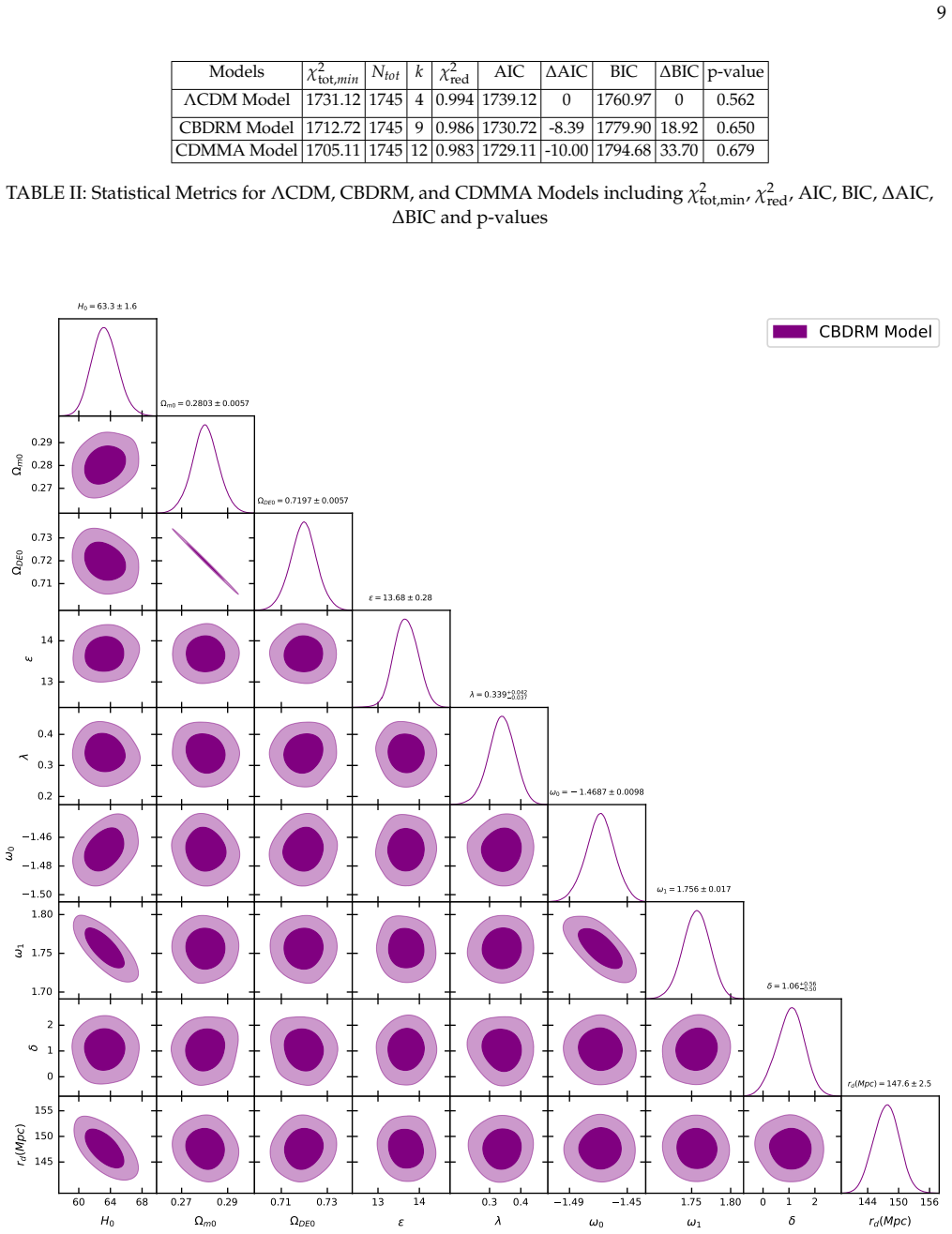
- [Section III, Table I] Table I reports posterior means that lie outside the stated prior ranges: for CBDRM, λ = 0.339 ± 0.037 with prior [0, 0.1], ω1 = 1.756 ± 0.017 with prior [0, 0.1], and δ = 1.059 ± 0.540 with prior [0, 1]; for CDMMA, λ = −0.082 ± 0.004 with prior [0, 0.1]. With bounded uniform priors, a posterior distribution supported outside the prior box is impossible in a correctly implemented nested-sampling or MCMC run. This indicates either misreported priors or an error in the sampling procedure. Since the paper's stated novelty is parameter constraining, this inconsistency directly undermines the reliability of the constraints used in all subsequent accretion plots.
- [Section II, Eq. (2), and Section III, Table I] The generalized Rastall theory is defined with λ = δ/R in Eq. (2), but in Section III the parameters λ and δ are treated as independent free parameters with independent priors and independent posterior means (e.g., for CBDRM, λ = 0.339 ± 0.037 and δ = 1.059 ± 0.540). No constraint enforcing λ = δ/R appears in the analysis. Because λ and δ both enter the Hubble parameter expressions in Eqs. (17) and (21) and the accretion integrand in Eqs. (36) and (38), this internal inconsistency affects the quantitative results and should be resolved before the mass-accretion conclusion can be assessed.
- [Section IV, Eq. (34)] Equation (34), which states (ρ+p) = −[(1−3ϵλ(1+ω(z)))/(3H(1−4ϵλ))] ρdot, is asserted without derivation. It does not follow directly from the generalized conservation law in Eq. (7); one would need additional assumptions relating Hdot, ρ, and ω(z). Since Eq. (35) is obtained by substituting Eq. (34) into Eq. (33), this missing derivation is a load-bearing step for the mass equation and for the plotted mass evolution. The authors should either provide the derivation or state the additional relation used.
minor comments (4)
- [Figures 3 and 4] Each of Figs. 3 and 4 appears to show two identical side-by-side panels. If these are duplicate panels, they should be removed; if they are meant to show different quantities or parameter choices, the panels should be labeled and the difference explained.
- [Figures 3-5] The axes in Figures 3-5 are not clearly labeled with units or normalization. Equation (35) gives M in terms of M0, but the plots show unlabeled values; the authors should state whether the plotted quantity is M/M0 and specify the values used for M0, a, b, and B1.
- [Section IV, paragraph after Eq. (30)] The phrase 'redial temporal component' should be 'radial temporal component'.
- [Abstract and title] The title and abstract contain stylistic and typographical issues, including a missing space before the question mark in the title and several comma splices; a careful language edit is recommended.
Circularity Check
Eq. (33) makes the sign of dM/dt proportional to the unconstrained prefactor (λB0+B1); the paper's mass-increase conclusion is therefore chosen via B1, not derived from the MCMC-constrained dark-energy parameters.
-
other
[Sec. IV, 'Mass accretion in generalized Rastall gravity theory', Eqs. (31), (33) and text following Eq. (33); central claim in Abstract and Conclusions.]
"M˙ = 4π (λB0 + B1)(ρ + p(ρ)) M2. ... Thus, in the phantom-filled Universe (ρ + p < 0), the mass of the black hole will gradually decrease; on the contrary, in the dark energy-filled Universe (ρ + p > 0), that mass will increase progressively. ... B0 = (4 f (r)/r − 2r f''(r)) and B1 being any integration constant whose dimension is the same as energy density."
Eq. (33) makes the sign of dM/dt equal to the sign of (λB0+B1)(ρ+p). The text infers the sign from ρ+p alone, but B1 is introduced as 'any integration constant' with no value, prior, or boundary condition, and B0 depends on the metric constants a and b from Eq. (26), also unassigned and unconstrained by the MCMC analysis. Therefore, with the same fitted CBDRM/CDMMA parameters and ρ+p>0, choosing λB0+B1<0 (e.g., a sufficiently negative B1) makes M decrease. The claimed mass increase is thus not a consequence of the constrained dark-energy parameterizations; it is an input encoded in the unconstrained prefactor. Figures 3-5 do not demonstrate the headline as a prediction.
full rationale
I find one load-bearing underdetermination that functions as circularity: the central 'mass increase' prediction is not a consequence of the MCMC-constrained EOS parameters, because Eq. (33) multiplies ρ+p by (λB0+B1), and B1 (plus a,b entering B0) is completely unconstrained. The paper's inference from ρ+p>0 to mass increase is exactly the step that is invalid without a sign choice for the prefactor; the result reduces to that arbitrary choice. Self-cited CBDRM/CDMMA parameterizations are adopted model inputs rather than derived outputs, so citing refs [19,20,52] is not by itself circular. The Visser equivalence [57] is independent support. Additional internal inconsistencies reinforce the concern but are not circularity: Table I reports posterior means outside the stated priors (CBDRM lambda=0.339±0.037 with prior [0,0.1] and omega1=1.756±0.017 with prior [0,0.1]; CDMMA lambda=-0.082±0.004 with prior [0,0.1]), and lambda and delta are fit independently despite Eq. (2) defining lambda=delta/R. Because the manuscript's headline claim is underdetermined by its fitted inputs and can be reversed by the arbitrary prefactor, the circularity score is 6.
Assumptions & free parameters
free parameters (22)
- H0 (CBDRM) =
63.282 ± 1.623
- H0 (CDMMA) =
65.032 ± 1.460
- Omega_m0 (CBDRM) =
0.280 ± 0.005
- Omega_m0 (CDMMA) =
0.279 ± 0.006
- Omega_DE0 (CBDRM) =
0.720 ± 0.005
- Omega_DE0 (CDMMA) =
0.721 ± 0.006
- epsilon (CBDRM) =
13.678 ± 0.273
- epsilon (CDMMA) =
14.614 ± 0.175
- lambda (CBDRM) =
0.339 ± 0.037 (prior [0, 0.1])
- lambda (CDMMA) =
-0.082 ± 0.004 (prior [0, 0.1])
- delta (CBDRM) =
1.059 ± 0.540 (prior [0, 1])
- delta (CDMMA) =
0.622 ± 0.026
- omega0 (CBDRM) =
-1.469 ± 0.099
- omega1 (CBDRM) =
1.756 ± 0.017
- omega0 (CDMMA) =
-1.451 ± 0.008
- omega1 (CDMMA) =
0.033 ± 0.003
- omega2 (CDMMA) =
0.916 ± 0.006
- alpha (CDMMA) =
0.068 ± 0.007
- beta (CDMMA) =
0.851 ± 0.093
- B1 =
not stated
- a =
not stated
- b =
not stated
assumptions (6)
- standard math Bianchi identity and standard FLRW kinematics
- domain assumption Generalized Rastall field equations Eq (3) and the modified conservation law Eq (1) are the correct gravitational theory
- domain assumption The Universe is spatially flat, isotropic, homogeneous and filled with a barotropic perfect fluid of dark matter plus dark energy
- domain assumption The same parameters epsilon, delta, lambda constrained by cosmological data are valid for the local black hole accretion problem
- ad hoc to paper The sign and magnitude of (lambda B0 + B1) allow a positive mass accretion rate for dark energy
- domain assumption The non-singular black hole solution Eq (26) with constraints Eqs (28)-(29) is taken from ref [47] without re-derivation
Cite this review
Pith. "Pith review of How parameter constraining can influence the mass accretion process of a Black Hole in the Generalized Rastall Gravity Theory ?." pith.science (2026). https://pith.science/paper/5MFXQAFE
@misc{pith2026241115619,
  author       = {Pith},
  title        = {Pith review of: How parameter constraining can influence the mass accretion process of a Black Hole in the Generalized Rastall Gravity Theory ?},
  year         = {2026},
  howpublished = {\url{https://pith.science/paper/5MFXQAFE}},
  note         = {Machine review of arXiv:2411.15619}
}
abstract
Black holes, one of the greatest enigmas of our Universe, are challenging to decipher. This work is dedicated to observing the changes in the mass of a non-singular black hole with the evolution of the Universe in the generalized Rastall gravity framework, considering the effects of parameter constraining. We examine two recently developed dynamical dark-energy equation of state parameterization models: Chaudhary-Bouali-Debnath-Roy-Mustafa-type~(CBDRM)~parameterization and Chaudhary-Debnath-Mustafa-Maurya-Atamurotov-type~(CDMMA)~parameterization. Starting with the concept and fundamental equations of the generalized Rastall gravity theory, we introduce the two models along with their equations of state, energy density equations, and corresponding Hubble parameter equations. We then constrain the required parameters using Monte Carlo Markov chain (MCMC) analyses to ensure the accuracy and reliability of our study. Next, we discuss the non-singular black holes from the perspective of generalized Rastall gravity theory and some of their essential properties. Finally, we pursue the primary goal of our work: analyzing the mass accretion process. We derive the mass equation for both models in terms of the redshift function, represent the results graphically, and compare them with the standard $\Lambda$CDM model of the Universe. Our findings indicate that the accretion of both CBDRM~and~CDMMA dark energy parameterizations, considering constrained parameter values, leads to an increase in the mass of the black hole during the Universe's evolution within the generalized Rastall gravity theory, revealing the true nature of dark energy.
Figures


Figures from the paper (1 more)

Reference graph
Works this paper leans on
-
[1]
Furthermore, by the positive value of C1 and the weak energy condition, we can ensure pos- itivity for both the unknown constant a and b
If we take some particular values for C1 and ϵ as fol- lows: C1 = b3 3ϵa and ϵ = ± 1 a, (28) Then, the Riemann and Weyl squares also comply with the above solution. Furthermore, by the positive value of C1 and the weak energy condition, we can ensure pos- itivity for both the unknown constant a and b. As en- tropy is always positive, by the relation S = 2...
-
[2]
S. Perlmutter, G. Aldering, S. Deustua, S. Fabbro, G. Gold- haber, D. E. Groom, A. Kim, M. Kim, R. Knop, P . Nugent, et al., Cosmology from type Ia supernovae, arXiv preprint astro-ph/9812473 (1998)
arXiv 1998
-
[3]
N. A. Bahcall, J. P . Ostriker, S. Perlmutter, P . J. Steinhardt, The cosmic triangle: Revealing the state of the universe, science 284 (5419) (1999) 1481–1488
1999
-
[4]
A. V . Filippenko, A. G. Riess, Results from the high-z su- pernova search team, Physics Reports 307 (1-4) (1998) 31– 44
1998
-
[5]
Verde, A
L. Verde, A. F. Heavens, W. J. Percival, S. Matarrese, C. M. Baugh, J. Bland-Hawthorn, T. Bridges, R. Cannon, S. Cole, M. Colless, et al., The 2dF Galaxy Redshift Survey: the bias of galaxies and the density of the Universe, Monthly Notices of the Royal Astronomical Society 335 (2) (2002) 432–440
2002
-
[6]
Padmanabhan, Cosmological constant—the weight of the vacuum, Physics reports 380 (5-6) (2003) 235–320
T. Padmanabhan, Cosmological constant—the weight of the vacuum, Physics reports 380 (5-6) (2003) 235–320
2003
-
[7]
S. M. Carroll, W. H. Press, E. L. Turner, The cosmologi- cal constant, In: Annual review of astronomy and astro- physics. Vol. 30 (A93-25826 09-90), p. 499-542. 30 (1992) 499–542
1992
-
[8]
Peebles, B
P . Peebles, B. Ratra, Cosmology with a time-variable cos- mological’constant’, Astrophysical Journal, Part 2-Letters to the Editor (ISSN 0004-637X), vol. 325, Feb. 15, 1988, p. L17-L20. NSF-supported research. 325 (1988) L17–L20
1988
Show all 93 references
-
[9]
R. R. Caldwell, A phantom menace? Cosmological conse- quences of a dark energy component with super-negative equation of state, Physics Letters B 545 (1-2) (2002) 23–29
2002
-
[10]
Armendariz-Picon, V
C. Armendariz-Picon, V . Mukhanov, P . J. Steinhardt, Dy- namical solution to the problem of a small cosmological constant and late-time cosmic acceleration, Physical Re- view Letters 85 (21) (2000) 4438
2000
-
[11]
Gasperini, F
M. Gasperini, F. Piazza, G. Veneziano, Quintessence as a runaway dilaton, Physical Review D 65 (2) (2001) 023508
2001
-
[12]
Sen, Rolling tachyon, Journal of High Energy Physics 2002 (04) (2002) 048
A. Sen, Rolling tachyon, Journal of High Energy Physics 2002 (04) (2002) 048
2002
-
[13]
Wei, R.-G
H. Wei, R.-G. Cai, D.-F. Zeng, Hessence: a new view of quintom dark energy, Classical and Quantum Gravity 22 (16) (2005) 3189
2005
-
[14]
Martin, M
J. Martin, M. Yamaguchi, DBI-essence, Physical Review D—Particles, Fields, Gravitation, and Cosmology 77 (12) (2008) 123508
2008
-
[15]
Li, A model of holographic dark energy, Physics Let- ters B 603 (1-2) (2004) 1–5
M. Li, A model of holographic dark energy, Physics Let- ters B 603 (1-2) (2004) 1–5
2004
-
[16]
Cai, A dark energy model characterized by the age of the universe, Physics Letters B 657 (4-5) (2007) 228–231
R.-G. Cai, A dark energy model characterized by the age of the universe, Physics Letters B 657 (4-5) (2007) 228–231
2007
-
[17]
Hao, et al., Cosmological constraints on new age- graphic dark energy, Physics Letters
W. Hao, et al., Cosmological constraints on new age- graphic dark energy, Physics Letters. Section B 663 (2008)
2008
-
[18]
Sardar, T
A. Sardar, T. Roy, U. Debnath, Cosmography for vari- ous parametrizations of dark energy equation of state, International Journal of Geometric Methods in Modern Physics 21 (02) (2024) 2450051
2024
-
[19]
Debnath, H
U. Debnath, H. Chaudhary, N. U. Molla, S. Pacif, G. Mustafa, Dark Energy Model in Einstein and Horava- Lifshitz Gravity with a new Parametrization of ω(z): Model Comparison, Analysis and Observational Con- straint, arXiv preprint arXiv:2405.15874 (2024)
2024 arXiv
-
[20]
Khurana, H
M. Khurana, H. Chaudhary, U. Debnath, A. Sardar, G. Mustafa, Exploring Late-Time Cosmic Acceleration with Eos Parameterizations in Horava-Lifshitz Gravity via Baryon Acoustic Oscillations, Fortschritte der Physik 72 (2) (2024) 2300238
2024
-
[21]
Chaudhary, U
H. Chaudhary, U. Debnath, S. Maurya, G. Mustafa, F. Atamurotov, Addressing the rd Tension using Late- Time Observational Measurements in a Novel deceler- ation Parametrization, Journal of High Energy Astro- physics (2024)
2024
-
[22]
Bondi, On spherically symmetrical accretion, Monthly Notices of the Royal Astronomical Society 112 (2) (1952) 195–204
H. Bondi, On spherically symmetrical accretion, Monthly Notices of the Royal Astronomical Society 112 (2) (1952) 195–204
1952
-
[23]
F. C. Michel, Accretion of matter by condensed objects, Astrophysics and Space Science 15 (1972) 153–160
1972
-
[24]
Babichev, V
E. Babichev, V . Dokuchaev, Y. Eroshenko, Black hole mass decreasing due to phantom energy accretion, Physical Re- view Letters 93 (2) (2004) 021102
2004
-
[25]
Babichev, V
E. Babichev, V . Dokuchaev, Y. N. Eroshenko, The accretion of dark energy onto a black hole, Journal of Experimental and Theoretical Physics 100 (2005) 528–538
2005
-
[26]
Jamil, Evolution of a Schwarzschild black hole in phantom-like Chaplygin gas cosmologies, The European Physical Journal C 62 (2009) 609–614
M. Jamil, Evolution of a Schwarzschild black hole in phantom-like Chaplygin gas cosmologies, The European Physical Journal C 62 (2009) 609–614
2009
-
[27]
Sharif, G
M. Sharif, G. Abbas, Phantom energy accretion by a stringy charged black hole, Chinese Physics Letters 29 (1) 16 (2012) 010401
2012
-
[28]
Debnath, Accretion and evaporation of modified Hay- ward black hole, The European Physical Journal C 75 (3) (2015) 129
U. Debnath, Accretion and evaporation of modified Hay- ward black hole, The European Physical Journal C 75 (3) (2015) 129
2015
-
[29]
Mukherjee, U
P . Mukherjee, U. Debnath, A. Pradhan, Accretion of modi- fied Chaplygin–Jacobi gas and modified Chaplygin–Abel gas onto Schwarzschild black hole., International Journal of Geometric Methods in Modern Physics 20 (12) (2023)
2023
-
[30]
Dutta, R
S. Dutta, R. Biswas, Dark Energy Accretion onto Van der Waal’s Black Hole, Communications in Theoretical Physics 71 (2) (2019) 209
2019
-
[31]
Debnath, Accretions of dark matter and dark energy onto (n+ 2)-dimensional Schwarzschild black hole and Morris-Thorne wormhole, Astrophysics and Space Sci- ence 360 (2) (2015) 40
U. Debnath, Accretions of dark matter and dark energy onto (n+ 2)-dimensional Schwarzschild black hole and Morris-Thorne wormhole, Astrophysics and Space Sci- ence 360 (2) (2015) 40
2015
-
[32]
Abbas, R
G. Abbas, R. Ramzan, Thermodynamics of Phan- tom Energy Accreting onto a Black Hole in Ein- stein—Power—Maxwell Gravity, Chinese Physics Letters 30 (10) (2013) 100403
2013
-
[33]
Dwivedee, B
D. Dwivedee, B. Nayak, M. Jamil, L. P . Singh, R. Myrza- kulov, Evolution of primordial black holes in loop quan- tum cosmology, Journal of Astrophysics and Astronomy 35 (2014) 97–106
2014
-
[34]
Mukherjee, U
P . Mukherjee, U. Debnath, A. Pradhan, Accretion Phe- nomena of Different Kinds of Chaplygin Gas Models onto Kehagias-Sfetsos Black Hole in Horava-Lifshitz Gravity Scenario (2024). arXiv:2410.20367. URL https://arxiv.org/abs/2410.20367
2024 arXiv
-
[35]
Rastall, Generalization of the Einstein theory, Physical Review D 6 (12) (1972) 3357
P . Rastall, Generalization of the Einstein theory, Physical Review D 6 (12) (1972) 3357
1972
-
[36]
Darabi, K
F. Darabi, K. Atazadeh, Y. Heydarzade, Einstein static universe in the Rastall theory of gravity, The European Physical Journal Plus 133 (7) (2018) 249
2018
-
[37]
Heydarzade, F
Y. Heydarzade, F. Darabi, Black hole solutions sur- rounded by perfect fluid in Rastall theory, Physics Letters B 771 (2017) 365–373
2017
-
[38]
I. P . Lobo, H. Moradpour, J. Morais Grac ¸a, I. Salako, Ther- modynamics of black holes in Rastall gravity, Interna- tional Journal of Modern Physics D 27 (07) (2018) 1850069
2018
-
[39]
Kumar, S
R. Kumar, S. G. Ghosh, Rotating black hole in Rastall the- ory, The European Physical Journal C 78 (2018) 1–13
2018
-
[40]
Mondal, U
D. Mondal, U. Debnath, Thermodynamics of Power– Maxwell charged AdS black holes with quintessence in Rastall gravity: Heat engine, International Journal of Modern Physics A 37 (10) (2022) 2250058
2022
-
[41]
Capone, V
M. Capone, V . F. Cardone, M. L. Ruggiero, Accel- erating cosmology in Rastall’s theory, arXiv preprint arXiv:0906.4139 (2009)
2009 arXiv
-
[42]
Batista, J
C. Batista, J. Fabris, M. H. Daouda, Testing the Rastall’s theory using matter power spectrum, arXiv preprint arXiv:1004.4603 (2010)
2010 arXiv
-
[43]
Moradpour, Y
H. Moradpour, Y. Heydarzade, F. Darabi, I. G. Salako, A generalization to the Rastall theory and cosmic eras, The European Physical Journal C 77 (2017) 1–9
2017
-
[44]
Lin, W.-L
K. Lin, W.-L. Qian, Cosmic evolution of dark energy in a generalized Rastall gravity, The European Physical Jour- nal C 80 (6) (2020) 1–8
2020
-
[45]
Ziaie, H
A. Ziaie, H. Moradpour, H. Shabani, Structure forma- tion in generalized Rastall gravity, The European Phys- ical Journal Plus 135 (11) (2020) 916
2020
-
[46]
D. Das, S. Dutta, S. Chakraborty, Cosmological conse- quences in the framework of generalized Rastall theory of gravity, The European Physical Journal C 78 (2018) 1– 8
2018
-
[47]
C. E. Mota, L. C. Santos, F. M. da Silva, G. Grams, I. P . Lobo, D. P . Menezes, Generalized Rastall’s gravity and its effects on compact objects, International Journal of Mod- ern Physics D 31 (04) (2022) 2250023
2022
-
[48]
Moradpour, Y
H. Moradpour, Y. Heydarzade, C. Corda, A. Ziaie, S. Ghaffari, Black hole solutions and Euler equation in Rastall and generalized Rastall theories of gravity, Mod- ern Physics Letters A 34 (37) (2019) 1950304
2019
-
[49]
Lin, W.-L
K. Lin, W.-L. Qian, Neutral regular black hole solution in generalized Rastall gravity, Chinese Physics C 43 (8) (2019) 083106
2019
-
[50]
J. Lu, L. Xu, J. Li, B. Chang, Y. Gui, H. Liu, Constraints on modified Chaplygin gas from recent observations and a comparison of its status with other models, Physics Let- ters B 662 (2) (2008) 87–91
2008
-
[51]
L. Xu, Y. Wang, H. Noh, Modified Chaplygin gas as a unified dark matter and dark energy model and cosmic constraints, The European Physical Journal C 72 (3) (2012) 1931
2012
-
[52]
Mukherjee, U
P . Mukherjee, U. Debnath, H. Chaudhary, G. Mustafa, Constraining the parameters of generalized and viscous modified Chaplygin gas and black hole accretion in Einstein-Aether gravity, The European Physical Journal C 84 (9) (2024) 930
2024
-
[53]
Chaudhary, A
H. Chaudhary, A. Bouali, U. Debnath, T. Roy, G. Mustafa, Constraints on the parameterized deceleration parameter in FRW universe, Physica Scripta 98 (9) (2023) 095006
2023
-
[54]
Majern´ık, Cosmological Model with Ω M-Dependent Cosmological Constant, General Relativity and Gravita- tion 35 (2003) 1007–1016
V . Majern´ık, Cosmological Model with Ω M-Dependent Cosmological Constant, General Relativity and Gravita- tion 35 (2003) 1007–1016
2003
-
[55]
A. I. Arbab, Cosmological consequences of a built-in cos- mological constant model, Journal of Cosmology and As- troparticle Physics 2003 (05) (2003) 008
2003
-
[56]
Singh, K
A. Singh, K. C. Mishra, Aspects of some Rastall cosmolo- gies, The European Physical Journal Plus 135 (2020) 1–18
2020
-
[57]
C. E. Batista, M. H. Daouda, J. C. Fabris, O. F. Piat- tella, D. C. Rodrigues, Rastall cosmology and the Λ CDM model, Physical Review D—Particles, Fields, Gravitation, and Cosmology 85 (8) (2012) 084008
2012
-
[58]
Visser, Rastall gravity is equivalent to Einstein gravity, Physics Letters B 782 (2018) 83–86
M. Visser, Rastall gravity is equivalent to Einstein gravity, Physics Letters B 782 (2018) 83–86
2018
-
[59]
Jimenez, L
R. Jimenez, L. Verde, T. Treu, D. Stern, Constraints on the equation of state of dark energy and the hubble constant from stellar ages and the cosmic microwave background, The Astrophysical Journal 593 (2) (2003) 622
2003
-
[60]
Simon, L
J. Simon, L. Verde, R. Jimenez, Constraints on the red- shift dependence of the dark energy potential, Physical Review D—Particles, Fields, Gravitation, and Cosmology 71 (12) (2005) 123001. 17
2005
-
[61]
Stern, R
D. Stern, R. Jimenez, L. Verde, M. Kamionkowski, S. A. Stanford, Cosmic chronometers: constraining the equa- tion of state of dark energy. i: H (z) measurements, Jour- nal of Cosmology and Astroparticle Physics 2010 (02) (2010) 008
2010
-
[62]
Moresco, L
M. Moresco, L. Verde, L. Pozzetti, R. Jimenez, A. Cimatti, New constraints on cosmological parameters and neu- trino properties using the expansion rate of the universe to z 1.75, Journal of Cosmology and Astroparticle Physics 2012 (07) (2012) 053
2012
-
[63]
Zhang, H
C. Zhang, H. Zhang, S. Yuan, S. Liu, T.-J. Zhang, Y.-C. Sun, Four new observational h (z) data from luminous red galaxies in the sloan digital sky survey data release seven, Research in Astronomy and Astrophysics 14 (10) (2014) 1221
2014
-
[64]
Moresco, L
M. Moresco, L. Pozzetti, A. Cimatti, R. Jimenez, C. Maras- ton, L. Verde, D. Thomas, A. Citro, R. Tojeiro, D. Wilkin- son, A 6% measurement of the hubble parameter at z 0.45: direct evidence of the epoch of cosmic re- acceleration, Journal of Cosmology and Astroparticle Physic...
2016
-
[65]
Ratsimbazafy, S
A. Ratsimbazafy, S. Loubser, S. Crawford, C. Cress, B. Bas- sett, R. Nichol, P . V ¨ais¨anen, Age-dating luminous red galaxies observed with the southern african large tele- scope, Monthly Notices of the Royal Astronomical Soci- ety 467 (3) (2017) 3239–3254
2017
-
[66]
Jimenez, A
R. Jimenez, A. Loeb, Constraining cosmological param- eters based on relative galaxy ages, The Astrophysical Journal 573 (1) (2002) 37
2002
-
[67]
Vagnozzi, A
S. Vagnozzi, A. Loeb, M. Moresco, Eppur `e piatto? the cosmic chronometers take on spatial curvature and cos- mic concordance, The Astrophysical Journal 908 (1) (2021) 84
2021
-
[68]
Brout, D
D. Brout, D. Scolnic, B. Popovic, A. G. Riess, A. Carr, J. Zuntz, R. Kessler, T. M. Davis, S. Hinton, D. Jones, et al., The pantheon+ analysis: cosmological constraints, The Astrophysical Journal 938 (2) (2022) 110
2022
-
[69]
Escobal, J
A. Escobal, J. Jesus, S. Pereira, Cosmological constraints on scalar field dark matter, International Journal of Mod- ern Physics D 30 (15) (2021) 2150108
2021
-
[70]
Adame, J
A. Adame, J. Aguilar, S. Ahlen, S. Alam, D. Alexander, M. Alvarez, O. Alves, A. Anand, U. Andrade, E. Armen- gaud, et al., Desi 2024 vi: Cosmological constraints from the measurements of baryon acoustic oscillations, arXiv preprint arXiv:2404.03002 (2024)
2024 arXiv
-
[71]
Abbott, M
T. Abbott, M. Adamow, M. Aguena, S. Allam, O. Alves, A. Amon, F. Andrade-Oliveira, J. Asorey, S. Avila, D. Ba- con, et al., Dark energy survey: A 2.1% measurement of the angular baryonic acoustic oscillation scale at redshift z eff= 0.85 from the final dataset, Physical Review...
2024
-
[72]
Collaboration, N
P . Collaboration, N. Aghanim, Y. Akrami, M. Ashdown, J. Aumont, C. Baccigalupi, M. Ballardini, A. Banday, R. Barreiro, N. Bartolo, et al., Planck 2018 results. vi. cos- mological parameters (2020)
2020
-
[73]
Pogosian, G.-B
L. Pogosian, G.-B. Zhao, K. Jedamzik, Recombination- independent determination of the sound horizon and the hubble constant from bao, The Astrophysical Journal Let- ters 904 (2) (2020) L17
2020
-
[74]
Jedamzik, L
K. Jedamzik, L. Pogosian, G.-B. Zhao, Why reducing the cosmic sound horizon alone can not fully resolve the hub- ble tension, Communications Physics 4 (1) (2021) 123
2021
-
[75]
Pogosian, G.-B
L. Pogosian, G.-B. Zhao, K. Jedamzik, A consistency test of the cosmological model at the epoch of recombination using desi bao and planck measurements, arXiv preprint arXiv:2405.20306 (2024)
2024 arXiv
-
[76]
W. Lin, X. Chen, K. J. Mack, Early-universe-physics in- sensitive and uncalibrated cosmic standards: Constraints on ωm and implications for the hubble tension, arXiv preprint arXiv:2102.05701 (2021)
2021 arXiv
-
[77]
Vagnozzi, Seven hints that early-time new physics alone is not sufficient to solve the hubble tension, Uni- verse 9 (9) (2023) 393
S. Vagnozzi, Seven hints that early-time new physics alone is not sufficient to solve the hubble tension, Uni- verse 9 (9) (2023) 393
2023
-
[78]
Handley, M
W. Handley, M. Hobson, A. Lasenby, Polychord: nested sampling for cosmology, Monthly Notices of the Royal Astronomical Society: Letters 450 (1) (2015) L61–L65
2015
-
[79]
Lewis, Getdist: a python package for analysing monte carlo samples, arXiv preprint arXiv:1910.13970 (2019)
A. Lewis, Getdist: a python package for analysing monte carlo samples, arXiv preprint arXiv:1910.13970 (2019)
2019 arXiv
-
[80]
Andrae, T
R. Andrae, T. Schulze-Hartung, P . Melchior, Dos and don’ts of reduced chi-squared, arXiv preprint arXiv:1012.3754 (2010)
2010 arXiv
-
[81]
Kuha, Aic and bic: Comparisons of assumptions and performance, Sociological methods & research 33 (2) (2004) 188–229
J. Kuha, Aic and bic: Comparisons of assumptions and performance, Sociological methods & research 33 (2) (2004) 188–229
2004
-
[82]
A. R. Liddle, Information criteria for astrophysical model selection, Monthly Notices of the Royal Astronomical So- ciety: Letters 377 (1) (2007) L74–L78
2007
-
[83]
Akaike, A new look at the statistical model identifica- tion, IEEE transactions on automatic control 19 (6) (1974) 716–723
H. Akaike, A new look at the statistical model identifica- tion, IEEE transactions on automatic control 19 (6) (1974) 716–723
1974
-
[84]
K. P . Burnham, D. R. Anderson, Multimodel inference: understanding aic and bic in model selection, Sociologi- cal methods & research 33 (2) (2004) 261–304
2004
-
[85]
Schwarz, Estimating the dimension of a model, The annals of statistics (1978) 461–464
G. Schwarz, Estimating the dimension of a model, The annals of statistics (1978) 461–464
1978
-
[86]
Jeffreys, The theory of probability, OuP Oxford, 1998
H. Jeffreys, The theory of probability, OuP Oxford, 1998
1998
-
[87]
R. L. Wasserstein, N. A. Lazar, The asa statement on p- values: context, process, and purpose (2016)
2016
-
[88]
A. D. Sakharov, The initial stage of an expanding universe and the appearance of a nonuniform distribution of mat- ter, Sov. Phys. JETP 22 (1966) 241
1966
-
[89]
E. B. Gliner, Algebraic properties of the energy- momentum tensor and vacuum-like states o+ matter, So- viet Journal of Experimental and Theoretical Physics 22 (1966) 378
1966
-
[90]
Dymnikova, Vacuum nonsingular black hole, General relativity and gravitation 24 (1992) 235–242
I. Dymnikova, Vacuum nonsingular black hole, General relativity and gravitation 24 (1992) 235–242
1992
-
[91]
Dymnikova, The cosmological term as a source of mass, Classical and Quantum Gravity 19 (4) (2002) 725
I. Dymnikova, The cosmological term as a source of mass, Classical and Quantum Gravity 19 (4) (2002) 725
2002
-
[92]
Dymnikova, Spherically symmetric space-time with regular de Sitter center, International Journal of Modern Physics D 12 (06) (2003) 1015–1034
I. Dymnikova, Spherically symmetric space-time with regular de Sitter center, International Journal of Modern Physics D 12 (06) (2003) 1015–1034
2003
-
[93]
Moradpour, M
H. Moradpour, M. Valipour, Generalized Misner–Sharp energy in generalized Rastall theory, Canadian Journal of 18 Physics 98 (9) (2020) 853–856
2020
Reviewed August 12, 2026 · model on record in the stance chip above.
Discussion (0). Continue with ORCID to comment.