REVIEW 3 major objections 5 minor 1 cited by
A Study of Black Holes in $F(R)-$ModMax Gravity: Gravitational Lensing and Constraints from EHT Observations
T0 review · 3 major / 5 minor · reviewed 2026-08-12 · deepseek-v4-flash
Pith's one-line read This paper argues that the shadow of a black hole in F(R)-ModMax gravity matches the Event Horizon Telescope's M87* measurement only when the F(R) parameter f_R0 lies below -1 for AdS spacetime or above -1 for dS spacetime, making the…
desk verdict The EHT constraint on F(R)-ModMax parameters is undermined by an unstated factor-of-two mass normalization, so the headline f_R0 sign preference is likely an artifact, though the optical analysis is careful. read the letter →
The pith
A machine-rendered reading of the paper's core claim, the machinery that carries it, and where it could break.
The reading
What carries the argument
The central object is the charged $F(R)$-ModMax black hole, whose metric function is $h(r)=1 - m_0/r - R_0 r^2/12 + q^2 e^{-\gamma}/((1+f_{R_0}) r^2)$, with $R_0$ the constant scalar curvature, $\gamma$ the ModMax coupling, $q$ the electric charge, and $f_{R_0}$ the derivative of the $F(R)$ correction evaluated at $R_0$. The argument runs through the photon effective potential: the unstable circular photon orbit follows from $V_{eff}=0$ and $V'_{eff}=0$, yielding $r_{ph} = (3/4)\left(m_0 + \sqrt{m_0^2 - 32 q^2/(9 e^{\gamma}(1+f_{R_0}))}\right)$, and the shadow radius is $r_{sh} = r_{ph}/\sqrt{A(r_{ph})}$. The comparison with M87* uses the EHT diameter $d_{M87*} = D\theta/M \approx 11.0 \pm 1.5$, and the paper maps this number, through these formulas, into allowed regions for $(q, \gamma, R_0, f_{R_0})$.
What would settle it
Compute the shadow diameter from Eqs. (3.10) and (3.11) with $q=0$, $\gamma=0$, and $R_0=0$, and check whether the diameter $2r_{sh}$ reproduces the Schwarzschild value $6\sqrt{3}M \approx 10.39M$; a plot whose $d_{sh}$ colorbar runs from about 3 to 6 while the target band is $11.0 \pm 1.5$ indicates that the plotted quantity is a radius rather than a diameter, and recomputing with the correct diameter would settle whether the $f_{R_0} < -1$ AdS conclusion survives.
Extended reading notes
Core claim
On the paper's own terms, the discovery is that the shadow of the $F(R)$-ModMax black hole is a quantitative filter: imposing the EHT constraint $d_{sh} = d_{M87*} \approx 11.0 \pm 1.5$ selects $f_{R_0} < -1$ when $R_0 < 0$ (AdS) and $f_{R_0} > -1$ when $R_0 > 0$ (dS). This follows from the geodesic computation of the photon sphere and shadow radius for the metric $h(r) = 1 - m_0/r - R_0 r^2/12 + q^2 e^{-\gamma}/((1+f_{R_0}) r^2)$, together with the second check that the Schwarzschild shadow deviation $\delta$ stays inside the EHT bound $-0.18 < \delta < 0.16$. The paper concludes that $f_{R_0}$, not the charge or the ModMax parameter, is the decisive quantity for consistency with the M87* image.
Load-bearing premise
The whole EHT comparison rests on an unstated identification between the metric parameter $m_0$ and the astrophysical mass $M$ used in the plots; if that identification is off by the factor that separates $m_0$ from $2M$, the shadow diameters would shift enough to move the reported $f_{R_0}$ boundaries.
Editorial extensions
If this is right
- If the central claim holds, the M87* shadow measurement becomes a direct bound on $f_{R_0}$: $f_{R_0} < -1$ for AdS-type backgrounds and $f_{R_0} > -1$ for dS-type backgrounds, so the sign of $f_{R_0}+1$ is tied to the sign of the cosmological curvature.
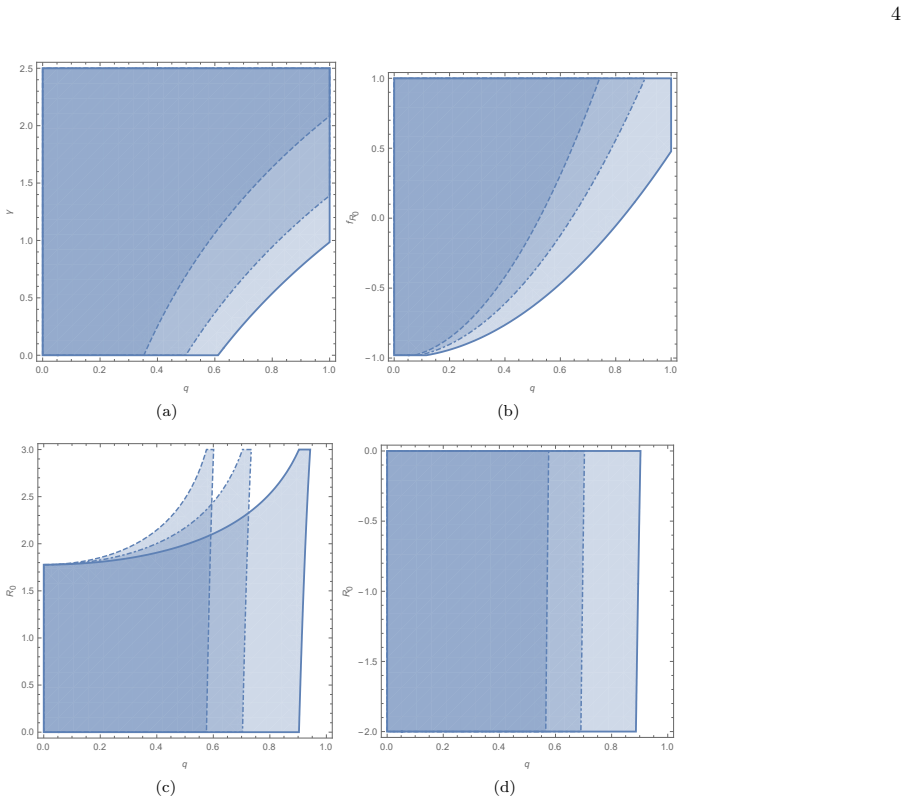
- Because the admissible-region plots (Figs. 5 and 6) show that a range of $(q, \gamma, R_0, f_{R_0})$ values satisfies the 1$\sigma$ and 2$\sigma$ EHT bounds, the observation constrains combinations of parameters rather than a single parameter.
- For the same black hole parameters, the energy emission rate is lower for larger $q$ and higher for larger $\gamma$ or $f_{R_0}$, implying that charged $F(R)$-ModMax black holes evaporate more slowly while the ModMax and $F(R)$ corrections speed evaporation up.
- In the weak-field lensing calculation, the deflection angle increases with $q$ and $f_{R_0}$ and decreases with $\gamma$, providing an independent optical signature that lensing observations could test.
Reading between the lines
- The paper never states the relation between $m_0$ and the astrophysical mass $M$ used in the EHT comparison; if the standard Schwarzschild identification $m_0=2M$ is intended rather than $m_0=M$, the plotted shadow diameters would double and the favored $f_{R_0}$ ranges could shift.
- The same constraint pipeline could be applied to Sgr A*, whose EHT shadow diameter is measured separately; agreement with the M87*-derived $f_{R_0}$ ranges would strengthen the claim, while disagreement would suggest the model needs another parameter.
- Because the spacetime is spherically symmetric, the model predicts a perfectly circular shadow; a future precision measurement of shadow circularity would directly test the static-solution assumption.
- The deflection-angle formula depends on $R_0$ and $f_{R_0}$ at finite impact parameter, so galaxy-scale strong-lensing observations could provide a shadow-free test of the same parameter ranges.
Editorial analysis
A structured set of objections, weighed in public.
Referee Report
Summary. The manuscript studies the optical properties of a static, spherically symmetric black hole solution in F(R)-ModMax gravity, with metric function given by Eq. (2.13). It computes the photon-sphere radius and shadow radius (Eqs. 3.10-3.11), plots shadow boundaries and their parameter dependence, compares the shadow diameter with EHT M87* constraints, and separately derives the energy emission rate and the weak-field deflection angle. The headline claim is that the EHT data favor f_R0 < -1 for AdS black holes and f_R0 > -1 for dS black holes, so that astrophysical observations can fix the sign of the F(R) parameter.
Significance. If the EHT comparison were performed with an unambiguous mass normalization, the claimed sign preference for f_R0 would be an interesting observational handle on F(R)-ModMax gravity. The paper has clear strengths: it works with an explicit exact solution, derives analytic expressions for the photon-sphere radius, shadow radius, energy emission rate, and deflection angle, and compares a parameter scan against published EHT numbers. However, the central constraint is currently not trustworthy because the relation between the metric parameter m0 and the astrophysical mass M is never stated, and the plotted shadow diameters appear to be off by a factor of two relative to the standard m0 = 2M convention. In addition, the f_R0 < -1 region, which drives the headline result, lies on the far side of a pole in the metric and is not physically justified in the paper. The significance is therefore conditional on a corrected reanalysis.
major comments (3)
- [III B, Eq. (3.18), Figs. 4-6, Eq. (2.13)] The relation between the metric integration constant m0 and the astrophysical mass M used in the EHT comparison is never stated. In the GR limit (f_R0 = 0, gamma = 0, R0 = 4 Lambda -> 0, q = 0), the metric (2.13) reduces to Schwarzschild only if m0 = 2M; then Eqs. (3.10)-(3.11) give r_sh = 3 sqrt(3) M and shadow diameter d_metric = 6 sqrt(3) M ~ 10.4, which is consistent with Eq. (3.18), d_M87* = 11.0 +/- 1.5. Yet the colorbars in Figs. 4(a)-4(c) show d_sh values in the range 3 to 6.5, which is what one obtains if m0 = M, i.e., if all lengths are measured in units of half the astrophysical mass. Because the paper never states which convention is used, the comparison in Figs. 5 and 6 is ambiguous. If m0 = M is the intended convention, all plotted shadow diameters must be doubled before comparison with Eq. (3.18), and the allowed regions and the claimed f_R0 preference could shift substantially. The authors must state the normalization explicitly, recompute the contour plots under the standard identification m0 = 2M, and verify whether the f_R0 < -1 (AdS) and f_R0 > -1 (dS) conclusions survive.
- [II, Eq. (2.13); III B, Figs. 5(c), 6(c)] The metric (2.13) contains (1 + f_R0) in the denominator of the electric-charge term, so f_R0 = -1 is a singular point at which the charge contribution diverges. For f_R0 < -1, the coefficient of q^2 e^{-gamma}/r^2 changes sign, turning the usual repulsive electromagnetic contribution into an attractive one. The paper scans through f_R0 = -1 in Figs. 5(c) and 6(c) and claims consistency with EHT data for f_R0 < -1 without discussing this pole or the sign flip. This is load-bearing because the headline result is precisely the f_R0 < -1 region; the authors need to justify that a physically admissible F(R)-ModMax solution exists on both sides of the pole, including the sign of the effective charge term and the behavior of the field equations (2.4)-(2.7) at f_R0 = -1.
- [III A, Eq. (3.14); Fig. 3] The celestial coordinates are given as X = -r_sh sqrt(1 + R0 r_sh^2/12) and Y = 0, which is a single point, not the boundary of a circular shadow. For a spherically symmetric and static spacetime, the shadow boundary should be a circle, e.g., X = r_sh cos(phi), Y = r_sh sin(phi), or an equivalent angular parametrization. The figures in Fig. 3 clearly plot closed circular curves, so the formula actually used is not the one written in Eq. (3.14). This needs to be corrected and the definition of r_sh clarified for the non-asymptotically flat AdS/dS backgrounds; otherwise the shadow shapes and the derived d_sh values are not properly defined.
minor comments (5)
- [Fig. 1 caption] Panels (c) and (d) of Fig. 1 have identical captions, although the plotted ranges of R0 differ; the caption should distinguish the two panels.
- [III C, Eq. (3.20)] The energy emission rate formula is written as d^2E/(dtdomega) = 2 pi^2 omega^3 r_sh^2 / (exp(omega/T) - 1), but the displayed text lacks parentheses around omega/T in the exponential; please fix the typographical ambiguity.
- [IV, around Eq. (4.14)] The sentence 'Employing Eqs. (4.13) and (4.14), we obtain the correct deflection angle' is self-referential because Eq. (4.14) is the deflection angle itself; the intended reference is probably Eqs. (4.12) and (4.13).
- [IV, Fig. 8 text] The discussion of Fig. 8 says 'the opposite behavior is observed in dS spacetime (see Fig. 8(e))', but Fig. 8(e) shows negative R0 (AdS); the second mention of dS should be AdS.
- [References] References [51] and [78] are the same paper (Zhu, Wu, Jamil, Jusufi, Phys. Rev. D 100, 044055 (2019)) and should be consolidated; also 'ModMox' appears in Section II and should read 'ModMax'.
Circularity Check
No significant circularity: the EHT comparison is an external benchmark applied after a parameter scan, not a fitted input.
full rationale
The paper's derivation chain is self-contained against an external benchmark. The central EHT preference (fR0<-1 for AdS, fR0>-1 for dS) is obtained by computing shadow radii from the geodesic equations for the metric (2.13) and comparing the resulting shadow diameter with the fixed observational interval d_M87* ~ 11.0 +/- 1.5 (Eq. 3.18). No parameter is fitted to that interval and then renamed a prediction; the allowed regions in Figs. 5 and 6 come from scanning the parameter space. Importing the metric and Hawking temperature from the prior solution [31] is ordinary reuse of a published result, not circular, and the qualitative agreements cited with [72] and [73] are contextual rather than load-bearing. The possible factor-of-two ambiguity in the m0/M normalization is a consistency or correctness concern about how d_sh is converted to M87* mass units, not a circular reduction: the comparison would still be a comparison, just possibly with an incorrect unit conversion. No equation in the paper has the EHT constraint as an input, no uniqueness theorem is imported from the authors' own prior work, and no fitted parameter is masquerading as a prediction.
Assumptions & free parameters
free parameters (5)
- q
- gamma
- f_R0
- R0
- m0 =
implicitly 1 in many figures
assumptions (6)
- domain assumption The metric h(r) in Eq (2.13) is a valid charged black hole solution of F(R)-ModMax gravity.
- domain assumption The constant scalar curvature condition R=R0 and the trace equation (2.9) correctly describe the F(R) sector.
- domain assumption The EHT measured ring diameter of M87* can be identified with the model shadow diameter d_sh.
- standard math Standard null geodesic equations and the photon sphere condition determine the shadow radius.
- domain assumption The Schwarzschild shadow deviation bound -0.18 < delta < 0.16 is directly applicable to this model.
- ad hoc to paper Parameter regions with 1+f_R0 < 0 are treated as physically allowed.
Cite this review
Pith. "Pith review of A Study of Black Holes in $F(R)-$ModMax Gravity: Gravitational Lensing and Constraints from EHT Observations." pith.science (2026). https://pith.science/paper/ZFSSBOAM
@misc{pith2026241115757,
  author       = {Pith},
  title        = {Pith review of: A Study of Black Holes in $F(R)-$ModMax Gravity: Gravitational Lensing and Constraints from EHT Observations},
  year         = {2026},
  howpublished = {\url{https://pith.science/paper/ZFSSBOAM}},
  note         = {Machine review of arXiv:2411.15757}
}
abstract
The study of astrophysical phenomena like black hole shadows is an effective approach to properly understand the modified gravity and explore its validity. Motivated by recent astrophysical observations, we consider a black hole (BH) in $F(R)-$ModMax gravity and study the optical features such as the shadow's geometrical shape, energy emission rate, and deflection of light. More specifically, we show how the variation of the model parameters imprints specific signatures on these optical quantities. In the following, we consider such black holes as supermassive BHs and evaluate the parameters of the model with shadow size estimates done by the observations of M87* from the Event Horizon Telescope (EHT). According to our findings, the parameter $f_{R_{0}}$ plays an effective role in having results consistent with the EHT data such that the resulting shadow of AdS black holes in $F(R)-$ModMax gravity agrees with the observational data for $f_{R_{0}}<-1$. However, for dS black holes, a consistent result is observed for $f_{R_{0}}>-1$.
Figures


Figures from the paper (5 more)


Forward citations
Cited by 1 Pith paper
-
Constraining ModMax Black Holes with EHT and GRAVITY Observations: Optical Signatures and Accretion Disk Properties
Combining EHT shadow observations of M87* and Sgr A* with mass and distance priors yields 95% upper limits Q < 0.391 and v < 4.153 on the ModMax black hole charge and nonlinearity parameter.
Reference graph
Works this paper leans on
-
[31]
Eslam Panah, Prog
B. Eslam Panah, Prog. Theor. Exp. Phys. 2024, 023E01 (2024)
2024
-
[1]
C. M. Will, Living reviews in relativity 17, 1 (2014)
2014
-
[2]
B. P. Abbott et al., Phys. Rev. Lett. 116, 061102 (2016)
2016
-
[3]
B. P. Abbott et al., Phys. Rev. Lett. 116, 241103 (2016)
2016
-
[4]
B. P. Abbott et al., Phys. Rev. Lett. 119, 161101 (2017)
2017
-
[5]
A. G. Riess et al., Astron. J 116, 1009 (1998)
1998
-
[6]
Perlmutter et al., ApJ 517, 565 (1999)
S. Perlmutter et al., ApJ 517, 565 (1999)
1999
-
[7]
Lovelock, J
D. Lovelock, J. Math. Phys. 12, 498 (1971)
1971
Show all 87 references
-
[8]
Lovelock, J
D. Lovelock, J. Math. Phys. 13, 874 (1972)
1972
-
[9]
de Rham, Living Rev
C. de Rham, Living Rev. Rel. 17, 7 (2014)
2014
-
[10]
Brans and R
C. Brans and R. H. Dicke, Phys. Rev. 124, 925 (1961)
1961
-
[11]
Barrabes and G
C. Barrabes and G. F. Bressange, Class. Quantum Gravit. 14, 805 (1997)
1997
-
[12]
E. F. Eiroa and C. M. Sendra, Eur. Phys. J. C 74, 3171 (2014)
2014
-
[13]
Akbar and R
M. Akbar and R. G. Cai, Phys. Lett. B 648, 243 (2007)
2007
-
[14]
J. C. C. de Souza and V. Faraoni, Class. Quantum Gravit. 24, 3637 (2007)
2007
-
[15]
Jafarzade, E
K. Jafarzade, E. Rezaei, and S. H. Hendi, Prog. Theor. Exp. Phys. 2023, 053E01 (2023)
2023
-
[16]
Akbar and R
M. Akbar and R. G. Cai, Phys. Lett. B 635, 7 (2006)
2006
-
[17]
Cognola, E
G. Cognola, E. Elizalde, S. Nojiri, S. D. Odintsov, L. Sebastiani, and S. Zerbini, Phys. Rev. D 77, 046009 (2008)
2008
-
[18]
Perlmutter et al, Astrophys
S. Perlmutter et al, Astrophys. 517, 565 (1999)
1999
-
[19]
A. G. Riess et al, Astrophys. 607, 665 (2004)
2004
-
[20]
Capozziello and A
S. Capozziello and A. Troisi, Phys. Rev. D 72, 044022 (2005)
2005
-
[21]
Capozziello, A
S. Capozziello, A. Stabile and A. Troisi, Phys. Rev. D 76, 104019 (2007)
2007
-
[22]
S. H. Hendi, B. Eslam Panah, and S. M. Mousavi, Gen. Relativ. Gravit. 44, 835 (2012)
2012
-
[23]
Woodard, Lect
R. Woodard, Lect. Notes Phys. 720, 403 (2007)
2007
-
[24]
Born and L
M. Born and L. Infeld, Foundations of the new field theory, Nature 132, 1004 (1933); Proc. R. Soc. Lond. 144, 425 (1934)
1933
-
[25]
Bandos, K
I. Bandos, K. Lechner, D. Sorokin, and P. K. Townsend, Phys. Rev. D 102, 121703 (2020)
2020
-
[26]
Cian Luke Martin, Perturbative Quantization of Modified Maxwell Electrodynamics, arXiv:2406.19086
-
[27]
Amirabi, S
Z. Amirabi, S. Habib Mazharimousavi, Eur. Phys. J. C 81, 207 (2021)
2021
-
[28]
Kruglov, Int
S.I. Kruglov, Int. J. Mod. Phys.D 31, 2250025 (2022)
2022
-
[29]
R. C. Pantig, L. Mastrototaro, G. Lambiase, A. ¨Ovg¨ un, Eur. Phys. J. C82, 1155 (2022)
2022
-
[30]
Amirabi, Annals Phys
Z. Amirabi, Annals Phys. 443, 168990 (2022)
2022
-
[32]
Barrientos, A
J. Barrientos, A. Cisterna, D. Kubiznak, J. Oliva, Phys. Lett. B 834, 137447 (2022)
2022
-
[33]
The Event Horizon Telescope Collaboration, Astrophys. J. Lett. 875 L1 (2019)
2019
-
[34]
Event Horizon Telescope collaboration, Astrophys. J. Lett. 875 L4 (2019)
2019
-
[35]
S. E. Gralla, A. Lupsasca, Phys. Rev. D 101, 044031 (2020)
2020
-
[36]
Rehman, Z
N. Rehman, Z. C. S. Chan, M. Jamil, M. Azreg-A ¨ ınou, Eur. Phys. J. C 85, 233 (2025)
2025
-
[37]
Maryam, M
S. Maryam, M. Jamil, M. Azreg-A ¨ ınou, Z. C. S. Chan, Annals Phys.473, 169911 (2025)
2025
-
[38]
Q. Gan, P. Wang, H. Wu, H. Yang, Phys. Rev. D 104, 044049 (2021)
2021
-
[39]
Bozza, Gen
V. Bozza, Gen. Rel. Grav. 42, 2269, (2010)
2010
-
[40]
Kumaran, A
Y. Kumaran, A. ¨Ovg¨ un, Eur. Phys. J. C83, 812 (2023)
2023
-
[41]
G. J. Olmo, J. L. Rosa, D. Rubiera-Garcia, D. S.-C. Gomez, 2023 Class. Quantum Grav. 40, 174002 (2023)
2023
-
[42]
A. R. Soares, C. F. S. Pereira, R. L. L. Vitoria, E. M. Rocha. Phys. Rev. D 108, 124024 (2023)
2023
-
[43]
A. R. Soares, R. L. L. Vitoria, C. F. S. Pereira, Phys. Rev. D 110, 084004 (2024)
2024
-
[44]
Amarilla, E.F
L. Amarilla, E.F. Eiroa and G. Giribet, Phys. Rev. D 81, 12404 (2010)
2010
-
[45]
Kumar, B
R. Kumar, B. P. Singh, M.S. Ali and S.G. Ghosh, Phys. Dark Univ. 34, 100881 (2021)
2021
-
[46]
Jafarzade, B
K. Jafarzade, B. Eslam Panah, M. E. Rodrigues, Class. Quantum Grav. 41, 065007 (2024)
2024
-
[47]
Guo, P.-C
M. Guo, P.-C. Li, Eur. Phys. J. C 80, 588 (2020)
2020
-
[48]
Asukula et al., Phys
H. Asukula et al., Phys. Rev. D 109, 064027 (2024)
2024
-
[49]
X. X. Zeng, H. Q. Zhang and H. Zhang, Eur. Phys. J. C 80, 872 (2020). 15
2020
-
[50]
X. X. Zeng, K. J. He, J. Pu, G. p. Li and Q. Q. Jiang, Eur. Phys. J. C 83, 897 (2023)
2023
-
[52]
Haroon, M
S. Haroon, M. Jamil, K. Jusufi, K. Lin, R. B. Mann, Phys. Rev. D 99, 044015 (2019)
2019
-
[53]
P.-C. Li, M. Guo, B. Chen, Phys. Rev. D 101, 084041 (2020)
2020
-
[54]
Allahyari, M
A. Allahyari, M. Khodadi, S. Vagnozzi, D.F. Mota, J. Cosmol. Astropart. Phys. 2002 (2020) 003
2020
-
[55]
Jafarzade, M
K. Jafarzade, M. Kord Zangeneh, F. S. N. Lobo, JCAP 04, 008 (2021)
2021
-
[56]
A. R. Soares, R. L. L. Vitoria, C. F. S. Pereira, Eur. Phys. J. C 83, 903 (2023)
2023
-
[57]
Atamurotov, B
F. Atamurotov, B. Ahmedov, A. Abdujabbarov, Phys. Rev. D 92 084005 (2015)
2015
-
[58]
Pahlavon, F
Y. Pahlavon, F. Atamurotov, K. Jusufi, M. Jamil, A. Abdujabbarov, Phys. Dark Univ. 45, 101543 (2024)
2024
-
[59]
Atamurotov, K
F. Atamurotov, K. Jusufi, M. Jamil, A. Abdujabbarov, M. Azreg-A ¨ ınou, Physical Review D104, 064053 (2021)
2021
-
[60]
S. Kala, H. Nandan, A. Abebe, S. Roy, Eur. Phys. J. C 84, 1089 (2024)
2024
-
[61]
S. Kala, H. Nandan, P. Sharma, Eur. Phys. J. Plus 137, 457 (2022)
2022
-
[62]
K. S. Virbhadra, G. F. R. Ellis, Phys. Rev. D 65, 103004 (2002)
2002
-
[63]
K. S. Virbhadra, C. R. Keeton, Phys. Rev. D 77, 124014 (2008)
2008
-
[64]
K. S. Virbhadra, Phys. Rev. D 106, 064038 (2022)
2022
-
[65]
S. E. Gralla, A. Lupsasca, Phys. Rev. D 102, 124003 (2020)
2020
-
[66]
Davoudiasl and P
H. Davoudiasl and P. B. Denton, Phys. Rev. Lett. 123, 021102 (2019)
2019
-
[67]
S. H. Hendi, Kh. Jafarzade, B. Eslam Panah, JCAP 02 022 (2023)
2023
-
[68]
Jafarzade, S
K. Jafarzade, S. H. Hendi, M. Jamil, S. Bahamonde, Phys. Dark Univ. 45, 101497 (2024)
2024
-
[69]
Nampalliwar, S
S. Nampalliwar, S. K., K. Jusufi, Q. Wu, M. Jamil, P. Salucci, Astrophys. J 916, 116 (2021)
2021
-
[70]
Jusufi, S
K. Jusufi, S. Capozziello, S. Bahamonde, M. Jamil, Eur. Phys. J. C 82, 1018 (2022)
2022
-
[71]
X. X. Zeng, G. P. Li and K. J. He, Nucl. Phys. B 974 (2022), 115639
2022
-
[72]
Dastan, R
S. Dastan, R. Saffari, S. Soroushfar, Eur. Phys. J. Plus 137 1002 (2022)
2022
-
[73]
J. Sun, Y. Liu, W-L. Qian, S. Chen, R. Yue, Chinese Phys. C 47, 025104 (2023)
2023
-
[74]
Hazarika, P
B. Hazarika, P. Phukon, Front. Phys. 20, 035201 (2025)
2025
-
[75]
Karmakar, U
R. Karmakar, U. D. Goswami, Eur. Phys. J. C 84, 969 (2024)
2024
-
[76]
Karmakar, D
R. Karmakar, D. J. Gogoi and U. D. Goswami, Phys. Dark Univ. 41, 101249 (2023)
2023
-
[77]
Parbin, D
N. Parbin, D. J. Gogoi, J. Bora, U. D. Goswami, Phys. Dark Univ. 42, 101315 (2023)
2023
-
[78]
T. Zhu, Q. Wu, M. Jamil, K. Jusufi, Phys. Rev. D 100, 044055 (2019)
2019
-
[79]
Zubair , M
M. Zubair , M. A. Raza, G. Abbas, Eur. Phys. J. C 82, 948 (2022)
2022
-
[80]
M. A. Raza et al., Phys. Dark Univ. 44, 101488 (2024)
2024
-
[81]
Guzman-Herrera, A
E. Guzman-Herrera, A. Montiel, N. Breton, JCAP 11, 002 (2024)
2024
-
[82]
Kumar, A
R. Kumar, A. Kumar, S.G. Ghosh, Astrophys. J. 896, 89 (2020)
2020
-
[83]
Akiyama, et al., EHT Collaboration, Astrophys
K. Akiyama, et al., EHT Collaboration, Astrophys. J. 875, L1 (2019)
2019
-
[84]
Akiyama, et al., Astrophys
K. Akiyama, et al., Astrophys. J. Lett. 930, L12 (2022)
2022
-
[85]
Wei and Y.-X
S.-W. Wei and Y.-X. Liu, JCAP 11, 063 (2013)
2013
-
[86]
Kottler, Annalen
F. Kottler, Annalen. Phys. 361, 401 (1918)
1918
-
[87]
Ishihara, Y
A. Ishihara, Y. Suzuki, T. Ono, T. Kitamura, H. Asada, Phys. Rev. D 94, 084015 (2016)
2016
-
[88]
Kumaran, A
Y. Kumaran, A. ¨Ovg¨ un, Turk J Phys.45, 247 (2021)
2021
Reviewed August 12, 2026 · model on record in the stance chip above.
Discussion (0). Continue with ORCID to comment.