REVIEW 4 major objections 6 minor 20 references
A Human-optimized Model Predictive Control Scheme and Extremum Seeking Parameter Estimator for Slip Control of Electric Race Cars
T0 review · 4 major / 6 minor · reviewed 2026-08-12 · deepseek-v4-flash
Pith's one-line read A slip controller that finds the optimal tire slip on its own, with no tire model, converges to within 0.25% in simulation.
desk verdict A promising MPC+ESC slip-control architecture for race cars, but the braking-side claims rest on an untested symmetry assumption. read the letter →
The pith
A machine-rendered reading of the paper's core claim, the machinery that carries it, and where it could break.
The reading
What carries the argument
The central object is an unconstrained MPC with integral action, whose finite-horizon output-tracking cost is written in quadratic form and solved analytically, yielding a direct state-feedback law of negligible computational cost. The extremum seeking loop (ESC) is the load-bearing estimation mechanism: it injects a sinusoidal perturbation into the slip reference, high-pass filters the measured longitudinal acceleration and the measured slip, multiplies them to get a non-negative gradient estimate, and integrates through a saturating integrator to update the estimated optimal slip. The ESC relies on the assumed symmetry $F_x(\kappa) = -F_x(-\kappa)$ to restrict the search to positive slip and reverse the sign for braking, and an additional piecewise affine scaling with lateral acceleration reduces the slip reference during cornering to preserve stability.
What would settle it
Measure the true optimal slip for braking and for acceleration on the same tire and road surface: if the braking peak differs from the acceleration peak by more than the ESC's convergence error, then the sign-reversal scheme will converge to the acceleration-optimal slip during braking, producing measurable suboptimal deceleration that the paper's symmetric model would not predict.
Extended reading notes
Core claim
The paper claims that optimal wheel slip, the slip ratio at which the tire produces maximum longitudinal force, can be found and tracked online without any tire model, by pairing an unconstrained MPC with integral action with an extremum-seeking estimator. The MPC tracks a time-varying slip reference through direct state feedback derived from a closed-form quadratic program, so the controller is computationally negligible and has few tuning parameters. The ESC perturbs the slip reference with a sinusoid, uses the measured longitudinal acceleration to estimate the local gradient of the force-slip curve, and integrates that gradient to drive the reference toward the peak; the estimate is cleaned by correlating with the high-pass-filtered measured slip rather than the raw perturbation, which removes phase lag. The paper reports simulation convergence to within 0.25% of the true optimal slip and compares favorably with a sliding-mode estimator, which needs aggressive tuning and oscillates under downforce.
Load-bearing premise
The load-bearing assumption is that a tire's longitudinal force has the same shape for positive and negative slip, so the controller can search only positive slip values and then use the same answer for braking by flipping the sign; real tires, particularly under braking with load transfer and downforce, are usually not symmetric.
Editorial extensions
If this is right
- An electric race car can operate at peak tire grip during acceleration and regenerative braking without an identified tire model, removing the need for pre-race tire parameter identification.
- The analytical MPC solution makes the controller feasible on low-cost ECUs, since no quadratic program is solved online.
- The human preference tuning loop means race engineers can calibrate the controller by comparing candidate behaviors rather than tuning numerical weights.
- The ESC's active perturbation keeps working under downforce changes during braking, where earlier slip estimators based on acceleration magnitude struggle to distinguish downforce from slip effects.
- Simulation indicates convergence to within 0.25% of the optimal slip after roughly two acceleration and two braking cycles.
Reading between the lines
- The assumed symmetry of tire force in braking vs acceleration is the most fragile link: real tires, especially with load transfer and downforce, have different peak slips in traction and braking, so the sign-reversal step could steer the system to a suboptimal braking slip. A direct test would compare the ESC's converged braking slip with the measured braking peak.
- The same MPC+ESC architecture could be extended to front-wheel-drive or all-wheel-drive layouts, but the lateral-stability scaling would need to be re-derived because rear-wheel-drive vehicles lose yaw stability first.
- The ESC perturbation amplitude and frequency set a floor on achievable accuracy and oscillation; the 0.25% convergence figure is specific to the chosen 1 Hz, 0.5% perturbation, and tighter convergence would require smaller amplitude at the cost of slower convergence.
- A testable extension is to replace the fixed sign reversal with independent ESC loops for traction and braking, which would remove the symmetry assumption while still requiring no tire model.
Editorial analysis
A structured set of objections, weighed in public.
Referee Report
Summary. This paper proposes a longitudinal slip control system for a rear-wheel-drive electric race car, combining an unconstrained MPC with analytical solution and an extremum seeking controller (ESC) that estimates the optimal slip reference in real time without prior tire knowledge. The MPC is formulated as a truncated LQR with integral action and is solved in closed form; the ESC uses a sinusoidal perturbation and a gradient estimate based on the measured longitudinal acceleration and wheel-speed-derived slip. The controller hyper-parameters (P, Q, N) are tuned using the preference-based c-GLISp algorithm. The paper reports simulation results on a detailed vehicle model with Magic Formula 5.2 tires, load transfer, downforce, and a limited-slip differential, showing that the MPC tracks slip references with less overshoot than a PID baseline, and that the ESC converges to within 0.25% of the optimal slip (4.4%) after two braking and two acceleration cycles. The central claim is that the system automatically finds and tracks the optimal longitudinal slip for both traction and regenerative braking with low computational cost and few tuning parameters.
Significance. If the claims are correct, the proposed architecture is attractive for real-time vehicle control: the analytical MPC requires negligible computation, the ESC removes the need for a tire model, and the c-GLISp tuning replaces hand-tuning of controller weights. The paper also makes a useful practical comparison with a sliding-mode-based slip estimator, showing qualitatively different oscillation behavior. The analytical MPC derivation in the appendix is standard and reproducible, and the simulation environment is described in sufficient detail to allow similar studies. However, the ESC convergence is only demonstrated empirically, the tire symmetry assumption in Eq. (8) is unverified and load-bearing for the braking case, and the hyper-parameter tuning is performed in-sample on the same evaluation scenario, which weakens the strength of the comparative claims. These issues do not invalidate the traction-side results, but they need to be addressed before the regenerative-braking claim can be accepted.
major comments (4)
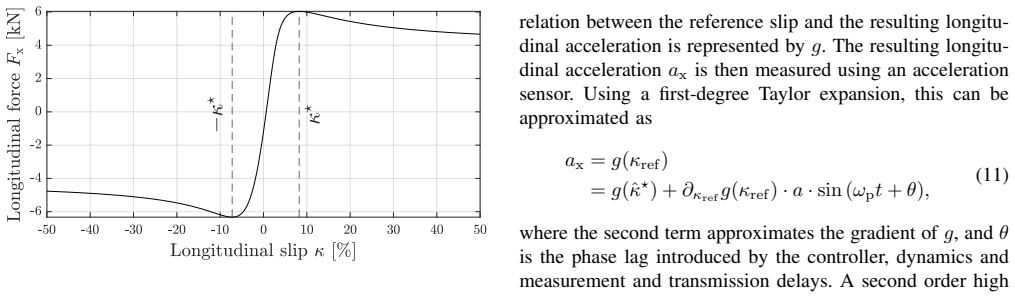
- [Section III, Eq. (8)] The symmetry assumption Fx(κ) = -Fx(-κ) is central to the ESC design: the search is restricted to positive slip and the sign of the resulting reference is simply reversed during braking. The paper provides no test or justification of this assumption for the Magic Formula 5.2 tire model used in Section V, and it explicitly states that the ESC is deactivated whenever the brakes are applied. Under realistic conditions with load transfer, downforce, and different peak friction for traction versus braking, the true braking optimum will generally differ from the sign-reversed traction optimum, so the ESC would systematically target the wrong braking slip. Please quantify the asymmetry for the simulation tire model (e.g., compare the peak-slip values for positive and negative κ) or provide a mechanism for searching the braking domain.
- [Section III, after Eq. (13)] The paper asserts that the ESC converges to the optimal slip (within 0.25% of 4.4% in Section V) but provides no convergence analysis or conditions under which the gradient estimate is accurate. The gradient estimator involves the product of the high-pass filtered slip and the filtered acceleration, and the derivation of the non-negative factor P(t) in Eq. (13) glosses over the phase shifts introduced by the high-pass filter and the plant. Since the ESC operates in closed loop with the MPC, the paper should either provide a stability analysis (e.g., based on averaging or singular perturbation methods) or at least a clear set of tuning guidelines and a sensitivity study over perturbation amplitude, frequency, and filter bandwidth.
- [Section V, Hyper-parameter optimization] The c-GLISp tuning is performed on the same simulation environment, including the same maneuvers and disturbance sequences, that is subsequently used to compare the tuned MPC against the PID baseline. This in-sample evaluation introduces an optimism bias: the reported improvements (e.g., the 2.2% overshoot difference in Fig. 6) may partly reflect overfitting to the specific test scenario rather than a general performance advantage. Please clarify the tuning/evaluation protocol; if possible, validate the tuned controller on a held-out scenario with different speed profiles, friction changes, and steering inputs.
- [Section V, ESC] The ESC perturbation parameters (amplitude 0.5%, frequency 1 Hz) are introduced without a principled selection procedure. The statement that the frequency is 'significantly higher than the time-varying dynamics of the plant, yet remains within the bandwidth of the MPC' is not supported by data or analysis. A sensitivity study varying these parameters (and possibly the integrator gain) and reporting convergence time, steady-state error, and reference oscillation amplitude would be needed to support the claim that the approach is easily tunable in practice.
minor comments (6)
- [Section III, Eq. (13)] The derivation of the gradient estimate is notationally confusing: the symbol H(˜κ) appears to denote a high-pass filtered signal that is then multiplied by ζ, which is itself the filtered acceleration. The claim that P(t) is always non-negative requires the phase φ to be zero or compensated; otherwise the product may have a time-varying sign. Please clarify the expressions and state the assumptions on phase.
- [Section IV] The sentence 'After 50 iterations, the resulting values were 250, 250 and 1450, for P, Q and N respectively' is striking because N=1450 at Ts=5 ms corresponds to a prediction horizon of 7.25 s, which is unusually long for slip control. Please confirm this value or explain how such a long horizon arises from the preference-based tuning.
- [Appendix] The analytical MPC derivation is standard but terse; the dimensions of the matrices in the augmented system (15) and the definition of the reference matrix ℜ_k are not fully specified. Adding a short explanation would improve reproducibility.
- [Section V] The sentence 'The estimated slip that was used as an input for the controller was estimated through wheel speeds and a fixed tire radius was assumed' implies that the feedback slip and the ESC gradient signal share the same estimation bias. Please discuss the effect of a fixed-radius assumption on the ESC convergence and on the claimed accuracy of 0.25%.
- [Minor text issues] Several typographical errors should be corrected: 'speed op this process' should be 'speed up this process' (Section III), 'area's' should be 'areas' (Section IV), 'bandwith' should be 'bandwidth' (Section III), and 'with a bandwith of ωp' is imprecise regarding the filter order and cut-off frequency.
- [Section I, Related literature] The statement that 'there is no optimal slip control method which does not require any prior knowledge of the tire, requires low computational effort and has limited control parameters' is a strong negative claim; without a more exhaustive literature survey it would be safer to say 'to the best of the authors' knowledge' or to state the claim after a more systematic review.
Circularity Check
No significant circularity: the ESC and MPC are derived from first principles within the paper, and the c-GLISp tuning is calibration rather than a disguised prediction.
full rationale
The paper's central derivation is self-contained against an external plant model. The MPC is an unconstrained truncated LQR (Eqs. (7), (23)-(27)) whose analytical solution is derived in the appendix; it does not encode the tire model. The ESC loop (Eqs. (10)-(13)) estimates the gradient of measured longitudinal acceleration with respect to a perturbed slip reference and integrates it via a saturating integrator; the optimum is therefore an online fixed point of a feedback system, not a value injected by the authors. The simulation optimum of 4.4% slip comes from the Magic Formula 5.2 tire model in Section V, which is not used in the controller design. The c-GLISp procedure tunes P, Q and N on repeated acceleration and braking maneuvers; this is calibration of tracking-shaping weights, not a fit of the ESC optimum, and the reported ESC convergence is not a re-statement of those weights. Reference [20], used for phase-compensated gradient estimation, is not by the authors and the gradient estimator is re-derived in Eq. (13), so no ansatz is smuggled in by citation. The explicit symmetry assumption Fx(kappa) = -Fx(-kappa) in Eq. (8) restricts ESC to the positive-slip domain and sign-reverses the reference during braking; this is a modeling assumption that could reduce braking-side accuracy, but it is not a definitional equivalence between the paper's inputs and its claimed result. No load-bearing self-citation chain or uniqueness import was found. Therefore no significant circularity is present.
Assumptions & free parameters
free parameters (7)
- P (MPC terminal weight) =
250
- Q (MPC stage weight) =
250
- N (prediction horizon) =
1450
- ESC perturbation amplitude a =
0.5%
- ESC perturbation frequency omega_p =
1 Hz
- ESC integrator gain =
not specified
- Lateral scaling parameters a0, a_kappa =
not specified
assumptions (6)
- standard math Standard linear algebra and forward Euler discretization are valid for the MPC derivation.
- domain assumption The longitudinal tire force is symmetric for positive and negative slip (Eq. 8).
- domain assumption The phase lag between slip reference and measured longitudinal acceleration equals the phase lag in the measured wheel speeds.
- domain assumption Longitudinal tire forces and clutch torque can be treated as constant disturbances over the prediction horizon.
- domain assumption The simulation environment (3-DoF vehicle, Magic Tire 5.2, downforce, LSD) is an adequate proxy for the real vehicle.
- domain assumption The restricted slip search region makes the force-slip optimization strictly convex.
Cite this review
Pith. "Pith review of A Human-optimized Model Predictive Control Scheme and Extremum Seeking Parameter Estimator for Slip Control of Electric Race Cars." pith.science (2026). https://pith.science/paper/ANK57MGI
@misc{pith2026241115823,
  author       = {Pith},
  title        = {Pith review of: A Human-optimized Model Predictive Control Scheme and Extremum Seeking Parameter Estimator for Slip Control of Electric Race Cars},
  year         = {2026},
  howpublished = {\url{https://pith.science/paper/ANK57MGI}},
  note         = {Machine review of arXiv:2411.15823}
}
read the original abstract
This paper presents a longitudinal slip control system for a rear-wheel-driven electric endurance race car. The control system integrates Model Predictive Control (MPC) with Extremum Seeking Control (ESC) to optimize the traction and regenerative braking performance of the powertrain. The MPC contains an analytical solution which results in a negligible computation time, whilst providing an optimal solution to a multi-objective optimization problem. The ESC algorithm allows continuous estimation of the optimal slip reference without assuming any prior knowledge of the tire dynamics. Finally, the control parameters are determined using a human-driven preference-based optimization algorithm in order to obtain the desired response. Simulation results and comparisons with other methods demonstrate the system's capability to automatically determine and track the optimal slip values, showing stability and performance under varying conditions.
Figures


Figures from the paper (4 more)



Reference graph
Works this paper leans on
-
[1]
Adaptation of hybrid five-phase abs algorithms for experimental validation,
M. Gerard, W. Pasillas-L ´epine, E. De Vries, and M. Verhaegen, “Adaptation of hybrid five-phase abs algorithms for experimental validation,” IF AC Proceedings V olumes, vol. 43, no. 7, pp. 13–18, 2010
work page 2010
-
[2]
Hybrid modeling and limit cycle analysis for a class of five-phase anti-lock brake algorithms,
W. Pasillas-L ´epine, “Hybrid modeling and limit cycle analysis for a class of five-phase anti-lock brake algorithms,” V ehicle System Dynamics, vol. 44, no. 2, pp. 173–188, 2006
work page 2006
-
[3]
I. Ait-Hammouda and W. Pasillas-L ´epine, “On a class of eleven- phase anti-lock brake algorithms robust with respect to discontinuous transitions of road characteristics,” IF AC Proceedings V olumes, vol. 37, no. 21, pp. 551–556, 2004
work page 2004
-
[4]
A fuzzy logic controller for an abs braking system,
G. F. Mauer, “A fuzzy logic controller for an abs braking system,” IEEE Transactions on Fuzzy Systems , vol. 3, no. 4, pp. 381–388, 1995
work page 1995
-
[5]
Fuzzy learning control for antiskid braking systems,
J. R. Layne, K. M. Passino, and S. Yurkovich, “Fuzzy learning control for antiskid braking systems,” IEEE Transactions on Control Systems Technology, vol. 1, no. 2, pp. 122–129, 1993
work page 1993
-
[6]
P. Khatun, C. M. Bingham, N. Schofield, and P. Mellor, “Application of fuzzy control algorithms for electric vehicle antilock braking/traction control systems,” IEEE Transactions on V ehicular Technology, vol. 52, no. 5, pp. 1356–1364, 2003
work page 2003
-
[7]
Traction control of hybrid elec- tric vehicle,
S. Li, C. Liao, S. Chen, and L. Wang, “Traction control of hybrid elec- tric vehicle,” in 2009 IEEE vehicle power and propulsion conference . IEEE, 2009, pp. 1535–1540
work page 2009
-
[8]
Pid plus fuzzy logic method for torque control in traction control system,
H. Z. Li, L. Li, L. He, M. X. Kang, J. Song, L. Y . Yu, and C. Wu, “Pid plus fuzzy logic method for torque control in traction control system,” International Journal of Automotive Technology , vol. 13, pp. 441–450, 2012
work page 2012
Show all 20 references
-
[9]
Sliding mode wheel slip controller for an antilock braking system,
A. Will, S. Hui, and S. Zak, “Sliding mode wheel slip controller for an antilock braking system,” International Journal of V ehicle Design , vol. 19, no. 4, pp. 523–539, 1998
1998
-
[10]
Simulated and experimental study of hydraulic anti-lock braking system using sliding-mode pwm control,
M.-c. Wu and M.-c. Shih, “Simulated and experimental study of hydraulic anti-lock braking system using sliding-mode pwm control,” Mechatronics, vol. 13, no. 4, pp. 331–351, 2003
2003
-
[11]
Reference input wheel slip tracking using sliding mode control,
K. R. Buckholtz, “Reference input wheel slip tracking using sliding mode control,” Sae Transactions, pp. 477–483, 2002
2002
-
[12]
Gain- scheduled wheel slip control in automotive brake systems,
T. Johansen, I. Petersen, J. Kalkkuhl, and J. Ludemann, “Gain- scheduled wheel slip control in automotive brake systems,” IEEE Transactions on Control Systems Technology , vol. 11, no. 6, pp. 799– 811, 2003
2003
-
[13]
Model based wheel slip control via con- strained optimal algorithm,
D. K. Yoo and L. Wang, “Model based wheel slip control via con- strained optimal algorithm,” in 2007 IEEE International Conference on Control Applications . IEEE, 2007, pp. 1239–1246
2007
-
[14]
Explicit nonlinear model predictive control for electric vehicle traction control,
D. Tavernini, M. Metzler, P. Gruber, and A. Sorniotti, “Explicit nonlinear model predictive control for electric vehicle traction control,” IEEE Transactions on Control Systems Technology , vol. 27, no. 4, pp. 1438–1451, 2018
2018
-
[15]
An explicit nonlinear model predictive abs controller for electro-hydraulic braking systems,
D. Tavernini, F. Vacca, M. Metzler, D. Savitski, V . Ivanov, P. Gruber, A. E. Hartavi, M. Dhaens, and A. Sorniotti, “An explicit nonlinear model predictive abs controller for electro-hydraulic braking systems,” IEEE Transactions on Industrial Electronics , vol. 67, no. 5, pp. ...
2019
-
[16]
An mpc/hybrid system approach to traction control,
F. Borrelli, A. Bemporad, M. Fodor, and D. Hrovat, “An mpc/hybrid system approach to traction control,” IEEE Transactions on Control Systems Technology, vol. 14, no. 3, pp. 541–552, 2006
2006
-
[17]
Abs control using optimum search via sliding modes,
S. Drakunov, U. Ozguner, P. Dix, and B. Ashrafi, “Abs control using optimum search via sliding modes,” IEEE Transactions on Control Systems Technology, vol. 3, no. 1, pp. 79–85, 1995
1995
-
[18]
A framework for extremum seeking control of systems with parameter uncertainties,
D. Nesic, A. Mohammadi, and C. Manzie, “A framework for extremum seeking control of systems with parameter uncertainties,” IEEE Trans- actions on Automatic Control , vol. 58, no. 2, pp. 435–448, 2012
2012
-
[19]
C-GLISp: Preference-based global optimization under unknown constraints with applications to controller calibration,
M. Zhu, D. Piga, and A. Bemporad, “C-GLISp: Preference-based global optimization under unknown constraints with applications to controller calibration,” IEEE Transactions on Control Systems Tech- nology, vol. 30, no. 3, pp. 2176–2187, Sep. 2022
2022
-
[20]
An introduction to extremum-seeking control,
A. Skafte, “An introduction to extremum-seeking control,” 2017. APPENDIX The objective function 7 requires the prediction model to provide the outputs as functions of the input rate. This is achieved by rewriting 6 into ∆xp(k + 1) y(k + 1) = Ap 0 CpAp I2 ∆xp(k) y(k) + Bp CpBp ...
2017
Reviewed August 12, 2026 · model on record in the stance chip above.
Discussion (0). Continue with ORCID to comment.