REVIEW 4 major objections 5 minor 36 references
Highly Efficient and Unsupervised Framework for Moving Object Detection in Satellite Videos
T0 review · 4 major / 5 minor · reviewed 2026-08-12 · deepseek-v4-flash
Pith's one-line read Moving object detection in satellite video can be done without manual labels or dense computation: a sparse point-cloud network with self-evolving pseudo-labels reaches 89.7% F1 at 98.8 fps.
desk verdict Clever sparse point-cloud detector for satellite video MOD, but the SOTA claim rests on an unfair comparison against baselines trained on old labels. read the letter →
The pith
A machine-rendered reading of the paper's core claim, the machinery that carries it, and where it could break.
The reading
What carries the argument
The central mechanism is the sparse spatio-temporal point cloud. A temporal-median filter estimates the background, the residual image is thresholded at $\mu + k\sigma$ with $k=3$, and the surviving pixels across 20 frames are gathered into a sparse 3D point cloud in which background regions are absent by construction. This cloud is processed by a sparse-convolution U-Net followed by an anchor-free head that predicts object centers, sizes, and offsets, so computation is spent only on candidate foreground locations. The second mechanism is label self-evolution: initial labels come from a traditional detector, SORT (a lightweight online tracker) filters them by trajectory length and velocity, and every 10 epochs the trained network re-labels the training set, with these new labels added to the retained initial labels. Together they let the model use long-term spatio-temporal information at low cost and recover dim targets that the initial coarse labels missed.
What would settle it
Run the sparse sampling module alone on a video with known dim targets, and count the fraction of ground-truth target pixels that survive the $\mu + 3\sigma$ threshold; if that fraction falls well below the reported 84.2% recall, the detection results cannot be coming from the sampled target pixels and the central claim collapses.
Extended reading notes
Core claim
The central claim is that satellite-video moving object detection does not need manual labels or dense multi-frame computation if one exploits the sparsity of moving targets and the low-rank structure of the background. The paper proposes a fully unsupervised pipeline, HiEUM, in which a temporal-median background model and an adaptive threshold convert a 20-frame clip into a sparse spatio-temporal point cloud of candidate foreground pixels; a sparse convolutional anchor-free network detects moving objects in that cloud, and pseudo-labels generated by a traditional method are iteratively refreshed during training, with a tracker filtering false alarms and old labels retained to prevent overfitting. On the re-labeled VISO test set, the paper reports 89.7% average F1 and 98.8 FPS, and its ablations show the label self-evolution loop raises F1 from 74.1% to 89.7% while the sparse network alone, even under manual supervision, outperforms the previous best supervised method by 7.7 F1 points.
Load-bearing premise
The load-bearing premise is that the $\mu + 3\sigma$ threshold used in sparse sampling keeps at least some pixels of every true moving target, because the paper itself notes that imperfect background modeling can wrongly remove large or extremely dim targets and those losses cannot be recovered in later steps.
Editorial extensions
If this is right
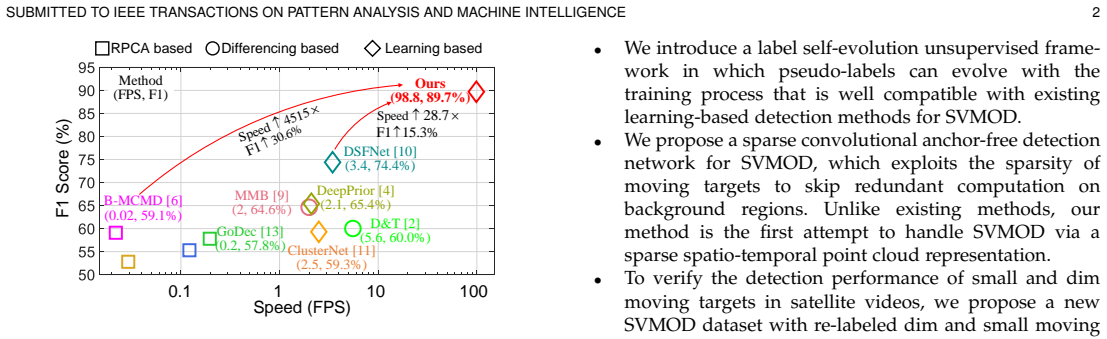
- Satellite video surveillance can run in real time without any manual labels: 98.8 FPS on 1024×1024 frames is 28.7× faster than the previous best learning-based method.
- Dim and small targets, which dominate the re-labeled benchmark, are recovered by long-term spatio-temporal modeling in the point cloud plus iterative label refreshment; the self-evolution loop alone raises F1 from 74.1% to 89.7%.
- The sparse representation cuts memory and computation enough that 20 frames can be processed at once, making multi-frame temporal cues affordable for very small targets.
- The unsupervised framework is generic: the initial pseudo-label generator and the detection network are replaceable, so other traditional methods could bootstrap other learning-based detectors.
- The re-labeled test set establishes a stronger benchmark for dim-target evaluation, with 155,987 instances versus 93,491 in the old labels.
Reading between the lines
- The paper leaves open whether the sparse-sampling threshold really retains dim targets: a pixel-level audit of how many ground-truth target pixels survive $\mu + 3\sigma$ would tell whether recall comes from sampling or from learning.
- An untested extension is applying the same self-evolving label loop to other sparse, dim-target video tasks such as aerial surveillance, since the framework accepts any traditional label generator and any point-cloud network.
- The 98.8 FPS figure depends on the 1.22% sampling ratio at $k=3$; denser clutter or higher-resolution inputs would move the operating point along the paper's own Table 4 trade-off curve.
- Because the re-labeled test set changes the evaluation basis, previously published F1 scores on the old labels are not directly comparable to the new benchmark unless re-scored.
Editorial analysis
A structured set of objections, weighed in public.
Referee Report
Summary. The paper proposes HiEUM, an unsupervised framework for moving object detection in satellite videos (SVMOD). It combines two main ideas: (1) a label self-evolution scheme that generates initial pseudo-labels with a traditional background-subtraction method, filters false alarms via SORT trajectory consistency, and iteratively updates labels using the network's own predictions during training; and (2) a sparse convolutional anchor-free detection network that converts the dense multi-frame image sequence into a sparse spatio-temporal point cloud, thereby skipping computation on background regions. On a relabeled version of the VISO dataset (7 videos), the method reports an average F1 of 89.7% at 98.8 FPS on 1024×1024 images, outperforming the previous best learning-based method DSFNet (74.4% F1). The paper also introduces a relabeled test set with substantially more annotations (155,987 vs. 93,491 instances), intended to include dim and small moving targets.
Significance. If the reported results are robust, this is a potentially significant contribution to SVMOD: it is the first fully unsupervised method in this domain that also achieves very high throughput, and the sparse point-cloud representation is a novel computational strategy for exploiting the extreme sparsity of moving targets in satellite videos. The relabeled test set, despite being limited to one dataset, could become a useful benchmark for evaluating dim-target detection. The paper also deliberately positions itself as opening a new direction, and the code and data are promised to be released. However, the state-of-the-art claim is currently not established because of evaluation-protocol issues that make the comparison to supervised baselines unfair and the reported numbers potentially optimistic.
major comments (4)
- [§4.1, Table 1] The comparison with supervised baselines is not controlled. The supervised baselines (ClusterNet, DSFNet, DeepPrior) are trained on the original VISO labels, which the authors themselves show omit 62,496 instances (mostly dim targets). In contrast, HiEUM is trained on pseudo-labels that are iteratively expanded during self-evolution, so it has effectively seen more complete target coverage. Evaluating both on the new relabeled test set therefore conflates detection capability with training-label completeness. To support the state-of-the-art claim, the authors must retrain (or fine-tune) the baselines on the same relabeled training labels (or at least on the same evolving pseudo-labels) and report the resulting F1 scores; otherwise the 15.3% improvement in Table 1 is not attributable to the method itself.
- [§4.2, Tables 4–6] Model selection and hyperparameter tuning appear to be done directly on the test set. The choice k=3 in Eq. (1), the trajectory length threshold (≥30 frames), the velocity threshold (≥0.55 pixels/frame), the loss weights λ1 and λ2, the input frame number (20), and the U-net depth (3) are all justified by their effect on the final test-set F1 (Tables 4, 5, 6 and the paragraph in §4.3). No validation split is described, and no error bars or statistics over multiple runs are reported. This can inflate the reported 89.7% average F1 and makes the evaluation non-reproducible. The authors should define a held-out validation set (e.g., a subset of the training videos) for parameter selection and report mean ± standard deviation over several independent runs.
- [§4.1] The relabeled ground truth is created solely by the authors without any inter-annotator agreement, annotation-quality analysis, or a detailed annotation protocol. Because the entire benchmark is evaluated against this new GT, a systematic annotator bias (e.g., including all targets the authors' own method can see) would directly bias all results. The paper should provide a quantitative measure of label reliability (e.g., a second annotator or a checking procedure), release the relabeled training set so that baselines can be trained on the same annotations, and clarify whether the training set was relabeled at all; currently only the test set is described as relabeled.
- [§3.2, Eq. (1) and Discussion] The sparse sampling module irreversibly discards all pixels below the threshold th = μ + kσ. The authors acknowledge in the Discussion that this can remove large or extremely dim targets. The overall recall of 84.2% likely masks much lower recall on the newly added dim targets, which are the reason for the relabeled dataset. The paper should report per-video recall broken down by target contrast/intensity, and should quantify how many true target instances are filtered out at the thresholding stage. Without this analysis, the claim that the method actually detects the dim targets that motivate the relabeled benchmark is not substantiated.
minor comments (5)
- [§3.1] When retaining initial pseudo-labels and adding new labels generated by the network, the paper does not specify how duplicate detections (a target already in the initial label set being re-detected) are handled; please clarify the label-merging procedure.
- [Figure 1 / §4.2] The speed comparison should report the exact GPU model and inference batch size for every method; currently the text states that all learning-based methods run on a single RTX2080Ti, while §4.2 says training uses two RTX2080Ti GPUs, and the traditional methods' hardware is not specified.
- [Table 2] The row HiEUM-sup is said to be trained 'under manual annotations'; please state explicitly whether these are the original VISO labels or the relabeled labels, since this is important for interpreting the ablation.
- [§4.3, text after Table 1] The phrase 'outperforming the second-best method DSFNet with 15.3%' should read 'by 15.3%' (a minor wording issue).
- [Table 4] The 'Sampling ratio' column is not defined; please state how it is computed (e.g., number of selected voxels divided by total number of pixels in the input clip).
Circularity Check
Headline F1 is selected from a test-set hyperparameter sweep; the reported SOTA number is partly fitted to the benchmark rather than independently predicted.
-
fitted input called prediction
[Sec. 4.2 and Sec. 4.4(3), Tables 4 and 1]
"To avoid over-fitting on the train set, we sampled 1/5 of the train set for training and the whole test set for evaluation. ... When k increases from 1 to 3, the detection performance significantly improves. ... We choose k = 3 as the threshold to balance performance and efficiency."
The paper reports the headline result as HiEUM average F1 = 89.7% (Table 1). That exact number is the k = 3 row of Table 4, and the sweep in Table 4 is evaluated on the same test set that Sec. 4.2 designates for evaluation. The same test set is also used to choose the 20-frame input (Table 5) and the 3-layer backbone (Table 6). The final F1 is therefore the selected maximum of a test-set sweep, not an independent prediction; the claimed state-of-the-art performance is statistically forced by the selection procedure.
full rationale
The non-circular parts of the method are substantial: the sparse spatio-temporal point cloud representation, the sparse convolutional U-Net, and the anchor-free head are implemented and ablated independently of the pseudo-label loop, and the paper's own ablations show the supervised version (HiEUM-sup, 82.1 F1) beating DSFNet and the unsupervised evolution (HiEUM, 89.7) beating no-evolution (HiEUM-unsup, 74.1), so the network and the label-evolution loop add real empirical signal rather than being identities. The self-training loop is not scored as a formal circular step because initial labels from a traditional method are retained and SORT trajectory filtering provides an external consistency check; weak self-training is standard practice. There is no load-bearing self-citation: the authors' prior works [4] and [13] are used for initialization and comparison, but the framework is declared replaceable and no uniqueness theorem is imported. The one concrete circularity is evaluation methodology: the headline F1 is chosen from a hyperparameter sweep run on the same test set used for the final comparison, so the central quantitative claim is fitted to the benchmark. The relabeling of the VISO test set and the lack of any statement that supervised baselines were retrained on the new labels are benchmark-validity concerns rather than derivation circularity, and they are not counted in the score beyond the general risk that the reported comparison is not a level playing field.
Assumptions & free parameters
free parameters (4)
- k (adaptive threshold coefficient) =
3
- trajectory length threshold =
30 points
- trajectory velocity threshold =
0.55 pixels/frame
- lambda_1 and lambda_2 (loss weights) =
not specified
assumptions (4)
- domain assumption The background is approximately low-rank and can be estimated by a temporal median filter.
- domain assumption Moving vehicles occupy a very small fraction of each frame (average target ratio below 0.3%).
- ad hoc to paper True moving vehicles have consistent trajectories longer than 30 frames and mean velocity above 0.55 pixels/frame.
- ad hoc to paper Residual pixels above mu + 3 sigma correspond to candidate moving targets, and dim targets below this threshold are not needed for training.
Cite this review
Pith. "Pith review of Highly Efficient and Unsupervised Framework for Moving Object Detection in Satellite Videos." pith.science (2026). https://pith.science/paper/6UKX53S3
@misc{pith2026241115895,
  author       = {Pith},
  title        = {Pith review of: Highly Efficient and Unsupervised Framework for Moving Object Detection in Satellite Videos},
  year         = {2026},
  howpublished = {\url{https://pith.science/paper/6UKX53S3}},
  note         = {Machine review of arXiv:2411.15895}
}
read the original abstract
Moving object detection in satellite videos (SVMOD) is a challenging task due to the extremely dim and small target characteristics. Current learning-based methods extract spatio-temporal information from multi-frame dense representation with labor-intensive manual labels to tackle SVMOD, which needs high annotation costs and contains tremendous computational redundancy due to the severe imbalance between foreground and background regions. In this paper, we propose a highly efficient unsupervised framework for SVMOD. Specifically, we propose a generic unsupervised framework for SVMOD, in which pseudo labels generated by a traditional method can evolve with the training process to promote detection performance. Furthermore, we propose a highly efficient and effective sparse convolutional anchor-free detection network by sampling the dense multi-frame image form into a sparse spatio-temporal point cloud representation and skipping the redundant computation on background regions. Coping these two designs, we can achieve both high efficiency (label and computation efficiency) and effectiveness. Extensive experiments demonstrate that our method can not only process 98.8 frames per second on 1024x1024 images but also achieve state-of-the-art performance. The relabeled dataset and code are available at https://github.com/ChaoXiao12/Moving-object-detection-in-satellite-videos-HiEUM.
Figures


Figures from the paper (3 more)


Reference graph
Works this paper leans on
-
[1]
Recent advances in intelligent processing of satellite video: Challenges, methods, and applications,
S. Li, X. Sun, Y. Gu, Y. Lv, M. Zhao, Z. Zhou, W. Guo, Y. Sun, H. Wang, and J. Yang, “Recent advances in intelligent processing of satellite video: Challenges, methods, and applications,” J-STARS, 2023
work page 2023
-
[2]
Needles in a haystack: Tracking city- scale moving vehicles from continuously moving satellite,
W. Ao, Y. Fu, X. Hou, and F. Xu, “Needles in a haystack: Tracking city- scale moving vehicles from continuously moving satellite,” IEEE TIP, vol. 29, pp. 1944–1957, 2020
work page 1944
-
[3]
Error bounded foreground and background modeling for moving object detection in satellite videos,
J. Zhang, X. Jia, and J. Hu, “Error bounded foreground and background modeling for moving object detection in satellite videos,” IEEE TGRS, vol. 58, pp. 2659–2669, 2020
work page 2020
-
[4]
C. Xiao, T. Liu, X. Ying, Y. Wang, M. Li, L. Liu, W. An, and Z. Chen, “Incorporating deep background prior into model-based method for unsupervised moving vehicle detection in satellite videos,” IEEE TGRS, vol. 61, pp. 1–14, 2023
work page 2023
-
[5]
Moving object detection by detecting contiguous outliers in the low-rank representation,
X. Zhou, C. Yang, and W. Yu, “Moving object detection by detecting contiguous outliers in the low-rank representation,” IEEE TP AMI, vol. 35, no. 3, pp. 597–610, 2013
work page 2013
-
[6]
Moving vehicle detection for remote sensing video surveillance with nonstationary satellite platform
J. Zhang, X. Jia, J. Hu, and K. Tan, “Moving vehicle detection for remote sensing video surveillance with nonstationary satellite platform.” IEEE TP AMI, vol. PP , 2021
work page 2021
-
[7]
Q. Yin, T. Liu, Z. Lin, W. An, and Y. Guo, “Moving object detection in satellite videos via spatial-temporal tensor model and weighted schatten p-norm minimization,” IEEE GRSL, 2021
work page 2021
-
[8]
S. A. Ahmadi, A. Ghorbanian, and A. Mohammadzadeh, “Moving vehicle detection, tracking and traffic parameter estimation from a satellite video: A perspective on a smarter city,” Int J Remote Sens , vol. 40, no. 22, pp. 8379–8394, 2019
work page 2019
Show all 36 references
-
[9]
Detecting and tracking small and dense moving objects in satellite videos: A benchmark,
Q. Yin, Q. Hu, H. Liu, F. Zhang, Y. Wang, Z. Lin, W. An, and Y. Guo, “Detecting and tracking small and dense moving objects in satellite videos: A benchmark,” IEEE TGRS, 2021
2021
-
[10]
Background subtraction based on low-rank and structured sparse decomposition,
X. Liu, G. Zhao, J. Yao, and C. Qi, “Background subtraction based on low-rank and structured sparse decomposition,” IEEE TIP, vol. 24, no. 8, pp. 2502–2514, 2015
2015
-
[11]
Multi-channel fused lasso for motion detection in dynamic video scenarios,
R. Gao, X. Liu, J. Yang, and H. Yue, “Multi-channel fused lasso for motion detection in dynamic video scenarios,” IEEE TCE, vol. 70, no. 1, pp. 496–508, 2024
2024
-
[12]
Background subtraction using spatio-temporal group sparsity recovery,
X. Liu, J. Yao, X. Hong, X. Huang, Z. Zhou, C. Qi, and G. Zhao, “Background subtraction using spatio-temporal group sparsity recovery,” IEEE TCSVT, vol. 28, no. 8, pp. 1737–1751, 2018
2018
-
[13]
Dsfnet: Dynamic and static fusion network for moving object detection in satellite videos,
C. Xiao, Q. Yin, X. Ying, R. Li, S. Wu, M. Li, L. Liu, W. An, and Z. Chen, “Dsfnet: Dynamic and static fusion network for moving object detection in satellite videos,” IEEE GRSL, vol. 19, pp. 1–5, 2021
2021
-
[14]
Clusternet: Detecting small objects in large scenes by exploiting spatio-temporal information,
R. LaLonde, D. Zhang, and M. Shah, “Clusternet: Detecting small objects in large scenes by exploiting spatio-temporal information,” in CVPR, 2018, pp. 4003–4012
2018
-
[15]
Very low- resolution moving vehicle detection in satellite videos,
Z. Pi, L. Jiao, F. Liu, X. Liu, L. Li, B. Hou, and S. Yang, “Very low- resolution moving vehicle detection in satellite videos,” IEEE TGRS , vol. 60, pp. 1–17, 2022
2022
-
[16]
Godec: Randomized low-rank & sparse matrix decomposition in noisy case,
T. Zhou and D. Tao, “Godec: Randomized low-rank & sparse matrix decomposition in noisy case,” in ICML, 2011
2011
-
[17]
Cross-frame foreground structural similarity modeling by convolutional sparse representation,
K. Naganuma and S. Ono, “Cross-frame foreground structural similarity modeling by convolutional sparse representation,” in APSIP A ASC, 2023, pp. 779–783
2023
-
[18]
Deep learning for generic object detection: A survey,
L. Liu, W. Ouyang, X. Wang, P . Fieguth, J. Chen, X. Liu, and M. Pietik¨ainen, “Deep learning for generic object detection: A survey,” IJCV, vol. 128, no. 2, pp. 261–318, 2020
2020
-
[19]
A survey of the four pillars for small object detection: Multiscale representation, contextual information, super-resolution, and region proposal,
G. Chen, H. Wang, K. Chen, Z. jun Li, Z. Song, Y. Liu, W. Chen, and A. Knoll, “A survey of the four pillars for small object detection: Multiscale representation, contextual information, super-resolution, and region proposal,” IEEE T. SYST. MAN. CY-S, pp. 1–18, 2020
2020
-
[20]
Multiframe many–many point correspon- dence for vehicle tracking in high density wide area aerial videos,
I. Saleemi and M. Shah, “Multiframe many–many point correspon- dence for vehicle tracking in high density wide area aerial videos,” IJCV, vol. 104, no. 2, pp. 198–219, 2013
2013
-
[21]
Real-time tracking of low- resolution vehicles for wide-area persistent surveillance,
M. Keck, L. Galup, and C. Stauffer, “Real-time tracking of low- resolution vehicles for wide-area persistent surveillance,” in WACV, 2013, pp. 441–448
2013
-
[22]
New generation deep learning for video object detection: A survey,
L. Jiao, R. Zhang, F. Liu, S. Yang, B. Hou, L. Li, and X. Tang, “New generation deep learning for video object detection: A survey,” IEEE TNNLS, 2021
2021
-
[23]
Faster r-cnn: towards real-time object detection with region proposal networks,
S. Ren, K. He, R. Girshick, and J. Sun, “Faster r-cnn: towards real-time object detection with region proposal networks,” IEEE TP AMI, vol. 39, no. 6, pp. 1137–1149, 2016
2016
-
[24]
Objects as points,
X. Zhou, D. Wang, and P . Kr ¨ahenb ¨uhl, “Objects as points,” arXiv preprint arXiv:1904.07850, 2019
1904 arXiv
-
[25]
Towards large-scale small object detection: Survey and benchmarks,
G. Cheng, X. Yuan, X. Yao, K. Yan, Q. Zeng, X. Xie, and J. Han, “Towards large-scale small object detection: Survey and benchmarks,” IEEE TP AMI, 2023
2023
-
[26]
Sdanet: Semantic- embedded density adaptive network for moving vehicle detection in satellite videos,
J. Feng, Y. Liang, X. Zhang, J. Zhang, and L. Jiao, “Sdanet: Semantic- embedded density adaptive network for moving vehicle detection in satellite videos,” IEEE TIP, vol. 32, pp. 1788–1801, 2023
2023
-
[27]
Graph moving object segmentation,
J. H. Giraldo, S. Javed, and T. Bouwmans, “Graph moving object segmentation,” IEEE TP AMI, vol. 44, no. 5, pp. 2485–2503, 2022
2022
-
[28]
Graph signal processing: History, development, impact, and outlook,
G. Leus, A. G. Marques, J. M. Moura, A. Ortega, and D. I. Shuman, “Graph signal processing: History, development, impact, and outlook,” IEEE SPM, vol. 40, no. 4, pp. 49–60, 2023
2023
-
[29]
Discovering objects that can move,
Z. Bao, P . Tokmakov, A. Jabri, Y.-X. Wang, A. Gaidon, and M. Hebert, “Discovering objects that can move,” in CVPR, 2022, pp. 11 789–11 798
2022
-
[30]
Large- scale unsupervised semantic segmentation,
S. Gao, Z.-Y. Li, M.-H. Yang, M.-M. Cheng, J. Han, and P . Torr, “Large- scale unsupervised semantic segmentation,” IEEE TP AMI, vol. 45, no. 6, pp. 7457–7476, 2023
2023
-
[31]
Unsupervised online video object segmentation with motion property understanding,
T. Zhuo, Z. Cheng, P . Zhang, Y. Wong, and M. Kankanhalli, “Unsupervised online video object segmentation with motion property understanding,” IEEE TIP, vol. 29, pp. 237–249, 2019. SUBMITTED TO IEEE TRANSACTIONS ON PATTERN ANAL YSIS AND MACHINE INTELLIGENCE 9
2019
-
[32]
Learning via watching: A weakly supervised moving object detector for satellite videos,
J. Zhang, J. Zhang, and X. Jia, “Learning via watching: A weakly supervised moving object detector for satellite videos,” in IGARSS, 2021, pp. 2333–2336
2021
-
[33]
Simple online and realtime tracking,
A. Bewley, Z. Ge, L. Ott, F. Ramos, and B. Upcroft, “Simple online and realtime tracking,” in ICIP, 2016, pp. 3464–3468
2016
-
[34]
Online structured sparsity- based moving-object detection from satellite videos,
J. Zhang, X. Jia, J. Hu, and J. Chanussot, “Online structured sparsity- based moving-object detection from satellite videos,” IEEE TGRS , vol. 58, no. 9, pp. 6420–6433, 2020
2020
-
[35]
From points to parts: 3d object detection from point cloud with part-aware and part- aggregation network,
S. Shi, Z. Wang, J. Shi, X. Wang, and H. Li, “From points to parts: 3d object detection from point cloud with part-aware and part- aggregation network,” IEEE TP AMI, vol. 43, no. 8, pp. 2647–2664, 2020
2020
-
[36]
Adam: A method for stochastic optimization,
D. P . Kingma and J. Ba, “Adam: A method for stochastic optimization,” arXiv preprint arXiv:1412.6980, 2014
2014 arXiv
Reviewed August 12, 2026 · model on record in the stance chip above.
Discussion (0). Continue with ORCID to comment.