REVIEW 3 major objections 5 minor 73 references
Med-PerSAM: One-Shot Visual Prompt Tuning for Personalized Segment Anything Model in Medical Domain
T0 review · 3 major / 5 minor · reviewed 2026-08-12 · deepseek-v4-flash
Pith's one-line read With a single labeled medical image and a set of unlabeled test images, Med-PerSAM obtains one-shot segmentation from a frozen Segment Anything Model by warping the reference mask into a dense visual prompt and iteratively refining it…
desk verdict The method is promising and well-ablated, but the headline 'one-shot, training-free' claim is not supported because the warping model trains on the full unlabeled test set and some hyperparameters are tuned on test DICE, making the comparison with inference-only baselines unfair. read the letter →
The pith
A machine-rendered reading of the paper's core claim, the machinery that carries it, and where it could break.
The reading
What carries the argument
The load-bearing object is the warping model $f_\theta$, a lightweight affine-plus-deformable registration network based on NICE-Trans and adapted from 3D to 2D. It is trained with a warping loss $L_{\text{warp}} = L_{\text{img}}(\hat{I}_{\text{ref}\to i}, I_i) + L_{\text{reg}}(\phi_{\text{ref}\to i})$ using SSIM or NCC similarity plus flow smoothness regularization, and an augmentation loss $L_{\text{aug}}$ that adds a DiceCE segmentation term between the warped augmented mask and the augmented mask. The trained model produces the optical flow $\phi_{\text{ref}\to i}$ and the warped mask $\hat{M}_{\text{ref}\to i} = M_{\text{ref}} \circ \phi_{\text{ref}\to i}$, which serves as the mask prompt for SAM. Erosion and dilation of that mask define candidate regions; a class-prototype cosine-similarity map $S_i$ selects $K$ positive points from eroded subregions and $K$ negative points from the dilated-minus-eroded ring, and $g_{\text{box}}$ returns the minimal enclosing rectangle. SAM receives point, box, and mask prompts together, its output becomes a new mask prompt, and after inference the SAM prediction is used as a pseudolabel to retrain the warping model through $L_{\text{retrain}} = L_{\text{train}} + L_{\text{seg}}(\hat{M}_{\text{ref}\to i}, \hat{M}_i)$. Iterating this loop transfers SAM's visual acuity back into the warping model and progressively improves the prompts.
What would settle it
Run Med-PerSAM on a medical dataset with deliberately heterogeneous capture poses or scan ranges, such as spinal CT slices spanning different vertebral levels or chest X-rays with strong rotation and zoom beyond the augmentation range; if the optical flow cannot align the reference mask to the test image, the warped mask prompt will mislead SAM and the reported DICE margin over PerSAM and Matcher should collapse or reverse.
Extended reading notes
Core claim
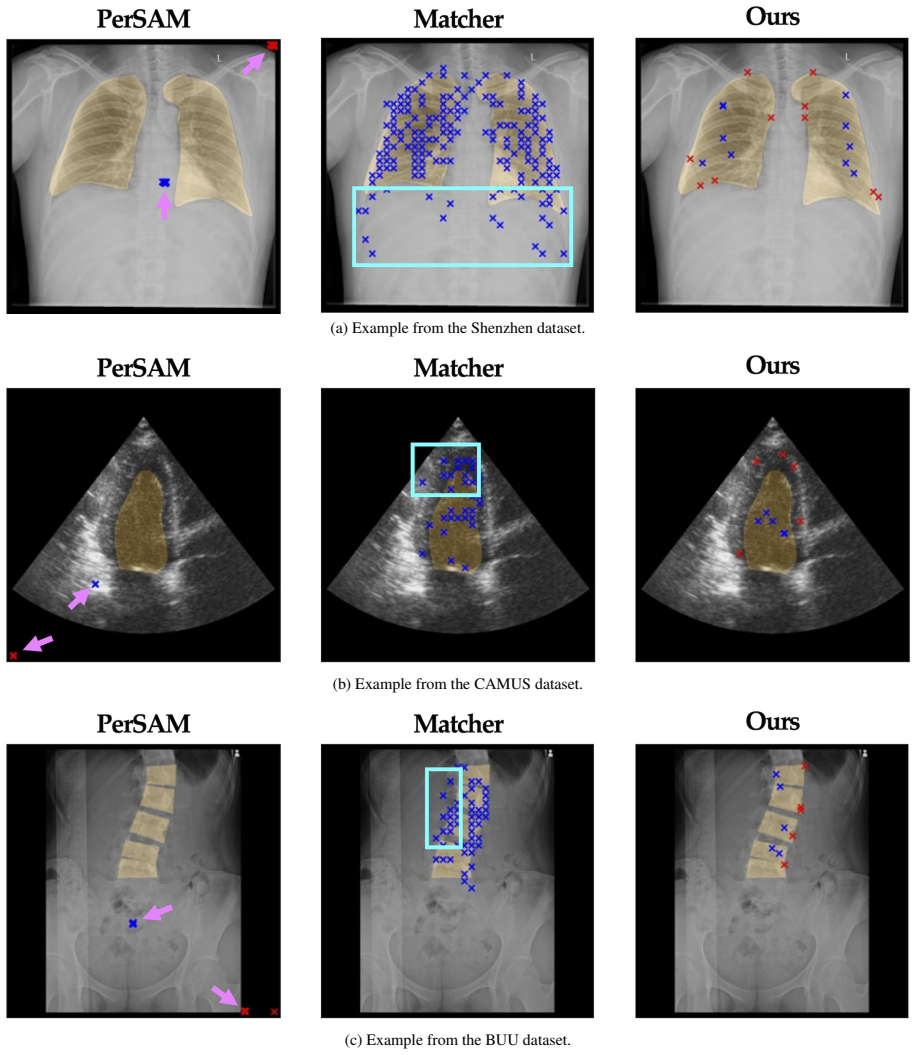
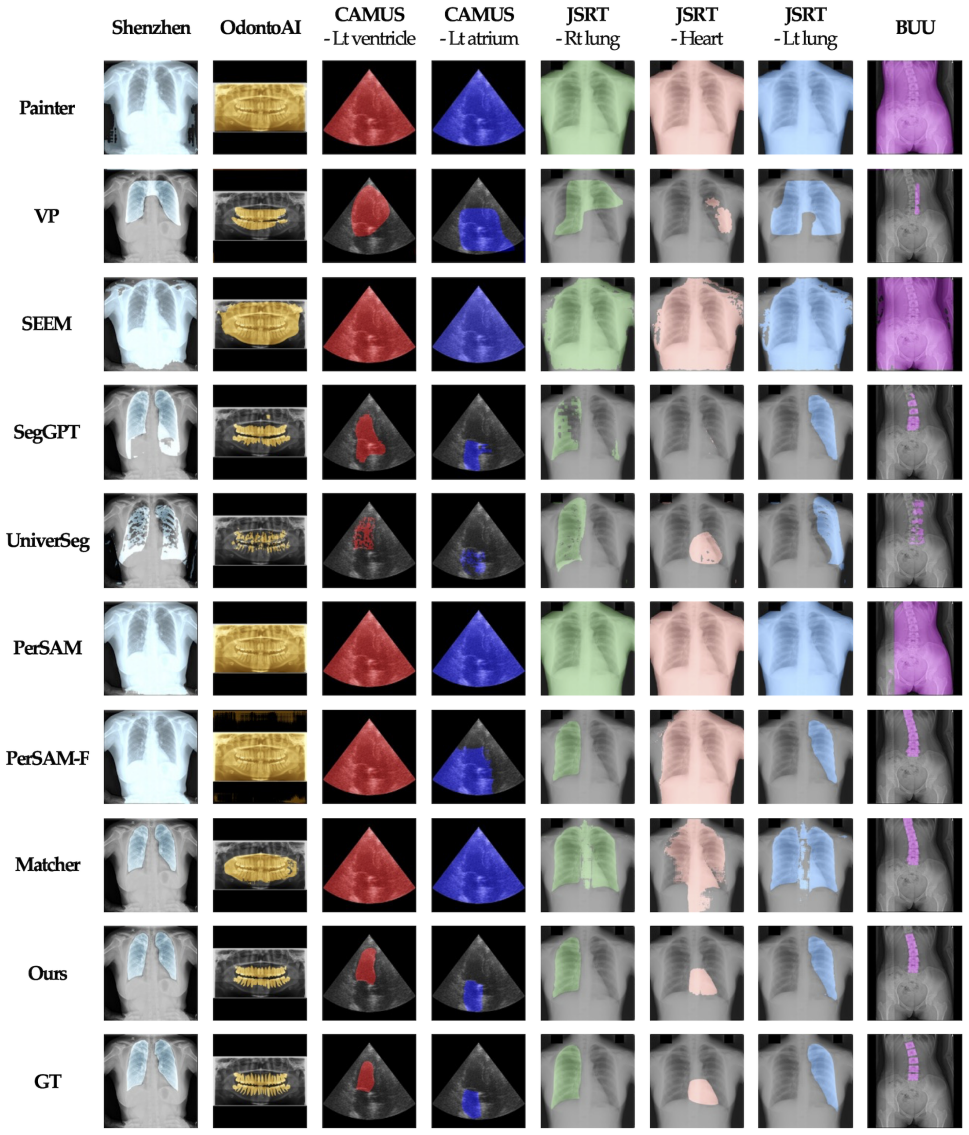
The central claim is that the poor performance of one-shot SAM in medical imaging comes from placing point prompts through pixel- or feature-similarity, which misplaces points in grayscale images where organs share intensities and clusters them around confident regions. Med-PerSAM claims to remove this bottleneck by learning the optical flow $f_\theta$ that registers the single reference image to each test image, warping the reference mask accordingly to produce a dense mask prompt, and extracting positive and negative point prompts from eroded and dilated subregions of that mask plus a box prompt. Using these automatically generated visual prompts, the frozen SAM reaches DICE scores of 92.0, 87.8, 74.2, 91.3, and 72.9 on Shenzhen, OdontoAI, CAMUS, JSRT, and BUU, outperforming PerSAM, Matcher, and every other compared foundation model on all five datasets without any fine-tuning of SAM or human intervention.
Load-bearing premise
The load-bearing assumption is that one reference image can be warped, pixel by pixel, into each unlabeled test image so that the reference mask rides along and lands on the target organ; when capture pose or scan range varies too much for such warping, the prompt misaligns and the whole chain breaks.
Editorial extensions
If this is right
- Frozen SAM can be personalized for a medical dataset from one labeled image plus unlabeled images, so no task-specific fine-tuning of the 641M-parameter model is needed.
- Dense mask prompts derived from registration are more reliable than point prompts placed by pixel similarity; the subregion-based point extraction removes the clustering and misplacement problems that hurt PerSAM and Matcher.
- Iterative retraining with SAM outputs as pseudolabels gives the framework a self-correction capacity; when the initial mask prompt is deliberately perturbed by a factor of 0.2, repeated retraining largely closes the performance gap.
- The method is relatively robust to domain shift: changing the reference sample to one from a different chest X-ray dataset barely changes DICE, and test-sample perturbations degrade Med-PerSAM less than the strongest baselines.
- Extension to multi-class segmentation is direct via one-hot mask prompts per foreground class, so the same warping-plus-prompt loop applies beyond binary organs.
Reading between the lines
- Beyond the paper: because the warping model is trained on the unlabeled test set, this is a test-time adaptation scheme rather than a zero-shot predictor; deploying it on a single arriving image without access to the rest of the test set would require a different training procedure.
- Beyond the paper: the registration bottleneck suggests a concrete extension where an explicit spatial transformer or a small atlas of multiple reference samples is used to rescue the mask prompt when pose or scan-range variation is extreme, a variant that could be tested directly on the failure cases the paper acknowledges.
- Beyond the paper: if the warping-to-prompt loop is the true source of the gain, swapping the 2D warper for a 3D one should extend the same mechanism to volumetric medical data, an open direction the paper lists as future work.
- Beyond the paper: the comparison with PerSAM and Matcher depends on the reference-sample selection protocol, so an independent re-run across many random reference samples, rather than the ten-sample average reported, would clarify how much of the advantage is robust to reference choice.
Editorial analysis
A structured set of objections, weighed in public.
Referee Report
Summary. The paper introduces Med-PerSAM, a one-shot visual prompt tuning framework for SAM in medical image segmentation. Given a single reference image and its mask plus an unlabeled test set, a lightweight warping model (about 19M parameters, based on NICE-Trans) is trained to align the reference to each test image, producing a warped mask that serves as a mask prompt; point and box prompts are then extracted via morphological operations and similarity-based subregion selection, and SAM's iterative predictions are used to refine prompts and to retrain the warping model with pseudolabels. Experiments on five 2D medical datasets report large DICE gains over PerSAM, Matcher, and other foundation-model baselines, with additional ablations, cross-dataset tests, and perturbation robustness studies. The central claim is that Med-PerSAM achieves superior performance 'without additional fine-tuning of SAM or manual visual prompts' in a one-shot setting.
Significance. If the reported gains were obtained under the claimed protocol, the paper would make a useful contribution: automated visual-prompt generation for SAM in medical imaging, a lightweight prompt-tuning mechanism, and an iterative refinement loop that appears to improve robustness. The manuscript is also commendably thorough in its ablations, including multiple reference samples (Table 2), cross-dataset reference swaps (Table 5), perturbation studies (Tables 6 and 15), and mask-prompt perturbation experiments (Fig. 6). However, the headline claim is not currently supported because the method trains on the unlabeled test set (transductive) and tunes key hyperparameters on test DICE, whereas the main baselines are inference-only. The comparison in Table 1 therefore conflates test-time adaptation and test-set selection with one-shot, training-free adaptation. With a corrected evaluation protocol, the method could still be valuable, but it would more accurately be characterized as a transductive/test-time-adaptation approach rather than a standard one-shot inference method.
major comments (3)
- [Sec. 3.1, Eq. (3); Sec. 4.3; Sec. 4.4] The warping model fθ is trained on the unlabeled test images before SAM inference. Section 3.1 states that 'training takes place between the reference sample and the test set, similar to the setting of test-time training/adaptation', and Eq. (3) minimizes Ltrain over the test images I_i. Consequently, every test image is seen as a training example, whereas PerSAM and Matcher are pure inference baselines that never train on the test set. The large margins in Table 1 therefore reflect an asymmetric comparison: Med-PerSAM receives test-time adaptation of a 19M-parameter model, while the baselines do not. To support the claim of one-shot, training-free superiority, the authors should either evaluate on a held-out split with a separate validation set, compare against transductive/test-time-adaptation baselines under the same protocol, or explicitly re-frame the method and claims as test-time adaptation rather than inference-only prompting.
- [Appendix C.2, Fig. 7; Sec. 4.3; Appendix B.1, Tables 12-13; Appendix C.1] Several hyperparameters are selected using the test set itself. Appendix C.2 says the number of point prompts K was chosen by varying K and measuring DICE on test images (Fig. 7), and Section 4.3 reports different K values per dataset. In addition, loss coefficients (Table 12), augmentation ranges (Table 13), and morphological kernel sizes (Appendix C.1) are dataset-specific. On small test cohorts such as CAMUS, JSRT, and BUU, even a small number of such choices can inflate reported scores. The authors should demonstrate that the reported performance is stable under a fixed hyperparameter configuration, or use a held-out validation set for selection, clearly separated from the final test evaluation.
- [Sec. 3.3; Sec. 4.7; Fig. 6] The iterative retraining loop uses SAM's own predictions as pseudolabels to retrain the warping model, after which those same SAM predictions are refined again. Since the final metrics are computed against external ground truth, this is not a logical circularity, but it creates a risk that the loop reinforces SAM's inductive biases rather than learning genuinely better prompts. The paper should report results with the retraining component disabled (i.e., using only the initially trained warping model and prompt generation, with and without prompt refinement) to quantify how much of the final gain is attributable to the pseudolabel loop, and ideally verify on a held-out set that the improvements from retraining generalize rather than reflecting adaptation to the specific test images.
minor comments (5)
- [Sec. 4.4] There are repeated typos: 'signficantly' should be 'significantly', and the sentence 'our model model consistently achieves reliable results' contains a duplicated word.
- [Sec. 4.5, Table 4] The heading 'Hopkin's statistics' should be 'Hopkins' statistics'. Also, the exclusion of Matcher from Table 4 is justified by different point numbers, but the comparison of clustering tendency would be more informative if Matcher were evaluated with the same number of points as the other methods.
- [Fig. 7] The x-axis label 'N umber of Points' contains an awkward space; it should read 'Number of Points'.
- [Abstract; Sec. 4.3] The phrase 'without additional fine-tuning' is ambiguous: SAM itself is indeed frozen, but the 19M-parameter warping model is trained on the test set. The wording should be clarified in the abstract and throughout, e.g., 'without fine-tuning SAM' rather than 'without additional training of the pretrained SAM or human intervention', which suggests no training occurs at all.
- [Sec. 4.3; Appendix B.4] The statement that replacing SAM with SAM2 yields 'similar performance' is supported by Table 14, but the discussion would benefit from reporting whether the differences are statistically significant given the small per-dataset differences.
Circularity Check
No circular derivation: the claimed segmentation gains are benchmarked against external ground truth, and the self-referential retraining loop is not equivalent to its inputs.
full rationale
Med-PerSAM's central claim is an empirical performance claim. Table 1 reports DICE and mIoU against public ground-truth labels from Shenzhen, OdontoAI, CAMUS, JSRT, and BUU, none of which appear in any training loss, so the reported scores cannot be reduced to the method's inputs by construction. The warping model is trained with Ltrain (Eq. 3) on the unlabeled test images, which is transductive test-time adaptation rather than a fitted parameter being renamed as a prediction; the final SAM masks are external outputs, not the warping loss targets. The pseudolabel retraining loop (Sec. 3.3) uses SAM's own predictions as supervision, so it is self-referential in mechanism, but its claimed improvements are independently checked against ground truth (Fig. 6, Table 15), so the improvement claim is not forced by definition. Test-set hyperparameter selection (App. C.2, Tables 12 and 13) is a benchmark-fairness and soundness limitation that can inflate absolute scores, but it does not make any predicted quantity equal to its fitting target. The only author self-citation (ref. [26] in Related Works) is not load-bearing for any result. Overall, no step in the paper's derivation chain is circular under the standards in the hard rules.
Assumptions & free parameters
free parameters (5)
- Number of point prompts per image =
10 for bilateral organs, 5 for unilateral organs
- Loss coefficients λreg and λaug =
λreg 0.6-0.9, λaug 0.1-0.5 depending on dataset
- Morphological kernel sizes Ke and Kd =
7×7 (Shenzhen, JSRT), 5×5 (CAMUS), 3×3 (OdontoAI, BUU)
- Number of retraining rounds and prompt refinement iterations =
5 retrains, 1 refinement
- Initial training epochs =
30 (most), 20 (CAMUS), 10 (Shenzhen perturbed)
assumptions (4)
- domain assumption Inter-patient deformable registration can align the reference image to test images sufficiently for mask transfer.
- domain assumption A SAM mask prompt used alone causes malfunctions, so point and box prompts are required.
- domain assumption The class prototype vector (average SAM foreground feature of the reference) is a reliable indicator of target-object similarity in test images.
- domain assumption SAM's output masks are accurate enough to serve as pseudolabels for retraining the warping model.
Cite this review
Pith. "Pith review of Med-PerSAM: One-Shot Visual Prompt Tuning for Personalized Segment Anything Model in Medical Domain." pith.science (2026). https://pith.science/paper/YWPNZJ3V
@misc{pith2026241116123,
  author       = {Pith},
  title        = {Pith review of: Med-PerSAM: One-Shot Visual Prompt Tuning for Personalized Segment Anything Model in Medical Domain},
  year         = {2026},
  howpublished = {\url{https://pith.science/paper/YWPNZJ3V}},
  note         = {Machine review of arXiv:2411.16123}
}
read the original abstract
Leveraging pre-trained models with tailored prompts for in-context learning has proven highly effective in NLP tasks. Building on this success, recent studies have applied a similar approach to the Segment Anything Model (SAM) within a ``one-shot" framework, where only a single reference image and its label are employed. However, these methods face limitations in the medical domain, primarily due to SAM's essential requirement for visual prompts and the over-reliance on pixel similarity for generating them. This dependency may lead to (1) inaccurate prompt generation and (2) clustering of point prompts, resulting in suboptimal outcomes. To address these challenges, we introduce \textbf{Med-PerSAM}, a novel and straightforward one-shot framework designed for the medical domain. Med-PerSAM uses only visual prompt engineering and eliminates the need for additional training of the pretrained SAM or human intervention, owing to our novel automated prompt generation process. By integrating our lightweight warping-based prompt tuning model with SAM, we enable the extraction and iterative refinement of visual prompts, enhancing the performance of the pre-trained SAM. This advancement is particularly meaningful in the medical domain, where creating visual prompts poses notable challenges for individuals lacking medical expertise. Our model outperforms various foundational models and previous SAM-based approaches across diverse 2D medical imaging datasets.
Figures


Figures from the paper (10 more)





Reference graph
Works this paper leans on
-
[2]
Role of segmentation in medical imaging: A compara- tive study
Preeti Aggarwal, Renu Vig, Sonali Bhadoria, and CG De- the. Role of segmentation in medical imaging: A compara- tive study. International Journal of Computer Applications, 29(1):54–61, 2011. 1
work page 2011
-
[3]
Protosam-one shot medical image segmentation with foun- dational models
Lev Ayzenberg, Raja Giryes, and Hayit Greenspan. Protosam-one shot medical image segmentation with foun- dational models. arXiv preprint arXiv:2407.07042, 2024. 3
arXiv 2024
-
[4]
V oxelmorph: a learning framework for deformable medical image registration
Guha Balakrishnan, Amy Zhao, Mert R Sabuncu, John Gut- tag, and Adrian V Dalca. V oxelmorph: a learning framework for deformable medical image registration. IEEE transac- tions on medical imaging , 38(8):1788–1800, 2019. 2, 3, 7, 13
work page 2019
-
[5]
Visual prompting via image inpaint- ing
Amir Bar, Yossi Gandelsman, Trevor Darrell, Amir Glober- son, and Alexei Efros. Visual prompting via image inpaint- ing. Advances in Neural Information Processing Systems , 35:25005–25017, 2022. 1, 5, 6
work page 2022
-
[6]
Gary Bradski, Adrian Kaehler, et al. Opencv. Dr. Dobb’s journal of software tools, 3(2), 2000. 4, 15
work page 2000
-
[7]
Lan- guage models are few-shot learners
Tom Brown, Benjamin Mann, Nick Ryder, Melanie Sub- biah, Jared D Kaplan, Prafulla Dhariwal, Arvind Neelakan- tan, Pranav Shyam, Girish Sastry, Amanda Askell, et al. Lan- guage models are few-shot learners. Advances in neural in- formation processing systems, 33:1877–1901, 2020. 2
1901
-
[8]
Lan- guage models are few-shot learners
Tom Brown, Benjamin Mann, Nick Ryder, Melanie Sub- biah, Jared D Kaplan, Prafulla Dhariwal, Arvind Neelakan- tan, Pranav Shyam, Girish Sastry, Amanda Askell, et al. Lan- guage models are few-shot learners. Advances in neural in- formation processing systems, 33:1877–1901, 2020. 1
1901
-
[9]
Uni- verseg: Universal medical image segmentation
Victor Ion Butoi, Jose Javier Gonzalez Ortiz, Tianyu Ma, Mert R Sabuncu, John Guttag, and Adrian V Dalca. Uni- verseg: Universal medical image segmentation. arXiv preprint arXiv:2304.06131, 2023. 1, 5, 6
arXiv 2023
Show all 73 references
-
[10]
Semi-supervised task-driven data augmentation for medical image segmentation
Krishna Chaitanya, Neerav Karani, Christian F Baumgart- ner, Ertunc Erdil, Anton Becker, Olivio Donati, and Ender Konukoglu. Semi-supervised task-driven data augmentation for medical image segmentation. Medical Image Analysis , 68:101934, 2021. 2
2021
-
[11]
Remedios, Shunxing Bao, Bennett A
Ruining Deng, Can Cui, Quan Liu, Tianyuan Yao, Lucas W. Remedios, Shunxing Bao, Bennett A. Landman, Lee E. Wheless, Lori A. Coburn, Keith T. Wilson, Yaohong Wang, Shilin Zhao, Agnes B. Fogo, Haichun Yang, Yucheng Tang, and Yuankai Huo. Segment anything model (sam) for digi- ta...
2023
-
[12]
Measures of the amount of ecologic association between species
Lee R Dice. Measures of the amount of ecologic association between species. Ecology, 26(3):297–302, 1945. 6
1945
-
[13]
A survey for in-context learning
Qingxiu Dong, Lei Li, Damai Dai, Ce Zheng, Zhiyong Wu, Baobao Chang, Xu Sun, Jingjing Xu, and Zhifang Sui. A survey for in-context learning. arXiv preprint arXiv:2301.00234, 2022. 1
2022 arXiv
-
[14]
Improving anatomical plausibility in medical image segmentation via hybrid graph neural networks: applications to chest x-ray analysis
Nicol ´as Gaggion, Lucas Mansilla, Candelaria Mosquera, Diego H Milone, and Enzo Ferrante. Improving anatomical plausibility in medical image segmentation via hybrid graph neural networks: applications to chest x-ray analysis. IEEE Transactions on Medical Imaging, 42(2):546–55...
2022
-
[15]
Simcse: Simple contrastive learning of sentence embeddings
Tianyu Gao, Xingcheng Yao, and Danqi Chen. Simcse: Simple contrastive learning of sentence embeddings. arXiv preprint arXiv:2104.08821, 2021. 4
2021 arXiv
-
[16]
Variational encoding and decoding for hybrid supervision of registration network
Dongdong Gu, Xiaohuan Cao, Guocai Liu, Zhong Xue, and Dinggang Shen. Variational encoding and decoding for hybrid supervision of registration network. In Machine Learning in Medical Imaging: 12th International Workshop, MLMI 2021, Held in Conjunction with MICCAI 2021, Stras- b...
2021
-
[17]
Domain adaptation for medical image analysis: A survey
Hao Guan and Mingxia Liu. Domain adaptation for medical image analysis: A survey. IEEE Transactions on Biomedical Engineering, 69(3):1173–1185, 2022. 6
2022
-
[18]
Ellen Grant, and Yangming Ou
Sheng He, Rina Bao, Jingpeng Li, Jeffrey Stout, Atle Bjornerud, P. Ellen Grant, and Yangming Ou. Computer- vision benchmark segment-anything model (sam) in medical images: Accuracy in 12 datasets, 2023. 3
2023
-
[19]
Learn2reg: comprehensive multi-task medical image regis- tration challenge, dataset and evaluation in the era of deep learning
Alessa Hering, Lasse Hansen, Tony CW Mok, Albert CS Chung, Hanna Siebert, Stephanie H ¨ager, Annkristin Lange, Sven Kuckertz, Stefan Heldmann, Wei Shao, et al. Learn2reg: comprehensive multi-task medical image regis- tration challenge, dataset and evaluation in the era of deep...
2022
-
[20]
When sam meets medical images: An investigation of seg- ment anything model (sam) on multi-phase liver tumor seg- mentation, 2023
Chuanfei Hu, Tianyi Xia, Shenghong Ju, and Xinde Li. When sam meets medical images: An investigation of seg- ment anything model (sam) on multi-phase liver tumor seg- mentation, 2023. 3
2023
-
[21]
Many-to-many splatting for efficient video frame interpola- tion
Ping Hu, Simon Niklaus, Stan Sclaroff, and Kate Saenko. Many-to-many splatting for efficient video frame interpola- tion. In Proceedings of the IEEE/CVF Conference on Com- puter Vision and Pattern Recognition , pages 3553–3562,
-
[22]
Two public chest x-ray datasets for computer-aided screening of pulmonary diseases
Stefan Jaeger, Sema Candemir, Sameer Antani, Y `ı-Xi´ang J W´ang, Pu-Xuan Lu, and George Thoma. Two public chest x-ray datasets for computer-aided screening of pulmonary diseases. Quantitative imaging in medicine and surgery , 4 (6):475, 2014. 5, 13
2014
-
[23]
Tumor aware recur- rent inter-patient deformable image registration of com- puted tomography scans with lung cancer
Jue Jiang, Chloe Min Seo Choi, Maria Thor, Joseph O Deasy, and Harini Veeraraghavan. Tumor aware recur- rent inter-patient deformable image registration of com- puted tomography scans with lung cancer. arXiv preprint arXiv:2409.11910, 2024. 2, 7
2024 arXiv
-
[24]
On the effect of inter-observer variability for a re- liable estimation of uncertainty of medical image segmenta- tion
Alain Jungo, Raphael Meier, Ekin Ermis, Marcela Blatti- Moreno, Evelyn Herrmann, Roland Wiest, and Mauricio Reyes. On the effect of inter-observer variability for a re- liable estimation of uncertainty of medical image segmenta- tion. In Medical Image Computing and Computer As...
2018
-
[25]
Harmony4d: A video dataset for in-the-wild close human interactions
Rawal Khirodkar, Jyun-Ting Song, Jinkun Cao, Zhengyi Luo, and Kris Kitani. Harmony4d: A video dataset for in-the-wild close human interactions. arXiv preprint arXiv:2410.20294, 2024. 1
2024 arXiv
-
[26]
Data-efficient unsupervised interpolation without any intermediate frame for 4d medical images
JungEun Kim, Hangyul Yoon, Geondo Park, Kyungsu Kim, and Eunho Yang. Data-efficient unsupervised interpolation without any intermediate frame for 4d medical images. In Proceedings of the IEEE/CVF Conference on Computer Vi- sion and Pattern Recognition, pages 11353–11364, 2024. 2
2024
-
[27]
Segment any- thing
Alexander Kirillov, Eric Mintun, Nikhila Ravi, Hanzi Mao, Chloe Rolland, Laura Gustafson, Tete Xiao, Spencer White- head, Alexander C Berg, Wan-Yen Lo, et al. Segment any- thing. arXiv preprint arXiv:2304.02643 , 2023. 1, 2, 3, 5, 14
2023 arXiv
-
[28]
Buu-lspine: A thai open lumbar spine dataset for spondylolisthesis detection
Podchara Klinwichit, Watcharaphong Yookwan, Sornsupha Limchareon, Krisana Chinnasarn, Jun-Su Jang, and Athita Onuean. Buu-lspine: A thai open lumbar spine dataset for spondylolisthesis detection. Applied Sciences, 13(15):8646,
-
[29]
New index for cluster- ing tendency and its application to chemical problems
Richard G Lawson and Peter C Jurs. New index for cluster- ing tendency and its application to chemical problems. Jour- nal of chemical information and computer sciences , 30(1): 36–41, 1990. 6
1990
-
[30]
Deep learning for segmentation using an open large-scale dataset in 2d echocardiography
Sarah Leclerc, Erik Smistad, Joao Pedrosa, Andreas Østvik, Frederic Cervenansky, Florian Espinosa, Torvald Espeland, Erik Andreas Rye Berg, Pierre-Marc Jodoin, Thomas Gre- nier, et al. Deep learning for segmentation using an open large-scale dataset in 2d echocardiography. IEE...
2019
-
[31]
Matcher: Segment anything with one shot using all-purpose feature matching
Yang Liu, Muzhi Zhu, Hengtao Li, Hao Chen, Xinlong Wang, and Chunhua Shen. Matcher: Segment anything with one shot using all-purpose feature matching. arXiv preprint arXiv:2305.13310, 2023. 1, 2, 3, 5, 6, 14, 18
2023 arXiv
-
[32]
Decoupled weight decay regularization
Ilya Loshchilov and Frank Hutter. Decoupled weight decay regularization. arXiv preprint arXiv:1711.05101, 2017. 14
2017 arXiv
-
[33]
Segment anything in medical images
Jun Ma, Yuting He, Feifei Li, Lin Han, Chenyu You, and Bo Wang. Segment anything in medical images. Nature Communications, 15(1):654, 2024. 3
2024
-
[34]
Learn- ing deformable registration of medical images with anatom- ical constraints
Lucas Mansilla, Diego H Milone, and Enzo Ferrante. Learn- ing deformable registration of medical images with anatom- ical constraints. Neural Networks, 124:269–279, 2020. 2, 7
2020
-
[35]
Non-iterative coarse-to-fine transformer net- works for joint affine and deformable image registration
Mingyuan Meng, Lei Bi, Michael Fulham, Dagan Feng, and Jinman Kim. Non-iterative coarse-to-fine transformer net- works for joint affine and deformable image registration. In International Conference on Medical Image Computing and Computer-Assisted Intervention , pages 750–760....
-
[36]
Correlation-aware coarse-to-fine mlps for deformable medi- cal image registration
Mingyuan Meng, Dagan Feng, Lei Bi, and Jinman Kim. Correlation-aware coarse-to-fine mlps for deformable medi- cal image registration. InProceedings of the IEEE/CVF Con- ference on Computer Vision and Pattern Recognition, pages 9645–9654, 2024. 3, 13
2024
-
[37]
V-net: Fully convolutional neural networks for volumetric medical image segmentation
Fausto Milletari, Nassir Navab, and Seyed-Ahmad Ahmadi. V-net: Fully convolutional neural networks for volumetric medical image segmentation. In 2016 fourth international conference on 3D vision (3DV), pages 565–571. Ieee, 2016. 3
2016
-
[38]
Fast binary dilation/erosion algorithm us- ing kernel subdivision
Ajay Narayanan. Fast binary dilation/erosion algorithm us- ing kernel subdivision. In Computer Vision–ACCV 2006: 7th Asian Conference on Computer Vision, Hyderabad, India, January 13-16, 2006. Proceedings, Part II 7, pages 335–342. Springer, 2006. 4
2006
-
[39]
Context-aware synthesis for video frame interpolation
Simon Niklaus and Feng Liu. Context-aware synthesis for video frame interpolation. In Proceedings of the IEEE con- ference on computer vision and pattern recognition , pages 1701–1710, 2018. 2
2018
-
[40]
Gpt-4 technical report
R OpenAI. Gpt-4 technical report. arxiv 2303.08774. View in Article, 2:13, 2023. 1
2023 arXiv
-
[41]
Dinov2: Learning robust visual features without supervision
Maxime Oquab, Timoth ´ee Darcet, Th ´eo Moutakanni, Huy V o, Marc Szafraniec, Vasil Khalidov, Pierre Fernandez, Daniel Haziza, Francisco Massa, Alaaeldin El-Nouby, et al. Dinov2: Learning robust visual features without supervision. arXiv preprint arXiv:2304.07193, 2023. 3
2023 arXiv
-
[42]
Video-based ai for beat-to-beat assessment of cardiac func- tion
David Ouyang, Bryan He, Amirata Ghorbani, Neal Yuan, Joseph Ebinger, Curtis P Langlotz, Paul A Heidenreich, Robert A Harrington, David H Liang, Euan A Ashley, et al. Video-based ai for beat-to-beat assessment of cardiac func- tion. Nature, 580(7802):252–256, 2020. 1
2020
-
[43]
Limitations of the ssim quality metric in the context of diagnostic imaging
Jean-Franc ¸ois Pambrun and Rita Noumeir. Limitations of the ssim quality metric in the context of diagnostic imaging. In 2015 IEEE international conference on image processing (ICIP), pages 2960–2963. IEEE, 2015. 13
2015
-
[44]
Asymmetric bilateral motion estimation for video frame interpolation
Junheum Park, Chul Lee, and Chang-Su Kim. Asymmetric bilateral motion estimation for video frame interpolation. In Proceedings of the IEEE/CVF International Conference on Computer Vision, pages 14539–14548, 2021. 2
2021
-
[45]
Biformer: Learning bilateral motion estimation via bilateral trans- former for 4k video frame interpolation
Junheum Park, Jintae Kim, and Chang-Su Kim. Biformer: Learning bilateral motion estimation via bilateral trans- former for 4k video frame interpolation. In Proceedings of the IEEE/CVF Conference on Computer Vision and Pattern Recognition, pages 1568–1577, 2023. 2
2023
-
[46]
Can we trust deep learning based diagnosis? the impact of domain shift in chest radiograph classification
Eduardo HP Pooch, Pedro Ballester, and Rodrigo C Barros. Can we trust deep learning based diagnosis? the impact of domain shift in chest radiograph classification. In Thoracic Image Analysis: Second International Workshop, TIA 2020, Held in Conjunction with MICCAI 2020, Lima, ...
2020
-
[47]
Improving language understanding by gen- erative pre-training
Alec Radford, Karthik Narasimhan, Tim Salimans, Ilya Sutskever, et al. Improving language understanding by gen- erative pre-training. 2018. 2
2018
-
[48]
Language models are unsu- pervised multitask learners
Alec Radford, Jeffrey Wu, Rewon Child, David Luan, Dario Amodei, Ilya Sutskever, et al. Language models are unsu- pervised multitask learners. OpenAI blog, 1(8):9, 2019. 2
2019
-
[49]
Sam 2: Segment anything in images and videos
Nikhila Ravi, Valentin Gabeur, Yuan-Ting Hu, Ronghang Hu, Chaitanya Ryali, Tengyu Ma, Haitham Khedr, Roman R¨adle, Chloe Rolland, Laura Gustafson, et al. Sam 2: Segment anything in images and videos. arXiv preprint arXiv:2408.00714, 2024. 14
2024 arXiv
-
[50]
Contrastive learning with hard negative sam- ples
Joshua Robinson, Ching-Yao Chuang, Suvrit Sra, and Ste- fanie Jegelka. Contrastive learning with hard negative sam- ples. arXiv preprint arXiv:2010.04592, 2020. 4
2010 arXiv
-
[51]
Is sam 2 better than sam in medical image segmentation?arXiv preprint arXiv:2408.04212, 2024
Sourya Sengupta, Satrajit Chakrabarty, and Ravi Soni. Is sam 2 better than sam in medical image segmentation?arXiv preprint arXiv:2408.04212, 2024. 14 10
2024 arXiv
-
[52]
Junji Shiraishi, Shigehiko Katsuragawa, Junpei Ikezoe, Tsu- neo Matsumoto, Takeshi Kobayashi, Ken-ichi Komatsu, Mi- tate Matsui, Hiroshi Fujita, Yoshie Kodera, and Kunio Doi. Development of a digital image database for chest radio- graphs with and without a lung nodule: receiv...
2000
-
[53]
Medical image registration based on uncoupled learning and accumulative enhancement
Yucheng Shu, Hao Wang, Bin Xiao, Xiuli Bi, and Weisheng Li. Medical image registration based on uncoupled learning and accumulative enhancement. In International Conference on Medical Image Computing and Computer-Assisted Inter- vention, pages 3–13. Springer, 2021. 3
2021
-
[54]
Odontoai: A human- in-the-loop labeled data set and an online platform to boost research on dental panoramic radiographs
Bernardo Silva, La ´ıs Pinheiro, Brenda Sobrinho, Fernanda Lima, Bruna Sobrinho, Kalyf Abdalla, Matheus Pithon, Patr´ıcia Cury, and Luciano Oliveira. Odontoai: A human- in-the-loop labeled data set and an online platform to boost research on dental panoramic radiographs. arXiv...
2022 arXiv
-
[55]
⊥-loss: A symmetric loss function for magnetic resonance imaging reconstruction and image registration with deep learning
Maarten L Terpstra, Matteo Maspero, Alessandro Sbrizzi, and Cornelis AT van den Berg. ⊥-loss: A symmetric loss function for magnetic resonance imaging reconstruction and image registration with deep learning. Medical Image Anal- ysis, 80:102509, 2022. 3
2022
-
[56]
Llama: Open and efficient foundation language models
Hugo Touvron, Thibaut Lavril, Gautier Izacard, Xavier Martinet, Marie-Anne Lachaux, Timoth ´ee Lacroix, Bap- tiste Rozi `ere, Naman Goyal, Eric Hambro, Faisal Azhar, et al. Llama: Open and efficient foundation language models. arXiv preprint arXiv:2302.13971, 2023. 2
2023 arXiv
-
[57]
Llama 2: Open foundation and fine-tuned chat models.arXiv preprint arXiv:2307.09288, 2023
Hugo Touvron, Louis Martin, Kevin Stone, Peter Albert, Amjad Almahairi, Yasmine Babaei, Nikolay Bashlykov, Soumya Batra, Prajjwal Bhargava, Shruti Bhosale, et al. Llama 2: Open foundation and fine-tuned chat models.arXiv preprint arXiv:2307.09288, 2023. 2
2023 arXiv
-
[58]
Multi-stage transfer learning for lung segmentation using portable x-ray devices for patients with covid-19
Pl ´acido L Vidal, Joaquim de Moura, Jorge Novo, and Marcos Ortega. Multi-stage transfer learning for lung segmentation using portable x-ray devices for patients with covid-19. Ex- pert Systems with Applications, 173:114677, 2021. 1
2021
-
[59]
Images speak in images: A generalist painter for in-context visual learning
Xinlong Wang, Wen Wang, Yue Cao, Chunhua Shen, and Tiejun Huang. Images speak in images: A generalist painter for in-context visual learning. In Proceedings of the IEEE/CVF Conference on Computer Vision and Pattern Recognition, pages 6830–6839, 2023. 1, 2, 5, 6
2023
-
[60]
Seggpt: Segmenting ev- erything in context
Xinlong Wang, Xiaosong Zhang, Yue Cao, Wen Wang, Chunhua Shen, and Tiejun Huang. Seggpt: Segmenting ev- erything in context. arXiv preprint arXiv:2304.03284, 2023. 1, 2, 5, 6
2023 arXiv
-
[61]
Emergent abilities of large language models
Jason Wei, Yi Tay, Rishi Bommasani, Colin Raffel, Barret Zoph, Sebastian Borgeaud, Dani Yogatama, Maarten Bosma, Denny Zhou, Donald Metzler, et al. Emergent abilities of large language models. arXiv preprint arXiv:2206.07682 ,
-
[62]
Chain-of-thought prompting elicits reasoning in large lan- guage models
Jason Wei, Xuezhi Wang, Dale Schuurmans, Maarten Bosma, Fei Xia, Ed Chi, Quoc V Le, Denny Zhou, et al. Chain-of-thought prompting elicits reasoning in large lan- guage models. Advances in Neural Information Processing Systems, 35:24824–24837, 2022. 1
2022
-
[63]
Prompting segment anything model with domain-adaptive prototype for generalizable medical image segmentation
Zhikai Wei, Wenhui Dong, Peilin Zhou, Yuliang Gu, Zhou Zhao, and Yongchao Xu. Prompting segment anything model with domain-adaptive prototype for generalizable medical image segmentation. In International Conference on Med- ical Image Computing and Computer-Assisted Interventi...
2024
-
[64]
Wong, Marianne Rakic, John Guttag, and Adrian V
Hallee E. Wong, Marianne Rakic, John Guttag, and Adrian V . Dalca. Scribbleprompt: Fast and flexible inter- active segmentation for any medical image, 2023
2023
-
[65]
Medical sam adapter: Adapting seg- ment anything model for medical image segmentation, 2023
Junde Wu, Wei Ji, Yuanpei Liu, Huazhu Fu, Min Xu, Yanwu Xu, and Yueming Jin. Medical sam adapter: Adapting seg- ment anything model for medical image segmentation, 2023. 3
2023
-
[66]
Cat-sam: Con- ditional tuning for few-shot adaptation of segment anything model
Aoran Xiao, Weihao Xuan, Heli Qi, Yun Xing, Ruijie Ren, Xiaoqin Zhang, Ling Shao, and Shijian Lu. Cat-sam: Con- ditional tuning for few-shot adaptation of segment anything model. arXiv preprint arXiv:2402.03631, 2024. 3
2024 arXiv
-
[67]
Customized segment any- thing model for medical image segmentation
Kaidong Zhang and Dong Liu. Customized segment any- thing model for medical image segmentation. arXiv preprint arXiv:2304.13785, 2023. 3
2023 arXiv
-
[68]
Person- alize segment anything model with one shot
Renrui Zhang, Zhengkai Jiang, Ziyu Guo, Shilin Yan, Junt- ing Pan, Hao Dong, Peng Gao, and Hongsheng Li. Person- alize segment anything model with one shot. arXiv preprint arXiv:2305.03048, 2023. 1, 2, 3, 5, 6, 7, 14, 15, 18
2023 arXiv
-
[69]
Unleashing the potential of sam2 for biomedical images and videos: A survey
Yichi Zhang and Zhenrong Shen. Unleashing the potential of sam2 for biomedical images and videos: A survey. arXiv preprint arXiv:2408.12889, 2024. 14
2024 arXiv
-
[70]
Semi-supervised cardiac image segmentation via label prop- agation and style transfer
Yao Zhang, Jiawei Yang, Feng Hou, Yang Liu, Yixin Wang, Jiang Tian, Cheng Zhong, Yang Zhang, and Zhiqiang He. Semi-supervised cardiac image segmentation via label prop- agation and style transfer. In Statistical Atlases and Com- putational Models of the Heart. M&Ms and EMIDEC ...
2020
-
[71]
Can sam segment polyps?, 2023
Tao Zhou, Yizhe Zhang, Yi Zhou, Ye Wu, and Chen Gong. Can sam segment polyps?, 2023. 3
2023
-
[72]
Test-time training for deformable multi-scale image registration
Wentao Zhu, Yufang Huang, Daguang Xu, Zhen Qian, Wei Fan, and Xiaohui Xie. Test-time training for deformable multi-scale image registration. In 2021 IEEE International Conference on Robotics and Automation (ICRA) , pages 13618–13625. IEEE, 2021. 3
2021
-
[73]
Segment everything everywhere all at once
Xueyan Zou, Jianwei Yang, Hao Zhang, Feng Li, Linjie Li, Jianfeng Wang, Lijuan Wang, Jianfeng Gao, and Yong Jae Lee. Segment everything everywhere all at once. Advances in Neural Information Processing Systems, 36, 2024. 1, 5, 6 11 Part I Appendix Table of Contents A . Dataset...
2024
-
[74]
target-semantic prompting
comprises teeth segmentation data, and we select 555 patients presenting a full set of 32 normal teeth. Addition- ally, we engaged with the CAMUS dataset [30], a cardiac ultrasound image dataset. We selected images from 500 patients, focusing on the 4-chamber view during the e...
Reviewed August 12, 2026 · model on record in the stance chip above.
Discussion (0). Continue with ORCID to comment.