REVIEW 2 major objections 5 minor 3 cited by
Event-boosted Deformable 3D Gaussians for Dynamic Scene Reconstruction
T0 review · 2 major / 5 minor · reviewed 2026-08-12 · deepseek-v4-flash
Pith's one-line read Event streams lift dynamic 3D Gaussian rendering by 2.73 dB
desk verdict Solid engineering with a real new benchmark; the event-gain attribution needs one clean experiment before the 2.73 dB claim is fully credible. read the letter →
The pith
A machine-rendered reading of the paper's core claim, the machinery that carries it, and where it could break.
The reading
What carries the argument
The central object is the learnable threshold map $\hat{C}_{t,f}\in\mathbb{R}^{B\times P\times H\times W}$, one scalar per time bin, polarity, and pixel, used to convert accumulated event counts into a predicted log-brightness change. It is optimized with a threshold loss against RGB frame brightness differences in Eq. (7) and a rendering loss against pseudo-frames rendered by the same 3D Gaussian scene in Eq. (4), and the scene, in turn, is supervised by the threshold-weighted events. The other mechanism is the dynamic-static decomposition: rendered-versus-ground-truth VGG cosine-similarity maps, binarized by Otsu's method, are unprojected to 3D, and Gaussians inside radius $r_1$ are marked dynamic, beyond $r_2$ static, with a pruned buffer zone in between.
What would settle it
Use the same pipeline on a real event camera with independently calibrated per-pixel, per-polarity thresholds, and compare reconstruction PSNR when the scene is trained with those fixed calibrated thresholds versus with the learned maps; if the fixed-calibrated version matches or exceeds the learned version, the paper's central mechanism is not adding independent motion information.
Extended reading notes
Core claim
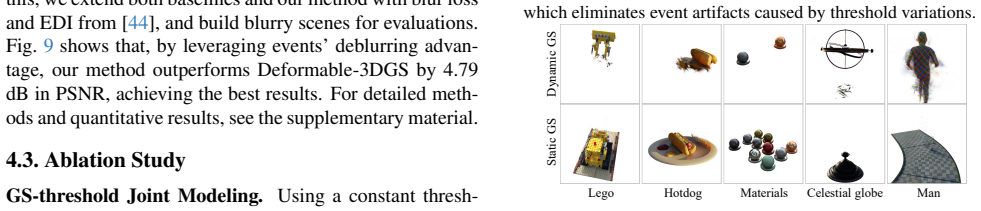
The paper's central claim is that event supervision, properly handled, is the missing ingredient for high-fidelity dynamic scene reconstruction with 3D Gaussian Splatting. With a constant event threshold, opposing-polarity events cancel imperfectly and produce trajectory artifacts and colored haze; the paper shows that optimizing per-pixel, per-polarity, per-time-bin threshold maps jointly with the Gaussians removes these artifacts and improves reconstruction. A second claim is that modeling the whole scene as deformable wastes capacity: by first reconstructing with static Gaussians only, the method locates regions the static model cannot represent, extends the 2D mask to 3D via unprojection, and applies a buffer-based soft decomposition so only genuinely dynamic Gaussians pass through the deformation field. The result is both higher fidelity and faster rendering.
Load-bearing premise
The load-bearing premise is that per-pixel, per-polarity, per-time-bin learnable thresholds, trained against RGB brightness changes and pseudo-frames rendered by the very Gaussian scene being optimized, capture real threshold variation rather than merely re-encoding the RGB supervision.
Editorial extensions
If this is right
- Events can substitute for dense RGB sampling in dynamic scenes, recovering inter-frame motion without raising camera frame rate.
- Threshold non-uniformity is not a nuisance to ignore; modeling it is necessary for clean event-based supervision of Gaussian scenes.
- Splitting the scene into dynamic and static Gaussians accelerates rendering and improves dynamic-region fidelity by not wasting deformation capacity.
- The new event-inclusive 4D benchmark (eight synthetic, four real-world scenes) gives the community a standard testbed for event-based dynamic reconstruction.
- Joint optimization of threshold and scene is mutually reinforcing: better thresholds give better event supervision, and better scenes give better pseudo-frames for threshold refinement.
Reading between the lines
- A direct test of whether the threshold maps add independent geometric information would be a real event camera with independently calibrated per-pixel thresholds; if substituting those calibrated thresholds matches or beats the learned maps, the gain may come mainly from fitting RGB brightness rather than from new motion constraints.
- The same joint-threshold recipe should transfer to event-based deblurring of Gaussian scenes, since motion blur and threshold variation both corrupt event integration.
- For high-speed robot egomotion, where RGB frames are extremely sparse, the dynamic-static split could let a deformation field focus on moving agents while static background is rendered at full speed.
- If threshold maps transfer across scenes captured with the same sensor, they could be pretrained, reducing the per-scene optimization burden.
Editorial analysis
A structured set of objections, weighed in public.
Referee Report
Summary. The paper proposes Event-boosted Deformable 3D Gaussians for dynamic scene reconstruction, integrating event camera streams into deformable 3D Gaussian Splatting. The main components are a GS-threshold joint modeling (GTJM) strategy that optimizes per-pixel, per-polarity, per-time-bin event threshold maps together with the 3D Gaussians, and a dynamic-static decomposition (DSD) strategy that separates static and dynamic Gaussians to improve rendering speed and dynamic-region fidelity. The authors also introduce a new event-inclusive 4D benchmark with eight synthetic and four real-world scenes. Reported results show an average 2.73 dB PSNR gain over their Event-4DGS baseline on synthetic scenes and an average 1.71x speedup over 4D-GS, alongside consistent gains on real-world scenes.
Significance. If the central attribution claim holds, this is a meaningful contribution: it is the first work to bring event supervision into deformable 3D Gaussian Splatting, it demonstrates that threshold modeling matters for event-based 3D reconstruction, and the proposed benchmark could be a useful community resource. The DSD component is a clean idea with a clear speed-quality trade-off, and the ablation results in Table 4 and sensitivity analysis in Fig. 12 are consistent. However, the paper's central claim that event streams provide independent inter-frame geometric information is not yet established, because the learnable threshold maps are fitted with RGB and rendered-image supervision and are then used inside the event loss. The decisive issue is auditability: without a control that breaks the link between event content and RGB supervision, the reported event-boosted gains could be explained by RGB or pseudo-frame information recoded through high-capacity threshold maps. This concern is concrete and testable, and the current paper does not provide the needed experiment.
major comments (2)
- [Sec. 3.2, Eqs. (7)-(10); Tables 1, 4] The central claim that event streams provide independent motion information is not yet supported, because the learned threshold maps C_hat_{t,f} in R^{B x P x H x W} are per-pixel, per-polarity, per-time-bin scalars optimized jointly with the 3D Gaussians using L_thres on RGB brightness differences and L_event on images rendered by the very Gaussians being trained. With millions of unregularized threshold parameters, the event loss in Eq. (4) can in principle be driven down by encoding RGB/pseudo-frame log-brightness changes into C_hat rather than by exploiting the temporal geometry of events. The 2.73 dB gain over Event-4DGS reported in Table 2 is therefore not yet attributable to event information. I ask the authors to (i) state explicitly whether and how C_hat appears in Levent in Eq. (4), and (ii) add at least one control experiment that breaks the event-RGB link, such as training with shuffled or randomly relabeled events of the same statistics, training with events from a different scene, or restricting C_hat to a smooth low-dimensional parameterization. Without such a control, the attribution of the reported gain to events remains unresolved.
- [Sec. 4.1, Sec. 4.2, Table 1, Table 3] Threshold accuracy is validated only on ESIM synthetic sequences where ground-truth thresholds are available (Table 1); for the four real-world scenes no ground-truth threshold exists, so the same audit cannot be performed. The real-world PSNR gains in Table 3 could therefore still reflect RGB-recoding through C_hat rather than independent event supervision. Please add a real-world proxy or a controlled experiment, for example: (i) evaluate on a scene with a static camera and pure event noise, where a correctly functioning event loss should not improve rendering; (ii) ablate event supervision by dropping or randomly corrupting event counts while keeping RGB identical; or (iii) measure how much of L_event is minimized by threshold map fitting alone relative to the contribution from improved Gaussians. This would make the central claim testable on the actual benchmark rather than only on synthetic data.
minor comments (5)
- [Eq. (4)] The notation E(t, t+Delta t) is not fully specified. Eq. (2) includes a threshold C, but Eq. (4) omits it; please state whether Levent uses the learned threshold map C_hat, a fixed constant threshold, or raw event counts, and clarify the relationship between Eqs. (2), (3), and (4).
- [Table 1] The row/column structure of Table 1 is hard to parse. Please define "Stage1" and "Stage2" explicitly and state which quantities are frozen or fine-tuned in each cell, so that the mutual-boosting claims can be checked against the exact optimization protocols.
- [Sec. 4.1] The real-world capture setup would benefit from a reported synchronization accuracy between the event camera and the frame camera, and from any calibration between the two sensors; this is important for assessing how much event-frame misalignment could affect the results.
- [Sec. 4.2 / Tables 2, 3] The average improvements are computed over the listed scenes, but no standard deviation or number of runs is reported. Since dynamic-scene optimization can be sensitive to initialization and hyperparameters, reporting repeated-seed statistics would strengthen the comparisons.
- [Sec. 4.1] The benchmark is promised for public release but is not available at the time of review. Please state whether the code and data are available and, if so, provide an anonymized link or a precise release plan; this is important for reproducibility of the claimed benchmark contribution.
Circularity Check
GTJM's per-pixel, per-polarity, per-time-bin threshold maps absorb event-count magnitudes, so the event-supervision channel reduces by construction to RGB photometric consistency; the 2.73 dB event gain is not yet attributable to independent event information.
-
self definitional
[Sec. 3.1-3.2, Eqs. (2)-(4), (7)-(10)]
"Ê(t, t+△t) := log(Î(t + △t)) − log(I(t)) (3), where Î and I respectively denote 3D-GS rendered and ground truth brightnesses. The event rendering loss is Levent = ||E(t, t+△t) − Ê(t, t+△t)||^2_2 (4). ... Using learnable threshold parameters Ĉ_{t,f} ∈ R^{B×P×H×W}, we compute Êthres(t, f) = Σ_{b=1}^B Σ_{p=1}^P (ECM_{t,f} ⊙ Ĉ_{t,f})_{b,p,:,:} (8)."
In the joint objective (Eq. 10), Lthres and Levent are minimized over Ĉ_{t,f} ∈ R^{B×P×H×W}, an unregularized scalar per (time-bin, polarity, pixel) per interval. Writing E := Σ_b Σ_p ECM_{t,f} ⊙ Ĉ, at each pixel the sum Lthres + Levent = (E − (log I_f − log I_t))^2 + (E − (log Î_f − log I_t))^2 is minimized over the free scalar E (reachable wherever the count maps have a nonzero entry), giving exactly ½(log I_f − log Î_f)^2. The event-count magnitudes cancel completely: at the joint optimum the 'event supervision' of the Gaussians is, by construction, a log-domain RGB photometric loss. Whatever the GS renders, Ĉ absorbs the discrepancy between the event counts and the target brightness change, so no constraint from the continuous motion content of the event stream remains.
-
fitted input called prediction
[Sec. 4.2 (Quantitative Results); Sec. 3.2]
"Event-4DGS still suffers from threshold variation, whereas our method with GTJM enables accurate threshold modeling and better event supervision, achieving an average PSNR improvement of 2.73 dB over Event-4DGS on synthetic datasets."
Ĉ is fitted to RGB brightness changes (Eq. 7: Ethres = log I(f) − log I(t)) and to renders of the very GS being trained (Eqs. 9-10); this fitted parameter is then credited with 'better event supervision' that produces the 2.73 dB gain. Since the event/threshold residual can be zeroed for any GS by choosing Ĉ (Step 1), the apparent event signal is a recoding of the RGB/pseudo-frame supervision, and the gain is attributable to Ĉ's added capacity and reweighting rather than to independent event information. No experiment corrupts or removes event content while holding Ĉ's capacity fixed, and on the real-world benchmark there is no ground-truth threshold with which to audit the fit: threshold MSE is reported only against ESIM simulator ground truth in Table 1.
1 more flagged steps
-
other
[Sec. 1 (Introduction); Sec. 3.2 (GS-boosted Threshold Refinement, Eq. (9))]
"This finally creates a mutually reinforcing process where RGB-optimized threshold enables better event supervision for 3D-GS, while improved 3D-GS in turn provides accurate geometric constraints for threshold refinement."
The described loop has two halves that carry the same RGB-derived signal. Eq. (9) refines Ĉ using pseudo-frames rendered by the same 3D-GS that Eq. (10) then supervises through the Ĉ-weighted 'event' loss; since that event loss reduces to an RGB photometric term (Step 1), the 'mutual reinforcement' is a fixed point of the RGB photometric objective rather than an exchange of independent event information. The only place the loop touches external ground truth is the synthetic threshold-MSE check in Table 1, which exists solely for simulated events; for real-world scenes the refinement has no independent verification.
full rationale
The central load-bearing step - the claim that events supply independent inter-frame motion constraints through the GTJM event loss - is partially circular. With threshold parameters Ĉ_{t,f} ∈ R^{B×P×H×W} unregularized and interval-specific, the sum ECM_{t,f} ⊙ Ĉ is a per-pixel free linear combination, so minimizing Lthres + Levent over Ĉ for any rendered image leaves exactly ½||log I_f − log Î_f||², an RGB photometric term; the continuous event content is absorbed into the fitted Ĉ. The subsequent attribution of the 2.73 dB improvement over Event-4DGS to 'better event supervision' is therefore not auditable as event information: no ablation corrupts or removes event content while holding Ĉ's capacity fixed, and real-world scenes have no ground-truth threshold (Table 1's MSE check exists only for ESIM synthetic events). Two factors prevent a maximal score: the threshold-MSE evaluation against simulator ground truth is genuinely external, and the held-out test-frame rendering numbers are genuine generalization rather than fits. The DSD module, the benchmark construction, and the baselines are not circular, and no load-bearing self-citation or imported uniqueness theorem appears. Because the central 'event-boosted' mechanism reduces by construction to a reweighting of RGB supervision, the score is 6.
Assumptions & free parameters
free parameters (5)
- Threshold maps Ĉ_{t,f} =
B×P×H×W per frame pair
- Buffer radii r1, r2 =
not specified; normalized by inter-Gaussian distance
- Static-only warmup iterations =
3000
- Time bins B =
not stated
- Loss weights (λ_s) =
not fully listed
assumptions (5)
- domain assumption Event generation model E=∫C·e(τ)dτ
- ad hoc to paper Threshold C can be represented as per-pixel, per-polarity, per-time-bin scalars
- ad hoc to paper Static Gaussians cannot represent motion, giving bimodal similarity maps
- domain assumption Pseudo-frames rendered by a frozen 3D-GS are valid threshold supervision
- standard math Deformation field from Deformable-3DGS
Cite this review
Pith. "Pith review of Event-boosted Deformable 3D Gaussians for Dynamic Scene Reconstruction." pith.science (2026). https://pith.science/paper/6KVF2Q6W
@misc{pith2026241116180,
  author       = {Pith},
  title        = {Pith review of: Event-boosted Deformable 3D Gaussians for Dynamic Scene Reconstruction},
  year         = {2026},
  howpublished = {\url{https://pith.science/paper/6KVF2Q6W}},
  note         = {Machine review of arXiv:2411.16180}
}
read the original abstract
Deformable 3D Gaussian Splatting (3D-GS) is limited by missing intermediate motion information due to the low temporal resolution of RGB cameras. To address this, we introduce the first approach combining event cameras, which capture high-temporal-resolution, continuous motion data, with deformable 3D-GS for dynamic scene reconstruction. We observe that threshold modeling for events plays a crucial role in achieving high-quality reconstruction. Therefore, we propose a GS-Threshold Joint Modeling strategy, creating a mutually reinforcing process that greatly improves both 3D reconstruction and threshold modeling. Moreover, we introduce a Dynamic-Static Decomposition strategy that first identifies dynamic areas by exploiting the inability of static Gaussians to represent motions, then applies a buffer-based soft decomposition to separate dynamic and static areas. This strategy accelerates rendering by avoiding unnecessary deformation in static areas, and focuses on dynamic areas to enhance fidelity. Additionally, we contribute the first event-inclusive 4D benchmark with synthetic and real-world dynamic scenes, on which our method achieves state-of-the-art performance.
Figures


Figures from the paper (8 more)



Forward citations
Cited by 3 Pith papers
-
E-4DGS: High-Fidelity Dynamic Reconstruction from the Multi-view Event Cameras
E-4DGS is a deformable 3D Gaussian Splatting method that reconstructs dynamic scenes directly from multi-view event camera streams, outperforming event-to-image baseline approaches.
-
GS2E: Gaussian Splatting is an Effective Data Generator for Event Stream Generation
A pipeline that turns sparse multi-view RGB images into a claimed 1,150-scene synthetic event dataset using 3D Gaussian Splatting rendering plus a stochastic event simulator.
-
DynaSplat: Dynamic-Static Gaussian Splatting with Hierarchical Motion Decomposition for Scene Reconstruction
DynaSplat is a dynamic Gaussian splatting method with static-dynamic separation, hierarchical motion decomposition, and a distance-angle opacity model; benchmark gains are small and the evaluation lacks error bars and code.
Reference graph
Works this paper leans on
-
[1]
Per-gaussian embedding-based deformation for deformable 3d gaussian splatting
Jeongmin Bae, Seoha Kim, Youngsik Yun, Hahyun Lee, Gun Bang, and Youngjung Uh. Per-gaussian embedding-based deformation for deformable 3d gaussian splatting. arXiv preprint arXiv:2404.03613, 2024. 2, 4
arXiv 2024
-
[2]
Mip-nerf: A multiscale representation for anti-aliasing neu- ral radiance fields
Jonathan T Barron, Ben Mildenhall, Matthew Tancik, Peter Hedman, Ricardo Martin-Brualla, and Pratul P Srinivasan. Mip-nerf: A multiscale representation for anti-aliasing neu- ral radiance fields. In Proceedings of the IEEE/CVF inter- national conference on computer vision , pages 5855–5864,
-
[3]
Blender - a 3d modelling and rendering package, 2018
Blender Online Community. Blender - a 3d modelling and rendering package, 2018. Version 12, 15. 6
work page 2018
-
[4]
Mitigating motion blur in neural radiance fields with events and frames
Marco Cannici and Davide Scaramuzza. Mitigating motion blur in neural radiance fields with events and frames. InPro- ceedings of the IEEE/CVF Conference on Computer Vision and Pattern Recognition, pages 9286–9296, 2024. 2, 3
work page 2024
-
[5]
Hexplane: A fast representa- tion for dynamic scenes
Ang Cao and Justin Johnson. Hexplane: A fast representa- tion for dynamic scenes. In Proceedings of the IEEE/CVF Conference on Computer Vision and Pattern Recognition , pages 130–141, 2023. 1
work page 2023
-
[6]
E2gs: Event enhanced gaussian splatting
Hiroyuki Deguchi, Mana Masuda, Takuya Nakabayashi, and Hideo Saito. E2gs: Event enhanced gaussian splatting. In 2024 IEEE International Conference on Image Processing (ICIP), pages 1676–1682. IEEE, 2024. 2
work page 2024
-
[7]
V2e: From video frames to realistic dvs event camera streams
Tobi Delbruck, Yuhuang Hu, and Zhe He. V2e: From video frames to realistic dvs event camera streams. arXiv e-prints, pages arXiv–2006, 2020. 2, 3
work page 2006
-
[8]
Fast dynamic radiance fields with time-aware neural vox- els
Jiemin Fang, Taoran Yi, Xinggang Wang, Lingxi Xie, Xi- aopeng Zhang, Wenyu Liu, Matthias Nießner, and Qi Tian. Fast dynamic radiance fields with time-aware neural vox- els. In SIGGRAPH Asia 2022 Conference Papers, pages 1–9,
2022
Show all 46 references
-
[9]
Plenoxels: Radiance fields without neural networks
Sara Fridovich-Keil, Alex Yu, Matthew Tancik, Qinhong Chen, Benjamin Recht, and Angjoo Kanazawa. Plenoxels: Radiance fields without neural networks. In Proceedings of the IEEE/CVF conference on computer vision and pattern recognition, pages 5501–5510, 2022
2022
-
[10]
K-planes: Explicit radiance fields in space, time, and appearance
Sara Fridovich-Keil, Giacomo Meanti, Frederik Rahbæk Warburg, Benjamin Recht, and Angjoo Kanazawa. K-planes: Explicit radiance fields in space, time, and appearance. In Proceedings of the IEEE/CVF Conference on Computer Vi- sion and Pattern Recognition, pages 12479–12488, 2023...
2023
-
[11]
Event-based vision: A survey
Guillermo Gallego, Tobi Delbr ¨uck, Garrick Orchard, Chiara Bartolozzi, Brian Taba, Andrea Censi, Stefan Leutenegger, Andrew J Davison, J ¨org Conradt, Kostas Daniilidis, et al. Event-based vision: A survey. IEEE transactions on pattern analysis and machine intelligence, 44(1)...
2020
-
[12]
End-to-end learning of repre- sentations for asynchronous event-based data
Daniel Gehrig, Antonio Loquercio, Konstantinos G Derpa- nis, and Davide Scaramuzza. End-to-end learning of repre- sentations for asynchronous event-based data. In Proceed- ings of the IEEE/CVF International Conference on Com- puter Vision, pages 5633–5643, 2019. 3
2019
-
[13]
Motion-aware 3d gaussian splatting for efficient dynamic scene reconstruction
Zhiyang Guo, Wengang Zhou, Li Li, Min Wang, and Houqiang Li. Motion-aware 3d gaussian splatting for efficient dynamic scene reconstruction. arXiv preprint arXiv:2403.11447, 2024. 2, 4
2024 arXiv
-
[14]
Sc-gs: Sparse-controlled gaussian splatting for editable dynamic scenes
Yi-Hua Huang, Yang-Tian Sun, Ziyi Yang, Xiaoyang Lyu, Yan-Pei Cao, and Xiaojuan Qi. Sc-gs: Sparse-controlled gaussian splatting for editable dynamic scenes. In Proceed- ings of the IEEE/CVF Conference on Computer Vision and Pattern Recognition, pages 4220–4230, 2024. 2, 4
2024
-
[15]
Ev-nerf: Event based neural radiance field
Inwoo Hwang, Junho Kim, and Young Min Kim. Ev-nerf: Event based neural radiance field. In Proceedings of the IEEE/CVF Winter Conference on Applications of Computer Vision, pages 837–847, 2023. 2, 3
2023
-
[16]
D-tensorf: Tenso- rial radiance fields for dynamic scenes
Hankyu Jang and Daeyoung Kim. D-tensorf: Tenso- rial radiance fields for dynamic scenes. arXiv preprint arXiv:2212.02375, 2022. 2
2022 arXiv
-
[17]
3d gaussian splatting for real-time radiance field rendering
Bernhard Kerbl, Georgios Kopanas, Thomas Leimk ¨uhler, and George Drettakis. 3d gaussian splatting for real-time radiance field rendering. ACM Trans. Graph., 42(4):139–1,
-
[18]
E-nerf: Neural radiance fields from a mov- ing event camera
Simon Klenk, Lukas Koestler, Davide Scaramuzza, and Daniel Cremers. E-nerf: Neural radiance fields from a mov- ing event camera. IEEE Robotics and Automation Letters, 8 (3):1587–1594, 2023. 2, 3
2023
-
[19]
De- sign of an rgbw color vga rolling and global shutter dynamic and active-pixel vision sensor
Chenghan Li, Christian Brandli, Raphael Berner, Hongjie Liu, Minhao Yang, Shih-Chii Liu, and Tobi Delbruck. De- sign of an rgbw color vga rolling and global shutter dynamic and active-pixel vision sensor. In 2015 IEEE International Symposium on Circuits and Systems (ISCAS) , p...
2015
-
[20]
Gaufre: Gaussian deformation fields for real-time dynamic novel view synthesis
Yiqing Liang, Numair Khan, Zhengqin Li, Thu Nguyen- Phuoc, Douglas Lanman, James Tompkin, and Lei Xiao. Gaufre: Gaussian deformation fields for real-time dynamic novel view synthesis. arXiv preprint arXiv:2312.11458 ,
-
[21]
Robust e-nerf: Nerf from sparse & noisy events under non-uniform motion
Weng Fei Low and Gim Hee Lee. Robust e-nerf: Nerf from sparse & noisy events under non-uniform motion. In Proceedings of the IEEE/CVF International Conference on Computer Vision, pages 18335–18346, 2023. 2, 3
2023
-
[22]
3d geometry-aware deformable gaussian splatting for dynamic view synthesis
Zhicheng Lu, Xiang Guo, Le Hui, Tianrui Chen, Min Yang, Xiao Tang, Feng Zhu, and Yuchao Dai. 3d geometry-aware deformable gaussian splatting for dynamic view synthesis. In Proceedings of the IEEE/CVF Conference on Computer Vision and Pattern Recognition, pages 8900–8910, 2024. 2, 4
2024
-
[23]
Dynamic 3d gaussians: Tracking by persistent dynamic view synthesis
Jonathon Luiten, Georgios Kopanas, Bastian Leibe, and Deva Ramanan. Dynamic 3d gaussians: Tracking by persistent dynamic view synthesis. arXiv preprint arXiv:2308.09713, 2023. 1, 2, 4
2023 arXiv
-
[24]
Dynamic 3d gaussians: Tracking by per- sistent dynamic view synthesis
Jonathon Luiten, Georgios Kopanas, Bastian Leibe, and Deva Ramanan. Dynamic 3d gaussians: Tracking by per- sistent dynamic view synthesis. In 2024 International Con- ference on 3D Vision (3DV), pages 800–809. IEEE, 2024. 1
2024
-
[25]
Deformable neural radiance fields using rgb and event cameras
Qi Ma, Danda Pani Paudel, Ajad Chhatkuli, and Luc Van Gool. Deformable neural radiance fields using rgb and event cameras. In Proceedings of the IEEE/CVF Interna- tional Conference on Computer Vision , pages 3590–3600,
-
[26]
Nerf: 9 Representing scenes as neural radiance fields for view syn- thesis
Ben Mildenhall, Pratul P Srinivasan, Matthew Tancik, Jonathan T Barron, Ravi Ramamoorthi, and Ren Ng. Nerf: 9 Representing scenes as neural radiance fields for view syn- thesis. Communications of the ACM, 65(1):99–106, 2021. 1, 2, 6
2021
-
[27]
A threshold selection method from gray-level histograms
Nobuyuki Otsu et al. A threshold selection method from gray-level histograms. Automatica, 11(285-296):23–27,
-
[28]
Nerfies: Deformable neural radiance fields
Keunhong Park, Utkarsh Sinha, Jonathan T Barron, Sofien Bouaziz, Dan B Goldman, Steven M Seitz, and Ricardo Martin-Brualla. Nerfies: Deformable neural radiance fields. In Proceedings of the IEEE/CVF International Conference on Computer Vision, pages 5865–5874, 2021. 2
2021
-
[29]
D-nerf: Neural radiance fields for dynamic scenes
Albert Pumarola, Enric Corona, Gerard Pons-Moll, and Francesc Moreno-Noguer. D-nerf: Neural radiance fields for dynamic scenes. In Proceedings of the IEEE/CVF Con- ference on Computer Vision and Pattern Recognition, pages 10318–10327, 2021. 2
2021
-
[30]
E2nerf: Event enhanced neural radiance fields from blurry images
Yunshan Qi, Lin Zhu, Yu Zhang, and Jia Li. E2nerf: Event enhanced neural radiance fields from blurry images. In Proceedings of the IEEE/CVF International Conference on Computer Vision, pages 13254–13264, 2023. 2, 3
2023
-
[31]
Esim: an open event camera simulator
Henri Rebecq, Daniel Gehrig, and Davide Scaramuzza. Esim: an open event camera simulator. In Conference on robot learning, pages 969–982. PMLR, 2018. 6
2018
-
[32]
Eventnerf: Neural radiance fields from a single colour event camera
Viktor Rudnev, Mohamed Elgharib, Christian Theobalt, and Vladislav Golyanik. Eventnerf: Neural radiance fields from a single colour event camera. InProceedings of the IEEE/CVF Conference on Computer Vision and Pattern Recognition , pages 4992–5002, 2023. 2, 3, 6
2023
-
[33]
Tensor4d: Efficient neural 4d decomposition for high-fidelity dynamic reconstruction and rendering
Ruizhi Shao, Zerong Zheng, Hanzhang Tu, Boning Liu, Hongwen Zhang, and Yebin Liu. Tensor4d: Efficient neural 4d decomposition for high-fidelity dynamic reconstruction and rendering. In Proceedings of the IEEE/CVF Conference on Computer Vision and Pattern Recognition, pages 166...
2023
-
[34]
Swings: sliding windows for dynamic 3d gaussian splatting
Richard Shaw, Michal Nazarczuk, Jifei Song, Arthur Moreau, Sibi Catley-Chandar, Helisa Dhamo, and Eduardo P´erez-Pellitero. Swings: sliding windows for dynamic 3d gaussian splatting. In European Conference on Computer Vision, pages 37–54. Springer, 2024. 1, 2
2024
-
[35]
Very deep convolutional networks for large-scale image recognition
Karen Simonyan. Very deep convolutional networks for large-scale image recognition. arXiv preprint arXiv:1409.1556, 2014. 4
2014 arXiv
-
[36]
Ref-nerf: Struc- tured view-dependent appearance for neural radiance fields
Dor Verbin, Peter Hedman, Ben Mildenhall, Todd Zickler, Jonathan T Barron, and Pratul P Srinivasan. Ref-nerf: Struc- tured view-dependent appearance for neural radiance fields. In 2022 IEEE/CVF Conference on Computer Vision and Pat- tern Recognition (CVPR), pages 5481–5490. IE...
2022
-
[37]
Image quality assessment: from error visibility to structural similarity
Zhou Wang, Alan C Bovik, Hamid R Sheikh, and Eero P Si- moncelli. Image quality assessment: from error visibility to structural similarity. IEEE transactions on image processing, 13(4):600–612, 2004. 6
2004
-
[38]
Eadeblur-gs: Event assisted 3d deblur reconstruction with gaussian splatting
Yuchen Weng, Zhengwen Shen, Ruofan Chen, Qi Wang, and Jun Wang. Eadeblur-gs: Event assisted 3d deblur reconstruction with gaussian splatting. arXiv preprint arXiv:2407.13520, 2024. 2
2024 arXiv
-
[39]
4d gaussian splatting for real-time dynamic scene rendering
Guanjun Wu, Taoran Yi, Jiemin Fang, Lingxi Xie, Xiaopeng Zhang, Wei Wei, Wenyu Liu, Qi Tian, and Xinggang Wang. 4d gaussian splatting for real-time dynamic scene rendering. In Proceedings of the IEEE/CVF Conference on Computer Vision and Pattern Recognition, pages 20310–20320,...
2024
-
[40]
Ev-gs: Event-based gaussian splatting for effi- cient and accurate radiance field rendering
Jingqian Wu, Shuo Zhu, Chutian Wang, and Edmund Y Lam. Ev-gs: Event-based gaussian splatting for effi- cient and accurate radiance field rendering. arXiv preprint arXiv:2407.11343, 2024. 2
2024 arXiv
-
[41]
Event3dgs: Event-based 3d gaussian splatting for high-speed robot egomotion
Tianyi Xiong, Jiayi Wu, Botao He, Cornelia Fermuller, Yiannis Aloimonos, Heng Huang, and Christopher Metzler. Event3dgs: Event-based 3d gaussian splatting for high-speed robot egomotion. In 8th Annual Conference on Robot Learn- ing, 2024. 2
2024
-
[42]
Real-time photorealistic dynamic scene representation and rendering with 4d gaussian splatting
Zeyu Yang, Hongye Yang, Zijie Pan, and Li Zhang. Real-time photorealistic dynamic scene representation and rendering with 4d gaussian splatting. arXiv preprint arXiv:2310.10642, 2023. 1
2023 arXiv
-
[43]
Deformable 3d gaussians for high- fidelity monocular dynamic scene reconstruction
Ziyi Yang, Xinyu Gao, Wen Zhou, Shaohui Jiao, Yuqing Zhang, and Xiaogang Jin. Deformable 3d gaussians for high- fidelity monocular dynamic scene reconstruction. In Pro- ceedings of the IEEE/CVF Conference on Computer Vision and Pattern Recognition, pages 20331–20341, 2024. 1, ...
2024
-
[44]
Evagaussians: Event stream assisted gaussian splatting from blurry images
Wangbo Yu, Chaoran Feng, Jiye Tang, Xu Jia, Li Yuan, and Yonghong Tian. Evagaussians: Event stream assisted gaussian splatting from blurry images. arXiv preprint arXiv:2405.20224, 2024. 2, 8
2024 arXiv
-
[45]
Gaussiancube: Structuring gaussian splatting using opti- mal transport for 3d generative modeling
Bowen Zhang, Yiji Cheng, Jiaolong Yang, Chunyu Wang, Feng Zhao, Yansong Tang, Dong Chen, and Baining Guo. Gaussiancube: Structuring gaussian splatting using opti- mal transport for 3d generative modeling. arXiv preprint arXiv:2403.19655, 2024. 1
2024 arXiv
-
[46]
The unreasonable effectiveness of deep features as a perceptual metric
Richard Zhang, Phillip Isola, Alexei A Efros, Eli Shecht- man, and Oliver Wang. The unreasonable effectiveness of deep features as a perceptual metric. In Proceedings of the IEEE conference on computer vision and pattern recogni- tion, pages 586–595, 2018. 6 10
2018
Reviewed August 12, 2026 · model on record in the stance chip above.
Discussion (0). Continue with ORCID to comment.