REVIEW 3 major objections 5 minor 13 references
Functionality understanding and segmentation in 3D scenes
T0 review · 3 major / 5 minor · reviewed 2026-08-12 · deepseek-v4-flash
Pith's one-line read The paper introduces Fun3DU, the first training-free pipeline that interprets a natural-language task description to segment functional objects—handles, switches, buttons—in 3D scenes, reporting large gains over open-vocabulary 3D…
desk verdict A credible first system for 3D functionality segmentation with honest ablations; the headline numbers are strong, but the evaluation has a tuning caveat and an acknowledged-but-unquantified failure mode around the contextual-object anchor. read the letter →
The pith
A machine-rendered reading of the paper's core claim, the machinery that carries it, and where it could break.
The reading
What carries the argument
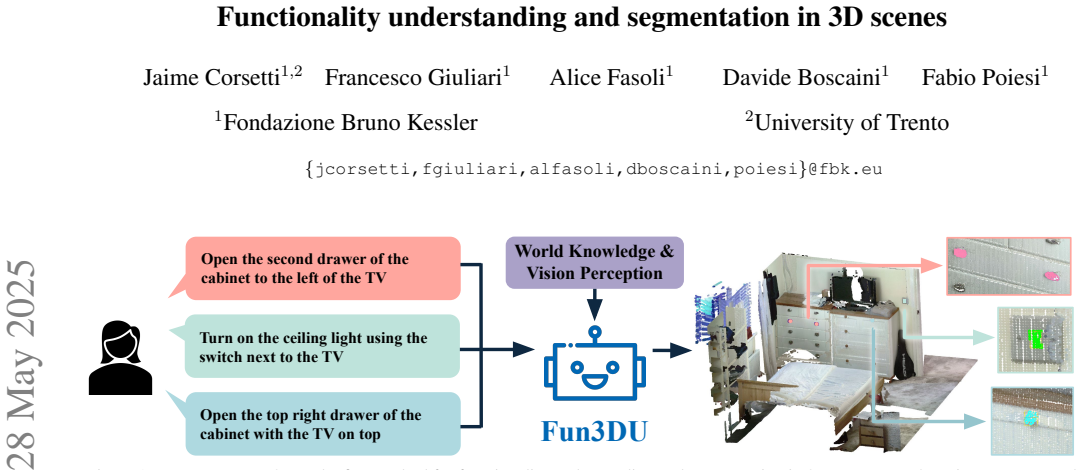
The load-bearing mechanism is a four-module pipeline. Task parsing uses a frozen LLM (Llama 3.1-9B) with Chain-of-Thought reasoning to output a task-solving sequence, the acted-on functional object F, and an object hierarchy whose first element is taken as the contextual object O. Contextual localization uses an open-vocabulary detector (OWLv2 with RobustSAM) to segment O in every view and scores each view by a weighted combination of detection confidence and two KL-divergence scores that reward masks centered and uniformly spread around the image center, reducing thousands of views to 50 informative ones. Functional pointing uses Molmo to answer 'Point to all the F in order to D' with pixel points, which a promptable segmentor (SAM) turns into 2D masks. 3D aggregation lifts these masks by camera pose into the point cloud, accumulating for each 3D point the number of 2D mask pixels projecting onto it, producing a multi-view-agreement heatmap that is thresholded at 0.7 to yield the final 3D mask.
What would settle it
Collect all SceneFun3D tasks where the LLM's hierarchy starts with a ceiling or other distant object and compare AP25 on that subset to the rest; near-zero AP25 on that subset while the rest stays high would show the contextual-anchor assumption is what carries the result.
Extended reading notes
Core claim
The paper's central claim is that 3D functionality segmentation can be reduced to a two-stage grounding problem: first use the reasoning of a frozen LLM to decide which contextual object contains the functional part and which part will be acted on, then use a 2D VLM to point at that part only in views where the contextual object is well visible. The discovered mechanism is that the contextual object serves as a spatial and semantic anchor: once the cabinet is found, the handle can be found near it; once the views are ranked by how centered and uniformly visible the cabinet is, the VLM's point predictions become reliable enough to segment small handles, knobs, and buttons. The paper reports that this design outperforms state-of-the-art open-vocabulary 3D segmentation by a large margin on both SceneFun3D splits, and that ablations attribute the gain to three components: the full task description in the VLM query, the VLM itself rather than an open-vocabulary detector, and the view-selection module, which the authors show is worth more than doubling the number of views.
Load-bearing premise
The weakest load-bearing premise is that the LLM's first hierarchy element O is a reliable spatial anchor—close to the functional object and visible whenever it is—since view selection keeps only views where O looks good; the paper's own 'turn on the ceiling light' example shows O can be the wrong anchor, leaving the switch out of the selected views.
Editorial extensions
If this is right
- Functionality understanding in 3D is achievable without any task-specific finetuning, using only pre-trained language and vision models plus geometric fusion.
- Open-vocabulary 3D segmentation methods fail on functional parts because they lack the reasoning step that maps a task description to the object part to be acted on.
- Selecting a small number of high-quality views by contextual-object visibility is more effective than processing many random views.
- A multi-view agreement heatmap can suppress the spurious masks that a 2D VLM produces on individual frames.
- The same zero-shot pipeline transfers to other scenes and task phrasings without collecting new 3D training data.
Reading between the lines
- The paper leaves untested the idea of conditioning the VLM on the full hierarchy returned by the LLM, not just the first element; that extension would likely fix the reported 'turn on the ceiling light' failure, where the hierarchy's first element is the ceiling light but the functional part is a wall switch.
- Because every module is frozen, the pipeline is a natural testbed for swapping in a higher-resolution or interactive VLM; if point-grounding precision is the remaining bottleneck, larger gains should come from improving the VLM rather than from more views or heavier aggregation.
- The measured 118 seconds per task at 50 views suggests practical use in offline scene annotation or one-shot robot teaching today, but a real-time embodied agent would need the view-selection step to be replaced by a learned ranker or the number of views cut further.
Editorial analysis
A structured set of objections, weighed in public.
Referee Report
Summary. The paper introduces Fun3DU, a training-free pipeline for grounding natural-language task descriptions to functional-object masks in 3D scenes. The method uses an LLM to decompose a task description into a functional object F and a contextual object O, segments O in 2D views with an open-vocabulary segmentor, ranks views with a visibility score, prompts the VLM Molmo to point to F in the selected views, feeds those points to SAM, and lifts and aggregates the resulting 2D masks onto the point cloud via a thresholded multi-view heatmap. Experiments on SceneFun3D report large gains over OpenMask3D, OpenIns3D, and LERF on both split0 (AP25 33.3 vs 0.4, mIoU 15.2 vs 0.2) and split1 (AP25 23.1 vs 0.0, mIoU 11.5 vs 0.1), with ablations for the VLM, the task description, view selection, and the view-selection hyperparameters.
Significance. If the results are robust, Fun3DU provides a useful first baseline for 3D functionality understanding and demonstrates that a training-free combination of frozen foundation models can outperform open-vocabulary 3D segmentation methods on this task. The large margin on split1, which was not used for hyperparameter selection, is a genuine strength, as is the modular and interpretable design of the pipeline. However, the evaluation has two important gaps: split0 serves both as the hyperparameter-selection set and as the headline test set, and the central view-selection assumption that the contextual object O is a reliable spatial anchor for the functional object F is acknowledged to fail in at least one supplementary example but is never quantified. These gaps need to be addressed before the general claim of significantly outperforming prior methods is fully established.
major comments (3)
- [§4.2, §4.4, Implementation details] The main hyperparameters (λm, λd, λα in Eq. (3), V̂, and τ) are chosen on split0, and split0 is also the test set for the headline results in Tables 1 and 4 and Figure 6. This makes the reported split0 numbers optimistically biased. The split1 results in Table 2 mitigate the concern, but the paper should still either fix a validation split, or present split0 as calibration with the main comparison on split1, and in both cases report per-scene standard deviations or confidence intervals. Without variance estimates, the word 'significantly' in the abstract is not supported by a statistical test.
- [§3.4 and Supplementary Fig. 1(d)] The view-selection module assumes that O is a reliable spatial anchor for F, because S_O scores only whether O is present, centered, and well-visible in a view. The paper's own supplementary material reports a direct counterexample: for 'Turn on the ceiling light', the LLM outputs 'ceiling light' as O while the functional object is a wall-mounted switch, so the top-ranked views need not contain F. The conclusion acknowledges this failure mode, but the paper gives no estimate of how often O is not co-located with F across the 3000+ task descriptions, and no per-task or per-category breakdown conditioned on anchor validity. Since the reported AP and mIoU are averages over tasks, the headline gains may be concentrated in tasks where the anchor assumption holds. Please add a per-task breakdown and a failure analysis for non-anchoring cases. A related issue is instance ambiguity: S_O takes the maximum over all masks of O, so when several instances exist (e.g., 'the cabinet with the TV on top'), the selected views may come from the wrong instance, and the later VLM prompt cannot recover from a missed instance.
- [§4.2, Tables 1 and 2] All metrics are reported as point estimates without per-scene standard deviations, per-scene histograms, or significance tests. Given that the baseline values are near zero, small per-scene fluctuations in Fun3DU's scores could change the absolute margins considerably. Reporting per-scene mean ± std, and ideally paired per-scene comparisons against each baseline, would make the claimed improvement substantiated.
minor comments (5)
- [Eq. (2)–(3)] The KL divergence D_KL(P || U) is not bounded above by 1, so the statement 'S_O ∈ [0,1]' is not guaranteed; in fact the score can be negative if the mask is highly concentrated. Please add a normalization or state explicitly that S_O is used only for ranking views, not as a calibrated probability.
- [§3.4] The symbol V̂ is used both for the selected set of views and for its cardinality; please disambiguate, e.g., with V_s for the set and |V_s| for the number of views.
- [§4.4 and Supplementary Table 3] The main text says that increasing V̂ beyond 50 gives 'marginally better performance' and refers to the supplementary material, but Supplementary Table 3 shows that V̂ = 200 lowers mIoU by 1.3 points at τ = 0.7; please clarify that the improvement is non-monotonic and peaks around 50–100 views.
- [Implementation details] The model is referred to as 'LLama3.1-9B'; the public Llama 3.1 release has 8B parameters, so please verify and correct the model name.
- [§4.3] There is a typo, 'behavious', in the first sentence of the qualitative-results section; it should read 'behavior'.
Circularity Check
No significant circularity: Fun3DU is a modular training-free pipeline whose outputs are not equivalent to its inputs by construction; hyperparameter tuning on split0 affects validity but not circularity.
full rationale
Fun3DU's derivation chain is a modular pipeline rather than a chain of equations. The LLM parses D into F and O (Sec. 3.3); O is segmented and scored for view selection (Sec. 3.4); the VLM points to F in the selected views; and the resulting 2D masks are lifted and thresholded in 3D (Sec. 3.5). Each transformation uses external frozen models, and no stage defines the output M as the input D or as a fitted constant. The evaluation is against the external SceneFun3D benchmark, and no SceneFun3D labels are used for training; the only tuned quantities are the view-selection weights, V_hat, and tau in Sec. 4.4. These are chosen on split0, which can inflate the split0 numbers, but the same settings are then applied to the held-out split1 scenes, so the central comparison does not reduce to a fit. The paper itself supplies a limitation: the supplementary case (d) ('Turn on the ceiling light') shows the contextual object 'ceiling light' can be an unsuitable anchor, and the conclusion says errors can occur when contextual-object location alone is insufficient; this is an empirical robustness caveat, not a circular step, because it is reported rather than used to define the metric. Citations to SceneFun3D and to pre-trained models are external, with no author-overlap chain and no imported uniqueness theorem. Accordingly, no prediction in the paper is equivalent to its input by construction.
Assumptions & free parameters
free parameters (3)
- View selection weights lambda_m, lambda_d, lambda_alpha =
0.5, 0.25, 0.25
- Number of selected views V-hat =
50
- Heatmap threshold tau =
0.7
assumptions (3)
- domain assumption The functional object is always located on or near the contextual object and is visible in views where the contextual object is well visible.
- domain assumption Molmo's point grounding is accurate enough to localize fine-grained functional objects in 2D views.
- standard math KL divergence properties and uniform reference distributions are used as valid similarity measures.
Cite this review
Pith. "Pith review of Functionality understanding and segmentation in 3D scenes." pith.science (2026). https://pith.science/paper/FRYE4OKU
@misc{pith2026241116310,
  author       = {Pith},
  title        = {Pith review of: Functionality understanding and segmentation in 3D scenes},
  year         = {2026},
  howpublished = {\url{https://pith.science/paper/FRYE4OKU}},
  note         = {Machine review of arXiv:2411.16310}
}
read the original abstract
Understanding functionalities in 3D scenes involves interpreting natural language descriptions to locate functional interactive objects, such as handles and buttons, in a 3D environment. Functionality understanding is highly challenging, as it requires both world knowledge to interpret language and spatial perception to identify fine-grained objects. For example, given a task like 'turn on the ceiling light', an embodied AI agent must infer that it needs to locate the light switch, even though the switch is not explicitly mentioned in the task description. To date, no dedicated methods have been developed for this problem. In this paper, we introduce Fun3DU, the first approach designed for functionality understanding in 3D scenes. Fun3DU uses a language model to parse the task description through Chain-of-Thought reasoning in order to identify the object of interest. The identified object is segmented across multiple views of the captured scene by using a vision and language model. The segmentation results from each view are lifted in 3D and aggregated into the point cloud using geometric information. Fun3DU is training-free, relying entirely on pre-trained models. We evaluate Fun3DU on SceneFun3D, the most recent and only dataset to benchmark this task, which comprises over 3000 task descriptions on 230 scenes. Our method significantly outperforms state-of-the-art open-vocabulary 3D segmentation approaches. Project page: https://tev-fbk.github.io/fun3du/
Figures


Figures from the paper (9 more)


Reference graph
Works this paper leans on
-
[1]
Yolo-world: Real-time open- vocabulary object detection
Tianheng Cheng, Lin Song, Yixiao Ge, Wenyu Liu, Xing- gang Wang, and Ying Shan. Yolo-world: Real-time open- vocabulary object detection. In CVPR, 2024. 1, 2
work page 2024
-
[2]
Scannet: Richly- annotated 3d reconstructions of indoor scenes
Angela Dai, Angel X Chang, Manolis Savva, Maciej Halber, Thomas Funkhouser, and Matthias Nießner. Scannet: Richly- annotated 3d reconstructions of indoor scenes. In CVPR,
-
[3]
Molmo and pixmo: Open weights and open data for state-of-the-art mul- timodal models
Matt Deitke, Christopher Clark, Sangho Lee, Rohun Tripathi, Yue Yang, Jae Sung Park, Mohammadreza Salehi, Niklas Muennighoff, Kyle Lo, Luca Soldaini, et al. Molmo and pixmo: Open weights and open data for state-of-the-art mul- timodal models. arXiv preprint arXiv:2409.17146, 2024. 3, 7
arXiv 2024
-
[4]
Scene- 5https : / / huggingface
Alexandros Delitzas, Ayca Takmaz, Federico Tombari, Robert Sumner, Marc Pollefeys, and Francis Engelmann. Scene- 5https : / / huggingface . co / google / owlv2 - base - patch16-ensemble 6https://huggingface.co/jadechoghari/robustsam- vit-large 7https://huggingface.co/allenai/Molmo-7B-D-0924 Fun3D: Fine-grained functionality and affordance understand- ing ...
work page 2024
-
[5]
Openins3d: Snap and lookup for 3d open-vocabulary instance segmentation
Zhening Huang, Xiaoyang Wu, Xi Chen, Hengshuang Zhao, Lei Zhu, and Joan Lasenby. Openins3d: Snap and lookup for 3d open-vocabulary instance segmentation. ECCV, 2024. 1, 2, 9
work page 2024
-
[6]
Lerf: Language embed- ded radiance fields
Justin Kerr, Chung Min Kim, Ken Goldberg, Angjoo Kanazawa, and Matthew Tancik. Lerf: Language embed- ded radiance fields. In ICCV, 2023. 1, 2, 9
work page 2023
-
[7]
Alexander Kirillov, Eric Mintun, Nikhila Ravi, Hanzi Mao, Chloe Rolland, Laura Gustafson, Tete Xiao, Spencer White- head, Alexander C Berg, Wan-Yen Lo, et al. Segment any- thing. In ICCV, 2023. 1, 3, 7
work page 2023
-
[8]
Srinivasan, Matthew Tancik, Jonathan T
Ben Mildenhall, Pratul P. Srinivasan, Matthew Tancik, Jonathan T. Barron, Ravi Ramamoorthi, and Ren Ng. Nerf: Representing scenes as neural radiance fields for view synthe- sis. ACM, 2021. 2
work page 2021
Show all 13 references
-
[9]
Learning transferable visual models from natural language supervision
Alec Radford, Jong Wook Kim, Chris Hallacy, Aditya Ramesh, Gabriel Goh, Sandhini Agarwal, Girish Sastry, Amanda Askell, Pamela Mishkin, Jack Clark, et al. Learning transferable visual models from natural language supervision. In ICML, 2021. 1, 2
2021
-
[10]
Mask3d: Mask trans- former for 3d semantic instance segmentation
Jonas Schult, Francis Engelmann, Alexander Hermans, Or Litany, Siyu Tang, and Bastian Leibe. Mask3d: Mask trans- former for 3d semantic instance segmentation. In ICRA, 2023. 1
2023
-
[11]
Openmask3d: Open-vocabulary 3d instance segmentation
Ayca Takmaz, Elisabetta Fedele, Robert Sumner, Marc Pollefeys, Federico Tombari, and Francis Engelmann. Openmask3d: Open-vocabulary 3d instance segmentation. NeurIPS, 2024. 1, 9
2024
-
[12]
Open-vocabulary panoptic segmentation with text-to-image diffusion models
Jiarui Xu, Sifei Liu, Arash Vahdat, Wonmin Byeon, Xiaolong Wang, and Shalini De Mello. Open-vocabulary panoptic segmentation with text-to-image diffusion models. In CVPR,
-
[2023]
Examples of selected contextual object masks with their scores, from highest rank (left) to lowest rank (right)
1, 2 Kitchen range hood S : 0.908 Sm : 0.878 Sd : 0.945 Sα : 0.929 S : 0.866 Sm : 0.777 Sd : 0.953 Sα : 0.956 S : 0.826 Sm : 0.748 Sd : 0.926 Sα : 0.879 S : 0.776 Sm : 0.766 Sd : 0.842 Sα : 0.730 S : 0.746 Sm : 0.727 Sd : 0.848 Sα : 0.684 Nightstand S : 0.843 Sm : 0.715 Sd : 0...
Reviewed August 12, 2026 · model on record in the stance chip above.
Discussion (0). Continue with ORCID to comment.